RESEARCH ARTICLE
Differential therapeutic effects
of atomoxetine and methylphenidate
in childhood attention deficit/hyperactivity disorder as measured by near-infrared
spectroscopy
Yoko Nakanishi 1* , Toyosaku Ota 1 , Junzo Iida 2 , Kazuhiko Yamamuro 1 , Naoko Kishimoto 1 , Kosuke Okazaki 1 and Toshifumi Kishimoto 1
Abstract
Background: The stimulant methylphenidate (MPH) and the nonstimulant atomoxetine (ATX) are the most com- monly-prescribed pharmacological treatments for attention deficit/hyperactivity disorder (ADHD). However, the drug- specific mechanism of action on brain function in ADHD patients is not well known. This study examined differences in prefrontal hemodynamic activity between MPH and ATX in children with ADHD as measured by near-infrared spectroscopy (NIRS) using the Stroop color-word task.
Methods: Thirty children with ADHD participated in the present study. We used 24-channel NIRS (ETG-4000) to measure the relative concentrations of oxyhemoglobin in the frontal lobes of participants in the drug-naïve condition and those who had received MPH (n = 16) or ATX (n = 14) for 12 weeks. Measurements were conducted every 0.1 s during the Stroop color-word task. We used the ADHD RS-IV-J (Home Version) to evaluate ADHD symptoms.
Results: Treatment with either MPH or ATX significantly reduced ADHD symptoms, as measured by the ADHD RS-IV-J, and improved performance on the Stroop color-word task in terms of number of correct words. We found signifi- cantly higher levels of oxyhemoglobin changes in the prefrontal cortex of participants in the ATX condition compared with the values seen at baseline (pre-ATX). In contrast, we found no oxyhemoglobin changes between pre- and post- treatment with MPH.
Conclusions: The present study suggests that MPH and ATX have differential effects on prefrontal hemodynamic activity in children with ADHD.
Keywords: Attention-deficit/hyperactivity disorder, Near-infrared spectroscopy, Functional neuroimaging, Atomoxetine, Methylphenidate
© The Author(s) 2017. This article is distributed under the terms of the Creative Commons Attribution 4.0 International License (http://creativecommons.org/licenses/by/4.0/), which permits unrestricted use, distribution, and reproduction in any medium, provided you give appropriate credit to the original author(s) and the source, provide a link to the Creative Commons license, and indicate if changes were made. The Creative Commons Public Domain Dedication waiver (http://creativecommons.org/
publicdomain/zero/1.0/) applies to the data made available in this article, unless otherwise stated.
Background
Attention-deficit/hyperactivity disorder (ADHD) is one of the most commonly diagnosed neurodevelopmental disorders in children with lifelong deficits in a wide range
of executive functions [1]. ADHD symptoms are thought to arise from dysregulation of prefrontal and subcortical catecholamine neurotransmission [2, 3]. The stimulant methylphenidate (MPH) and the nonstimulant atom- oxetine (ATX) are the most frequently prescribed drugs for the treatment of ADHD. Both drugs are known to reduce clinical ADHD symptoms. The common mecha- nism of both drugs is that they modulate dopamine (DA) and norepinephrine (NE) neurotransmission [4]. Small
Open Access
*Correspondence: [email protected]
1
Department of Psychiatry, Nara Medical University School of Medicine, 840 Shijo-cho Kashihara, Nara 634-8522, Japan
Full list of author information is available at the end of the article
changes in DA or NE concentration affect networks of pyramidal cells in the prefrontal cortex (PFC), which regulates and sustains attention [5]. It is believed that the therapeutic effects of both medications occur primarily in the PFC [5], although the exact mechanisms of their actions are unclear.
Methylphenidate acts as an indirect DA agonist, inhib- iting DA reuptake by occupying the DA transporter [6].
MPH has also shown to block the norepinephrine (NE) transporter in NE transporter-rich regions, including the PFC [7]. In rodent studies, MPH has been shown to enhance the extracellular levels of both DA and NE [8]. In contrast, although ATX is a selective NE reup- take inhibitor, it also inhibits DA reuptake in the PFC.
Therefore, while it does not increase DA in the striatum, it increases both DA and NE in the prefrontal cortex [8]. The partially overlapping pharmacologic profiles of these medications suggest both similarities and differ- ences in their therapeutic mechanisms of action. In the meta-analysis focused on the comparison between MPH and ATX, MPH showed a higher response rate com- pared to ATX [9]. In a randomized study directly com- paring MPH and ATX in adults with ADHD, the effects on executive functions were generally similar, although there was a suggestion that ATX might show a slight ben- efit to the immediate-release MPH in terms of improv- ing spatial planning [10]. However, another head-to-head study comparing the two drugs found that only osmot- ically-released MPH improved set-shifting and verbal fluency, although osmotically-released MPH and ATX both improved executive function generally in children and adolescents with ADHD [11]. Distinct underlying pharmacological mechanisms may cause these practi- cal differences. There are few neuroimaging studies that examined these differences [12, 13]. Cubillo et al. showed that ATX upregulated and normalized right dorsolateral prefrontal cortex under activation measured by func- tional magnetic resonance imaging (fMRI), while MPH upregulated left inferior frontal cortex activation [13].
Near-infrared spectroscopy (NIRS) enables the non- invasive detection of neural activity near the surface of the brain using near-infrared light [14, 15]. It measures alterations in oxygenated hemoglobin ([oxy-Hb]) and deoxygenated.
Hemoglobin ([deoxy-Hb]) concentrations in micro- blood vessels on the brain surface. Local increases in [oxy-Hb] and decreases in [deoxy-Hb] are indicators of cortical activity [15, 16]. In animal studies, [oxy-Hb] is the most sensitive indicator of regional cerebral blood flow because the direction of change in [deoxy-Hb] is determined by the degree of changes in venous blood oxygenation and volume [17]. Therefore, we decided to focus on changes in [oxy-Hb]. Furthermore, changes in
[oxy-Hb] have been associated with changes in regional cerebral blood volume, using a combination of NIRS and positron emission tomography (PET) measurements [18, 19]. NIRS is a neuroimaging modality that is espe- cially suitable for psychiatric patients for the following reasons [20]. First, because NIRS is relatively insensitive to motion artifact, it can be used in experimental sce- narios in which motion may occur, such as while assess- ing participants who are prone to vocalization. Second, participants can be examined in a natural sitting posi- tion, without any surrounding distractions such as fMRI.
Third, the cost is much lower than that of other neuro- imaging modalities and the setup is very easy. Fourth, the high temporal resolution of NIRS is useful in char- acterizing the time course of prefrontal activity in peo- ple with psychiatric disorders [21, 22]. Fifth, functional studies of pediatric patients using single-photon emis- sion computed tomography (SPECT) and PET are rare due to restrictions regarding the use of radioactive mate- rials in young individuals. Accordingly, NIRS has been used to assess brain function in people with many types of psychiatric disorders, including schizophrenia, bipolar disorder, post traumatic disorder, obsessive–compulsive disorder, and ADHD [20–28].
In pediatric ADHD, reduced prefrontal hemody- namic response has been measured by NIRS [23, 29, 30]. Negoro et al. examined prefrontal hemodynamic response during the Stroop color-word task in 20 chil- dren with ADHD and 20 healthy age- and sex-matched controls. They found that the oxy-Hb changes in the infe- rior prefrontal cortex in the control group were signifi- cantly larger than those in the ADHD group during the Stroop color-word task [23]. In an NIRS study of medi- cation, Ota et al. examined the effects of a clinical dose of ATX on changes in prefrontal hemodynamic response during the Stroop color-word task in pediatric ADHD.
They found that ATX induced an intensified prefron- tal hemodynamic response [31]. In another NIRS study, Araki et al. found that the oxy-Hb concentration in the right dorsolateral PFC in the post-ATX condition was significantly increased compared to the pre-ATX condi- tion during a continuous performance task [32]. Despite several NIRS studies with ADHD, only a few studies have examined the therapeutic effects of medication. Moreo- ver, no studies have compared MPH with ATX directly.
In this study, we examined the drug-specific effects of
a clinical dose of either MPH or ATX on frontal activa-
tion as measured by NIRS in a cohort of medication-
naïve pediatric ADHD subjects. We used the Stroop
color-word task to assess inhibitory control and selective
attention. As outlined above, there are distinct underly-
ing pharmacological mechanisms associated with MPH
and ATX. Therefore, we hypothesized that there might
be a differential hemodynamic response across MPH and ATX.
Methods Participants
Thirty patients aged 6–14 years and diagnosed with ADHD according to the DSM-5 criteria [33] participated in the present study. Participants had no history of treat- ment for a developmental disorder, and had consulted an experienced pediatric psychiatrist at the Department of Psychiatry at Nara Medical University. These partici- pants underwent a standard clinical assessment compris- ing a psychiatric evaluation, a semi-structured diagnostic interview (the kiddie schedule for affective disorders and schizophrenia for school-age children-present and life- time version [34]), and a medical history assessment.
Two experienced pediatric psychiatrists confirmed the diagnosis of ADHD according to the DSM-5 criteria [33].
Intellectual level was assessed using the Wechsler intel- ligence scale for children-fourth edition (WISC-IV), and individuals with full-scale IQ (FIQ) scores below 70 were excluded. We also excluded those who presented with a comorbid Axis I diagnosis, a neurological disorder, a head injury, a serious medical condition, or a history of substance abuse/dependence because these influenced the prefrontal hemodynamic response [20–22, 24, 26, 35, 36]. In total, 30 participants with ADHD who had no previous medication history were enrolled in the present study. All participants were right-handed and of Japanese descent.
We used NIRS to measure the relative concentra- tions of oxy-Hb in participants in the drug-naïve con- dition (pre-treatment) and after 12 weeks of treatment with either osmotically released MPH (n = 16) or ATX (n = 14) (post-treatment). The participants were assigned either MPH or ATX by the decision of an experienced pediatric psychiatrist. All measurements were conducted at the same time of day (10.00–11.00 h). All the partici- pants were MPH and ATX naïve and started to take MPH 18 mg/day or ATX 0.5 mg/kg/day in the morning, respec- tively. They were titrated up as needed to the lowest effective dose by the decision of an experienced pediatric psychiatrist every 2 weeks. The mean dose of MPH was 0.87 mg/kg (SD = 0.23), and the mean dose of ATX was 1.30 mg/kg (SD = 0.44). The characteristics of the par- ticipants are shown in Table 1. This study was approved by the Institutional Review Board at Nara Medical Uni- versity. Written informed consent was obtained from all participants and/or their parents prior to the study.
Assessment of ADHD symptoms
We used the ADHD Rating Scale-IV-Japanese version (ADHD RS-IV-J) (Home Version) [37] to evaluate ADHD
symptoms in the participants. A higher ADHD RS-IV-J score is associated with more severe ADHD symptoms.
All participants underwent ADHD RS-IV-J assessment pre- and post-treatment which were rated by parents (Table 3).
The Stroop color‑word task
The traditional Stroop task was combined with the word-reading task, incongruent color-naming task, and the color-naming task. However, we reconstructed the Stroop task according to previously described methods [38]. The Stroop color-word task consisted of two pages stapled together: each page had 100 items in five columns of 20 items each and the page size was 210 × 297 mm.
On the first page, the words RED, GREEN, and BLUE were printed in black ink. On the second page, the words RED, GREEN, and BLUE were printed in red, green, or blue ink, with the limitation that the word meaning and ink color could not match. The items on both pages were randomly distributed, with the exception that no item could appear directly after the same item within a col- umn. Before the task, the examiners instructed the par- ticipants as follows: ‘This is to test how quickly you can read the words on the first page, and say the colors of the words on the second page. After we say “begin”, please read the words in the columns, starting at the top left, and say the words/colors as quickly as you can. After you finish reading the words in the first column, go on to the next column, and so on. After you have read the words on the first page for 45 s, we will turn the page. Please repeat Table 1 Participant characteristics
MPH methylphenidate, ATX atomoxetine, NA not applicable, FIQ full-scale IQ, WISC-IV Wechsler Intelligence Scale for children-fourth edition, ARF ADHD RS
IV-J full scores, ARI ADHD RS IV-J inattention subscale scores, ARH ADHD RS IV-J hyperactivity subscale scores, SCWC-1 Stroop color-word task number of correct answers first time, SCWC-2 Stroop color-word task number of correct answers second time, SCWC-3 Stroop color-word task number of correct answers third time
a
The Chi square test was used; otherwise t-tests were used
MPH (n = 16) ATX (n = 14) p value
Mean SD Mean SD
Sex (male/female)
a14/2 11/3 0.642
Age (years) 8.19 2.46 9.50 2.03 0.125
Medication dose (mg/kg) 0.87 0.23 1.30 0.44 NA FIQ (WISC-IV) 94.19 13.46 96.64 14.43 0.634
ARF 30.63 10.65 32.29 13.46 0.709
ARI 16.75 5.52 18.29 6.84 0.502
ARH 13.88 6.72 14.00 7.99 0.963
SCWC-1 18.31 7.66 25.86 8.76 0.018
SCWC-2 19.81 9.56 29.36 11.11 0.017
SCWC-3 21.19 9.17 25.36 10.35 0.252
this procedure for the second page.’ The entire Stroop color-word task sequence consisted of three cycles of 45 s spent reading the first page and 45 s spent reading the second page (the color-word task). The task ended with 45 s spent reading the first page, which we designated as the baseline task. We recorded the number of correct answers in each cycle, and refer to them as follows:
Stroop color-word task number of correct answers first time (SCWC-1), second time (SCWC-2), and third time (SCWC-3). Examiners who were blind to the diagnoses of the participants administered the Stroop color-word task. The Stroop task used in this study was different from the traditional Stroop task. We made the Stroop color-word task simple because the participants were school-aged children. Furthermore, we excluded the color-naming task (part of the traditional Stroop task) because we wanted to have only two tasks (baseline task and activation task) for our NIRS study.
NIRS measurements
We measured [oxy-Hb] using a 24-channel NIRS machine (Hitachi ETG-4000, Hitachi Medical Corporation, Tokyo, Japan). We measured the absorption of two wavelengths of near-infrared light (760 and 840 nm). [Oxy-Hb] was calculated as previously described [39]. The inter-probe intervals of the machine were 3.0 cm, and previous reports have established that the machine measures at a point 2–3 cm beneath the scalp, that is, the surface of the cerebral cortex [36, 40]. The participants were asked to adopt a natural sitting position for the NIRS measure- ment. The distance between the participants’ eyes and the paper on which items were listed was between 30 and 40 cm. The NIRS probes were placed on the scalp over the prefrontal brain regions, and arranged to measure the relative changes in Hb concentration at 24 measurement points that made up an 8 × 8-cm
2. The lowest probes were positioned along the Fp1–Fp2 line according to the international 10/20 system commonly used in electroen- cephalography. The correspondence between the probe positions and the measurement points in the cerebral cortex were confirmed by superimposing the probe posi- tions onto a three-dimensionally reconstructed cerebral cortex of a representative participant in the control group, obtained via MRI (Fig. 1). The absorption of near-infrared light was measured with a time resolution of 0.1 s. The data were analyzed using the ‘integral mode’: the pre-task baseline was determined as the mean across the 10 s just before the task period, the post-task baseline was deter- mined as the mean across the 25 s immediately after the task period, and linear fitting was performed on the data between the two baselines. Moving average methods were used to exclude short-term motion artifacts in the ana- lyzed data (moving average window, 5 s). We attempted
to exclude motion artifacts by closely monitoring artifact- evoking body movements, such as neck movements, bit- ing, and blinking (identified as being the most influential in a preliminary artifact-evoking study), and by instruct- ing the participants to avoid these movements during the NIRS measurements. Examiners were blind to the treat- ment condition of the participants.
Statistical analysis
We used the Chi square (χ
2) test to examine group differ- ences for categorical variables (e.g. gender). Clinical vari- ables with a normal distribution were compared using Student’s t tests. Correlations between SCWC and char- acteristics of the subjects were tested with Spearman’s correlation test. For statistical comparison of the partici- pant characteristics between the pre- and post-treatment conditions, we used a two-tailed paired t test. Specifi- cally, we compared oxy-Hb changes between the pre- and post-treatment conditions. To conduct a more detailed comparison of oxy-Hb changes along the time course of the task, we used MATLAB 6.5.2 (Mathworks, Natick, MA, USA) and Topo Signal Processing type-G version 2.05 (Hitachi Medical Corporation, Tokyo, Japan).
Analyses of variance were performed to examine treat- ment (with two levels, i.e. MPH and ATX) × condition (with two levels, i.e. pre- and post-treatment) interactions.
Fig. 1 Location of the 24 channels on the near-infrared spectroscopy
instrument
The threshold for statistical significance was set at p < 0.05.
Bonferroni-adjusted p values are reported (i.e. corrected for multiple comparisons). We used PASW Statistics18.0J for Windows (SPSS, Tokyo, Japan) for statistical analyses.
Results
Demographic data
The demographic characteristics of the study participants are presented in Table 1. The participant groups did not differ in terms of mean age, sex, FIQ, ADHD-RS-IV-J scores including the ARF, ARI and ARH subscale scores, and SCWC-3 scores (p > 0.125 for all 7 variables). We found significant differences in the SCWC-1, SCWC-2 scores between the MPH and ATX groups (t = −2.52, p = 0.018; t = −2.53, p = 0.017).
Correlation between Stroop task performance and participant characteristics
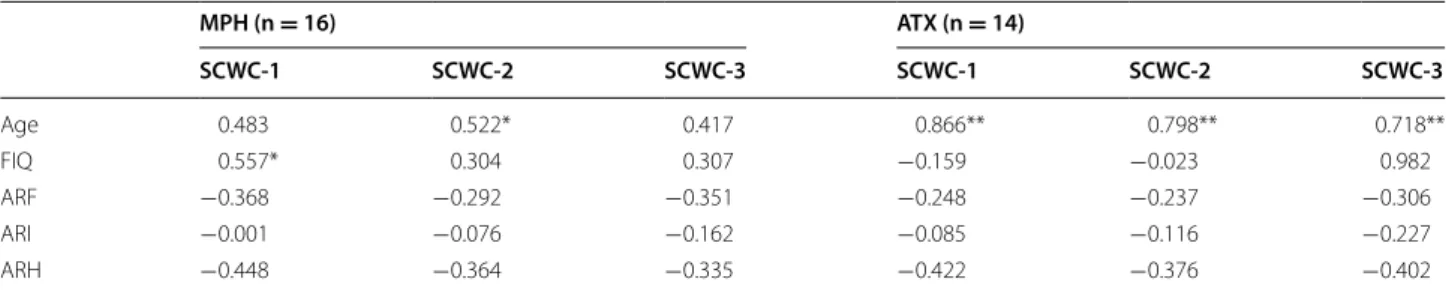
Because the MPH and ATX groups varied consider- ably in terms of SCWC-1 SCWC-2 scores, we calculated
Spearman’s correlations for the SCWC scores, age, FIQ, and ADHD-RS-IV-J, as shown in Table 2. In the ATX group, the SCWC-1, SCWC-2 and SCWC-3 scores were positively correlated with age (ρ = 0.866, p < 0.000, ρ = 0.798, p < 0.001 and ρ = 0.718, p < 0.004), while none of SCWC scores significantly correlated with FIQ and ADHD-RS-IV-J scores. In the MPH group, the SCWC2 score were positive correlated with age (ρ = 0.522, p < 0.038), and SCWC1 score were positive correlated with FIQ (ρ = 0.557, p < 0.025), whereas none of the SCWC scores were significantly associated with ADHD- RS-IV-J scores.
Clinical and behavioral improvement
Both treatments were associated with statistically sig- nificant improvements in terms of both ADHD-RS-IV-J scores and SCWC scores, as shown in Table 3. In both groups, the ADHD-RS-IV-J scores including the ARF, ARI and ARH subscale scores in the post-treatment condition were significantly lower than scores in the Table 2 Correlation between Stroop task performance and participant characteristics
MPH methylphenidate, ATX atomoxetine, FIQ full-scale IQ, WISC-IV Wechsler Intelligence Scale for children-fourth edition, ARF ADHD RS IV-J full scores, ARI ADHD RS
IV-J inattention subscale scores, ARH ADHD RS IV-J hyperactivity subscale scores, SCWC-1 Stroop color-word task number of correct answers first time, SCWC-2 Stroop color-word task number of correct answers second time, SCWC-3 Stroop color-word task number of correct answers third time
* p < 0.05
** p < 0.01
MPH (n = 16) ATX (n = 14)
SCWC‑1 SCWC‑2 SCWC‑3 SCWC‑1 SCWC‑2 SCWC‑3
Age 0.483 0.522* 0.417 0.866** 0.798** 0.718**
FIQ 0.557* 0.304 0.307 −0.159 −0.023 0.982
ARF −0.368 −0.292 −0.351 −0.248 −0.237 −0.306
ARI −0.001 −0.076 −0.162 −0.085 −0.116 −0.227
ARH −0.448 −0.364 −0.335 −0.422 −0.376 −0.402
Table 3 Clinical outcome and task performance
MPH methylphenidate, ATX atomoxetine, ARF ADHD RS IV-J full scores, ARI ADHD RS IV-J inattention subscale scores, ARH ADHD RS IV-J hyperactivity subscale scores, SCWC-1 Stroop color-word task number of correct answers first time, SCWC-2 Stroop color-word task number of correct answers second time, SCWC-3 Stroop color-
word task number of correct answers third time
a
Two-tailed paired t test
b
Two-way factorial ANOVA
MPH (n = 16) ATX (n = 14) p value
Pre‑ Post‑ Pre‑ Post‑ MPH ATX
Mean (SD) Mean (SD) Mean (SD) Mean (SD) Pre vs post
aPre vs post
aTime × Drug Interaction
bARF 30.63 (10.65) 17.06 (10.51) 32.29 (13.46) 22.71 (10.54) 0.000 0.001 0.208
ARI 16.75 (5.52) 10.13 (6.01) 18.29 (6.84) 13.71 (6.27) 0.000 0.010 0.272
ARH 13.88 (6.72) 6.94 (5.47) 14.00 (7.99) 9.00 (4.84) 0.000 0.002 0.295
SCWC-1 18.31 (7.66) 27.75 (11.70) 25.86 (8.76) 33.79 (13.57) 0.000 0.000 0.520
SCWC-2 19.81 (9.56) 28.13 (10.54) 29.36 (11.11) 33.50 (12.82) 0.000 0.033 0.098
SCWC-3 21.19 (9.17) 26.44 (10.91) 25.36 (10.35) 34.07 (12.16) 0.006 0.002 0.210
pre-treatment condition (p < 0.01 for all 6 variables).
Additionally, the SCWC-1, SCWC-2 and SCWC-3 scores in the post-treatment condition were significantly higher than those in the pre-treatment condition (p < 0.033 for all 6 variables). There were no significant main effects of treatment condition × medication interactions for any of the performance measures (p > 0.098 for all 6 variables).
Comparison of NIRS measurements between pre‑
and post‑ treatment
We calculated the grand average waveforms of [oxy-Hb]
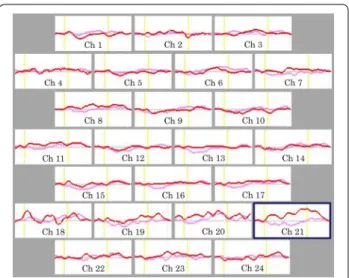
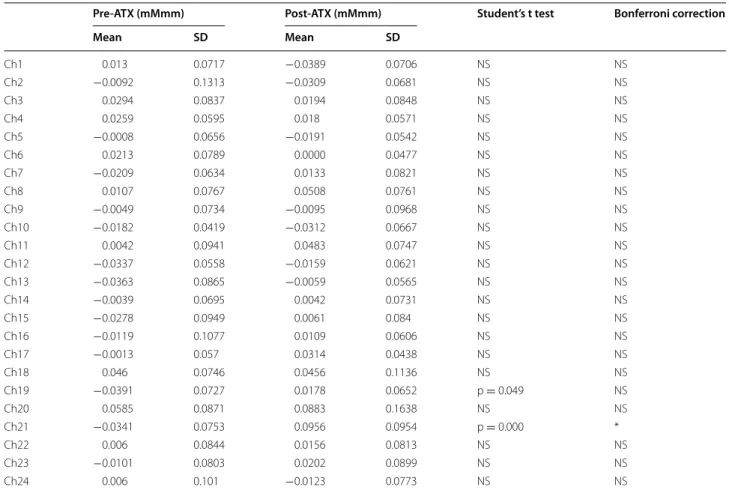
concentration changes during the Stroop color-word task in the pre- and post-treatment condition (Figs. 2, 3). In the MPH group, the grand waveforms of [oxy-Hb] con- centration showed little change in both pre- and post- conditions (Fig. 2). We did not find any differences in mean [oxy-Hb] measurements between pre- and post- MPH in any of the 24 channels that were recorded in Table 4. By contrast, in the ATX group, the grand wave- forms of [oxy-Hb] concentration change appeared to increase substantially during task performance in the post- rather than in the pre-condition (Fig. 3). On chan- nel 21, the mean oxy-Hb measurement was significantly larger in the post-condition relative to the pre-condition, as displayed in Table 5.
Comparison of NIRS measurements between two groups Channel 21 showed significant treatment-by-condition interactions (F = 13.102, p = 0.002). However, there were no main effects for either treatment or condition on chan- nel 21 (F = 2.260, p = 0.147; F = 3.99, p = 0.058). We
did not find any differences in mean [oxy-Hb] measure- ments between the pre-ATX and the pre-MPH (t = 0.756, p = 0.458) on this channel. However, the mean oxy-Hb measurement for channel 21 was significantly larger for post-ATX relative to post-MPH (t = −0.2802, p = 0.009).
Correlation between degree of clinical improvement and hemodynamic change in Channel 21
We conducted Spearman’s rank correlation analy- ses between hemodynamic change in channel 21 with scores of SCWC and ADHD-RS-IV-J scores, shown in Table 6. There were no correlations between hemody- namic change and these scores for either ATX or MPH (all p > 0.2).
Discussion
To our knowledge, this is the first NIRS study to com- pare the effectiveness of MPH with ATX directly in chil- dren with ADHD by measuring hemodynamic responses during the Stroop color-word task. ATX significantly increased activation in the prefrontal cortex, especially in left lateral frontal pole cortex (FPC), after 12 weeks of administration. MPH did not increase activation in the prefrontal cortex, but it did make comparable improve- ments in terms of ADHD symptoms and Stroop color- word task performance to those seen in ATX.
Some studies have referred indirectly to differences in the neurobiological actions between MPH and ATX.
Event-related potential studies of oddball tasks in pedi- atric ADHD have shown that MPH can normalize low Fig. 2 Grand average waveforms showing changes in
oxyhemoglobin(oxy-Hb) during the Stroop color-word task pre- and post-MPH. Cyan lines indicate pre-MPH and blue lines indicate post- MPH. Yellow lines indicate the beginning and end of each trial. Ch channel
Fig. 3 Grand average waveforms showing changes in
oxyhemoglobin(oxy-Hb) during the Stroop color-word task pre- and
post-ATX. Pink lines indicate pre-ATX and red lines indicate post-
ATX. Yellow lines indicate the beginning and end of each trial. The
statistically significant region is shown within navy frames (Ch21). Ch
channel
P300 or mismatch negativity amplitudes [41], while ATX can normalize long P300 latencies and low MMN ampli- tudes, at least partially [42]. In a fMRI study of adult ADHD using a multi-source interference task, ATX did not activate dorsal anterior midcingulate cortex [43], as MPH has been shown to do [44]. However, few stud- ies have directly investigated how the pharmacologi- cal mechanisms of action differ between the two drugs, and little is known about the mechanisms by which they exert their therapeutic effects. In one fMRI study that used a go/no-go task with 36 participants with pediatric ADHD, comparable improvements in response inhibi- tion and ADHD symptoms were seen after 6 to 8 weeks of daily treatment with MPH vs ATX. Symptomatic improvement was associated with gains in task-related activation for ATX and reductions in activation for MPH in the right inferior frontal gyrus, left anterior cingulate/
supplementary motor area, and bilateral posterior cin- gulate cortex [45]. In another fMRI study using a count- ing Stroop paradigm, 12 weeks of ATX pharmacotherapy
decreased activity in the dorsal anterior cingulate cortex and dorsolateral prefrontal cortex in 42 participants with pediatric ADHD, which correlated with improvement in focused attention. In contrast, MPH increased activity in the inferior frontal gyrus, which correlated with decreas- ing severity of impulsivity [46]. Comparing effects of acute doses of both drugs and a placebo with boys with ADHD during a stop task, MPH had a drug-specific effect of normalizing the right ventrolateral prefrontal and cer- ebellar under-activation observed under both placebo and ATX [47]. Taken together, these reports indicate that the mechanisms by which MPH and ATX exert their thera- peutic effects are different: this is consistent with the find- ings from the present study. Nevertheless, the concept of drug-specific laterality effects on prefrontal regions is still controversial. Our data showed that ATX upregulated the frontal cortex during Stroop interference, at least partially.
The present findings suggest that frontal mechanisms serve an important role in the therapeutic actions of ATX.
However, despite the fact that MPH did not increase acti- vation in the PFC, there were still comparable improve- ments in terms of ADHD symptoms for those taking this medication. One parsimonious explanation is that MPH increases activation in other brain regions, which might contribute to the improvement in ADHD symptoms.
Volkow et al. [48, 49] found that in healthy adults, MPH enhanced the salience of a reward task, increased levels of extra-cellular dopamine, and induced reductions in glu- cose metabolism within the default mode network (DMN).
The DMN is a distributed brain system, comprising medial pre-frontal cortex and medial and lateral parietal regions.
It is anti correlated with the attentional networks acti- vated by goal-directed behavior, and is thought to reflect intrinsic activity [50]. Recently, influential new brain net- work models [51, 52] have proposed that proper sustained attention functioning requires both engagement of task- positive networks (TPNs), including a frontoparietal con- trol network and dorsal and ventral attention networks, and suppression of the DMN [50, 53, 54]. A failure of the anti-phase synchronization between DMN and TPN may be involved in the manifestation of ADHD. There is evi- dence suggesting that the striatal DA system plays a role in the modulation of the DMN [55, 56]. MPH produces robust increases in extracellular dopamine levels [57], which potentiate corticostriatal inputs [58] and have been found to enhance striatal activation in child ADHD [59, 60]. Furthermore, some studies have shown that MPH may normalize DMN deactivation patterns [61, 62]. There- fore, we speculate that MPH might tend to activate DMN regions rather than TPN during task-related activation.
In contrast, an increase of prefrontal activation has been reported after MPH treatment in several studies using dif- ferent neuroimaging modalities, including NIRS [44, 59, Table 4 Difference in mean oxyhemoglobin between the
task and post-task periods pre- and post-MPH
Group differences tested with t test
NS not significantPre‑MPH (mMmm) Post‑MPH (mMmm) Student’s t test
Mean SD Mean SD
Ch1 0.0136 0.1101 −0.0319 0.1463 NS
Ch2 −0.0254 0.1011 −0.0739 0.0782 NS Ch3 −0.0047 0.0878 −0.0689 0.1241 NS
Ch4 0.0097 0.0759 −0.0062 0.0981 NS
Ch5 −0.0209 0.0746 −0.0225 0.0585 NS Ch6 −0.0245 0.1071 −0.1513 0.2498 NS Ch7 −0.0354 0.1242 −0.0337 0.1116 NS
Ch8 0.0019 0.0623 −0.0018 0.1245 NS
Ch9 −0.0009 0.0707 −0.0173 0.1256 NS Ch10 −0.0601 0.1518 −0.0436 0.0936 NS
Ch11 0.0174 0.0686 0.0426 0.2025 NS
Ch12 −0.0092 0.0494 −0.013 0.1055 NS Ch13 −0.0371 0.0739 −0.023 0.0948 NS Ch14 −0.0001 0.1577 −0.0349 0.1056 NS Ch15 −0.0033 0.0667 0.0233 0.2365 NS Ch16 −0.0356 0.0745 −0.0476 0.0712 NS Ch17 −0.0154 0.0741 −0.0415 0.0804 NS Ch18 0.0207 0.1593 − 0.0691 0.1423 NS
Ch19 0.0006 0.138 −0.035 0.1215 NS
Ch20 −0.0571 0.091 −0.0582 0.1153 NS
Ch21 −0.00569 0.1034 −0.0432 0.1346 NS
Ch22 −0.0553 0.0996 −0.0371 0.0891 NS
Ch23 −0.0369 0.0936 −0.037 0.0688 NS
Ch24 −0.0414 0.0836 −0.0326 0.1047 NS
63, 64]. The variability in findings across studies is likely related to different cognitive tasks, dosage, patients’ ages, and treatment duration.
Increases in left lateral FPC activity were observed after ATX treatment in our study. However, we found no significant correlations between the hemodynamic changes in this area and degree of the clinical improve- ments. The FPC is the most anterior part of the cerebral cortex, and has reciprocal connections with most pre- frontal areas [65, 66]. Tsujimoto et al. suggested that the FPC has a role in monitoring and evaluating decisions, especially those with a self-generational component [67]. Arai et al. found that children with ADHD show abnormalities in functional maturation of the frontal pole [68]. Based on these findings, a direction for future research will be to assess participants using another bat- tery associated with self-generated behavior, separate to NIRS recordings.
The results of the present study suggest that multi- channel NIRS systems may have potential in the phar- macotherapeutic evaluation in children with ADHD for clinical practice. It is very significant for patients that an effect of the pharmacotherapy is visualized. In the future, Table 5 Difference in mean oxyhemoglobin measurements between the task and post-task periods pre- and post-ATX
Group differences tested with t test
NS not significant* Significant with Bonferroni correction for multiple comparisons
Pre‑ATX (mMmm) Post‑ATX (mMmm) Student’s t test Bonferroni correction
Mean SD Mean SD
Ch1 0.013 0.0717 −0.0389 0.0706 NS NS
Ch2 −0.0092 0.1313 −0.0309 0.0681 NS NS
Ch3 0.0294 0.0837 0.0194 0.0848 NS NS
Ch4 0.0259 0.0595 0.018 0.0571 NS NS
Ch5 −0.0008 0.0656 −0.0191 0.0542 NS NS
Ch6 0.0213 0.0789 0.0000 0.0477 NS NS
Ch7 −0.0209 0.0634 0.0133 0.0821 NS NS
Ch8 0.0107 0.0767 0.0508 0.0761 NS NS
Ch9 −0.0049 0.0734 −0.0095 0.0968 NS NS
Ch10 −0.0182 0.0419 −0.0312 0.0667 NS NS
Ch11 0.0042 0.0941 0.0483 0.0747 NS NS
Ch12 −0.0337 0.0558 −0.0159 0.0621 NS NS
Ch13 −0.0363 0.0865 −0.0059 0.0565 NS NS
Ch14 −0.0039 0.0695 0.0042 0.0731 NS NS
Ch15 −0.0278 0.0949 0.0061 0.084 NS NS
Ch16 −0.0119 0.1077 0.0109 0.0606 NS NS
Ch17 −0.0013 0.057 0.0314 0.0438 NS NS
Ch18 0.046 0.0746 0.0456 0.1136 NS NS
Ch19 −0.0391 0.0727 0.0178 0.0652 p = 0.049 NS
Ch20 0.0585 0.0871 0.0883 0.1638 NS NS
Ch21 −0.0341 0.0753 0.0956 0.0954 p = 0.000 *
Ch22 0.006 0.0844 0.0156 0.0813 NS NS
Ch23 −0.0101 0.0803 0.0202 0.0899 NS NS
Ch24 0.006 0.101 −0.0123 0.0773 NS NS
Table 6 Correlation between degree of clinical improve- ment and hemodynamic change in channel 21
Tested using Spearman’s correlation test
MPH methylphenidate, ATX atomoxetine, ARF ADHD RS IV-J full scores, ARI ADHD
RS IV-J inattention subscale scores, ARH ADHD RS IV-J hyperactivity subscale scores, SCWC-1 Stroop color-word task number of correct answers first time,
SCWC-2 Stroop color-word task number of correct answers second time, SCWC-3Stroop color-word task number of correct answers third time
All p > 0.216
MPH ATX
ARF −0.006 −0.196
ARI −0.072 −0.406
ARH −0.017 −0.087
SCWC-1 −0.331 0.147
SCWC-2 −0.213 −0.014
SCWC-3 −0.349 −0.100
it is need to predict the effect of the pharmacotherapy using the NIRS for clinical practice.
The present study has several potential limitations. First, methodological limitations include the relatively small number of participants, non-randomised study, and lack of a double-blind, placebo-controlled design. At baseline, the ATX group had higher mean SCWC1 and SCWC2 scores than the MPH group. Although scores were not correlated with degree of clinical severity with ADHD-RS, the two groups were not quite entirely equivalent in their charac- teristics. Future work seeking to compare MPH, ATX and/
or placebo should consider a double-blind randomized or crossover design with larger samples. Second, we had no healthy control as a comparison cohort. Our study showed that ATX significantly increased activation in channel 21.
In one previous NIRS study using the Stroop, Negoro et al.
reported a lower increase of oxy-changes in channels 8, 18, 19, 21, and 22 in individuals with child ADHD com- pared with controls [23]. Considering the above findings, we predicted that improvement of ADHD symptoms with ATX treatment would be associated with increased acti- vation in those regions; our findings were consistent with these predictions. Third, NIRS does not detect activity in deeper cortical structures, such as the medial pre-frontal cortex, which is part of the DMN. Fourth, the spatial reso- lution for the detection of hemodynamic responses from the scalp surface using NIRS is lower than that of fMRI, SPECT, or PET. However, the spatial resolution may be within an acceptable range because previous NIRS stud- ies have also found clear distinctions in hemodynamic responses between diagnostic groups [23–26, 28, 69].
Conclusions
In conclusion, this is the first NIRS study using the Stroop interference task to examine how the pharmacological mechanisms of action differ between MPH and ATX. Find- ings suggest that effective treatment with MPH and ATX is produced by distinct mechanisms in frontal regions.
Abbreviations
MPH: methylphenidate; ATX: atomoxetine; ADHD: attention deficit/hyperactiv- ity disorder; fMRI: functional magnetic resonance imaging; NIRS: near-infrared spectroscopy; DA: dopamine; NE: norepinephrine; PFC: prefrontal cortex;
SPECT: single-photon emission computed tomography; PET: positron emis- sion tomography; FIQ: full-scale IQ; WISC-IV: Wechsler intelligence scale for children-fourth edition; ARF: ADHD RS IV-J full scores; ARI: ADHD RS IV-J inat- tention subscale’s scores; ARH: ADHD RS IV-J hyperactivity subscale’s scores;
SCWC-1: Stroop color-word task number of correct answers first time; SCWC-2:
Stroop color-word task number of correct answers second time; SCWC-3:
Stroop color-word task number of correct answers third time; FPC: frontal pole cortex; DMN: default mode network; TPNs: task-positive networks.
Authors’ contributions
YN, TO and JI developed the study protocol. YN, TO, KY, NK and KO performed the experiments. YN and TO analyzed the data. JI and TK administered and supervised programs and overall conduct of the study. All authors read and approved the final manuscript.
Author details
1
Department of Psychiatry, Nara Medical University School of Medicine, 840 Shijo-cho Kashihara, Nara 634-8522, Japan.
2Faculty of Nursing, Nara Medical University School of Medicine, 840 Shijo-cho Kashihara, Nara 634-8522, Japan.
Acknowledgements
We wish to thank the participants for their invaluable participation in the study. The authors would also like to thank Hitachi Medical Corporation for the ETG-4000 equipment, and the skilled technical and methodical support.
Competing interests
YN, TO, KY, NK and KO have no competing interests, respectively. JI and TK have received honoraria for lecturing from Eli Lilly and Janssen Pharmaceutica.
Consent for publication
Written informed consent was obtained from all participants and/or their parents prior to the study.
Ethics approval and consent to participate
This study was approved by the Institutional Review Board at Nara Medical University.
Funding
This study was supported by JSPS KAKENHI Grant Number 22591285 without a further role in the study design, collection, analysis, and interpretation of the data, drafting the report, or the decision to submit the paper for publication.
Publisher’s Note
Springer Nature remains neutral with regard to jurisdictional claims in pub- lished maps and institutional affiliations.
Received: 4 December 2016 Accepted: 6 May 2017
References
1. Seidman LJ. Neuropsychological functioning in people with ADHD across the lifespan. Clin Psychol Rev. 2006;26(4):466–85.
2. Chamberlain SR, Del Campo N, Dowson J, Müller U, Clark L, Robbins TW, Sahakian BJ. Atomoxetine improved response inhibition in adults with attention deficit/hyperactivity disorder. Biol Psychiatry. 2007;62(9):977–84.
3. Del Campo N, Chamberlain SR, Sahakian BJ, Robbins TW. The roles of dopamine and noradrenaline in the pathophysiology and treat- ment of attention-deficit/hyperactivity disorder. Biol Psychiatry.
2011;69(12):e145–57.
4. Makris N, Biederman J, Monuteaux MC, Seidman LJ. Towards conceptual- izing a neural systems-based anatomy of attention-deficit/hyperactivity disorder. Dev Neurosci. 2009;31(1–2):36–49.
5. Arnsten AF. Toward a new understanding of attention-deficit hyperactiv- ity disorder pathophysiology: an important role for prefrontal cortex dysfunction. CNS Drugs. 2009;23(Suppl 1):33–41.
6. Volkow ND, Wang GJ, Fowler JS, Gatley SJ, Logan J, Ding YS, Hitzemann R, Pappas N. Dopamine transporter occupancies in the human brain induced by therapeutic doses of oral methylphenidate. Am J Psychiatry.
1998;155(10):1325–31.
7. Hannestad J, Gallezot JD, Planeta-Wilson B, Lin SF, Williams WA, van Dyck CH, Malison RT, Carson RE, Ding YS. Clinically relevant doses of methyl- phenidate significantly occupy norepinephrine transporters in humans in vivo. Biol Psychiatry. 2010;68(9):854–60.
8. Bymaster FP, Katner JS, Nelson DL, Hemrick-Luecke SK, Threlkeld PG, Heiligenstein JH, Morin SM, Gehlert DR, Perry KW. Atomoxetine increases extracellular levels of norepinephrine and dopamine in prefrontal cortex of rat: a potential mechanism for efficacy in attention deficit/hyperactiv- ity disorder. Neuropsychopharmacology. 2002;27(5):699–711.
9. Liu Q, Zhang H, Fang Q, Qin L. Comparative efficacy and safety of meth-
ylphenidate and atomoxetine for attention-deficit hyperactivity disorder
in children and adolescents: meta-analysis based on head-to-head trials. J
Clin Exp Neuropsychol. 2017. doi:10.1080/13803395.2016.1273320.
10. Ni HC, Shang CY, Gau SS, Lin YJ, Huang HC, Yang LK. A head-to-head ran- domized clinical trial of methylphenidate and atomoxetine treatment for executive function in adults with attention-deficit hyperactivity disorder.
Int J Neuropsychopharmacol. 2013;16(9):1959–73.
11. Yang L, Cao Q, Shuai L, Li H, Chan RC, Wang Y. Comparative study of OROS-MPH and atomoxetine on executive function improvement in ADHD: a randomized controlled trial. Int J Neuropsychopharmacol.
2012;15(1):15–26.
12. Smith A, Cubillo A, Barrett N, Giampietro V, Simmons A, Brammer M, Rubia K. Neurofunctional effects of methylphenidate and atomoxetine in boys with attention-deficit/hyperactivity disorder during time discrimina- tion. Biol Psychiatry. 2013;74(8):615–22.
13. Cubillo A, Smith AB, Barrett N, Giampietro V, Brammer M, Simmons A, Rubia K. Drug-specific laterality effects on frontal lobe activation of atom- oxetine and methylphenidate in attention deficit hyperactivity disorder boys during working memory. Psychol Med. 2014;44(3):633–46.
14. Boas DA, Dale AM, Franceschini MA. Diffuse optical imaging of brain activation: approaches to optimizing image sensitivity, resolution, and accuracy. Neuroimage. 2004;23(Suppl 1):S275–88.
15. Strangman G, Boas DA, Sutton JP. Non-invasive neuroimaging using near- infrared light. Biol Psychiatry. 2002;52(7):679–93.
16. Obrig H, Villringer A. Beyond the visible–imaging the human brain with light. J Cereb Blood Flow Metab. 2003;23(1):1–18.
17. Hoshi Y, Kobayashi N, Tamura M. Interpretation of near-infrared spectros- copy signals: a study with a newly developed perfused rat brain model. J Appl Physiol. 2001;90(5):1657–62.
18. Ohmae E, Ouchi Y, Oda M, Suzuki T, Nobesawa S, Kanno T, Yoshikawa E, Futatsubashi M, Ueda Y, Okada H, Yamashita Y. Cerebral hemodynamics evaluation by near-infrared time-resolved spectroscopy: correlation with simultaneous positron emission tomography measurements. Neuroim- age. 2006;29(3):697–705.
19. Villringer K, Minoshima S, Hock C, Obrig H, Ziegler S, Dirnagl U, Schwaiger M, Villringer A. Assessment of local brain activation. A simultaneous PET and near-infrared spectroscopy study. Adv Exp Med Biol. 1997;413:149–53.
20. Matsuo K, Kato T, Taneichi K, Matsumoto A, Ohtani T, Hamamoto T, Yamasue H, Sakano Y, Sasaki T, Sadamatsu M, Iwanami A, Asukai N, Kato N.
Activation of the prefrontal cortex to trauma-related stimuli measured by near-infrared spectroscopy in posttraumatic stress disorder due to terror- ism. Psychophysiology. 2003;40(4):492–500.
21. Kameyama M, Fukuda M, Yamagishi Y, Sato T, Uehara T, Ito M, Suto T, Mikuni M. Frontal lobe function in bipolar disorder: a multichannel near- infrared spectroscopy study. Neuroimage. 2006;29(1):172–84.
22. Suto T, Fukuda M, Ito M, Uehara T, Mikuni M. Multichannel near-infrared spectroscopy in depression and schizophrenia: cognitive brain activation study. Biol Psychiatry. 2004;55(5):501–11.
23. Negoro H, Sawada M, Iida J, Ota T, Tanaka S, Kishimoto T. Prefrontal dys- function in attention-deficit/hyperactivity disorder as measured by near- infrared spectroscopy. Child Psychiatry Hum Dev. 2010;41(2):193–203.
24. Ota T, Iida J, Sawada M, Suehiro Y, Yamamuro K, Matsuura H, Tanaka S, Kishimoto N, Negoro H, Kishimoto T. Reduced prefrontal hemodynamic response in pediatric obsessive-compulsive disorder as measured by near-infrared spectroscopy. Child Psychiatry Hum Dev. 2013;44(2):265–77.
25. Okada K, Ota T, Iida J, Kishimoto N, Kishimoto T. Lower prefrontal activity in adults with obsessive-compulsive disorder as measured by near- infrared spectroscopy. Prog Neuropsychopharmacol Biol Psychiatry.
2013;43:7–13.
26. Yamamuro K, Ota T, Iida J, Nakanishi Y, Uratani M, Matsuura H, Kishimoto N, Tanaka S, Negoro H, Kishimoto T. Prefrontal dysfunction in pediatric Tourette’s disorder as measured by near-infrared spectroscopy. BMC Psychiatry. 2015;15:102.
27. Yamamuro K, Makinodan M, Kimoto S, Kishimoto N, Morimoto T, Toritsuka M, Matsuoka K, Takebayashi Y, Takata T, Takahashi M, Tanimura Y, Nishihata Y, Matsuda Y, Ota T, Yoshino H, Iida J, Kishimoto T. Differential patterns of blood oxygenation in the prefrontal cortex between patients with methamphetamine-induced psychosis and schizophrenia. Sci Rep.
2015;5:12107.
28. Yamamuro K, Kimoto S, Iida J, Kishimoto N, Nakanishi Y, Tanaka S, Ota T, Makinodan M, Kishimoto T. Reduced prefrontal cortex hemodynamic response in adults with methamphetamine induced psychosis: relevance for impulsivity. PLoS ONE. 2016;11(4):e0152373.
29. Weber P, Lütschg J, Fahnenstich H. Cerebral hemodynamic changes in response to an executive function task in children with attention-deficit hyperactivity disorder measured by near-infrared spectroscopy. J Dev Behav Pediatr. 2005;26(2):105–11.
30. Inoue Y, Sakihara K, Gunji A, Ozawa H, Kimiya S, Shinoda H, Kaga M, Inagaki M. Reduced prefrontal hemodynamic response in children with ADHD during the Go/NoGo task: a NIRS study. NeuroReport.
2012;23(2):55–60.
31. Ota T, Iida J, Nakanishi Y, Sawada S, Matsuura H, Yamamuro K, Ueda S, Uratani M, Kishimoto N, Negoro H, Kishimoto T. Increased prefrontal hemodynamic change after atomoxetine administration in pediatric attention-deficit/hyperactivity disorder as measured by near-infrared spectroscopy. Psychiatry Clin Neurosci. 2015;69(3):161–70.
32. Araki A, Ikegami M, Okayama A, Matsumoto N, Takahashi S, Azuma H, Takahashi M. Improved prefrontal activity in AD/HD children treated with atomoxetine: a NIRS study. Brain Dev. 2015;37(1):76–87.
33. American Psychiatric Association. Diagnostic and statistical manual of mental disorders. (DSM-5). 5th ed. Arlington: APA; 2013.
34. Kaufman J, Birmaher B, Brent D, Rao U, Flynn C, Moreci P, Williamson D, Ryan N. Schedule for affective disorders and schizophrenia for school-age children-present and lifetime version (K-SADS-PL): initial reliability and validity data. J Am Acad Child Adolesc Psychiatry. 1997;36(7):980–8.
35. Roberts CA, Montgomery C. fNIRS suggests increased effort during executive access in ecstasy polydrug users. Psychopharmacology.
2015;232(9):1571–82.
36. Hock C, Villringer K, Müller-Spahn F, Wenzel R, Heekeren H, Schuh-Hofer S, Hofmann M, Minoshima S, Schwaiger M, Dirnagl U, Villringer A. Decrease in parietal cerebral hemoglobin oxygenation during performance of a verbal fluency task in patients with Alzheimer’s disease monitored by means of near-infrared spectroscopy (NIRS)–correlation with simultane- ous rCBF-PET measurements. Brain Res. 1997;755(2):293–303.
37. Ymazaki K. ADHD-RS-IV Japanese version. In: Kanbayashi Y, Saito K, Kita M, editors. Japanese guideline for the diagnosis and treatment of attention deficit hyperactivity disorder (ADHD). Tokyo: Jiho; 2013. p. 48–54 (In Japanese).
38. Golden CJ. A group version of the Stroop color and word test. J Pers Assess. 1975;39(4):386–8.
39. Schweitzer JB, Faber TL, Grafton ST, Tune LE, Hoffman JM, Kilts CD. Altera- tions in the functional anatomy of working memory in adult attention deficit hyperactivity disorder. Am J Psychiatry. 2000;157(2):278–80.
40. Toronov V, Webb A, Choi JH, Wolf M, Michalos A, Gratton E, Hueber D.
Investigation of human brain hemodynamics by simultaneous near- infrared spectroscopy and functional magnetic resonance imaging. Med Phys. 2001;28(4):521–7.
41. Sawada M, Iida J, Ota T, Negoro H, Tanaka S, Sadamatsu M, Kishimoto T.
Effects of osmotic-release methylphenidate in attention-deficit/hyper- activity disorder as measured by event-related potentials. Psychiatry Clin Neurosci. 2010;64(5):491–8.
42. Yamamuro K, Ota T, Iida J, Nakanishi Y, Matsuura H, Uratani M, Okazaki K, Kishimoto N, Tanaka S, Kishimoto T. Event-related potentials reflect the efficacy of pharmaceutical treatments in children and adolescents with attention deficit/hyperactivity disorder. Psychiatry Res. 2016;242:288–94.
43. Bush G, Holmes J, Shin LM, Surman C, Makris N, Mick E, Seidman LJ, Biederman J. Atomoxetine increases fronto-parietal functional MRI activa- tion in attention-deficit/hyperactivity disorder: a pilot study. Psychiatry Res. 2013;211(1):88–91.
44. Bush G, Spencer TJ, Holmes J, Shin LM, Valera EM, Seidman LJ, Makris N, Surman C, Aleardi M, Mick E, Biederman J. Functional magnetic resonance imaging of methylphenidate and placebo in attention-deficit/
hyperactivity disorder during the multi-source interference task. Arch Gen Psychiatry. 2008;65(1):102–14.
45. Schulz KP, Fan J, Bédard AC, Clerkin SM, Ivanov I, Tang CY, Halperin JM, Newcorn JH. Common and unique therapeutic mechanisms of stimulant and nonstimulant treatments for attention-deficit/hyperactivity disorder.
Arch Gen Psychiatry. 2012;69(9):952–61.
46. Chou TL, Chia S, Shang CY, Gau SS. Differential therapeutic effects of 12-week treatment of atomoxetine and methylphenidate on drug-naïve children with attention deficit/hyperactivity disorder: a counting Stroop functional MRI study. Eur Neuropsychopharmacol.
2015;25(12):2300–10.
• We accept pre-submission inquiries
• Our selector tool helps you to find the most relevant journal
• We provide round the clock customer support
• Convenient online submission
• Thorough peer review
• Inclusion in PubMed and all major indexing services
• Maximum visibility for your research Submit your manuscript at
www.biomedcentral.com/submit