QCD instanton effects in light and heavy mesons
Yuki Sakai
Department of Physics,
Graduate School of Science and Engineering, Tokyo Metropolitan University
Dissertation submitted to
Graduate School of Science and Engineering, Tokyo Metropolitan University
2018
Acknowledgements
I would like to show my greatest appreciation to my supervisor Professor Osamu Yasuda for the continuous support of my Ph.D study. I am deeply grateful to Assistant Professor Noriaki Kitazawa for his fruitful advices and a great deal of discussions. I am also deeply grateful to referees of this thesis, Associate Professor Sergey V. Ketov and Associate Professor Daisuke Jido with many useful comments on this thesis.
I would like to thank colleagues, Dr. Tsukasa Yumibayashi, Mr. Hi- romitsu Harada, Mr. Satoru Kohara, Dr. Shinya Fukasawa, Mr. Yuki Waki- moto, Mr. Hirosuke Kuwabara, Mr. Hideo Kawaguchi, Mr. Shumei Yanagida, Mr. Kento Shibata, Mr. Kenji Aoki and Mr. Kyosuke Masukawa for their en- couragements. I would also like to thank my friends, Mr. Hirotaka Kato, Mr. Akira Yamada, Mr. Hiroshi Nakada and Mr. Kensuke Yoshida. Their intent attitude toward physics encouraged me to keep on studying when I was depressed about my mother’s illness.
I was supported by the scholarship of Tokyo Metropolitan University for graduate students when I was a doctoral course student. I was also supported by JGC-S scholarship foundation when I was a first and second year doctoral student. I would like to thank these scholarship programs.
Finally, I owe my deepest gratitude to my father and brother for their supports and I deeply pray for my mother to rest in peace.
Abstract
Quantum chromodynamics (QCD) describes the physics of the strong inter- action between quarks and gluons. QCD has a characteristic feature called
“asymptotic freedom”, and this feature leads to non-perturbative phenom- ena. How the non-perturbative effects in QCD are evaluated is one of the important issue in the elementary particle physics.
It is blindly believed that a non-trivial vacuum structure in QCD is the quantum mechanical superposition of an infinite number of vacua. The QCD instanton solution is a classical solution to Yang-Mills theory in Euclidean space-time, and is believed to describe the transition between the vacua.
Although this object is very interesting and contributes to developments of mathematical and theoretical physics, its signature has not been discovered in any experiment yet. The verification of the non-trivial vacuum structure or the QCD instanton effects is important to comprehend the phenomena in the non-perturbative region in QCD.
We discuss the constraint on the size of the QCD instanton effects in a low-energy effective theory. Among various instanton effects in meson mass spectrum and dynamics, we concentrate on the instanton-induced masses of light quarks, namely up, down and strange quark. The famous instanton- induced six-quark interaction, the so-called ’t Hooft vertex, could give non- perturbative quantum corrections to light quark masses. Many works have already been done to constrain the mass corrections in the light meson sys- tem, namely in the system of π, K, η and η′, and we know the fact that the instanton-induced mass of up-quark is too small to realize the solution of the strong CP problem because of vanishing current mass of up-quark.
In this thesis we give a constraint on the instanton-induced mass correc- tion to light quarks from the mass spectrum of heavy mesons, B+, B0, Bs and their anti-particles. To accomplish this, the complete second order chiral symmetry breaking terms are identified in the heavy meson effective theory.
We find that the strength of the constraint from heavy meson masses is at
the same level as that from light mesons, and it would be made even stronger by more precise data from future B factories and lattice calculations.
Contents
1 Introduction 2
2 Symmetry 7
2.1 Noether current and charge . . . . 8 2.2 Spontaneous symmetry breaking . . . . 9 2.3 Nonlinear realization . . . 11 3 Non-trivial vacuum structure in QCD 15 3.1 Instanton solutions in quantum mechanics . . . 16 3.2 QCD instantons . . . 29 3.3 The ’t Hooft vertex . . . 35
4 Light meson sector 39
4.1 Construction of light meson effective Lagrangian . . . 39 4.2 Instanton transformation . . . 43 4.3 Constraints in light meson system . . . 45
5 Heavy meson sector 51
5.1 Realization of heavy quark symmetry . . . 52 5.2 Construction of heavy meson effective Lagrangian . . . 55 5.3 Constraints in heavy meson system . . . 60
6 Conclusion 63
Chapter 1 Introduction
The aim of elementary particle physics is to find a fundamental principle which governs all the phenomena in the real world. The principle is believed to be simple and the fundamental theory is expected to be universal. It is im- portant that experiments and theories should be complementarily developed in physics. To discover how the real world is, a lot of collider experiments and observations as well as theoretical investigations have been done in the past. For now, the standard model of elementary particles is the most reliable theory.
The standard model of elementary particles is composed by SU(3)Cgauge symmetry of the strong interaction and SU(2)L×U(1)Y gauge symmetry of the electroweak interaction [1, 2, 3]. The standard model provides the most successful description of the physics in the energy scale which we can cur- rently reach with particle accelerators. Especially, the discovery of Higgs particle [4, 5], which is associated with the spontaneously electroweak sym- metry breaking, is one of the glorious achievements in the Large Hadron Collider [6].
Despite its successes, many open questions remain in the standard model.
One of the theoretical problems is that the gravitational interaction is not contained in the standard model. There are a lot of unpredicted parameters associated with the flavor sector of the standard model. This mystery, which would be related with the origin of electroweak symmetry breaking, implies an existence of fundamental physics behind the standard model. Further-
more, in view of cosmological observations, dark matter and dark energy are also left unexplained.
There are a great deal of challenges to explain above issues with many different types of the new physics beyond the standard model (for exam- ple, supersymmetric models, models with extra dimensions, composite Higgs models and so on). It is highly important to investigate which new physics is the most suitable scenario to describe nature. However, no signature of the new physics has been discovered in the experiments and observations in the past yet.
On the basis of these circumstances, deep understanding of the standard model is more important than verifying the physics beyond the standard model. Quantum chromodynamics (QCD) is known as the system with the asymptotic freedom which the coupling constant of QCD, namely the strong coupling constant, becomes small in process with large momentum transfer [7, 8]. On the other hand, the coupling constant becomes large in process with small momentum transfer, corresponding to interactions at large distance scales. This characteristic feature leads to non-perturbative phenomena such as the confinement of quarks and gluons. How the non-perturbative effects are evaluated is one of the most challenging subject in understanding the standard model deeper than now.
The non-trivial vacuum structure in QCD, which is the quantum mechan- ical superposition of an infinite number of vacua, has not been discovered.
The transition from one vacuum to another vacuum in the vacuum structure would be described by an instanton solution (or an instanton configuration) which are classical solutions to the non-Abelian gauge field equation defined in Euclidean space-time [9]. This tunneling effect is referred to as an “instan- ton effect”. The verification of existences of the non-trivial vacuum structure and the QCD instanton effect is an important topic which is related to un- derstanding of non-perturbative effects in the QCD sector. In this thesis, we give a possibility to verify the instanton effect in the non-trivial QCD vacuum in the low energy effective theory.
In the limit in which up, down and strange quark masses vanish, the QCD Lagrangian has a chiral symmetry which is an invariance under the indepen- dent phase transformation of the left-handed and right-handed fermions. The
chiral symmetry is spontaneously broken due to the quark condensate and the Nambu-Goldstone bosons are expected. The light mesons, π, K and η are identified as the Nambu-Goldstone bosons. However, it is known that the physical η′ mass is much larger than the theoretical prediction [10]. A possibility to solve this problem, so-called U(1)A problem, by using the in- stanton effect has been pointed out in [11]. The statement is that as a result of the axial anomaly [12, 13] and the non-trivial vacuum structure, there is no Nambu-Goldstone boson coupled to the physical U(1)A current. Therefore, η′ would be heavy.
On the other hand, there are some indications which suggest that the instanton effect may not necessarily give a solution of this problem. The problem could be understood within the 1/Nc expansion [14, 15, 16]. There is also an indication of inconsistency between the Ward-Takahashi identity for the U(1)A current and the quark condensate in the instanton configuration [17]. In addition, the instanton effect has not been directly confirmed by experiments yet.
If we believe the existence of the non-trivial vacuum structure, the instan- ton effect provides the so-called Θ-term which gives CP violation in QCD.
Then the Θ-term should be strongly suppressed by some reasons because such a CP violating process is not observed in QCD. In fact, from the CPT theorem, CP violation leads T violation and the observed scale of T violation in physics demands Θ < 10−5 [18]. This is called strong CP problem. The Peccei-Quinn mechanism [19] is a possibility to solve this problem. The pre- dicted new particle, called “axion”, which is a Nambu-Goldstone boson with the spontaneous breaking of the Peccei-Quinn symmetry, has not been dis- covered yet. The verification of the instanton effect in the real world remains to be achieved.
It is highly important to directly observe instanton-induced effects in ex- periments. The instanton effect gives a six-quark interaction, which violates the U(1)Asymmetry in QCD, known as ’t Hooft vertex [20]. The contribution of instanton-induced effects in deep inelastic scattering is investigated with instanton perturbation theory [21] and the direct searches have been made at the electron-proton collider HERA [22, 23, 24]. No signal is observed, and it gives a constraint on the cross section by the instanton-induced processes.
This is one of the quantitative result of the direct search for instanton effects.
The six-quark interaction also induces a quantum correction to light quark masses. This quantum correction is proportional to the product of different quark flavor masses. An “effective up-quark mass” of the form has been first considered in connection with the instanton effect in [25, 26]. Since the instanton effect could generate a non-zero effective up-quark mass even when mu = 0, the strong CP phase could be unphysical, and there could be no strong CP problem. Here, mu is a bare or current quark mass, and mu = 0 means the existence of chiral symmetry for up quark. A hidden sym- metry under the so-called instanton transformation, which is related to the instanton-induced quark mass correction, is discovered in the low-energy light meson effective theory with next-to-leading order terms in chiral Lagrangian [27]. The instanton effect on the second order coupling constant has been discussed in [28]. This attempt is one of the other quantitative result of the indirect search for the instanton effect in the light meson system.
The precise data on B meson masses, namely b-flavored pseudoscalar mesons B+, B0, Bs and their anti-particles, are obtained by various experi- ments. The purpose of this thesis is to give another quantitative result from heavy meson system. We consider a heavy meson system with the heavy meson effective theory. In order to discuss the constraint on the size of the instanton effect, the chiral symmetry breaking terms in next-to-leading or- der effective Lagrangian are systematically investigated. We find a hidden symmetry under the instanton transformation in the heavy meson effective theory. We estimate the upper bound of the correction to light quark masses from the instanton-induced effect under some assumptions and also discuss whether or not the instanton-induced effective mass is large enough to resolve strong CP problem by mu = 0.
In the future theB-factories, such as LHCb and Super-KEKB, will give more precise data on the mass spectrum and the decay constants in the B meson system. In addition, the development of lattice calculation on heavy quarks gives useful information. These knowledge would provide more strict constraints on the instanton-induced effects.
This thesis is developed as follows. Chapters 1 to 4 represent a review of essential theory whereas chaper 4 and 5 contain the original results. In the
next chapter, we review the fundamental properties of symmetries and the spontaneous symmetry breaking. We also introduce the general formulation of a low energy effective theory with spontaneous symmetry breaking. In chapter 3, the tunneling effect in quantum mechanics is briefly reviewed. The QCD instanton effects are introduced as tunneling effects between non-trivial vacua in QCD which are classified with integers n. We see that the instanton effects induce an quark effective interaction. In chapter 4, the effective theory which describes the interactions of pseudo Nambu-Goldstone bosons at low energies is introduced. The dynamical meaning of instanton transformation, which is related to instanton-induced mass correction, is discussed. The light meson mass formulae of next-to-leading order in chiral expansion are derived.
We extract the value of couplings which are sensitive to the instanton effect using the formulae, and the constraint on the quark mass correction given by the instanton effect is discussed. In chapter 5, we discuss the instanton effect in the heavy meson effective theory. The effective Lagrangian which includes the next-to-leading order of chiral symmetry breaking terms is constructed.
We show the invariance under the instanton transformation even in the heavy meson effective theory. The mass formulae of pseudoscalarB mesons and the formulae of their mass differences are given. The constraint on the instanton- induced effect are obtained in the B system. Chapter 6 is devoted to the conclusion.
Chapter 2 Symmetry
In the elementary particle physics, the concept of symmetry plays an impor- tant role in classifying the particles spectra and in relating the interactions between them. When the Lagrangian of a system is invariant under trans- formations, the symmetries of the transformations realize in the system.
In certain cases, though the Lagrangian of a system is invariant under the transformation of a symmetry groupG, the ground state is not necessar- ily invariant under the transformation of symmetry G but invariant under the transformation of symmetry subgroup H. This phenomenon is called
“spontaneously symmetry breaking”.
The spontaneously symmetry breaking occurs in cases, for example, the acquiring of vacuum expectation values by one scalar field in the theory as in the breaking of local SU(2)L×U(1)Y gauge invariance by Higgs field in the electroweak interactions. Even in the absence of scalar fields, quantum effects can lead to the dynamical breaking of a symmetry as in the case of chiral symmetry breaking by quark condensate in the strong interaction.
We give the formulation for realization of symmetries and its sponta- neously breaking in this chapter. The treatment in this chapter will be used for construction of the chiral effective theory as we will see later.
2.1 Noether current and charge
Let us assume that the Lagrangian (density) is a functional of fields ϕ and its derivative as
L=L(ϕ,∂µϕ). (2.1)
The symmetry is represented as the invariance of Lagrangian L. The dy- namical variables are the fields, and symmetries describe invariance under transformations of the fields. We consider a continuous infinitesimal trans- formation of the field as
ϕ(x)−→ϕ′(x) = ϕ(x) +θa(δϕ)a, (2.2) where θa is a transformation parameter and a is the index of the transfor- mation. Under the transformation of eq.(2.2), the Lagrangian is transformed as
L(ϕ,∂µϕ)−→L(ϕ′,∂µϕ′) =L(ϕ,∂µϕ) +θa(δL)a. (2.3) When the Lagrangian has the symmetry of the transformation, the deviation of Lagrangian vanishes so that
(δL)a = ∂L
∂ϕ(δϕ)a+ ∂L
∂(∂µϕ)(δ(∂µϕ))a
=∂µ
∂L
∂(∂µϕ)(δϕ)a = 0, (2.4)
with Euler-Lagrange equation, and the Lagrangian is invariant under the transformation of eq.(2.2).
We define the Noether current as Jµa ≡ − ∂L
∂(∂µϕ)(δϕ)a (2.5)
and the corresponding charge as Qa≡ −
!
d3xJ0a(x). (2.6)
When the Lagrangian has the symmetry, the divergence of current vanishes,
∂µJµa = 0, (2.7)
and we find that the charge is time-independent d
dtQa =−
!
d3x∂0J0a =−
!
d3x∂iJia = 0 (2.8) under an assumption that the field and its derivative converge at the bound- ary. In the canonical quantization, the charge becomes the operator which generates the transformation of fields:
[iQˆa,ϕ] = (δϕ)a, (2.9) where ˆQa is the quantized operator.
2.2 Spontaneous symmetry breaking
In case that the Lagrangian of a system is invariant under the transformation of a symmetry group, there are two situations called by the Wigner phase or the Nambu-Goldstone phase. The situations are symbolically described by
Q|0⟩= 0 Wigner phase,
Q|0⟩ ̸= 0 Nambu-Goldstone phase, (2.10) where Q is the generator of the symmetry and the vacuum state is defined by annihilation operators in the asymptotic fields of the theory.
In the Wigner phase the charge Q is well-defined from eq.(2.6). Since Q and the vacuum state are invariant under space and time translations, the quantity
⟨0|Q|0⟩=−
!
d3x⟨0|j0(x)|0⟩
=−⟨0|j0(0)|0⟩
!
d3x (2.11)
converges only in the case of ⟨0|j0(0)|0⟩= 0, that is to say, Q|0⟩= 0.
The same argument does not apply in the Nambu-Goldstone phase. The charge Q is not well-defined since the volume integral in eq.(2.11) diverges.
Therefore, the phenomenon of spontaneous symmetry breaking is defined in
terms of the condition that there exists at least one operator Φsatisfying the commutation relation
[iQ,Φ(y)]≡ −i
!
d3x[j0(x),Φ(y)] =δΦ(y) (2.12) with the finite vacuum expectation value
⟨0|δΦ|0⟩ ̸= 0. (2.13) The Nambu-Goldstone theorem states that massless bosons, the Nambu- Goldstone bosons, appear and are coupled to the currents in the system with spontaneously broken symmetry. We show the consequences of the theorem in the following. Define a correlation function as
!
d4xeiq·x∂µ⟨0|T jµ(x)Φ(0)|0⟩, (2.14) where T is a time ordered product. This correlation function is related to the vacuum expectation value of eq.(2.12) in the soft limit qµ →0,
!
d4xeiq·x∂µ⟨0|T jµ(x)Φ(0)|0⟩=−⟨0|[Q,Φ]|0⟩, (2.15) from the current conservation. When the theory is in the Nambu-Goldstone phase, the correlation function becomes finite. The correlation function can be also expressed as
!
d4xeiq·x∂µ⟨0|T jµ(x)Φ(0)|0⟩=−iqµ
!
d4xeiq·x⟨0|T jµ(x)Φ(0)|0⟩
=i"
n
FnGn
q2
q2−m2n+iϵ, (2.16) where we use the completeness of the theory
1 ="
n
! d3pn
2p0n(2π)3|n(pn)⟩⟨n(pn)|. (2.17) Here Fn and Gn are defined as
⟨0|jµ(x)|n(pn)⟩=ipµFne−ip·x, (2.18)
⟨0|Φ(x)|n(pn)⟩=Gne−ip·x, (2.19)
withFn̸= 0 andGn ̸= 0 whenn corresponds to the Nambu-Goldstone mode.
Namely, since we identify eq.(2.18) with the current sandwiching between the vacuum and the one Nambu-Goldstone boson state |πa⟩,
⟨0|jµa(x)|πb(p)⟩=iδabpµfπe−ip·x, (2.20) where fπ is the pion decay constant, the current can be expressed as
jµa(x) =−fπ∂µπa(x) +· · · , (2.21) where the dots stand for the continuous spectrum parts. The current con- servation implies the masslessness of the Nambu-Goldstone boson πa. In the soft limit eq.(2.16) requires the existence of massless Nambu-Goldstone bosons coupled to the currentjµ(the Goldstone theorem [29]). We can easily find that the number of the independent Nambu-Goldstone bosons is given by the number of independent broken generators.
2.3 Nonlinear realization
In a system realizing the symmetry G which is spontaneously broken down to the subgroup H, we show the procedure for constructing a low energy effective Lagrangian, the CCWZ Lagrangian, which has been introduced in [30] (and see ref.[31] for review). The effective Lagrangian is constructed in terms of the nonlinearly transforming Nambu-Goldstone bosons and the terms of the lowest order in derivatives on the Nambu-Goldstone bosons are uniquely determined without any parameter.
We consider the case that the symmetry groupGis spontaneously broken down to the subgroup H. Here we assume that GandH are compact simple groups.
The set of the generators TA of Gis divided into the generators Sα ∈H of the unbroken subgroup H and the rest Xa∈G−H as
{TA}={Sα ∈H, Xa ∈G−H}. (2.22) We employ the normalization and orthogonality of generators as
tr(TATB) = 1
2δAB, tr(SαXa) = 0, (2.23)
where the second equation implies
tr(Sα[Sβ, Xa]) = tr([Sα, Sβ]Xa) = 0, (2.24) so that the element [Sα, Xa] always lies in G−H,
[H,G−H]⊂G−H. (2.25)
The Nambu-Goldstone bosonsπ(x), whose number is equal to the dimen- sion of the (right) coset space G/H, dimG−dimH, are transformed under H, so that π(x) can be identified with the coordinates in coset space G/H.
The Nambu-Goldstone bosons are not linearly transformed under G. To construct a G-invariant nonlinear Lagrangian with such Nambu-Goldstone bosons, we see the non-trivial transformation property of π(x). Let ξ(π) be “representatives” of the coset space G/H, which is parameterized by the Nambu-Goldstone bosons π(x) as
ξ(π) = eiπ(x)/f, π(x)≡ "
a∈G−H
πa(x)Xa, (2.26) where f is a scale parameter or the decay constant at the tree level with a mass dimension. An element gξ(π) yielded by the left multiplication of g ∈ G is in G. There exists the representative ξ(π′) corresponding to the element gξ(π) (see Fig.(2.1)). We find that the element can be decomposed into the coset part and unbroken part as
gξ(π) =ξ(π′)h(π, g), h(π, g)∈H. (2.27) Note that this element h depends on π(x) as well as on g. Therefore, we define the transformation of the Nambu-Goldstone bosons π(x) under the G-transformation as
ξ(π′) =gξ(π)h−1(π, g), g ∈G. (2.28) As we expected, the transformation becomes linear as
ξ(π′) =hξ(π)h−1(π, h),⇒π′(x) =hπ(x)h−1, h∈H, (2.29) when the left multiplication is an element h belonging to subgroup H in eq.(2.28).
Figure 2.1: Image of the decomposition of the elementgξ(π). A box implies a set of elements of Gand the bottom of box (shaded area) is a set of elements of G/H. The two carves represent the equivalence classes ξ(π)H.
We now consider the case when G is a simple group. We introduce a 1-form as
α(π) = 1
iξ−1dξ, ξ ∈G/H, (2.30)
or more explicitly as αµ(π)dxµ = 1
iξ−1(π) ∂ξ
∂xµdxµ⇒αµ(π) = 1
iξ−1∂µξ, (2.31) which is well-known as the Maurer-Cartan 1-form. Since the 1-formα(π) be- longs to the Lie algebra G and can be expanded with its generators {TA}= {Sα ∈ H, Xa ∈ G−H}, we can define the parallel and perpendicular com- ponents of αµ(π) to H as
αµ∥(π)≡αµα(π)Sα= 2tr(Sααµ(π))·Sα∈H,
αµ⊥(π)≡αµa(π)Xa = 2tr(Xaαµ(π))·Xa∈G−H. (2.32) From eq.(2.28), we find that the transformation law of αµ(π) is
αµ(π)→αµ(π′) = h(π, g)αµ(π)h−1(π, g) + 1
ih(π, g)∂µh−1(π, g). (2.33)
The second term in the above equation comes from the transformation of the parallel component of αµ(π), sinceh(π, g)∂µh−1(π, g) is inH. That is to say, each component is transformed under the G-transformation as
αµ∥(π)→αµ∥(π′) =h(π, g)αµ∥(π)h−1(π, g) + 1
ih(π, g)∂µh−1(π, g) αµ⊥(π)→αµ⊥(π′) = h(π, g)αµ⊥(π)h−1(π, g). (2.34) We see that only the perpendicular component αµ⊥ transforms homoge- neously, and the G-invariant Lagrangian can be constructed in terms of tr(αµ⊥(π))2. The most general Lagrangian with the lowest order in deriva- tives is given by
L=f2tr(αµ⊥(π))2 (2.35)
where the square of a factor f is multiplied in order to normalize the kinetic terms of the π(x) fields.
In QCD, the Lagrangian has the approximate symmetry, the chiral sym- metry, which is the global U(Nf)×U(Nf) symmetry with the number of the quark flavors Nf. The chiral symmetry is spontaneously broken by the quark condensate. Therefore, we can construct the chiral effective theory using the procedure for constructing CCWZ Lagrangian.
Chapter 3
Non-trivial vacuum structure in QCD
It is widely believed that a non-trivial vacuum structure exists in QCD.
The non-trivial vacuum structure is described by the quantum mechanical superposition of equivalent vacua classified by an integer called “a winding number”. In the quantum mechanics, tunneling effects are transitions from one vacuum to another vacuum. The effects can be described by the classical solutions to the equation of motion in the semi-classical approximation and the classical solutions are called “instanton solutions”. Tunneling effects in QCD could be described by the instanton solutions which are classical solutions (or often referred to as gauge field configurations) formulated in Euclidean space-time.
In QCD, the axial current, which is related to the chiral symmetry, is not conserved at the quantum level and this is known as the chiral anomaly [12, 13]. It could be interpreted that the tunneling effect, namely instanton effect, causes non-conserving of the chiral charges. An effective interaction, the so-called ’t Hooft vertex, is induced by the instanton effect, which changes the axial charge by twice of the number of flavors in QCD.
In this chapter, we start by introducing the path integral in Euclidean space-time and discuss a tunneling effect in a system with a double-well potential. Then, we overview the non-trivial vacuum structure and the in- stanton effect in QCD, which induce the ’t Hooft vertex.
3.1 Instanton solutions in quantum mechan- ics
Before we discuss QCD, let us review tunneling effects in quantum mechanics using the method of pass integral as a simple example. We consider the theory of a particle with mass m moving in a one-dimensional potential V(x) in Minkowski space-time. The action and Lagrangian are
S =
!
dtL, L= m 2
#dx dt
$2
−V(x). (3.1)
The Hamiltonian is H =pdx
dt −L= p2
2m +V(x) = m 2
#dx dt
$2
+V(x) (3.2) with canonical momentum
p≡ ∂L
∂x˙ =mdx
dt. (3.3)
The transition amplitude from x =xi at t =−T /2 to x =xf at t =T /2 is given by
⟨xf|eiHT /!|xi⟩=N
!
DxeiS/! (3.4)
in the path integral representation. On the left-hand side, |xi⟩ and |xf⟩ are the position eigenstates. On the right-hand side, N is a normalization factor and Dx donotes integration over all functions x(t), satisfying the boundary conditions, x(−T /2) =xi and x(T /2) =xf.
The action in Euclidean space-time is given by the analytic continuation in the time coordinate. Euclidean coordinates are denoted as
xµE = (x1, x2, x3, x4) = (x1, x2, x3,−ix0), (3.5) and the metric is
gEµν = diag(−1,−1,−1,−1). (3.6)
Figure 3.1: Integration along the path C.
We take a closed path C in the complex-plane shown as Fig.3.1, and decom- pose the integral into four parts of the path as
%
C
dtL=
!
C1
dtL+
!
C2
dtL+
! T /2
−T /2
dtL+
! iT /2
−iT /2
dtL. (3.7) Assuming that there are no singularities inside the closed path and that the contribution from two integrals on the contoursC1 andC2vanish in the limit T → ∞, we have
S=
! T /2
−T /2
dtL =−
! iT /2
−iT /2
dtL
=−
! T /2
−T /2
idτ
&
−1 2
#dx dτ
$2
−V(x) '
=i
! T /2 T /2
dτLE
≡iSE, (3.8)
where τ ≡ −ix0 and the Lagrangian in Euclidean space-time is LE≡ m
2
#dx dτ
$2
+V(x). (3.9)
We can naively see that the Euclidean action is defined as −i times the Minkowskian action. Since we consider QCD in Euclidean space-time later, we use a subscript E.
The Hamiltonian is HE =pEdx
dτ −LE= m 2
#dx dτ
$2
−V(x) =−H (( ((
t=iτ
, (3.10)
where the canonical momentum in Euclidean space-time is pE ≡ ∂LE
∂(dx/dτ) =mdx
dτ. (3.11)
The amplitude of transition from x=xi at τ =−T /2 to x=xf atτ =T /2 is given by
⟨xf|e−iHT /!|xi⟩=⟨xf|e−i(−H)(−iT)/!|xi⟩
=⟨xf|e−HET /!|xi⟩
=N
!
Dxe−SE/! (3.12)
in the path integral representation. If we expand the left-hand side in a complete set of energy eigenstates,
HE|n⟩=En|n⟩, (3.13) then
⟨xf|e−HET /!|xi⟩="
n
e−EnT /!⟨xf|n⟩⟨n|xi⟩. (3.14) The leading term in this expression for large T is saturated by the energy and the wave-function of the lowest-lying energy eigenstate.
On the right-hand side of eq.(3.12), the integration parameter can be written as
x(τ) =xcl(τ) +"
n
cnxn(τ), (3.15)
where xcl(τ) is the classical solution to the equation of motion md2xcl
dτ2 − dV(xcl)
dx = 0, (3.16)
and xn are a complete set of real orthonormal function satisfying the bound- ary conditions,
! T /2
−T /2
dτxn(τ)xm(τ) = δmn,
xn(τ =±T /2) = 0. (3.17) The measure is defined by
Dx≡)
n
dcn
√2π!. (3.18)
We can readily evaluate the path integral in eq.(3.12). The Lagrangian be- comes
LE = m 2
#dxcl dτ
$2
+V(xcl) + 1
2
"
n
"
m
cncmxm
#
−m d2
dτ2 +d2V(xcl) dx2
$
xn+O(!). (3.19) Choosing xn to be the eigenfunctions of the second derivative of SE at xcl,
#
−m d2
dτ2 + d2V(xcl) dx2
$
xn=λnxn(τ), (3.20) we obtain
LE= m 2
#dxcl dτ
$2
+V(xcl) + 1 2
"
n
"
m
cncmxmλnxn+O(!). (3.21) We can carry out the integral of the action
SE =SE(xcl) + 1 2
"
n
c2nλn+O(!), (3.22)
Figure 3.2: The shape of the potential as a simple example.
and the amplitude is
⟨xf|e−HET /!|xi⟩=Ne−SE(xcl)/!
&
)
n
λn
'−12
(1 +O(!))
=Ne−SE(xcl)/!
* det
#
−m d2
dτ2 +V′′(xcl)
$+−12
(1 +O(!)), (3.23) where the prime denotes differentiation with respect to x. We find that the transition amplitude is proportional to exp(−SE(xcl)/!). When SE is much greater than !, this expansion on!is a good approximation. The expansion is known as a semi-classical approximation or the WKB approximation.
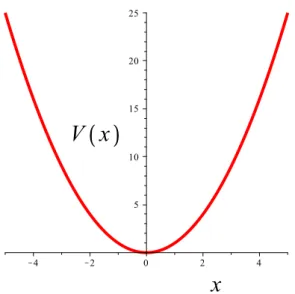
As a simple example of applying a semi-classical approximation, consider the parabola potential shown in Fig.(3.2) with the boundary condition that both the initial and final states are at the origin, namely xi = xf = 0. We expect that the vacuum energy of the system is that of a harmonic oscillator.
The only solution to the classical equation of motion is
xcl(τ) = 0, x˙cl = 0, SE(xcl) = 0. (3.24)
The transition amplitude from the initial state to the final state after (Eu- clidean) time T is
⟨0|e−HET /!|0⟩=N
* det
#
−m d2
dτ2 +mω2
$+−12
, (3.25)
where
ω2 ≡ V′′(0)
m . (3.26)
To calculate the determinant, we consider the equation
#
−m d2
dτ2 +mω2
$
fn =λnfn, n= 1,2,3,· · · , (3.27) where the eigenfunctions fn(τ) satisfies the conditions
fn
#
−T 2
$
=fn
#T 2
$
= 0. (3.28)
The eigenfunctions can be taken both symmetric and anti-symmetric function as
fksym = cos,
(2k+ 1)πτ T
-
, k = 0,1,2,· · · , fkanti−sym = sin,
2kπτ T
-, k = 1,2,3,· · · , (3.29)
with each of the eigenvalues m
.(2k+ 1)π T
/
+mω2, k= 0,1,2,· · · , m
.2kπ T
/
+mω2, k= 1,2,3,· · · . (3.30) This results in
λn =m.,nπ T
-2
+ω2 /
, n= 1,2,3,· · · , (3.31)