• 検索結果がありません。

INTEGRATING LINGUISTICS MAPS TO SHOW SCHOLARLY INTERPRETATION

N/A
N/A
Protected

Academic year: 2021

シェア "INTEGRATING LINGUISTICS MAPS TO SHOW SCHOLARLY INTERPRETATION "

Copied!
15
0
0

読み込み中.... (全文を見る)

全文

(1)

INTEGRATING LINGUISTICS MAPS TO SHOW SCHOLARLY INTERPRETATION

Chitsuko F UKUSHIMA

University of Niigata Prefecture, Japan [email protected]

Abstract

There are four steps in the process of map-making using a computer: 1) Electronic data production, 2) Sorting and mapping data, 3) Comparing, integrating, superimposing, and linking data, and 4) Publishing linguistic maps. The third stage includes integrating linguistic data from different sources. In this paper, map integration in this stage is focused and its examples are introduced to prove that the procedure is also based on scholarly interpretation. First, linguistic maps of a small lexical system are integrated to depict lexical stratification in the area. Second, linguistic maps made from the phonological point of view are integrated to show phonological stratification in the area. Phonologically contrastive areas and phonologically transitional areas are expressed by integrated maps.

Keywords

Geolinguistics, linguistic maps, linguistic variation, map integration, scholarly interpretation

1. Introduction

The papers presented at a recent international symposium on geolinguistics prompted the author to comment on the current trends in geolinguistics around the world. Those papers are to be published in this special issue of Dialectologia. This review has already been published as part of a report coauthored with David Heap in the first issue of Dialectologia (Fukushima and Heap 2008).

In reviewing current trends in geolinguistics, the author found that there are four

steps in the process of map-making using a computer: 1) Electronic data production, 2)

(2)

Sorting and mapping data, 3) Comparing, integrating, superimposing, and linking data, and 4) Publishing linguistic maps (Fukushima and Heap 2008: 142). The first and second steps are sufficient for making a linguistic map. However, once linguistic maps are created, they may need to be compared, integrated, superimposed, and linked in order to make deeper analyses of the data. This third step includes the following procedures: 1) Integrating linguistic data from different sources, 2) using GIS (Geographic Information Systems) and superimposing maps, 3) Combining old and new materials, 4) Linking with multimedia information, and 5) Statistical analysis. In this paper we focus on map integration, using examples where linguistic maps are compared or integrated to show scholarly interpretation.

2. Using SEAL to integrate linguistic maps

The author has developed SEAL, a software system for personal computers to assist in making linguistic maps. From its very beginning in 1983 when it was published, the system has had the function of integrating linguistic maps. SEAL has also been used for individual map making (Fukushima & Fukushima 2002).

SEAL uses quantification (frequency counts of the selected items) to process the geolinguistic data in dialectometry. Whereas studies in dialectometry often aim to demarcate linguistic areas, the author’s method is different: integration is done based on scholarly interpretation. The maps to be integrated and the words to be counted are selected by the researcher. The quantification is simple; it is just the addition of frequency. After each map is made, related maps are integrated and the linguistic variation or diffusion are visualized on the map.

Linguistic maps not only exhibit the original data used to reconstruct the

linguistic history of an area but also they are the result of interpretation; that is the

challenge for linguistic reconstruction. When making linguistic maps, word forms are

selected based on the interpretation, but when integrating linguistic maps, the linguistic

maps are selected based on the interpretation. What is important in this method is to

decide on which linguistic feature to focus.

(3)

3. Comparing or integrating linguistic maps

We compare or integrate linguistic maps in the next step. We have several reasons to do so. There are linguistic maps that have similar distributions. This is caused by “internal reasons such as common linguistic features (semantic, phonological, morphological, and syntactic) as well as external reasons such as the areal boundary or the prestige of a certain dialect or word-forms” (Fukushima 2007: 40). The comparison or integration of linguistic maps can lead to further understanding of an area.

As an example, some linguistic maps of related lexical items make up a small lexical system. These maps often show similar or related distributions. By comparing them, linguistic changes can be examined more thoroughly. For example, the kinship terms of the Tokunoshima dialect, Amami, Japan, were analyzed (Fukushima 1995, Fukushima 2000b). Tokunoshima is an island located in the southwest of Japan (see Fig. 1).

Figure 1. Location of surveyed area

The survey of kinship terms was conducted by the author and colleagues in the

1970s. The terms found in the survey were grouped based on their geographical

distributions and registers. Four groups were identified (in their estimated chronological

order): Proto-Tokunoshima Type, Original Ryukyu Type, Adapted Ryukyu Type, and

(4)

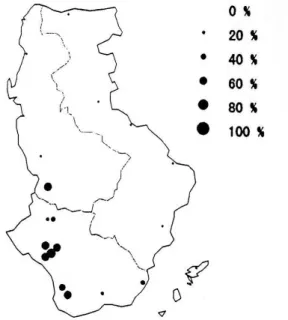
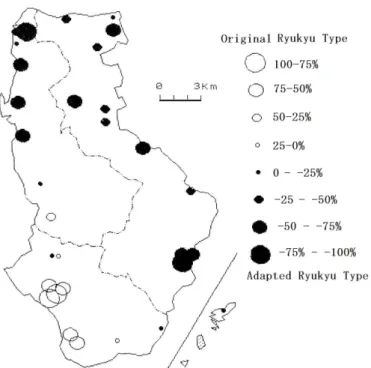
Modern Type. The variation in total word frequency in each group was displayed in integrated linguistic maps of the island. The Proto-Tokunoshima Type was? found separately in the north and the south. The Original Ryukyu Type was? found in the south and was? in complementary distributions with the Adapted Ryukyu Type. The Modern type is scattered across the island. The formation of the linguistic distributions was described as ‘dialectal stratification’ (Figs 2A-2E).

Figure 2A. Proto-Tokunoshima Type Figure 2B. Original Ryukyu Type

Figure 2C. Adapted Ryukyu Type Figure 2D. Modern Type

(5)

Figure 2E. Original Ryukyu Type vs. Adapted Ryukyu Type

In addition to the lexical stratification shown above, phonological stratification can also be identified by integrating linguistic maps. Here we introduce examples from the Tokunoshima Dialect in one of the Ryukyu Dialects of Japanese. Groups of phonological linguistic maps are compared and integrated, thereby presenting evidence to explain the regional variation or diffusion.

4. Data

4.1. Original data

The geolinguistic data were collected in 1977 by the dialectologist Takahiro Okamura, a native-speaker. He surveyed 52 localities on the island. After the survey, the author and colleagues worked with him as a team to analyze the data and report the results (Okamura 1978). Later the author continued the analysis. She is responsible for creating the electronic data, mapping and analyzing maps for this paper.

1

1

The first version of the analysis was presented at Methods X (1999) and printed as Fukushima (2000a).

(6)

4.2. Tokunoshima Dialect

The Tokunoshima Dialect belongs to the Amami Dialect, a sub-dialect group of the Ryukyu Dialects, and one of the two main dialect branches of the Japanese language. There are regular phonological correspondences between the Ryukyu Dialects and Standard Japanese; the maps were made and classified based on these correspondences.

While Standard Japanese (hereafter SJ) has a five vowel system, the Amami Dialect (hereafter AD) has a seven vowel system (See Figure 3):

Standard Japanese Amami Dialect /i/ /u/ /i/ / ï / /u/

/e/ /o/ /e/ /ë/ /o/

/a/ /a/

*SJ /o/ : AD /u/, and SJ /e/ : AD / ï / (/ ï / and /ë/ are central vowels.)

Figure 3. Comparison of Vowel Systems

5. Phonologically contrastive areas in Tokunoshima

There are many linguistic maps showing clear-cut systematic distributions which reflect phonologically contrastive regions in Tokunoshima. They are classified based on phonological correspondences to SJ. Shown here are part of them, the maps for SJ /s-/:

specifically /sa/, /si/, /su/, /se/, and /so/. Each correspondence has more than one linguistic map. The variation of phonological correspondences is summarized in Table 1.

Area/system /sa/ /si/ /su/ /se/ /so/

North sa/sja sï sjï sju

South sa sji sï su

New Trend sa sji su

Table 1. Variation of phonological correspondences in Tokunoshima

(7)

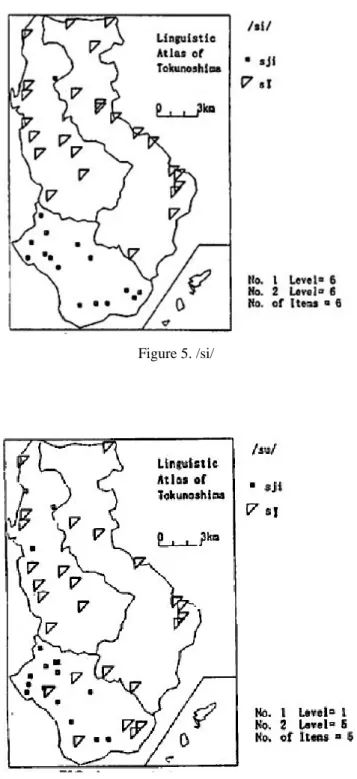
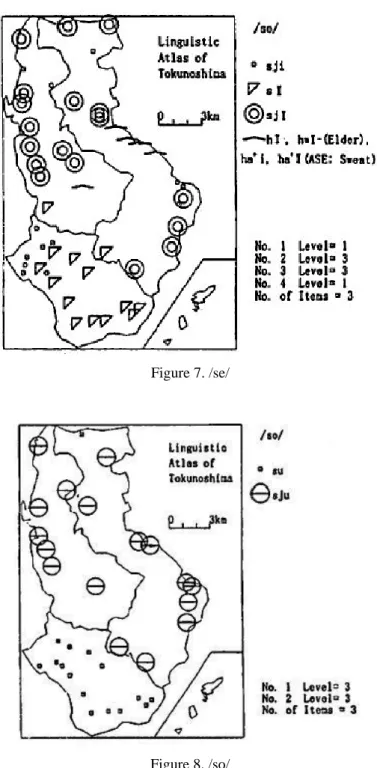
This variation is clearly depicted in Figures 4-8. Each integrated map depicts a phonological correspondence. The frequency of relevant phonological form is given for each locality and the symbols with different size, color, or shape are plotted based on the accumulated frequencies; thus this method was called the “cumulative identity method” by F. Inoue (Inoue 1996a & 1996b). In these maps, the symbols are plotted only when the frequency is greater than or equal to the figure set after simple statistics.

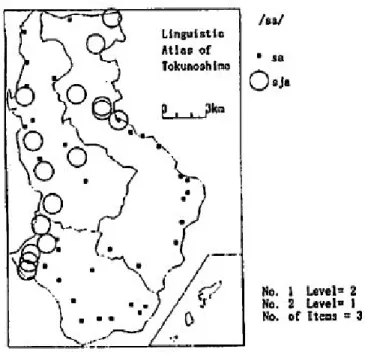
The integrated map of /sa/ (Figure 4) is the combined result of three maps; thus

“No. of Items = 3”. Here [sa] and [sja] are found. The ‘mode’ of the frequency distribution was used as the criterion for plotting the symbols. ‘Mode’ is a term in statistics meaning the most frequently occurring value. In the case of /sa/, the mode of [sa] was 2 and that of [sja] was 1; thus a symbol was plotted when the frequency of [sa]

is 2 or more and when the frequency of [sja] is 1 or more. These are expressed as “No. 1 Level=2” and “No. 2 Level=1”. Figures 5-8 follow the same procedure.

Figure 4. /sa/

In the map of /sa/ (Figure 4), the palatalized [sja] occurs in the northwest of the

island. In the map of /si/ (Figure 5), [sji] is found in the south whereas [sï] with a central

vowel is found in the two northern towns. In one locality of the north, [sji] is found. In

the map of /su/ (Figure 6), the same forms are found but in different distributions. In the

case of /se/ (Figure 7), the peculiar sound [sj ï ] (a combination of the palatalized s and

(8)

the central vowel) is found in the north and [s ï ] in the south. In some localities, [s]

changed into [h] and beyond that. In the map of /so/ (Figure 8), the palatalized [sju] is in the north and [su] in the south.

The three systems shown in Table 1 are depicted in these maps. The new trend with no central vowel is found in part of the north and in part of the southwest. These localities are actually new villages that developed in the last century.

Figure 5. /si/

Figure 6. /su/

(9)

Figure 7. /se/

Figure 8. /so/

6. Phonologically transitional areas in Tokunoshima

The distributions discussed above are rather clear-cut with a slight transitional

area. But other phonological variations can be lexical or morphological and are often

seen with a rather wide transitional area.

(10)

The first group of maps has the pattern with old forms in the northwestern region.

The black symbols are assigned to the old, relic forms, and the blank symbols to the new forms. In the map of /hi/ (Figure 9), the old sound [hw ï ] is found in the northwestern area. Until medieval Japanese, /hi/ used to be [hw ï ].

Figure 9. /hi/

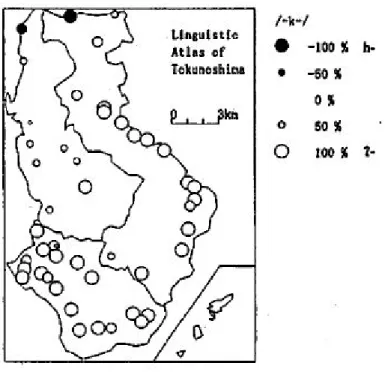
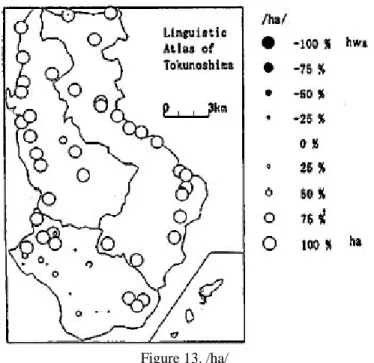
Maps such as Figure 10 are done differently from the maps in the previous section. When there are only two choices of varieties, a special calculation is done to produce the following figures. If one form is used throughout, then it is 100%. If another form is used throughout, it is -100%. Plus and minus figures are expressed using different colors and sizes of circle. In this type of map, the locality with no mark is neutral according to calculation. These are called “contrast maps.” When there are three or more choices, the variation is simply expressed using different symbols as the maps in the previous section. These are called “diffusion maps” (Fukushima &

Fukushima 2002).

(11)

Figure 10. /-ka/, /-ke/

In Figure 10, the /k/ sound in the middle of the word became /h/ and was deleted finally. In Figure 11, /mi/ has four varieties. This is a morphological variant, so the verb MIRU (“see”) has two or more variants in the paradigm. Figure 12 shows a typical phonetic change seen in the Ryukyu Dialect area (ex. -bura > -mba). The northern region retains the original form.

Figure 11. /mi/

(12)

Figure 12. /-ra/

The second group (Figures 13 & 14) has the pattern with old forms such as /hwa/

and /ri/ in the south. In Figure 14, /r/ is deleted at many localities, but the older form /ri/

is retained also in part of the eastern region.

Figure 13. /ha/

(13)

Figure 14. /ri/

The third pattern shows new forms in the eastern region (Figure 15). This is the map of the distinction between the clear beginning and the gradual beginning in Tokunoshima. The distinction only survives in the western region. In the east, the gradual beginning has become extinct. Actually this pattern possibly caused the first and second patterns. The new forms tend to spread from the eastern region so that the old forms are retained in the northwest and in the south.

Figure 15. /wo/

(14)

7. Conclusion

Linguistic geography is an independent discipline in linguistics that has its own aim. We make linguistic maps in order to observe a linguistic history from geographical distributions on a map. To make linguistic maps one needs to classify and order the original data. Thus, any linguistic map is interpretive unless transcribed forms are printed verbatim on the map. The same applies to map integration. We make hypotheses about language change in an area and integrate linguistic maps based on scholarly interpretation.

References

F

UKUSHIMA

, Chitsuko (1995) “Kinship Terms in Tokunoshima”, TULIP, 14, 339-357. [In Japanese.]

F

UKUSHIMA

, Chitsuko (1999) “Calculating and Mapping Regional Speech Variation on an Island”, A paper presented at 10

th

International Congress on Methods in Dialectology (Methods X) , St. John's, Canada.

F

UKUSHIMA

, Chitsuko (2000a) “Calculating and Mapping Regional Speech Variation in Tokunoshima”, The Bulletin of Niigata Women’s College, 37, 79-87.

F

UKUSHIMA

, Chitsuko (2000b) “Using a Personal Computer to Grasp Dialectal Variation”, Dialectologia et Geolinguistica, 8, 37-52.

F

UKUSHIMA

, Chitsuko (2007) “Superimposing Linguistic Maps to Trace Linguistic Changes”, Linguistic Atlantica, 27-28, 2006-2007, 40-45.

F

UKUSHIMA

, Chitsuko & Yusuke F

UKUSHIMA

(2002) SEAL Users' Manual, 6th Edition (English Version) SEAL 6.0E for Windows 98/Me/2000, Report for Grant-in-Aid For Scientific Research, Niigata: Niigata Women’s College.

F

UKUSHIMA

, Chitsuko & David H

EAP

(2008) “A Report on the International Conference:

Geolinguistics around the World”, Dialectologia, 1, 135-156.

(http://www.publicacions.ub.es/revistes/dialectologia1/)

I

NOUE

, Fumio (1996a & 1996b) “Computational Dialectology (1) (2)”, Area and Culture

Studies, 52, 67-102, 53, 115-134.

(15)

O

KAMURA

, Takahiro (1978) “Phonological distribution in Tokunoshima Island: on syllables

beginning with ‘s’”, A paper presented at 27

th

meeting of Dialectological Circle of Japan,

Kumamoto, Japan. [In Japanese.]

Figure 1. Location of surveyed area
Figure 2A. Proto-Tokunoshima Type  Figure 2B. Original Ryukyu Type
Figure 2E. Original Ryukyu Type vs. Adapted Ryukyu Type
Figure 4. /sa/
+7

参照

関連したドキュメント

In Section 3 the extended Rapcs´ ak system with curvature condition is considered in the n-dimensional generic case, when the eigenvalues of the Jacobi curvature tensor Φ are

In this paper, we have analyzed the semilocal convergence for a fifth-order iter- ative method in Banach spaces by using recurrence relations, giving the existence and

This article concerns the behaviour of solutions to a coupled sys- tem of Schr¨ odinger equations that has applications in many physical problems, especially in nonlinear optics..

We present sufficient conditions for the existence of solutions to Neu- mann and periodic boundary-value problems for some class of quasilinear ordinary differential equations.. We

Then it follows immediately from a suitable version of “Hensel’s Lemma” [cf., e.g., the argument of [4], Lemma 2.1] that S may be obtained, as the notation suggests, as the m A

Definition An embeddable tiled surface is a tiled surface which is actually achieved as the graph of singular leaves of some embedded orientable surface with closed braid

discrete ill-posed problems, Krylov projection methods, Tikhonov regularization, Lanczos bidiago- nalization, nonsymmetric Lanczos process, Arnoldi algorithm, discrepancy

Jin [21] proved by nonstandard methods the following beautiful property: If A and B are sets of natural numbers with positive upper Banach density, then the corresponding sumset A +