The International Program: Its Content and Results Faculty of Economics
Soka University
Mariko J. Honma
1. Introduction
1.1 Program Overview
The International Program (IP) of the Faculty of Economics is a four-year aca- demic program for undergraduate economic majors, offering English-medium Economics courses and intensive training in English language skills to ensure successful academic performance in Economics courses. Its purpose is to provide students with an articulated curriculum for obtaining basic knowledge of Economics and high English proficiency, a study-abroad type of experience at their home campus, and an optimal preparation for long-term or short- to medium-term study abroad. It offers English foundation courses to assure that students learn the skills necessary to do well aca- demically in English-medium content courses. The goals of the program are for the student to (1) acquire sound knowledge of basic Economics, (2) achieve TOEFL score of PBT 600 (CBT 250; iBT 100) , and (3) attain advanced oral and written English communication skills.
Another important aspect of the program is its link with Japanese-medium Eco- nomics courses to create a mutually beneficial relationship academically and in student's learning experience in the Faculty. The program curriculum is designed with the intent of Japanese-medium and English-medium Economics courses to complement each other whereby the knowledge and skills in both types of classes can be used to further enhance student's understanding of Economics. Although numerous topics covered in the IP and Japanese-medium Economics courses overlap, its coverage differs and teaching method of large lecture-style class and smaller interactive-style class coexist. The end result is the student deepening their understanding through looking at Economics con- cepts from different perspectives and also several times, which is crucial to committing the knowledge in the student's long-term memory.
Begun in its pilot form in 1999, the first phase of the program included three Eco-
74 P1 0 4 iVol. XXXVII, No. 1.2•3.4 nomics courses and an adjunct English language course. From the 2001 academic year, the title "International Program" was officially used, and twelve courses were offered in the program: seven Economics courses and five English adjunct courses. In the 2003 -4 academic year
, major curricular changes were implemented in the Faculty of Eco- nomics, and IP further developed its curriculum offering a larger number of courses so that all those satisfying minimum English requirement in the Faculty of Economics would be able to enroll in the program. In the 2007-8 academic year, a total of 66 courses were offered (14 Economics and 52 adjunct English courses) which is an increase of 5.5 times in the number of courses offered, with twice as much Economics courses and 10 times as much adjunct English classes since the program's establish- ment. The student enrollment has also seen a significant growth where in 2001 spring semester, there were 51 students enrolled, compared with student enrollment of 298 in 2007 spring semester—a six-fold increase.
The program has become very popular among the Economics students and con- tinues to show evidence that it is successfully meeting the student needs and fulfilling its goals, with room for improvement, as well as making important contributions to the Faculty of Economics as a whole. Various measurements of the program's success show a steady development in its course offerings, faculty participation , and number of enrolled students.
1.2 Student Information
The program is targeted for those students with a strong desire to achieve high proficiency of English and Economics knowledge. Some students wish to have an expe- rience similar to studying abroad while they are learning in Japan . Others may be making specific goals of going on a long-term study abroad at English-medium institu- tions. One prevalent characteristic of IP students is that they are predominantly first-
and second-year students. In the spring semester of 2007-8 academic year , of the total 289 students enrolled in IP, first-year students accounted for 61% and the second-year students accounted for 26%, and the combined total of third and fourth year students accounted for 12%. Three possible explanations are available as to the small percent- age of enrollment in IP for third- and fourth-year students: (1) third-year students begin active preparations for job search, (2) they wish to acquire certificates of skills and qualifications as an advantageous step for job search, and (3) students wish to focus on their major field of study within Economics .
Many students select the Faculty of Economics upon entering the university
because they plan to enroll in IP. These students begin taking IP courses from Semester 1 of their studies. It is also possible for students to enroll in the program later in their university studies. Courses are offered on the basis of English profi- ciency, not the year of study in the university. A number of third-year transfer stu- dents from Soka Women's College also participate in the program each year. A few international students register for IP courses to learn Economics while improving Eng- lish skills or wish to take English-medium Economics courses as their comprehension of English-medium courses is higher than Japanese-medium courses. In most cases, these students are on a one-year academic exchange from abroad, and Japanese profi- ciency is inadequate to enroll in Japanese-medium content courses.
The English level of students participating in IP vary from ITP 380 to nearly 600, and those with extensive English learning in high school and those with very limited learning. Students in the first group, those with considerably higher English profi- ciency, were often enrolled in English-focused programs in high school which would include five hours of English instructions per week with native speakers of English available as teachers and for after-school conversation opportunities. Others include those who prepared intensively and applied to study at foreign universities; spent one- year study abroad in high school; lived abroad with family for several years; belonged to English clubs; or have passed second level Eiken, the official English Proficiency Examination administered in Japan. Those with limited English are students who had no class with native speakers throughout high school, no conversation class, and only one to two classes per week of English class.
As for the IP students' Economics background, a small percentage of students have taken courses in Political Economy in high school. Majority of IP first-year stu- dents has not had any Economics class at the university level while second-year stu- dents have already had several Japanese-medium Economics courses.
To enroll in IP courses, ITP and GPA requirements are clearly set so that stu- dents will have explicit, short-term and long-term goals to set from which they can create a study plan to achieve those goals. The ITP requirements are set for Pre-IP at 380-417, for Level 1 at 420-500, for Level 2 ITP 480+, and for Level 3 530+. Min- imum GPA required is 2.7 for 2006 + students using the 4- point GPA scale and 3.7 for 2007 students using the 5- point GPA scale, which was implemented from 2007 aca-
demic year. These requirements serve as incentive to challenge all courses that they
are taking if they wish to continue taking IP and sets explicit expectation placed on
the students if they wish to continue.
76 peVol. XXXVII, No. I.2.3.4 In this paper, details of the program and its outcomes will be explained from quantitative and qualitative perspectives. The explanation of the program will include the curriculum, faculty, instructional method, teaching materials, international experi- ence, and support system. In the section covering the program results, topics discussed are enrollment, student feedback on the program and IP courses, international experi- ence, TOEFL score change, relationship between IP and career opportunities, academic recognition, GPA change, and hensa-chi change.
2. Curriculum, Staff, Instructional Method, Teaching Materials 2.1 Curriculum
The IP curriculum is comprised of Economics courses and adjunct English courses . The educational goals and objectives of the curriculum were created jointly by an instructor specializing in Economics education and another specializing in English lan- guage education. The objective of Economics courses is to develop students' knowledge of Economics concepts and theories and application of those concepts and theories . Based on Bloom's Taxonomy of cognitive educational objectives , learning objectives for Economics courses include comprehension of Economics material, application , analysis, synthesis, evaluation of this knowledge. English courses instruct students on study skills, language skills, and English cognitive skills which they will need in order to suc- cessfully perform in their Economics courses. Hence, the course load of English courses are heavier in the beginning of the program to develop academic and func- tional English language competency while gradually decreasing it as students acquire the necessary skills. During the three to four years that a student is enrolled in the program, the ratio of English courses to Economics courses change as shown on Table 1.
Courses are classified into three levels based on Economics knowledge and English pro- ficiency level. Level 1, the introductory level, accepts students with ITP scores of 380- 500 in the first semester, and 420-500+ in the second semester. Level 2, the mid-level,
Table 1: Ratio of English to Economics Courses
English Courses
Economics Courses
Level1 Semester
Semester
1 290%
67%
10%
33%
Level 2 Semesters 3
& 4 50% 50%
Level
3 Semesters Semesters
5 7
& 6
& 8
33%
10%
67%
90%
accepts students with ITP score of 480+ for second year students (prerequisite course is Global Economy) and 503+ for first year students. Level 3, the highest level, is for students with ITP score of 530+. Prerequisite courses for Level 3 are Economics A
(Principles of Microeconomics) and Economics B (Principles of Macroeconomics) . Upon beginning their studies in respective levels, student has a set of required courses to be completed in that level. Required courses are shown on Table 2. For Level 1,
one Economics course and five English courses are required. For Level 2, two Eco- nomics courses and two English courses are required. For Level 3, all Economics
courses are electives, and one English course is required.
Furthermore, within levels 1 and 2, two sublevels have been created based on stu- dents' English proficiency. In Level 1, two sublevels exist which are intermediate and advanced levels. In Level 2, two sublevels also exist which are Advanced A level and Advanced B level. Level 3 does not have any sublevels.
Due to high popularity of IP courses by Economics students, numerous sections of required courses are offered to assure optimal instructor to student ratio for all courses. For example, in Level 1 semester 2, courses offered include 2 sections of Global Economy course, 6 sections of TOEFL course, 7 sections of EAP course. This facilitates for detailed instruction to individual students, creates positive and personal relationships among students and with faculty/student relationship, and allows for pro- viding necessary feedback to student work.
Since maximum credits allowed per semester for Economics students are twenty credits, IP students have substantial IP course credit early on as can be seen in Table 3. Since each class session is ninety minutes long and a semester is typically fifteen weeks long, the total number of in-class hours within this framework of courses of all IP required courses in Levels 1 and 2 is approximately 430 hours. In addition, out-of- class hours spent for completing all assignments averages ten hours per week to a total of 600 hours in two years; bringing in- and out-of-class English use hours to
Table 2: IP Required Courses
Economics English
Level 1
Global Economy EAP (2 semesters)
TOEFL (2 semesters) Communication
(1 semester)
Level 2
Economics A (Microeconomics) Economics B (Macroeconomics)
EAP (2)
Level
3 All courses are electivesEAP (1)
78 =fIJ fill A ,r1 a Vol. XXXVII, No . 1.2.3.4 Table 3: IP Credit Load per Semester
IP Courses
Japanese Courses Level
Level
1 2Semester 1 Semester 2
9 credits 12 credits
11 8
credits credits
Level 2Semesters 3 &
4 8 credits 12 creditsLevel
3 all semesters 4 or 6 credits 16 or 14 creditsapproximately 1030 hours.
Another important aspect is that credits for all IP courses are in the category of Economics credits because, in addition to Economics courses, English language courses use large volume of authentic Economics material to develop students' language skills.
Hence, a student in EAP (English for Academic Purposes) will have numerous writing assignments in a course of one semester where Economics topics are used as essay topics.
Finally, coordination of IP course schedule which will be mutually beneficial with Japanese Economics courses is another aspect which has worked successfully in IP.
Each year, as Economics courses offered for the upcoming academic year is finalized, the staff of Academic Affairs and IP coordinators collaborate to create optimal course schedule as not to have required Japanese Economics courses offered at the same day and time as IP courses. This coordination effort enables IP students to enroll in all IP required courses and Japanese courses concurrently.
2.1.1 IP Economic Courses
In order to create the Economics part of the program , information on undergradu- ate economics education was researched (see Undergraduate Economics: A Handbook for Instructors by Walstad and Saunders, 1998) . It covers goals and objectives of eco- nomics instruction; foundation for teaching; instructional methods in economics , lec- tures & textbooks, discussion, writing, and active learning; experiments and technology;
active and cooperative learning strategies for Economics classroom; and, evaluation of instruction: testing and teaching. As a faculty development reference , it was extremely helpful in determining integral aspects of curriculum design for the Economics courses . Based on topics discussed in the reference, curricular decisions were made.
Foundation courses in Economics, generally speaking, are microeconomics , ma-
croeconomics, and statistics. IP Economics courses currently offer courses in mi-
croeconomics and macroeconomics, but not statistics. In the first IP Economics course
in Level 1, student is introduced to Economics vocabulary and concepts for the first
time. The course is called Global Economy, and its primary educational goal is the acquisition of basic Economics vocabulary and concepts. Other goals include the ability to comprehend lecture of Economics in English, in other words the ability to compre- hend all inputs through lecture and readings and to make academically acceptable out- puts which include written form (outlining, note taking, answers to written questions) and oral outputs (in-class discussion, answering questions) . This cognitive process of conducting all necessary academic endeavors in English requires much practice and time. The Global Economy course is the first step toward acquiring this ability and introduction of topics in microeconomics and macroeconomics are taught in the course.
At this stage, knowledge and comprehension is the primary goal with their application also implemented to a limited degree using current economic issues for analysis.
In Level 2, principles of microeconomics and macroeconomics are taught in a broader scope and depth than those of Level 1 course. As students' English profi- ciency and the cognitive aspect of processing all English information advances, student is ready to challenge the material at a more advanced level. Building on the Eco- nomics knowledge students acquired in Level 1 Global Economy and in Japanese- medium Economics courses, educational goals include not only knowledge and compre- hension but a greater degree of application, analysis, synthesis, and evaluation. Using cases in the textbook and current economic issues, students apply principles learned to the solution of Economics problems as well as conduct analysis. Educational objective
of these two courses in Level 2 include the synthesis of ideas learned in not only Levels 1 and 2 of IP but also that of Japanese-medium Economics courses, by writing two major research papers.
In Level 3, since students have acquired the basic knowledge of Economics and skills needed to perform successfully at a higher level course, Economics courses in various fields are offered. Table 4 shows courses offered thus far in Level 3.
2.1.2 IP English Courses
In the beginning stage of the program, it was important for the content-course
instructor to understand the basic components of language curriculum. For that pur-
pose, a number of books written for the development of English language curriculum
were used as references. (Brinton, Snow, and Wesch, 1989) , (Brown, 1995) , (Kennedy
and Bolitho, 1984) , (Oxford, 1996) , (Robinson, 1991) . In The Elements of Language
Curriculum: a Systematic Approach to Program Development by J. D. Brown (1995) ,
information for program development is explained in detail: information that content-
8o
Table 4:
II1 1i
2001-2007 Level
Vol. XXXVII, No. 1.2.3.4 3 Courses
Applied Microeconomics ASEAN in Asia-Pacific
Introduction to Economic Statistics Introduction to Southeast Asia Southeast Asia: Diversity and Change East Asian Economies
Intermediate Macroeconomics Economics of the European Union
Economic Development of India Japan in the World Economy
Comparative Study of Economic Systems Developmental Economics
History of the Vietnamese Economy
The ASEAN in Inter-regional and Intra- Regional Dynamics
World Trade and Fundamental Human Rights Human-Environment Interaction in East Asia
course instructor would normally not have or know. It includes needs analysis, goals and objectives, testing, materials, teaching, and program evaluation. An example of language program at Guangzhou English Language Center in China (pp . 25-26) pro- vided a model of English foundations program aimed at facilitating academic English proficiency and skills to those students and researchers slated to study abroad or begin research abroad. It discusses many fine points of courses offered , sequencing of the courses, number of hours necessary to achieve student goals, etc . The English level was similar to that of students in IP, and they had 20 hours per week of English classroom hours, 20 hours out of class assignments , and took 3 semester periods (one year in their academic system) to achieve their goal of competency in academic Eng- lish to take content courses in English-medium universities.
It is very import in IP to help set realistic goals for students by identifying the objectives of language learning. For example, learner needs to set what he or she wants to be able to do in speaking, reading, listening, and writing (Rubin and Thomp- son, 1994) . In speaking, objectives are identified as follows: (1) novice: prefunctional level, (2) intermediate: survival level, (3) advanced: limited working proficiency , (4) superior: professional proficiency, (5) distinguished, and (6) educated native speaker level (Rubin and Thompson, 1994, pp. 16-18) . In another example, writing objectives are identified in an academic setting (Swales and Feak, 1994) . This would include lan- guage style, vocabulary, formal grammar and style, and language flow.
Furthermore, because IP offers adjunct language courses to facilitate student learn-
ing of academic language needs, textbooks which meet this purpose were extensively
studied (Yates, 1997) . These books include specific instructions on how to understand
Economics language, charts, and tables, among others . Although it is a language text-
book, it includes a coverage of production possibility frontier, markets , economic analy-
sis, consumer choice, money and banking, and international trade to introduce standard
Economics vocabulary and concepts.
As explained in one of the previous sections, IP English Courses are offered in the curriculum for the primary purpose of facilitating student's English development to achieve successful academic performance in IP Economics courses. (As will be discus- sed in the results, these skills are found to be very valuable for Japanese courses as well.) A list of overall goals and objectives was created by the English Courses Coor- dinator of the International Program based on clearly defined academic English skills necessary for Economics courses. Since the content course in International Program is Economics, the focus is on Economics, but this does not mean that a similar adjunct language courses cannot be offered for other academic content areas. In fact, adjunct English course can be offered for a wide range of academic subjects. Curriculum goals for Level 1 include developing a strong foundation of basic English skills including lis- tening comprehension, reading comprehension, vocabulary, grammar, timed essay writ- ing and speaking; and, developing basic skills in outlining, summarizing, and essay writ- ing. In Level 2, in addition to enhancing English skills listed for Level 1, IP English courses will develop students' knowledge and understanding of microeconomics and ma- croeconomics concepts and terminology, application of these concepts to their daily lives, and skills of research paper writing, presentation, and academic discussion. In Level 3, curriculum goals continue to be enhancing skills of writing, critical thinking, discussion, presentation, but also added to this would be developing debating skill and techniques, enhance vocabulary knowledge and range of usage, and enhance world knowledge to serve as frame of reference for critical thinking. Without exception, all English courses have specific goals and objectives which are interconnected to jointly facilitate student's achievement of the said goals and objectives.
2.2 Staff
The program administrators include one coordinator to oversee the overall pro- gram and Economics courses, one coordinator for all English courses, and staff support by two members of the Faculty of Economics Office. The program coordinator and the
English courses coordinator collaborate to continue to implement program development as well as evaluate and assess curricular needs. The program coordinator's duties include (1) working collaboratively with faculty in the Faculty of Economics to develop IP curriculum; (2) working collaboratively with IP English Courses Coordina- tor to promote program development as well as evaluate and assess curricular needs;
(3) conducting program evaluation jointly with English Courses Coordinator; (4) being
fully responsible for the planning and the innovation of IP related activities; (5) advis-
82 ----}^J^J A %f a Vol. XXXVII, No. 1.2.3.4 ing and guiding IP students to help them reach their full potential; (6) reporting on IP status to the Dean of the Faculty of Economics; (7) creating and implementing over- seas study tours for IP students; (8) engaging in ongoing professional development activities; and (9) coordinating all academic aspects of courses taught by visiting pro- fessor to the Faculty. The current program coordinator is a full - time faculty specializ- ing in Economics and teaches IP Economics courses for Levels 1 & 2.
The duties of the English Courses Coordinator are as follows: (1) develop, manage, and update the English curriculum and ensure that the program's curricular objectives are successfully met; (2) create teaching staff schedule in cooperation with the univer- sity's World Language Center Vice Director and submit it to the Program Coordinator;
(3) provide in-house professional development for IP English instructors and staff; (4) engage in ongoing professional development activities; (5) administer and grade evalua- tion tests for course placement of all IP students; (6) keep record of student progress in English proficiency using ITP, TOEFL, and TOEIC; and (7) work in cooperation with the Program Coordinator in curricular development and administrative tasks . The current English Courses Coordinator is a full-time faculty member of the Faculty of Economics and specializes in education and teaching , English to speakers of other lan- guages.
The faculty members of the program include Economics instructors and English instructors. Economics courses are taught by members of the Faculty of Economics , adjunct professor, and visiting professor. A list of visiting professors is presented in Table 5. The faculty include both native and non-native speakers of English but all instructions are in English. IP English course instructors include full - time coordinator of IP English Courses and members of the university language center called the World Language Center. Through their excellent support and cooperation, full-time adjunct instructors who are members of the World Language Center are assigned to teach IP English courses through coordination between IP English Coordinator and WLC admin- istrators. For the success of the program, quality of education provided by IP instruc-
Table 5: Visiting Professors 2001-2007
Dr. Chia Lin Sien, National University of Singapore Dr. Voon Phin Keong, University of Malaya, Malaysia
Dr. Gian Casadio„ University of Bologna, Italy Dr. W. M. Tilakaratne, University of Perideniya, Sri Lanka
Dr. Gerardo L. Largoza, De La Salle University, Philippines
Dr. Sylvano Mahiwo, University of the Philippines, Diliman
Dr. Nguyen Ngoc Thanh, Vietnam National Uni- versity, Hanoi
Prof. Madhusudan Ghosh, Visva-Bharati Univer-
sity, India
tors is of primary importance. Undergraduate education in general requires much dedi- cation by faculty members to design a course that meets the needs of students, the needs of the discipline, and is academically challenging as well as stimulating for the students (Boyer, 1990) . In IP, numerous planning meetings for course preparation and implementation are held to insure that every instructor understands the goals and objectives of his or her course, and how it fits into the total curriculum. Moreover, meetings and frequent discussions are held between the content professors and adjunct English professors to coordinate the syllabus, as well as, to communicate issues of con- cern.
2.3 Instructional Method
The instructional method of IP is content-based English education where students learn Economics in their target language of English. Content-based approach to learn- ing English is defined by Brinton, Snow, and Wesche (1989) as "the integration of con- tent learning with language teaching aims." (p. vii) Furthermore, they say, "it refers to the concurrent study of language and subject matter, with the form and sequence of language presentation dictated by content material. The language curriculum is center- ed on the academic needs and interest of the students, crossing over the barrier between language and subject matter courses. which exists in most secondary and post- secondary institutions." They explain that this approach satisfied several conditions which is in line with the principle of student-centered education. First, the content- based language curriculum takes into account the interests and needs of the learners.
Second, it incorporates the eventual uses the leaner will make of the target language.
Third, it builds on the students' previous learning experiences. Fourth, it allows a focus on use as well as on usage. Fifth, it offers learners the necessary conditions for second language learning by exposing them to meaningful language use. Of the three models which exist for this purpose, IP has adopted the adjunct language course model where students are enrolled in two to three linked courses of content and language courses.
An example of this type of program is the Freshman Summer Program offered at
UCLA, as introduced in Brinton, Snow, and Wesche (1989, pp 57-69) . Offered since
1977, it is an intensive preparatory program to help underprepared and ESL (English
as Second Language) students and focuses especially on reading and writing of English
and on study skills. In addition to introducing students to the intellectual environment
of university, it promotes the development of academic language skills necessary for
success. The program links one to two language classes with one academic content
84 A Vol. XXXVII, No. 1.2.3.4 course in psychology, social science, computer science, geography, political science, or history. Content class and language support classes are coordinated through the pro- gram administration.
Besides the academic goals of IP, it also wishes to create an overall experience to students which (1) provides a challenging but supportive environment in the transi- tional period from high school to university; (2) disseminates realistic idea to students of what entails intensive language learning to achieve one's academic and foreign lan- guage goals; (3) creates a positive self-image through successful academic experiences;
and (4) fosters a sense of connectedness with other students and faculty members in their university community. For this purpose, cooperative learning method is emphas- ized throughout all aspects of learning in IP. Cooperative learning is defined as "coop- eration is working together to accomplish shared goals. Cooperative learning is the instructional use of small groups so that students work together to maximize their own and each other's learning" (Johnson, Johnson, and Smith, 1998, p. 14) .
For curriculum design and development, it was important to understand the learn- ing process of the students. Although the focus of IP is Economics learning , IP's objec- tive includes facilitating students' success at achieving goals set forth by the program . Learning process in general has been identified as cooperative, competitive , or individu- alists (Johnson, Johnson, and Smith, 1998) . Cooperative learning has been shown through research to achieve the three points of (1) efforts to achieve, (2) positive rela- tionships, and (3) psychological health because of five basic elements of cooperative learning: positive interdependence, individual accountability, promotive interaction , social skills, and group processing.
According to Johnson et al, the old paradigm of college learning falls under the
following five points. First, knowledge was believed to be simply transferred from fac-
ulty to students. Second, students were assumed to be "passive vessel to be filled by
faculty's knowledge." Third, nature of learning was learning individually and required
external tool for increasing incentive such as a high grade. Fourth, faculty's purpose
was to classify and sort students into categories of those who have the academic apti-
tude to learn and those who don't. Fifth, the relationship between the faculty and stu-
dent was impersonal as well as among students. Sixth, the content of learning was
assumed to be competitive and individualistic. Lastly, an expectation existed that any
instructor who has expertise in his or her field can effectively teach . The new para-
digm, which they have created through thirty-five years of research, includes the fol-
lowing points. In terms of knowledge, it is jointly constructed by students and faculty .
Students are perceived as active constructor, discoverer, transformer of own knowl- edge. And, particularly applicable to IP, is the nature of learning they discuss (see pp.
9-10) which says "Learning is fundamentally social; requires supportive environment/
community to unleash intrinsic motivation." Furthermore, on same pages, "Education is a social process that cannot occur except through interpersonal interaction (real and implied) . The interpersonal interaction in which students construct their knowledge is enhanced by a supportive environment and the development of learning community.
Caring relationships in which students are committed to their own and each other's learning and development unleashes intrinsic motivation to learn. Caring and commit- ted relationships provide meaning and purpose to learning. Both academic and per- sonal social support contribute to achievement and productivity, physical health, psy- chological health, and constructive management of stress. The more difficult and com- plex the learning, the harder students have to struggle to achieve, the more social sup- port students need. There is a general rule of instruction: The more pressure placed on students to achieve and the more difficult the material to be learned, the more important it is to provide social support within the learning situation (Bold letters by authors) . Challenge and social support must be balanced if students are to cope suc- cessfully with the stress inherent in learning situations." Hence the social support is a crucial aspect of IP which is provided by the students and faculty alike.
Substantial attention has been rendered in the current years to the importance of
teaching first-year students and to the student-centered approach to teaching. In Teach-
ing College Freshmen (Erickson and Strommer, 1991) , typical concerns and worries of
freshman, their assumptions, and habits which may hinder their learning progress are
thoroughly discussed. The book advices faculty members on how to teach students
effectively in their first year, which they call the "most critical year." They cover
numerous topics under categories of Understanding Freshman, Teaching Freshman, and
Special Challenges. Being that nearly 70% of incoming freshman in the 2007-8 aca-
demic year were enrolled in IP courses, teaching effectively to first-year students is an
issue that must be carefully considered. A student-centered approach teaching naturally
calls for the faculty to understand the needs and concerns of first-year students and
implement a system that would best facilitate their needs. In Improving Your Class-
room Teaching (Weimer, 1993) , common issues were raised which include syllabus
preparation, classroom management issues, active learning, and explaining content
material clearly. In IP, all courses take into consideration the challenges and changes
facing students in their first year as well as keep in mind their differences in learning
86 ='T11 01 Mi +Vol . XXXVII, No. 1.2.3.4 styles and intellectual development. Presenting a well thought-out and explicit syllabus that includes course objectives, assignments, grading criteria, class policies, among others, is used in all IP courses. Classroom management issues include lateness in coming to class, not meeting assignment deadlines, leaving class early, talking, eating, and sleeping in class. These are all addressed in IP classes as inappropriate behavior which will not be tolerated. Another important policy of IP is the "English Only Pol- icy" whereby students are asked to communicate in the classroom as well as out of the classroom in English. It requires persistent guidance on the part of the faculty to continue to remind students of this policy, but by the second month of classes students begin to feel comfortable in using the target language and show less resistance to this policy. The key to successful implementation is for the instructor not to give up on the policy.
Also central to student-centered learning is the active learning method in the class- room. Research has shown that when students are learning actively, they are learning more (Weimer, 1993) . Hence, attention to conducting active learning both in class and
out of class is an important element of IP's instructional method . In-class activities currently implemented in IP Economics courses include (1) faculty asking questions to students concerning material taught or related current events, (2) conducting group dis- cussion to promote peer learning which include summarization of material and clarifi- cation of points in lecture, (3) video analysis to understand the relevance of classroom material and contemporary economic issues in society , (4) having guest speakers on topics of relevance to class. Out-of-class activities include (1) voluntary study groups to enhance learning and (2) group research projects that require interviewing busines- ses or individuals off campus and group collaboration to achieve completion of the research project.
2.4 Teaching Materials
Principal textbooks currently used for IP Economics courses in Levels 1 and 2 are
titled Our Economic System: An Introduction to Economics (Feagin , 2000) and The
Study of Economics: Principles, Concepts & Application (Mings and Marlin , 2000) .
These textbooks were selected from a broad range of Economics textbooks available
from Social Studies School Service at <http://socialstudies .com/>. This is an Amer-
ican company specializing in providing a wide array of teaching materials in social sci-
ences for students in primary education to early tertiary education . In addition to prin-
cipal textbooks for IP Economics courses, the following books are used as references
to enhance class lecture:
(1) Samuelson, P. A. & Nordhaus, W. D. (1998 ) . Economics: International Edi- tion. 16th edition.
(2) Dornbusch, R., Fischer, S. & Startz, R. (1998) . Macroeconomics. 7th edition.
(3) Flath, D. (2005) . The Japanese Economy. 2" edition.
(4) Mankiw, N. G. (1998) . Principles of Economics.
(5) Ito, T. (1992) . The Japanese Economy.
(6) Schiller, B. R. (2000) . The Economy Today. International Edition. 8th edi- tion.
(7) Nihon Keizai Shinbun - sha. (2006) . 11 /ra 71 2007--0ff [New Economic Business Terms 2007] .
(8) Kanamori, H. (1991) . 00/q):a4V3A-9- [Dictionary of Economics Terms] .
(9) Asahi Shimbun-sha. (2007) . - f- 7—/'' 2007.
In selecting the principal textbook, it was important to evaluate selection of text- books using criteria specifically tailored for usage in IP Economics classes. Criteria used were as follows:
(1) language and reading level: elementary, intermediate, or advanced (2) academic vocabulary: introductory, intermediate, or advanced
(3) content focus: introductory principles, research guide, microeconomics, anthol- ogy of economics articles, etc.
(4) quantitative or qualitative in nature
(5) subject coverage: limited and brief, average, or in-depth
(6) content appeal: material presentation is interesting or dull; current issues are included or not
(7) interactive or not: includes material usable for in-class or out-of-class inter- active learning
(8) length: short (up to 50 pages) , medium (50-200 pages) , or long (more than 200 pages)
(9) others: material is organized well, reader friendly, easy reading but interest- ing content, all games which apply economics concepts, etc.
In addition, the availability and types of supplementary teaching material were
also important factors. These include teaching guide, student study guide, student work-
sheets, test questions, PowerPoint slides, and textbook web site. The point of selecting
student-appropriate textbook cannot be over-emphasized as most content course
88 Tafi AiVol . XXXVII, No.1.2.3. 4 instructors wish to immediately begin using university-level textbooks written for native speakers of English in a similar content-based English programs. In IP, how- ever, language proficiency assessment serves as the critical guideline in selecting appro- priate level of textbook that would ensure approximately 60-80% comprehension of the reading material. This implies that the scope of instruction in Economics may be com- promised in the earlier courses of the program, but student-centered approach to teach- ing and adherence to program objective make it necessary to take this step. As stu- dents' academic and basic English proficiency develop, textbooks requiring higher level of comprehension and cognitive process will be the natural and optimal choice. It is the long-term goal that the program is aiming for; and hence, Economics textbooks and syllabus must be selected as well as created with this long-term vision.
In addition to the principal textbook and other relevant supplementary teaching materials, other materials currently used include videos of contemporary economic problems for increasing interest and awareness of these problems and to engage stu- dents in the material presented in the classes. Japanese-medium videos of current global economic issues are presented in class to provide general world knowledge of current economic issues and analysis of the issues. While watching, students take notes
of main points in English, writing it in an outline style, and use the notes for analysis and discussion. For first- and second-year students of Economics, a surprisingly large number of students have extremely limited background knowledge and frame of refer- ence in Economics matters. For conducting meaningful discussion in Economics issues and relating concepts learned through textbooks, video analysis is an integral part of IP Economics courses. Another valuable teaching material used is newspapers where students choose an article with concepts presented in class and summarize the article . Students then present the summary in small group discussion during class.
Teaching materials for IP English courses are selected by the English Courses
Coordinator and IP English instructors. While several textbook are available specifi-
cally for Economics such as English for Academic Purposes Series: Economics by C. St
J. Yates (1997) , among others, teaching materials are selected carefully based on stu-
dent needs and goals of each course. A very valuable part of language support course
is EAP (English for Academic Purposes) that include teaching study skills to set the
students on the right course for a successful academic experience. An example of such
textbook would include reading efficiently, note taking methods, preparing for tests
and exams, and writing research paper (Wallace, 1980) .
3. International Experience and Support System 3.1 International Experience
The purpose of international experience is for students to feel the need and the desire to achieve advanced level of English, to broaden their world perspective, and to gain a first-hand experience in seeing the relationship between economic growth and people's lives. The effects of study abroad include student development in both aca- demic and non-academic aspects as well as the benefit to the sending institution itself.
Those effects are internationalization of university education, positive influence on stu- dent's sense of independence and self-reliance, tolerance and acceptance of others and for difficult and unusual situations, perspective on homeland and own personal iden- tities, and learning to be difference hence developing sensitivity to being different
(Institute of International Education, 2000) , (Burn, Cerych, and Smith, 1990) , (Opper, Teichler, and Carlson, 1990) , (Laubscher, 1994) , (Burn, 1991) , (Carlson, Burn, Useem, and Yachimovica, 1990) . In light of these results, for IP students who are Japanese nationals with limited experience of going abroad and studying English intensively in the International Program, it is of highest educational value that students embark on an overseas experience through choices available to them in IP, the university as a whole, NPO volunteer projects, and privately.
The university currently provides many opportunities for short- and long-term study abroad experiences. In addition to these programs offered to students of all departments and faculties, the International Program offers two study tours annually — one to Singapore and another to California. Begun in 2005, the Singapore Study Tour enables students to study about the economic development of Singapore in pre-depar- ture session totaling approximately 20 hours, do field work in Singapore to see for themselves the changes made due to economic development through visiting businesses
and government agencies, and write a research paper based on one's research. Stu-
dents are assigned to a group for cooperative learning which include extensive discus-
sions on economics issues of Singapore and completion of group research project in-
cluding a group presentation. The tour also includes day trips to Indonesia and
Malaysia which enable students to see the disparity in economic development and its
implications to the lives of people there. Students also visit local universities to expe-
rience diversity of university atmosphere and classes and have exchanges with univer-
sity students. The study tour to California has the same purpose, which includes a
visit to Mexico, and the itinerary is comprised of similar events. It is hoped that
through participation in these study tours, IP students will have renewed motivation to
90 +U Ali liM ?AVol. XXXVII, No. 1.2.3.4 achieve their English language goals and deeper understanding of relevance of Eco- nomics study in the world. Consequently these outcomes will provide the incentive to keep studying in an academically rigorous program such as the International Program.
In addition to the study tours, the Faculty of Economics offers an overseas lan- guage and internship program to Manchester, UK. Opened to IP and non-IP students, this program is comprised of a one-month English language instruction followed by a one-month internship at businesses, educational institutions, and various other organiza- tion based on the interests of the student.
Aside from overseas programs described thus far, the visiting professor to the fac- ulty each semester makes an important contribution to the IP students' international experience. Because majority of students have been receiving lectures from Japanese faculty members, taking a class taught by non-Japanese person presents a valuable intercultural experience to the students. Students discover that faculty expectation of in-class student behavior differs as educational system of various countries place differ- ent expectations to a certain degree (Forest, 1998) . Differences in perception of what constitutes good teaching, or in definition of a good student , as well as values and beliefs which come to the fore in the course of one semester are sometimes a cause of confusion for the student but certainly an opportunity for them to experience inter- cultural communication. To be engaged in meaningful dialogues with the visiting pro- fessor in and out of class provides students with first-hand experience in international encounters. Since many IP students have goals of securing employment in an interna- tional environment, this type of international experience is extremely valuable .
3.2 Support System
There are three types of support system to facilitate the success of the Interna- tional Program — professional development, student support, and administrative support . The professional development for IP faculty members include participation in Faculty Development programs held by the university and by outside organizations for improve- ment of teaching quality and curricular issues. Visitations to domestic and overseas universities which offer similar program are also an important means of further devel- opment of the IP.
The student support is provided primarily by the IP Students Group which is a
group of IP students who have volunteered to provide academic and non-academic sup-
port to IP students. In specific terms, they offer an informal mentor service, tutorial
service, provide individual or group academic guidance, and conduct a monthly IP stu-
dents meeting which feature topics of interests to IP students, including guest speakers.
The administrative support for the IP is provided by the staff members of the Faculty of Economics Office. Their support include all phases of planning and im- plementing two IP study tours and international internship program, the non-academic aspects of visiting professor, and creating and maintaining an up-to-date homepage for the IP.
In this part of the paper, topics covered included the basic overview of the pro- gram, curriculum, faculty, teaching materials, instructional method, international experi- ence, and support system. Since its official beginning, IP has attempted to establish clear goals and objectives and the implementation of methods deemed most suitable for the program's purpose. It is through the collaborative relationship among all of its members that IP has been able to develop thus far. In the next part of the paper, the results of the program will be discussed.
4. Results 4.1 Enrollment
Student enrollment in IP courses has increased substantially since its earliest period in 1999 (Table 6) . Due to the popularity of the program, the average increase during the period 1999-2007 is 42%. In 2007, a record number of students were enrolled in IP programs, bringing the percentage of first - year students taking IP courses to approximately 70%. Fortunately, all those students who satisfied the ITP requirement and wished to enroll in the program were all accepted to enroll by increasing the course sections.
4.2 Student Feedback on IP, Its Courses, and International Experience
Next, the student feedback regarding IP in general, IP courses, and international experience are presented. The survey was conducted in November and December 2007 to students currently taking courses in Levels 1 and 2. Table 7 shows the results. To the question of whether or not the learning that takes place in IP Economics classes enhance their understanding of Japanese-medium Economics classes, an overwhelming majority of students responded affirmatively. One of the primary goals of IP is to cre-
ate a mutually beneficial system between the IP and Faculty of Economics curricula.
Students' replies indicate that this goal is being met.
Reasons for why students feel that IP classes are complimenting their Japanese
92
Table 6: IP Enrollment 1999-2007
Vol. XXXVII, No. 1-2-3-4
Academic Year Semester 1 Enrollment Percentage Increase
1999 30
2000 39
30%
2001 51
70%
2002 103
101%
2003 97
-6%
2004 110
13%
2005 159
45%
2006 176
11%
2007 298
69%
Table 7: Survey results regarding IP in general
Does1.
2.
3.
taking IP class help you in your Japanese Level 2 Level 1
Yes 86% 82%
No 4% 6%
Don't know 11% 12%
courses
(Economics
andothers) ?
How
1.
2.
3.
4.
5.
6.
does taking IP help in your Japanese courses? (multiple answers)
Level 2
made many friends who motivated me to study more 86%
became more interested in studying Economics 57%
can use time management skill for all classes 50%
learned to think more logically43%
can write reports in Japanese better36%
became more interested in studying all courses 25%
Level 1 86%
71%
38%
27%
14%
35%
IP requires your time in
1. Yes 2.No 3. Don't
a lot of time due to intensive learning IP is valuable?
Level 2 89%
0%
know 11%
Level 1 83%
5%
12%
and training. Do you think
classes are listed in the order of most favored answers. The first reason is the peer
motivational factor that comes from studying with many students who are intrinsically
motivated. As was indicated in the basic elements of cooperative learning, "positive
interdependence" is a constructive force that drives students to go beyond their self -
imposed limit of what he or she can do. Because IP students are enrolled in several
required courses together and constantly have group work in the classroom, it is rela-
tively simple as well as natural for students to be able to develop a support network
of close friends. The change in educational paradigm discussed earlier also applies to
the opinion of IP students that the social network created among IP students provide
supportive environment so valuable particularly for first-year students.
The second reason is rise in interest toward studying Economics as a result of taking IP courses. This is particularly true for first-year students whereby many stu- dents have articulated that they entered the Faculty of Economics without concrete idea of what they will learn in Economics. Ample discussion in IP Economics courses and video of current issues appear to help students become more engaged in the sub- ject area.
Reasons three, four, and five become more prevalent as students take variety of Japanese courses where students can apply the skills of time management, logical thinking, and report writing for their Japanese classes. It is understandable, therefore, that second-year students feel these three reasons more keenly than first year students.
Due to the number of IP required courses per semester and weekly assignments from all IP classes, large amount of time needs to be invested by the students for studying IP courses. To the question of whether or not students feel that time spent for IP courses is valuable or not, 80% to 90% of students of both levels indicated that they feel it is valuable. This reply implies that the opportunity cost of time used for IP is less valued than IP time.
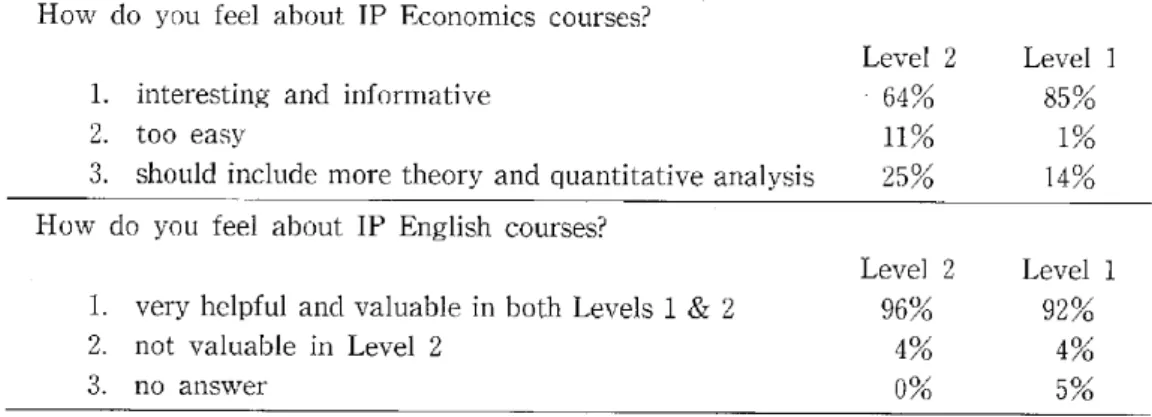
Next, results regarding IP Economics and English courses are given (Table 8) . Opinions regarding the content of IP Economics courses show that in Level 2, two- thirds of the students find the course interesting and informative, but one-fourth of the students would prefer inclusion of more theory and quantitative analysis. This goes to show that as students advance in their learning Economics, quantitative method is preferred by some students rather than the qualitative method having been used in IP Economics courses. For Level 1 students, 85% indicated their satisfaction while 14%
requested for more theory and quantitative analysis.
Regarding the instructional method of promoting active learning both in and out of class, opinions on the efficacy of outlining for active reading and organization of read- ing material, conducting group discussions during class to enhance understanding, and using video analysis for raising awareness of course content relevance and comprehen- sion were asked (Table 9) . Results indicate that (1) approximately two-thirds of stu- dents find outlining to be helpful; (2) high percentage of students in both levels find group discussion helpful; and (3) high percentage of students also find video analysis
to be effective in facilitating deeper comprehension of course content.
Next, we turn to the results of Student Course Evaluation conducted by the uni-
versity at the end of each semester. Table 10 shows the results of ratings by students
94
Table 8: Survey Results regarding
1
A~
IP Economics and
Vol. XXXVII, No. 1.2.3.4 English Courses.
How
1.
2.
3.
do you feel about IP Economics courses?
interesting and informative too easy
should include more theory and quantitative analysis
Level 2 64%
11%
25%
Level 1 85%
1%
14%
How
1.
2.
3.
do you feel about IP English courses?
very helpful and valuable in both Levels 1 & 2 not valuable in Level 2
no answer
Level 2 96%
4%
0%
Level 1 92%
4%
5%
Table 9: Results of Instructional Method in IP Economics Courses
Does writing outline for assign- Does small group
discussion
in Does watching video of currentment help you
understand
Eco-Economics class help
your economic issuesin Economics
nomics content?
understanding? class help your understanding?
Level 2 Level 1
Level 2 Level 1 Level 2 Level 11.Yes
68% 74%
1.Yes86% 91%
1.Yes93% 86%
2.No
11% 4%
2.No7% 2%
2.No0% 2%
3.Don't know
18% 19%
3.Don't know7% 7%
3.Don't know4% 10%
4.No answer
4% 4%
4.No answer0% 1%
4.No answer4% 2%
on IP Economics courses offered in Levels 1 and 2, for a total of four courses . The questionnaire result is from 2006-7 fall semester. Students enrolled in these courses totaled 140 students. The explanation of ratings is given in Table 11.
All evaluation of IP Economics courses is higher that the average course evalua- tion of Faculty of Economics courses and average for all courses in the university . The category "class attendance" measures the regularity in which students attend the course. This rating is 4.49 for IP courses. Next, "out of class study time" has grown to be of concern lately due to significant decrease of it. Compared with the faculty average of 2.52 and the university average of 1.99, IP courses have 4 .54 ratings for studying out of class. Finally, the overall rating of the course is 4 .47 for IP courses,
a rating higher than average for the Faculty as well as that of all courses offered at the university. These high ratings indicate overall satisfaction of courses by the IP stu- dents.
In addition to numeral ratings, students were asked on the evaluation to give rea-
sons for their overall satisfaction of the courses. The top three reasons for the over-
all rating were (1) acquisition of new knowledge and skills; (2) heightening of intellec-
tual curiosity; and, (3) feeling of academic fulfillment. Students are also asked on the
evaluation to write their candid comments about the course . The following is the sum-
mary of comments written by students.
Table 10: IP Economics Course Evaluation Results from 2006 Fall Semester
IP Economics Courses
Evaluation
Average: Faculty of Economics Courses
Average University All Courses
Class attendance
4.49 4.00 4 .17Out of class study time
4.54 2.52 1 .99Overall rating
4.47 3.73 3 .86Table 11: Explanation of Student Course Evaluation Ratings
points 5 4 3 2 1