Jikeikai Med J 2018; 65: 23-7
Introduction
Laparoscopic appendectomy is a common, safe, and ef- fective procedure for treating acute appendicitis in most conditions, including the severity of inflammation1,2. A pre- viously performed abdominal surgical procedure has been
considered a contraindication for laparoscopic surgery3. In particular, a previous abdominal operation performed with laparotomy increases the risks of complications and hospi- talization after a subsequent laparoscopic surgery4. Howev- er, several recent studies have suggested that a previous abdominal surgical procedure is not a contraindication for
Received for Publication, August 27, 2018
柴 浩明,小林 徹也,阿部 正,北条 誠至,中川 光,榎本 浩也,松本 倫,田辺 義明,矢永 勝彦
Mailing address : Hiroaki Shiba, Shin-yurigaoka General Hospital, 255 Furusawatsuko, Asao-ku, Kawasaki-shi, Kanagawa 215-0026, Japan.
E-mail : [email protected]
23
Previous Abdominal Surgery Has No Negative Effect on Laparoscopic Appendectomy for Acute Appendicitis
hiroaki Shiba1, Tetsuya KobayaShi1, Tadashi abe1, Seishi hojo1, hikaru NaKagawa1, hiroya eNomoTo1, Tomo maTSumoTo1, yoshiaki TaNabe1, and Katsuhiko yaNaga2
1Department of Surgery, Shin-yurigaoka General Hospital
2Department of Surgery, The Jikei University School of Medicine
ABSTRACT
Background : Laparoscopic appendectomy is effective for acute appendicitis. Previous abdominal operations cause intraperitoneal adhesions and may lead to complications following abdominal laparo- scopic operations. In the present study, we accessed the effect of previous abdominal surgery on lapa- roscopic appendectomy for acute appendicitis.
Methods : We retrospectively analyzed 170 patients who had undergone laparoscopic appendec- tomy for acute appendicitis at Shin-yurigaoka General Hospital from January 2013 through December 2016.
Results : Sixteen patients had previously undergone abdominal surgery by means of laparotomy or laparoscopy. Univariate analysis showed that patients who had previously undergone abdominal surgery were significantly older (p < 0.001) and were more often women (p = 0.002). The incidence of postoperative complications was similar among patients who had or had not previously undergone abdominal surgery. Multivariate analysis showed that independent risk factors for complications after laparoscopic appendectomy were perforated appendicitis (p = 0.003), a stercolith of the appendix (p
= 0.031), and an elevated preoperative white blood cell count (p = 0.047) but not a previous abdomi- nal surgery.
Conclusion : The present findings suggest that for patients undergoing laparoscopic appendecto- my for acute appendicitis, previous abdominal operation does not have negative effects on the inci- dence of postoperative complications or on the rate of conversion to laparotomy.
(Jikeikai Med J 2018 ; 65 : 23-7) Key words : previous surgery, appendicitis, laparoscopic appendectomy
laparoscopic surgery, including cholecystectomy5,6, gastrec- tomy7, colectomy8-10, hysterectomy11, radical cystectomy12, nephrectomy13, and bariatric surgery14. With regard to lapa- roscopic appendectomy for acute appendicitis, few studies have reported negative effects of a previous abdominal op- eration15,16. Therefore, the aim of the present study was to examine the effects of a previous abdominal surgical proce- dure on intraoperative outcomes, the rate of conversion to laparotomy, and postoperative complications in patients un- dergoing laparoscopic appendectomy for acute appendicitis.
Patients and Methods
We reviewed 170 patients who had undergone laparo- scopic appendectomy for acute appendicitis at the Depart- ment of Surgery, Shin-yurigaoka General Hospital, Kanaga- wa, Japan, from January 2013 through December 2016. Of these patients, 16 had previously undergone abdominal sur- gery by means of laparotomy or laparoscopy. Hematologic and chemical variables were routinely measured preopera- tively for each patient.
We investigated via univariate analysis the relation be- tween clinicopathologic variables and previous abdominal surgical procedures. The following 13 factors were analyzed : age, sex, preoperative white blood cell counts (WBC), preoperative serum C-reactive protein, time from onset to surgery, preoperative computed tomography (CT) findings, perforated appendicitis, duration of operation, drain replacement during operation, conversion to laparoto- my, time to flatus after operation, postoperative hospital stay, and incidence of postoperative complications.
Next, we investigated via multivariate analysis the re- lation between clinicopathologic variables, including previ- ous abdominal surgery, and the incidence of postoperative complications. The following 9 factors were analyzed : age, sex, previous abdominal operation, preoperative WBC, pre- operative serum C-reactive protein, preoperative CT find- ings of stercolith of appendix, ascites, abscess, and perforat- ed appendicitis during operation.
This retrospective study was approved by the Ethics Committee of Shin-yurigaoka General Hospital (20171127- 1), where the work was performed, and conforms to the provisions of the Declaration of Helsinki in 1995 (as revised in Brazil in 2013).
Surgical procedure
Hasson’s open technique was used to insert the first 12-mm trocar from the umbilicus for patients who had or had not previously undergone an abdominal operation. The suprapubic 5-mm trocar and the left lower quadrant abdom- inal 5-mm trocar were inserted under visual guidance with a 5-mm flexible laparoscope. If adhesions or inflammation was severe, another 5-mm trocar was inserted in the right lower quadrant of the abdomen. The mesoappendix was di- vided with laparosonic coagulating shears, and the appendi- ceal stump was closed with a linear stapler.
Statistical analysis
Univariate analysis of clinicopathologic variables was performed with the Mann-Whitney U test and Pearson’s chi-square test. Multivariable analysis was performed to in- vestigate the relationship between clinicopathologic vari- ables and the incidence of postoperative complications via a logistic regression model and a backward-elimination step- wise approach. All P-values were considered statistically significant when the associated probability was less than 0.05. These analyses were performed with software pro- gram IBM SPSS Statistics version 20.0 (IBM Japan, Tokyo, Japan).
Results Patients with previous abdominal operations
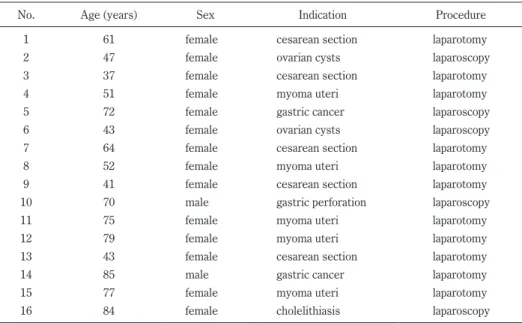
For the abdominal operations that had previously been performed in 16 patients, laparotomy had been used in 11 patients, and laparoscopy had been used in 5 patients (Table 1).
Univariate analysis of characteristics and variables in pa- tients who had or had not undergone abdominal surgery before laparoscopic appendectomy
Patients who had previously undergone abdominal sur- gery were significantly older (p < 0.001) and were more of- ten women than were patients who had not (p = 0.002 ; Ta- ble 2). Of the 16 patients who had previously undergone abdominal surgery, 1 had had an abdominal abscess as a postoperative complication. The incidence of postoperative complications was similar among patients who had and pa- tients who had not previously undergone abdominal sur- gery.
Multivariate analysis of clinicopathologic variables in relation to postoperative complications after laparoscopic appendectomy
Independent risk factors for postoperative complica-
tions after laparoscopic appendectomy were a perforated appendicitis at surgery (odds ratio = 7.022, 95% confidence interval [CI] = 1.923-25.644, p = 0.003), preoperative CT Table 1. Patients with previous abdominal surgery
No. Age (years) Sex Indication Procedure
1 61 female cesarean section laparotomy
2 47 female ovarian cysts laparoscopy
3 37 female cesarean section laparotomy
4 51 female myoma uteri laparotomy
5 72 female gastric cancer laparoscopy
6 43 female ovarian cysts laparoscopy
7 64 female cesarean section laparotomy
8 52 female myoma uteri laparotomy
9 41 female cesarean section laparotomy
10 70 male gastric perforation laparoscopy
11 75 female myoma uteri laparotomy
12 79 female myoma uteri laparotomy
13 43 female cesarean section laparotomy
14 85 male gastric cancer laparotomy
15 77 female myoma uteri laparotomy
16 84 female cholelithiasis laparoscopy
Table 2. Univariate analysis of characteristics and variables in patients with or without previous abdominal surgery on laparoscopic appendectomy
Factor Previous abdominal surgery
P-value Yes (n = 16) No (n = 154)
Age (years) 61.3 ± 16.5* 39.3 ± 18.7 <0.001
Sex (male : female) 2 : 14 83 : 71 0.002
Preoperative white blood cell count (103/µl) 12.4 ± 3.2 12.8 ± 3.9 0.651
Preoperative serum C-reactive protein (mg/dl) 7.0 ± 5.4 5.8 ± 6.7 0.404
Time to surgery from the onset (days) 1.6 ± 1.3 1.4 ± 1.0 0.580
Preoperative computed tomography findings
Stercolith of the appendix (yes) 9 (56.3%) 77 (50.0%) 0.634
Ascites (yes) 4 (25.0%) 35 (22.7%) 0.837
Abscess (yes) 1 (6.3%) 13 (8.4%) 0.762
Perforated appendicitis (yes) 5 (31.3%) 38 (24.7%) 0.565
Duration of operation (min) 65.2 ± 27.5 53.0 ± 21.1 0.105
Drain replacement at surgery (yes) 7 (43.8%) 42 (27.3%) 0.166
Conversion to laparotomy (yes) 1 (6.3%) 6 (3.9%) 0.652
Time to farting after surgery (days) 1.6 ± 0.6 1.5 ± 0.9 0.473
Postoperative hospital stay (days) 4.9 ± 1.8 4.6 ± 2.9 0.557
Postoperative complication
Reoperation 0 2 (1.3%) 0.647
Abdominal abscess 1 (6.3%) 4 (2.6%) 0.410
Surgical site infection 0 4 (2.6%) 0.514
Paralytic ileus 0 4 (2.6%) 0.514
*mean ± SD
findings of stercolith of the appendix (odds ratio = 5.922, 95% CI = 1.177-29.787, p = 0.031), and elevated preopera- tive WBC (odds ratio = 1.170, 95% CI = 1.002-1.367, p = 0.047) but not a previous abdominal operation (Table 3).
Discussion
Because of recent improvements in laparoscopic surgi- cal techniques and instruments, a previous abdominal sur- gery procedure has become a relative contraindication for a subsequent laparoscopic surgery procedure. However, sev- eral concerns remain regarding operative results, such as the duration of an operation and the rate of conversion to laparotomy, especially for gastrointestinal surgery. Among other laparoscopic procedures, laparoscopic cholecystecto- my is common and is, for patients who have previously un- dergone abdominal surgery, even in the upper abdomen, ef- fective and safe. However, a previous upper abdominal operation is associated with a higher conversion rate to lap- arotomy, a longer duration of the operation, a higher inci- dence of surgical wound infection, and a longer postopera- tive hospital stay5,6. A previous abdominal operation has been suggested to not be a contraindication for laparoscop- ic-assisted gastrectomy if careful attention is given for all procedures, including port insertion and dissection of intra- abdominal adhesions7. Laparoscopic colectomy for patients with previous abdominal surgery has exhibited acceptable short- and long-term outcomes but has been associated with increases in the conversion rate, the incidence of post- operative ileus, and the incidence of surgical wound infec- tion8-10. Laparoscopic liver resection has been suggested to be a safe procedure for patients who have previously under- gone upper abdominal surgery but to be associated with a conversion to laparotomy17. Regarding laparoscopic appen- dectomy, earlier studies and the present study have con- cluded that previous abdominal operations have no negative effect on outcomes, including the duration of operation, the
conversion rate to laparotomy, and the incidence of postop- erative complications15,16. Possible reasons for the lack of negative effects are that laparoscopic appendectomy is sim- pler and easier to perform than other laparoscopic proce- dures and requires only limited adhesiolysis.
A major concern regarding laparoscopic surgery is the risk of bowel or vessel injury when the first trocar is insert- ed if adhesion has been caused by a previous abdominal op- eration. However, for inserting the first trocar in such pa- tients, Hasson’s open technique is reportedly safe15. In the present study, Hasson’s open technique was used to insert the first trocar regardless of whether the patient had previ- ously undergone abdominal surgery. With Hasson’s open technique, the first trocar was successfully inserted from the umbilicus in all patients and produced no intraoperative complications, such as bowel or vessel injury.
In conclusion, our findings suggest that a previous ab- dominal operation has no negative effects, such as an in- creased incidence of postoperative complications or conver- sion to laparotomy, when laparoscopic appendectomy is performed for acute appendicitis.
Acknowledgments: Authors have no conflict of interest.
References
1. Brügger L, Rosella L, Candinas D, Güller U. Improving out- comes after laparoscopic appendectomy : a population-based, 12-year trend analysis of 7446 patients. Ann Surg. 2011 ; 253(2) : 309-13.
2. Guller U, Hervey S, Purves H, Muhlbaier LH, Peterson ED, Eubanks S, et al. Laparoscopic versus open appendectomy : outcomes comparison based on a large administrative data- base. Ann Surg. 2004 ; 239(1) : 43-52.
3. Curet MJ. Special problems in laparoscopic surgery. Previous abdominal surgery, obesity, and pregnancy. Surg Clin North Am. 2000 ; 80(4) : 1093-110.
4. Seetahal S, Obirieze A, Cornwell EE 3rd, Fullum T, Tran D.
Open abdominal surgery : a risk factor for future laparoscopic Table 3. Multivariate analysis of clinicopathologic variables in relation to postoperative complications after laparoscopic
appendectomy
Factor Hazard ratio (95% confidence interval) P-value
Perforated appendicitis 7.022 (1.923-25.644) 0.003
Stercolith of the appendix 5.922 (1.177-29.787) 0.031
Preoperative white blood cell count (103/µl) 1.170 (1.002-1.367) 0.047 Variables analyzed : age, sex, previous abdominal surgery, ascites, abdominal abscess, preoperative C-reactive protein
surgery? Am J Surg. 2015 ; 209(4) : 623-6.
5. Akyurek N, Salman B, Irkorucu O, Tascilar O, Yuksel O, Sare M, et al. Laparoscopic cholecystectomy in patients with previ- ous abdominal surgery. JSLS. 2005 ; 9(2) : 178-83.
6. Karayiannakis AJ, Polychronidis A, Perente S, Botaitis S, Si- mopoulos C. Laparoscopic cholecystectomy in patients with previous upper or lower abdominal surgery. Surg Endosc.
2004 ; 18(1) : 97-101.
7. Nunobe S, Hiki N, Fukunaga T, Tokunaga M, Ohyama S, Seto Y, et al. Previous laparotomy is not a contraindication to laparos- copy-assisted gastrectomy for early gastric cancer. World J Surg. 2008 ; 32(7) : 1466-72.
8. Kamer E, Acar T, Cengiz F, Durak E, Haciyanli M. Laparo- scopic colorectal surgery in patients with previous abdominal surgery : A single-center experience and literature review.
Surg Laparosc Endosc Percutan Tech. 2017 ; 27(6) : 434-9.
9. Lee SY, Kim CH, Kim YJ, Kim HR. Laparoscopic surgery for colorectal cancer patients who underwent previous abdominal surgery. Surg Endosc. 2016 ; 30(12) : 5472-80.
10. Yamamoto M, Okuda J, Tanaka K, Kondo K, Asai K, Kayano H, et al. Effect of previous abdominal surgery on outcomes fol- lowing laparoscopic colorectal surgery. Dis Colon Rectum.
2013 ; 56(3) : 336-42.
11. Seo ES, Lee SH, Chon SJ, Jung SY, Cho YJ, Lim S. Influence of previous abdominal surgery on clinical outcomes of patients undergoing total laparoscopic hysterectomy. Obstet Gynecol
Sci. 2018 ; 61(3) : 379-85.
12. Wei X, Lu J, Siddiqui KM, Li F, Zhuang Q, Yang W, et al. Does previous abdominal surgery adversely affect perioperative and oncologic outcomes of laparoscopic radical cystectomy? World J Surg Oncol. 2018 ; 16(1) : 10.
13. Ouellet S, Sabbagh R, Jeldres C. Transperitoneal laparoscopic nephrectomy : Assessing complication risk in cases of previ- ous abdominal surgery. Can Urol Assoc J. 2017 ; 11(3-4) : 131-5.
14. Major P, Droś J, Kacprzyk A, Pędziwiatr M, Małczak P, Wysocki M, et al. Does previous abdominal surgery affect the course and outcomes of laparoscopic bariatric surgery? Surg Obes Relat Dis. 2018 ; 14(7) : 997-1004.
15. Wu JM, Lin HF, Chen KH, Tseng LM, Tsai MS, Huang SH.
Impact of previous abdominal surgery on laparoscopic appen- dectomy for acute appendicitis. Surg Endosc. 2007 ; 21(4) : 570-3.
16. Liu SI, Siewert B, Raptopoulos V, Hodin RA. Factors associat- ed with conversion to laparotomy in patients undergoing lapa- roscopic appendectomy. J Am Coll Surg. 2002 ; 194(3) : 298- 305.
17. Cipriani F, Ratti F, Fiorentini G, Catena M, Paganelli M, Ald- righetti L. Effect of previous abdominal surgery on laparo- scopic liver resection : analysis of feasibility and risk factors for conversion. J Laparoendosc Adv Surg Tech A. 2018 ; 28(7) : 785-91.