名古屋工業大学学術機関リポジトリ Nagoya Institute of Technology Repository
Identification of Innovation Process among the Indonesian Craft Industrial Cluster:Small and Medium‑Sized Tourism Enterprises
著者(英) Muhammad Furkan Lalu
学位名 博士(学術)
学位授与番号 13903甲第987号 学位授与年月日 2015‑03‑23
URL http://doi.org/10.20602/00003165
Dissertation
Identification of Innovation Process among the Indonesian Craft Industrial Cluster:
Small and Medium- Sized Tourism Enterprises
January, 2015
Lalu Muhammad Furkan
1
i
Table of Contents
CHAPTER 1 INTRODUCTION ... 1
1.1 Background ... 3
1.2 Problem Statement ... 5
1.3 Research Question... 6
1.4 Goal and Objectives ... 6
1.5 Scope of Research ... 7
CHAPTER 2 THEORETICAL REVIEW ... 9
2.1 Cluster Approach ... 11
2.1.1 Cluster Life-Cycle ... 12
2.2 The Creative Industrial Cluster in Regional Perspective ... 13
2.3 Innovation in the Creative Industrial Cluster ... 16
2.4 Transfer of Knowledge in the Cluster ... 18
2.6 Network and Organization, and New Competition ... 21
2.7 Knowledge and Regional Networks ... 22
CHAPTER 3 RESEARCH DESIGN ... 25
3.1 The Indonesian Craft Industry ... 28
3.2 The Indonesian Craft Industry Best Practices ... 29
3.3 The Indonesian Craft Industrial Cluster ... 33
3.4. Research Method ... 34
CHAPTER 4 IDENTIFICATION OF INNOVATION PROCESS ... 37
4.1 Introduction ... 39
4.2 The Importance of Knowledge and Innovation in the Cluster ... 40
4.3 Tourism and Craft Industry in Indonesia ... 42
4.3.1 Tourism Industry in Indonesia ... 42
4.3.2 Craft Industry in Indonesia ... 43
4.4 The Indonesian Craft Industrial Cluster ... 44
4.4.1 General Business Information ... 44
4.4.2 Innovation Activities in the Indonesian Craft Industrial Cluster ... 45
4.4.3 Innovation Co-operation ... 46
4.4.4 Protection of Innovation ... 47
4.4 Discussion ... 51
4.5 Summary ... 52
CHAPTER 5 BEST PRACTICE OF INNOVATION ... 55
ii
5.1 Introduction ... 57
5.2 The Tourism and Craft Industry in Indonesia ... 58
5.2.1 The Tourism Industry in Indonesia ... 58
5.2.2 The Craft Industry in Indonesia ... 59
5.3 The Indonesian Craft Industry Best Practices (Classification and Research Object) ... 60
5.4 Case study: UD KamasanBali ... 61
5.4.1 Brief History of the UD KamasanBali ... 61
5.4.2 The Role of the Government, Universities, Corporations, and Agencies ... 64
5.4.3 UD KamasanBali, Other Players and Associations ... 66
5.5 The Case of Mawar Art Shop ... 68
5.5.1 The Brief History of Mawar Art Shop ... 68
5.5.2 The Role of Government, Corporation, and Agencies ... 70
5.5.3 Collaboration with Others Tourism Players and Association ... 71
5.6 Case of Adeshya ... 72
5.6.1 Brief History of Adeshya ... 72
5.6.2 The Role of the Government, Corporation, Agencies ... 72
5.6.3 Adeshya, Others Players and Association ... 73
5.6.4 Adeshya and Technology ... 74
5.7 The Importance of Exhibition or Trade Expo ... 74
5.8 Discussion ... 76
5.9 Summary ... 77
CHAPTER 6 MANAGING INNOVATION ... 79
6.1 Introduction ... 81
6.2 Tourism and Craft Industry in Indonesia ... 82
6.2.1 Tourism Industry in Indonesia ... 82
6.2.2 The Indonesian Craft Industry ... 83
6.3 The Indonesian Craft Industrial Cluster ... 84
6.3.1 General Business Information ... 84
6.3.2 Innovation Activities in the Indonesian Craft Industrial Cluster ... 85
6.3.3 Innovation Co-operation ... 86
6.3.4 Protection of Innovation ... 87
6.4 The Indonesian Craft Industry Best Practices ... 91
6.5 The Indonesian Craft Industry Best Practices Cluster ... 93
6.5.1 Case 1: UD KamasanBali ... 93
6.5.2 Case 2: Mawar Art Shop ... 99
iii
6.5.3 Case 3: Adeshya ... 102
6.6 The Importance of Exhibition or Trade Expo ... 105
6.7 Discussion ... 106
6.8 Summary ... 108
CHAPTER 7 DISCUSSION ... 109
7.1 Motivation of This Thesis ... 111
7.2 Innovation Process among the Indonesian Craft Industrial Cluster ... 112
7.3 Innovation Process among the Indonesian Craft Industry Best Practices ... 112
7.4 Managing Innovation in the Indonesian Creative Industrial Cluster ... 113
7.5 Summary ... 113
CHAPTER 8 SUMMARY AND CONCLUSION ... 115
8.1 Summary ... 117
8.2 Conclusion ... 118
8.3 Limitation and Future Research ... 118
8.3.1 The Limitation of the Research ... 118
8.3.2 The Future Research ... 118
APPENDIX ... 121
Bibliography ... 133
iv
List of Figures
Figure 1. Master Plan Acceleration and Expansion Indonesia Economic
Development 2011-2025 ... 5
Figure 2. the UNESCO Award in Asia ... 32
Figure 3. Craft industry export-import (billion rupiah) ... 39
Figure 4. The Indonesian tourism cluster network with flight route ... 43
Figure 5. General Business Information... 44
Figure 6. Innovation Activities ... 46
Figure 7. Protection of Innovation ... 47
Figure 8. The Indonesian Craft Industrial Cluster ... 49
Figure 9. Economic Corridor Republic of Indonesia ... 59
Figure 10. Sales Mawar Art Shop in Rupiah (Rp) ... 69
Figure 11. The Indonesian Craft Industrial Cluster (Source: Surveyed 2012) ... 74
Figure 12. The Indonesian tourism cluster network with flight route ... 83
Figure 13. General Business Information ... 84
Figure 14. Innovation Activities (Source: Surveyed in 2012) ... 86
Figure 15. Innovation Co-operation ... 87
Figure 16. Protection of Innovation ... 87
Figure 17. The Indonesian Craft Industrial Cluster... 89
Figure 18. The Indonesian Craft Industry best practices Cluster ... 105
List of Tables
Table 1. Tourism Performance of Indonesia ... 4Table 2. Survey schedule ... 34
Table 3. Innovation Co-operation in the Indonesian Craft Industry ... 47
Table 4. Classification of the Indonesian Handicraft ... 61
Table 5. Classification of the Indonesian Handicraft industry ... 92
1
CHAPTER 1 INTRODUCTION
2
3
CHAPTER 1 INTRODUCTION
1.1 Background
For decade cluster approach has been insightful notion of development which has drawn much attention across disciplines. However, its theoretical development and empirical practices never end with satisfying result and consensus (Cumber &
Mckenon, 2004). Until now the major question regarding the necessity of clustering or not remains debatable even though various perspective on economics (Spencer, Vinodrai, Gertler, & Wolfe, 2010), spatial planning (Asheim, Cooke, & Martin, 2006), Sociology (Steiner, 2006; Staber, 2007), and public policy (Swan, 2006) have taken part in understanding cluster phenomena.
Clusters allow enterprises to thrive under conditions of increasingly global competition. By clustering together firms can achieve economies of scale and scope and lower their transaction costs due to geographical proximity and increased interaction often based on trust. Industry concentrations can lead to the appearance of localization economies reducing costs through the availability of specialized labor and business services, public sector investments aim at satisfying particular industry need. Cluster have also been identified as motor for innovation , as companies co-operating and competing at close geographic proximity can learn from each other, developing unique local knowledge and creating knowledge-spillovers in the process. Transfer of knowledge and technology is favored both by the element of competition as well by the possibility. Cluster phenomena could be found in many local regions in Indonesia which includes all kind of industries such as agriculture, tourism, and creative industry.
The Indonesian tourism industrial cluster has experienced rising number of international and domestic tourists. This positive trend is predicted to continue along with the improving condition and global performance of the Indonesian economy in the midst of global economic fluctuations. Global economic fluctuations have not affected the tourism industry internationally and domestically, especially in the case of Indonesia evidenced by its growth. This increase in tourism will stimulate the economy of Indonesia and will have a multiplier effects on multiple sectors of the Indonesian economy. As we can see in Table 1 a number of foreign tourists visiting achieved 7 million tourists while the total of 935 million people
4
tourists in the world by 2010. From growth of foreign tourist visit perspective, we found the growth of foreign tourists visit in Indonesia is higher than the growth of foreign tourists visit in the world. The growth in Indonesia achieved 10.74% which is higher than the world growth mentioned 6.61% by 2010. Consequently, income from foreign tourist in Indonesia was approximately about USD 7.6 billion while in the world was USD 3,900 by 2008.
Table 1. Tourism Performance of Indonesia
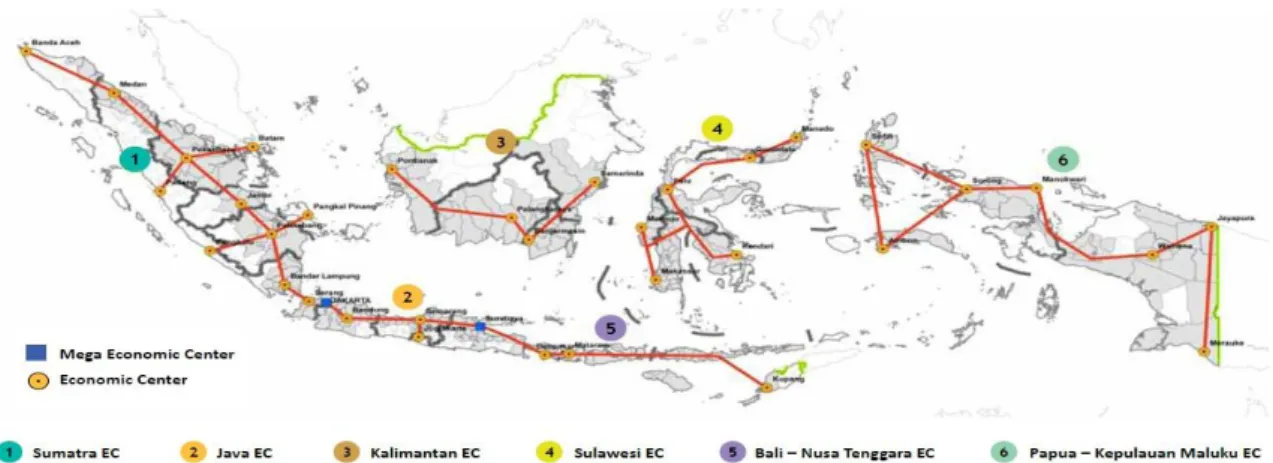
Further, Master Plan Acceleration and Expansion Indonesia Economic Development 2011-2025 is aimed at distributing development pies across rural and urban regions in Indonesia. It has development themes across regions divided into six corridors. The development corridor are as follows:
Sumatra economic corridor as referred as corridor 1 is a “center for production and processing of natural resources and as a nation energy reserve”.
Java economic corridor as referred as corridor 2 is a “driver for national industry and service provision.
Kalimantan economic corridor as referred as corridor 3 is “center for production and processing of national mining and energy reserves”.
Sulawesi economic corridor as referred as corridor 4 is “center for production and processing of national agricultural, plantation, fishery, oil & gas, and mining”
Bali and Nusa Tenggara economic corridor as referred as corridor 5 is “gateway for national tourism and national food support.
Papua-Kepulauan Maluku economic corridor as referred as corridor 6 is “center for development of food, fisheries, energy, and national mining.
The following figure shows economic corridors where government of Indonesia
5
focuses on development. The development focus of corridor 5 is tourism. Indonesia is an archipelago country consisting of more than 17,000 islands with a population of around 240 million people, more than 300 ethnic groups and divided into 33 provinces. Its total area is two-thirds of ocean and one-third land. The land area of Republic Indonesia covers 1,811,570 square kilo-meters. It is considered that Indonesia has great potential to promote tourism. Tourism industry is broad industry where creative industry belongs to tourism industry. Creative industry is a potential industry to be promoted. The government pay attention on creative industry development since it is emerging industry that contribute significantly to the Indonesian economy.
Figure 1. Master Plan Acceleration and Expansion Indonesia Economic Development 2011-2025
1.2 Problem Statement
Department for Culture, Media and Sport’s (DCMS, 1998) defined creative industries as activities that have their origin in individual creativity, skill and talent.
It includes: performing arts, advertising, architecture, the art and antiques, design, designer fashion, film and video, interactive leisure software (such as computer game), music, publishing, software and computer services, television and radio, and craft.
Despite, a growing number of reports on creative industry, many questions have yet to be fully addressed. For example, are creative industries capable of developing original and unique cultural products and creative services with sustainable effects (German commission for UNESCO, 2007)? To date, very few studies deal with innovation within creative industries (Miles & Green, 2008). Discussion of content
6
innovation has rarely been articulated in innovation studies. It is more commonly encountered in cultural studies, and even then is often not portrayed as innovation (e.g., Wright, Boria, & Breidenbach, 2002: Zackariasson, Walfisz, & Wilson, 2006).
Furthermore, research has pointed to the need to explore innovation among creative industries in relation to the idiosyncrasies of the sector (Handke, 2008), such as the presence of “soft innovation” linked to changes of aesthetic nature, as opposed to more widely used definitions of innovation that refer to changes in the functionality of products and process (Stoneman, 2009).
1.3 Research Question
This study is a set within the Indonesian craft industrial cluster. It has raised the following research question:
“Clarify to what extent the Indonesian craft industrial cluster have embraced innovation practices?”
The research question is divided into the following question:
Identify general business information of the Indonesian craft industrial cluster?
Identify innovation activities among the Indonesian craft industrial cluster?
Identify actors involved of the Indonesian craft industrial cluster?
Which actors are central in the innovation network in the cluster and how vital they are for the network?
What is the importance of government, universities and research center and other institution for the cluster?
Identify protection of innovation among the Indonesian craft industrial cluster?
1.4 Goal and Objectives
This research is aim at clarifying innovation process among the Indonesian craft industrial cluster. To achieve these goal some objectives that will be covered as follows:
1. To identify general business information of the Indonesian craft industrial cluster.
2. To identify innovation activities among the Indonesian craft industrial cluster.
3. To identify actors involved of the Indonesian craft industrial cluster.
7
4. To understand which actors are central in the innovation network in the cluster and how vital the actors for the networks.
5. To understand the importance of government, universities and research center and other institution for the cluster.
6. To identify protection of innovation among the Indonesian craft industrial cluster.
1.5 Scope of Research
The research scope addresses to clarify to what extent the Indonesian craft industrial cluster have embraced innovation practices. Cluster remains center of innovation (Porter, 1998). First of all, innovation practice is clarified among the Indonesian craft industrial cluster. Thus, innovation practices among the Indonesian craft industry best practices cluster is examined to be the lesson learnt to the Indonesian craft industrial cluster. The research focuses to clarify innovation practices in the context of cluster. Firstly, general information of the target cluster is very important to determine in order to give a description of the target cluster. Secondly innovation activities are explored in the target cluster. From these activities we have understanding various types of innovation in the cluster. Thirdly, network of innovation explains actors involved in promoting innovation in the cluster. These actors or institutions contribute to innovation activities. Lastly, protection of innovation varies among regions. It can be understood since concentration of the regions is different among others.
The Indonesian craft industrial cluster is selected as an empirical research for the purpose of this study for three reasons: The government concern to promote tourism and creative industry development as a potential industry. Secondly, the Indonesian craft industry is among the highest contribution to creative industry and confirms to GDP (Gross Domestic Product). Thirdly, the pace of market change and the uncertainty of consumer acceptance have increased recently, and managerial attention has therefore been focused on innovative product development efforts and practices. A framework of surveys was undertaken in the creation of tourism cluster network based on The Master Plan for Acceleration and Expansion of Indonesia Economic Development 2011-2025. Three provinces (Bali, West Nusa Tenggara, and Daerah Istimewa Yogyakarta) out of 33 provinces all over Indonesia are included in the sample survey. The total of 101 enterprises across three provinces was undertaken in the survey. Thus, best practices of a successful Indonesian craft
8
industrial cluster are highlighted to support the improved performances the Indonesian craft industry cluster based on the winner of the UNESCO Award. In this study, we clarified innovation practices among the Indonesian craft industrial cluster and the Indonesian craft industry best practices cluster.
9
CHAPTER 2 THEORETICAL REVIEW
10
11
CHAPTER 2 THEORETICAL REVIEW
2.1 Cluster Approach
There is large degree of confusion regarding the concept of the clusters or clustering means different thing to different people. One of the reasons for this is the fact that there is no real unified theoretical framework for examining clusters. Feser (1998) notes there is no cluster theory per se, rather a broad range of theories and ideas that constitute the logic of clusters. Some argue that this situation has had negative policy ramifications: “sadly, in the rush by various governments to employ clusters, some fundamental issues have been slighted, including appropriate research methods and even the definition of the cluster itself” (Held, 1996). Held claims that this approach can be harmful.
Part of this problem owes to the fact that there has been a variety of different definitions used when examining clusters. Michael Porter defines cluster as
“concentrations of interconnected companies and institutions in particular field”
(1998, p.78). Meanwhile the DTI (1998, p.22) defines clusters as “a concentrations of competing, collaborating and interdependent companies and institutions which are connected by a system of market and non-market links”. Scottish Enterprise(SE) define clusters as “customers, suppliers, competitors and other supporting institutions such as universities, colleges, research bodies, financial institutions and the utilities” (Scottish Enterprise, 1998).
In practice, clusters are taken to mean a group of business enterprise and non- business organizations for whom membership within the group is an important element of each member firm’s individual competitiveness. Binding the cluster together are ‘buyer-supplier relationships, or common technologies, common buyers or distribution channels, or common labor pools’ (Enright 1997, p. 191). It is also important to note that clusters involve certain degree of spatial proximity between its actors. Geographical proximity enables face-to-face networking, common labor market, and the diffusion of knowledge, especially ‘tacit’ knowledge which is difficult to codify.
Throughout the developing world, well-developed networks are rare (Nadvi and Schmitz, 1994), although both internal and external networks are important for
12
diffusion of technology in the clusters (Sandee, 1995: Sandee and ter Wingel, 2002).
Indonesia’s clusters also appear to be quite weak in this regard (Sato 2000, Supratikno 2001, 2002; Sandee et al. 2002; Weijland 1992). (Tambunan, 2007) noted that almost all known types of government intervention to promote the development of SMEs have been tried at one time or another In Indonesia. These include subsidized credit, development of small rural development banks, human resource development trainings, management quality system ISO-9000, providing total quality control advice, technology, and internet access. They also include advisory extension workers, subsidized input, facilitation, setting up of cooperative of small- scale industries in clusters, development of infra-structures, building special small- scale industrial estates, partnership programs, small business consultancy clinics and so forth.
Most observers acknowledge, however, that Porter’s work is merely the starting point for the majority of the cluster studies whilst tapping into wider range of more developed ideas to explain the origins of industry clusters, the dynamic of cluster growth and change and advantages to using clusters as basis for regional policy (Bergman and Feser, 1999). Current thinking on clusters lead by Michael Enright suggests that Porter work should be used as starting point or a catalyst to undertake cluster development and not as some kind of manual which have to be rigidly followed. From a policy perspective, different clusters are often highly place-specific and public policy toward clusters should be flexible enough to accommodate varying industrial, institutional and political conditions.
2.1.1 Cluster Life-Cycle
As many observers have noted, clusters are not a static phenomenon. Once cluster begins to form, a self-reinforcing cycle promotes growth, especially when local institutions are supportive and local competitions are vigorous (Porter, 1998).
Vibrant clusters are constantly innovating, changing shape and altering their internal dynamics (Baptista, 1998). In fact the reconfiguration of any given industry or cluster is often a mark of the level of innovation within its component part. Indeed, clusters which remains stable and do not transform themselves may end up stagnating, especially if they do not upgrade and keep abreast of new technology.
There are numerous examples of regions which have been severely hits because a dominant industrial cluster failed to diversify, upgrade or move up the value-chain.
13
Although clusters have varying trajectories, some seem to develop along a life- cycle model (Swann, 1988). Often the life-cycle of any given clusters owes to new development in technology and when a new technology or innovation process occur, new or embryonic cluster emerge. These often arise from research within universities and research bodies. Given this cluster is made-up of university researchers and small spin-off companies, this cluster is clearly in the formative stages of its development and will probably not fully develop until well into the next century. In fact, according to Porter (1998), numerous case studies suggest that cluster requires a decade or more to develop depth and real competitive advantage.
Clusters which follow above type of development trajectory are often formed by commercializing the existing science base. Using an example for a hypothetical cluster, the life-cycle could be categorized as follows:
Stage 1: The research base creates the technology which forms the bedrock for the future development of the cluster.
Stage 2: The research base commercialize the technology either internally through spin-offs or via a third party contractor.
Stage 3: Companies begin to grow and develop around the technology creating a small cluster of related firms. Employment level are still quite low.
Stage 4: Specialist support services and suppliers emerge to service the cluster, adding to depth and innovative capacity.
Stage 5: Companies begin to grow and expand their capabilities. Often trade bodies or informal networks grow during this stage.
Stage 6: Companies begin to reach a degree of maturity and may need to diversify to be able to continue in business. Linkage with universities or other suppliers of technology may be necessary to upgrade.
Not all clusters of industrial activity follow this simple linear developmental part.
Often clusters arise as a consequence of convergence between traditional and newer technology. Indeed the convergence between traditional technologies and new ones can sometimes yield substantial dividends (Swann, 1998).
2.2 The Creative Industrial Cluster in Regional Perspective
The emergence of creative industries which may act as engines of regional economic growth is usually associated with the quality of human capital, that is, to the
14
development and refinement of specific individual attitudes and capabilities. Schultz (1961), Becker (1964) and Barro (1991) were among the first to stress the importance of human capital in explaining economic growth. Jacobs (1961, p.147) argued that diversity of whatever kind is more likely to produce creative outcomes in areas where
“so many people are so close together, and among them contain so many different taste, skills, needs, supplies, and bees in their “bonners”.
A number of studies have since then attempted to explore determinants and effects of new ideas and abilities from a regional perspective. Among others, Florida (2002) suggests that scholars in this field should use a new measure of human capital, based on specific set of occupations that make up the ‘creative class’, including science, engineering, arts, culture, and entertainment. Lucas (2008) focuses on the channels through which new ideas may result in sustained growth, stressing the role of a class of educated people spending their career exchanging ideas, solving work related problems and generating new knowledge. See also Howkins (2001). Barry and Glaeser (2005) show that the difference in endowment of human capital across regions are likely to grow larger and more pronounced, therefore resulting in the persisting and substantial variation in wealth which can exist between regions within one country. Saxenian (1994) highlighted the importance of universities, entrepreneurs, and network-based industrial systems which are able to promote collective learning as factors favoring the development of high-tech industry in certain regions. Mellander and Florida (2007) identify some conventional and less conventional measures of human capital and “talent” in factors such as the presence of universities, amenities or service industry, openness and tolerance. Florida, Mellander and Stolaric (2008) discuss the role of creativity industries, the university system and concentration of gay and lesbian households (taken as a proxy of
“diversity”) in fostering economic growth by means of a stage-based general model of regional development. Morrison (2008) follows an evolutionary approach in observing that industrial districts, as networks of heterogeneous agents, concentrating knowledge within small epistemic communities make some regions intrinsically more dynamic than others.
Entrepreneurship and the process of new business formation have also been shown to be drivers of progress at the regional level. Audretsch and Keilbach (2005) indicate a direct link between entrepreneurship capital, a specific type of human capital referring to capacity of a region to generate entrepreneurial activity, and
15
regional economic growth (cf. also Audretsch, 2007; Van Praag and Versloot, 2007).
However, as aptly argued by Fritsch (2008), persuasive evidence on the ways in which entrepreneurship and new firm creation shape economic growth has not been provided yet and they are likely to interact in a haphazard fashion.
A third major determinant of regional economic growth is technological change and innovation, even of an incremental nature. Acs and Varga (2002) identify three main aspects of research into technology-led regional economic growth. First is the concentration issue, i.e. the fact that knowledge-related economic activities tend to concentrate in certain regions rather in others. Second is the identification issue, i.e.
finding out the key processes and institutional arrangements which favor technological advances. Third is the modelling issue, i.e. the construction of an analytical framework explaining the role of technological change in regional economic growth (Acs, 2002).
It is widely recognized that agglomeration of economic activity in space, by favoring Marshallian external economies of scale in production leads to increased and enhanced economic output. Economic agglomeration in region spurs growth, which in turn foster agglomeration, with growth and geographic agglomeration of economic activities representing mutually self-reinforcing processes (Martin and Ottaviano, 2011). By following a hoteling framework, Glaeser et.al. (1992) and Fujita and Thisse (2002) demonstrate that the extent of knowledge spillovers is determined by geographic proximity , and that agglomeration is limited by the centrifugal effects of transport costs, congestion, immobility of the factors of production. Agglomeration is made easier by a pooled labor market, greater provision of non- traded inputs, and knowledge spillovers (Giovannetti, Neuhoff and Spagnolo, 2007). Glaeser et.al.
(1992) stress the importance of geographic proximity in defining the extent of knowledge spillovers among firms of a given industry to explain the agglomeration in cities and regions. The presence of industrial districts and their relative size in terms of resident population is, accordingly, often associated with regional growth.
The knowledge of a (regional) economy can be considered simply as a list of the knowledge of its members (Arrow 1962; Lucas, 2008). Each person may gain from the knowledge of the people around her, and a concentration of highly knowledgeable people within a region might positively affect economic growth. Consistent with this assumption, in some studies (e.g. in Florida, Mellander and Stolarick, 2008)
16
universities are found to be significantly associated with the presence in the same territory of both highly-skilled human capital and the creative class. Discussed by Storper and Scot (2009) some studies (including Florida and Gates, 2001; Florida, 2002) found a positive association between diversity and regional growth, under the assumption that a tolerant milieu is more likely to be conducive to creativity provided that talented people have a preference for tolerance.
The interaction of institutional factors (such as the presence of stable networks of inter-firm relations) intellectual capital (i.e. knowledge capital in general), social capital (cooperative spirit and reciprocity), and political capital (capacity for collective action) results in what Camagni (2008) has defined territorial capital: a mix of sources of potential competitive advantage which encompasses the productivity enhancing potential of all local and spatially banded characteristics in a region. (cf. Batabyal and Nijkamp, 2009; Rodriguez-Pose, 2009)
2.3 Innovation in the Creative Industrial Cluster
Burns and Stalker (1971) refer to the organization and management of innovation as a product of the social processes taking place within organizations. Drucker (1985, p. 67) describes innovation as ‘the effort to create purposeful, focused change in an enterprise’s economic or social potential’. A company can choose to carry out different kinds of innovation, mainly innovation in product, strategy, process, and market, jointly or on its own, depending on the level of risk and commitment it decides to take on (Kuster & Vila, 2011).
Until recently, there have been few attempts to explore aesthetic and content innovation using the methods of innovation research. Stoneman (2007) noted that the creative industries sometimes engage in traditional technological innovation. He terms their aesthetic innovations as ‘soft innovation’, and distinguishes two aspects of such soft innovation: (1) innovation in products that are themselves largely aesthetic in nature (e.g., music, books, film); and (2) innovation in industries where innovation output is not aesthetic per se but functional. Miles & Green (2008) noted that the innovation patterns of creative industries have features in common with those described for other information goods, services, and experiences. Moreover, Green et al. (2007, 2008) present a ‘diamond-shaped’ framework of innovation to identify the six dimension prominent in creative industries. They argue that four of
17
these six dimensions, i.e., cultural products, user interface, cultural concept, and delivery, are particularly prominent in creative industries. While other researchers use the similar term of cultural product and process (CPP) to examines innovation in creative sectors. CPP innovation refers to stylistic innovation in content of form (new creative work), driven by the creative inspiration of makers (research-driven innovation) or by changes in taste of consumers (user-driven innovation; caves, 2000).
CPP innovation is concerned with the research, development, application, and diffusion of cultural products (stylistic changes, changes to forms, changes to content) and their processes (how products are made, delivered and distributed;
Jaaniste, (2009). Moreover, Tran (2010) argued that stylistic innovation deals with two type of changes in creative industry context: (1) aesthetic through change in looks, shape, and forms, and (2) changes in symbolic value expressed through new meaning and language of products. Most importantly, Tran (2010) claimed that if the creative sector is to take its own innovation seriously, then technological product and process (TPP) innovation must be completed with CPP innovation (Jaaniste, 2009).
Innovation in the firm is a multidimensional concept (Neely et al, 2001). An innovation can be defined as “an idea, practice, or object that is perceived as novel by an individual or other unit of adoption” (Rogers 1995:11). Another definition of innovation is “any ideas, practices, or material artifacts perceived to be new by the relevant unit of adoption” (Zaltman et al. 1973:10). Wissema (2005) argues that
“innovation is the successful introduction of something new, successful as shown by acceptance in the market or other use”. This implies that the processes that leads to an innovation is only partly a technical or scientific process. It is very much also commercial process, putting the new product in the market. In the management literature, particularly in that dealing with innovation and the growth of firms, several types of innovation have been identified, i.e. product, service, process, market, logistic and organizational innovation (Neely et al. 2001; Johanessenet.al 2002;
Avermaete, 2003).
Product innovation not only encompasses new product characteristics like the material or component used, but also new designs. Similarly market innovation is a quite broad concept, including new geographic markets and deepening of existing markets by new market segments. Note that the presentation of innovation in the table above suggests that innovations are stand-alone events. In practice, however different types may occur simultaneously because they are connected each other.
18
Thus, to a certain extent product innovation cannot go without process innovations and organizational innovations because the latter two are the condition for the first one.
It seems obvious that the types of dominant innovations are not the same across the world economy. In core regions of developed country, the emphasis is often on new products based on new technologies (like bio technology and new materials) and new services (e.g. supported by new concepts derived from integration with information and communication of technology), whereas in peripheral areas in these economies and in developing economies the emphasis is often in the process innovations aimed at reduction of costs, e.g. in processing based on the low costs of labor and material inputs (see e.g. Vernon, 1966). Likewise the newness of innovation differs across the world, with innovation new for the country and new for the world almost exclusively in developed countries. The previous assumptions are, of course, derived from simplified model and needs to be fine-tuned for developing countries.
It is now widely recognized that knowledge assets are highly important for the development of firms. In this context, the basic “ingredient” is people, not technology (Claver et al. 1998; and woodman et al. 1993 as cited in Prajogo et al. (2004). In term of people the main factors are the capabilities to be open to new knowledge, to understand new knowledge and to absorb in such way that it can be used on the work floor and the same time be evaluated and enriched based on practical experiences. Many authors have argued that knowledge management is an important business activity and a determining factors in innovation (Nonaka and Takeuchi; Johannessen et al. 1997; Mac Donald 1998). For instance, according to Cohen and levinthal (1990) knowledge capacity -defined as an organization’s ability to recognize the value of new external knowledge and to assimilate and apply it effectively- is a critical part of an organization’s innovative capability. In recent study Darroch and McNaughtan (2002) show a positive and significant relationship between knowledge management and innovation performance.
2.4 Transfer of Knowledge in the Cluster
There is extensive literature on the importance of knowledge and innovation among enterprises in the cluster. It has now become common to refer to knowledge as the
19
primary input into economic processes and as a crucial condition for the ability of the companies, communities and individual to participate successfully in the global economy (Reich, 1991; Hollifield and Donner meyer, 2003). New knowledge is a new resource to innovate under certain conditions where innovation is the key to survive domestic and international competition. There are some studies indicate the strong effect of new knowledge on the innovativeness of a company. Rothwell (1991), working in the European context, finds that small firms which employ extensive relationships with external parties including knowledge exchange, are more successful at innovation. He reveals that in order to compete successfully, small firms need to upgrade their knowledge through various channels of information with surrounding stakeholders. Kristiansen et al (2005) in a study of Tanzanian cottage industries find a similar result: that knowledge obtained from various sources (i.e.
media, socials, network, and customer relation) has a significant impact in innovation. However, another finding in Russia, Johanessen et al (1997) observed that the use of new knowledge is not significantly linked to the success in innovation.
The different findings may result from the different types of knowledge or the differing subject matter of knowledge in each case, for example: technology, markets, suppliers and industry characteristics. New knowledge creates business opportunities and becomes a valuable input of economic activity in poor countries (Melody, 1985). In many cases new knowledge is developed in other organizations at a distance from the firm concerned, meaning that the knowledge need to be transferred.
Many developing economies exhibit a pattern in which informal sources like family business, friends and customers, but also different practices and style of innovation related to the specific culture and social and institutional forces play a more important role than in developed economies (Hofsted, 1991; Holden, 1992). In this case, the organizations need to develop through new sources of knowledge. The transfer of knowledge becomes important. Several channels can be used: personal communication via face-to-face contact with customers, telecommunication modes (the internet and television), branch journals, technical manuals, visits to exhibitions, etc. (Van Geenhuizen, 1995). Transfer of knowledge from the source to the users may be rather expensive. Ogawa (1998) summarizes various reasons for high costs of the transfer process, like the nature of the knowledge itself e.g. a tacit character, high complexity and protected status of the knowledge- and the types for channel used for transfer. In this context, Von Hippel (1995) categorizes knowledge
20
as “sticky” if it is (very) costly to transfer due to characteristics of the knowledge itself and characteristics of and choices made by the knowledge providers and users.
For instance, if small manufacturers in developing countries seek information in technological solution to particular production problems, they may face sticky information due to high complexity of the information, charges to the access of this information, and large distances to the equipment manufacturers and knowledge institutes where the knowledge is developed. By adopting a spatial point of view, a different situation may be expected in clusters of nearby, related or competing companies. Many authors assume that in particular spatial clusters –facing long standing and trustful relations between the companies concerned, like suppliers, customers, competitors- search costs for new knowledge are low and much knowledge circulates for free (e.g. Audretsch 1998; Maskell and Malmberg 1999). A frequent interaction, partially due to meeting by chance and due to similar social context, lies to the basis of this ideas. Such a situation may apply both to developed and developing economies. Where new knowledge can be accessed and absorbed successfully not only depends on the origin of the knowledge and the channel of transfer, but also on the capability of the firms concerned. It is plausible that various structural characteristics influence this capability, like age, size and corporate position (e.g. subsidiary or an independent position), and membership of a community that provides the tools to easily understand and absorb the new knowledge. According to Affuah (2003), knowledge sources can be classified as functional sources of innovation and categorized into five groups: (1) international value chain functions; (2) external value-added chain of suppliers, customers, and complementary innovators; (3) university, government and private laboratories; (4) competitors and related industries; (5) other nations or regions. Seen from a slightly different perspective, one may also distinguish between so-called circumstantial sources (Affuah, 2003) indicating when or under what circumstances one may expect on innovation. Example of this type of sources are planned activities, e.g.
experimentation on purpose; unexpected occurrences, e.g. failure in production; and main changes outside the firm e.g. technological discontinues, deregulation and globalization. We may expect in global economies a pattern in which informal sources play a more important role than in developed economies like family businesses, friends and customers, but also different practices and style of innovation related with the specific culture and social and institutional forces (e.g. Hofstede 1991;
Holden, 2002).
21
2.6 Network and Organization, and New Competition
The term “Network” has become the vogue in describing contemporary organization.
From large multinationals to small entrepreneurial firms, from manufacturing to service firms, from emerging industries such as biotechnology to traditional industries such as automobile, from regional district such as Silicon Valley and Italy Prato district to national economies such as those of Japan and Korea, more and more organizations are being described as networks.Typically, the term “network” is used to describe the observed pattern of organization. But just as often it is used normatively: to advocate what organizations must become if they are to be competitive in today business environment. The concept of networking has also become popular theme at the individual level of analyses: Individuals are alerted to the importance of their so-called “connections” in getting things done or moving ahead in life and are therefore urged to network more –to build relationships they can use to their advantage. A growing number of networking or organizations that help people make all sorts of contacts – from finding dates to finding venture partner – have sprung to capitalize on the interest in networks. Many firms (aided by willingness consultants) have also joined the bandwagon, offering in-house training programs that help their employees learn about the importance of networks and how to go about building and using them.
What accounts for this enormous contemporary interest in networks? After all, the idea itself is not new. At least since the 1950s, the concept of network has occupied a prominent place in such diverse field as anthropology, psychology, sociology, mental health, and molecular biology. In the field of organizational behavior, the concept dates back even further. As early as the 1930s, Roethlisberger and Dickson (1939) described and emphasized the importance of informal network of relations in organizations.
Nohria (1992) believes that there are three major reasons for the increased interest in the concept of network among those interested in organizational phenomena. The first is the emergence over the last two decades of what Best (1990) has labeled “the New Competition”. This is the competitive rise over the last two decades of small entrepreneurial firms, of regional districts such as Silicon Valley in California and Prato and Modena in Italy, of new industries such as computers and biotechnology, and of Asian economy such as those of Japan, Korea, and Taiwan. This
22
New Competition has been contrasted with the old in one important way. If the old model of organization was the large hierarchical firm, the model of organization that is considered characteristic of the New Competition is a network, of lateral and horizontal inter-linkages within and among firms. The competitive success of the New Competition has thus led to an increased interest in networks, particularly as the old seeks to become more like new. Established firms are trying to restructure their internal organizations along the line of networks. They are also trying to redefine their relationship with vendors, customers, and even competitors, instead of arm-length, competitive relation, they are seeking more collaborative relations that will bind them together into network. Several regions have launched initiatives to grow their own version of the entrepreneurial network district.Even at the level of national economic and legislative policy, discussion about the possibility of adopting Japanese kieretsu type network structures and about relaxing traditional antitrust policy that forbid collaboration among the firm in and industry.
In addition to the interest in the new competition, a second reason for the increased interest in networks has to do with recent technological development. New information of technologies have made possible an entirely new set of more disaggregated, distributed, and flexible production arrangement, as well as new ways for firms to organize their internal operation and their ties to firm with which they transact. The rise such manufacturing and telecommunication networks has led to a concomitant interest in the organizational networks that these new technological development may spawn.
2.7 Knowledge and Regional Networks
Yet, there is good reason to believe that the production of ideas may be, contrary to its economics, prescribed within spatial boundaries. In his comparative analysis of nations published in industry and trade (1920), Alfred Marshall noted that economic activity was drawn to regions rich in the “atmosphere” of ideas. Vibrant regions are those that produce knowledge externalities that denote the spillovers of ideas from innovating firms to other firms. The existence of these stable regions implies that these externalities are also localized; that is, they do not spill perfectly over spatial borders. Yet, economic treatment of externalities largely assume them to be “there”
such as embodied in capital goods rather than a property that itself deserve to be explained. Knowledge externalities, however, are not simply generated by given
23
technology. The relationship among firms, universities, star scientists, and engineers strongly conditions the extent by which knowledge spill over.
The importance of regions in economic development has been a persistent, though often lost, theme in economic sociology. Jane Jacobs (1969) put forth an argument that the growth of cities is based on positive cycle of linkage among industries; the social economic linkage among diverse activities generate and sustain growth. In a seminal study, Saxenian (1994) carried out an ethnography of engineers in Silicon Valley (South of San Francisco) and Route 128 ( which rings Boston), and attributed the success of the former to a more robust exchange of ideas among firms.
The relationship between social networks and spatial localization of knowledge is usually neglected in economic study on externalities. In an important exception, Jaffe et al. (1993) analyzed patent citation data pertaining to domestic university and corporate patents to test the extent of localization of knowledge spillovers. At three different geographic levels (country, state and SMSA), they found evidence that patent citation tend to belong the same geographic areas as the originating patents (the patent they cite), even after controlling for the existing concentration of patenting activity. Their finding indicated that knowledge localization exists in the aggregate. Because they did not analyze the variation of localization by region and technology, they left open the issues of whether the properties of technology and institutions determine knowledge externalities. Jacob’s (1969) argues that localized knowledge builds upon cumulative ideas within regional boundaries.
The interdependence of technological accumulation and regions has marked the development of semiconductor industry from its origins. The industry originated from the invention of the first solid state transistor at the laboratories of AT & T (Bell labs) in New Jersey in 1947. Over the next five decades process and product technology in the semiconductor industry has advance at rapid pace while the industry has grown increasingly international.
Within the United States, inter-firm linkages between domestic companies are common. Most firms, including Intel, Advanced Micro Devices, National Semiconductors, and Texas instruments, have a history of alliances of various types with other semiconductor firms. Of the over 1800 recorded alliances in the industry between 1961 and 1989, nearly 1200 involved U.S firms (Kogut & Kim 1992). Formal
24
technology transfer arrangements have also helped to diffuse technology internationally. Japanese and European firms have both benefited from extensive strategic alliances with U.S. firms.
In addition to formal transfer of technology, there is also impressive ethnographic evidence of the spread of knowledge through more informal channels that may differ by region. Since its inception, the American semiconductor industry has been characterized by inter-firm mobility of scientists and engineers. Rival firms actively courted key engineers leading to extensive inter-firm mobility of personnel (Roger & Larrson 1984). Entrepreneurship has been another significant characteristic of the American industry. Ever since William Shockley left Bell labs to start Shockley semiconductors in Palo Alto, California, start-ups have played an important role in the diffusion of knowledge and evolution of the industry (Moore 1986). Several of Shockley’s assistants left his firm and formed Fairchild semiconductors in 1957. The origins of almost every firms in Silicon Valley can be traced back to Fairchild. In addition to the role of the pioneering firms, universities played an important role. The area boasts two frontier universities in electrical engineering, university of California at Berkeley and Stanford University, which proactively pursued the diffusion of knowledge to the regions (Leslie and Kargan 1996). The significance of university research for local diffusion is confirmed in several studies, notably Jaffe et al. (1993) and Zuker et al (1994).
For the purpose of this research the author will concentrate on clusters was sparked by the influential work of Michael Porter (1990). Further, it is widely recognized that most cluster studies use Porter’s work as the starting point for cluster analysis (Bergman and Feser, 1999). In fact, according to study examining cluster initiative across Europe, the majority of cluster programs were not preceded by in-depth regional analysis comparable with porter’s cluster mapping process (Lagendijk, 1999a). Moreover, Lagendijk claims that the general Porterian concept of clusters have been interpreted very differently across regions and translated into practical initiatives according to specific need of the local economy. This has been backed up by other clusters researchers.
25
CHAPTER 3 RESEARCH DESIGN
26
27
CHAPTER 3 RESEARCH DESIGN
As previously discussed Porter (1998) defines “cluster” as a geographically proximate group of interconnected companies and associated institutions in a particular field, linked by commonalities and complementarities. The geographic scope of a cluster can range from a single city or state to a country or even a network of neighboring countries. In this definition, the word “interconnected” means transaction sharing, customer sharing and technology sharing. These aspects can be adopted into inter- firm networks. There are two main aspects to the concept of cluster: accumulation in terms of proximity and networking in terms of relationship. Therefore, if there is networking among firms and institutes in a certain area and they accumulate to form a cluster, they might be classified as a target cluster. In addition to enhancing productivity, clusters play a vital role in a company’s ongoing ability to innovate.
Thus, clusters can remain centers of innovation for decades.
To date, very few studies deal with innovation within creative industries (Miles
& Green,2008). Discussion of content innovation has rarely been articulated in innovation studies. It is more commonly encountered in cultural studies, and even then is often not portrayed as innovation (e.g., Wright, Boria, & Breidenbach, 2002:
Zackariasson, Walfisz & Wilson, 2006). Furthermore, research has pointed to the need to explore innovation among creative industries in relation to the idiosyncrasies of the sector (Handke, 2008), such as the presence of “soft innovation” linked to changes of aesthetic nature, as opposed to more widely used definitions of innovation that refer to changes in the functionality of products and process (Stoneman, 2009).
This study is a set within the Indonesian craft industrial cluster. The purpose of this study is to clarify to what extent the Indonesian craft industrial and best practices cluster have embraced innovation practices between 2009 and 2011.
The research question are divided to 6 parts as follows:
Identify general business information of the Indonesian craft industrial cluster?
Identify innovation activities among the Indonesian craft industrial and best practices cluster?
Identify actors involved of the Indonesian craft industrial and best practices cluster?
28
Which actors are central in the innovation network in the cluster and how vital they are for the network?
What is the importance of government, universities and research center and other institution for the cluster?
Identify protection of innovation among the Indonesian craft industrial and best practices cluster?
To understand the context of this study it’s important first to describe the structure of the Indonesian craft industry and its characteristics. After that deeper analysis about the Indonesian craft industrial cluster is given.
3.1 The Indonesian Craft Industry
Handicrafts are defined as products that are produced either completely by hand or with the help of tools. Mechanical tools may be used as long as the direct manual contribution of the artisan remains the most substantial component of the finished product. Handicrafts are made from raw materials and can be produced in unlimited numbers. Such products can be utilitarian, aesthetic, artistic, creative, culturally expressive, decorative, functional, traditional, religiously and socially symbolic and significant (adopted from the definition for crafts/artisan products at the UNESCO/ITC international symposium on “Crafts and the International Market:
Trade and Custom Codification”, Manila, Philiphinnes, October 1997)
Handicrafts classification can be seen as follows:
Textile (e.g. cotton, silk, linen)
Natural Fibers (e.g. bamboo, vetiver grass, rattan)
Ceramics (e.g. clay, earthenware, pottery, stoneware, porcelain)
Wood (including paper and lacquer ware)
Metal (e.g. silver, gold, bronze, iron, pewter)
Stone (e.g. precious, semi-precious, jades)
As mentioned craft industry is one of the Indonesian tourism players. It is also subject to government policy as mentioned in the Master Plan Acceleration and Expansion the Indonesia Economic Development 2011-2025. To achieve the vision 2025 the Indonesian government emphasize on development efforts. Development efforts are divided into six economic corridors:
29
Sumatra economic corridor as referred as corridor 1 is a “center for production and processing of natural resources and as a nation energy reserve”.
Java economic corridor as referred as corridor 2 is a “driver for national industry and service provision
Kalimantan economic corridor as referred as corridor 3 is “center for production and processing of national mining and energy reserves”
Sulawesi economic corridor as referred as corridor 4 is “center for production and processing of national agricultural, plantation, fishery, oil & gas, and mining”
Bali and Nusa Tenggara economic corridor as referred as corridor 5 is “gateway for national tourism and national food support
Papua- Kepulauan Maluku economic corridor as referred as corridor 6 is “center for development of food, fisheries, energy, and national mining.
The figure shows economic corridors where government of Indonesia focuses on development. The development focus of corridor 5 is tourism. It consists of three provinces: Province of Bali, West Nusa Tenggara and East Nusa Tenggara. These provinces are characterized by the presence of university or other higher education, less research institutions regarding craft industrial cluster, but only few other services to the craft industrial cluster.
3.2 The Indonesian Craft Industry Best Practices
The best practices are highlighted to support the improved performances the Indonesian craft industrial cluster based on the winner of the UNESCO Award of Excellence for Handicrafts 2010. It is UNESCO’s flagship program for supporting craft producers. It aims to encourage artisans to produce handicrafts using traditional skills, patterns and themes, in an innovative ways, in order to ensure the continuity and sustainability of these traditions and skills. Thus, it elaborates into some specific objectives as follows:
Objective 1: Establish rigorous standards of excellence for handicrafts.
The UNESCO “Award Excellence for Handicrafts” aims to promote quality crafts that uphold rigorous standards of excellence. It aims to ensure that when consumers buy awarded handicrafts, they are buying high quality, culturally authentic products that have been manufactured in a socially-responsible manner with respect for the environment.
30 Objective 2: Encourage innovativeness
While it seeks to promote the continuation of traditional skills, the UNESCO Awards also encourage products innovation in order to ensure that handicraft remain relevant, valuable, and marketable in modern life.
Objective 3: Offer training and support services
The UNESCO program aims to provide capacity-building and training workshops to assist craft producers in the improvement of their product design and marketing, development of their markets, and protection of their intellectual property rights.
Objective 4. Provide new opportunities to ensure sustainability of handicraft industries
The handicraft sector plays an increasingly significant role in local economic development and poverty eradication. By providing new market opportunities, the programs aims to enable handicraft producers to establish sustainable livelihoods.
This will be achieved through developing networks of handicrafts producers and buyers, including the higher-end market, and through exhibition and trade fairs.
The producers of awarded product benefit in the following ways:
Certificate of excellence
Each product recognized with the UNESCO Award is given a certificate. The certificate can be used as a promotional tool (for a specific product or product line only) to attest the quality and authenticity of a product.
Training capacity-building
UNESCO assists national and sub-regional partners in organizing workshops on product assessment, design and promotion for the producers of awarded products and product applicants.
Trade fairs and exhibitions
Producers have an opportunity to display the awarded products at annual exhibitions and fairs and will receive guidance about participating in international trade fairs.
Communication and promotion
Producers benefit from the communication and promotion campaign coordinated by UNESCO and its partner. Promotional materials, such as brochures, and catalogues, will enhance the product visibility and acknowledgement.
Website
All awarded products, together with producers ‘information data, are listed in
31
the UNESCO Bangkok websites so that interested person can directly communicate with producers.
Intellectual property and copyrights
Producers of awarded handicrafts are sensitized on the benefit of registering their products under intellectual property right regimes.
A product that is granted the UNESCO Award meets the highest level of crafts excellence and is distinguished as a benchmark of craft production. An international panel of experts, nominated by UNESCO evaluate submissions based on meeting all of the following four criteria:
Excellence
Demonstrated excellence and standard-setting quality in craftsmanship:
determine by the use of high quality materials, a high standard of techniques and special attention to manufacturing and finishing detail.
Authenticity
Expression of cultural identity and traditional aesthetic values: demonstrated by a well achieved application of aesthetic and cultural expression or traditional crafting techniques.
Innovative
Innovation in design and production: demonstrated by an effective and successful blend of traditional and contemporary, or inventive and creative use of material, design and production processes.
Marketability
Marketability of the craft products with potential to the regional and/or international market: related to the functionality of the products, the safe use by potential buyers, a balanced-price quality relationship or the sustainability of production.
To be eligible and enter the evaluation, all submissions must first fulfill two pre- condition. Products and process must be:
Eco-friendly
Respect for the environment in materials and production techniques: exemplified through the sustainable use of natural dyes, natural fibers, recycle material, and the use of materials and production processes that are environmentally friendly.
Fair
Social responsibility: the producer must affirm that no labor law or copyrights
32
was violated and no individual or groups exploited unfairly at any stage in the production of a handicraft submitted for the award program.
The Award of Excellence for handicraft, previously called “Seal of Excellence”, was jointly established by UNESCO and the ASEAN Handicraft Promotion and Development.
Figure 2. the UNESCO Award in Asia
Association (AHPADA) in 2001. Owing to its success, the program has been expanded worldwide. Within Asia, the Award is coordinated by the following sub- regional partner organizations:
South-East Asia: Brunei Darussalam, Cambodia, Indonesia, Lao PDR, Malaysia, Myanmar, Philippines, Singapore, Thailand, Timor Leste and Vietnam. [The regional partner is ASEAN Handicraft Promotion and Development Association (AHPADA)].
West-Central Asia: Afghanistan, I.R. of Iran, Kazakhstan, Kyrgyzstan, Tajikistan, Turkmenistan, and Uzbekistan. [The regional partner is Central Asia Crafts Support Association (CACSA)].
South Asia: Bangladesh, Bhutan, India, Nepal, Maldives, Pakistan, and Srilanka [The regional partner is Craft council of India (CCI)].
East Asia: People’s Republic of China, Democratic People’s Republic of Korea, Japan, Mongolia, and republic of Korea. [The regional partner is National Craft
33 Association in East Asia on a rotational basis].
3.3 The Indonesian Craft Industrial Cluster
The Indonesian craft industrial cluster consists of many different actors in the regions. Firsts are companies which are doing business in the craft industry. Further there are many companies focusing on field that support the craft industry. They are mainly tourism industry such as transportation, hotel, travel agent, eco-tourism, historical sites, food and beverage, etc. These tourism players are not the main focus of research but they benefit the craft industrial cluster development. There are also public institutions among the regions such as universities, research centers and services, corporations, international and domestic agencies and local government, and also sometimes in collaboration with the national government in order to support the Indonesian craft industrial cluster.
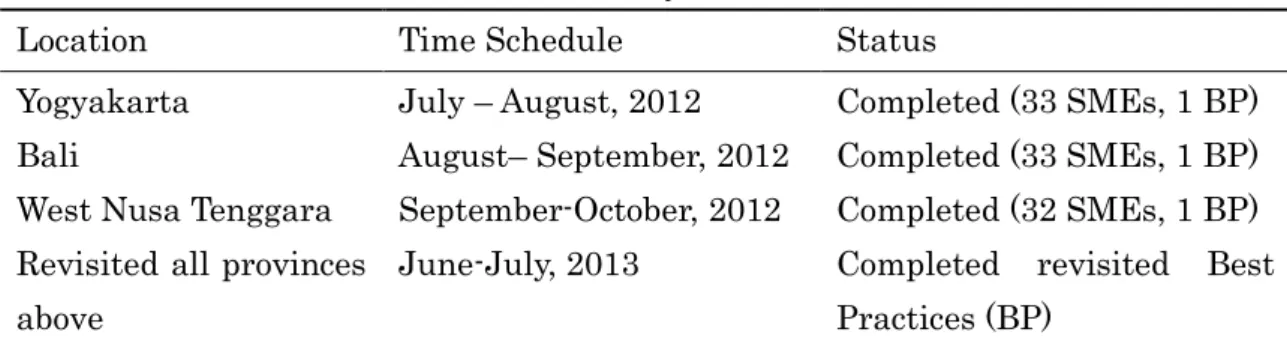
There are 101 enterprises and three best practices belong to the Indonesian craft industrial cluster taken as a sample survey across three provinces: Province of Bali, Yogyakarta, and West Nusa Tenggara. It represents 33 enterprises plus 1 best practice each province. All companies have been visited by the author during July, 2012 and October, 2012 and the researcher collect information related innovation into the craft industrial cluster. Thus, it is followed by revisiting the best practice for in-depth interview about information related innovation in 2013. To complete additional information, information technology such as e-mail, Short Message Send (SMS) are adopted.
In addition to the companies, there are three universities that have major role in those regional craft industrial cluster. Their importance in the innovation network is one of the key topic of this study. They are Udayana University located in Bali, Mataram University (West Nusa Tenggara) and Gadjah Mada University and the Indonesian Art Institute located in Yogyakarta.
Among these universities consist some research groups that contribute to the craft industrial cluster. Gadjah Mada University is among the best university in Indonesia. It has a bundle of knowledge where national and local government have engaged Gadjah Mada University in many development programs related to cluster development. Since Yogyakarta is also well-known for student life from many