A Critical Review of English Locative Alternation Studies:
Proposal for Distinguishing between Alternating and Non-alternating Verbs
Yasuko KAWANOכ
The locative alternation in English is a phenomenon in which a certain class of verbs, such as smear, causes an alternation of two syntactic frames (e.g., He smeared paint onto the wall/He smeared the wall with paint). An abiding research question has been identifying the differences between alternating and non-alternating verbs. Therefore, to address this question, this paper gives a critical analysis of three major English locative alternation studies by Pinker (1989), Levin (2006), and Iwata (2008), identifying crucial problems in their theoretical frameworks and providing reasons why they have failed to successfully answer the aforementioned question. Then, on the basis of Kawano’s (2009) analysis of the Japanese locative alternation, an alternative framework is proposed, which clearly identifies the differences between alternating and non-alternating verbs. Finally, to demonstrate the validity of the proposed framework, a further alternation is discussed, which can be accounted for when using the proposed framework but not when using the frameworks presented in Pinker (1989), Levin (2006), and Iwata (2008).
Keywords: Locative alternation, Spray/load alternation, In-with alternation 1. Introduction
The locative alternation in English is a phenomenon in which a certain class of verbs, such as smear, causes an alternation of a [V NP spatial PP] frame (henceforth, the into/onto frame1) and a [V NP with NP] frame (henceforth, the with frame) as demonstrated in (1) (Fillmore 1968, 1977; Anderson 1971;
Fraser 1971; Jeffries and Willis 1984; Fukui et al. 1985; Rappaport and Levin 1988; Pinker 1989;
Jackendoff 1990, 1996; Dowty 1991; Gropen et al. 1991; Tenny 1992, 1994; Levin 1993, 2006; Goldberg 1995, 2006; Baker 1997; Rappaport Hovav and Levin 1998, 2010; Levin and Rappaport Hovav 1998, 2003, 2005; Croft 1998, 2012; Davis 2001; Boas 2003; Van Valin 2004, 2007; Koenig and Davis 2006;
Iwata 2008; Beavers 2010, 2017; among others).
כAssociate Professor, Graduate School of Humanities and Social Sciences, Saitama University. Linguistics.
1 I use “the into/onto frame” to refer not only to the syntactic frame containing into or onto but also to that containing other spatial prepositions such as in and on.
『埼玉大学紀要(教養学部)』第54巻第2号、2019年
(1) a. He smeared paint onto the wall. (into/onto frame) b. He smeared the wall with paint. (with frame)
What should be noted is that not all verbs allow the locative alternation. Put, for example, can take only the into/onto frame as shown in (2), and fill can take only the with frame as shown in (3).
(2) a. He put the books on the desk. (into/onto frame) b.*He put the desk with the books. (with frame) (3) a. He filled the glass with water. (with frame)
b.*He filled water into the glass. (into/onto frame)
This fact raises the question of why the verb smear allows the locative alternation and put and fill do not;
that is, what distinguishes between alternating and non-alternating verbs. Even though these questions are important in understanding the locative alternation mechanism, few studies have explicitly examined this aspect, except for Pinker (1989), Levin (2006), and Iwata (2008). As pointed out by Beavers (2017:4032–
4034), identifying which verbs allow the alternation and which do not and why remains a key research need for locative alternation studies.
This paper seeks to contribute to this discussion through a critical analysis of Pinker (1989), Levin (2006), and Iwata’s (2008) theoretical frameworks. The remainder of this paper is organized as follows.
Sections 2, 3, and 4, respectively, examine the theoretical frameworks of Pinker (1989), Levin (2006), and Iwata (2008) and show that these studies have crucial problems in their theoretical frameworks and therefore fail to successfully answer the question of what distinguishes between alternating and non- alternating verbs. On the basis of Kawano’s (2009) analysis of the Japanese locative alternation, Section 5 proposes an alternative framework that is able to capture the differences between alternating and non- alternating verbs. Section 6 further discusses the validity and usefulness of the proposed framework through the presentation of another type of alternation that is accounted for when using the proposed framework but cannot be accounted for when using Pinker (1989), Levin (2006), or Iwata’s (2008) frameworks. Section 7 gives a summary and conclusions.
2. Pinker (1989) 2.1. Overview
As mentioned above, locative alternation verbs in English take both into/onto and with frames. The first step in the locative alternation analysis is to specify the semantic difference between these two frames.
Pinker (1989:77) claims that the into/onto frame has a thematic core “X moves Y into/onto Z” while the with frame has a thematic core “X causes Y to change its state by means of moving Z to Y.”
On the basis of these observations, Pinker (1989) proposes a lexical rule that changes a verb’s semantic structure:
Given all these proposals, the locative alternation can now be stated simply: it is a rule that takes a verb containing in its semantic structure the core “X causes Y to move into/onto Z,” and converts it into a new verb whose semantic structure contains the core “X causes Z to change state by means of moving Y into/onto it.” (Pinker 1989:79)
He argues that the basic semantic structure and the newly created structure are associated with their respective syntactic frames, which consequently causes the locative alternation.
The difference in argument structure follows from the linking rules: in the old verb, the moving thing was the theme and hence was linked to direct object; in the new verb, the location is the theme (of a state change) and hence is linked to object. (Pinker 1989:79)
Assuming this to be the locative alternation mechanism, Pinker (1989: 77–82, 124–130) then examines the conditions that define alternating verbs and proposes a broad-range rule and a set of narrow-range rules. The broad-range rule states that both the type of motion and the end state must be specified;
therefore, according to Pinker (1989), spray allows the locative alternation because it satisfies this condition, whereas put does not allow the with frame as it does not specify a state change. However, Pinker (1989) argues that the broad-range rule is only a necessary but not a sufficient condition as some non-alternating verbs such as drip also seem to satisfy this condition. To resolve this problem, Pinker (1989) then proposes a set of narrow-range rules that classify alternating verbs into six classes (shown below) and argues that membership in one of these classes is a sufficient condition for a verb to allow the locative alternation.
The content-oriented classes:
1. Simultaneous forceful contact and motion of a mass against a surface: smear, brush, dab, daub, plaster…
2. Vertical arrangement on a horizontal surface: heap, pile, stack…
3. Force is imparted to a mass, causing ballistic motion in a specified spatial distribution along a trajectory: splash, inject, spatter, spray…
4. Mass is caused to move in a widespread or nondirected distribution: scatter, bestrew, sow…
The container-oriented classes:
1. A mass is forced into a container against the limits of its capacity: pack, cram, crowd, jam, stuff…
2. A mass of a size, shape, or type defined by the intended use of a container (and not purely by its geometry) is put into the container, enabling it to accomplish its function: load, pack, stock…
(from Pinker 1989: 126–127)
Therefore, for Pinker (1989), the difference in the syntactic behavior between spray and drip is explainable as follows: spray allows the locative alternation because it belongs to one of the alternating classes, whereas drip does not allow the locative alternation because it does not belong to any of these alternating classes (Pinker 1989 also classifies non-alternating verbs into eight classes and places drip in a non-alternating class in which “a mass is enabled to move via the force of gravity” (126)).
2.2. Problems
As outlined in 2.1, Pinker (1989) presents broad-range and narrow-range rules to predict the verbs that allow the locative alternation. However, these rules do not appear to have any explanatory power. Let us examine the broad-range rule first. According to this rule, the reason why (4b) is acceptable and (5b) is not is that spray specifies an end state and put does not.
(4) a. He sprayed paint onto the wall. (into/onto frame) b. He sprayed the wall with paint. (with frame) (5) a. He put paint on the wall. (into/onto frame)
b.*He put the wall with paint. (with frame)
The problem, however, is that how do we know that spray specifies an end state and put does not. Pinker (1989) claims that the end state is specified by change-of-state verbs in the with frame but not by change -of-location verbs in the into/onto frame. This indicates that it is theoretically impossible to determine whether spray and put satisfy the broad-range rule without referring to the acceptability of (4b) and (5b).
The same problem arises in (6) and (7).
(6) a. He sprayed the wall with paint. (with frame) b. He sprayed paint onto the wall. (into/onto frame) (7) a. He filled the glass with water. (with frame)
b.*He filled water into the glass. (into/onto frame)
On the basis of the broad-range rule, the reason why (6b) is acceptable and (7b) is not is that spray specifies a type of motion whereas fill does not. However, it is logically inconsistent to determine whether
spray and fill specify a type of motion without referring to the acceptability of (6b) and (7b) as the type of motion is specified by change-of-location verbs in the into/onto frame but not by change-of-state verbs in the with frame. Therefore, the broad-range rule has a circular definition that fails to predict the possibility of alternation.
Next, let us examine the narrow-range rules. According to the narrow-range rules, spray allows the alternation because it belongs to one of the alternating classes, and drip does not allow the alternation because it belongs to one of the non-alternating classes. However, this is equivalent to saying that spray allows the alternation because it is an alternating verb and drip does not allow the alternation because it is a non-alternating verb, which is fairly an unsatisfactory explanation. The narrow-range rules do not specify the semantic characteristics that the six alternating classes share and neither how these differ from the semantic characteristics of the non-alternating classes; that is, the narrow-range rules only seem to classify alternating verbs and non-alternating verbs into groups without defining the differences between alternating and non-alternating verbs.
3. Levin (2006) 3.1. Overview2
Levin (2006) seeks to provide a unified account for English object alternations including the locative alternation, on the basis of a “bipartite view of verb meaning” (2). This view assumes that “a verb’s meaning consists of two distinct types of components: a ‘root’—or core meaning—and an event structure template” (Levin 2006:8).3 The event structure template is claimed to be a “structural part of a verb’s meaning” that is “relevant to determining the semantic classes of verbs that are grammatically relevant”
(Rappaport Hovav and Levin 1998:106). (8a–d) are examples of these event structure templates.
(8) a. [[ x ACT <MANNER> ] CAUSE [BECOME [ y <RES-STATE> ]]]
b. [x ACT <MANNER> ] c. [x <STATE> ]
d. [BECOME [ x <STATE> ]] (Levin 2006: 8–9 (20)–(22))
The event structure template includes a position for a root to be integrated, which is indicated with italics and angle brackets in (8). The root is defined as the “idiosyncratic aspect of verb meaning” that “serves to differentiate a verb from other verbs sharing the same structural aspects of meaning” (Rappaport Hovav and Levin 1998:106–107). The association between roots and event structure templates is determined by the root’s ontological type (Rapport Hovav and Levin 1998:108, Levin 2006:9). For example, verbs with
2 This overview is mainly drawn from Levin (2006), but I also referenced related work such as Rappaport and Levin (1988), Levin (1993), Rappaport Hovav and Levin (1998, 2010), and Levin and Rappaport Hovav (1998, 2003, 2005) for further understanding.
3 The root is referred to as a “constant” in Rappaport Hovav and Levin (1998).
a result root, that is, those that specify a result state, such as dry, are assumed to be associated with a complex event structure template that consists of two subevents, as in (9).
(9) [[ x ACT ] CAUSE [ BECOME [ y <DRY> ]]]
(Rapapport Hovav and Levin 1998:107 (15b))
In contrast, verbs with a means/manner root, that is, those that specify the means, manner, or instrument of action, such as run, are assumed to be associated with a simple event structure template that consists of a single subevent, as in (10).
(10) [ x ACT <RUN> ] (Levin 2006:14 (31))
Having outlined the theoretical components, Levin (2006) examines what distinguishes alternating from non-alternating verbs, arguing that “having a root basically associated with a simple event structure makes it possible for a verb to show an object alternation” (17). Take smear, as an example, which, according to Levin’s definition, has a means/manner root and is, therefore, associated with a simple event structure.
According to Levin (2006), smear has three participants: an actor, some spreadable stuff, and a surface.
The actor is matched with the single variable in the simple event structure template (i.e., “x”) and is syntactically realized as the subject. However, the simple event structure template has no second variable to impose a constraint on the object. This means that verbs associated with the simple event structure template “have flexibility as to object choice, which makes them candidates for object alternations” (Levin 2006:17). In contrast, verbs with a result root, such as fill, are associated with the complex event structure template, which has two variables (i.e., “x” and “y”). Therefore, “their object is always associated with a particular semantic role, so that alternative object choices and, hence, object alternations, are disallowed”
(Levin 2006:21).
Levin (2006) states, however, that having a simple event structure is only a necessary condition because not all simple event verbs allow object alternations. For example, push does not cause any object alternations even though it is associated with the simple event structure template. To distinguish the alternating simple event verbs (e.g., smear) from the non-alternating simple event verbs (e.g., push), Levin (2006) claims that “many of the best known object alternations arise from the association of the activity described by certain types of means/manner verbs with a particular nonverbal predicate expressing a result of this activity” (26). Take smear again as an illustration. According to Levin (2006), either of the nonactor participants (the stuff or the surface) can be the object of smear as stated above. In addition,
“there are prepositions available that license whichever is not the object. English with can license the realization of the stuff when the surface is the object… [and] a variety of special prepositions can license the realization of the surface, when the stuff is the object…” (Levin 2006:26). An object alternation, the
locative alternation in this case, arises as a consequence. In contrast, push does not cause any object alternations because “displacement to a goal is not a type of result that can license an alternate argument realization” (Levin 2006: 32).
3.2. Problems
Levin (2006) argues that the verbs that allow the locative alternation are those that denote an activity conventionally associated with particular types of results that can be expressed by spatial prepositions and with. However, this is equivalent to saying that verbs that take the into/onto frame and the with frame allow the locative alternation, which is a circular definition that fails to predict whether a given verb allows the locative alternation.
In addition, a careful examination of Levin’s theory leads us to the more crucial question of whether this framework is appropriate for addressing object alternations. Levin’s (2006) theory is based on a bipartite view that divides a verb’s meaning into structural or idiosyncratic parts. Depending on this verb meaning subdivision, whether a verb allows object alternation is clearly an issue associated with the structural part of verb meaning. However, the event structure templates proposed by Levin (2006) are unable to clearly distinguish between alternating and non-alternating verbs as both the alternating verb smear and the non-alternating verb push are associated with the same event structure template (i.e., simple event structure template) in Levin’s (2006) model. Further, it is contradictory to describe the semantic commonalities in alternating verbs in terms of the root as the root is defined as the idiosyncratic part of the verb’s meaning. To summarize, Levin’s (2006) framework has a theoretical problem as neither of the semantic levels posited to define verb meaning are able to account for the possibility of the locative alternation.
4. Iwata (2008) 4.1. Overview
Iwata’s (2008) aims are to “give a coherent account of the locative alternation in English” and to
“develop a constructional theory which overcomes a number of problems with the version proposed by Goldberg (1995, 2006), via the case study of the English locative alternation” (1). In Goldberg’s account, the locative alternation is understood as a phenomenon in which a single verb meaning fuses with two distinct constructions. Although Iwata (2008) agrees with this view in principle, he argues that Goldberg’s account does not satisfactorily predict the possibility of alternation. According to Goldberg, spray causes the locative alternation because the participant roles of spray (i.e., sprayer, target, and liquid) can fuse with the argument roles of the two constructions. However, Iwata (2008) argues that ‘it is hard to believe that the participant roles of pour [(a non-alternating verb)] are that much different from those of, say spray”
and comments that “Goldberg’s practice of matching role labels is tantamount to saying that the verb and the construction can be fused because the full expression is actually acceptable” (20). From this critique
of Goldberg’s account, Iwata (2008) insists that “a more detailed examination of verb meanings is necessary” and proposes a lexical-constructional approach that “pays more attention to verb meanings than Goldberg’s account” (27).
Another characteristic of Iwata’s (2008) approach is the introduction of lower-level constructions. He argues that the constructions posited by Goldberg (1995) such as the “caused-motion construction” are quite abstract and that lower-level constructions such as “verb-specific constructions” and “verb-class- specific constructions” are needed. These constructions are defined in the following:
The verb put always appears in context, like John put the box on the desk. By abstracting over this and other individual occurrences like (17a) and (17b), a verb-specific construction arises in which put appears in the syntactic frame [NP V NP PP].
(17) a. John put the box on the desk.
b. Mary put a dish on the table.
Now there are other verbs like throw in (18a) or move in (18b) that have similar meanings and which also occur in the same syntactic frame.
(18) a. John threw a ball into center field.
b. John moved the piano into the bed room.
By abstracting over these verb-specific constructions, we now have a verb-class-specific construction which pairs the common semantics with the syntactic frame [NP V NP PP].
(Iwata 2008:36)
On the basis of this framework, Iwata (2008) analyzes the locative alternation as follows. He starts his account by arguing that spray paint onto the wall and spray the wall with paint basically describe the same scene, wherein “one sends substance in a mist, typically in a back and forth manner” and “as a result of this back and forth movement, the substance eventually comes to cover a large portion of the surface to which it has been applied” (31). According to Iwata (2008), this scene can have two alternate interpretations: “If we focus on the paint, we get an event of sending a substance in a mist,” and “if, on the other hand, we focus on the wall, this is an event of covering the wall with paint” (31). The former event is described by He sprayed paint onto the wall, which is acceptable because “it is sanctioned, along with She put the box on the desk or He poured water into a glass, by a verb-class-specific construction which pairs the syntactic frame [NP V NP PP] with the semantics ‘X moves Y into/onto Z’” (39). The latter event is described by He sprayed the wall with paint, which is acceptable because “it is sanctioned, along with She covered the floor with a rug, by a verb-class-specific construction that pairs the syntactic frame [NP V NP] with the semantics ‘X causes a layer to cover Y’” (40). In contrast, verbs such as cover and put do not cause the locative alternation. Iwata (2008) explains the inability of these verbs to cause the locative alternation by saying that “a change of location is simply lacking” (82) in the meaning of
cover and “it is quite obvious that put cannot be used to describe a covering-type event” as “the essential feature of put is that things go to where they belong” (81).
4.2. Problems
In Iwata’s (2008) account, the reason (11b) is acceptable and (12b) is not is that the scene described by spray can be interpreted as an event where “X moves Y into/onto Z” whereas the scene described by cover cannot.
(11) a. He sprayed the wall with paint. (with frame) b. He sprayed paint onto the wall. (into/onto frame) (12) a. He covered the floor with a rug. (with frame)
b.*He covered a rug onto the floor. (into/onto frame)
The question, however, is how do we know that the scene described by spray is interpreted as an event where “X moves Y into/onto Z” and the scene described by cover is not. Iwata (2008) claims that “X moves Y into/onto Z” is the semantics of the into/onto frame but not of the with frame. This indicates that it is not possible to determine whether spray and cover have an “X moves Y into/onto Z” interpretation without referring to the acceptability of (11b) and (12b). The same problem arises between (13) and (14).
(13) a. He sprayed paint onto the wall. (into/onto frame) b. He sprayed the wall with paint. (with frame) (14) a. He put the books on the table. (into/onto frame)
b.*He put the table with the books. (with frame)
In Iwata’s (2008) account, the reason (13b) is acceptable but (14b) is not is that the scene described by spray can be interpreted as an event where “X causes a layer to cover Y” whereas the scene described by put cannot be interpreted in this way. Some readers may think that it is possible to determine whether spray and put have an “X causes a layer to cover Y” interpretation without referring to the acceptability of (13b) and (14b). However, this gives rise to a logical inconsistency because, in Iwata’s (2008) model, the “X causes a layer to cover Y” interpretation is explained as the semantics of the with frame but not of the into/onto frame. Therefore, it is theoretically impossible in Iwata’s (2008) model to determine whether a given verb receives an “X causes a layer to cover Y” interpretation without referring to its acceptability in the with frame. This inability to predict the possibility of alternation is essentially the same as that in Pinker’s (1989) broad-range rule (see 2.2).
Why does such a problem arise in Iwata’s (2008) model? This problem is closely connected to the theoretical framework adopted by Iwata (2008). As shown in 4.1, Iwata (2008) introduces two
construction levels, namely, verb-class-specific constructions and verb-specific constructions, to account for the locative alternation. However, do these constructions assist in distinguishing between alternating and non-alternating verbs? Let us examine verb-class-specific constructions first. In Iwata’s (2008) model, spray (alternating) and cover (non-alternating) belong to the same verb-class-specific construction (i.e., Syn: [NPX V NPY] = Sem: “X causes Y to have a layer over it”), and spray (alternating) and put (non- alternating) belong to the same verb-class-specific construction (i.e., Syn: [NPX V NPY directional PPZ]
= Sem: “X moves Y into/onto Z”). This indicates that verb-class-specific constructions do not distinguish alternating verbs (e.g., spray) from non-alternating verbs (e.g., cover and put).4
When examining the much-lower-level constructions, the verb-specific constructions, this time, spray (alternating) and cover (non-alternating) belong to distinct verb-specific constructions, and spray (alternating) and put (non-alternating) belong to distinct verb-specific constructions. However, this does not mean that verb-specific constructions can distinguish alternating verbs from non-alternating verbs, because spray and smear also belong to distinct verb-specific constructions despite both allowing the locative alternation. That is, verb-specific constructions are literally “verb-specific”, as they are represented as [NP spray NP PP], [NP put NP PP], [NP smear NP PP] …, and hence, it is impossible to capture the commonality of alternating verbs or that of non-alternating verbs, with a focus on verb-specific constructions.
In conclusion, verb-class-specific constructions are too abstract, and verb-specific constructions are too specific to distinguish between alternating and non-alternating verbs, which is a similar problem as Levin’s (2006) event structure template and root as the event structure template is too abstract to distinguish between alternating and non-alternating verbs, and the root, or the idiosyncratic part of verb meaning is not helpful in capturing the semantic commonalities between verbs that have the same syntactic behavior. Although there are many differences between Iwata (2008) and Levin’s (2006) frameworks, they share a common weakness: a lack of an appropriate semantic level for identifying the differences between alternating and non-alternating verbs.
5. A proposal
As discussed in the previous sections, it is impossible to predict the possibility of alternation in the frameworks presented in Pinker (1989), Levin (2006), or Iwata (2008). In this section, on the basis of Kawano’s (2009) analysis of the Japanese locative alternation, a possible solution to this problem is presented.
4 Some readers may think that spray and cover have differences in that the former belongs to two verb-class-specific constructions (Syn: [NPX V NPY] = Sem: “X causes Y to have a layer over it” and Syn: [NPX V NPY directional PPZ] = Sem: “X moves Y into/onto Z”) whereas the latter belongs to one verb-class-specific construction (Syn: [NPX V NPY ] = Sem: “X causes Y to have a layer over it”). However, this is equivalent to saying that spray allows the locative alternation (that is, takes two verb-class-specific constructions) whereas cover does not (that is, only takes one verb-class-specific construction), rather than predicting whether these verbs would allow the locative alternation. The same holds true for spray and put.
5.1. Kawano’s (2009) approach to the locative alternation in Japanese: a hierarchical model of semantic verb types
The locative alternation in Japanese is a phenomenon in which a certain class of verbs, such as nuru (“smear”) causes an alternation of a [NP-ni NP-o V] frame (henceforth, the ni frame) and a [NP-o NP-de V] frame (henceforth, the de frame). The ni frame and the de frame, respectively, correspond to the into/onto frame and the with frame in English.
(15) a. kabe-ni penki-o nuru (ni frame)
wall-on paint-ACC smear
‘smear paint onto the wall’
b. kabe-o penki-de nuru (de frame)
wall-ACC paint-with smear
‘smear the wall with paint’
As in English,Japanese has non-alternating as well as alternating verbs. For example, tukeru (“put”) does not take the de frame, as shown in (16), and yogosu (“soil”) does not take the ni frame, as shown in (17).
(16) a. kabe-ni penki-o tukeru (ni frame)
wall-on paint-ACC put
‘put paint onto the wall’
b. *kabe-o penki-de tukeru (de frame)
wall-ACC paint-with put
(17) a. yuka-o doro-de yogosu (de frame)
floor-ACC mud-with soil
‘soil the floor with mud’
b.*yuka-ni doro-o yogosu (ni frame)
floor-on mud-ACC soil
This raises the same question as has been asked regarding the English locative alternation: what distinguishes between alternating and non-alternating verbs?
As Okuda (1968), Okutsu (1981) and others have observed, the ni frame is associated with a change- of-location meaning, and the de frame is associated with a change-of-state meaning. Therefore, it might be concluded from this observation that verbs with both change-of-location and change-of-state meanings allow the locative alternation whereas verbs with only one of these two meanings do not.
However, this simple explanation fails to predict the possibility of alternation because it is not possible to determine the semantic verb type unless the syntactic frame that the verb takes is known; that is, it is known that nuru (“smear”) has both change-of-location and change-of-state meanings because it can be used in both the ni frame and the de frame. Therefore, the statement that “verbs with both change-of- location and change-of-state meanings allow the locative alternation whereas verbs with only one of these two meanings do not” is merely a paraphrase of the observation and does not predict which verbs allow the alternation (the accounts of Pinker 1989, Levin 2006, and Iwata 2008 contain essentially the same shortcomings, as examined in 2.2, 3.2, and 4.2).
Therefore, Kawano (2009) proposes an alternative approach to identify the conditions that can define alternating verbs without resorting to circular reasoning. The basic idea underlying Kawano’s (2009) approach is as follows: although verbs in the ni frame express a change of location as many studies have observed, it is insufficient to simply state that they express a change of location because this cannot predict the difference in syntactic behavior between nuru (“smear”) and tukeru (“put”) as they both take the ni frame and express a change of location but only nuru (“smear”) allows the locative alternation, as shown in (15) and (16). This suggests that there is a need to divide the “change of location” meaning (CL) into two subtypes (CL1 and CL2):
Change of location (CL)
CL1: The type of change of location expressed by alternating verbs such as nuru (“smear”) CL2: The type of change of location expressed by non-alternating verbs such as tukeru (“put”)
By specifying the difference between CL1 and CL2, it becomes possible to predict whether a given change- of-location verb allows the locative alternation without needing to refer to its acceptability in the de frame;
that is, if a given change-of-location verb expresses CL1 in the ni frame, the verb is predicted to also take the de frame (that is, it is predicted to allow the locative alternation). Conversely, if a given change-of- location verb expresses CL2 in the ni frame, the verb is predicted to fail to take the de frame (that is, it is predicted to fail to allow the locative alternation).
The same can be applied to the “change of state” meaning. As many studies have observed, verbs in the de frame express a change of state. However, it is insufficient to simply state that they express a change of state because this does not predict the difference in the syntactic behavior between nuru (“smear”) and yogosu (“soil”) as they both take the de frame and express a change of state but only nuru (“smear”) allows the locative alternation, as shown in (15) and (17). This suggests that there is a need to divide the “change of state” meaning (CS) into two subtypes (CS1 and CS2):
Change of state (CS)
CS1: The type of change of state expressed by alternating verbs such as nuru (“smear”)
CS2: The type of change of state expressed by non-alternating verbs such as yogosu (“soil”)
By specifying the difference between CS1 and CS2, it becomes possible to predict whether a given change- of-state verb allows the locative alternation without needing to refer to its acceptability in the ni frame;
that is, if a given change-of-state verb expresses CS1 in the de frame, the verb is predicted to also take the ni frame (that is, it is predicted to allow the locative alternation). Conversely, if a given change-of-state verb expresses CS2 in the de frame, the verb is predicted to fail to take the ni frame (that is, it is predicted to fail to allow the locative alternation).
Kawano’s (2009) idea is illustrated in Figure 1.
a level
determining change of location (CL) change of state (CS) the syntactic
frame of a verb:
a level CL2 CL1 CS1 CS2
determining change of location change of location change of state change of state whether a verb expressed by expressed by expressed by expressed by undergoes non-alternating alternating verbs alternating verbs non-alternating the alternation: verbs (e.g., tukeru) (e.g., nuru) (e.g., nuru) verbs (e.g., yogosu)
Figure 1. Semantic level relevant to the possibility of alternation (Kawano 2009:50, my translation)
Figure 1 shows that, although a change of location (CL) and a change of state (CS) are relevant to the choice of syntactic frame, they are insufficient in predicting the possibility of alternation in the syntactic frames. For example, although the ni frame verbs such as nuru (“smear”) and tukeru (“put”) can be defined as change-of-location verbs, this alone cannot explain why nuru (“smear”) allows the alternation but tukeru (“put”) does not. To capture the difference between these two verbs, it is necessary to focus on the lower-level difference between CL1 and CL2. The same holds true for a change of state.5
Note that, unlike the frameworks in Levin (2006) and Iwata (2008), Kawano’s (2009) hierarchy in Figure 1 consists of verb class meaning levels and does not contain a verb-specific (idiosyncratic) meaning level. This is because this hierarchy captures the relationship between the semantic verb type and its
5 For details on Kawano’s analysis of specifying the difference between CL1 and CL2 and that between CS1 and CS2, see Kawano (2009, 2017).
syntactic behavior, and idiosyncratic meaning is not relevant to determining the systematic syntactic behavior of verbs.6
5.2. Proposal for English locative alternation studies
As discussed in 3.2 and 4.2, event structure templates in Levin (2006) and verb-class-specific constructions in Iwata (2008) are too abstract to distinguish between alternating and non-alternating verbs.
The root in Levin (2006) and verb-specific constructions in Iwata (2008) are also not useful because they are defined as idiosyncratic or verb-specific meaning, and therefore, they are unable to capture the common semantic features of verbs with the same syntactic behavior. Therefore, to distinguish between alternating and non-alternating verbs, it is necessary to focus on a different semantic level that is lower than Levin’s event structure templates and Iwata’s verb-class-specific constructions, but not the verb- specific (idiosyncratic) meaning level, as Kawano (2009) posits “a level determining whether a verb undergoes the alternation” below “a level determining the syntactic frame of a verb.”7 By specifying the difference between alternating and non-alternating verbs on this lower semantic level, it becomes possible to identify the conditions that define alternating verbs without the need to resort to circular reasoning.
Essentially the same can be said for Pinker’s (1989) framework. As discussed in 2.2, Pinker’s (1989) broad-range rule, which states that verbs specifying both a type of motion and an end state can undergo the locative alternation, has a circular definition that fails to predict the possibility of alternation. To identify the conditions that define alternating verbs without resorting to circular reasoning, the following are necessary: 1) to specify the difference between the type of motion expressed by alternating change- of-location verbs (e.g., spray) and that expressed by non-alternating change-of-location verbs (e.g., put), and 2) to specify the difference between the type of end state expressed by alternating change-of-state verbs (e.g., spray) and that expressed by non-alternating change-of-state verbs (e.g., cover). By doing 1), it becomes possible to predict whether a given change-of-location verb can take the with frame without referring to its acceptability in the with frame, and by doing 2), it becomes possible to predict whether a given change-of-state verb can take the into/onto frame without referring to its acceptability in the into/onto frame. In other words, a hierarchy of semantic verb types and a focus on lower-level semantic types are needed.
6. More on the validity of the hierarchical model of semantic verb types
6 Davis (2001) proposes to posit a semantic type called “sp-rel” as a subtype of “cause-mot-rel” (the counterpart of change-of-
location meaning (CL) in Kawano’s (2009) model) to capture the differences between alternating and non-alternating verbs.
Although there are differences between the models of Davis (2001) and Kawano (2009), especially regarding the change-of-state meaning (CS), the basic idea of positing a lower (but not idiosyncratic) semantic level is shared with these two models.
7 Iwata’s (2008) verb-class-specific construction level corresponds to “a level determining the syntactic frame of a verb” in Kawano’s (2009) model (Figure 1). These levels are not useful when seeking to identify the conditions that define alternating verbs because they are levels for capturing the commonalities of spray and cover (they both take the with frame), but not the levels for capturing their difference (only spray undergoes the locative alternation).
Although not widely known, both English and Japanese have another alternation pattern. This section further confirms the validity of Kawano’s (2009) hierarchical model of semantic verb types by showing that by using this model, it is possible to provide a unified account for the locative alternation and this second type of alternation.
The following examples, (18) and (19), demonstrate the English alternation referred to by Iwata (2008) as the “in-with alternation.”
(18) a. coat the fish in seasoned flour.
b. coat the fish with seasoned flour. (Iwata 2008:102 (5c))
(19) a. smother a steak in mushrooms.
b. smother a steak with mushrooms. (Iwata 2008:102 (5d))
The in-with alternation is same as the locative alternation in which it is an alternation between a [V NP spatial PP] frame and a [V NP with NP] frame. However, it differs from the locative alternation in its alternation pattern as illustrated in the following.
(20) Locative alternation in English
a. V NP spatial PP (e.g., smear paint onto the wall.)
b. V NP with NP (e.g., smear the wall with paint.) (21)In-with alternation in English
a. V NP spatial PP (e.g., coat the fish in seasoned flour.)
b. V NP with NP (e.g., coat the fish with seasoned flour.)
Interestingly, Japanese, too, has a phenomenon corresponding to the in-with alternation, as exemplified in (22) and (23) (Kawano 1997, 2006, 2009).
(22) a. hurosiki-ni hon-o kurumu (ni frame)
wrapping.cloth-in book-ACC wrap
‘wrap a book in wrapping cloth’
b. hon-o hurosiki-de kurumu (de frame)
book-ACC wrapping.cloth-with wrap
‘wrap a book with wrapping cloth’
(23) a. kami-ni purezento-o tutumu (ni frame) paper-in present-ACC wrap
‘wrap a present in paper’
b.purezento-o kami-de tutumu (de frame)
present-ACC paper-with wrap
‘wrap a present with paper’
As this pattern of alternation lacks a conventionally accepted name, here we refer to it as a “kurumu alternation,” after its representative verb. The kurumu alternation is same as the locative alternation in which it is an alternation between a ni frame and a de frame, which are, respectively, associated with a change-of-location meaning and a change-of-state meaning. However, it differs from the locative alternation in its alternation pattern, as illustrated in the following.
(24)Locative alternation in Japanese
a.NP-ni NP-o V (e.g., Kabe-ni penki-o nuru ‘smear paint onto the wall’)
b.NP-o NP-de V (e.g., Kabe-o penki-de nuru ‘smear the wall with paint’)
(25)Kurumu alternation in Japanese (the counterpart of the English in-with alternation)
a. NP-ni NP-o V (e.g., Hurosiki-ni hon-o kurumu ‘wrap a book in wrapping cloth’)
b. NP-o NP-de V (e.g., Hon-o hurosiki-de kurumu ‘wrap a book with wrapping cloth’)
What is important here is that, in both English and Japanese, alternating verbs can be divided into two groups. In English, both smear and coat show the same syntactic behavior as they both allow an alternation between the into/onto frame and the with frame; however, they have different alternation patterns (smear follows the locative alternation pattern, whereas coat follows the in-with alternation pattern). Similarly, in Japanese, nuru (“smear”) and kurumu (“wrap”) show the same syntactic behavior as they both allow an alternation between the ni frame and the de frame; however, they have different alternation patterns (nuru (“smear”) follows the locative alternation pattern, whereas kurumu (“wrap”) follows the kurumu alternation pattern). Now the question is, how is it possible to identify this syntactic verb distribution?
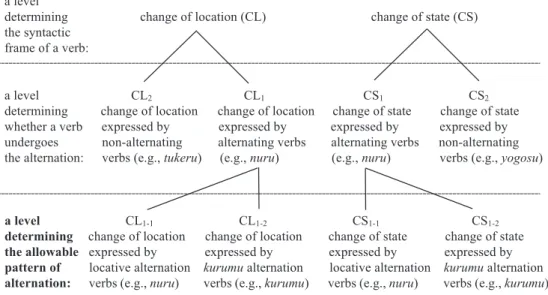
Kawano (2009) argues that this distribution can be captured by positing a much lower level for the semantic verb types and proposes the model shown in Figure 2.
a level
determining change of location (CL) change of state (CS) the syntactic
frame of a verb:
a level CL2 CL1 CS1 CS2
determining change of location change of location change of state change of state whether a verb expressed by expressed by expressed by expressed by undergoes non-alternating alternating verbs alternating verbs non-alternating the alternation: verbs (e.g., tukeru) (e.g., nuru) (e.g., nuru) verbs (e.g., yogosu)
a level CL1-1 CL1-2 CS1-1 CS1-2
determining change of location change of location change of state change of state the allowable expressed by expressed by expressed by expressed by pattern of locative alternation kurumu alternation locative alternation kurumu alternation alternation: verbs (e.g., nuru) verbs (e.g., kurumu) verbs (e.g., nuru) verbs (e.g., kurumu)
Figure 2. Semantic level relevant to alternation pattern choice (Kawano 2009:56, my translation)
Recall that the characteristic of Kawano’s (2009) model is the positing of a hierarchy of semantic verb types. In this model, it is possible to introduce much lower-level semantic types (i.e., CL1-1, CL1-2, CS1-1, and CS1-2) to account for the difference between locative alternation verbs and kurumu alternation verbs.
In other words, this hierarchical model of semantic verb types can identify not only which verbs allow the alternation but also which alternation pattern they take.
Frameworks such as those of Iwata (2008) and Levin (2006), however, are unable to identify the relationship between locative alternation verbs and in-with alternation verbs. Iwata’s (2008) verb-class- specific constructions do not distinguish between locative alternation verbs and in-with alternation verbs as both types have the same syntactic frames (the [V NP spatial PP] frame and the [V NP with NP] frame) and are therefore classified as the same verb-class-specific constructions. That is, Iwata’s (2008) framework, which does not posit a hierarchy of verb-class-specific constructions cannot address the issue of what distinguishes between locative alternation verbs and in-with alternation verbs. Needless to say, Iwata’s (2008) verb-specific constructions likewise cannot distinguish between these types, because the
“verb-specific” meaning level does not identify the common semantic features of the verbs participating in each alternation type.
Although Levin (2006) does not address the in-with alternation, this framework has the same problems as Iwata’s (2008): event structure templates are too abstract to identify the difference between locative alternation verbs and in-with alternation verbs, and the root, the idiosyncratic part of the verb meaning, does not identify the common semantic features of the verbs participating in each alternation type.
As stated above, locative alternation verbs and in-with alternation verbs have the same syntactic behavior in which both allow alternation between the into/onto frame and the with frame, but they differ in alternation pattern. Therefore, to capture this syntactic verb distribution, a hierarchy of semantic verb types is necessary, with a focus on the lower-level semantic types.
7. Summary
This paper has examined whether it is possible within the theoretical frameworks of Pinker (1989), Levin (2006), and Iwata (2008) to predict the possibility of alternation. The conclusions are as follows:
a. The semantic conditions presented in Pinker (1989), Levin (2006), and Iwata (2008) are unable to predict the possibility of alternation as it is not possible to determine whether a given verb satisfies the conditions other than by reference to its acceptability in the two syntactic frames. The semantic levels discussed in these studies (i.e., broad-range rule and narrow-range rule in Pinker 1989, event structure template and root in Levin 2006, and verb-class-specific constructions and verb-specific constructions in Iwata 2008) are unable to distinguish between alternating verbs and non-alternating verbs, and therefore, these are unhelpful in predicting the possibility of alternation.
b. To capture the difference between alternating and non-alternating verbs, another semantic level is necessary, which is lower than Pinker’s (1989) broad-range rule level, Levin’s (2006) event structure template level, or Iwata’s (2008) verb-class-specific construction level (but not the idiosyncratic meaning level). By specifying the difference between alternating and non-alternating verbs on this lower semantic level, it becomes possible to identify the conditions that define alternating verbs without the need to resort to circular reasoning.
c. Introducing lower semantic levels allows for a unified account of the locative alternation and the in- with alternation. That is, this model not only identifies which verbs allow the alternation but also identifies which alternation pattern they follow, which is not possible in the frameworks of Pinker (1989), Levin (2006), and Iwata (2008).
References
Anderson, Stephen. 1971. On the role of deep structure in semantic interpretation. Foundations of Language 7: 387–396.
Baker, Mark C. 1997. Thematic roles and syntactic structure. In Elements of Grammar, ed. Liliane Haegeman, 73–137. Dordrecht: Kluwer.
Beavers, John. 2010. The structure of lexical meaning: Why semantics really matters. Language 86: 821–
864.
Beavers, John. 2017. The spray/load alternation. In The Wiley Blackwell Companion to Syntax, 2nd edition, eds. Martin Everaert and Henk C. van Riemsdijk, 4011–4041. Hoboken, NJ: John Wiley
& Sons.
Boas, Hans C. 2003. Towards a lexical-constructional account of the locative alternation. Proceedings of the 2001 Western Conference on Linguistics, 13, eds. Lesley Carmichael, Chia-Hui Huang, and Vida Samiian, 27–42.
Croft, William. 1998. Event structure in argument linking. In The Projection of Arguments: Lexical and Compositional Factors, eds. Miriam Butt and Wilhelm Geuder, 21–63. Stanford, CA: CSLI Publications.
Croft, William. 2012. Verbs: Aspect and Causal Structure. Oxford: Oxford University Press.
Davis, Anthony. 2001. Linking by Types in the Hierarchical Lexicon. Stanford, CA: CSLI Publications.
Dowty, David. 1991. Thematic proto-roles and argument selection. Language 67: 547–619.
Fillmore, Charles J. 1968. The case for case. In Universals in Linguistic Theory, eds. Emmon Bach and Robert T. Harms, 1–88. New York: Holt, Reinehart and Winston.
Fillmore, Charles J. 1977. The case for case reopened. In Grammatical Relations, eds. Peter Cole and Jerrold M. Sadock, 59–81. New York: Academic Press.
Fraser, Bruce. 1971. A note on the spray paint cases. Linguistic Inquiry 2: 604–607.
Fukui, Naoki, Shigeru Miyagawa and Carol Tenny. 1985. Verb classes in English and Japanese: A case study in the interaction of syntax, morphology and semantics. Lexicon Project Working papers 3.
Cambridge, MA: Center for Cognitive Science, MIT.
Goldberg, Adele. 1995. Constructions: A Construction Grammar Approach to Argument Structure.
Chicago: University of Chicago Press.
Goldberg, Adele. 2006. Constructions at Work: The Nature of Generalization in Language. Oxford:
Oxford University Press.
Gropen, Jess, Steven Pinker, Michelle Hollander, and Richard Goldberg. 1991. Affectedness and direct objects: The role of lexical semantics in the acquisition of verb argument structure. Cognition 41:
153–195.
Iwata, Seizi. 2008. Locative Alternation: A Lexical-Constructional Approach. Amsterdam/ Philadelphia:
John Benjamins Publishing Company.
Jackendoff, Ray. 1990. Semantic Structures. Cambridge, MA: MIT Press.
Jackendoff, Ray. 1996. The proper treatment of measuring out, telicity, and perhaps even quantification in English. Natural Language and Linguistic Theory 14: 305–354.
Jeffries, Lesley and Penny Willis. 1984. A return to the spray paint issue. Journal of Pragmatics 8: 715–
729.
Kawano, Yasuko. 1997. Itihenka doosi to zyootaihenka doosi no setten: Iwayuru kabenuri daikan o tyuusin ni [The relation between change of location verbs and change of state verbs: Based on the spray
paint hypallage]. Tsukuba Nihongo Kenkyuu 2: 28–40.
Kawano, Yasuko. 2006. Gendai nihongo ni okeru itihenka koobun to zyootaihenka koobun no kootai gensyoo: Kakuseibun no taioo no sikata [The alternation between change of location sentences and change of state sentences in Japanese: A system for determining the alternation patterns].
Nihongo no Kenkyu 2–1: 32–47.
Kawano, Yasuko. 2009. Kabenuri daikan o okosu doosi to okosanai doosi: kootai no kahi o ketteisuru imi kaisoo no sonzai [Locative alternation in Japanese: The difference between alternating verbs and non-alternating verbs]. Nihongo no Kenkyu 5–4: 47–61.
Kawano, Yasuko. 2017. “Gurasu kara mizu o akeru” to “gurasu o akeru”: ridatugata kabenuri daikan no bunseki [Gurasu-kara mizu-o akeru ‘empty water from the glass’ and gurasu-o akeru ‘empty the glass’: An analysis of the locative alternation with verbs of removal in Japanese]. Saitama University Review (Faculty of Liberal Arts) 52–2:121–134.
Koenig, Jean-Pierre and Anthony Davis. 2006. The KEY to lexical semantic representations. Journal of Linguistics 42:71–108.
Levin, Beth. 1993. English Verb Classes and Alternations: A Preliminary Investigation. Chicago:
University of Chicago Press.
Levin, Beth. 2006. English object alternations: A unified account. Stanford, CA: Stanford University, unpublished ms. Online: http://www.stanford.edu/~bclevin/pubs.html (last accessed on November 7, 2018).
Levin, Beth and Malka Rappaport Hovav. 1998. Morphology and lexical semantics. In The Handbook of Morphology, eds. Andrew Spencer and Arnold M. Zwicky. 248–271. Oxford: Blackwell Publishers.
Levin, Beth and Malka Rappaport Hovav. 2003. Root and template in the representation of verb meaning.
Stanford, CA: Department of Linguistics, Stanford University, handout. Online:
http://web.stanford.edu/~bclevin/hnd.html (last accessed on November 7, 2018).
Levin, Beth and Malka Rappaport Hovav. 2005. Argument Realization (Research surveys in linguistics series). Cambridge: Cambridge University Press.
Okuda, Yasuo. 1968. O-kaku no meisi to doosi no kumiawase (1) [The collocation between NP-o and verb]. Kyooiku Kokugo 12: 26–40.
Okutsu, Keiichiro. 1981. Idoohenka doosibun: Iwayuru spray paint hypallage nituite [On spray paint hypallage in Japanese]. Kokugogaku 127: 21–33.
Pinker, Steven. 1989. Learnability and Cognition: The Acquisition of Argument Structure. Cambridge, MA: MIT Press.
Rappaport, Malka and Beth Levin. 1988. What to do with theta-roles. In Syntax and Semantics 21:
Thematic Relations, ed. Wendy Wilkins, 7–36. New York: Academic Press.
Rappaport, Hovav, Malka and Beth Levin. 1998. Building verb meanings. In The Projection of Arguments: Lexical and Compositional Factors, eds. Miriam Butt and Wilhelm Geuder, 97–134.
Stanford, CA: CSLI Publications.
Rappaport, Hovav, Malka and Beth Levin. 2010. Reflections on manner/result complementarity. In Lexical Semantics, Syntax, and Event Structure, eds. Malka Rappaport Hovav, Edit Doron, and Ivy Sichel, 21–38. Oxford: Oxford University Press.
Tenny, Carol. 1992. The aspectual interface hypothesis. In Lexical Matters. eds. Ivan A. Sag and Anna Szabolcsi, 1–28. Stanford, CA: CSLI Publications.
Tenny, Carol. 1994. Aspectual Roles and the Syntax-Semantics Interface. Dordrecht: Kluwer Academic Publishers.
Van Valin, Robert D., Jr. 2004. Semantic macroroles in role and reference grammar. In Semantische Rollen, eds. Rolf Kailuweit and Martin Hummel, 62–82. Tübingen: Gunter Marr Verlag Tübingen.
Van Valin, Robert D., Jr. 2007. The role and reference grammar analysis of three-place predicates.
Suvremena Lingvistika 63: 31–63.
Acknowledgements: This work was supported by JSPS (Japan Society for the Promotion of Science) KAKENHI Grant-in-Aid for Young Scientists (B) Grant Number 23720231, Grant-in-Aid for Scientific Research (C) Grant Numbers 26370527, 18K00605.