24
・Article・
How "Disparity" Constructs
"Solidarity": A Case
Study of an Organization
for Women's Participatory
Development
Program in Rural Uttar Pradesh
Misako Kanno
1. Introduction
Introduction of WID/GAD approaches1 into the development programs aimed at betterment of women's lives and gender relations, in India and elsewhere in the world, has changed the position of women in the paradigm of development from mere "targets" to active "agents". Women are deemed to be capable transformers, at least potentially, who naturally formulate solidarity based on sisterhood. Thus, the most important strategy of development programs is to encourage women to participate at various stages.
Basic notions behind the participatory approaches to women's development programs mentioned above are that women are marginalized in the hierarchical gender regime as a whole (vertical position), and that they share common interests, sentiments, as well as the will to unite with each other (horizontal position). As a result, women's solidarity and sisterhood are stressed to promote their position in the gender hierarchy [Sen and Grown 1988; Rowlands 1997; Benmayor and Torruellas 1997; Mathur 2004].2
However, it is also obvious that women are not equal in various spheres in most societies, especially in North India where I conducted this research. Women are actually divided and stratified not only by caste, class, age, educational qualifications, etc. but also by individual ability to articulate their will and negotiate in given settings. In addition to this reality, the
菅 野 美 佐 子 Misako Kanno
Author: The Graduate University for Advanced Studies, School of Cultural and Social Studies. Subject: Comparative Studies
Article: "Struggle for the Elimination of Violence against Women in Rural Uttar Pradesh",Journa of Asian Women's Studies, Vol.14, 2005. pp.37-43.
development organizations themselves have hierarchical structures: headquarters, program officers, workers, and so on. Therefore, women's sisterhood has gradually been perceived as a problematic concept which disguises the difference immanent in each individual woman and confines several problems into a single category of "female issues" [Mohanty 2003: 168; Richards 2004].3
If so, how do participatory approaches promoted by hierarchical organizations that stress solidarity and sisterhood among women, who are not equal in many senses, function? How is "we-ness" as women internalized by women belonging to different positions in the programs? And how do women change their self-image, self-representation and relative positions in society through experiences with women's solidarity and sisterhood stressed by those programs?
In short, the perspective of hierarchy among women should be included to understand the real meaning of participatory approaches. This article tries to examine these questions, based on the results of a field survey conducted in the Mahila Samakhya program in Uttar Pradesh. As Wright [1994: 6] points out, not only management of the organization but also its members' activities can affect the structure of the organization. In Mahila Samakhya, as well as other organizations that Wright focuses on, it is probable that women create several informal rules besides the existing formal rules in the organization. Further, it should also be presumed that the informal rules involve hierarchical aspects based on caste and class prevalent in North Indian society. It is in these informal rules that I attempt to capture the real drives of women's participation in the program.
Therefore, while focusing on the everyday activities of programs implemented by Mahila Samakhya, I will analyze the process of negotiation in the context of power-relations among members based on the concepts of "disparity" and "solidarity". The concept of "solidarity" will be used in this study to explain women's strong connections based on a single identity as members of Mahila Samakhya who face the same hardship and share the same resolve. On the contrary, I apply the concept of "disparity" to explain cases which do not simply involve different or antagonist relations, but contain power, authority and thus hierarchy. These two aspects are seemingly immanent in the collective as one set, though they contain a sense of contradiction. It is assumed in this article that using these concepts will be useful to unveil how women with different backgrounds form a collective within the program.
2. Profile of Mahila Samakhya
2.1 Outline of Mahila Samakhya
Mahila Samakhya (hereafter referred to as MS), an organization engaged in the improvement of the status and living conditions of women in rural India, was established in 1989 in three states including Uttar Pradesh, Karnataka and Gujarat. The budget of the MS program is funded by the Indian government, international organizations including the World Bank, UNDP, and several enterprises from all over the country [Mahila Samakhya,
26 Journal of the Japanese Association for South Asian Studies, 18, 2006
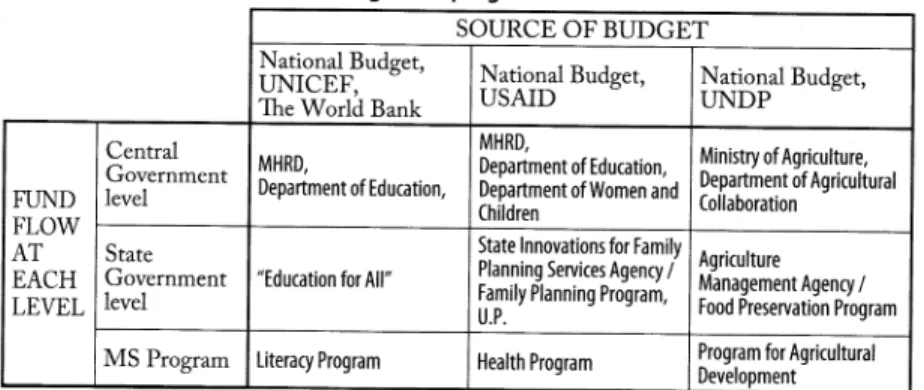
Uttar Pradesh 2002]. The budget basically flows from the Ministry of Human Resource Development (MHRD) to the State Office of MS . However, as Table 1 shows, each program receives additional funds from a variety of international aid organizations through different departments of MHRD. The program implemented by MS was initially designed toward "Education for Women's Equality" under the National Policy of Education enforced in 1986. Currently, the programs are being implemented in 15,800 villages of more than 60 districts in nine states.' In Uttar Pradesh (hereafter referred to as U.P.), 43,440 women of 2,765 villages in 12 districts participate in the programs5 and as indicated in Table 2, women are involved in several programs provided by MS.
Table 1 Source and Flow of Funding to MS programs
[Source] Annual Report of Mahila Samakhya U.P. (2001)
Table 2 Achievement of MS Program in U.P.*1
[Source] Website of the Department of Elementary Education and Literacy, The Government of India (http://www.education.nic.in/ms/ms.asp).
Although the MS program is involved with the national policy of social welfare for women and children, it is not totally embedded in the administrative system. This program has promoted decentralization of social welfare, grass-roots approach to rural poverty and egalitarianism among its members. These efforts are usually conducted by NGOs to construct equal relationships among those who are engaged in its programs while enforcing horizontal interrelations among them. Hence, some scholars consider the MS program as a "quasi-governmental" or "non-governmental" program [Kapadia 2002: 16; Townsend, Porter and Mawdsley 2004: 881]. In this sense, MS holds a dual characteristic as a bureaucracy in terms of financial system, and as a NGO in terms of program ideology.
2.2 The Structure of Mahila Samakhya
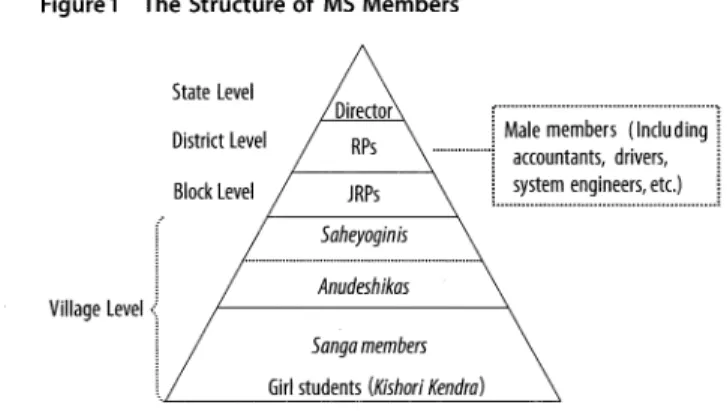
The program has a structure divided into four levels or sections in which members are allocated as shown in Figure 1. At the village level, female members are organized in groups, called mahila sangha under the supervision of saheyoginis, the field workers employed by MS. They are introduced as mediums between rural women and the program decision makers. Anudeshikhas are also employed at the village level, as teachers who manage schools
for adolescent girls aged between twelve and eighteen. Saheyoginis and anudeshikas are
supervised by a Junior Resource Person (hereafter referred to as JRP) at the block level, a Resource Person (hereafter referred to as RP) at the district level and a Director who represents MS at the state level. All members except drivers, cooks, accountants, system engineers and agricultural experts, consist of women. As shown in Figure 1, the structure of the MS program is a pyramidal hierarchy which clearly shows an administrative character.
In order to work for MS as anudeshikas or saheyoginis, a completion of approximately the 10th grade is a prerequisite. Accordingly, a bachelor's degree is necessary for the JRP and RP positions. Accepted workers are requested to take a training program at the district
28 Journal of the Japanese Association for South Asian Studies, 18, 2006
office thereafter and they constantly have to attend training programs a few times every year. The salary for anudeshikas by fiscal year of 2003 was Rs.1000, Rs.1500 for saheyoginis, Rs.4500 for JRPs and Rs.5800 for RPs.6
MS is engaged in several programs including literacy education, agriculture, health and sanitation, political participation, girls' education and savings. The activities of the groups at the village level are basically meetings organized by MS a few times every month.
Saheyoginis arrange and supervise the meetings of approximately ten villages visiting
each village by rotation. They also convey information regarding hygiene, health care, agricultural technology, and children's education to group members. They record what they discuss during the meetings and report it to the other saheyoginis, the JRPs and to the RP at the time of block level or district level meetings, which are held once every month.
Another important meeting is called maha sangha, which means "great meeting" in Hindi, held monthly by representatives of sanghas from 20 villages so that they are able to exchange information and ideas regarding their programs. The agenda of maha sangha is also reported to the State Office. Meetings are organized at the State level as well, where the RPs and JRPs from every district exchange information and ideas. MS regularly organizes events called meld, at the district or state level; in which group members enjoy recreational activities such as games, puppet shows, songs, etc. while gaining knowledge regarding gender issues. As a result, by organizing frequent meetings and events at each level, MS has built a thoroughgoing network.
3. Profile of the Region
Maharam district7 is located in the eastern part of U.P. and abutted on the border between U.P. and Bihar. The railway connects the central city of the district to main cities in other districts such as Delhi and Kolkata. I have conducted a nineteen-month fieldwork from January 2003 to August 2004, in Sahipur village8 of Nagarawa block.9
This district has an approximate population of 1.64 million and 90% of the population resides in rural areas. Regarding the religious distribution, 88% of the population is Hindu, 11% is Muslim and the other minor religions such as Buddhism, Christian and Jain account for less than 1% [Jagran Research Centre 2003]. The language spoken in this area is called Bhojipuri which is considered to be one of many dialects derived from Hindi.
Eastern U.P. including Maharam district is afflicted by frequent natural disasters such as droughts and floods, and its economy is acutely backward due to lack of natural resources. In addition, social welfare of the state government does not reach sufficiently to the local people [Jeffery 2001]. Accordingly, the school attendance rate in this district is low, and
as a result, the literacy rate is 43% for females and 56% for males [Jagran Research Centre 2003].
The composition of castes in this area is complicated and there has been a considerable
caste structure and both have possessed hereditary land-ownership.' The other land owning castes in the area are Yadays (or Ahirs)12 and Kurmis.13
Bind is another major caste particular to this region, belonging to a lower caste. "Bind" is considered to be a dialect for "Mallahs" which represents the fishermen or boatmen caste, though most of them are currently engaged in agriculture or labor work. In addition, there are many other jatis belonging to the lower stratum of the caste hierarchy such as Kumhars (potters), Telis (oil pressers), and Harwais (sweet makers).14
The scheduled castes are mainly represented by Chamars (tanners), Dhobis (washermen) and Pasis (agriculturists). While many Dhobis are still occupied in the laundry business, the livelihood of Chamars and Pasis is based on agricultural labor in the village area and wage labor in construction of pavements, house-maids, and sweepers in the towns and cities.
In the rural areas, caste restriction, for example, social prohibitions of commensality, physical contact and inter-caste marriage are still observed.15 Because of these hierarchical characteristics embedded in the society, people have learned how to adjust themselves to inter-caste relationships with the appropriate behavior or attitude. Furthermore, there is a tendency for women to remain more within the caste-linked prescriptions than men do.16 Hence, it is presumed that this hierarchical structure of the society under study influences the relationship among MS members.
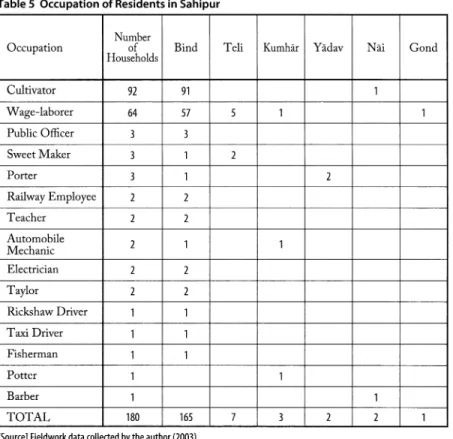
Sahipur is a small-sized village with approximately one thousand inhabitants located one kilometer away from the MS office of Nagarawa block. The following seven jatis are found in Sahipur: Bind, Kumhar (potter), Tell., Yadav, Baniya (trader and businessmen),
Gond (bean roaster), and Nai (barber), however more than 90% of the entire households in the village are Bind.17
While few villagers earn their own livelihood, for example, the railway officers, teachers, service engineers, or tailors, the majority is engaged in agriculture mainly producing rice and wheat as tenant farmers working in farms owned by Brahmins and Thakurs dwelling in adjacent villages, or as petty farmers managing farmland of less than an acre." The rest, and those who cannot get sufficient income as farmers and have to compensate for deficiency in living expenses, earn by working as porters of vegetables in markets or as builders of brick houses.19
Although the route for the public primary school is accessible from the village (one kilometer away from the village), only a small number of children attend school everyday. The level of school attendance of women is extremely low and female literacy rate is approximately 36% according to a household survey conducted in 2003, which falls far short of the rate in Maharam district.
There is no hospital near the village and only a Primary Health Center (PHC) is located near the primary school. However, villagers rarely go there even though they frequently have health problems. It is particularly serious for pregnant women who often suffer from anemia and gestosis due to overwork and undernourishment.
30 Journal of the Japanese Association for South Asian Studies, 18, 2006
One of the reasons why women in Sahipur do not go to PHCs or hospitals is that they are not accustomed to going outside their own villages and thus, they rarely go to the market, temple or even to hospitals.20 The other reason is that women are responsible for many chores including childrearing, cultivating, taking care of domestic animals etc., and are too busy to take care of themselves. At the time of seeding and harvest, women whose male family members work as wage-laborers, usually work for land-owners and get rice and wheat as salaries. These tasks are a heavy burden for them.
Regarding local politics, the village coalesces with seven neighboring villages and forms a single Gram Sabha where one of the members of the Gaon Panchayat in Sahipur, who is a Bind woman, represented the Pradhan of Gram Sabha at the time I was in fieldwork. In this region, people belonging to lower and the lowest caste such as Bind, Yadav and Chamars are the majority and thus, they have obtained more political power. In fact, U.P. has been known for its strong connection with political parties and certain caste groups. In particular, the Bahujan Samaj Party (BSP) has acquired great support from the lowest caste groups such as Chamars, and the Samajwadi Party (SP) which represents the lower castes, especially the group of Yadav, has also gained great support. BSP had led the state government for two years from 2002 to 2003 and SP has taken office thereafter. Although, there was unrest among MS members during the change of government, the program has been expanding without being affected by the political situation. The most likely reason for this is that the program was established by the initiatives of the national government and international aid organization and thus, the program has retained autonomy from the state government.21
Participants consist of women of lower and lower-middle classes at the most, though the MS program does not focus on a particular caste or class. It is assumed that women of upper caste or class do not participate in the program because of socio-cultural restriction mentioned above. In Nagarawa block, the program was implemented in 40 villages in 2003 and expanded to 80 villages in 2004.22 In Sahipur, MS has organized a sangha consisting of thirteen members,23 and initiated programs of literacy class, micro-credit, introduction of manure making from cow dung, drain construction around wells and hand pumps, and girls' primary school called "Kishori Kendra".
At the beginning, despite the MS workers' great effort to mobilize the villagers to participate in the programs, a lack of understanding and fatalism due to their underprivileged condition made them rather indifferent to the possibility of better circumstances and thus to MS programs. In addition, confidence could not be built up and suspicion by villagers regarding the program remained. Sangha had been repeatedly dissolved since the initiation of the program in 2000 due to the absence of members in the regular meetings and activities. When I was engaged in fieldwork in 2003, the program eventually operated on a regular basis in the village and attitude toward the MS program gradually improved.
4. Place for the Practice of Hierarchy
As I described in Section 2, the MS program forms a pyramidal structure stratified from rural group members at the bottom up to the Director of the State Office at the top level. However, this hierarchical structure contradicts the egalitarian ideology of the program, and thus Mahila Samakhya has made an effort to overcome this contradiction by emphasizing an equal relationship between the workers at different positions and sangha members. In The Feminist Training: Precepts and Practice, one of the publications of Mahila Samakhya, some aspects regarding the equality among workers and group members are described as follows:
A training environment which facilitates experiences of mutuality and reciprocity also demands that all the women involved in the learning process interact as equals. In MS training, there is seldom any separation between women at different levels in the structure, and Consultants and Resource Persons from district teams join sahayogini training as participants, not observers. Everyone works, eats and sleeps together-there are no special arrangements for trainers or for "senior" people. The pyramid of hierarchies built into the structure of the program-rank, location in the structure, financial and decision making power-have been circumvented and neutralized in this way, perhaps because they are always visible and silently acknowledged as"givens"[Bhaiya & Menon-Sen 1996 : 33].
In spite of the efforts by MS, however, it has been observed that the hierarchical aspect of the structure is emphasized by its members through daily activities. To analyze the situation, in this section, I will focus on (1) terms of address that can indicate how they identify each other, and (2) the persons who preside at the meetings and how workers and sangha members are located within the meeting place. In order to investigate these points, I will analyze their narratives and behavior during the meetings and interviews. These analyses will illustrate the process of how MS has built its own system and how workers and sangha members have formed a hierarchy through the programs. Finally, I will also show how women exercise power and how other members negotiate power inside the hierarchical structure of the program.
4.1 Terms of Address Shaping Hierarchical Relationships
Terms of address can be one of the most useful criteria for understanding the relationship between two people. At MS, for example, sangha members call female workers didi which means "elder sister".24 The same term is used when a worker of a lower position calls another of a higher position. Didi is widely used for women in a superior position at the workplace, for seniors at school, and for elders within the family, relatives or neighbors. The term didi connotes not only respect but also closeness between those who use this term and those
32 Journal of the Japanese Association for South Asian Studies, 18, 2006
who are called by this term.
MS program determines the use of this terminology and thus, at the time of joining the program, MS members are trained to use the term didi, so that it is possible to construct a sisterhood among the workers and sangha members.
Another term of address is baben-ji which is also used for female elders and superiors in the region. The term is used in two contexts. First, it is used for unknown women in a public place, for instance, vendors call shoppers bahen-ji at the marketplace; or when addressing a respectable woman such as a teacher. In this context, the term is used in a formal way, and hence, emphasizes more respect but less closeness than didi.
In another context, this term connotes pleasantry or rather amusement and less a degree of respect. For example, I observed that a mother sometimes calls her daughter bahen-ji when she tries to coax her to do something (e.g. cooking or finishing her homework). This term is also used among female friends when teasing each other. Among MS workers, for instance, I found that some of them called their elder colleagues bahen-ji in a humorous sense to express exaggerated respect for them. However, if MS workers use bahen-ji towards someone in a higher position (e.g. JRPs or RPs) in the same way, it might be perceived as an insult, lack of confidence and a lesser degree of closeness. Hence, the term bahen-ji is not used in this sense unless there is great trust between those who employ the term and those who are referred to by that term.
As described above, although the meanings of didi and bahen-ji are relatively similar since both indicate elder or superior women, they are used in different contexts. MS workers and sangha members use the term of didi for a woman in a higher position than them regardless of their age or caste. Sangha members also call workers didi, and the term is very common among MS members apart from a few exceptions. For instance, when students at the girls' education program usually call their teacher bahen-ji, the age gap between students and teachers, as well as her position, is considered, and thus, they use the term of bahen-ji rather than didi, to show respect for their teachers.
Another exception is that non-member village women call the workers bahen-ji to express their respect to them when they visit the village. Moreover, workers at the time of meld, call female guests belonging to the group of activists, top-level officers or scholars by the term of madaem' (referring to the English term "madam"), so that they can show their greatest respect towards them.
As for male workers in MS, such as accountants, drivers and computer engineers, they are not clearly located inside the hierarchical structure of the program. They use madaem, bahen-ji or just add ji after the name, towards their superiors, especially in the case of JRPs and RPs, instead of didi. In eastern U.P., it is rare that adult men use didi to address or refer to their female elders or superiors except for their relatives, and therefore, it is considered that the use of the term is relatively limited to women and children.
Although the MS intends to construct a sisterhood among workers and sangba members by using the term didi, the relationship between those who use the term didi and those
who are referred to as such is not always the ideal form of sisterhood that MS attempts to achieve. In the following case study, I demonstrate that some saheyoginis have a sense of grievance about the use of didi and the hierarchical relationship among workers. Case 1:
The RP is a 27 year-old 25 Kshatriya woman who has completed a master's degree. She has just got married and has a small baby. One day, some saheyoginis and anudeshikas were chatting at the block office of Mahila Samakhya. When I asked one of them, "What are you talking about?" an anudeshika told me, "RP has recently become overbearing and she behaves arrogantly", and threw her head back pretending to be haughty. Other anudeshikas
and saheyoginis laughed watching her. They thought that the JRP, 37-year-old Brahmin
woman was more reliable and appropriate for the position of RP. The JRP, listening to what the anudeshikas and saheyoginis were talking about said, "I could be a RP if I had applied for the job at Mahila Samakhya a little earlier. She speaks English better than I do, but the reason I became a JRP was just because I was too late to contact the MS Office."
Saheyoginis and anudeshikas use didi when addressing the RP and JRP. They also put
didi after the name of JRP, both in front of her and in her absence, whereas they call the RP only by her name without including didi when they talk about her in her absence.
Most saheyoginis and anudeshikas of average age of 35-40, belonging to the Brahmin
and Thdkur castes, unhappily accepted the young RP whose caste was the same or lower than their own and who was not mature as a wife and mother. It can be assumed that the attitude of the RP was seen by the workers as arrogant and impudent. On the contrary, there was another case which showed how some saheyoginis who were elder, more active and reliable than the others, or who had longer experience, more knowledge and information regarding the program were called didi as a sign of respect by the rest.
What can be understood from these cases mentioned above is that the vertical interrelations constructed through terms of address are not necessarily sisterhood-like-relationships and that hierarchical sisterhood-like-relationships can also be built between the members who are supposed to have a horizontal relationship. It is obviously subject to their age, class, caste, length of experience, quantity of knowledge, and even to their personality; and moreover, MS members thereby determine whom to call didi beyond the official position within the program.
Meanwhile, how are sangha women called by the workers? MS workers call sangha members sakhi which means "female friend" in Hindi, though they do not refer to workers in inferior positions as sakhis. The MS publication reports that only anudeshikas who are in lower positions than saheyoginis are called "saheli" which also means "female friend" in Hindi. Sangha members in the same village usually call each other by their names, but when sangha members from different villages are assembled at the block or district office or meld, they sometimes address as didi or sakhi the sangha members from other villages whose
34 Journal of the Japanese Association for South Asian Studies, 18, 2006
names are not known. Sakhi has an equal and friendlier connotation, while didi shows their respect towards the person whom they are addressing. Hence, in this case, as in the case of MS workers, sangha members are also likely to decide how they call each member-didi, sakhi, or by her name-in relation to her age, how much knowledge and experience they have, and how active they are in the organization.
Furthermore, the personal pronoun to address the second person corresponding to the English term "you" is rather complicated. In Hindi, there are three kinds of designation for the term used for the second person. In the polite manner, the term used is ap, then there is turn which is used in a friendlier manner, and finally to which is used by a superior addressing an inferior in an excessively confident manner. Accordingly, the last one is used in relations of great intimacy.
In the particular case of Bhojipuri however, there is no distinction between these three designations. The common term corresponding to "you" is toh regardless of inferiority or
superiority. Those who have had school education including saheyoginis and anudeshikas
understand the difference in Hindi terms for the second person. They sometimes use tum and ap during the meetings and sangha women have gradually acquired the usage of turn and ap. The introduction of Hindi terms for the second person into their activities has promoted superior-inferior relationships between those who use the term didi and those who are addressed as such.
In this section, I have focused on the term of address exemplified in a case study, since calling others is a repetitive action, which may prescribe, for the women, how to recognize themselves and differentiate themselves from others. Usage and repetition of terminology emphasize position, and once women participate in the program, they are compelled to be involved in the hierarchical relationships within the program structure. These hierarchical relationships are due to the program structure, and are affected by external factors such as caste, class, the level of education, and age. Furthermore, it is necessary to mention that they also call other members in an inappropriate way, which does not follow the rule of the program, from sense of grievance (as seen in Case 1) or sense of respect.
In short, through the analyses of terminology used within the program, it has been shown that the systematic hierarchy has been modified and new layers have been added among workers and members in relation to the amount of experience and knowledge they have or how active they are. In other words, the participants call others didi according not only to their position, but factors inherent among members, and this also decides the position of each member in the hierarchical relations.
In addition, the relationship constructed through the usage of terms of address is reinforced by other activities of the program. In the following section, I will focus on the roles the members are responsible for and the spatial layout of each member during the activities. From these points of view, I will discuss how the roles and layout within the programs reflect and affect the relationship among members.
4.2 Roles and Layout within Activities
In this section, I will discuss how roles and layout determined by vocational position of each member configure the relationship among them within the hierarchical structure. In order to understand this issue, I will especially focus on maha sangha, a block level monthly meeting in which representatives from each sangha group, all saheyoginis and anudeshikas of the block, and the JRP gather and discuss gender issues and programs. The proceeding of a meeting described below is an example of a maha sangha held on June 6th, 2004, which depicts a typical meeting at the block level.
1. Singing in chorus
2. Taking a record of attendance
3. Speech by JRP or saheyogini regarding the purpose of the meeting 4. Lecture and discussion about child rearing, health, and hygiene
5. News of other groups and villages regarding gender issues (DV, education, family planning, etc.)
6. Information regarding programs (law study class, herbal medicine program, nari adalat (a trial program for women), dai (midwifery) training etc...)
Maha sangha usually starts from 11:00 A.M.26 in a small Hindu temple near the block office. The meeting starts by singing songs composed by the MS workers.27 The participants are divided into two groups, one group singing a phrase first and the other repeating it afterwards. Anudashikas mainly take the responsibility for this; they compose the songs and also lead the participants while singing louder than others.
The meeting is presided over by a JRP and saheyoginis provide assistance. When the JRP is absent or turns up late, saheyoginis lead the meeting until the JRP comes. After the arrival
Figure 2 Seating Arrangments in a Meeting (Maha Sangha)
Figure 3 Seating Arrangments in a Meeting (Sangha Meeting)
36 Journal of the Japanese Association for South Asian Studies, 18, 2006
of the JRP, however, the role of the organizer is shifted to her immediately. Furthermore, if a RP who attends maha sangha meetings once every 2-3 times is present, then she takes over the role from JRP. In addition, village level meetings are presided by a saheyogini who covers villages under her charge and sometimes with anudeshikas as well.
Meanwhile, the attitudes of sangba members who participate in the meeting are varied; some of them listen attentively while workers make a speech or actively speak up, some chat with others sitting nearby, some are looking on while sitting a short distance away, and
some come and go several times during the meeting in order to do household chores. Figures 2, 3 and 4 demonstrate some patterns that I have observed and recorded where members sit during the meetings.' Those who sit at the center are usually workers, for instance, the JRP and the RP; saheyoginis and anudeshikas sit around the JRP and the RP, and finally sangha women sit near the latter. At the village level, members usually gather at a meeting room of a panchdyat hall, Hindu temples, or in a house of one of the members and sit on a mat on which saheyoginis and anudeshikas occupy the middle area. They frequently use charpai 29 when they gather at a member's house. Saheyoginis and anudeshikas sit on a charpai, as Figure 4.1 shows, and sangha members sit on a mat spread on the ground (at the feet of the charpai).
Workers sometimes refuse to sit on a charpai because they have been told to sit on the same place as the sangha members. This is meant to construct an equal relationship between workers and sangha members. When workers visit villages, however, sangha members usually offer charpai to them in a persistent way. The workers at first seem to pretend as if they sit on it reluctantly because of the sangha members' insistence though they are not willing to do so.
I have also observed the differences in sitting positions among sangha members. It is indicated on Figure 4.2, that sangha members who are more actively engaged in the
(1) A meeting conducted by several MS workers.
(2) A meeting conducted by a single MS worker.
program than other members, sit near a saheyogini (on a charpai). Besides the meetings, I have observed that sangha members and MS workers sit in separate places when meals are provided for them at a meld or training program. Sangha members eat food while squatting down on the ground or floor, which is the general manner of eating in this region. On the contrary, workers usually use chairs, and as far as I have observed, they never squat down next to sangha members when a chair is not available, and if that is the case, they eat standing up and hold the plate with the left hand or eat apart from the sangha members.
These analyses of the members' positions inside the spaces where activities are held cannot be directly connected to the formation of hierarchical relationships. It is taken for granted that those who preside over the meeting or organize and supervise the program are located centrally so that they are able to work effectively. The important point, however, is the fact that the position is determined and recognized by each member by sitting at the
center or the peripheral, and at a higher or lower place.
In the case of positioning, as well as the usage of term discussed in the previous section, active sangha members build a new hierarchical structure by sitting next to the workers on a chdrpdi and by taking on more responsibility than the other members. Interestingly, this happened even after MS ostensibly emphasized equality among members by sharing a common space. That is, they somehow divide the space of meetings and activities, which is apparently shared by the members and workers. Moreover, the position of each member is reaffirmed by playing roles imposed on each member by the program through mundane activities. This positional identity can also be considered as corresponding to the identity of power relations between those who use the term didi and those who are addressed as such.
5. "Disparity" and "Solidarity" among Members in the
Hierarchical Relationship
The MS program promotes egalitarian relationship among members by using certain terms of address and sharing time and space with other members. Nonetheless, it is likely that the hierarchical relationship and disparity among members in different positions have rather become prominent through the practice of program activities. It is a fact, however, that the MS members are collectively engaged in many activities against the so called "
patriarchal society", in order to obtain women's rights and urge transformation into an egalitarian society. How then can those women nurture solidarity among members and work collectively beyond differences in age, class, caste and various motivations for participation in the programs? What is the connection among those members whose backgrounds are different? In this section, I will argue in what way solidarity between
38 Journal of the Japanese Association for South Asian Studies, 18, 2006
5.1 Sharing the Discourse of Mahila Samakhya
MS makes effort to promote the feeling of solidarity among its members with different backgrounds, as a strategy to unite them into a strong body that will transform conventional society into that which is more open to women. Thus, to realize this, the aim has been to raise the awareness of rural women through education from the very beginning. Regarding this matter, Feminist Training states as follows:
Feminist training is rooted in feminist ideology and politics, which are based on recognizing the structural causes of women's subordination, subjugation, oppression and exploitation, and by "naming" this system of patriarchy. The objective is not merely to ensure women's involvement as actors in the process of learning, but to identify, locate and name the material and ideological factors responsible for women's subjugation and thereby to initiate transformative changes in their lives [Bhaiya &Menon-Sen 1996: 12]....In our practice of feminist training, there is a conscious effort to down the stereotype of women as passive victims, and counter the tendency to emphasize women's oppression to such an extent that it ignores women's strength, agency, resourcefulness and courage... [Bhaiya & Menon-Sen 1996: 14].
In short, one of their goals is to increase knowledge and raise awareness of members, through meetings and training, so that they are able to realize how women have been oppressed and how the society is far from being gender equal. The publication quoted above is published in English and accordingly, it is concerned that the ideology of the MS program was shaped by intellectuals, who are concerned with feminist ways of thinking, and policy makers belonging to the top of the hierarchical structure.
Actually, men's drinking, gambling, fighting, abuse, domestic violence etc. were usually picked up and shared by members as the main issues at the meetings. In this way, the program draws the attention of members to gender issues such as patriarchy and inequality, with the purpose offorming a single direction towards MS goals of women's empowerment through encouragement of strength (takat) and bravery (himmat) against patriarchal society. This is the main strategy of the MS program and as a result, the awareness and knowledge regarding gender issues have gradually spread within the members.
In fact, all of the six informants I interviewed, including saheyoginis and the JRP answered "yes" to the following question: "Has there been any change since you started working for Mahila Samakhya?" The most common answer was "I have come to be independent and am able to go out of the house" (B, C, F, G30), or "I have come to be able to talk with men" (C.D.E.F). The important point here is not the literal meaning of the answers that explains how women have been changing through the participation in the program, but how those women have learnt and internalized the discourse of Mahila
Case 2: A narrative of JRP (B)
As I started to work for Mahila Samakhya, I have obtained a lot of information. I have also met many people and realized various problems I didn't know about before I started to work. Since inside-the-house is a limited world (simit darya), you can't get enough information...In addition, I have become stronger (takat) since I began to work here. Now, I can argue with anyone without hesitation. I have fired up my enthusiasm. I have obtained power. It (MS program) is mine, it gives me power. If every one gets together, we can do what we cannot do when we are alone. We can even change the world.
[December 14th, 2003. At a block office] Case 3: A narrative of saheyogini (C)
I had never ridden a bicycle before. I had never thought I would ride a bicycle. But I do now I had never thought I would go outside. But I do now. Before, I was scared of men, such as a police man. I talk with them now if necessary. So, there are many changes. If I stayed at home quietly, then I couldn't do anything like this.
[December 15th, 2003. At a block office]
These narratives of two workers show the most typical kind of discourse of the Mahila Samakhya which emphasizes the achievement of strength and bravery to change "gender biased society". The tendencies in these narratives were more or less similar to those of other workers I interviewed. For instance, "I have obtained a lot of information", "I have met many people and realized various problems I didn't know before" and "I have become stronger since I began to work here" expressed in the narrative of JRP(B) are similar to those of saheyogini (C), (E), and (F). In addition, "I came to be able to do what I couldn't do before"
in the narrative of saheyogini (C) is also very common among the other workers and even
among sangha members. I realize that since I was an interviewer coming from a different background, that is to say, someone who had come alone from abroad and visited the program in order to conduct field work, the women tried to answer my questions according to the discourse of Mahila Samakhya to try to respond to my possible expectations. If this was indeed what they did, this fact itself is evidence that they have unconsciously acquired and accepted the discourse of Mahila Samakhya
The next case is a narrative of a sangha member who is currently a mother of five children. She lives with her children, husband, mother-in-law, brother-in-law and his family. She has taken the responsibility of making herbal medicines at Sanjvani Kendra (Herbal Medicine Center). She visits the block office a few times a week and makes medicines with selected members from other villages and with saheyoginis. Since she has gained the trust of saheyoginis through frequent participation in activities and has become a group leader, other sangha members have started to rely on her.
40 Journal of the Japanese Association for South Asian Studies, 18, 2006
Case 4: A Narrative of a Sangha member
My life has changed greatly. (Through attending the literacy program) I have come to read and write and talk with men outside. I don't only stay at home. I go outside. I also go to meetings.... I couldn't speak in front of so many people before. Since Mahila Samakhya came to our village, I have gradually been able to do so. When there was a dispute (ihagda) between men from the village who gambled and MS members, we talked with them. Though they said, "We will make problems for you", I answered, "Try, if you can. We will also show you our strength (takat)." Then, they were scared. After that, gambling never happened again.
[February 10th, 2004. At a block office]
It can be understood from the narrative that not only workers but also sangha members share and use discourses typical to Mahila Samakhya. In the narrative of the sangha member, she expressed a great pleasure about being able to know how to read and write, go outside and talk to male villagers. In addition, she implied how women should be brave and strong so that they can fight with village men over habits such as gambling. The other sangha members in the village, as well as the interviewee, insisted how gambling, drinking and using abusive words to others are vicious habits, and how MS member should approach and get rid of such behavior of the male villagers.
Hence, from the narratives of these informants belonging to different positions, it can
be said that MS members including workers and sangha members share the same discourse.
The members have internalized the ideas and manners of speaking which make them "an authentic member of Mahila Samakhya" and this can be considered a kind of tie or bonding which connects different individuals with the program.
This discourse is shared not only at an intellectual level but also at a practical level. The JRP (B)'s comment illustrated above: "If every one gets together, we can do what we cannot
do when we are alone" is realized in some activities of MS program.
As part of the MS programs, there is an informal trial course for village women with problems such as domestic violence and dowry harassment by their family members, relatives, or neighbors. This activity is called "Nari Adalat" (i.e. the women's court). Once information regarding problems mentioned above is conveyed to MS office, the members go to villages to discuss with the perpetrators, on behalf of them. Whenever they arrange a trial, several saheyoginis and sangha members from different villages participate in it. If an agreement from both sides is reached, they write down the agreed points and all the participants including sangha members sign their names or put thumb marks on it.
Usually MS workers talk to men or family members of the woman who has a problem with her husband or in-laws. Sangha members sit around them, usually at the side of MS workers (opposite side of the perpetrators) and they occasionally voice their opinion. Many sangha members participate in the court so that they are able to overpower the perpetrators in superior numbers and the saheyoginis who speak to them feel a sense of security.
Nonetheless, sangha members' comments interrupting the trial sometimes make the argument more complicated or out of focus due to their lack of ability to speak logically, even though their attendance is substantially supportive for MS workers. If their comments disturb the trial, MS workers ask them not to speak. As I observed, sangha members sometimes seemed to feel frustrated because they could not say what they wanted to say.
Taking account of the case of Nari Adalat, it can be considered that both disparity and solidarity are implicit in the relationship between MS workers and sangha members. On the one hand, they emphasize a sense of solidarity among them as they have the occasion to confront the perpetrators. In this situation, it is not difficult to promote solidarity. On the other hand, a difference is created between MS workers who "can" speak logically, some active sangha members who "can" state their opinion but "cannot" speak in a logical way, and the rest of the members who are less active and "cannot" express their opinion. Even though some sangha members can speak logically, they cannot fully express their opinion because they are not saheyoginis or because they are not authorized to do so. These differences in their ability to express themselves ("can" or "cannot") may be seen as a beginning of disparity which might become a cause of formation of hierarchy. In this sense, it can be said that the concept of solidarity and disparity are not totally opposite but closely related to each other. In other words, it can be considered that disparity and solidarity seem to be adopted according to the situation as in the case of Nari Adalat, with the purpose of reaching the aims stated in the discourse.
In summary, as long as the women share the ideology or purpose of the program at the level of discourse, they can connect with each other as a member of MS. However, once the discourse is realized by some members, a disparity can be produced between those who "can" realize what is said in the discourse and those who "cannot". The significance
of the disparity formed in this context is different from the one argued in many other studies that connote power relations represented by the concepts of "dominance" and "subordination". This is because the disparity in this case also composes a factor of the women's empowerment since they are able to do what they could not do before. Thus it can be regarded as a factor that makes them feel a sense of pleasure or satisfaction. Accordingly, it can be concluded that disparity is one of the causes which attracts MS members to the program and creates solidarity between sangha members and MS programs.
5.2 Interrelationship of Dependence: "Relying" and "Caring"
Another important point is the interaction between members. In the previous section, I argued how the discourse of Mahila Samakhya helps this. However, in this section, I would like to focus on the formation of interdependency between people who "rely" on others for care, and those who do the "caring", as this might show how the interaction of each member promotes solidarity. In this case, the former is a sangha member, and the latter is a worker who does the caring. The relationship between them also corresponds to the relationship between those who use the term didi for others and those who are called didi by others.
42 Journal of the Japanese Association for South Asian Studies, 18, 2006
A question may arise, "How can it be said that a relationship of interdependency exists between the two groups, when what can be perceived is a unidirectional sense of dependence?" The answer is that the women who take care of those who rely on them can also gain some positive effects, such as sense of confidence, honor and satisfaction, and hence it is not a one-way-dependency. In the following section, I will focus on the didi's point of view and consider the process of interdependency by analyzing their narratives.
The following is a transcription of an interview with one saheyogini. Case 5: Narrative of Saheyogini (F)
[Q: What are they (sangha members) planning to do in the future?]
They say, "Give me more knowledge didi so that we can do our own job without you (we can be independent)."
[Q: What is their opinion of you?]
They might think I am good. They think I am good. The number of villages (in which the program is being deployed) has been increasing in recent years. So, women of the old villages think, "Please come to our village too, didi. Don't stop coming." I try to go to those villages sometimes, but the curriculum changes frequently. I don't have time and therefore I can't go. But they keep saying, "Didi, please continue visiting us. We have to improve our activities." They even force me to go to their villages.
[December 16th, 2003. At a block office]
It seems that Saheyogini (F) feels that she has attained great trust from the sangha members. It is not easy to confirm whether such a strong trust of the sangha members towards the saheyogini, as she spoke in the interview, is real or not. It cannot be denied that
sangha members have a sense of respect and trust toward saheyoginis, but their purpose
of attending the program and reliance on the workers is mainly to gain the benefit of improving their impoverished lives rather than constructing reliability with the workers.
Hence, there may be a discrepancy between expectations and feelings that sangha members
have toward saheyoginis and how saheyoginis interpret the feelings and expectations of sangha members.
The following narrative of JRP (B) indicates how she conceived the dependence of sangha members in a very different way.
Case 6: A narrative of JRP (B)
I really don't have time nowadays. Now, the program has been expanded from 40 villages to 80 villages...but (in a village where the program is initiated for the first time) there are many problems over land. Even this morning, one lady came to our office. Everybody thinks that I am able to solve any problem but actually I can't.
Although I keep on repeating the same indications to the members, nothing really has changed. There is no meaning unless there is an indication of improvement, but they think
that they don't have to do anything except ask for help because Mahila Samakhya will do something for their benefit.... If something happens they instantly come to me. They think didi can manage any problem. As soon as I woke up early this morning, a village woman was already waiting for me. I don't have time for myself. Village women don't change by themselves. I sometimes think that I should quit this job and start something else so that I can always stay at home.
[August, 2004. At a block office.]
In this narrative, the JRP expresses her annoyance with the over-dependency of village women and their tenacious manner of pursuing benefits. In short, the point is not whether sangha members actually have respect or confidence toward MS workers, but how the workers understand the members' attitude. Regardless of the attitude or affection of sangha members toward Saheyogini (F), she thought that sangha members trust in her, and she had improved her confidence and prestige thereby. Thus she gained a reason for achieving a positive feeling about herself. Among the six informants I interviewed, five of them said that sangha members trust them and have amiable feelings towards them. JRP (B), who complained of over-dependency of sangha members in Case 6, also answered in the interview that she was pleased to help poor rural women.
In this sense, it can be concluded that there is a certain consistency which involves what can be referred to as "a community of interest" that satisfies both sangha members and MS workers. That is, sangha members are able to achieve economic benefits and probably a sense of security based on feelings that workers will do something for them on the one hand; and workers obtain a positive sense of honor and confidence on the other. Such relationships cannot be formed unless asymmetries based on a hierarchical structure exist between their positions. More precisely, it may be said that solidarity through "care" can be formed only by emphasizing disparity among members.
In many studies, particularly in women's studies, asymmetrical relationship within hierarchical structure (not only among men and women, but also regarding class, race and caste) has been deemed as an object of criticism. This is because it was presumed that those disparities have been the cause of oppression against people located at the bottom of a hierarchy. This study, however, evidently shows that a hierarchical structure is maintained by those who are located in the lower strata of the system in order to obtain benefits. 6. Conclusion
This article attempted to describe how hierarchical relationships are formed among women in participatory development programs.
In India, several organizations aiming at women's empowerment including MS have a tendency to nurture pseudo-sisters' affections and friendship, which can also be referred to as "sisterhood", while negating the strata or hierarchy existing inside the organization.
44 Journal of the Japanese Association for South Asian Studies, 18, 2006
On the other hand, it is a fact that these organizations cannot avoid managing themselves in a systematic way, which may accentuate a top-down and hence vertical structure. This has become a cause of contradiction or dilemma between an organization's ideology and its functions.
The background of the situation where these dilemmas or contradictions have been conceived to be problematic can be related to the discourses hitherto argued in the studies for WID and GAD. In the major argument over WID/GAD so far, "disparity" and "hi
erarchy" have seemingly been deemed as vicious factors which foil women's solidarity and equality that direct the movement toward a gender equal society and women's empowerment. Moreover, as seen in the criticism of western feminism by Mohanty [2003: 22], it has been perceived by western feminists as though disparity was a result of the situation in which poor women in the third world are too weak due to ignorance, lack of education, being tradition-bound etc. to overcome the difficult conditions in their lives.
Contrary to these arguments, women in the MS program show a more comfortable relationship inside the hierarchical structure, which they use to their advantage depending on the situation. In other words, women in the lower position intentionally reinforce the hierarchical relationship to obtain benefits for their own interests, while those who are in higher position of the program attempt to eliminate disparities and hierarchical relationship among members. Thus, the main contribution of this case study has been to propose an alternative perspective as an antithesis of the argument represented in WID and GAD studies. That is, this article reconsiders the meaning of "disparity" hitherto argued by western scholars from the perspective of local people by anthropological analyses and deconstructs the mechanism of women's collective structure and the process of their empowerment.
Finally, disparity and hierarchy formed inside women's groups, which this article has focused on and analyzed, are still arguable when applied to the wider context of WID and GAD. Hence, this article has tried rather to indicate the significance of reconsidering discourses and concepts prevailing in WID and GAD studies from the perspective of a particular group of people and local society. It hopes that by thus recasting the argument regarding development and welfare programs for women in the Third World, a more subtle discussion will be possible. Further effort, however, will be required to connect these arguments to more practical affairs.
Acknowledgements
The present article has been supported by generous financial support from The Japan Foundation and The Matsushita International Foundation. The conclusion of this paper would not have been possible without the valuable suggestions of the following people: Prof. Fumiko Oshikawa, Prof. Masakazu Tanaka, and Prof. Akira Adachi. My sincere appreciation to Dr. Ranjana Sheel, Dr. Brij Tankha, and Dr. Patricia Uberoi, for their
useful comments and support while I was in India. Finally, I would like to thank everyone at Mahila Samakhya who kindly allowed me to complete my research.
Notes
1) The concept of WID (Women in Development) and GAD (Gender and Development) was conceived in the 1980s with the purpose of involving women in the field of
develop-ment, since the idea that they should be one of the main actors has become common. Since the concept was declared, participation of women has become a main strategy in the para-digm of development [Moser 1993: 2-3].
2) For instance, Benmayor and Torruellas have pointed out the importance of establishing solidarity, while gaining common identity and defining a common set of interests that binds subordinated group of people together in collective action for cultural citizenship
[1997: 189].
3) Regarding women's diversity, Mohanty [2003: 168] has pointed out how western feminists have described Third World working women as if they have struggled with common prob-lems and looked for common interests while ignoring their working environments. Rich-ards [2004: 97] has also argued that the motivation of participation is complex and diverse while activists of women's movements use the same terminology (participation).
4) It includes Uttaranchal, Bihar, Uttar Pradesh, Jharkhand, Gujarat, Kerala, Karnataka, Assam and Andra Pradesh.
5) The data is based on the website of Department of Elementary Education and Literacy, Government of India (http://www.education.nic.in/ms/ms.asp).
6) 1 rupee was equivalent to 2.6 yen (January, 2006).
7) Maharam is a pseudonym to protect the privacy of MS members. 8) Sahipur is a pseudonym to protect the privacy of MS members. 9) Nagarawa is a pseudonym to protect the privacy of MS members.
10) This caste is also referred to as Rajput which is considered to be a Kshatriya in the varna system.
11) In addition to Brahmin and Thakur, Baniya. (trader and commerce) and Kayastha (scribes) are dominant castes. Members of all these caste groups have occupied prominent positions in the educational and political life of the state.
12) Cattle-raising is their hereditary occupation but most of them are settled cultivators. Al-though they are assigned as Other Backward Classes enacted by the Indian government so that they receive certain preferential treatment in terms of education and occupation, they have been given political power in the states. Samajiwadi party, the most powerful party of U.P. is largely supported by Yadav communities and the chief of the party has been the State Minister of U.P. since May 2004.
13) Most of the Kurmis are peasants growing vegetables and other special cash crops rather than rice and wheat.
46 Journal of the Japanese Association for South Asian Studies, 18, 2006
15) Caste restriction based on the rank ofjati in the local hierarchy has been discussed since 1950, mainly related to the concept of purity and impurity [Srinivas 1996: ix].
16) According to Dube, women are more particular about commensal restrictions, and tend to be more circumscribed in taking proscribed foods or accepting food from other castes. This is because men go out to towns for the sake of employment and mix with all kinds of people in their daily lives, while women are confined to the domestic domain where they rarely have contact with people from other castes [Dube 1996: 5-7].
17) See Table 3.
18) See Table 4.
19) See Table 5.
20) However, I frequently observed in my fieldwork that many women go to their natal vil-lage few times a year for the purpose of attending marriages and Hindu festivals. 21) Although, as far as I observed, there is no strong connection between MS programs and
these political parties, they occasionally organize programs in collaboration with com-munist NGOs and some members of the Comcom-munist Party of India (Marxist: CPI). Since
Table 3 Caste Composition of Sahipur Village
[Source] Fieldwork data collected by the author (2003).
Table 4 Size of Cultivated Land and Number of Households in Sahipur
MS in other states such as Karnataka also invites CPI to several events, it is assumed that MS has some connections with leftist organizations.
22) Currently (in 2006), the program is implemented in 110 villages in Nagarawa block. One of the main reasons is that MS programs have shown good performance by making a lot of effort and have thus established trust for their reliability, while many NGOs and public groups have obscured the reality of their performance.
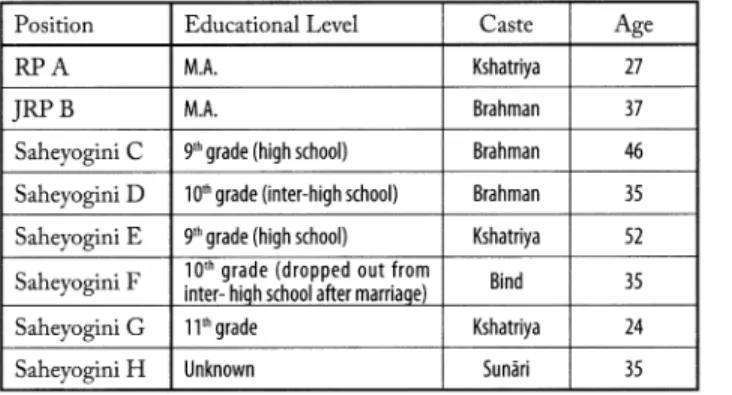
23) See Table 6.
24) I distinguish the usage of the term of address (didi) from the kinship terminology (bahen-li).
25) As of 2003.
26) Maha sangha meetings, however, usually start half-hour or one-and-half-hour later than the scheduled time since sangha members do not come to the meetings punctually. I par-ticipated in maha sangha ten times, but none of the meetings started on time.
Table 5 Occupation of Residents in Sahipur
[Source] Fieldwork data collected by the author (2003).
48 Journal of the Japanese Association for South Asian Studies, 18, 2006
27) In this region, women play a main role as composers and singers in the long rites of mar-riage or at the birth of a boy. Therefore, Mahila Samakhya has decided to sing songs before a meeting starts. These songs are related to women's issues (e.g. Tod tod ke bandban ko dekho bahaney ati hain [women are coming to destroy social boundaries]).
28) The layout described in Figure 2, 3, 4 was observed by me in June 2004.
29) An Indian string cot which means "four props" in Hindi. It is quite common for villagers in the region to use this cot.
Table 6 Caste, Educational level and Age of MS workers at Nagarawa Block
[Source] Fieldwork data collected by the author (2003).
Table 7 Characteristics of the Informants
[Source] Fieldwork data collected by the author (2003).
*I interviewed sangha members and workers
, regarding their life histories from their childhood, their future plan, and their idea and opinion about Mahila Samakhya. I also interviewed MS members regarding their marriage or their son's marriage from the wedding day until present time, as well as their opinion about Mahila Samakhya.
30) Capital letters correspond to persons interviewed as indicated in Table 7.
31) These cases are taken from the interviews I conducted in my own fieldwork. The cases are transcripts of tape recordings I collected and translated into English. The details of all informants I have interviewed are shown in Table 7.
References
Arce, Albert, and Long, Norland, 2000, "Reconfiguring Modernity and Development from an Anthropological Perspective", in Albert Arce and Norland Long (eds.), Anthropology, Development and Modernities: Exploring Discourses, Counter-tendencies and Violence, London:
Routledge, pp. 1-31.
Batliwala, S., 1994, "The Meaning of Women's Empowerment: New Concepts Form Action", in G. Sen, A. Germain and L. C. Chen (eds.), Population Policies Reconsidered: Health, Empow-erment and Rights, Boston: Harvard University Press, pp. 127-138.
Seitz, Virginia. R., 1995, Women, Development and Communities for Empowerment in Appalachia, New York: State University of New York.
Benmayor, Rina, and Torruellas, Rosa, 1997, "Education, Cultural Rights and Citizenship", in Cathy J. Cohen, Kathleen B. Jones, and Joan C. Tronto (eds.), Women Transforming Politics: An Alternative Reader, New York: New York University Press, pp. 187-204.
Beyer, J., and Trice, H., 1989, "The Communication of Power Relations in Organizations Through Cultural Rites", in Michael Owen Jones, Michael Dane Moor and Richard Chris-topher Snyder (eds.), Inside Organizations: Understanding the Human Dimension, Newbury Park: Sage Publications, pp. 141-157.
Bhaiya, Abha and Menon-Sen, Kalyani, 1996, Feminist Training: Precepts and Practice, Luc-know: Mahila Samakhya.
Dube, Leela, 1996, "Caste and Women", in M.N. Srinivas (ed.), Caste: Its Twentieth Century Avatar, New Delhi: Viking, pp.1-27.
Gandhi, Nandita, and Shah, Nandita, 1999, "Organizations and Autonomy", in Nivedita Me-non (ed.), Gender and Politics in India, New Delhi: Oxford University Press, pp. 299-341. Jagran Research Centre 2003, Uttaranchal and Uttar Pradesh: At a Glance 2003, Kanpur: Jagran
Research Centre.
Jeffery, Roger, 2001, "Uttar Pradesh: Into the Twenty-first Century", in Roger Jeffery and Jens Lerche (eds.), Social and Political Change in Uttar Pradesh, Delhi: Manohar, pp. 17-53. Kapadia, Karin, 2002, "Introduction: The Politics of Identity, Social Inequalities and Economic
Growth", in Karin Kapadia (ed.), The Violence of Development: The Politics of Identity, Gender and Social Inequalities in India, New Delhi: Kali for Women, pp.1-40.
Mahila Samakhya, Uttar Pradesh, 2002, Strong Choices: Annual Report 2001-2002, Lucknow: Mahila Samakhya, Uttar Pradesh.
Marsden, David, 1994, "Indigenous Management and the Management of Indigenous", in Su-san Wright (ed.), Anthropology of Organizations, London: Routledge, pp.41-54.
50 Journal of the Japanese Association for South Asian Studies, 18, 2006
Mathur, Kanchan, 2004, Countering Gender Violence: Initiatives Towards Collective Action in Ra-jasthan, New Delhi: Sage Publication.
Mohanty, C. Talpade, 2003, Feminism without Borders: Decolonizing Theory, Practicing Solidarity, Durham: Duke University Press.
Moser, O.N. Caroline, 1993, Gender Planning and Development: Theory, Practice and Training, London: Routledge.
Mosse, D., 1998, "Process-Oriented Approaches to Development Practice and Social Research", in David Moose, John Farrington and Alan Rew (eds.), Development as Process: Concepts and Methods for Working with Complexity, London: Routledge, pp. 3-30.
Newman, Katherine, 1980, "Bureaucratic Scholarship: The Development of Hierarchies in Egalitarian Organizations", in Gerald, M. Britan and Ronald Cohen (eds.), Hierarchy and Society: Anthropological Perspective on Bureaucracy, Philadelphia: Institute for the Study of Human Issues, pp. 143-164
Noorjahan, B., 1997, "Introduction", in Noorjahan Bava (ed.), Non-Governmental Organisations in Development: Theory and Practice, New Delhi: Kanishka Publishers, pp. 3-20.
Richards, Patricia, 2004, Pobaladoras Indigenas and the State: Conflicts Over Women's Rights in Chile, New Jersey: Rutger University Press.
Sen, G., and Grown, C., 1988, Development, Crises and Alternative Visions: Third World Women's Perspectives, New York: Monthly Review Press.
Sen, Ilina, 1999, "Feminists, Women's Movement", in Nivedita Menon (ed.), Gender and Politics in India, New Delhi: Oxford University Press, pp. 370-380.
Srinivas, M.N., 1996, "Introduction", in M.N. Srinivas (ed.), Caste: Its Twentieth Century Avatar, New Delhi: Viking, pp. ix-xxxivvv.
Townsend, G. Janet, Porter, Gina, and Mawdsley, Emma, 2004, "Creating Spaces of Resistance: Development NGOs and Their Clients in Ghana, India and Mexico", Antipode 36, Nov. 2004, pp.871-889.
Wright, Susan 1994, "Culture in Anthropology and Organizational Studies", in Susan Wright (ed.), Anthropology of Organizations, London: Routledge, pp. 1-31.