Japan Advanced Institute of Science and Technology
JAIST Repository
https://dspace.jaist.ac.jp/
Title 三元触媒作用のためのハイスループット実験の設計
Author(s) TRAN, PHUONG NHAT THUY Citation
Issue Date 2020‑09
Type Thesis or Dissertation Text version ETD
URL http://hdl.handle.net/10119/17005 Rights
Description Supervisor:谷池 俊明, 先端科学技術研究科, 博士
Design of High-Throughput Experiments for Three-Way Catalysis
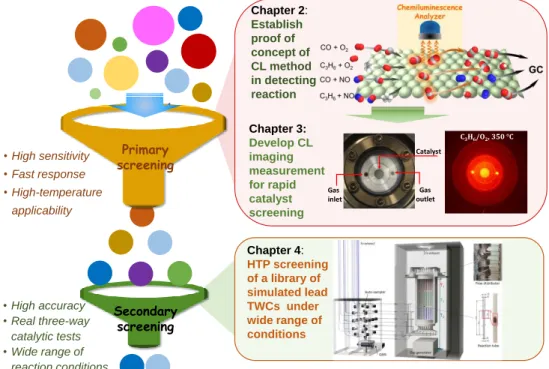
Tran Phuong Nhat Thuy 1720416 To meet the increasingly stringent legislation for the gasoline engine exhaust emission, the exhaust aftertreatment systems need a breakthrough in the research and development of three-way catalysts (TWCs). While the catalysis society has made enormous efforts focusing on materials aspects for seeking the best or novel catalyst formulations, the development in methodology aspects, especially high-throughput (HTP) approaches, has just emerged to hold a great promise in that regard. Even though HTP catalyst screening techniques have become a mature and well-established tools in many catalytic systems, their applications in the TWCs have been hardly reported due to both technical and material constraints. The diversity and complexity of the catalytic system and reaction conditions necessitate a primary screening technique to quickly and broadly screen a huge parametric space. This catalytic system also requires highly accurate screening tools to distinguish the activity in a one-digit difference, signifying the essential of implementing secondary screening with higher precision. Therefore, the aim of this thesis is to design an integrated HTP screening protocol for the development of the TWCs.
The upstream of the hierarchical HTP workflow is the primary catalyst screening, which typically requires a fast and non-intrusive technique being capable of truly parallelized screening, preferably based on an optical method. For that, a novel chemiluminescence (CL) method was developed with special emphasis on high- temperature gaseous catalysis. In Chapter 2, the proof of concept of the CL method was formulated by thoroughly studying the CL behavior of the catalytic oxidation of CO and C3H6 by of O2 and/or NO, which are the major processes in a catalytic converter, under both stoichiometric and non-stoichiometric conditions. In this stage, a CL instrument was developed based on the cooperation among a gas mixer, a custom- made CL analyzer using a photonmultiplier as a detector, and an on-line gas chromatography (GC) for simultaneous analysis of the effluent mixture from the CL reactor. The CL activity of these oxidation reactions was confirmed by temperature- ramping measurements, where the CL intensity showed an exponential behavior against the temperature irrespective of catalysts. Steady-state measurements demonstrated a linear relationship between the CL intensity and reactions rate regardless of stoichiometry, thus the CL intensity is a good measure of the reaction rate. The capability of the CL method in rapid catalyst screening was confirmed by a good linear correspondence between the CL intensity and the catalytic activity in C3H6 oxidation by O2 for a series of Rh-based catalysts In Chapter 3, a CL imaging instrument was designed for achieving primary screening of the TWCs. The CL imaging instrument was equipped a reactor cell for gaseous catalysis and electron multiplying charged- coupled device camera for single photon detection in the form of images. The CL imaging technique exhibited the feasibility of a simple, straightforward, and rapid evaluation of catalytic activity based on a good correlation between the CL intensity and the C3H6 conversion. In addition, the one-to-one correspondence of the CL intensity obtained from the single and parallel measurement signified the great potential of the CL imaging technique in HTP catalyst screening. Chapter 4 describes the HTP secondary screening of a simulated lead TWCs library based on a HTP screening instrument featured with fully-automated catalytic evaluation of 20 reactor channels in a wide range of conditions with the aid of a quadruple mass spectrometer. The
instrument allowed generation of a large process-relevant dataset at high accuracy, which is satisfactory for the secondary screening. Three-way catalytic reactions were conducted in 49 conditions over 20 catalyst samples, affording 980 data points in one operation. The obtained dataset is of high quality and accuracy, and the catalyst performance (in terms of light-off temperature and width of stoichiometric window) were found consistent with literature data. The reaction conditions cover a wide range of temperature and air/fuel equivalence ratio , allowing the multi-aspect comparison of the TWCs.
Figure 1. The developed high-throughput approach for three-way catalyst.
Keywords: Three-way catalysts, high-throughput catalyst screening, chemiluminescence imaging, high-throughput screening instruments, multi-aspect comparison.
Primary screening
Secondary screening
Chapter 2:
Establish proof of concept of CL method in detecting reaction
Chapter 3:
Develop CL imaging measurement for rapid catalyst screening
Chapter 4:
HTP screening of a library of simulated lead TWCs under wide range of conditions
•High accuracy
•Real three-way catalytic tests
•Wide range of reaction conditions
•High sensitivity
•Fast response
•High-temperature applicability
Gas inlet
Gas outlet Catalyst
C3H6/O2, 350 °C