平成 26 年度電気関係学会四国支部連合大会 講演論文集 (2014 徳島大学)
2014 SHIKOKU-SECTION JOINT CONVENTION RECORD OF THE INSTITUTES OF ELECTRICAL AND RELATED ENGINEERS (TOKUSHIMA)
Investigation of Oscillation Frequencies of Two Coupled Chaotic Circuits
Misa SEKIMOTO
1Toshiaki NISHIUMI
1Yoko UWATE
1Yoshifumi NISHIO
1( Tokushima University
1)
1. Introduction
The synchronization is observed as not only natural phenomena but also in various fields. There are a lot of methods to confirm synchronization phenomena. Change of frequency when synchronization state is changed from asynchronous into synchronous has not been investigated so far. In this study, we investigate oscillation frequencies of two coupled chaotic circuits.
2. Circuit model
Figure 1 shows the circuit model. This circuit model uses two Nishio-Inaba circuits. Each circuit is connected by a resistor.
-r1
L12 L11
C1
v1
vd1 i11 i12
-r2
L22
L21 C2
v2
vd2
i21 i22 R
Figure 1: Circuit model.
We can derive the following normalized equations:
dx
idτ = α
ix
i+ z
idy
idτ = β
iz
i− 1
2 |σ
iy
i+ β
i| − |σ
iy
i− β
i| dz
1dτ = γ
1(z
2− z
1) − x
1− y
1dz
2dτ = γ
2(z
1− z
2) − x
2− y
2(1)
(i = 1, 2).
For this simulation, we set the parameters as α
1= 0.40, α
2= 0.43, β
1= β
2= 3.0 and γ
1= γ
2= 470.0, and choose the coupling strength σ = σ
1= σ
2as a control parameter.
3. Simulation results
We carry out computer simulations by changeing σ.
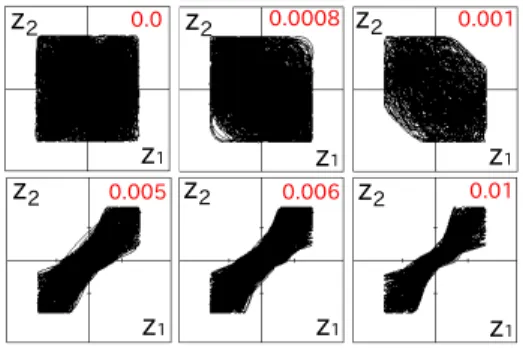
First, phase difference for the coupling strength are shown in Fig. 2. The synchronization state changes from asyn- chronous into synchronous when we increase the coupling strength σ. Second, we measure average value of rota- tional frequency when the solution of chaotic attractor goes around the origin in the phase space. These frequen- cies are shown in Table 1. F
lis defined as the average frequency of the left circuit. F
ris defined as the average frequency of the right circuit. Finally, we investigate oscil- lation frequencies of two coupled chaotic circuits. Figure 3 shows comparison of the average frequencies.
As the simulation results, the frequency become closer to a value as synchronization state becomes synchronous.
z
1z
2 0.0008z
2z
1 0.001z
2z
1z
2z
1z
1z
2 0.01z
1x
0.006 0.005