INVITED PAPER
Special Section on Award-winning PapersAccent Sandhi Estimation of Tokyo Dialect of Japanese Using Conditional Random Fields
Masayuki SUZUKI†∗a),Member, Ryo KUROIWA†∗∗b), Keisuke INNAMI†∗∗∗c), Shumpei KOBAYASHI†∗∗∗∗d), Shinya SHIMIZU†∗∗∗∗∗e),Nonmembers, Nobuaki MINEMATSU†f),Senior Member, andKeikichi HIROSE†g),Fellow
SUMMARY When synthesizing speech from Japanese text, correct as- signment of accent nuclei for input text with arbitrary contents is indis- pensable in obtaining naturally-sounding synthetic speech. A phenomenon called accent sandhi occurs in utterances of Japanese; when a word is uttered in a sentence, its accent nucleus may change depending on the contexts of preceding/succeeding words. This paper describes a statisti- cal method for automatically predicting the accent nucleus changes due to accent sandhi. First, as the basis of the research, a database of Japanese text was constructed with labels of accent phrase boundaries and accent nucleus positions when uttered in sentences. A single native speaker of To- kyo dialect Japanese annotated all the labels for 6,344 Japanese sentences.
Then, using this database, a conditional-random-field-based method was developed using this database to predict accent phrase boundaries and ac- cent nuclei. The proposed method predicted accent nucleus positions for accent phrases with 94.66% accuracy, clearly surpassing the 87.48% ac- curacy obtained using our rule-based method. A listening experiment was also conducted on synthetic speech obtained using the proposed method and that obtained using the rule-based method. The results show that our method significantly improved the naturalness of synthetic speech.
key words: Japanese text-to-speech, accent sandhi, accent phrase bound- ary estimation, accent type estimation, conditional random field
1. Introduction
Japanese text-to-speech (TTS) systems need to estimate not only phonetic symbols but also accent information from text as pre-processing[1]. TTS systems then generate speech waves given the phonetic symbols and accent information shown in Fig. 1. Because errors of accents degrade the nat- uralness of outputted speech, accent information from text needs to be correctly estimated.
Japanese words have their own accent nucleus posi- tion as one of their lexical attributes. However, its posi- tions often shift when the words are read in sentences due
Manuscript received October 31, 2016.
Manuscript publicized December 8, 2016.
†The authors are with The University of Tokyo, Tokyo, 113–
8656 Japan.
∗Presently, with IBM Research - Tokyo.
∗∗Presently, with NTT DATA Corporation.
∗∗∗Presently, with Fujitsu Limited.
∗∗∗∗Presently, with Nomura Research Institute, Ltd.
∗∗∗∗∗Presently, with AgIC Inc.
a) E-mail: [email protected] b) E-mail: [email protected] c) E-mail: [email protected] d) E-mail: [email protected] e) E-mail: [email protected]
f) E-mail: [email protected] g) E-mail: [email protected]
DOI: 10.1587/transinf.2016AWI0004
to a phenomenon called accent sandhi. Figure 2 shows an example of accent sandhi of Tokyo dialect. The Japanese words for “Tokyo” and “university” have their own accent nucleus positions as their lexical attribute. The nucleus po- sitions are changed when they are combined in a sentence as
“The University of Tokyo” like it is in Fig. 2. Native speak- ers of Japanese unconsciously and correctly estimate accent sandhi. Nevertheless, making clear and perfect rules for ac- cent sandhi is almost impossible.
Our objective is to build a high-quality system for es- timating accent sandhi for Tokyo dialect of Japanese to im- prove the naturalness of TTS. We first built a database of 6,334 sentences that were labeled with accent phrase bound- aries and an accent nucleus position of each accent phrase in sentences. Then, we then developed a conditional ran- dom fields (CRF) based system to estimate accent informa- tion from sentences. The proposed system achieved 94.66%
accuracy, which is a 57% relative improvement from our rule-based baseline system. We also found that our method significantly improves the naturalness of speech synthesis.
2. Definition of Accent of Tokyo Dialect
Japanese has pitch accent at the mora level. A mora is a unit in phonology, an it generally corresponds to a Japanese Hi- ragana characters except Youon. An accent phrase is com- posed of some morphemes. Accent sandhi occur within the accent phrase. In other words, accent sandhi never occur across the boundaries of accent phrase. As for Tokyo di-
Fig. 1 Flowchart of Japanese Text-To-Speech (TTS).
Fig. 2 Example of Japanese accent sandhi.
Copyright c2017 The Institute of Electronics, Information and Communication Engineers
alect, an accent phrase has at most one mora, the next mora of which has a clearly lower pitch. We call the mora the
“nucleus”. With the accent nucleus position, we can define accent types for accent phrases using natural numbers; when Nth mora is an accent nucleus, we define it as accent typeN.
If accent phrases do not have any accent nucleus, we define it as accent type 0. In addition to the pitch drop at the accent nucleus, rapid pitch rising occurs from the first mora to the second mora except accent type 1.
These definitions are not perfect definitions to explain all the accent phenomena concerning Tokyo dialect. But we use these definitions for convenience. With the defini- tion, the estimation of accent sandhi can be divided into two tasks: (1) a task to estimate accent phrase boundaries from morpheme sequences and (2) a task to estimate accent types for accent phrases.
3. Rule-Based Approach
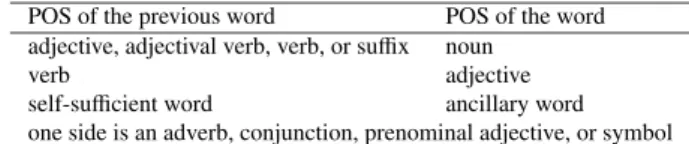
3.1 Rule-Based Accent Phrase Boundary Estimation A rule-based method to estimate accent phrase bound- aries from morpheme sequences is implemented in Open JTalk[2]. Open JTalk version 1.05 uses the rules in Table 1.
The rules only depend on the part-of-speech (POS) of mor- phemes.
3.2 Rule-Based Accent Type Estimation
Sagisuka’s rule, which is well known, estimates accent types from accent phrases[3]. The rule first annotates all the mor- phemes with accent modification types. Using the accent modification types, POS, and position of accent nucleus for isolated words, Sagisaka’s rule estimates the accent types for accent phrases. For example, the accent phrase of “The Univeristy of Tokyo”, which consists of Japanese two words
“Tokyo/Noun” and “University/Noun/accent mode C2”, applies a rule “For two adjacent nouns, if the accent mode of latter nouns is C2, accent nucleus is on the first mora of the latter word”. This rule brings the correct accent type 5, as shown in Fig. 2.
Other rules are often applied for numeral expressions because Sagisuka’s rule does not handle such expressions.
For example, Miyazaki’s rule is often used[4]. In Open JTalk 1.05, Sagisuka’s rule and their own rules for numeral expressions are implemented.
However, the rule-based approach is not perfect be- cause many exceptions exist. Our group tried to improve
Table 1 Conditions to find accent phrase boundaries used in Open JTalk version 1.05. If these conditions are matched, the rule based system detects accent phrase boundaries.
POS of the previous word POS of the word adjective, adjectival verb, verb, or suffix noun
verb adjective
self-sufficient word ancillary word
one side is an adverb, conjunction, prenominal adjective, or symbol
these rules, but could not achieve substantial improve- ment[5],[6].
4. Database
A Japanese text database with accent labels in sentences was not available, although some papers reported machine learn- ing based systems for accent estimation outperformed rule- based systems[7]–[10]. Thus, we built a publicly available database[11],[12]. Our sentence-level accent database in- cludes 6,334 sentences used in the JNAS corpus. We did morphological analysis with UniDic for the sentences, and manually modified errors of pronunciation estimation. Next, we labeled accent phrase boundaries and an accent nucleus position for each accent phrase in sentences.
The database has high consistency. Because the accent varies depending on dialects, individuals, and reading speed, we selected only one labeler who grew up in Tokyo and had an excellent sense of relative pitch. We got her to read sen- tences with a speed of 7 mora per seconds, which is widely accepted as a speed for TTS. Another person who grew up in Tokyo checked her accent labels to ensure no errors were made.
The database is available for people who have a license for JNAS or S-JNAS[13],[14]. Readers interested in using the database should contact the authors.
5. Accent Sandhi Estimation with CRF
5.1 Estimation of Accent Phrase Boundaries with CRF We formulated a task to estimate accent phrase boundaries as binary label sequence estimation for morphology se- quences, where the labels represents whether or not accent phrase boundaries are just before the morphology.
We use CRF with features in Table 2 to estimate the bi- nary label sequence[16]. The most import feature template is POS, which is also used for rule-based estimation. Some attributes of morphemes labeled in UniDic were also used as feature templates.
Estimating accent phrase boundaries is especially dif- ficult for adjacent nouns. For example, see Fig. 3. If we can use POS information only, we cannot estimate this kind of boundary correctly. To deal with this problem, we intro- ducedn-gram frequency based scores as features for CRF.
Fig. 3 Accent boundary estimation for three adjacent morphemes: To- kyo, university, and faculuty-of-engineering.|represents an accent phrase boundary. Even though all the POSs are nouns, a correct boundary and an incorrect boundary were evident.
Table 2 Feature templates for CRF-based accent phrase boundary estimation. See[15]for the defini- tion of the features. We used these features of five adjacent words (from two before to two words after) if available. We digitalized numerical numbers into 1, 2, 3, 4, and, 5 by quantiles forjtom.
Index Feature templates
a POS
b Pairs of lemma, pronBase, and cType
c cType
d cForm
e goshu
f iType
g aType
h aModType
i Binary label whether Bunsetsu boundary is estimated before the word j Bigram frequency
k jdivided by unigram frequency of the previous word l jdivided by unigram frequency of the word
m jdivided by unigram frequency both of the previous word and the word
Table 3 Definitions of labels for accent relative change.
Label definisions
Vanish the isolated word has a nucleus, but the nucleus vanished in the sentence Remain the isolated word has a nucleus, and the nucleus remained in the sentence
Never the isolated word is 0 type, and the word in the sentence also does not have a nucleus Before the isolated word has a nucleus, and the nucleus moved to one mora before the sentence Last The last mora of the word in the sentence is an accent nucleus
First The first mora of the word in the sentence is an accent nucleus Penultimate The second last mora of the word in the sentence is an accent nucleus
After the accent nucleus moved to the mora just after from the accent nucleus position of the isolated words Second the accent nucleus moved to the second mora after from the accent nucleus position of the isolated words Third the accent nucleus moved to the third mora after from the accent nucleus position of the isolated words
These scores are expected to be effective because accent boundaries do not tend to appear as boundaries between two words that often appear continuously.
We did further feature engineering. Our implementa- tion provides more details[26].
5.2 Estimation of Accent Nucleus Positions with CRF We formulated the task to estimate accent nucleus positions as a “label for accent relative change” in sequence estima- tion for the morphology sequence of accent phrases. The labels for accent relative change are defined as Table 3.
These definitions did not apply to the morphology in a few cases. In usch cases, we simply removed the data from the training data or added “Fourth” label, “Fifth” label, and so on. For the training phase, if a word accent nucleus posi- tion met multiple conditions of these definitions, the former label was applied. For the testing phase, after estimating the labels for accent for each morphemes in an accent phrase, we saw the labels from left to right and regarded the first accent nucleus as the accent nucleus for the accent phrase.
With this rule, estimating labels for accent relative change for morphemes in accent phrases enables estimating accent nucleus positions.
We used CRF for modeling with features in Table 4.
POS, accent type of isolated words, the number of mora, and accent modification type, which are used for rule-based sys- tems, are also used as feature templates. In addition, we esti- mated the labels for accent relative change using Sagisaka’s
rule and Miyazaki’s rule and used them as feature templates.
To further leverage Sagisaka’s rule, we used this classi- fication that is used in Sagisaka’s rule[18]. Sagisaka’s rule classifies morphemes into 4 types: (1) the isolated word has an accent nucleus on the last mora (2) the isolated word has an accent nucleus on the second last mora (3) the isolated word has an accent nucleus on the other mora (4) the iso- lated word does not have an accent nucleus. We used this classification as feature templates.
For loanwords, the accent type is known to depend on the number of mora being less than three or not, and whether it includes a heavy syllable. We added these features for loanwords[19].
For numeral expressions, the accent is known to de- pend on the types of counter suffixes. We used the classifi- cation of counter suffixes as Fig. 4, and used them as feature templates.
We did further feature engineering. Again, our imple- mentation provides more details[26].
6. Experiments
6.1 Experimental Conditions
We used MeCab version 0.993[20], CaboCha version 0.62[21], UniDic version 1.3.12[15]and its attached mod- els for morphology analysis, pronunciation estimation, Bun- setsu boundary estimation, and named entity tags defined by information retrieval and extraction exercise (IREX). These
Table 4 Feature templates for estimating accent types. See[15]for a definition of the features. We used these feature of five words (from two before to two words after) if available.
Index Feature templates
a POS
b aType
c the number of mora d aConType for verbs e aConType for adverbs
f aConType for nouns
g aModType
h aType after conjugation
i label for accent relative change by rules j classification of Sagisaka’s rule
k orth
l pron
m cType
n cForm
o lForm
p goshu
q iConType
r Binary label on whether or not the word is the first word in the accent phrase s the number of words in the accent phrase
t Named entity tag defined by IREX[17]
u Binary label on whether or not the word has exactly two mora v pair ofuand goshu
w Binary label on whether or not the word includes heavy syllables x the first mora of the word
y the second first mora of the word z the mora just before the accent nucleus A the mora of the accent nucleus B the mora just after the accent nucleus C the last mora of the word
D the second last mora of the word
Fig. 4 Classification table for couner suffixes.
estimations had some errors, especially for pronunciation estimation. Our objective was to see the effect of accent estimation for TTS, so we removed sentences including pro- nunciation estimation errors in these experiments. With this processing, the number of sentences decreased from 6,334 to 4,785. We divided the 4,785 sentences into 3,786 sen- tences for training and 999 sentences for evaluation. The training data included 66,048 morphologies and 25,542 ac- cent phrases. The evaluation data included 17,801 mor-
Table 5 Results of accent phrase boundary estimation.
Precision Recall F-value
Rule 89.1% 88.7% 88.9
CRF 97.4% 90.5% 93.8
phologies and 7,641 accent phrases.
We used CRF++version 0.57 for implementation[22].
We used, for feature templates, the templates in Table 2 for accent phrase boundary estimation and thouse in Table 4 for accent nucleus position estimation. To calculaten-gram statistics, we used Japanese Wikipedia articles as of Apr. 10, 2012. We applied three-fold cross validation and used 0.1 for the accent boundary estimation and 0.8 for the accent nu- cleus position estimation for the regularization parameters.
We trained the final model with the all of the training data with the regularization parameters. The implementation and trained models are publicly available[26].
6.2 Estimation of Accent Phrase Boundaries
We compared the proposed CRF-based approach and the rule-based approach. We used the rules defined in Table 1 for the rule-based system.
Table 5 shows the results. The proposed CRF-based system improved both the precision and recall of the rule- based system. Our system achieved an absolute 5 point im- provement in F-values.
Table 6 shows the breakdown of the results for adja-
Table 6 Results for the case of compound nouns comprising two words.
Precision Recall F-value
Rule N/A 0% N/A
CRF 65.2% 88.7% 74.5
CRF w/on-gram 62.7% 85.4% 72.3
Table 7 Results of accent sandhi estimation.
Accent phrase Accent type Accuracy
Correct Rule 90.30%
Correct CRF 97.11%
Rule Rule 87.48%
Rule CRF 94.48%
CRF Rule 87.61%
CRF CRF 94.66%
cent nouns. The evaluation data consisted of 1,760 mor- phology boundaries and 606 accent phrase boundaries. To see the effect of usingn-gram based feature templates, we prepared another CRF withoutn-gram based features. The rule-based system could not estimate these boundaries com- pletely because no rule existed to estimate the boundary be- tween adjacent nouns. However, CRF had much better re- sults. The comparison of CRF and CRF without n-gram features yielded a 2.2 point absolute improvement after in- troducingn-gram features.
6.3 Accent Nucleus Position Estimation
We compared our CRF-based approach and the rule-based approach. We implemented Sagisaka’s rule and Miyazaki’s rule for the rule-based system. We used three types for accent phrase boundaries: correct boundaries, estimated boundaries using the rule-based system, and the estimated boundaries using the CRF-based system. When we used correct accent boundaries, 7,641 accent phrases appeared in the evaluation data. Even if the estimated accent boundaries were not correct, we used the references of accent nucleus positions based on correct accent boundaries so that the final TTS system outputted natural pitch patterns while ignoring the errors of accent phrase boundaries.
Table 7 shows the results. our CRF-based system out- performed the rule-based system with all kinds of accent boundary estimation. When we applied the rule-based sys- tem both for accent phrase boundary estimation and nucleus position estimation, the correct answer rate was 87.48%, and when we applied the CRF-based system for both of them, correct error rate was 94.66%. This represents a relative 57% reduction in error.
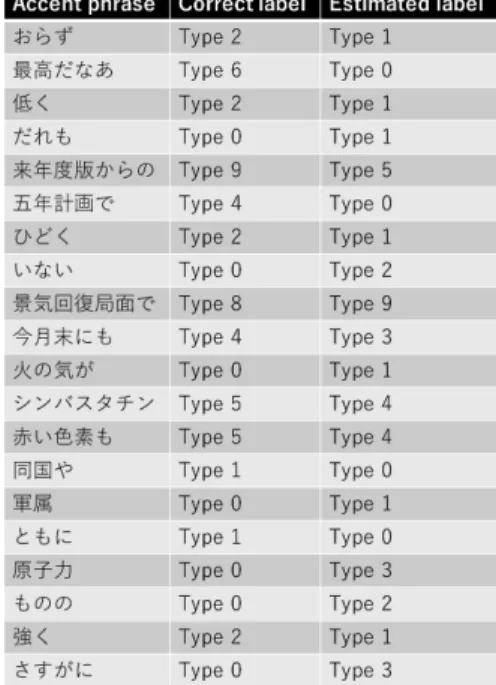
When we used correct accent phrase boundaries, the correct answer rate reached 97.11%. Figure 5 shows 20 ran- domly selected of the errors. We have not done any quan- titative analysis, but native Japanese speakers may feel that not only the correct accent type but also the estimated accent type are acceptable for some cases.
6.4 TTS Evaluation
We evaluated our system through TTS. We synthesized two
Fig. 5 Examples of errors of accent type estimation when correct accent phrase boundaries are given.
types of speech with the rule-based accent estimation and the CRF-based accent estimation and compared them using a listening test.
We used the HMM-based speech synthesis system with Open JTalk version 1.05, hts engine API version 1.06[24], HTS Voice Mei (Normal) version 1.1[25] for TTS sys- tem. The sampling frequency was 48kHz, the frame pe- riod was 240 points, and the all-pass constant was 0.55. Be- cause Open JTalk used the NAIST Japanese Dictionary[23], which was sometimes different from UniDic, we selected 873 sentences from 999 evaluation sentences where pronun- ciation estimation results perfectly corresponded. We se- lected 50 sentences from the 873 sentences randomly and used them for the listening test.
We used implementation of Open JTalk for the rule- based accent estimation system. This implementation was very similar to our implementation of the rule-based system.
In our system, we only replaced the context labeling of HTS Voice for accent boundaries and the accent nucleus position using the estimated results. Other context labeling was the same.
Twelve people who had been lived in Tokyo for more than two years and usually spoke Tokyo dialect were used as listeners. The accent labeler was not included with the twelve people. The listeners used headphones and compared two voices, selecting the one that had better naturalness. We randomly changed the order of the two voices.
Figure 6 shows the results. In many sentences, our method was judged as more natural. A t-test was significant atp <0.01. Thus, we can say that our system can improve TTS naturalness.
Fig. 6 Results of the paired comparison test.
7. Related Works
Nagano et al. proposed doing word segmentation, pronun- ciation estimation, and accent estimation simultaneously by using pairs of words, POS, pronunciation, and accent type as a token ofn-gram[7],[8]. Our proposed system has to do them separately. One of the differences from Nagano’s study is that we used a CRF-based discriminative model and did feature engineering, which is difficult forn-gram based modeling.
8. Conclusion
In this paper, we proposed a method to estimate accent phrase boundaries and accent types using CRF to improve the naturalness of Japanese TTS. We built a text database with accent labels in sentences. We achieved a relative 57%
improvement from a rule-based system in accent estimation.
The results of a listening test also show that the proposed method significantly improves the naturalness of Japanese TTS.
References
[1] S. Seto, M. Morita, T. Kagoshima, and M. Akamine, “Automatic rule generation for linguistic features analysis using inductive learn- ing technique: Linguistic features analysis in TOS drive TTS sys- tem,” Proc. 5th International Conference on Spoken Language Pro- cessing (ICSLP), pp.1059–1063, 1998.
[2] Open JTalk, http://open-jtalk.sourceforge.net/
[3] Y. Sagisaka and H. Sato, “Accentuation rules for Japanese word con- catenation,” IEICE Trans. Inf. & Syst. (Japanese Edition), vol.J66-D, no.7, pp.849–856, July 1983.
[4] M. Miyazaki, “Accent rules for numerical expressions for Japanese speech synthesis,” Journal of Information Processing Society of Japan (IPSJ), vol.25, no.6, pp.1035–1043, 1984. [In Japanese]
[5] R. Kuroiwa, N. Minematsu, and K. Hirose, “Improvements of rules for Japanese accent sandhi using conjugative suffix,” Annual Confer- ence of Natural Language Processing in Japan, pp.995–998, 2006.
[In Japanese]
[6] N. Minematsu, K. Ryuji, and K. Hirose, “Automatic estimation of accentual attribute values of words for accent sandhi rules of Japanese text-to-speech conversion,” IEICE Trans. Inf. & Syst., vol.E86-D, no.3, pp.550–557, March 2003.
[7] T. Nagano, S. Mori, and M. Nishimura, “An N-gram-based approach to phoneme and accent estimation for TTS,” Journal of Informa- tion Processing Society of Japan (IPSJ), vol.47, no.6, pp.1793–1801, 2006. [In Japanese]
[8] T. Nagano, R. Tachibana, and M. Nishimura, “Corpus-based text-to- speech front-end for Japanese,” IEICE Trans. Inf. & Syst. (Japanese Edition), vol.J93-D, no.10, pp.2096–2106, Oct. 2010.
[9] K. Suzuki, M. Yamamoto, C. Kook, and Y. Yamashita, “Automatic accent type labeling for spoken sentences based on statistical meth- ods using accentuation rules,” Journal of Acoustic Society of Japan (ASJ), vol.66, no.10, pp.487–496, 2010. [In Japanese]
[10] M. Yamamoto, C. Kook, and Y. Yamashita, “Automatic prediction of accent phrase boundaries using linguistic and F0 information,”
IEICE Technical Report, SP2010-109, 2011. [In Japanese]
[11] R. Kuroiwa, Improvement of rules and statstical approach for accent sandhi estimation for Japanese speech synthesis, Master Thesis of the University of Tokyo, 2007. [In Japanese]
[12] N. Minematsu, R. Kuroiwa, K. Hirose, and M. Watanabe, “CRF- based statistical learning of Japanese accent sandhi for developing Japanese text-to-speech synthesis systems,” Proc. Sixth ISCA Work- shop on Speech Synthesis Workshop Proceedings, 2007.
[13] ASJ Japanese Newspaper Article Sentences Read Speech Corpus (JNAS), http://research.nii.ac.jp/src/JNAS.html
[14] Japanese Newspaper Article Sentences Read Speech Corpus of the Aged (S-JNAS), http://research.nii.ac.jp/src/S-JNAS.html [15] Y. Den, T. Ogiso, H. Ogura, A. Yamada, N. Minematsu, K.
Uchimoto, and H. Koiso, “The development of an electronic dic- tionary for morphological analysis and its application to Japanese corpus linguistics,” Science of Japanese, vol.22, pp.101–122, 2007.
[In Japanese]
[16] J. Lafferty, A. McCallum, and F. Pereira, “Conditional random felds:
Probabilistic models for segmenting and labeling sequence data,”
Proc. 18th International Conference on Machine Learning (ICML), pp.282–289, 2001.
[17] S. Sekine and H. Isahara, “IREX: IR and IE evaluation project in Japanese,” Proc. LREC 2000.
[18] K. Innami, Error analysis and improvement for CRF based Japanese accent sandhi estimation, Master Thesis of the University of Tokyo, 2009. [In Japanese]
[19] S. Kobayashi, Improvement of CRF based accent sandhi estimation and application for Japanese-language education, Master Thesis of the University of Tokyo, 2012. [In Japanese]
[20] MeCab, http://code.google.com/p/mecab/ [21] CaboCha, http://code.google.com/p/cabocha/
[22] CRF++, https://code.google.com/p/crfpp/
[23] NAIST Japanese Dictionary, http://sourceforge.jp/projects/ naist-jdic/
[24] hts engine API, http://hts-engine.sourceforge.net/ [25] MMDAgent, http://www.mmdagent.jp/
[26] TASET, https://sites.google.com/site/suzukimasayuki/accent
Masayuki Suzuki received his B.Eng., M.Eng., Ph.D. degrees in electrical engineering and information systems from the University of Tokyo, in 2008, 2010, and 2013. Since 2013, he has been working at IBM Research - Tokyo.
His research interests include speech and spo- ken language processing. He is a member of the Acoustical Society of Japan (ASJ), the In- stitute of Electronics, Information and Commu- nications Engineers (IEICE), IEEE, and ISCA.
He received the Awaya Award from the ASJ in 2013.
Ryo Kuroiwa received the Master degree in information science and technology from the University of Tokyo in 2007. He is now with NTT DATA Corporation.
Keisuke Innami received the Master degree in frontier sciences from the University of Tokyo in 2009. He is now with Fujitsu Limited.
Shumpei Kobayashi received the Master degree in information science and technology from the University of Tokyo in 2012. He is now with Nomura Research Institute, Ltd.
Shinya Shimizu recieved the Master degree in information science and technology from the University of Tokyo in 2012. He is now with AgIC Inc.
Nobuaki Minematsu received the Ph.D.
degree in electronic engineering in 1995 from the University of Tokyo. In 1995, he became an assistant researcher with the Department of Information and Computer Science, Toyohashi University of Technology, and in 2000, he was an associate professor with the Graduate School of Engineering, the University of Tokyo. Since 2012, he has been a professor with the Graduate School of Engineering, the University of Tokyo.
From 2002 to 2003, he was a visiting researcher at Kungl Tekniska H¨ogskolan (KTH), Sweden. He has a wide interest in speech from science to engineering, including phonetics, phonology, lan- guage learning, speech perception, speech analysis, speech recognition, speech synthesis, and speech applications. Dr. Minematsu is a member of IEEE, ISCA, IPA, the Institute of Electronics, Information and Communi- cation Engineering, the Acoustical Society of Japan, the Information Pro- cessing Society of Japan, the Japanese Society for Artificial Intelligence, and the Phonetic Society of Japan. He received best paper awards from Research Institute of Signal Processing in 2007 and 2013.
Keikichi Hirose received the B.E. degree in electrical engineering in 1972, and the M.E.
and Ph.D. degrees in electronic engineering re- spectively in 1974 and 1977 from the University of Tokyo. From 1977, he was a faculty member at the University of Tokyo, and was a profes- sor of the Department of Electronic Engineer- ing from 1994, and a professor of the Depart- ment of Information and Communication Engi- neering, Graduate School of Information Sci- ence and Technology, from 2004. In 2015, he retired from the University of Tokyo, and was received Professor of Emer- itus title. He is also a visiting professor of National Institute of Informat- ics from 2015. From March 1987 to January 1988, he was Visiting Sci- entist at the Research Laboratory of Electronics, Massachusetts Institute of Technology, Cambridge, U.S.A. He has been engaged in a wide range of research on spoken language processing, including analysis, synthesis, recognition, dialogue systems, and computer-assisted language learning.
From 2000 to 2004, he was Principal Investigator of the national project
“Realization of advanced spoken language information processing utiliz- ing prosodic features.” He served as the general chair for INTERSPEECH 2010, Makuhari, Japan. Since 2010, he serves as the Chair of ISCA (In- ternational Speech Communication Association) Special Interest Group on Speech Prosody (SProSIG). He became an honorary member, Polish Pho- netic Association, in 2013. In 2015, he was honored as a Named Person of Merit in Science and Technology by the Mayor of Tokyo. He is a member of a number of academic societies, including ISCA (Board member), IEEE, Acoustical Society of America, Acoustical Society of Japan, Information Processing Society of Japan, and Research Institute of Signal Processing Japan (Board member).

![Table 2 Feature templates for CRF-based accent phrase boundary estimation. See [15] for the defini- defini-tion of the features](https://thumb-ap.123doks.com/thumbv2/123deta/5630620.1500984/3.892.242.654.155.368/table-feature-templates-accent-phrase-boundary-estimation-features.webp)
![Table 4 Feature templates for estimating accent types. See [15] for a definition of the features](https://thumb-ap.123doks.com/thumbv2/123deta/5630620.1500984/4.892.186.672.160.781/table-feature-templates-estimating-accent-types-definition-features.webp)