• 検索結果がありません。

太陽活動と地震

N/A
N/A
Protected

Academic year: 2021

シェア "太陽活動と地震"

Copied!
102
0
0

読み込み中.... (全文を見る)

全文

(1)

九州大学学術情報リポジトリ

Kyushu University Institutional Repository

太陽活動と地震

モハマド フザイミ ビン ジュソー

https://doi.org/10.15017/1398311

出版情報:Kyushu University, 2013, 博士(理学), 課程博士 バージョン:

権利関係:Fulltext available.

(2)

i

Solar Activity and Seismicity

(太陽活動と地震)

九州大学

モハマド フザイミ ビン ジュソー 平成

25

(3)

ii

Solar Activity and Seismicity

A DISSERTATION SUBMITTED

BY

MOHAMAD HUZAIMY BIN JUSOH TO

THE DEPARTMENT OF EARTH AND PLANETARY SCIENCES GRADUATE SCHOOL OF SCIENCES

IN PARTIAL FULFILLMENT OF THE REQUIREMENTS FOR THE DEGREE

OF

DOCTOR OF SCIENCE

KYUSHU UNIVERSITY FUKUOKA, JAPAN

SEPTEMBER 2013

(4)

i

Abstract

Solar activity plays an important role in regulating the electromagnetic coupling between the Sun and the Earth. Therefore, investigations on different elements of solar activity and their possible effects on seismic activity are important. This research investigates the possible relationship between different solar parameters and seismic activities.

In the first part of this study, we have analyzed long term trend of global and local earthquake occurrence and its energy with sunspot numbers. The observation period covers 4 most recent solar cycles 20-23 from year 1963-2008. In the second part, we have analyzed the earthquake events with respect to high speed solar wind (HSSW), solar wind dynamic pressure (Pdyn) and solar wind input energy (Ɛ). In the first part of analysis shows that both local and global seismic activities tend to occur more frequently in the descending phase of the solar cycles. This trend is similar to those detected in HSSW, Pdyn and solar wind input energy.

To connect the solar wind and the seismic activity, we examine two possibilities.

The first is the ground magnetic pulsations as one of the connecting agent. We analyzed ground magnetic pulsations at different ranges of ultra low frequency, e.g.

Pc3 (22-100 mHz), Pc4 (6.7-22 mHz) and Pc5 (1.7-6.7 mHz) with the occurrence of localized earthquake events. This analysis focuses at 2 different seismic regions;

Japan and Sumatra/ Indonesia. Our results show that Pc5 range pulsation is the

most likely connection between the solar wind and seismic activity. The second

possibility we examined is the Lorentz force produced by the underground current

induced by the ionospheric Sq current system. Our analysis shows the Sq current

may provide enough energy for earthquake activities.

(5)

ii

The overall analysis shows earthquakes of all magnitude tend to occur more

frequently during descending solar cycle, when the solar wind parameters (solar

wind speed, input energy and dynamic pressure) are high. However, one solar wind

event does not trigger one earthquake. Geomagnetic pulsations and Lorentz force

produced by induced currents can be possible connecting agents between the solar

wind and the seismic activity.

(6)

iii

Table of Contents

Abstract……….…………i

List of Tables……….….v

List of Figures………..……….…vi

Chapter 1: Introduction 1.1: Concept of Solar – Seismicity Coupling………..……1

1.2: Solar activities associated with earthquakes………...2

1.3: Motivation and objective of this study……….….5

1.3.1: Motivation 1.3.2: Objective 1.3.3: Outline Chapter 2: Data 2.1: Earthquake data………..7

2.2: Solar cycle data……….………..8

2.3: Solar wind data……….………...8

2.3.1: Solar wind speed………..8

2.3.2: Solar wind dynamic pressure………...11

2.3.3: Solar wind input energy………....11

2.4: MAGDAS instrumentation and geomagnetic field variation………...12

2.4.1: Geomagnetic data………..………...13

(7)

iv Chapter 3: Results

3.1: Variation of earthquake occurrence with solar cycle (SC)………...16

3.2: Variation of earthquake epicenter depths with solar cycles………...22

3.3: Variation of global earthquake energy with solar cycles………..…..26

3.4: Distribution of regional earthquake energy with solar cycles.………30

3.4.1: Japan region………...30

3.4.2: Sumatra region ………..33

3.5: Solar wind parameters associated with earthquakes………..35

3.5.1: Relationship of Earthquake with HSSW……….35

3.5.2: Relationship of Earthquake with High Solar Wind Dynamic Pressure……….43

3.5.3: Relationship of Earthquakes with Solar Wind Input Energy..….50

Chapter 4: Discussion: Possible physical mechanism 4.1: Ultra Low Frequency (ULF) of Magnetic Pulsations………58

4.2: Lorentz Force……….67

Chapter 5: Summary and Conclusion……….………..77

Acknowledgements………81

References………..……….83

(8)

v

List of Tables

Table 1: IAGA classification of ULF waves in 1964………...15

Table 2: Dependence of skin depth on the wave period of the inducing fields and

electric conductivity in the lithosphere……….…….60

Table 3: Estimation of torque and force at different solar wind input energy………..76

(9)

vi

List of Figures

Figure 1: General concept of solar – seismicity coupling……….3 Figure 2: Typical CME-HSSW (bold line-detected on 22 September 1999) and CH- HSSW (dashed line-detected on 27 September 1999). The observation period is from 20 September to 30 September 1999………10 Figure 3: MAGDAS/CPMN (MAGnetic Data Acquisition System/Circum-pan Pacific Magnetometer Network) system of the ICSWSE, Kyushu University………….………13

Figure 4: The geomagnetic field components; [F] Total intensity of the geomagnetic field, Horizontal component (H), Declination component (D), and the Vertical component (Z) ………..………14 Figure 5: Superposition of sunspot number (Solar Cycle 20 – 23) and Earthquakes;

(a) EQ magnitude 4.0 – 4.9, (b) EQ magnitude 5.0 – 5.9, (c) EQ magnitude 6.0 – 6.9, (d) EQ magnitude 7.0 – 7.9 and (e) EQ magnitude 9.0 – 9.9………..18-20

Figure 6: Percentage of Earthquakes during Solar Cycles 20 to 23……….19 Figure 7: Superposition of yearly number of earthquake at epicenter depth< 40 km with sunspot number during solar cycle 20 to 23………23 Figure 8: Superposition of yearly number of earthquake at epicenter depth 40-100

km with sunspot number during solar cycle 20 to 23………..23

(10)

vii

Figure 9: Variation of yearly shallow earthquake event at epicenter depth < 40 km with respect to sunspot number ...………...….25 Figure 10: Variation of yearly deep earthquake event at epicenter depth 40-100 km

with respect to sunspot number ………25 Figure 11: Superposition of yearly earthquake energy with respect to sunspot

number………..…….28

Figure 12: Earthquake released energy during Solar Cycle 20 to 23………….…….28 Figure 13: Superposition of yearly shallow earthquake energy (epicenter depth < 40

km) and sunspot number………...29

Figure 14: Superposition of yearly shallow earthquake energy (epicenter depth 40- 100 km) and sunspot number………...29

Figure 15: Yearly energy released by earthquakes of magnitude 4.0 – 5.9 during SC 20 – SC 23 for Japan region………32 Figure 16: Yearly energy released by earthquakes of magnitude 6.0 – 9.0 during SC

20 – SC 23 for Japan region………32 Figure 17: Yearly energy released by earthquakes of magnitude 4.0 – 5.9 during SC

20 – SC 23 for Sumatra region………...……..34 Figure 18: Yearly energy released by earthquakes of magnitude 6.0 – 9.0 during SC 20 – SC 23 for Sumatra region………34 Figure 19: Yearly number of high speed solar wind event during solar cycle 23

………36 Figure 20: Yearly earthquake energy released during solar cycle 23

………..………..…36

(11)

viii

Figure 21: Correlation coefficient between earthquake and high speed solar wind

……….39

Figure 22: Percentage of Earthquake Events with respect to HSSW ………..39 Figure 23: Power spectrum analysis for solar wind speed during year 2005………..41

Figure 24: Power spectrum analysis for global earthquake at epicenter depth < 40 km during year 2005….……….………41 Figure 25: Power spectrum analysis for global earthquake at epicenter depth 40-100

km during year 2005………..…42

Figure 26: Yearly solar wind dynamic pressure during solar cycle 22

……….……45

Figure 27: Yearly total earthquake energy during solar cycle 22………..45 Figure 28: Correlation coefficient between high solar wind dynamic pressure and

earthquake (magnitude 5.0-9.9) during SC

23………49

Figure 29: Percentage of earthquake with respect to day of high solar wind dynamic

pressure ………..…49

Figure 30: Yearly solar wind input energy during solar cycle 23………...52

Figure 31: Solar wind input energy and earthquake released energy from epicenter

depth < 40 km with respect to sunspot number………..……..…54

Figure 32: Solar wind input energy and earthquake released energy from epicenter

depth 40-100 km with respect to sunspot number………..….…54

(12)

ix

Figure 33: Comparison of energy from (a) solar wind, and (b) earthquake at lower magnitude range, 4.0 – 5.9 and (c) higher magnitude range, 6.0 – 9.9………..57

Figure 34: Epicenter depth of North Japan region earthquake for year 2005……….61 Figure 35: Epicenter depth of North Sumatra region earthquake for year 2010…….61 Figure 36: Variation of (a) solar wind speed, (b) average amplitude of Pc 5 and (c) earthquake events from 15 August to 14 September 2005 for North Japan region………...63 Figure 37: Variation of (a) solar wind speed, (b) average amplitude of Pc 5 and (c) earthquake events from 12 March to 11 April 2010 at North Sumatra, Indonesia region……….66 Figure 38: Schematic sketch of the average induced Sq current system in the lithosphere……….69 Figure 39: Electromagnetic model of MM concept with regards to Sq-induced current

and horizontal component of earth’s magnetic field ………..72

Figure 40: Observation result of solar wind input energy variation from 20 to 22

August 2005………..75

Figure 41: Observations of ionospheric current during low solar wind input energy on

20 August (blue line) and high solar wind input energy on 22 August

(green line) at Ashibetsu station, Japan …..………..75

(13)

1

Chapter 1 Introduction

1.1 Concept of Solar Seismicity Coupling

The sun is the main source of energy to the solar system, and it plays a major role in affecting the ionosphere, atmosphere and the earth’s surface. The Sun- Earth relationship is a central point in many research directions nowadays and some Sun-Earth relationships have already been confirmed and have been incorporated into several scientific areas. In particular, the space science community has concentrated its interest on so-called “space weather” in order to predict geomagnetic and ionospheric disturbances, which have a significant impact on electrical power systems, telecommunications, oil pipelines, spacecraft and aircraft electronics, astronauts safety, etc. [Baker, 2005; Marhavilas, 2008;

Lanzerotti, 2010]. Scientific research has also provided some evidence on the relation of solar – magnetospheric activity with earthquakes.

Figure 1 shows the concept of solar – seismicity coupling. The concept

involves the study of both extraterrestrial and terrestrial parameters. For this

study, we examined the extraterrestrial parameters includes solar cycles

(sunspot numbers), solar wind speed (SW speed), solar wind dynamic pressure

(SW dynamic pressure) and solar wind input energy (SW input energy). The

terrestrial parameters examined are ionospheric current, earthquake at different

magnitude and epicenter depth (global and local events), and geomagnetic

(14)

2

pulsations. The details of the examined parameters will be explained in the

following chapters.

(15)

3

Figure 1: General concept of solar – seismicity coupling

(16)

4

1.2 Solar activities associated with earthquakes

The physical processes of transferring electromagnetic energy from sun to the earth can be referred as Solar – Terrestrial system. It involves terrestrial atmosphere, the outer part of geomagnetic field, and the solar events, which influence them. Theoretically, this coupling mechanism starts from the sun as the main source of energy to the solar system and plays a significant role in affecting the interplanetary space, magnetosphere, ionosphere, neutral ionosphere and biosphere.

The main focus addressed in this study is the possible relationship between solar activity and seismicity. Several authors [Gousheva et al., 2003, Odintsov et.

al, 2006, Khain and Khalilov, 2008] reported that although many researchers have studied the influence of extraterrestrial factors in seismicity by demonstrating some evidences and statistical analysis, the problem remains ambiguous. Recently, there is an increasing evidence for an influence of solar activity upon seismic activities. For instance, Khain and Khalilov [2008]

presented statistical results that in both the spectra of earthquakes with magnitude, M ≥ 7 Richter scale and sunspot numbers, the main harmonic was found at T ≈ 10-11 years. The authors suggested a long-term forecast for seismic activity until 2018 based on its high correlation with solar activity.

Odintsov et al., [2006] determined that the maximum of seismic energy released from earthquake is observed during the declining phase of solar cycle and it lags 2 years behind the year of solar maximum.

Other than that, Gousheva et al., [2003] has performed a statistical study and

they found two maxima in the global yearly number of earthquakes in the 11-year

sunspot cycle, one coinciding with the solar cycle maximum, and the other on the

(17)

5

descending phase of the solar cycle. In agreement with these results, S.

Odinstov et al. [2006] confirmed that the maximum earthquakes occurrence directly correlates with a sudden increase in the solar wind velocity.

1.3 Motivation and objective of this study 1.3.1 Motivation

Even though several authors have demonstrated possible solar cycle relationship with earthquake events, very few authors have attempted to investigate on the causal effect of solar wind parameters and earthquakes.

Tsurutani and Gonzalez, [1997] reported that, during the period of high electromagnetic energy input, the amplitude of Sq current in the ionosphere will also be enhanced. Through induction process, the Sq current variation in the ionosphere will induce underground current [Matsushita, 1968]. Therefore, the increase of Sq current in the ionosphere will also increase the amount of induced underground current.

Furthermore, Zeigarnik et al., [2007] reported a probable triggering effect of anthropogenic impulsive electrical signals on seismicity. Analyzing variations of the number of earthquakes in Kyrgyzstan associated with electrical signals radiated by an MHD generator, they inferred that the number of earthquakes tends to increase 2 to 6 days after the electrical signal passage.

This is similar to the case when we consider the source of high

electromagnetic energy from the solar wind event (eg: geomagnetic storm). By

investigating solar wind parameters, it could be possible to examine the

relationship between solar activity and seismicity.

(18)

6 1.3.2 Objective

As we have seen before, to date, previous researchers have done the investigations on relationship of:

• Global EQ and solar cycle (SC 18-19) [Simpson, 1967; Belov et al., 2009]

• EQ and High speed solar wind during SC 21-22 [Odintsov et al., 2006]

• Global geomagnetic activities & Sq current [Duma et al., 2002; Gousheva et al., 2003]

In order to investigate the possible solar – seismicity coupling, we have to:

1. Re-examine the relationship between global earthquake and high speed solar wind with longer time period (4 solar cycles; SC 20-23).

2. Examine the relationship of local earthquake and its released energy at longer time period (4 solar cycles).

3. Examine possible relationship between EQ and solar wind dynamic pressure, and solar wind input energy.

4. Examine geomagnetic pulsations as connecting parameters between solar and EQ events.

1.3.3 Outline

The current work aims to examine the possible connection between solar

activity and earthquakes. The study is divided into five chapters; begins with this

chapter as introduction part to solar – seismicity coupling. 2 nd chapter will explain

the methodology used in the study, then followed by results and analysis in the

Chapter 3. The possible physical mechanism connecting solar activity and

seismicity will be discussed in Chapter 4, and then the summary of the study will

be in the last chapter.

(19)

7

Chapter 2 Data

Methods of data analysis – In this study, we are investigating the possible effect of solar activity on seismicity. Therefore, a comprehensive analysis for possible correlation of solar activity and seismicity requires a large database to clearly explain the relationship between them.

2.1 Earthquake data

The global earthquake events with magnitude 4.0 to 9.9 Richter scale from year 1963 to 2010 are extracted from ANSS, hosted by Northern California Earthquake Data Center (http://www.ncedc.org/anss/). The earthquakes are selected based on the depth of epicenter less than 100 km to ensure the possible triggering factors are from external sources.

The energy released in earthquakes is calculated based on Kanamori seismic energy method [Kanamori, 1983]:

Log E = 1.5M + 4.7 (1)

Where E is the earthquake energy expressed in Joule unit and M is the earthquake

magnitude.

(20)

8 2.2 Solar cycle data

Sunspot cycle in solar activities is a well known parameter and often used by space physics researchers to monitor the sun’s activities. In this research, the values of sunspot numbers from Marshall Space Flight Center, NASA database (http://solarscience.msfc.nasa.gov/) were used to indicate different phases of solar cycle. These phases reflect the activity of the Sun. An active Sun occurred during maximum while minimum indicates low activity period of the sun.

2.3 Solar wind data

Solar wind is a highly ionized gas originated from the sun. It is one of the most prominent features of the Sun and acts as a medium for the solar control of the earth.

Lots of space missions were and still are dedicated to observe its composition, velocity, density and temperature, inside and, outside of the terrestrial magnetosphere (WIND, ACE, Ulysses, SOHO). All the parameters of solar wind data for this study were obtained from the Goddard Space Flight Center, NASA via the OMNIWeb Data Explorer and the Space Physics Data Facility.

2.3.1 Solar wind speed

Solar wind plasma consists of electrons, protons, helium and heavier nuclei, which are carrying along them the solar magnetic field resulting into an interplanetary magnetic field (IMF). The average velocity of the solar wind plasma is 350 km/s with minimum of about 200 km/s and a maximum over 1000 km/s.

In this study, a high speed solar wind (HSSW) is characterized by four factors

[Mavromichalaki and Vassilaki, 1998]; considerable enhancement in plasma stream

(21)

9

speed (ΔV SW ≥ 100 km/s), higher temperature (T in K), a high variation of proton density (N in cm -3 ) and higher magnitude of IMF (B in nT).

Solar wind from the sun can be categorized into slow and fast solar winds which

have different origins in the solar coronal [Lyatsky et al., 2007 and Gupta and

Badruddin, 2010]. During HSSW originated from coronal holes (CH-HSSW), the

plasma speed increases relatively slowly to reach its maximum, with similar pattern

in temperature, while the proton density and magnitude of IMF reaches its peak

before the speed maximum. During HSSW from coronal mass ejection (CME-HSSW),

the speed increases faster and rises to peak value simultaneously with proton

density and magnitude of IMF while its temperature becomes lower after the initial

rise during the shock. Figure 2 shows the typical CME-HSSW and CH-HSSW.

(22)

10

Figure 2: Typical CME-HSSW (red-line detected on 22 September 1999) and CH-HSSW (blue-line detected on 27 September 1999). The observation period is from 20 September to 30 September 1999.

20 21 22 23 24 25 26 27 28 29 30

Date of September 1999 B

T

N

V SW

(23)

11 2.3.2 Solar wind dynamic pressure

In space weather study, the effects of solar wind to the earth system are very significant. The enhancement of dynamic pressure caused by solar wind flow; called solar wind dynamic pressure (SW Pdyn) has been widely discussed by previous researchers [Russell et al., 1994; Lyons et al., 2000; Zesta et al., 2000; Boudouridis et al., 2003 and Lee et al., 2004 to name a few]. The solar wind dynamic pressure can be calculated from formula (2):

SW Pdyn = 1.6726 * exp-6 * N * Vsw 2 [nPa] (2)

Where: N = Proton density and Vsw = Solar wind speed

2.3.3 Solar wind input energy

The penetration of solar wind energy from the magnetosphere to the ionosphere and further transfers to lower atmosphere and lithosphere is an important process in solar physics. It has been explained empirically by several researchers [Dungey, 1961; Axford and Hines, 1961 and Akasofu, 1981]. Solar wind input energy can be calculated using formula (3) [Akasofu, 1981]:

Epsilon (ε) = Vsw * B 2 * F(θ) * lo 2 [Watt or Erg/s] (3)

Where:

Vsw = solar wind speed,

B = IMF magnetic field,

lo = 7 Earth radii and

(24)

12 F(θ) = function of the angle θ (B y /B z ).

F(θ) denotes a function of the angle θ, the polar angle of the IMF vector, projected onto the Y-Z plane, namely:

θ = tan -1 abs(B y /B z ) for B z > 0

θ = 180 o - tan -1 abs(B y /B z ) for B z < 0

2.4 MAGDAS instrumentation and geomagnetic field variation

International Center for Space Weather Science and Education, ICSWSE (the new name for Space Environment Research Center, SERC), Kyushu University, Japan has introduced a real-time Magnetic Data Acquisition System of Circum-pan Pacific Magnetometer Network, i.e. MAGDAS/CPMN for space weather study and application, which was deployed for the International Heliophysical Year (IHY; 2007- 2009) [Yumoto et al., 1996]. By using this system, ICSWSE conducted real-time monitoring and modelling of (1) global 3-dimensional current system, (2) plasma mass density, and (3) penetrating process of polar electric fields into the equatorial ionosphere, in order to understand the Sun-Earth coupling system and the electromagnetic and plasma environment changes [Yumoto, 2009]. To date, MAGDAS/CPMN consists of three unique chains of magnetic observatories; most magnetometers were densely installed at 210 0 magnetic meridian, on African longitude-sector and the other one is along the magnetic equator (with total of 71 stations worldwide), as shown in Figure 3.

From the magnetometer, we can extract the ambient magnetic field, expressed

by H (Geomagnetic Northward), D (Geomagnetic Eastward) and Z (Vertical

Downward) components.

(25)

13

Figure 3: MAGDAS/CPMN (MAGnetic Data Acquisition System/Circum-pan Pacific Magnetometer Network) system of the ICSWSE, Kyushu University.

2.4.1 Geomagnetic data

Geomagnetic data is used in this study as a monitoring parameter for solar and

seismicity coupling. The data was extracted from MAGDAS/CPMN network

constructed by Prof. Yumoto. Two (2) stations involved in this study are Ashibetsu

(ASB) station in Japan and Langkawi (LKW) station located at Malaysia. The

MAGDAS/CPMN magnetometer is a ring core-type fluxgate magnetometer that

measures the three components of the geomagnetic field; Horizontal component (H),

Declination component (D), and the Vertical component (Z) as shown in Figure 4

[Campbell, 2003].

(26)

14

Figure 4: The geomagnetic field components; [F] Total intensity of the

geomagnetic field, Horizontal component (H), Declination component (D), and the

Vertical component (Z).

(27)

15

The 1-sec resolution data from horizontal component were used to examine the geomagnetic pulsations, Pc 3, Pc 4 and Pc 5 as classified by International Association of Geomagnetism and Aeronomy (IAGA) in Table 1. The raw data from MAGDAS/CPMN stations was first bandpass-filtered before we plotted the dynamic power spectra density to identify the occurrences of ultra low frequency (ULF) at Pc 3, Pc 4 and Pc 5.

Table 1: IAGA classification of ULF waves in 1964.

CONTINUOUS IRREGULAR

Pc 1 Pc 2 Pc 3 Pc 4 Pc 5 Pi 1 Pi 2 Period

(sec) 0.2-5 5-10 10-45 45-150 150-600 1-40 40-150 Frequency

(mHz) 200-5000 100-200 22-100 6.7-22 1.7-6.7 25-1000 6.7-25

(28)

16

Chapter 3 Results

3.1 Variation of Earthquake Occurrence with Solar Cycle (SC)

In order to examine the possible relationship between solar cycles (and sunspot numbers) with earthquakes, we have plotted the superposition of both earthquake events and solar cycle for the period of solar cycle (SC) 20 to 23, from year 1963 to 2009 as in Figure 5(a) to (e) starts from the lowest earthquake magnitude to the highest magnitude respectively. The green line is the value of yearly sunspot number and the blue line is the yearly value of earthquake number. We are filtering out the earthquakes with surface in depth more than 100 km since the external factors of earthquakes tend to influence earthquake at shallow or moderate epicenter depth [Sasorova, and Levin, 2007].

For earthquake magnitude 4.0 to 4.9 Richter scale as shown in Figure 5(a), the total number of earthquakes recorded is 250,661 events. The comparison of earthquake number with solar cycle shows the number of earthquakes is higher during descending and minimum phases of solar cycles mainly during solar cycles 21 to 23. For earthquake at magnitude 5.0 to 5.9 Richter scale as shown in Figure 5(b), we can see several distinctive peaks of earthquake numbers during descending and minimum phases of solar cycle 20 to 23. Total examined earthquake events during this period are 65,694 events.

Figure 5(c) shows the occurrence of earthquakes at magnitude 6.0 to 6.0 Richter

scale with total 4676 events. The trend of earthquake occurrence shows an abrupt

increase of around 50% started during the descending phase of solar cycle 22.

(29)

17

Higher number of earthquake also appears during the descending period of solar cycle 20, 22 and 23. The total number of earthquake examined at magnitude 7.0 to 7.9 is 476 events as shown in figure 5(d). During the descending and minimum phases of solar cycles; mainly solar cycle 20, 22 and 23, the number of earthquake tend to occur more as compare to other phases. For the highest earthquake magnitude 8.0 to 9.9 as shown in Figure 5(e), earthquakes show the tendency to occur during the descending and minimum phases of solar cycle, mainly during solar cycles 21, 22 and 23. The number of earthquake for this magnitude is higher during the last two solar cycles 22 and 23.

Overall, we can see more earthquakes tend to occur around minimum and descending phases of solar cycle especially for greater earthquake magnitudes. This trend confirms the results by Gousheva et al., [2003] and Khain and Khalilov [2008]

which show the earthquake at higher magnitude (M ≥ 7.0) corresponds better with

solar activity.

(30)

18

(a)

(b)

2

1

0

1963 1968 1973 1978 1983 1988 1993 1998 2003 2008

Year

200

100

0

Y e a rly su n sp o t n u m be r

Y e a rly n u m be r o f e a rth q u a ke ( x1 0 4 ) Y e a rly n u m be r o f e a rth q u a ke

2200

1800

1400

1000

600

160

120

80

40

0

Y e a rly su n sp o t n u m be r

1963 1968 1973 1978 1983 1988 1993 1998 2003 2008

Year

(31)

19

(d) (c)

200

150

100

50

0

1963 1968 1973 1978 1983 1988 1993 1998 2003 2008

Year

200

150

100

50

0

Y e a rly su n sp o t n u m be r

20

15

10

5

0

200

150

100

50

0

Y e a rly n u m be r o f e a rth q u a ke

1963 1968 1973 1978 1983 1988 1993 1998 2003 2008

Year

Y e a rly su n sp o t n u m be r

Y e a rly n u m be r o f e a rth q u a ke

(32)

20

Figure 5: Superposition of sunspot number (Solar Cycle 20 – 23) and Earthquakes;

(a) EQ magnitude 4.0 – 4.9, (b) EQ magnitude 5.0 – 5.9, (c) EQ magnitude 6.0 – 6.9, (d) EQ magnitude 7.0 – 7.9 and (e) EQ magnitude 8.0 – 9.9

(e)

4

3

2

1

0

Y e a rly n u m be r o f e a rth q u a ke

160

120

80

40

0

Y e a rly su n sp o t n u m be r

1963 1968 1973 1978 1983 1988 1993 1998 2003 2008

Year

(33)

21

The sunspot numbers and earthquake events at different magnitudes were further analyzed by examining the percentage of earthquake event occurred at different phases of solar cycle as shown in Figure 6. During this period of observation, we can see earthquakes have higher tendency more than 60% to occur during minimum and descending phases of solar cycle at all magnitude.

Figure 6: Percentage of Earthquakes during Solar Cycles 20 to 23

(34)

22

3.2 Variation of earthquake epicenter depths with solar cycles

The earthquake epicenter depth is the point under the earth’s surface, where the fault begins to rupture and cause earthquake events. This is an important parameter for any earthquake event since the maximum magnitude of earthquakes is decreasing for deeper epicenter depth [Kagan, 1991]. In the recent study by Tavares et al., [2011], they have pointed out that the highest correlation of sun activity and earthquake is observed for shallow earthquake by analyzing the earthquake depth 7 to 35 km. However, there is no comparison has been made for deeper depth earthquake events.

In this study, we have examined the occurrences of earthquakes from wider

range of epicenter depth, from 0 to 100 km with respect to solar cycles 20 to 23. This

is important to investigate which epicenter depth of earthquake corresponds better

with solar activity. We separate earthquakes into shallow and deep ones, with

epicenter depth above and below 40 km, respectively. Figure 7 shows the

superposition of yearly number of shallow earthquake and sunspot number (SSN)

during solar cycles 20 to 23. In general, we can see the number of earthquakes

keeps increasing and reaches the maximum number during the descending phase of

solar cycle 23. More interestingly, one can see clearly the numbers of earthquakes

are higher during lower sunspot number especially during minimum phases of solar

cycles 21 to 23. We also examine the number of earthquakes at deeper depth, from

40 to 100 km as shown in Figure 8. The number of earthquakes steadily stays at

average 1000 events before suddenly increased during descending phase of solar

cycle 23. From both Figure 7 and 8, we can see that the solar activity phases are

corresponding better to earthquake with shallow (< 40 km) epicenter depth.

(35)

23

Figure 7: Superposition of yearly number of earthquake at epicenter depth < 40 km with sunspot number during solar cycle 20 to 23

Figure 8: Superposition of yearly number of earthquake at epicenter depth 40-100 km with sunspot number during solar cycle 20 to 23

2

1

0

Y e a rly n u m be r o f e a rth q u a ke ( x1 0 4 )

200

100

0

Y e a rly su n sp o t n u m be r

1963 1968 1973 1978 1983 1988 1993 1998 2003 2008

Year

4000

2000

0

Y e a rly n u m be r o f e a rth q u a ke

200

100

0

Y e a rly su n sp o t n u m be r

1963 1968 1973 1978 1983 1988 1993 1998 2003 2008

Year

(36)

24

We further examined the previous results by plotting the number of earthquakes with respect to SSN during the same period (solar cycles 20 to 23) as shown in Figure 9 for the case of shallow (< 40 km) earthquakes and Figure 10 for deeper earthquakes (40-100 km). Y-axis on the left panel represents the number of yearly earthquake events and X-axis represents the yearly sunspot number. Y-axis on the right panel shows the total number of earthquake events at each sunspot level which are categorized into 0-20, 20-40, 40-60, etc. ranges of sunspot number. From Figure 9, we can see that the largest number of shallow earthquakes is observed at the lowest level of sunspot number below 20 with ~ 56,000 events in total. The number of earthquakes decreases with increasing SSN until SSN reaches 60. It then stays stable except for an increase between 120 and 140 SSN. The same trend also can be observed with earthquake events at epicenter depth in between 40 to 100 km.

The only difference is that the total number of earthquake events is smaller than the number of shallow earthquake.

Overall, more earthquakes seem to occur at lower range of sunspot number. This

result confirms the study by Tavares et al., [2011]. The field experiments observed

by Zeigarnik et al., [2007] shows that the number of shallow earthquake at epicenter

depth between 5-25 km occurred more frequently after the high power

electromagnetic pulses injected into the earth crust. This shows the possibility of

shallow earthquakes to be triggered by external sources. However, more

investigations on extraterrestrial and terrestrial factors are needed to confirm this

expectation.

(37)

25

Figure 9: Variation of yearly shallow earthquake event with respect to sunspot number

Figure 10: Variation of yearly deep earthquake event with respect to sunspot number

15000

10000

5000

0

0 20 40 60 80 100 120 140 160

Sunspot number

0 20 40 60 80 100 120 140 160

Sunspot number

Y e a rly n u m be r o f e a rth q u a ke

6

4

2

0 4 T o ta l e ar th q ua ke a t e a ch su n sp o t leve l ( x1 0 )

3000

2000

1000

0

Y e a rly n u m be r o f e a rth q u a ke

15

10

5

0 3 T o ta l e ar th q ua ke a t e a ch su n sp o t leve l ( x1 0 )

(38)

26

3.3 Variation of Global Earthquake Energy with Solar Cycles

The main purpose of the analysis is to analyze the total energy of earthquake instead of the total number of earthquake. A large number of small earthquakes could have the same amount of energy released from small number of big earthquakes.

Figure 11 shows the superposition of yearly sunspot numbers during solar cycle 20 to 23, from year 1963 to 2009 (green lines) with the energy released in earthquakes (red lines). This earthquake energy was calculated from earthquake with magnitude 4.0 to 9.9, with epicenter depth less than 100 km. The limit of epicenter depth is a consideration of possible external influenced on shallow and moderate earthquake events. It clearly shows that during descending and minimum phase of solar cycle 21 to 23, the amount of energy released from earthquake is greater than during other phases of solar cycle.

This pattern was confirmed by the graph shown in Figure 12. As we can see, the percentage of energy released from all earthquakes with magnitude 4.0 to 9.9 shows higher during descending and minimum phases of solar cycles 21 to 23. The percentage of earthquake energy during descending and minimum with ascending and maximum phases of solar cycle 20 was 49% and 51% respectively; only 2%

differences. However, the percentage of energy released during descending and

minimum phases of solar cycles 21 and 22 have increased to 58%, 16% higher than

the energy released during ascending and maximum phases of solar cycles 21 and

22. This difference rapidly increased during solar cycle 23, where the descending

and minimum phase contributes 78% compared to other phase of solar cycle. The

big difference in energy released from earthquake was contributed mainly from the

increase of big earthquakes during descending and minimum phase of solar cycle 23.

(39)

27

We investigate further the global earthquake released energy during solar cycle 20 to 23 at different epicenter depth for shallow (epicenter depth < 40 km) and deep earthquakes (epicenter depth 40-100 km) as shown in Figure 13 and 14 respectively.

The earthquake energy from shallow epicenter depth shows higher tendency to release more during descending period of solar cycles as can be seen in Figure 13.

However, for deeper depth earthquakes, as in Figure 14, it is hardly to see any significant variation of earthquake energy with solar cycles. These trends suggest that the shallow depth earthquake has a better possibility to relate with solar activity as compared to deep one.

The tendency of earthquake released energy to be higher during the declining phase of solar cycle has also been demonstrated by Odintsov et al., [2006]. They have analyzed the variations in the energy of earthquake events from year 1900 to 2000 by averaging all the earthquake magnitudes greater than 5 Richter scale. For our analysis, we have re-examined the results by extending the analysis to the most recent solar cycles. In addition, we also notice a long-term increasing trend of earthquake released energy with the recent 4 solar cycles.

Overall, we can see that the higher magnitude of earthquakes play significant

roles in the earthquake released energy as compared to the occurrence number of

earthquakes. This is due to the energy of earthquake is an exponential function of

the magnitude. For example, for every 1 magnitude increase of earthquake, the

energy will be increased by 32 times.

(40)

28

Figure 11: Superposition of yearly earthquake energy with respect to sunspot number

Figure 12: Earthquake Released Energy during Solar Cycle 20 to 23

200

150

100

50

0

Y e a rly su n sp o t n u m be r

2

1.5

1

0.5

0

E a rth q u a ke e n e rg y [ Jo u le] ( x1 0 18 )

1963 1968 1973 1978 1983 1988 1993 1998 2003 2008

Year

(41)

29

Figure 13: Superposition of yearly shallow earthquake energy (epicenter depth < 40 km) and sunspot number

Figure 14: Superposition of yearly shallow earthquake energy (epicenter depth 40-100 km) and sunspot number

1963 1968 1973 1978 1983 1988 1993 1998 2003

Year

200

150

100

50

0

Y e a rly su n sp o t n u m be r

2

1.5

1

0.5

0

E a rth q u a ke e n e rg y [ Jo u le] ( x1 0 18 )

200

100

0

Y e a rly su n sp o t n u m be r

10

5

0

E a rth q u a ke e n e rg y [ Jo u le] ( x1 0 16 )

1963 1968 1973 1978 1983 1988 1993 1998 2003

Year

(42)

30 3.4 Distribution of regional earthquake energy

To examine the possible relationship between solar activity and local earthquake events, we have analyzed the occurrence of earthquake events at two most seismically active regions; Japan region and Sumatra (Indonesia) region during SC 20 to SC 23. The number of earthquake events for both regions has been categorized into two magnitude ranges; magnitude 4.0 – 5.9 and magnitude 6.0 – 9.0.

3.4.1 Japan region

Japan has had a long history of seismic activity. It is an area of high seismicity because it is located near major tectonic plate boundaries which are Asia plate, Philippine plate and Pacific plate.

To examine the tendency of earthquakes in Japan with solar activity, we have plotted the annual earthquake released energy during SC 20 to SC 23 for magnitude 4.0 to 5.9 and for magnitude 6.0 to 9.0 Richter scale as shown in Figure 15 and Figure 16, respectively. For both plots, X-axis shows the year of solar cycles while Y axis on the left scale shows the yearly earthquake energy in unit Joule represented by bars and Y-axis on the right scale shows the annual sunspot number represented by green line.

The results show that the earthquake released energy from both magnitude

ranges tends to be higher during descending cycle of solar activity or sunspot

number. For lower magnitude range of earthquake in Figure 15, we can see that the

earthquake energy keeps increasing from the first year of solar cycle until the fifth

year of solar cycle, during the maximum period of solar cycle. The energy decreased

in the following year before increasing again and reaching the peak on the ninth year

(43)

31

(four years after sunspot maximum), during the descending period of solar cycle.

However, the result from higher magnitude of earthquake in Figure 16 shows peak of the earthquake released energy observed on the third year after sunspot maximum.

If we sum up the energy of earthquake from both magnitude ranges, it will give

similar result with statistics demonstrated by Odintsov et al., [2007] where maximum

amount of earthquake energy was observed during the third year after sunspot

maximum.

(44)

32

Year of solar cycle

Figure 15: Yearly energy released by earthquakes of magnitude 4.0 – 5.9 during SC 20 – SC 23 for Japan region

Year of solar cycle

Figure 16: Yearly energy released by earthquakes of magnitude 6.0 – 9.0 during SC 20 – SC 23 for Japan region

140 120 100 80 60 40 20 0

A ve ra g e E Q E n e rg y [ Jo u le] A n n u a l S u n sp o t Nu m b e r A n n u a l S u n sp o t Nu m b e r A ve ra g e E Q E n e rg y [ Jo u le]

140

120

100

80

60

40

20

0

(45)

33 3.4.2 Sumatra region

The Indonesian island of Sumatra is located in a highly seismic area of the world.

In addition to the subduction zone and the associated Sunda Arc off the west coast of the island, Sumatra also has a large strike-slip fault, the so-called Great Sumatran Fault, running the entire length of the island. This fault zone accommodates most of the strike-slip motion associated with the oblique convergence between the Indo- Australian and Eurasian plates [Sieh and Natawidjaja, 2000].

To investigate the occurrence pattern of earthquakes at Sumatra region and relate them with solar activity, we have plotted the solar cycle distribution of the yearly earthquake released energy during solar cycle 20 to 23. The plots have been divided into 2 earthquake magnitude ranges; 4.0 to 5.9, in Figure 17 and 6.0 to 9.0 Richter scale in Figure 18. The labels of X and Y-axis in Figure 17 and Figure 18 are similar with the previous Figures 15 and 16. Both ranges of earthquake magnitudes from Sumatra region show less significance with maximum year of solar cycle. The maximum earthquake energy released occurs on the tenth and ninth year of solar cycles for lower magnitude range and higher magnitude range of earthquake, respectively. There is 1 year lag for both magnitude ranges as compared with the Japan region earthquake.

However, for both plots, we can see the same pattern where most of earthquake

energy tends to be released during the descending phase of solar cycle. This trend

is the same with that in Japan region and in global earthquake.

(46)

34

Year of solar cycle

Figure 17: Yearly energy released by earthquakes of magnitude 4.0 – 5.9 during SC 20 – SC 23 for Sumatra region

Year of solar cycle

Figure 18: Yearly energy released by earthquakes of magnitude 6.0 – 9.0 during SC 20 – SC 23 for Sumatra region

140 120 100 80 60 40 20 0

A ve ra g e E Q E n e rg y [ Jo u le]

140 120 100 80 60 40 20 0

A ve ra g e E Q E n e rg y [ Jo u le] A n n u a l S u n sp o t Nu m b e r A n n u a l S u n sp o t Nu m b e r

(47)

35

3.5 Solar wind parameters associated with earthquakes

The correlation between solar wind and seismic activities has been demonstrated by a number of researchers [Sytinskii, 1997; Odintsov et al., 2006;

Anagnostopoulos, 2012, to name a few], however, the possible physical mechanism that connecting solar wind and seismicity is not well established yet. Therefore, in order to examine the possible solar – seismicity coupling, in this study, we are investigating various possible aspects and parameters of solar wind e.g. high speed solar wind (HSSW), solar wind dynamic pressure (SW Pdyn) and solar wind input energy, epsilon (ε) with earthquake events at different magnitudes.

3.5.1 Relationship of earthquake with high speed solar wind (HSSW)

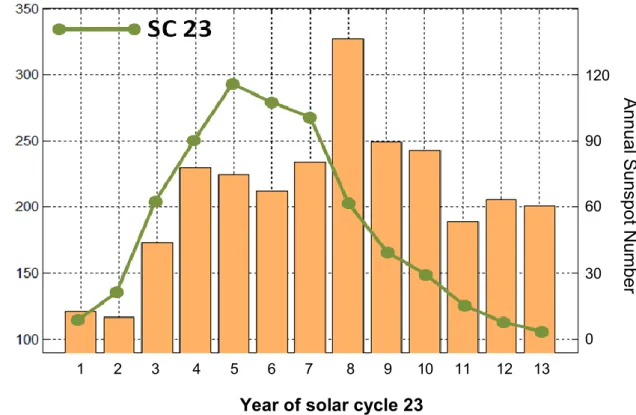
To examine the relationship between earthquake and HSSW [Lyatsky et al., 2007 and Gupta and Badruddin, 2010], we firstly monitor the yearly number of HSSW during solar cycle 23. The HSSW events shown in Figure 19 were selected based on the factors is mentioned earlier in Chapter 2. We can see that the number of HSSW event is higher during the descending phase as compared to ascending phase of solar cycle 23. The trend is similar to that of the amount of earthquake energy in Figure 20.

Figure 20 presents the solar cycle distribution of the average yearly energy released from global earthquake events at magnitude 4.0 to 9.9 Richter scale.

Maximum energy is released during descending phase of solar cycle 23, coinciding

with the number of HSSW detected in the previous figure. This similarity shows a

possible relation between them. Therefore, further analysis is needed to examine

their relationship.

(48)

36

Figure 19: Yearly number of high speed solar wind event during solar cycle 23

Figure 20: Yearly earthquake energy released during solar cycle 23 120

90

60

30

0 120

90

60

30

0

A n n u a l S u n sp o t Nu m b e r A n n u a l S u n sp o t Nu m b e r

Num b e r o f HS S W E ve n t T o ta l E Q E n e rg y [ Jo u le] ( x 1 0 18 )

2

1.5

1

0.5

0

1 2 3 4 5 6 7 8 9 10 11 12 13

Year of solar cycle 23

1 2 3 4 5 6 7 8 9 10 11 12 13

Year of solar cycle 23

(49)

37

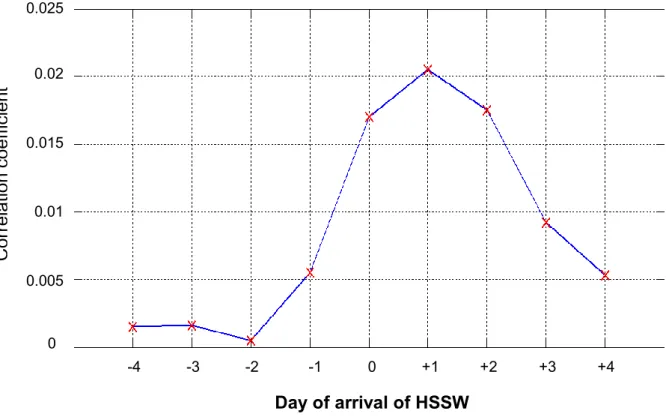
The plot for day-to-day variation of big earthquake events (magnitude 6.0 or greater) with respect to HSSW is shown in Figure 21. It is a correlation analysis of earthquake with respect to the days of arrival of HSSW. X axis represents the day of arrival of HSSW (0), one day before and one day after the arrival of the HSSW (-1 and +1, respectively), etc. Y axis represents the correlation coefficient between earthquake event and HSSW. The analysis was done for the period of 4 days before and 4 days after the arrival of HSSW event from year 1964 to 2008, covering 4 solar cycles 20 to 23. For this analysis, we have calculated the correlation coefficient between earthquake and HSSW events for each day of arrival of HSSW by shifting the earthquake events from 4 days before to 4 days after the arrival of HSSW.

The result shows correlation coefficients keep increasing from 4 days before the arrival of HSSW event and reached maximum one day after the arrival of HSSW.

The value of correlation coefficients decreased on the following days. From 1603 cases of HSSW within this period, 997 events or 62% were recorded on the day or within 4 days before the big earthquake events. Even though the values of correlation coefficients are low, the observation within this range suggests that, the period of 1 day after the arrival of HSSW corresponds well with the seismic events.

Gousheva et al., [2003] has compared the occurrence of global earthquake at magnitude 5.5 and greater with the HSSW during year 1973 to 2000 and obtained similar result.

The percentage of big earthquake events with respect to HSSW can be referred in Figure 22. The pie chart shows that the percentage of earthquake occurred 4 days before HSSW, on the day of HSSW and 4 days after HSSW are 26%, 9% and 35%

respectively. Only 30% out of 4108 big earthquake events not relate to the arrival of

HSSW. To relate with HSSW, only 46% of earthquake events occurred on the day of

(50)

38

the arrival of HSSW (10%) and within 4 days after HSSW (36%). Another 54% of

earthquakes occurred before the arrival of HSSW (25%) and beyond the observation

time (29%). We assume that, these 54% of earthquakes have no relationship with

HSSW. This shows that HSSW could trigger more earthquakes but the HSSW event

is not the only factor triggering the earthquake events. Earthquake events could be

triggered or caused by other geophysical factors such as the movement of tectonic

plates, accumulation of underground static dynamic stress [Kilb et al., 2000], crustal

faulting [Boatwright, 1997] and many more.

(51)

39

Figure 21: Correlation coefficient between earthquake and high speed solar wind

Figure 22: Percentage of Earthquake Events with respect to HSSW

-4 -3 -2 -1 0 +1 +2 +3 +4

Day of arrival of HSSW

Cor re lat ion co e ff ici e nt

0.025

0.02

0.015

0.01

0.005

0

(52)

40

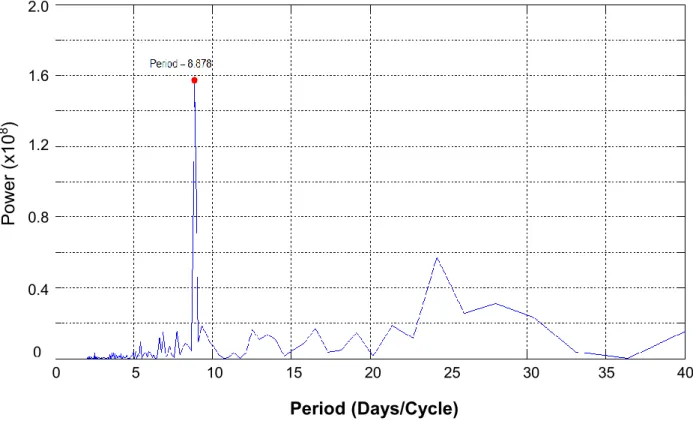
We further analyze the periodicity of solar wind speed based on the power

spectrum analysis as shown in Figure 23. According to the figure, solar wind speed

shows a prominent peak at around 9 days period during year 2005. To examine

wether global earthquake events have the same periodicity, we compared the power

spectrum of shallow earthquake events at epicenter depth < 40 km and deep

earthquake events at epicenter depth 40-100 km as shown in Figure 24 and 25

respectively. The plots show no significant peak around 9 days. This suggest that,

there is no one to one correspondence between solar wind speed and global

earthquake activity.

(53)

41

Figure 23: Power spectrum analysis for solar wind speed during year 2005

Figure 24: Power spectrum analysis for global earthquake at epicenter depth <

40 km during year 2005

0 5 10 15 20 25 30 35 40

Period (Days/Cycle)

0 5 10 15 20 25 30

Period (Days/Cycle)

2.0

1.6

1.2

0.8

0.4

0

P o wer ( x1 0 8 )

2.0

1.6

1.2

0.8

0.4

0

P o wer ( x1 0 6 )

(54)

42

Figure 25: Power spectrum analysis for global earthquake at epicenter depth 40-100 km during year 2005

0 5 10 15 20 25 30

Period (Days/Cycle)

2.0

1.6

1.2

0.8

0.4

0

P o wer ( x1 0 8 )

(55)

43

3.5.2 Relationship of EQs with High Solar Wind Dynamic Pressure

In space weather study, the effects of solar wind to the earth system are very significant. Solar wind dynamic pressure enhancements are known to cause various types of disturbances to the magnetosphere. Solar wind dynamic pressure sometimes increases abruptly. The effect of such an abrupt increase on various types of magnetospheric phenomena has long been a subject of active research.

The types of effects include ground magnetic disturbances [Russell et al., 1994], geosynchronous magnetic field response [Lee et al., 2004], geosynchronous energetic particle disturbance [Lee et al., 2005], auroral disturbance [Lyons et al., 2000; Zesta et al., 2000; Boudouridis et al., 2003], and energetic neutral atom response [Lee et al., 2007].

Since solar wind dynamic pressure is a function of solar wind speed, and is able to affect the magnetospheric and ionosphere, it is worthwhile to evaluate the statistical significance of dynamic pressure with the occurrences of earthquake events. To our knowledge, there is no reported work on this topic so far.

To examine the possible relationship of dynamic pressure with the earthquake

event, we have statistically compared the yearly SW Pdyn and the energy released

from earthquakes during solar cycle 22 as shown in Figure 26 and Figure 27,

respectively. The annual SW Pdyn in unit nano Pascal (nPa) was plotted during the

11-year period of solar cycle 22. We can see the SW pdyn is higher on the sixth year

of solar cycle 22 before decreasing in the following years. On the tenth and eleventh

year, the SW Pdyn increased abruptly. The annually averaged energy from

earthquake shows the similar pattern (Figure 27). Annually averaged earthquake

energy increased tremendously during the last two years of solar cycle 22 to more

than 2.5x10 17 Joule, nearly double of that in previous years of solar cycle 22 with

(56)

44

average energy only around 1.3x10 17 Joule. The similarity between the annually

averaged of SW Pdyn and earthquake energy during 11-year period of solar cycle 23

shows the possible interconnection between them. Therefore, it is necessary to

further analyze both parameters to establish a better explanation for the possible

influence of SW Pdyn to the earthquake events.

(57)

45

Figure 26: Yearly solar wind dynamic pressure during solar cycle 22

Figure 27: Yearly total earthquake energy during solar cycle 22 180 - 150 120 - 90

60 - 30

0 - - 0 0

A n n u a l S u n sp o t Nu m b e r

A ve ra g e S W Dyn a m ic P re ss u re [n P a ]

3

1

0.5

0

1 2 3 4 5 6 7 8 9 10 11

Year of solar cycle 22

T o ta l E Q E n e rg y [ Jo u le] ( x 1 0 17 ) 2 1.5 1 0.5 1

0.5 0

ffdff

1 2 3 4 5 6 7 8 9 10 11

Year of solar cycle 22

180 150 120 - 90

60 - 30 0

- 0 0

A n n u a l S u n sp o t Nu m b e r

(58)

46

According to our preliminary analysis, the average daily value of SW Pdyn is 2.12 nPa. Based on this result, the value of 3 nPa has been chosen as upper threshold value to compare the day to day variation of high SW Pdyn with the occurrences of EQ events.

In Figure 28, we have compared the day-to-day variation of correlation coefficient for global earthquake events at magnitude 5.0 to 9.9 Richter scale with respect to the day of observed high SW Pdyn during solar cycle 23. In the graph, X- axis represents the day of observed high SW Pdyn (0 day), 1 day before and after the detected high SW Pdyn (- 1 day and + 1 day respectively), etc. Y-axis represents the correlation coefficient between earthquake event and high SW Pdyn.

The correlation coefficients are calculated by varying the onset time of earthquake event from 4 days before until 4 days after of high SW Pdyn. In the graph, we can see the value of correlation coefficients keeps increasing from 4 days before the high SW Pdyn and reached maximum 1 day after (+1) the high SW Pdyn. Even the values of cross correlations are low for this analysis, one can assume that if there is possible connection between solar wind dynamic pressure and seismic activity, the period of 1 day after high solar wind dynamic pressure detected is corresponding with the seismic activity. This correlation is similar with the trend between earthquake events and HSSW. The similarity of both parameters (HSSW and SW Pdyn) with earthquake events suggests a mutual mechanism connecting solar activity and seismicity.

The pie chart in Figure 29 shows the average fraction of earthquake events with respect to different time lag of high SW Pdyn onset day. Referring to the chart, 54%

of earthquakes occurred on the day or 4 days after the observed high SW Pdyn

events. Another 46% of earthquakes occurred within 4 days before the observed of

(59)

47

high SW Pdyn and beyond the observation time with percentage 21% and 25%

respectively.

Based on this analysis, statistically the SW Pdyn shows a good correspondence with earthquake events where the higher amplitude of SW Pdyn tends to trigger more earthquakes. However, further analysis is necessary to concretely establish the relationship between SW Pdyn and seismic activities since we are not sure what is (or are) the direct connecting parameters connecting them.

To date, several researchers have done different part of study which could be possibly considered as connecting events/parameters. Choi et al., [2008] statistically investigated the effect of SW Pdyn enhancements during geomagnetic storms. They reported that enhancement of SW Pdyn can be a substorm trigger under a prolonged southward of interplanetary magnetic field (IMF) condition. Other studies by Zhou &

Tsurutani, [2001] and Shi et al., [2006] also show promising results connecting SW Pdyn with geomagnetic storm.

In another aspect of study, Mukherjee, [2002] monitored the planetary index, Kp and Coronal mass ejection (CME) events and gives a hypothesis that the explosive events on the sun will transfer the energy into magnetosphere and generating geomagnetic storms which occasionally may affect the active faults to trigger shallow depth of earthquake. Han et al., [2004] reported that the occurrence of many geomagnetic storms will produce stronger eddy current in the lithosphere, then generates more heat and triggers more earthquakes events in China and western Mongolia.

By referring to both aspects of studies, it could be possible to consider

geomagnetic storm as one of the connecting parameters between the high SW Pdyn

and seismic activities. However, the investigation on the influence of geomagnetic

(60)

48

storms at various geographical regions could give different relationship due to the

latitudinal dependence on storm activities. These possibilities warrant further studies.

(61)

49

Figure 28: Correlation coefficient between high solar wind dynamic pressure and earthquake (magnitude 5.0-9.9) during SC 23.

Figure 29: Percentage of earthquake with respect to day of high solar wind dynamic pressure

-4 -3 -2 -1 0 +1 +2 +3 +4 Day of High SW Pdyn Onset

0.03 0.025 0.02 0.015 0.01 0.005 0

Cor re lat ion co e ff ici e nt

Gfdgh

Figure  2:  Typical  CME-HSSW  (red-line  detected  on  22  September  1999)  and  CH-HSSW (blue-line detected on 27 September 1999)
Figure 7: Superposition of yearly number of earthquake at epicenter depth &lt; 40 km  with sunspot number during solar cycle 20 to 23
Figure  9:  Variation  of  yearly  shallow  earthquake  event  with  respect  to  sunspot  number
Figure 11: Superposition of yearly earthquake energy with respect to sunspot  number
+7

参照

関連したドキュメント

A three-stage room thermostat is modeled to output three on/off control functions that can be used to control a system having a solar heat source, an auxiliary heater, and a

In particular, we consider a reverse Lee decomposition for the deformation gra- dient and we choose an appropriate state space in which one of the variables, characterizing the

Keywords: continuous time random walk, Brownian motion, collision time, skew Young tableaux, tandem queue.. AMS 2000 Subject Classification: Primary:

A wave bifurcation is a supercritical Hopf bifurcation from a stable steady constant solution to a stable periodic and nonconstant solution.. The bifurcating solution in the case

In order to be able to apply the Cartan–K¨ ahler theorem to prove existence of solutions in the real-analytic category, one needs a stronger result than Proposition 2.3; one needs

This paper presents an investigation into the mechanics of this specific problem and develops an analytical approach that accounts for the effects of geometrical and material data on

While conducting an experiment regarding fetal move- ments as a result of Pulsed Wave Doppler (PWD) ultrasound, [8] we encountered the severe artifacts in the acquired image2.

Taking as the connected component of the subgraph in the Baby Monster graph induced on the set of vertices fixed by an element of order 3 and in view of (1.5)(iv) one gets the