PARTICLE ACCELERATION BY MAGNETIC RECONNECTION AND FAST MAGNETOSONIC SHOCK WAVES
IN SOLAR FLARES
JtJ.n-ichi Sakai* and Yukiharu Ohsawa**
·ABSTRACT
This article reviews recent development of the theory of current loop coalescence and fast magnetosonic shock waves, giving particular attention to particle acceleration caused by these processes.
It is shown that the spiral, two sided plasma jets can be explosively driven by the plasma rotational motion induced by magnetic reconnection during the two current loop coalescence. The rebound following the plasma pinch driven by the Lorentz force can generate the fast magnetosonic shock waves.
For a weak magnetic field (wce<wpe), strong acceleration by the shocks' occurs to proton only.
While the simultaneous acceleration of protons and electrons takes place in a rather strong magnetic field such that Wce�Wpe· Resonant protons gain relativistic energies within the order of the ion cyclotron period (much less than l s for solar plasma parameters) . The electron acceleration time is shorter than the ion cyclotron period.
Keyword; Magnetic reconnection,.Shock acceleration, plasma j et formation, Magnetic collapse, Solar flares, Current loop coalescence.
1. I NTROD U CTI O N
· I 2 3
The solar flare (for previous summaries, see Svestka, 1 976; Sturrock , 1 980; Kundu et al. ,
1986; Sturrock et al. ,
41 986) is a manifestation of the explosive release process of magnetic energy stored in the lower corona. During the solar flare a large amount of energy, up to 1032 ergs , is released in the solar atmosphere with atime period of a few to about ten minutes. Energy release in solar flares can occur in various forms; plasma heating from 1 0k to 5 · 1 0k. acceleration of charged particles up to relativistic energy, plasma jet motions, and production of electromagnetic radiations in the range from the radio to r-ray wavelengths.
In order to fully understand the whole picture of solar flares, we must investigate at least the three physical processes related to magnetic energy, i.e., generation, storage, and dissipation of
* Department of Applied Mathematics and Physics, Faculty of Engineering, Toyama University, Toyama
930
Japan* * Institute of Plasma Physics, Nagoya University, Nagoya 464 Japan
Bul letin of F aculty of E ngi neeri ng Toyam a University
1989
Evolution of a Solar Flare
Current generation and storage of magnetic energy
I
photospheric plasma motionsI
Vrot Vshear
Dissipation of magnetic energy through reconnection
current loop coalescence nonlinear kink instability
Flare phenomena
plasma heating and plasma motions
� �
radiations
shock waves
high energy particles
Fig.l Evolution of a Solar F lare
magnetic energy. We show a possible senario for the solar flares in Fig.1 ( Sakai and Ohsawa, 1987
5) , which has been drawn with particular attention to the generation, storage, and dissipation of magnetic energy.
Direct observations of soft X-rays ( Howard and Svestka, 1977
6) showed that multiple bright
coronal loops exist in the magnetic active regions of many magnetic bipoles. These loops may carry
plasma currents, which can be generated by photospheric plasma motions in active regions such as
SAKAI • OHSA W A : PARTICLE ACCELERATION BY MAGNETIC RECONNECTION AND FAST MAGNETOSONIC SHOCK WAVES IN SOLAR FLARES
shear motions of sun spots and rotational motions. Mutual interactions of interconnecting coronal loops could be quite an important physical process for magnetic energy release in solar flares
7
8 9(Gold and Hoyle, 1 960; Taj ima et al. , 1 9 8 2 ; Taj ima et al. , 1 987) . In fact, recent observations of
10 11
H
aemmision, radio waves (Kundu , 1 98 2 ) and hard X-rays (Machsdo et al. , 1 988) suggest that the interactions of coronal loops in the impulsive phase lead to the solar flare.
In order to explain the rapid quasi-periodic acceleration of both ions and electrons observed in the June 7, 1 980 flare, Taj ima and Sakai ( 1 985 � 21 9861 ) and Taj ima et al. ( 1 9 82 � 1 987 J showed
that the most likely mechanism for the impulsive release of magnetic energy in solar flares is the current loop coalescence (for review, see Sakai and Ohsawa, 1 98 7 J . It has been shown by theory
14
15
)9,.and simulation (Sakai and Tajima, 1 9 86, Tajima and Sakai , ·1�89) that during the coalescence of two current loops, the magnetic reconnection can explosively transform the magnetic energy to kinetic energy, producing high energy particles and increasing plasma temperatures. The transformation can occur within the Alfven transit time across the currnt loops, which is about 1 - 1 0 s for appropriate loop radii. Furthermore, the energy release can be achieved in quasi-periodic manner, when the ratio Bp/Bt between the poloidal (Bp: produced by the loop current) and the toroidal (Bt: potential field) components of the magnetic field is greater than one. While in the reverse case. Bp/Bt< 1 , the energy release by magnetic reconnection is not so explosive compared with the case of Bp/Bt > 1. In this situation the two current loops begin to rotate around the reconnection point shown in Fig. 2 (Sakai , 1 989) . After the coalescence of two current loops, the 17 single current loop can still do the plasma rotational motion as shown in Fig.2 b-d
a b c d
Reconnection
-
-+�
·- �
�
v� �v�-
v�Loop-Loop Coalescence
Fig.2 Loop-Loop Coalescence
Bulletin of Faculty of Engineering Toyama University 1989
In section 2, we show the results of spiral plasma jet formation driven by the plasma rotational motion induced during the two current loop coalescence process (Sakai , 1 989) . By means of a
17theoretical model based on the ideal
MHDequations, we find that the spiral, two sided jets can be explosively produced by the combination of the magnetic pinch effect (magnetic collapse) and the plasma pressure. The plasma rebound flow following the magnetic collapse can strongly induce the super·Alfvenic plasma flow, which can generate the fast magnetosonic shock waves.
In section
3,as a possible mechanism for high energy particle acceleration in the impulsive phase of solar flares, a new particle acceleration mechanism in the fast magnetosonic shock waves
18 5
is proposed (Ohsawa , 1 9 8 5; see for review, Sakai and Ohsawa, 1 987) . The collisionless fast magnetosonic shocks can promptly accelerate protons and electrons to relativistic energies, which
19
20
was found by theory and relativistic particle simulation (Ohsawa and Sakai , 1987; 1 9 8 8a , 1988b Y. The simultaneous acceleration of protons and electrons takes place in a rather strong magnetic field such that Wce2':wpe· Resonant protons gain relativistic energies within the order of the ion cyclotron period (much less than
Is) . The electron acceleration time is shorter than the ion cyclotron period.
In section4, we discuss some applications to solar flares.
2. PLASMA JET AND SHOCK FORMATION DURING CURRENT LOOP COALESCENCE The magnetic reconnection process during the current loop coalescence was reviewed by Sakai and Ohsawa (1987) . in which the effect of toroidal magnetic field
5(Bt) on reconnection was discussed. When the toroidal field, Bt is less than the poloidal field, Bp. explosive reconnection is observed and instead a plasma rotational motion around the reconnection point occurs when Bt becomes larger than Bp. This plasma rotational motion after the magnetic reconnection can be observed in the computer simulation of the two current loop coalescence (Zaidman , 1 986) . We call 22 this the threshold phenomena with the toroidal magnetic field. The same threshold phenomenon as the above is observed in simulations of reconnection triggered by impinging
MHDwaves (Sakai et al.2 t 984).
We consider the single current loop which can be produced by the two current loop coalescence shown in Fig. 2. After the magnetic reconnection, the single current loop can be produced and the plasma can be heated by the magnetic energy dissipation. At the same time, the plasma rotaional motion (V .p) around the reconnection point can be induced during the loop coalescence process when the ratio Bp/Bt is less than one.
In order to represent the spiral plasma jet nd spiral magnetic field structure associated with the jet which may be generated during the above process, we assume the physical quantities as follows;
for the velocity components, V
r= �r a . V.p = -r,
C1C1
Vz = bz, b
(2 .1)
SAKAI · OHSA WA: PARTICLE ACCELERATION BY MAGNETIC RECONNECTION AND FAST MAGNETOSONIC SHOCK WAVES IN SOLAR FLARES
for magnetic field componen:ts, B10 ( r )
B r
=Tb T , B
� =��� ( T),
B z
=7TbA Bo _2 B1 0 ( -z- ) ' (2.2)
where we used the cylindrical coordinates (r,rfl,z) , and the dot means the time-derivative. The time
dependent scale factors, a (t) , c 1 (t) and b (t) can be self-consistently determined from the ideal MHD equations with the adiabatic law (p - P
Y) . Bw.B20 and B0 are constants and A is a characteristic scale length which we are concerned with. From the continity equation. we find the density p as p
=p0/a2b, where Po is a constant. From the Maxwell equation,
weobtain the current j.
=cB2ol2rr A a2b, which flows along the loop. The time-dependent scale factors can be determined from the equations of motion as follows
2 2 2
•d a _ Cs 2 VA + c ·C 1 ) 2
7 - A2a21 1b1 1 A2ab a c;- '
d2b C5 2
7
=A2a2T 2br
,·2 2 2 "2
•d C1 _ VA2Cl + C 1 _2 a
•2
� - A2a2b ---c;,- ac� ,
where Cs 2
=p 10/ Po. vi
=B�ol 4rrPo. vi
=v A (Bw/B2o) 1 12.
We here assume that the pressure is given by ( ) _ ( ) (plr (t) r2 + P1z (t) z2) . p r,z,t - p0 t -
2 A 2 ,
where Po (t) ,p1r (t) and P 1z (t) can be determied from the adiabatic law as P o (t)
=p00/ (a2b)
Y,(2. 7)
0.6
where p00 and p10 are. constants.
0.4We show numerical results obtained from Eqs. �
0.2(2.3) - (2.5)' which determine the all physical e quantities such as the velocity field (2 .1) and the �
0.0magnetic field (2.2). The time is normalized by the
-0.2
(2.3) (2.4) (2.5)
(2.6)
Alfven transit time
-rA
=A /v A· The velocity is normalized by the Alfven velocity which is deter
mined from the poloidal magnetic field B2o. The initial conditions for the velocities are Vr
=-
1 0-6
(vAriA ) , Vz
= 1 0-6(vAz/A) and
v� = 0.1(vAriA ) . The plasma beta ratio is taken to be
0.0 1 .-0.4 '---'-'---'--..._-"'----'----'---'
0 ' 2 3 4 5 6
Fig.3
Bulletin of Faculty of Engineering Toyama University 1989
We take B1
=Bo and
y =5/3. Figure 3 shows the time evolution of the radial plasma flow
velocity.
5The initial rotational plasma flow induced
4 32
after the magnetic reconnection can drive the plasma collapse ( v r < 0) mainly by the jz X B
s6force, which corresponds to the second term of the right-hand side of Eq. (2.3) . During the plasma collapse, the explosive plasma jet in the z-direction can be produced as seen in Fig.4. The acceleration time to the maKimum velocity of the jet is quite short and about 0. 1 1
rA· The plasma jet can be driven by the combination of two forces. namely, the jzXBs£ (which drives the magnetic collapse) and the pressure gradient 0p/ 0z. The jet max
imum velocity obtained during the short time period is not so sensitive to the initial rotational velocity. We found the same results for the cases V
s6 =0.0 1 - 1 (vAr/ ;.) . The most important pa
rameter which determines the maximum j et veloc
ity and the acceleration time is the plasma beta ratio. When the beta ratio decreases, the maximum jet velocity also decreases and the acceleration time becomes long. While the beta ratio increases.
the maximum jet velocity increases and becomes super-Alfvenic within the very short time period.
o L----'---'---'---'----..L--.!...,_--1----'
The plasma jet obtained here shows the two sided flows which originate from the current coalescence region as seen in Fig. 2 .
'<:l
�
8.0
6.0
4.0
2.0
0.0 -1.0
0 0.4 0.8 1.2 1. 6
0 2 3 4
Time
( rA) Fig.5
5 6
As seen in Fig. 3 , the plasma rebound (vr>O) can occur following the plasma collapse. The velocity of the rebound can be enhanced by the magnetic collapse and adiabatic compression, when the plasma beta ratio is small. We here investigate the condition of fast magnetosonic shock waves by the rebound after the magnetic collapse. In the low beta plasma , the shock formation condition, Vr> (vA2+ cs2) 112, is given by
(2. 8) We obtain one condition which must be satisfied in Eq. (2 .8) . Namely, the term with a parenthesis of the left-handed side must be positive,
lb a> { 1 + (� �� ) 2 } 1 12. (2. 9)
If the condition (2 .9) is satisfied, the fast magnetosonic shock wave can be generated in the region
of r >rs. where rs is given by
SAKAI · OHSA W A : PARTICLE ACCELERATION BY MAGNETIC RECONNECTION AND FAST MAGNETOSONIC SHOCK WAVES IN SOLAR FLARES
(2.10) Figure 5 shows the time variation of .fb a in the case of
B1o = B2o =- 1 . The region where
.fb a > J2 is satisfied can be observed in Fig.5. The radius where the shock can be produced is around the scale length A·
If we take A - 1 08cm which corresponds to the loop radius, and the Alfven velocity v
A=500km/ s, the Alfven transit time is
r A =A IV
A =2seconds. Therefore the acceleration time to the maximum j et velocity is 0. 1 - 1s, depending on the plasma beta ratio.
The two sided jet flows originated from the current loop coalescence region may be observed during the impulsive phase.
During the plasma collapse, the strong electric field, E
=- (VX B) /c can be produced by the change of the magnetic field. This electric field can generate high energy particles within one second.
3. PROMPT S IMU LTANEO US ACCE LERATI O N OF PROTO N S
AND E LECTRONS T O RE LATIVISTIC ENERG IES BY S H OCK WAVES In previous section we showed that the fast mode shocks by the rebound following the magnetic collapse is very effectively formed, even though the colliding velocity of the two current loops is much less than the Alfven velocity.
1{!·21
Recently theoretical and simulation work (Ohsawa et al. ) has shown that a quasi-perpendicular fast magnetosonic shock wave can accelerate both protons and electrons to relativistic energies within a very short time period (shorter than
Is for the solar plasma parameters) . The simultaneous acceleration takes place in a rather strong magnetic field (wee
2::Wpe) . For weak magnetic field (wee<: Wpe) , strong acceleration occurs to protons only.
When the ambient magnetic field is weak (wee<wpe) , fast magnetosonic shock waves are well
24 25 26
described by nonrelativistic theory (Adlam and Allen , 1 9 58; Davis et al. , 1 958; Sagdeev ,1966) .
18
19For such nonrelativistic shocks, it is known (Ohsawa , 1 985; Ohsawa and Sakai , 1 987) that a quasi·
perpendicular fast magnetosonic shock wave can trap some ions and resonantly accelerate time in the direction perpendicular to the ambient magnetic field and parallel to the wave front up to the speed
(3 .1) where M is the Alfven Mach number. Those trapped ions are accelerated within a short time period, t - wci
1(m/me)
112,where wei· is the ion cyclotron frequency. When the resonant ions reach the maximum speed, equation (3. 1 ) , they are etrapped and left behind the shock front. For simplicity, we have written the expression of the maximum speed for a perpendicular shock in a zero beta plasma (for the maximum velocity in oblique shocks in finite beta plasmas, see Ohsawa, 1 986 ,
271986 J 8.
Equation (3 . 1 ) indicates that the maximum speed of resonantly accelerated ions increases with
the Alfven speed. Further it suggests that the resonant ions gain relativistic energies when the
Alfven speed is rather large, v
A>c (melmJ
112;this is equivalent to the condition Wee2:wpe· We will
Bulletin of Faculty of Engineering Toyama University 1989
discuss shock waves and particle acceleration in such a parameter regime.
First, we analytically show very briefly that ions can be promptly accelerated to relativistic energies for
arather strong magnetic field Wce2:wpe· From the analysis of single particle orbits in a monochromattc electrostatic wave E
=E x sin ( kx - wt ) propagating across the magnetic field B that points in the z-direction, it was shown ( Sagdeev and Shapiro 1 9 7 3 ; Sugihara and
29Midzno, 1 979 J0 that trapped particles can be accelerated in the direction parallel to the wave front and perpendicular to the magnetic field up to the speed v - cEjB. The strong longitudinal electric field in the shock region also traps some ions and resonantly accelerates them by the same mechanism. The quantity cEx/B in a shock wave can be calulated from the self-consistent nonlinear wave theory, and the maximum speed of resonantly accelerated ions is found to be
( 3. 2) where
(3. 3) with B the magnetic field strength normalized to the far upstream magnetic field strength B0, B = B/B0, and Bm is the maximum value of B. When the ambient magnetic field is weak, Eq. (3. 2 ) reduces the nonrelativistic equation ( 3. 1 ) . The resonant ions gain relativistic energies i n the time
. d
-1( I )
112peno
t-wciIDi IDe .
Next, we show simulation results; a relativistic particle simulation demonstrates a shock wave does accelerate some ions to relativistic energies, if the ambient magnetic field is rather strong ( wee 2wpe ) . Moreover, some electrons are also accelerated to relativistic energies; this is in contrast to the nonrelativistic shocks in weak magnetic fields ( wee <::wpe ) , in which strong acceleration occurs to ions only.
To study time evolution of shock waves, we use a 1 - 2/ 2 dimension ( one dimension in real space and three dimension in velocity space ) , fully relativistic, fully electromagnetic particle
1 8
simulation with full ion and electron dynamics ( for details of the code, see Ohsawa , 1 985 ) . In this particle code, each simulation particle moves according to the relativistic equation of motion. The electric and magnetic fields are governed by full z
Maxwell equations. The total number of simula·
tion particles is N
i =Ne = 65000. The total grid size is Lx = 1 02 4b.g, where b.g is the grid spacing.
All length and velocities in our simulations are
normalized to b.g and Wpe �g. respectively. The simulation parameters are the following. Is
The ion-to-electron mass ratio is m/me = 1 00.
The speed of light is c
=4. In the upstream region, the ion temperature is equal to the electron temperature T
i= Te, With the ion thermal speed
VTi =
0.08 1 and the electron thermal speed
VTe =0.8 1 . The strength of the external magnetic field is chosen so that Wee! Wpe = 3 in the far upstream
ion acceleration
Fig.6
y
SAKAI· OHSAWA: PARTICLE ACCELERATION BY M AGNETIC RECONNECTION AND FAST M AGNETOSONIC SHOCK WAVES IN SOLAR FLARES
Bi!:
Ex
u
E
� �
u Q) ---...
E
�
Q)80
40
0
10
2 1 0 -1 -2 6 3
-3 -6
Wce/Wpe=3 (a)
9=84°
Wpet=216
(C)
700 900 X
400
cp
200
0 30
(b)
(d)
700 900 X
Fig.7 Shock profile and the shock front is x::::800.
(a) 2 (b)
u
1
-...--....
E 0
>.
Q.
-1 Wce/Wpe=3
Wpet=216 -2
(C)
..(d)
u Q) -...--....
E
Q)
0
>.
Q.
-3 -6
500 700 900 500 700' 900
X X
Fig.8 Phase-space plots of ions(a)
& (b)of electrons (c)
&(d)
Bulletin of Faculty of Engineering Toyama University 1989
Px/m;C Py/m;C
2r-r-r-r-���,-, 2.-.-.-.-.-.-.-,-, (b)
0 -1
(c) (d)
0
-1
-2
o'--'---'--'--,-'-1 0---'----'---'---'220-2 0Wpet
55 11 0 165 220
Wpet
Px/meC
6 .-.-,-�-r��--�
Py/meC
6.-.-.-.-.-.-�.-.
(a) (b)
3
-3
-6 ����-L����
-6 ����-L����
6 5.-.-.-.-��----�
(c) (d)
3 -
-3
-6o.__�..-...�55__,__ 1�1 o---'--16�5-L2�2o -6oL-�55--'-- ,�1o---'--,6�5-L2�2o
UJpet UJpet
Fig.9 Time variations of momenta of strongly accelerated ion (a)
& (b)and electron (c)
& (d).SAKAI · OHSA W A : PARTICLE ACCELERATION BY M AGNETIC RECONNECT! ON AND FAST MAGNETOSONIC SHOCK WAVES IN SOLAR FLARES
region. For these parameters, the Alfven speed is v
A= 1 .2; the ion Larmor radius is 2.8; the electron inertial length is c/ Wpe = 4. The plasma beta ratio in the far upstream is f3 = 0.02.
Figure 6 shows the coordinate system, in which the shock front and the direction of accelerated ion are shown. Figure 7 shows shock profile at Wpet
=2 16. (a) is the magnetic field Bz (x) , (b) the potential
<}, (c) the longitudinal electric field Ex (x) , and (d) the transverse electric field Ey. The propagation angle of the is 84
° .The shock is propagating in the positive x·direction with Alfven Mach number M = 2.3, and the shock front is at x= 800 at Wpet = 2 16.
It is to be
notedthat in a relativistic shock wave the
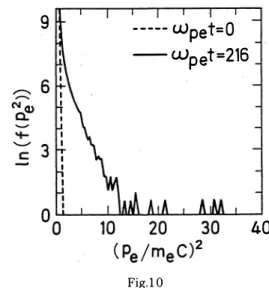
9 --- Wpet=O
-
wpet=216
Fig. l O
40
electric fields are so
strongthat
thequantities ExiBz and Ey/Bz are of the order of unity in the shock region, while in nonrelativistic shocks
thosequantities are much smaller than unity.
Figure 8 shows phase-space plots of
ions((
a) & (b)) and of electrons ((c) & (d)) . Both ions and electrons are strongly accelerated in
the shockregion
torelativistic energies.
The acceleration mechanism of electrons is different from that of
ions
. Itcan be easily seen from Figure 9 which shows typical time evolution of the momenta of a strongly accelerated ion ((a) & (b)) and of an electron ((c) & (d)) . Figures 9 ( a) & (b) show that a trapped ion is accelerated in the direction of the wave normal and to the negative y-direction until it is detrapped. While the electron gains kinetic energy making Larmor gyration many times as seen in Fig.9( c) & (d). The electron acceleration time is about the transit time of the plasma across the shock region (t -�/vsh with � the shock width and Vsh the shock speed) andhence much shorter than the ion cyclotron period.
Figure 10 shows the electron ditribution function in the region 640 � x � 800. Up to now, we do not have a theory that predicts the precise shape of the energy distribution function.
4. D ISC U SS I O N
W e have shown from a simple theoretical model based o n the ideal MHD equations that the two sided plasma jets can be explosively produced within the short time period. The fast magnetosonic shock waves can also be generated from the rebound after the plasma collapse. The fast magnetosonic shock waves can promptly accelerate both electrons and ions to relativistic energies.
This mechanism could play an essential role in the particle acceleration in the impulsive phase of solar flares. It explains following important features: (1) the acceleration occurs simultaneously to protons and electrons, (2) the acceleration time is quite rapid (within 1 s) , and (3) protons and electrons are accelerated to relativistic energies. If shock waves produced in rather strong magnetic field region where the corrent loop coalecence occurs (Bt > Bp) propagate out
toweak magnetic field regions, they will become ineffcient in accelerating electrons. However, they will
3 1