Atomic Evangelists: An Investigation of the American Atomic Narrative Through News and Magazine Articles, Official Government
Statements, Critiques, Essays and Works of Non/Fiction
髙田, とも子
https://doi.org/10.15017/4059961
出版情報:九州大学, 2019, 博士(文学), 課程博士 バージョン:
権利関係:
Doctoral Dissertation
Atomic Evangelists:
An Investigation of the American Atomic Narrative Through News and Magazine Articles, Official Government Statements,
Critiques, Essays and Works of Non-Fiction
Tomoko Takada
January 2020
Graduate School of Humanities
Kyushu University
has always provided me with unwavering support and guidance since the day I entered Kyushu University’s graduate program. In retrospect, I could not have chosen my research topic had it not been for his constructive advice. His insightful suggestions helped me understand that literature, or in a broader sense, humanities, can go far beyond the human imagination. I would also like to express my sincere thanks to the members of Genbaku Bungaku Kenkyukai, especially Kyoko Matsunaga, Michael Gorman, Takayuki Kawaguchi, Tomoko Ichitani and Shoko Itoh for generously sharing their extensive knowledge and giving me the most creative and practical comments on my research. Ever since I joined this group in 2011, their advice never failed to give me a sense of “epiphany”. As for the grants that supported my research for writing this dissertation, I am extremely grateful to Kyushu University Graduate School of Humanities, JSPS, The America-Japan Society and the US Embassy in Japan for offering me the invaluable opportunity to conduct my research in the United States. To my family Shohei Takada, many thanks for your unparalleled support, tolerance, wisdom and strength to pull us through the many hardships for the past 13 years. Finally, I also wish to thank Emi Okamoto, my colleague and comrade, whom I admire so much. Without her benevolence and helpful advice on my English, this thesis would never have been completed. Thank you very much.
______________________________________________________________________
Introduction 1
Chapter 1. First Correspondents’ Atomic Reportage 21
Chapter 2. Genesis in 1945: The Rhetoric of William L. Laurence’s Nuclear Articles and Judeo-Christian Atomic Propaganda 47
Chapter 3. John Hersey’s Sensational Text and the Context of the American Society Between August 6, 1945 and August 31, 1946 83
Chapter 4. Lewis Mumford’s Atomic Narrative and Possibility of Future Nuclear Criticism 111
Chapter 5. Retelling the Story of Nagasaki: Susan Southard’s Nagasaki: Life after Nuclear War and the Western Atomic Narrative Sphere of Nagasaki 138
Ending Chapter: Reconsidering the “American” Atomic Narrative 180
Works Cited 195
Introduction
Since the two atomic bombs were dropped on Hiroshima and Nagasaki, the word “nuclear” has been closely intertwined with the image of “fear” in the Western literary context. As Robert A. Jacobs, an American historian, noted The Dragon’s Tail: Americans Face the Atomic Age, the word “nuclear fear” had become a serious issue as it spread through popular culture. In this Western context, as John W.
Treat observes in Writing Ground Zero: Japanese Literature and the Atomic Bomb (1995), apocalyptic fear toward nuclear power is emphasized without focusing on the hibakusha, the atomic bomb victims, as though they never existed.
In the United States, it seems that it all started on August 7, 1945, when a sensational article appeared on the front page of The New York Times (see figure 1). The title of the article is “First Atomic Bomb Dropped on Japan.” On this day, not only the front page, but nearly the entire paper was devoted to articles relating to the first atomic bomb. The readers were able to learn about the details of the atomic bomb and see the previously the veiled faces of those involved the production of this enigmatic power. Scientists such as Robert J. Oppenheimer, Enriko Fermi, Neils Bohr and James B. Conant are lauded as the leading members of the Manhattan Project, with the paper showing large photographs of each of their faces.
The most outstanding article of the day was the statement signed by Harry S. Truman, the 33rd President of the United States. This statement not only suggested that the power of the atomic bomb should be “praised” as God’s power, but also emphasized the U.S. acquirement of this power ahead of Germany is nothing if not “Providence.” This first atomic statement both shocked and pleased
the American public by its clever use of images and metaphors derived from the Old Testament. It was as if the dystopian fictional world of H.G Wells’ The World Set Free (1914) had become a reality.
Yet, as far as one can see in the letter-to-the-editor columns in the newspapers of that era, the people of the U.S. seemed to have embraced this statement enthusiastically, not without a sense of smugness over Truman’s declaration that the Americans are
“the chosen”:
Sixteen hours ago an American airplane dropped one bomb on Hiroshima, an important Japanese Army base. That bomb had more power than 20,000 tons of TNT. It had more than two thousand times the blast power of the British “Gland Slam” which is the largest bomb ever yet used in the history of warfare.
[. . .] It is an atomic bomb. It is a harnessing of the basic power of the universe. The force from which the sun draws its powers has been loosened against those who brought war to the Far East.
[. . .] We may be grateful to Providence that the V-2’s late and in limited quantities and even more grateful that they did not get the atomic Figure 1: The top page of the New York
Times on August 7, 1945.
bomb at all.
However, long before the atomic bomb was dropped on the two cities, stories of atomic energy had been told by the mass media and scientists, often with use of biblical images. Spencer R. Weart, the author of Nuclear fear: A History of Images (1988) observes:
[t]he most curious and unsettling thing is that every theme in such tales was already at hand early in the twentieth century, decades before the discovery of nuclear fission showed how to actually release the energy within atoms. The imagery, then, did not come from experience with real bombs and power plants. It came from somewhere else (Nuclear Fear 4).
This story linking atomic energy with the power of God became more popular in the era of the Cold War. During this time when the nuclear arms race was a grave matter, nuclear iconography became widespread through popular culture in the form of novels, movies, TV programs, commercials, graphic novels, and even games.
It can be said, as Mike Gorman states, within this cultural context, nuclear technology came to be perceived as a “motif,” rather than an actual “threat”
(Gorman, 124).
Over the years, a lot has been written about the relationship between nuclear images and fear. Among them, American historian Robert Jacobs’s The Dragon’s Tail: American Face the Atomic Age (2010) is particularly notable.
According to Jacobs, the nuclear image as an icon set off a chain reaction of “fear”
and became the basis of an apocalyptic discourse in the American post-atomic culture. As Jacobs points out, when stories of the two atomic bombs are told and described within this cultural context, the “apocalyptic image” dominates most of the narrative. What is more striking is that in this kind of narrative, the hibakusha,
namely the atomic bomb victims, are ignored and treated as though do not exist.
Critics such as John W. Treat have observed that this type of apocalyptic narrative is the most remarkable characteristic of American atomic texts.
This raises the following questions: why did such an apocalyptic atomic narrative emerge in the first place? Are there any foundational texts that helped promote such perspectives? What was happening just after Hiroshima and Nagasaki in the context of the American atomic discourse? The objective of this thesis is to show that the American texts on Hiroshima and Nagasaki have never been analyzed from a literary perspective, and that it is necessary to study such texts from this angle. Of course, some of the works are indeed remarkable and even considered historical, exerting influence on atomic discussions even to this day, as seen in Spencer R. Weart’s Nuclear Fear (1988), or Paul Boyer’s By the Bomb’s Early Light (1995). However, from the post-atomic era to the present day, atomic texts including newspaper and magazine articles, reportages, documentaries, and official government statements have mainly been used as “tools” by historians for the purpose of discussing particular historical events, such as the censorship imposed by the American government, nuclear disarmament, or the nuclear arms race. As a result, the worth and meaning of American atomic texts have become undermined.
Considering the point above, this thesis will cast light on the overshadowed stories and discourses by mainly focusing on newspaper and magazine articles, official government statements, critiques, and works of nonfiction written by American writers, all of which are known to have spread widely among the American public in the atomic age. While referring to the preceding studies conducted by historians, this thesis seeks to illuminate the obscured details of
Hiroshima and Nagasaki by investigating relevant texts from a literary perspective. There are five chapters in all.
The first chapter, “First Correspondents’
Atomic Reportage,” aspires to reveal the hidden stories that exist behind the early journalistic texts on Hiroshima and Nagasaki. It is estimated that more than ten American war correspondents entered the devastated cities of Hiroshima and Nagasaki between the time the first atomic bomb was dropped on Japan and early September 1945. Because these first dispatches were famously written under strict censorship implemented by the General Head Quarters (GHQ), many historically significant works of nonfiction have sought to explain why the journalists did not have the freedom to write their articles as they wished. This in turn meant not enough attention was given to the hibakushas, downplaying the hardships endured by the bomb victims as a result.
Monica Braw’s The Atomic Bomb Suppressed: American Censorship in Japan 1945-1949 (1986) is perhaps the most prominent example. While examining this historical background, this chapter will focus on other aspects of these reportages by examining them as the first publicly released atomic narratives. Two important articles written by the war correspondents Homer Bigart and George Weller will be investigated in detail. Like the other atomic articles written by American journalists, the reports of Bigart and Weller went under strict censorship.
However, they were unlike the others in that Bigart’s Hiroshima reports and Figure 2: The Cover photo of
George Weller’s First Into Nagasaki, published in 2015.
Weller’s Nagasaki coverages attempted to highlight the unknown aspects of the two cities.
Homer Bigart, who entered Hiroshima as one of the government’s press members, released his first Hiroshima report on September 5, 1945, just a month after the first bomb was dropped on Hiroshima. What should be noted here is that this firsthand Hiroshima report was not just an ordinary on-the-spot news coverage. On the surface, Bigart’s report seemed like a run-of-the-mill news article illustrating the aftermath of the bomb, with considerable appeal to the American public with its sensational descriptions of the ruined city of Hiroshima.
However, because of its populist nature, his report was thought to have little literary value: it has been historically bracketed with the other wartime press reports and has never been analyzed in a literary context. Still, taking a closer look at Bigart’s report today, there seems to be an element that distinguishes it from the others, rising above the framework of conventional news coverage. Despite the strict censorship, he managed to give details on not only the ruined city, but also the conditions of the victims. Whatever his intent was, he had captured the essence of the lives of hibakushas. This raises the next question: how can a horrifying event, namely, the atomic holocaust, be described through the eye of a writer who has not experienced it?
It was just after the two cities were destroyed that many news articles about the atomic bomb were published in the United States. Most of these articles focused on nuclear energy, which later became the focal point of the apocalyptic atomic narrative. Of course, there were some exceptions, and some articles focused on the damage done to human bodies, such as injuries sustained by the bomb victims. A recent study conducted by The Foreign Correspondents’ Club revealed
that the first on-the-spot dispatch had been written by the Japanese American Leslie Nakashima, who entered Hiroshima on August 27, 1945. His report, entitled
“Hiroshima Gone, Newsman finds” appeared in the New York Times on August 31, 1945. In this article, Nakashima, who entered Hiroshima in search of his mother, focuses on the devastating panorama of Hiroshima and suffering victims as well.
Another exception was Australian journalist Wilfred Burchett, who was able to successfully send his whole Hiroshima report to the Daily Express in London on September 5, 1945. The report was titled “The Atomic Plague,” explaining radiation sickness and nuclear fallout. Subsequently, the GHQ ordered a strict censorship and banned the coverage of the atomic wastelands of Hiroshima and Nagasaki without their permission. Because Nakashima and Burchett were free from censorship, they were able to perceive the two bombed cities without being biased.
According to Braw, under the censorship, describing the victims’ sufferings or referring to radiation sickness were strictly forbidden. In this situation where the victims of Hiroshima and Nagasaki are not visualized, Bigart’s atomic report attempts to discover the hibakusha, making the readers feel that Hiroshima is closer to their everyday lives than they had ever imagined. Considering these points, this first section will investigate how this writer covertly tried to depict the pain of the hibakushas, who were regarded as a complicated existence among the American people.
The second section will focus on another important Nagasaki writer, George Weller. His coverage of Nagasaki is said to be one of the first atomic texts and is a compilation of several dispatches. Unlike Bigart and William L. Laurence, who conducted atomic research with other correspondents, Weller wrote on his own
during August and September of 1945. However, this series of dispatches were secretly censored, then banished just before Weller sent them to the Chicago Daily News. It was 60 years later that they were discovered and published as First into Nagasaki (2005) by his family members.
One of the most unique elements of this “discovered” text is that the writer focuses not only on the bombing of Nagasaki itself, but also on the various brutal acts committed by the Imperial Japanese Army to the prisoners of war (POW). By depicting not only the devastating panorama of the hypocenter but introducing the accounts given by the prisoners of war, Weller tried to “decentralize” the memory of the Second World War. Decentralizing, in this case, is reminding the readers that Nagasaki is not the only place that was affected of this war, and that there are numerous victims other than the hibakushas of Nagasaki. This kind of Nagasaki narrative can be considered one of the first typical atomic discourses in the U.S. Considering this point, the second section of this chapter seeks to analyze Weller’s Nagasaki narrative as a story that reflects the American national memory during the Second World War, meanwhile making reference to memory studies.
The second chapter, “Genesis in 1945: William L. Laurence and Judeo- Christian Atomic Propaganda” is a rhetorical investigation of the master-narrative on the nuclear issue, which became widespread throughout the American society in the post Hiroshima and Nagasaki era. As mentioned above, more than ten American war correspondents entered the devastated cities of Hiroshima and Nagasaki between August 6 and early September 1945. Most of them were acclaimed journalists, such as Homer Bigart, whose series of articles about the Pacific and Korean wars earned him the Pulitzer Prize.Other early correspondents include the previously mentioned Leslie Nakashima, who is said to be the first
foreign reporter to write about Hiroshima, and George Weller, whose Nagasaki reports were allegedly banned by the U.S. Office of Censorship.
Among them was one journalist in particular who differentiated himself from other war correspondents. His name was William Leonard Laurence (1888- 1977), a New York Times science writer who would eventually wield enormous influence on the way American citizens regarded nuclear weapons. When compared to the other journalists who had entered the ruined cities of Hiroshima and Nagasaki, there are two elements that separate this writer from the others.
First, the U.S. government granted him a “privilege” for his great knowledge of nuclear power, which he had been accumulating since the early 1940s.
Because of this “privilege,” he was the only journalist allowed to witness the first nuclear test held in New Mexico on July 16, 1945.
Second, in contrast to the other reporters who wrote on-the-spot reports about Hiroshima and Nagasaki, Laurence openly showed support for the decision to drop the bombs on Japan and denied the existence of “radiation sickness.” Some scholars, such as Amy and David Goodman, have castigated Laurence for his insincere attitude toward Hiroshima and Nagasaki, and are currently lobbying for the withdrawal of his Pulitzer Prize. However, considering that his reports on nuclear weapons circulated throughout the entire nation via newspapers, the following point must be acknowledged: William L. Laurence was one of the most influential figures in forming the American citizens’ perspective and attitude toward nuclear weapons.
One remarkable feature of Laurence's articles on the atomic bomb is the writer's cold indifference toward the hibakushas, namely the victims of the two cities. That is to say, one does not find the “voices” of hibakushas in his reports as
in the writings of other journalists such as John Hersey and other press members.
Therefore, the meaning of “Hiroshima and Nagasaki” described by Laurence is completely different from that of the hibakushas people. For Laurence, atomic power and the nuclear weapon itself were synonymous with “God's power”: he was, as Stephen Walker emphasized in his book Shockwave Countdown to Hiroshima, a staunch devotee of that omnipotent power. This leads to the following question:
how was Laurence’s perspective toward nuclear energy formed in the first place?
As mentioned, recent studies have criticized Laurence for not only justifying but also endorsing the use of nuclear weapons. However, few studies have discussed the reason why Laurence became a worshiper of atomic power as a force akin to
“God.” The second chapter will focus mainly on Laurence’s attitude toward the atomic bomb, as well as on the difference between his perspective and that of the Japanese hibakushas.
Chapter 3, entitled “John Hersey's Sensational Text and the Context of American Society in the Early Atomic Age,” will focus on John Hersey's Hiroshima, which was published in August 1946 and has long been considered one of the most influential and sensational texts in the post atomic age. In 1999, the New York University Journalism faculty selected “The Top 100 Works of Journalism in the United States in the 20th Century,” and Hersey's Hiroshima took first prize, prevailing over other great texts such as Rachel Carson's “Silent Spring.” Hersey’s Hiroshima created a great sensation soon after its publication and became a best- seller, and much has been said about the response it triggered.The following is an excerpt from Robert J. Lifton and Greg Mitchell’s Hiroshima in America.
When a new issue of the New Yorker arrived at the very end of August it seemed no different from any other. The cover featured a generic picnic
scene. But quickly subscribers must have recognized that something was odd about this issue: there was no “Talk of the Town”; there were no cartoons. The entire issue was devoted to a “Reporter at Large” feature, sixty-eight pages long, titled simply “Hiroshima.” [...] The article caused an immediate sensation. All copies sold out on newsstands. The mayor of Princeton, New Jersey, asked every citizen to read it. The entire thirty- thousand-word story was read over the ABC radio network on four consecutive evenings, and many stations repeated the programs due to popular demand....Columnists and editors, most of whom had expressed strong support for the use of the bomb, nevertheless praised the article, many calling it the best reporting job of its time.(87-8)
As Lifton and Mitchell observe, Hiroshima enlightened even the people who supported the U.S. decision to drop the two atomic bombs. Until now, many critics have discussed how Hiroshima attained the readers’ sympathy and has completely changed the perspectives of the American citizens. Most of these critics maintain that Hiroshima impressed the American readers with its humanistic element, unlike the former atomic narratives that failed to vividly portray the bombed cities and citizens. Moreover, critics have argued that Hiroshima should be praised for portraying the Japanese people as human beings, not as a faceless Yellow Peril.To the average American, Hiroshima seemed to have unexpectedly burst into prominence as the first written account displaying a sympathetic attitude toward the hibakushas.
However, one important question must be raised. Why did Hiroshima garner so much attention in the fall of 1946, when the public’s interest on Hiroshima and Nagasaki was starting to fade? More importantly, was Hiroshima
the first text that depicted the hibakushas in such a way that allowed the Americans to clearly visualize the two bombed cities? These are the questions that must be answered in this paper.
Hiroshima has been called the text of morality, but in fact, it contains many realistic and grotesque descriptions of human beings. For example:
Mr. Tanimoto's way around the fire took him across the East Parade Ground, which, being an evacuation area, was now the scene of a gruesome review: rank on rank of the burned and bleeding. Those who were burned moaned, “Mizu, mizu! Water, water!” Mr. Tanimoto found a basin in a nearby street and located a water tap that still worked in the crushed shell of a house, and he began carrying water to the suffering strangers. When he had given drink to about thirty of them, he realized he was taking too much time. “Excuse me,” he said loudly to those nearby who were reaching out their hands to him and crying their thirst. “I have many people to take care of.” Then he ran away.
In this scene, Reverend Tanimoto Kiyoshi, who is one of the most important characters of Hiroshima, wanders around confused in the evacuation area, and is unable to do anything for the dying people. Here, the readers are shocked to see the reality of the atomic wasteland and are dismayed that Reverend Tanimoto's humanitarian efforts mean nothing in the midst of such havoc.
The same can be said about the scene where Father Kleinsorge, another vital character, sees the faces of twenty men wholly burned, their eye sockets hollow, the fluid from their melted eyes running down their cheeks (68). These realistic descriptions may isolate the readers from the hibakushas rather than stirring up feelings of compassion.
In spite of these matter-of-fact depictions of devastation and human nature, Hiroshima has been considered a humanistic text that makes the readers feel empathy toward the hibakushas. What element of Hiroshima elicited such response? The most important point to be made is that Hiroshima should not be seen as an individual text but must be regarded in relation to the texts that preceded its publication. In other words, even before Hiroshima made its debut, the American public was already pre-conditioned to embrace it with fervency.
Under this premise, the third chapter will focus on the two types of pretexts on the nuclear issues stemming from differing disciplines: religion and science.
In fact, religious discourse and scientific frame of knowledge have always shared an analogical relationship in the Western world. As Spencer Weart notes, the word “science” had been linked with the image of the apocalypse since the early 19th century, “when a fantastic novel, The Last Man, was published in France” in 1805 (Nuclear Fear 19). In the late 19th century, when the newly discovered scientific energy was made public, the word “atom” emerged within the apocalyptic discourse. According to Weart, the “atomic apocalyptic narrative” was already a familiar concept among the American citizens in the 1930s. During this period, many Christian sermons preached that the atomic power is an untouchable and omnipotent force. Just after the two bombs were dropped on Hiroshima and Nagasaki, American Christian churches reinforced this stance and began to speak out against the use of the all-consuming bomb based on moralistic grounds.
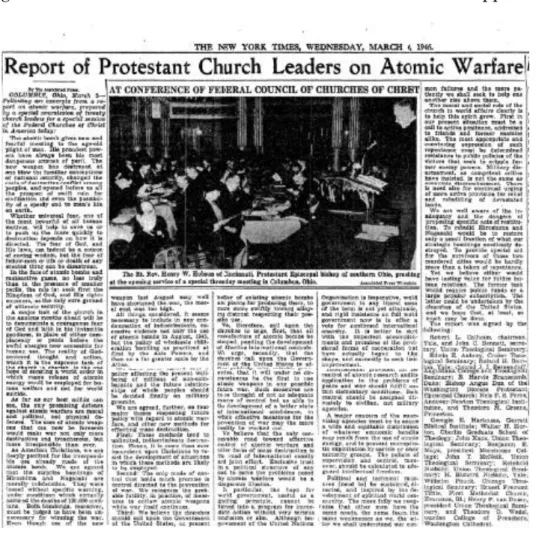
It was early 1946, six months after the two bombs were dropped, that the Federal Council of Churches of Christ in America published a report called “Atomic Warfare and the Christian Faith,” which castigated the use of the two bombs.
Around the same time, Phillip Morrison, an acclaimed scientist who was involved
in the Manhattan Project, released a firsthand essay on Hiroshima and Nagasaki.
By analyzing the rhetoric of these two texts, this chapter aims to examine a certain perspective that elicited enthusiastic response from the readers and made Hiroshima’s sensation inevitable. How these two narratives shaped the American attitude toward Hiroshima and Nagasaki must be reconsidered in this day and age.
Chapter 4, “Lewis Mumford and the Possibility of Nuclear Criticism” will focus on the anti-nuclear critique written by Lewis Mumford. Mumford is well known for his various works dealing with human civilization, such as The Story of Utopias (1922) and The Condition of Man (1944), which have been mainly discussed in historical and sociological circles. Based on these previous writings, Mumford started to publish nuclear critiques from 1945. Unlike most news coverages or media narratives on atomic bombs in the post Hiroshima and Nagasaki era, Mumford emphasizes humanity and insists that the use of atomic bomb should be recognized as a sin. Mumford’s nuclear critique can be seen as a counter-narrative toward the dominant atomic discourse that was spread predominantly through the media and official statements. To the present day, some historians such as Robert J. Lifton, Greg Mitches and Paul Boyer have already discussed Mumford’s atomic critique, but they have not focused on how these ideas originated. Considering this point, while mainly focusing on Mumford’s 1946 nuclear critique, this chapter will attempt to answer the following questions: in what aspect does Mumford’s nuclear critique differ from the dominant atomic narrative in the U.S.?When the two atomic bombs are discussed from a humanistic perspective, would it be possible to reevaluate Hiroshima and Nagasaki in American literary circles?
Based on the discussions from the previous four chapters, the fifth chapter, called “Retelling Nagasaki: Susan Southard, Nagasaki: Life After Nuclear War”
will consider the current situation surrounding Hiroshima and Nagasaki’s narrative sphere, focusing on the remarkable work of non-fiction published by the
American writer Susan Southard in 2015.
This award-winning reportage is markedly dissimilar from the American official atomic narrative. In her book, Southard sheds light on the lives of the Nagasaki hibakushas by mainly focusing on five survivors, all teenagers at the time of the bombing. It should be noted that by highlighting the historically overshadowed victims, Southard endeavors to create a new framework for understanding the Nagasaki bombing. When we consider that for decades, as John W. Treat notes, the pain of atomic bomb survivors have been overlooked in the American literary context, Southard’s Nagasaki may hold the key to retelling the story of the 1945 atomic warfare in an entirely new light. When Nagasaki: Life After Nuclear War won the Dayton Literary Peace Prize in 2016, Southard emphasized in her speech that the “witnesses” of the victims have been largely ignored in the American atomic narrative sphere, and that this is one of the main reasons why she was compelled to write this hibakusha story.
This raises the question of why, after a long period of silence, the hibakushas’ life stories appeared in 2015. What do we need to understand about this ambitious counter-narrative to the conventional atomic discourse? Could this Figure 3: The cover photo of
Nagasaki: Life After Nuclear War (2015)
text be read as something that can both overcome and update the dominant American atomic narrative? The purpose of the last chapter is to answer these questions while reconsidering the meaning of Southard’s Nagasaki narrative.
Additionally, how Southard’s Nagasaki story fits in the American atomic narrative history will be investigated.
Finally, the meaning of this thesis will be explained through the history of former studies. For over 70 years, much has been discussed and investigated from various academic angles on the issue of the two atomic bombs being dropped over the cities of Hiroshima and Nagasaki. Most studies focus on the background of the historical, sociological, and political aspects of the bombings.
There is, however, a “unique” academic approach that came into fashion in the 1960s, mainly among Japanese scholars, with the purpose of reconsidering the Hiroshima and Nagasaki issue from a broader perspective encompassing various academic disciplines such as literature, history, sociology, and art. The collective term for these studies is “A-bomb literature research.” From its inception, a series of critical reviews on acclaimed novelists such as Toge Sankichi, Hara Tamiki, Kurihara Sadako, Hayashi Kyoko, and Ibuse Masuji have been written. The academic movement in regard to atomic literature accelerated in the 1980s, when Nagaoka Hiroyoshi, a Japanese scholar, compiled Nihon-no-Genbaku-Bungaku, which consisted of fifteen volumes of Japanese atomic bomb literature. Following this, another celebrated Japanese scholar Kuroko Kazuo’s Genbaku-bungaku-ron (Critical Response to Atomic Bomb Literature) was published in 1993. Two years later, an American scholar, John W. Treat, published Writing Ground Zero:
Japanese Literature and Atomic Bomb (1995). Treat’s book is an example of how Japanese literature on the a-bomb and its devastating consequences impacted
American scholars.
It is undeniable that we Japanese have a duty to focus not only on Japanese
“A-bomb literature,” but also to study American literary works for a better understanding of Hiroshima and Nagasaki. By examining such works of literature, it will be possible for the Japanese to gain knowledge of the distinctly American perspective of this calamitous event, one that is no doubt quite different from that of the Japanese “A-bomb literature.” As stated above, Japanese “A-bomb literature research” has a relatively long history, but there seems to be only a few studies on how American writers describe Hiroshima and Nagasaki through literary works.
While some academics such as Martha A. Bartter and Gene Ray have examined how “nuclear issues” and “America’s paranoia of the unknown” are actualized in works of science fiction, such critiques have the tendency to focus not on the text itself but on the turbulent sociological situation of the Cold War era. Essentially, not enough research has been done on the early years when the notion of a nuclear holocaust first entered the American psyche or lexicon; furthermore, they scarcely investigate what such texts truly mean.
Therefore, this paper will focus on Hiroshima and Nagasaki narratives, written and told by American war journalists, Christian ministers, non-fiction writers, and critics, all of whom felt compelled to speak out about the two bombed cities. One important purpose of this study is to uncover their innermost thoughts on the bombings and unintentional inherent stories behind such discourses. More precisely, the questions that must be asked are: 1) What aspects of the reportages do the authors focus on? 2) Are there any differences between their discourses, and if there are, what are those differences? These are the questions at the core of this study.
The American stance toward Hiroshima and Nagasaki was quite sensational for me, who, as an average Japanese student, had been taught by teachers, parents, and relatives that Japan was the victim when it comes to the dreadful events of August 1945. I still remember how shocked I was when, upon starting my research, I read the novel Empire of the Sun (1984), written by J. G.
Ballard. The main character of this story, Jim, is a young British man captured by the Imperial Japanese Army and is imprisoned in a concentration camp in China.
On August 9, 1945, he witnesses a large, bright light shining over the far east. It was the atomic explosion of Nagasaki.
But a flash of light filled the stadium, flaring over the stands in the south- west corner of the football field, as if an immense American bomb had exploded somewhere to the north-east of Shanghai….Jim smiled at the Japanese, wishing that he could tell him that the light was a premonition of his death, the sight of his small soul joining the larger soul of the dying world.
However, even after this incident, the story continues as if nothing significant had taken place and the novel finishes with a happy ending. In contrast to the hibakushas’ stories, no one dies or is injured because of the bomb. The bombing of Nagasaki is merely mentioned in passing, with no influence on the storyline. This was the first time I realized that the story of the atomic bomb could be told with a different perspective than that of the hibakushas.
The standpoint of Empire of the Sun, which is markedly different from that of the Japanese, raised an awareness within myself of how crucial it is to regard a particular issue from various angles. Thanks to this realization, I have come to see Hiroshima and Nagasaki in a broader sense. The ultimate objective of this thesis
is to help resolve the discrepancy among the people discussing the memory of the two events and shed new light on the atomic narrative sphere by introducing a transpacific perspective.
The title of this thesis, Atomic Evangelists, has nothing to do with American evangelical churches or any organization in particular: there is no intention of making any political implications with the use of the word
“evangelists”. However, considering that words like nuclear energy, atomic bomb, or simply “atom” have long been used alongside Judeo-Christian imagery in the United States, the works of writers such as the war correspondents, non-fiction writers, and journalists mentioned in this thesis share some common ground with Christian pastors. These writers have explained the atomic bomb using simple words so that the U.S. readers can comprehend it easily. The point I find most fascinating is that these writers, since the inception of the atomic weapons, have strived to express their views on nuclear energy in a country where religion, science, and mass media are inextricably associated. Some have openly “praised”
atomic power in the name of God: in this narrative sphere, victims under the mushroom cloud are disregarded. When an event is told and committed to memory within a certain context, one should reconsider its implications: there may be a vast universe of parallel stories that are excluded from that discourse.
William Downey, who was a military chaplain assigned to the 509th Composite Group in charge of delivering the atomic bombs to their Japanese targets,celebrated the successful creation of the deadly weapons in his sermon. He spoke the following words during Mass shortly before the box car flew over Japan on August 8, 1945.
Almighty Father, who wilt hear the prayer of those that love thee, we pray
thee to be with those who brave heights of thy heaven and who carry the battle to our enemies. Guard and protect them, we pray thee, as they fly the appointed rounds. May they, as well as we, know thy strength and power, and armed with thy might may they bring this war to a rapid end.
We pray thee that the end of the war may come soon and once more we may know peace on earth. May the men who fly this night be kept safe in thy care, and may they be returned safely to us. We shall go forward trusting in thee knowing that we are in thy care now and forever. In the name of Jesus Christ, Amen.1
As George Zabelka, another chaplain in this mission later recalled, Downey subsequently came to strongly regret blessing the atomic bomb. The primary mission of these chaplains was to pray for the safe return of the bombardiers and to wish success in dropping the bombs on the Japanese cities. There seemed to be nothing wrong with this mentality in the context of August 1945. However, after the actual casualties and damages were made known, these chaplains’ holy discourses can be read in an entirely new light. Thus, the act of “telling a story”
sometimes reaches far beyond its original intent, in some cases leading people to unexpected destinations.
1 This sermon is quoted from https://www.lewrockwell.com/2007/10/laurence-m- vance/should-christians-be-military-chaplains/
Chapter 1: First Correspondents’ Atomic Reportage
I.Dispatch on the Pain of Others: Homer Bigart’s Hiroshima Coverage Both mentally and physically, it is impossible for humans to completely understand a certain incident unless theyexperience it for themselves. For many years, various Japanese atomic-bomb literature writers have written about their experience based on their own stories and most of them are survivors of Hiroshima and Nagasaki. It must be noted that when discussing Hiroshima and Nagasaki, the manner in which the writer is connected to the bomb experience is crucial.
Once that is established, we must examine how these writers describe Hiroshima and Nagasaki.
For example, Hara Tamiki, one of the most well-known writers of a-bomb literature, described the horrible reality of Hiroshima just after the bomb detonated. In Summer Flower (1947), he writes as follows.
Someone called me in a sharp, pitiful voice. Below I saw a naked young boy whose lifeless body was completely sunk in the water, and two women squatting on the stone steps less than four feet from the corpse. Their faces were swollen twice their natural size, distorted in an ugly way, and only their scorched rumpled hair showed that they were women. Looking at them, I shuddered rather than felt pity. (The Crazy Iris, 44-5)
The narrator “I” is not just a bystander, but one of the citizens who witnessed and experienced the white light on August 6, 1945. The narrator’s reaction to the suffering victims may seem rather cruel, but this “cruelty” also shows that the writer identifies himself with the bomb victims. The victims could have been the writer himself because they shared the same horrible experience on the same day
and place. The narrator’s eye is directed not only to the pain of the bomb victims, but also to the narrator himself. Throughout its history, Japanese atomic bomb literature has represented the pain of bomb victims and most of them have been written by the bomb survivors.
This raises two questions: how was the pain of bomb victims seen through the eyes of “others,” who had not experienced Hiroshima/Nagasaki? Moreover, how could they describe the unimaginable pain of the bomb victims?
When we focus on U.S. newspaper coverage soon after the bombings, we can see a remarkable tendency. That is to say, as soon as the first atomic bomb was dropped on the city of Hiroshima, "nuclear-control" became one of the biggest issues that the people were urged to consider. For example, on August 7, 1945, an editor of the New York Herald Tribune had already written an editor’s note titled
"The Atomic Bomb," and in this postscript, the editor connotes that this new weapon could bring about the destruction of the human race. He says:
It is as if the gruesome fantasies of the "comic" strips were actually coming true. It is as if we had put our hands upon the levers of a power too strong, too terrible, too unpredictable in all its possible consequences for any rejoicing over the immediate consequences of its employment. (New York Herald Tribune, August 7, 1945)
This note shows that from an early stage following the bombing of Hiroshima, the Americans had become obsessed with the idea that someday, perhaps in the near future, another atomic bomb created by another country could very well be dropped on any U.S. city. However, the “we” in the editorial note signifies only the U.S.
citizens, who had not experienced the atomic holocaust. The dead citizens of Hiroshima and Nagasaki are not included. On this point, one may say that the U.S.
response to Hiroshima and Nagasaki clashed with that of Japan's from the outset.
On one hand, Japanese people considered Hiroshima and Nagasaki as a starting point of world peace, but on the other, the Americans recognized the events as the dawn of a horrible atomic holocaust. This is one reason behind the discrepancy between the American and Japanese attitudes regarding the bombings of Hiroshima and Nagasaki. However, this sort of disagreement may be resolved if the two nations make attempts to understand the historical and social background of the other. It is vital that the Japanese try to see things from the American perspective.
In the 1960s, some American writers successfully described the U.S.
citizens’ inner distress toward atomic warfare by writing fictional stories. However, there are some questions regarding these fictional movements. What was the main sourceof the American peoples’ terror? Why did unease spread among U.S. citizens after the Second World War? In other words, what impact did Hiroshima and Nagasaki have to the American people? In regard to these questions, the newspaper coverages of Hiroshima and Nagasaki just after the Second World War may play a significant role in providing some answers.
In this section, the Hiroshima and Nagasaki coverage led by the New York Herald Tribune, one of the major newspapers in theU.S., will be examined closely, focusing especially on the Hiroshima reports written by Homer Bigart (1907-91).
Bigart was a two-time Pulitzer Prize winner and is to this day regarded as one of the most acclaimed journalists of the 20th century. He was chosen as one of the press tour members by the U.S. government, which meant he directly witnessed the aftermath of Hiroshima in early September 1945.
There is one thing that should be kept in mind. Homer Bigart's report on
Hiroshima is not an example of ordinary journalism. Rather, it is laden with literary techniques that allows it to be read as "literature." This is one of the important reasons why this paper focuses on his "Hiroshima report." Of course, a
“reportage” can be analyzed from various academic approaches, and each approach can have different results, since their perspectives differ from one other. In this paper, this report will be interpreted from a literary point of view, while focusing on the text itself, and attempt to reveal the author's idea and attitude toward Hiroshima. By doing so, some new aspects of the Hiroshima and Nagasaki reports may be discovered as a result of a completely new and different approach.
The main objective of this section is to analyze the "narrative technique" of Homer Bigart's Hiroshima report, and to investigate what we can learn from the effects of this technique. To demonstrate these points, it will be useful to firsthave an understanding of the tendency of the New York Herald Tribune's coverage of the atomic bomb during August 1945. Next, Bigart's Hiroshima report will be analyzed in detail, focusing on three significant points.
II. How the New York Herald Tribune Covered Hiroshima and Nagasaki in August and September 1945
First, it must be examined how Hiroshima and Nagasaki was reported by the New York Herald Tribune from August 7 to the end of September in 1945.
The articles that emphasize the atomic bomb's destructive power most frequently appear from August 7 to 15. These articles not only stress the bomb's devastating power, but simultaneously give biased information about the atomic bomb to the readers: they explain how the confidential “Manhattan Project” was launched and emphasizes the wonderous possibilities of nuclear energy for future
generations. Sometimes, these articles applaud the success of the two atomic bombs with photographs of the scientists who created them. It seems that in those days, these scientists were considered “heroes,” although they would later suffer from the tremendous guilt of having created such monstrous weapons.
It was just after the end of the Second World War that another, more apocalyptic kind of article started to appear frequently. These articles expressed more concern toward "nuclear control," and warned the public that the future use of atomic bombs can bring devastating consequences to humankind. The previously mentioned editor’s note, “The Atomic Bomb,” is a typical example. What is most interesting about such articles is that they have two different agendas. Though both types of articles discuss "nuclear control," their tones are very different.
The first kind leans heavily toward Christianity. As several pastors commented on August 13th, atomic power is seen as a force equaling God’s power, and therefore humans must not abuse it. Based on this line of thinking, they released multiple statements promoting nuclear control. One of the pastors stresses that “the thing we have to remember is that the power in the atom lay inert for centuries. Science did not create that power. It is God’s power. We must pray for its constructive use in the words of the Lord’s prayer, for Thine is the Power.” It is apparent that this logic defining atomic energy as God’s power is one feature of the American mindset, and is rarely seen in Japan, where Christian faith has not taken root in society.
The second type of article is more political. They demand stricter nuclear control because if every nation has atomic bombs, the destruction of the human race will surely become inevitable. It is obvious that behind this logic, there is a fear of being attacked by a foreign country. Such articles continue to appear until
Homer Bigart's Hiroshima reportage comes out on September 5, 1945, but after that, "Hiroshima and Nagasaki issues" gradually fade out.
III. Homer Bigart's Perspective Toward Hiroshima
Homer Bigart's "Hiroshima Reportage" appeared as the top issue on September 5, 1945. It is titled “A Month After the Atom Bomb: Hiroshima Still Can't Believe It,” and consists of six chapters. As the title shows, this is one of the first on-the-spot reportages written just after the first atomic bomb was dropped on Hiroshima. Before this report, he had written several articles for the Herald Tribune. For example, one was entitled “Air View of What Was Nagasaki: People Plod Across a Vast Ruin” appeared on August 28, 1945, but this Nagasaki report focuses primarily on the damages of infrastructure and buildings, so its readers could not be informed on what happened to the people in Nagasaki after the bomb.
The same can be said about the first paragraph of this Hiroshima report.
When taking a look at the first few sentences, it seems that there are no notable differences compared to the former atomic bomb coverages. It begins with the detailed description of the damages suffered by the city and the number of the people who died. The writer describes these things objectively, not subjectively.
However, whenthe text is carefully examined, it becomes apparent how the readers will likely be drawn in by the writer's ingenious narrative technique.
Because of the skillfully executed writing, the readers effectively relive the fatal day of the Hiroshima bombing. Let us explore these "narrative techniques" in detail.
IV. The Eyes of the Japanese
Bigart’s Hiroshima report starts as follows.
On the morning of Aug. 6, the 340,000 inhabitants of Hiroshima were awakened by the familiar howl of air-raid sirens. The city had never been bombed―it had little industrial importance....At 8 a.m. the "all clear"
sounded. Crowds emerged from the shallow raid shelters in Military Park and hurried to their jobs in the score of tall, modern, earthquake-proof buildings along Hattchobori, the main business street of the city. Breakfast fires still smoldered, in thousands of ovens―presently they were to help to kindle a conflagration.
Upon reading this report, the readers can see what the people of Hiroshima experienced on the morning of August 6, 1945, because the story is based on the eyewitness accounts of the Hiroshima citizens. Therefore, the readers can have a clear and vivid image of what it must have been like to be in Hiroshima on Aug.6.
As far as one can ascertain, this type of narrative first appears after the Herald Tribune started to cover the atomic bomb issue. What is more, we must focus on the fact that the writer uses the Japanese witnesses as "storytellers." These storytellers play a significant role within the text, because they possess the power to tell the reader what truly happened to the Hiroshima citizens on that day.
Another storyteller shares his experience:
When Lieut. Taira Ake, a naval surgeon, reached the city at 2:30 P.M., he found hundreds of wounded still dying unattended in the wrecks and fields on the northern edge of the city. "They didn't look like human beings," he said. "The flesh was burned from their faces and hands, and many were blinded and deaf…"
"The first thing I [Hirokuni Dadai] saw was brilliant flash," he said.
"Then after a second or two came a shock like an earthquake. I knew immediately it was a new type of bomb. The house capsized on top of us and I was hit with falling timbers."
This narrative technique using the Japanese people as “storytellers” allows the U.S. readers to see the destruction of Hiroshima not as a fantasy or an incident dissociated from their daily lives, but as something very real and close. The readers areintegrated with the protagonists in the story of Hiroshima.
V. The Old Man and the Writer
In the middle of this text, the readers meet a strange "old man." At first glance, this "old man" does not seem to be a significant figure, but it must be emphasized that he is actually one of the important characters in this text. The following excerpt appears just after the press tour members asked the naval lieutenant to halt some pedestrians and gather eyewitness accounts of the blast.
"They may not want to talk to you," he [the naval Lieutenant] said. But finally he stopped an old man, who bared his gold teeth in an apparent gesture of friendship.
"I am a Christian," said the old man, making the sign of the cross.
He pointed to his ears, indicating deafness, and the lieutenant, after futile attempts to make him hear, told us that the old man, like many others, apparently had suffered permanent loss of his hearing when the crashing blast of the atomic bomb shattered his eardrums....Down one street was the ruined wall of a Christian church, and near it the site of the Japanese Second Army headquarters.
The first thing that must be noted is that there are "dialogues" in this scene. In
fact, this interaction between the "old man" and the writer may not seem like a traditional dialogue because only the "old man" speaks in the text. In this respect, some may argue that this is only a "one-way communication." Besides, it is "we"
the readers who meet "the old man," not just the writer. However, the significance lies in the fact that the writer dares to focus on the actions of the old man, who reveals his Christian faith while showing his cross. Furthermore, when the writer reports on how much damage Hiroshima suffered, he does not forget to describe
"the ruined wall of a Christian church". This mention of "the ruined Christian church" corresponds with the communication with the old man. In other words,
"Christianity" functions as a common concept or sign shared between "the old man"
and the writer. For this reason, the excerpt can be seen as a “dialogue” between this old man and the writer. Thus, we can witness the "dialogue" between the old man and the writer in this scene, but the writer attempts to hide himself from the text: though the writer surely exists there, he seems to be missing from the text, since he does not include anything he might have said to the old man. For this reason, the reader may have the impression that only the old man talks in the text.
This makes the readers feel as if they entered the world of the story and had a conversation with the old man. However, they may later find that this is only an illusion.
Who is this "old man" and why does his name remain unmentioned in the text? In other words, why did the writer not give him a name? The most straightforward answer is that the writer could not ask the old man his name because of his deafness. However, we should think of this question on a more profound level, because if this Christian old man is given a name like Dadai Hirokuni or Kanazawa Masao, he suddenly becomes a fixed character and cannot
be perceived as just a fragile Christian man. This old man chooses to introduce himself not with his own name, but with his Christian faith, because by doing so, he thought he could bring himself closer to the Americans. In other words, "being a Christian" is his entire identity, and is more important than his real name. By introducing an old man who has nothing except his "faith,"the readers are made aware of the fact that they are interchangeable with the characters in the text.
VI. Who are “We?”
Finally, let us focus on the use of “personal pronouns” in this text. A close examination reveals that the Hiroshima and Nagasaki reports have a certain tendency when it comes to the usage of personal pronouns. If the writer is equivalent to the narrator within the text, the writer tends to use "I" when referring to oneself. This type of narrator can be seen in George Weller's Nagasaki reports. If the writer describes the Hiroshima/Nagasaki story based on the eyewitness accounts of someone else, the writer is missing from the text and has the tendency to use the third person for the witness. This type of narrator can be seen in John Hersey's Hiroshima. However, Homer Bigart's Hiroshima reports do not fall into either of those categories. To be specific, instead of missing from the text, the writer comes into view by using the term "we." It is worth pointing out that both the first and last sentences of this Hiroshima report start with the word
“we.”
We walked today through Hiroshima, where survivors of the first atomic- bomb explosion four weeks ago still dying at the rate of about 100 daily from burns and infections which the Japanese doctors seem unable to cure.
...They also asked whether Hiroshima "would be dangerous for 70
years." We told them we didn't know.
This raises a question: who are "we"? One possible answer is that the word "we"
signifies the writer and other press tour members. Or we could consider things from another angle: what if "we" includes the person outside the text, namely, the readers? When read this way, the entire report could be interpreted in a completely different manner, because if "we" includes the person outside the text, that person suddenly becomes one of the characters. The result is that they are confined to the text and unable to escape it. In this sense, the use of "we" can be understood as a literary technique to force the readers out of their tranquil daily lives into coming face-to-face with the dreadful reality of Hiroshima.
VII. What We Can Learn from Bigart’s Hiroshima Coverage
As examined earlier, the initial Hiroshima and Nagasaki coverages might have failed to convey in a real sense the magnitude of destruction regarding the atomic wastelands, since they mainly focus on the post atomic age situation.
Because of this, the readers most likely feel apprehensive about a future in which they must cohabitate with atomic bombs. On the other hand, such reportages do not help the readers imagine what truly happened in the two cities in August of 1945. When all these elements are taken into consideration, it is obvious that Homer Bigart's Hiroshima report contains some literary devices that differentiates itself from previous atomic bomb-related coverages.
As mentioned in the previous section, his narrative technique lures the readers into feeling that Hiroshima is something that is closely related to their daily lives, not some irrelevant incident that took place in a remote location. The first reason is that the readers go through a “simulated experience” when the
writer introduces the Japanese atomic bomb survivors as "storytellers." Secondly, the writer purposely inserts "the old man" whom he met by chance in Hiroshima as one who is only allowed to be defined by his Christian faith. As a result, the old man becomes interchangeable with the American readers, who are predominantly Christian. Finally, instead of using the third person or "I," the writer uses "we."
Because of this, the readers are integrated into the text, and they see the city of Hiroshima through the writer's eyes. In other words, contrary to the former coverages, this Hiroshima report allows the reader to see the atomic warfare from the Japanese hibakusha's perspective, and the readers feel more involved in the atomic field.
All of these literary techniques show the writer's attitude toward Hiroshima. It is widely known that during the Korean War, a series of articles Bigart had written earned him a Pulitzer Prize, but at the same time, he was accused of undermining General of the Army Douglas MacArthur. As we can see from this episode, one may argue that this writer was not so obedient, though he was chosen as one of the press tour members by GHQ. Although there is no way to know his true character, one thing is for sure: he made a tremendous effort to write exactly what he saw and felt, taking pains to paint an honest picture without any dramatization.
Some critics say that before John Hersey's Hiroshima, which appeared as a top issue of the New Yorker in August 31, 1946, few reports covered the destruction of Hiroshima and Nagasaki with focus on moral problems. As a result, the American people did not have access to specific information on what happened to those who had been in the two cities in August of 1945. This might be one of the reasons why Hiroshima was a best seller, and subsequently became one of the most
important works of literature in the 20th century. However, this fact does not in any way mean that Homer Bigart's Hiroshima report failed to cover the damages suffered by the citizens. Indeed, the uneasy situation just after the Second World War forced the American people to read this type of early atomic report in a certain way. That is why people had no awareness of the dreadful reality the people of Hiroshima were forced to contend with even after reading Homer Bigart's report.
The American were already obsessed with an atomic future from an early stage.
VIII. George Weller’s Banished Reports and Fluctuating Nagasaki Narrative In contrast to Bigart, whose Hiroshima report permeated the U.S. media immediately, another American war journalist, George Weller, was unable to have the American public read his Nagasaki reports until several decades later.
As a war correspondent of Chicago Daily Express, Weller sneaked into Nagasaki on his own just after the censorship began. Through September 6 to 9, 1945, he wrote several on-the-spot Nagasaki reports, then moved to Omuta City in Fukuoka Prefecture, where the internment camp was located. After interviewing several prisoners there, he once more entered Nagasaki and continued to write about the bombing of Nagasaki until September 25, 1945. The total of 32 reports he had written were censored, and then subsequently banned from being published.
It was about 60 years later that these texts were found by his family member, then published as First into Nagasaki in 2005.
As Robert J. Lifton, an American psychologist, states in Hiroshima in America (1995), Weller’s Nagasaki reports “would never appear in print in any form, despite the fact that Weller felt rather dispassionate about (and indeed, endorsed) the atomic bombings. Weller had bluntly described the physical and
medical effects of the Nagasaki bomb but ‘eschewed all horror angles,’ he later recalled” (50, emphasis added). For example, in the Nagasaki report written on September 8, 1945, Weller notes:
The atomic bomb may be classified as a weapon capable of being used indiscriminately, but its use in Nagasaki was selective and proper and as merciful as such a gigantic force could be expected to be…As one whittles away at embroidery and checks the stories, the impression grows that the atomic bomb is a tremendous but not a peculiar weapon. The Japanese have heard the legend from American radio that the ground preserves deadly irradiation. But hours of walking amid ruins where the odor of decaying flesh is still strong produces in this writer nausea, but no sign of burns or debilitation. Nobody here in Nagasaki has yet been able to show that the bomb is different than any other, except in the broader extent of its flash and a more powerful knockout (First into Nagasaki, 29-30, emphasis added).
According to this early dispatch, the atomic bomb is no different from any other weapon, and the use of the second atomic bomb is justified. However, Weller’s Nagasaki reports cannot be characterized as a mere endorsement of the atomic bomb. When these reports are examined more closely, we may discover that they have double meanings. It is true that Weller’s reports satisfy the desires of both the citizens and the U.S. government, which is the need to believe that the Japanese are savage. Inserting the POW’s accounts regarding the brutality of the Imperial Japanese Army works well in this light: while revealing the fact that Japan was not only the victim but also the perpetrator of brutal acts, the reports successfully help to decentralize Hiroshima and Nagasaki.
On the other hand, however, they discreetly raise a question on mass destruction. This double structure of Weller’s reports has a strong correlation with the author’s complicated point of view regarding the atomic holocaust and the American memory of the Second World War. In the next section, Weller’s fluctuating Nagasaki narrative will be closely examined by shedding light on the difference between “what the author actually witnessed,” and “what he believed”
in the American literary context during the Second World War.
IX. Changing Attitude: “Early Dispatches”
Weller’s Nagasaki report starts with the description of the damage done to buildings. Hibakushas do not appear at all in the early texts. In addition, as stated above, the narrator displays a positive attitude toward the use of the atomic bomb.
There is no mention of any “victims.” It is as if no one in Nagasaki got hurt.
However, this tendency changes in a short period of time. First, one must focus on the narrator’s perspective and ask this question: how does his viewpoint transition from focusing predominantly on the destructed buildings to devastated human bodies?
Weller’s twelve Nagasaki reports can be categorized into four types. In the first type, which we will call Group A, the atomic bomb is not significantly different from any other weapon of mass destruction, and its power is underestimated. The Group B texts are derived from the accounts given by POWs: they mostly condemn the myriad of brutal acts led by the Imperial Japanese Army. The Group C texts, on the other hand, refer to “disease X,” which is now known as radiation sickness and its harmful effect on the human body. Finally, the Group D texts mostly focus
on the damage to buildings but not on humans and depict the geographic panorama after the destruction. With these four categories in mind, the twelve Nagasaki reports will be investigated in respective order.
The earliest report, written on September 6, is turbulent. In fact, it is rather difficult to grasp the narrator’s attitude toward the bombing of Nagasaki.
On one hand, Nagasaki’s gruesome condition is described in a calm tone, as follows:
The mystery of the atomic bomb is still sealed. But the ruins are here in testimony that not only Nagasaki but the World was shaken….They [the atomic bomb] are burning the last human bodies on improvised ghats of rubbish…What looked like disinterest amid Nagasaki’s peace-imploring debris was the suppression of personal feeling in obedience to the emperor’s order. (25-6)
Figure 4: The POW camp in Koyagi, a small village near Nagasaki City, where Weller gathered the accounts of prisoners. (Courtesy of Nagasaki Atomic Bomb Museum)
The narrator casts sympathetic eyes toward the people of Nagasaki, who were forced to live in devastating conditions during and after the Second World War. Yet, this compassion is seen only in the beginning. In the following scene, the narrator’s lack of information about the atomic wasteland is revealed. This is because Weller depended on the account of one surviving hibakusha instead ofseeing for himself the damage done to the human bodies. In this first story, Nagasaki is universalized:
it is not very different from any other bombed city.
The following four consecutive reports, which were written from September 7th to 8th, were a compilation of accounts and dialogue gathered from POWs in Nagasaki (see figure). They can be categorized as Group B on the basis that these accounts condemn the various brutal acts led by the Imperial Japanese Army.
Whilecalling attention to the appalling acts of savagery such as the Bataan Death March, these reports alsoreinforce the national memory within the reader, which can be traced back to the attack on Pearl Harbor on December 7, 1941. Here, Nagasaki becomes decentralized as the crimes committed by the Japanese are examined under a harsh light. Furthermore, as Emily S. Rosenberg states in her book A Date Which Will Live: Pearl Harbor in American Memory (2003), the American Memory, which can be traced back to the day when the Imperial Japanese Army invaded Pearl Harbor, makes an appearance. On one hand, Nagasaki and its citizens are the second bombarded victim, but on the other, they are accomplices to Japan’s brutality. In the social climate of the U.S. in 1945, as John Dower states, Japan was considered a “Yellow Peril”. This sentiment against the Japanese permeated the official narratives and mass-media, forming a stereotypical American wartime frame of reference. Dower also states that contrary to Germany, where only the Nazis were considered to be the root of all