九州大学学術情報リポジトリ
Kyushu University Institutional Repository
無水バターオイルにおける非酵素的ラクトン生成に 関する研究
BUSARIN, CHONGCHAROENYANON
Laboratory of Food Process Engineering, Division of Food Science and Biotechnology, Department of Bioscience and Biotechnology, Graduate School of Bioresource and Bioenvironmental Sciences, Kyushu University
https://doi.org/10.15017/25184
出版情報:Kyushu University, 2012, 博士(農学), 課程博士 バージョン:
権利関係:
Study on Non-Enzymatic Lactone Release from Dehydrated Butter Oil
Busarin Chongcharoenyanon
2012
Study on Non-Enzymatic Lactone Release from Dehydrated Butter Oil
by
Busarin Chongcharoenyanon 2012
A Thesis Submitted in Partial Fulfillment of the Requirements for the Degree of
Doctor of Philosophy in Agriculture
Laboratory of Food Process Engineering, Division of Food Science and Biotechnology, Department of Bioscience and Biotechnology,
Graduate School of Bioresource and Bioenvironmental Sciences,
Kyushu University
Acknowledgement
I would like to express my very great appreciation and gratitude to Professor Mitsuya Shimoda, Laboratory of Food Process Engineering, Division of Food Chemical Engineering, Graduate School of Bioresource and Bioenvironmental Science, Kyushu University, for his valuable and constructive suggestions during the planning and development of this research work. His willingness to give his time so generously has been very much appreciated. I also wish to thank Professor Toshiro Matsui, Laboratory of Food Analysis, Division of Food Chemical Engineering, Graduate School of Bioresource and Bioenvironmental Science, Kyushu University and Associate Professor Noriyuki Igura, for their useful suggestion in the thesis preparation.
This is a great opportunity to express my gratitude to Assistant Professor Seiji Noma and Mr. Tatsuo Katoh, for their helpful advisements throughout the course of this study.
I would like to offer my special thanks to Dr. Dusida Tirawat and Miss Wannaporn Klangpetch, for their encouragement and Japanese language support. In addition, I am pleased to thank my Japanese friends and my Thai-Fukuoka friends for their valuable support and advisements.
I am very thankful to my family. I would not have been complete this thesis without their encouragement. This thesis is dedicated to my family. Finally, I would
like to express my deepest thank to Monbukagakusho: MEXT scholarship for supporting all expense for my life in Japan.
Busarin Chongcharoenyanon June 2012
- i -
LIST OF CONTENTS
ACKNOWLEDGEMENT
Chapter I Introduction
1 BUTTER OIL AND ITS RELATED PRODUCTS. . . .1 2 EXTRACTION OF VOLATILE FLAVOR COMPOUNDS
IN BUTTER. . . .10 3 LACTONE GENERATION. . . 13 4 RESEARCH OBJECTIVE. . . .16
Chapter II Volatile Flavor Compounds Extraction from Butter Oil by Low- Density Polyethylene (LDPE) Membrane Pouch Method
1 INTRODUCTION. . . 18
- ii -
2 MATERIALS AND METHODS. . . 26
3 RESULTS AND DISCUSSION. . . 30
4 SUMMARY. . . 41
Chapter III Lactone Release from Dehydrated Butter Oil 1 INTRODUCTION. . . 43
2 MATERIALS AND METHODS. . . .47
3 RESULTS AND DISCUSSION. . . 50
4 SUMMARY. . . 64
Chapter IV Conclusion. . . .65
LITERATURE CITED. . . 70
Chapter I Introduction 1
Chapter I
Introduction
1 BUTTER OIL AND ITS RELATED PRODUCTS
Dairy product is one of the most important food supplies for human. A primary source of consuming dairy is cow milk. Milk is so-called a perfect food due to its high nutrients of protein, fat, sugar, minerals and vitamins (Balcão and Malcata, 1998). Various dairy products, e.g., drinking milk, cream, milk powder, cultured products and butter can be made from milk. Figure I-1 shows a simple scheme of dairy production from fresh cow milk (Marta et al., 2011) Fresh milk is also called as a whole milk. It is centrifuged to separate cream/fat from skimmed milk. Drinking milk, yoghurt and dairy desserts are processed from whole milk and/or partially skimmed milk. The separated cream can be consecutively used to produce cultured
Chapter I Introduction 2
Figure I-1 Dairy production scheme. Adapted from Marta et al., 2011
Cream Skimmed Milk
Butter oil/Anhydrous Milk Fat
Buttermilk Powder
Butter Buttermilk
Sour Cream
Cream Cheese Milk Protein Concentrate
Skimmed Milk Powder
Casein
Fresh Cow Milk Drinking Milk,
Yoghurt and Desserts
Chapter I Introduction 3 products, i.e., sour cream and cream cheese or churned to produce butter with buttermilk as a by-product.
Butter is formed as water-in-oil emulsion containing (1) milk fat, (2) water solution of lactose, lactic acid, albumin and soluble mineral salt from milk, and (3) casein and insoluble mineral matter (Andrew and Kate, 1937). It contains about 80- 82% of milk fat (Douglas, 1995). There are mainly three kinds of butter; salted butter, unsalted butter and cultured butter. Table I-1 shows the composition of butter according to United States Department of Agriculture (USDA). As its high fat content, butter is a carrier of fat soluble vitamins; vitamin A, vitamin D, vitamin E and vitamin K. Milk fat provides a unique flavor and mouthfeel to dairy products in term of organoleptic (Ortiz-Gonzalez et al., 2007). It provides broad nutrition and various physical properties due to its high content of volatile soluble fatty acids, which differs from animal body or vegetable fat (Marta et al., 2011).
Butter oil containing 99.3% milk fat, is an anhydrous milk fat product.
Temperatures to melt butter are 50-80 ºC, while Ghee, that is an Asian traditional butter oil is prepared at 110-140 ºC (Özkanlı and Kaya, 2007; Lech, 2002). Butter oil is widely used in food industry due to its unique flavor characteristics. It is mainly used to enhance buttery and milky flavors in the productions of recombined milk and butter, manufacture of ice cream, confectionary, and fat spreads. In USA, partially lipolyzed butter oil is added to chocolate to enhance customers’ odor preference.
Chapter I Introduction 4 Table I-1 Composition of butter
Composition Butter
Salted butter Unsalted butter Nutrients/100g
Energy, kcal Water, g Protein, g Total lipids, g Saturated fat, g
Monounsaturated fat, g Polyunsaturated fat, g Trans fat, g
Cholesterol, mg Total carbohydrates, g Ash, g
717 15.87
0.85 81.11 51.37 21.02 3.04 2.98 215 0.06 2.11
717 17.94
0.85 81.11 51.37 21.02 3.04 2.98 215 0.06 0.04 Vitamins
Vitamin A, IU Vitamin E (alpha- tocopherol), mg Folate, μg Niacin, mg Riboflavin, mg Thiamin, mg Vitamin B-6, mg Vitamin D, IU Pantothenic acid, mg Vitamin B-12, μg Vitamin K, μg
2499 2.32
3 0.04 0.034 0.005 0.003 56 0.11 0.17 7
2499 2.32
3 0.04 0.034 0.005 0.003 56 0.11 0.17 7 Minerals
Calcium, mg Iron, mg
Magnesium, mg Phosphorous, mg Potassium, mg Sodium, mg Zinc, mg Selenium, μg
24 0.02
2 24 24 576 0.09
1
24 0.02
2 24 24 11 0.09
1
Source: USDA National Nutrient Database for Standard Reference, Release 20 (2007) (as cited in Wisconsin Milk Marketing Board, n.d.)
Chapter I Introduction 5 For household, the major application of butter oil is in cooking and frying food with superior flavor and more oxidation stability than vegetable oil.
Butter oil is a general collective term of milk fat products with slightly different composition (Table I-2). The composition of butter oil is directly affected by triglycerides and free fatty acids in cream or butter. Balcão and Malcata (1998) reviewed that milk fat may be the most complex natural fats with its combination of 100,000 types of triacylglycerols. The fatty acid profile of milk fat compose of 50 mol% long-chain saturated fatty acid residues and 15 mol% short- and medium- chain fatty acid residues. The amounts of fatty acids in butter oil are presented in Table I-3. The principle of butter oil production is removing milk-solids-nonfat and water from milk, cream or melted butter. There is no quality difference among butter oils made from the mentioned raw materials. The flavor of butter oil is influenced by fat fraction obtained from decantation or evaporation (Sarrazin et al., 2011; Mallia et al., 2008). In butter oil production that used cream as raw material, the cream is heated to 60 ºC and concentrated. This process provides 75-78% cream and skimmed milk as by-product. The cream is transferred to a high pressure homogenizer which phase inversion of the oil takes place. At this state, the membrane of fat globules is destroyed by pressure and fat is liberated. Hence the fat can be separated in a separator. Then an oil concentrator is used to separate the emulsion of butter oil from serum. The butter oil with concentration of 99.5% is gained along with buttermilk.
Chapter I Introduction 6 Table I-2 Characteristics of milk fat products
Product characteristic
Milk fat products Anhydrous
milk fat
Anhydrous
butter oil Butter oil Definition
Composition
Milk fat (%maximum) Water (%maximum)
Free fatty acids (%maximum) Copper (ppm maximum) Iron (ppm maximum) Peroxide (milliequivalent O2/kg fat)
Coliforms
Taste and texture
Neutralizing substances
Water-free milk fat made from top quality milk, cream or butter without
neutralizing substance adding.
99.8 0.1 0.3 0.05 0.2 0.2
Negative/g Pure and mild (at 20 to 25 ºC)
None
Water-free butter fat made from cream or butter of any age.
99.8 0.1 0.3 0.05 0.2 0.3
Negative/g No
pronounced impure or in any other way imperfect taste or aroma Traces
Dry butter fat made from cream or butter of any age.
99.3 0.5 0.3 0.05 0.2 0.8
Negative/g No
pronounced impure or in any other way imperfect taste or aroma Traces Note: Adapted from “Milk Fat Processing. Butter and Butteroil/AMF (Anhydrous Milk Fat)” by Arnold. U., 1996. Retrieved from http://www.gea-
westfalia.no/arch/_img/9044529.pdf
Chapter I Introduction 7
Table I-3 Fatty acids in butter oil
Fatty acid Average amount (g) /100 g butter Unsaturated
Monounsaturated 16:1 Palmitoleic 18:1 Oleic Polyunsaturated 18:2 Linoleic 18:3 Linolenic
21.021 0.961 19.961 3.043 2.728 0.315 Saturated
4:0 Butyric 6:0 Caproic 8:0 Caprylic 10:0 Capric 12:0 Lauric 14:0 Myristic 16:0 Palmitic 18:0 Stearic
3.226 2.007 1.19 2.529 2.587 7.436 21.697 9.999
Source: USDA National Nutrient Database for Standard Reference, Release 20 (2007) (as cited in Wisconsin Milk Marketing Board, n.d.)
Chapter I Introduction 8 The concentrated butter oil is heated and polished to purify the oil, and then the butter oil is finally dehydrated by vacuum evaporator (Wilfried and Axel, n.d.).To make butter oil from butter, the butter is heated to 70-75 ºC. The melted butter is homogenized to process the phase inversion that minimizes the emulsion phase. The butter oil separated in oil concentrator provides 99.0-99.5% fat. The heavy phase buttermilk is separated and the butter oil is also polished. The further process is similar to the butter oil produced from cream (Arnold, 1996).
Although the milk fat products have the superior part in human diet, the consumption has been declining from the last decades. The main reasons are (1) its high price comparing to vegetable oil and margarine, (2) the unhealthy image relating to increase the risk of coronary disease and obesity, (3) limited functionality; poor spreadability at low temperature, and (4) little product innovation and poor advertisement comparing with margarine (Marta et al., 2011). Margarine has been marked as a butter substitute since its first introduction in the 1870’s. However, melting character of margarine is insufficient in peculiar consistency of butter; it is brittle rather than plastic and rapidly liquefies while butter is warmed, gradually soft and only finally melts. Furthermore, margarine lacks of rich creamy aroma that only butter can provide (Bakal et al., 1983; Snodgrass, 1930).
To revalorize milk fat products, there are attempts to modify the composition of milk fat or milk fat engineering in butter to overcome the problem of functionality
Chapter I Introduction 9 lacking such as an improper plasticity and hardness for puff pastry and poor spreadability in refrigerated product (Deffense, 1993). The milk fat profile has been improved to suit both food industrial and household application. The common ways to modify milk fat composition are (1) the upstream treatment; feed adjustment, (2) in the process treatment; genetic modification, and (3) the downstream treatment;
enzymatically, physically or chemically modification of milk fat product (Balcão and Malcata, 1998). The feed adjustment was manipulated by altering the profile of long- chain fatty acid absorbed from the small intestine of lactating cow (Ortiz-Gonzalez et al., 2007), although the effect was not obvious as the down-stream treatment.
Furthermore, the flavor characteristics of milk fat is subjected to biological variation;
diet, breed, season and state of lactation, etc (Kinsella et al., 1967). These factors unavoidably affect the flavor quality of dairy product.
Fractionation, a downstream treatment, is widely used to overcome the problems of physicochemical properties of butter oil (Deffense, 1993). Reddy (2010) obtained, by dry fractionation, the butter oil with 50-55% stearin which improved the plasticity by increasing solid contents at all temperatures. Another attempt to modify milk fat is interesterification of milk fat. It could be performed by chemically or enzymatically in which sodium methoxide or lipases were used, respectively (Dérick and Alejandro, 1999). Lipases used in food industry are adopted from microorganisms, e.g., Candida cylindracea, Staphylococcus aureus and Psudomonas
Chapter I Introduction 10 spp. So the process could be categorized as environment-friendly (Balcão and Malcata, 1998).
Lipases are not only applied in fractionation of lipid but also in flavor modification. Margarine and margarine-like spread are combined with lipolyzed cream or lipolyzed butter oil to impart the butter flavor (Bakal et al., 1983). However, lipolyzed milk fat trends to develop an undesired strong cheesy flavor due to moisture in fat. The relatively high cost of specific lipases is still one of impediment for this process (Marta et al., 2011).
2 EXTRACTION OF VOLATILE FLAVOR COMPOUNDS IN BUTTER Food flavors are composed of at least 3 factors; aroma, taste, and texture.
Other minor factors affecting one’s definition of a flavor are color, sound and previous experiences (Kinsella et al., 1967). The aromas provided by volatile flavor compounds are essential element in sensory characteristic of foods.
The methods to investigate volatile flavor compounds become sophisticated and rely on gas chromatography-mass spectrometry (GC-MS) (Nursten, 1997). Prior to GC-MS analysis, sample preparation and extraction of volatile flavor compounds are essential manners. The sample preparation typically consists of extraction which results in isolation and enrichment of interest components from a sample matrix.
Purge and Trap technique is a well-known method based on analyzing headspace of
Chapter I Introduction 11 sample. Peterson and Reineccius (2003) studied on the aroma of heated sweet cream butter by Purge and Trap technique, combined with GC-Olfactometry. The results showed some of volatile flavor compounds were detected in the headspace of the heated butter with the increase of acids, lactones and carbonyl compounds. Although quite a number of the headspace technique applications were reported, the main defect was the low sensitivity in the detection of volatile flavor compounds with low volatility (Sarrazin et al., 2011; Adahchour et al., 1999). In addition, this technique requires specific apparatus and pure purging gas. Furthermore, in comparison with solid-phase microextraction (SPME), Purge and Trap technique had less precision in detecting off-flavor in milk. SPME is less expensive and less influenced by artifacts compared to Purge and Trap technique (Contarini and Povolo, 2002). This technique is based on adsorption of trace compounds on fused silica fiber coated with an adsorbent, e.g., poly(dimethylsiloxane) and the adsorbed compounds can be thermally desorbed in a GC injection port (Yang and Peppard, 1994). SPME could be easily confused with solid-phase extraction (SPE) that rely on solvent extraction in small cartridge. Adahchour et al. (2005) used both SPE and SPME in an attempt to determine flavor compounds in butter. They separated water phase of butter sample and loaded in SPE cartridge so only polar flavor compounds were analyzed. For SPME, the fiber was set in headspace of sample to adsorb the volatile flavor compound, and the adsorbed compounds were analyzed by GC-MS. The benefit of
Chapter I Introduction 12 SPE was that the sample did not contain any compound that can damage the GC column such as triglyceride (Adahchour et al., 1999). However, the volatile flavor compounds in oil phase were excluded from the analysis of aqueous phase. Although the combination of SPME and SPE technique was practical in flavor analysis of butter, it was complicated and inconvenience. Moreover, the data in SPME showed that it is susceptible to experimental condition and sample matrix variation which reflect the sensitivity and reproducibility (Yang and Peppard, 1994) and SPE is time, solvent and labor consuming technique (Rodil et al., 2009).
Direct extraction with organic solvent is impractical to fatty materials because most organic solvents are dissolved in fat (Lee et al., 1991). There are many developments on conventional distillation to isolate volatile components from fatty samples, e.g., simultaneous distillation-extraction, high-vacuum cold-finger distillation, reduced pressure steam distillation (Forss and Holloway, 1967; Lee et al., 1991). They were applied in volatile flavor compound extraction from dairy products, e.g., cheese (de Frutos et al., 1988), skimmed milk (Shiratsuchi et al., 1994) and butter oil (Forss and Holloway, 1967). However, this technique requires relatively long manipulating time and high cost solvent waste disposal management.
Short-path distillation was applied to the analysis of butter oil (Sarrazin et al., 2011). The distillation unit was set at 50 ºC and 0.09-0.12 mbar. Melted butter oil was introduced to the distillation unit at a feed rate of 0.6 ml/min, and the distillate
Chapter I Introduction 13 was collected with a liquid nitrogen trap. This method yielded volatile flavor samples with more concentration because none of assisted solvent was used (Sarrazin et al., 2011). Although this technique is applied efficiently to oil sample, it is laborious technique (Mallia et al., 2008; Adahchour et al., 1999).
Membrane-assisted extraction is in attention among flavorists because of its
high extraction efficiency, rapidity, and simplicity. Low-density polyethylene (LDPE) membrane extraction is based on a small-scale liquid-liquid extraction with a polymer membrane separating aqueous from organic phase. Further information of LDPE membrane extraction method will be described in detail in Chapter II.
3 LACTONE GENERATION
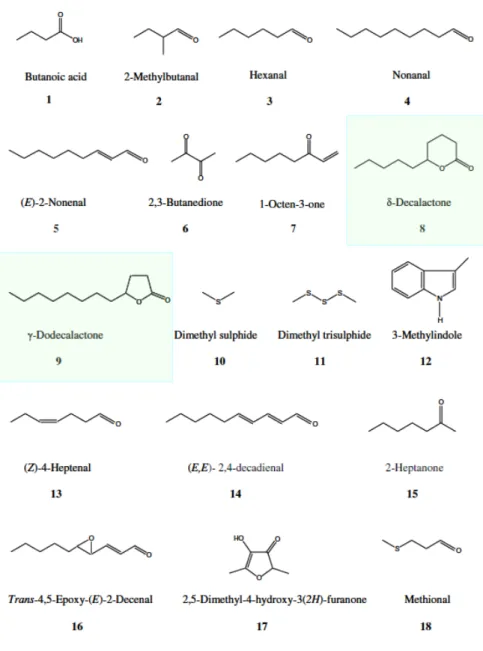
Lactones are a family of flavors and fragrance. They exhibit fruity and oily odor along with peach, apricot or coconut notes (Romero-Guido et al., 2011). Mallia et al. (2008) reviewed that there are identified 230 volatile compounds from butter but only small number of them is key odorants of butter, and lactones are included (Figure I-2). Lactones are important in the flavor of butter, butter oil and other dairy products and are added to some margarine to simulate butter flavor (Ellis and Wong, 1974). Many studies showed the abundance of lactones are key butter aroma compounds such as δ-decalactone and δ-dodecalactone which give oily, peachy and sweet buttery aroma.
Chapter I Introduction 14
Figure I-2 Chemical structures of potent odor-active compounds of butter Source: Mallia et al., 2008
Chapter I Introduction 15 Along with lactones, other flavor compounds, e.g. butanoic acid, dodecanoic acid and hexadecanoic acid also play important roles in the flavor of butter oil (Sarrazin et al., 2011; Mallia et al., 2008; Widder et al., 1991).
Lactones can be biochemically produced by yeasts and fungus. Enzymes from yeasts and fungus enable the transformation of some fatty acids into lactones that can thus be natural. The main enzymatic steps are hydroxylation and β-oxidation in the traditional way, and lactone desaturation (Romero-Guido et al., 2011). Forss (1969) suggested that lactones can be chemically formed from hydroxyalkanoic acids or triglycerides by heat at 130 ºC for 1 hour under vacuum. Alewijn et al. (2004) investigated the production of lactones in Gouda cheese. They found the initially rapid production of δ-lactones while the production of γ-lactones was slower. Trace amounts of water were necessary for lactone formation. This water was assumed to hydrolyze the hydroxy esters in lactone formation. Free fatty acids are generally formed by hydrolysis of the lipids which may contribute to desirable flavor in cheese or undesirable flavor in milk (Forss, 1969). Fatty acids are precursor of lactones (Alewijn et al., 2004; Kinsella et al., 1967). No lactones were produced upon complete dehydration by calcium hydride. Thus, under the conditions previously studied, intramolecular alcoholysis appears to be an unimportant mechanism for lactone formation (Wyatt et al., 1966).
Chapter I Introduction 16
4 RESEARCH OBJECTIVE
The flavor of butter oil directly affects the quality of the mentioned end products, i.e., recombined milk and butter, ice cream, confectionary and fat spreads.
Thus, it is important to use the high quality butter oil which can be indicated by the extraction and analysis of volatile flavor compounds. Since the existing extraction techniques prior to GC-MS analysis have deficiency in volatile flavor compound extraction from oily sample, the first part of this research was devoted to the application of LDPE membrane pouch extraction to butter oil. LDPE membrane is recognized for its semipermeability and acts as a molecular sieve. In cooperated with organic solvent, LDPE membrane can separate small molecules such as volatile flavor compounds from large molecules of triglycerides. The method was developed to establish the efficient methodology for volatile flavor compound extraction from butter oil prior to GC-MS analysis without depending on specific apparatus. Lactone concentration magnification was measured to investigate the performance of LDPE membrane pouch method. The sensory evaluation of a butter oil aroma model was also investigated to express the extraction efficiency.
The next part involved specific lactone release from dehydrated butter oil by non-enzymatic treatment. The effect of moisture, temperature and storage time on lactone release in butter oil was studied. The accumulated lactone concentrations
Chapter I Introduction 17 were determined along with moisture content in butter oil samples during storage.
The volatile flavor profiles were determined by GC-MS analysis. Lactone potential was also manipulated to determine the ability of the specific lactone release. The generated lactones along with the former fatty acids were expected to characterize the buttery and creamy aroma for butter oil samples. The specific lactone release is an alternative method for lactone generation in flavor industry.
Chapter II Volatile Flavor Compound Extraction from Butter Oil by
LDPE Membrane Pouch Method 18
Chapter II
Volatile Flavor Compound Extraction from Butter Oil by Low-Density Polyethylene (LDPE)
Membrane Pouch Method
1 INTRODUCTION
In the analysis of food aroma, the extraction of volatile flavor compounds from oil samples such as butter oil has always been challenging. Prior to GC-MS analysis, sample preparation is required to avoid any taint of non-volatile compounds from the damage of GC column. It is also important in flavor analysis to have fast, sensitive and reproducible methods. There are many attempts to develop the suitable methodology for volatile flavor compound extraction from oily sample. Direct extraction with organic solvent is impractical to fatty materials because most organic solvents dissolve fat (Lee et al., 1991). So there are many developments on distillation techniques to
Chapter II Volatile Flavor Compound Extraction from Butter Oil by
LDPE Membrane Pouch Method 19
isolate volatile components from oil-based samples, e.g., short-path distillation (Sarrazin et al., 2011), simultaneous distillation-extraction (Larráyoz et al., 2001), cold-finger molecular distillation and reduced pressure steam distillation (Forss and Holloway, 1967). However, those techniques had deficiencies because volatile flavor compounds with low volatility were hardly distillated from oil-based sample, which resulted in low recovery. Recently, headspace techniques such as Purge and Trap and Solid Phase Micro-Extraction (SPME)technique are widely applied to volatile flavor compound extraction from food matrix, e.g., milk(Contarini and Povolo, 2002), butter (Yang and Peppard, 1994; Peterson and Reineccius, 2003; Adahchour et al., 2005) and cheese (Larráyoz et al., 2001). Nevertheless, the drawbacks of those headspace techniques are the low sensitivity in oil-based sample compared to the aqueous-based sample, because the solubility of flavor compounds is generally much higher in oil than in water (Yang and Peppard, 1994). Hence, only high volatile principle components could be determined.
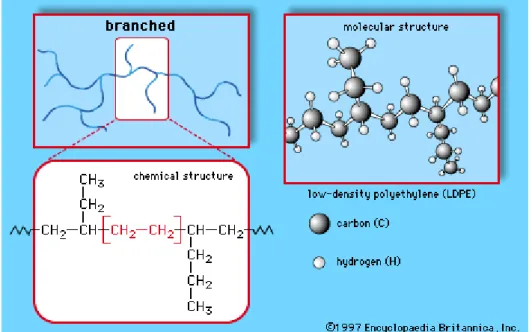
Polyethylene (PE) is one of the most common polymers. It consists of repeating unit of carbon and hydrogen, ─ (CH2 ─ CH2) n─. PE membrane was introduced to food packaging industry as food contact polymer due to its non-toxicity and flexibility (Matsui et al., 1992b). LDPE membrane (Fig II-1) is a polymer in PE family. It is widely used due to its properties, e.g., heat sealable, odor free, good moisture barrier and shrinks when heated.
Chapter II Volatile Flavor Compound Extraction from Butter Oil by
LDPE Membrane Pouch Method 20
Figure II-1 LDPE structure
Source: Encyclopædia Britannica, Inc.
Chapter II Volatile Flavor Compound Extraction from Butter Oil by
LDPE Membrane Pouch Method 21
However, it has relatively high gas permeability, sensitivity to oils and poor odor resistance which cause deterioration of intrinsic food flavors (Matsui et al., 1992a).
From food packaging aspect, the inferiors of permeation and sorption have to be studied and overcame. On the other hand, those LDPE membrane inferiors could become advantage properties in flavor extraction.
Membrane extraction technique, bases on a small-scale liquid-liquid extraction with a polymer membrane barrier (Hauser and Popp, 2001), has been developed with less expensive and higher performance. The membrane is used as an interface between the sample (donor) and the organic solvent (acceptor). It is either a flat sheet or bag that acts as a phase separator. The present analytes in the aqueous sample dissolve in the membrane material and pass through it before being enriched in solvent (Hauser and Popp, 2001).
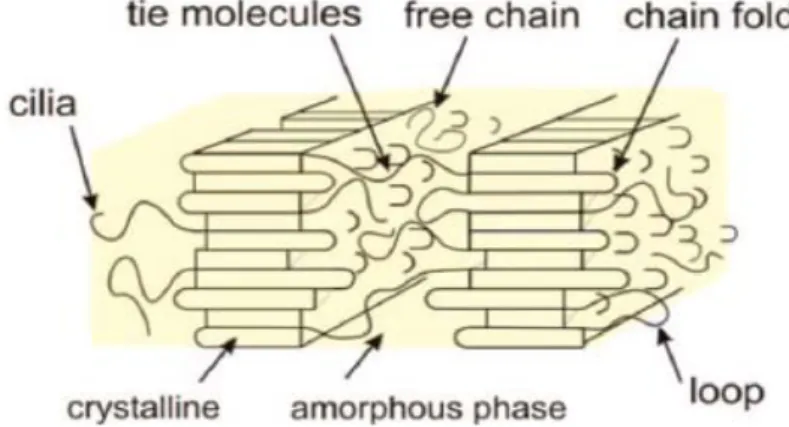
LDPE membrane has two phases, amorphous and crystalline phases or three phases, with boundary region around the crystalline (Fig II-2) (Kim and Glinka, 2009), hence LDPE membrane is called semicrystalline membrane. The amorphous phase locates between spherulites, the spherically symmetric configuration of crystalline (Dryden, 1988). The amorphous phase consists of relatively mobile chains between spherulites and in liquid pockets and severely restricted chains. Through the amorphous phase, the small molecules such as volatile flavor compounds permeate to the extracting solvent while the crystalline phase acts as an impermeable region (Vittoria, 1995).
Chapter II Volatile Flavor Compound Extraction from Butter Oil by
LDPE Membrane Pouch Method 22
Figure II-2 Components of semicrystalline membrane Source: Kim and Glinka, 2009
Chapter II Volatile Flavor Compound Extraction from Butter Oil by
LDPE Membrane Pouch Method 23
It could be considered that the LDPE membrane with the semipermeable property acts as molecular sieve. The analyte extraction rate (permeability) is governed by a solution- diffusion mechanism (Barri and Jönsson, 2008). The major advantages are the small amount of solvent required and little time consumed (Schellin and Popp, 2003). Rodil et al. (2009) applied bags (7×20 mm and 7×40 mm) of polymeric materials to contain the solvent (100 μl and 200 μl) for extracting UV filter compounds in sunscreen lotion from water samples of river, lake, and sea water. The extracted solvents were autosampled to the GC-MS by large volume (25 μl) injection. They found that low- and high-density polyethylene membrane suited to extract the analytes from water. Perfluorosulfonic acid membranes were used to separate flavor compounds in model system of 11 flavor compounds mixed with corn oil (Bemkler and Reineccius, 1979). The membrane separated solvent and sample mixture on the opposite side of dialysis unit. At the end of separation, this method yields flavor extract with very little of oil diffused through the membrane. Other kind of polymeric membranes can be applied to drug extraction and enrichment from blood plasma and urine, and extraction of pollutants in groundwater (Jönsson and Mathiasson, 2000). The membrane extraction technique has promise for extracting the analytes from water sample with advantages; only small amount of solvent was required and easy to combine with the autosampler. Although the membrane extraction technique has shown a high efficiency in the aqueous-based
Chapter II Volatile Flavor Compound Extraction from Butter Oil by
LDPE Membrane Pouch Method 24
sample extraction, the application to the volatile flavor compounds extraction from oil- based sample has never been investigated.
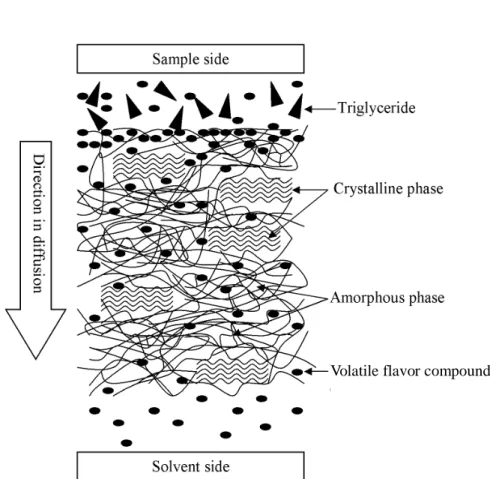
This chapter devoted to the development of new volatile flavor compounds extraction method by LDPE membrane pouch. This method based on the molecular sieve effect of LDPE membrane, that is, semipermeable property (Figure II-3). It was used to form an oil-membrane-solvent system in the extraction. The volatile flavor compounds from the oil could be extracted through the amorphous phase to the organic solvent, since the crystalline phase acts as an impermeable region, thus triglycerides could not diffuse through the membrane (Schellin and Popp, 2003; Shimoda et al., 1988). The volatile flavor compounds from the butter oil were extracted through the amorphous phase to the organic solvent leaving the large molecule triglycerides remained in the sample side. In addition, this system made oil sample in the pouch indirectly contact to solvent so the extract did not contain non-volatile compounds such as triglyceride. Thus the LDPE membrane pouch method was developed to extract volatile flavor compounds from butter oil prior to GC-MS analysis. This method is simple, inexpensive and not required specific equipments.
Chapter II Volatile Flavor Compound Extraction from Butter Oil by
LDPE Membrane Pouch Method 25
Figure II-3 Image of molecular sieve effect of semicrystalline structure in LDPE membrane
Volatile flavor compound
Chapter II Volatile Flavor Compound Extraction from Butter Oil by
LDPE Membrane Pouch Method 26
2 MATERIALS AND METHODS
2.1 Pouch preparation
The pouches in size of 6 × 5 cm were prepared from LDPE membrane with specific gravity 0.92 g/cm3 and 40 μm thick (Tamapoly Co., Ltd., Tokyo, Japan). To avoid the heat degradation, the pouches were heat-sealed at 140 ºC by Poly sealer PC- 300 (Fuji Impulse Co. Ltd., Osaka, Japan). The pouches were soaked in diethyl ether at 40 ºC for 2 h before the use to remove the extractable interfering compounds, i.e., alkanes and phathalates from the membrane (Chongcharoenyanon et. al., 2012).
2.2 Butter oil
Unsalted butter (Snow Brand Milk Products Co., Ltd., Tokyo, Japan) was melted in water bath at 40 ºC and the melted butter was centrifuged at 800×g for 3 min.
The supernatant of butter oil was separated and kept at 4 ºC until use.
2.3 Volatile flavor compound extraction by LDPE membrane pouch method Twenty grams of melted butter oil was put in the pouch and heat-sealed. The pouch was settled in the airtight bottle containing 30 ml diethyl ether (Figure II-4) and the volatile flavor compounds were extracted in a shaking water bath maintained at 40
Chapter II Volatile Flavor Compound Extraction from Butter Oil by
LDPE Membrane Pouch Method 27
ºC for 1 h. After the extraction, the butter oil pouch was discarded and the extracted solvent was kept in the bottle for the further steps. Five microliters of 1.0%
cinnamamide ethanol solution was added as an internal standard (IS). Anhydrous sodium sulfate was added to the diethyl ether solution to remove trace of water.
Concentration was carried out in a water bath at 44 ºC until the ether remained about 0.1 ml for GC-MS analysis.
2.4 GC-MS Analysis
GC-MS analyses were carried out in a GC-MS-QP2010 Plus (Shimadzu., Kyoto, Japan). The injection volume was 1 μl with a splitter injection at a split ratio of 20:1. The column used was a DB-5MS [30 m × 0.25 mm (inside diameter), 0.25 μm film] (Agilent Technologies, Inc., Tokyo, Japan). The carrier gas was helium with a linear velocity of 35 cm/s. The temperature program was a gradient of 3 ºC/min from 50 ºC to 260 ºC. The mass spectrometer was operated in EI (70 eV) mode and connected to the GC with a transfer line heated at 260 ºC. The mass spectra of volatile flavor compounds were compared with those in the NIST Library year 2008 edition (NIST 08) by using a computer system. Retention indices were determined after injection of a series of n-alkanes (C6-C23) eluted with the same oven program.
Chapter II Volatile Flavor Compound Extraction from Butter Oil by
LDPE Membrane Pouch Method 28
Figure II-4 Heat-sealed LDPE membrane pouch containing butter oil Airtight bottle
Diethyl ether (30 ml)
Butter oil (20 g) LDPE membrane pouch
Chapter II Volatile Flavor Compound Extraction from Butter Oil by
LDPE Membrane Pouch Method 29
2.5 Aroma recombination
Aroma recombinate of 12 butter oil odorants (Table II-4, excluded Hexanoic acid and γ-decalactone) was prepared in a model system (Peterson and Reineccius, 2003) (34.4 g tricaprylin and 5.6 g of 11.5% NaCl solution, pH 6.48) for sensory analysis at the concentration determined. Ten panelists were selected based on interest and time availability (undergraduate and graduate students, 6 females and 4 males, and ages 21 to 26). In training, panelists were trained to distinguish and recognize the odor attributes of butter; creamy, sweet, buttery, cheesy and rancid. Panelists received 6 training sessions in 2 weeks. Sensory analyses were performed in a lecture room where the panelists could have a private area. Ten ml of butter oil samples and aroma recombinate were served in 100 ml amber glass bottles capped with Teflon liner plastic lids. All samples were labeled with 3-digit numbers and heated at 38 ºC for 20 min before served. The panelists required to sniff and score the five odour attributes of the aroma recombinate and the butter oil on a seven-point scale from 0 (not recognized) to 3 (clearly recognized). Sensory analyses were performed in triplicate with samples presented in random order.
Statistical analysis of the sensory data was performed by Student’s t-test to evaluate the difference existed between the butter oil and the aroma recombinate.
Significance was established at p > 0.05.
Chapter II Volatile Flavor Compound Extraction from Butter Oil by
LDPE Membrane Pouch Method 30
3 RESULTS AND DISCUSSION
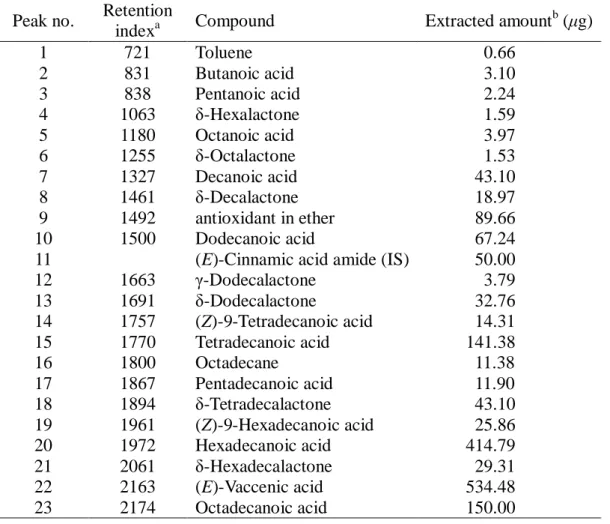
The membrane extraction technique was developed for volatile flavor compounds extraction from butter oil because of its promising of selectivity. Table II-1 shows volatile flavor compounds which were extracted by the LDPE membrane pouch method. According to the molecular sieve effect (Figure II-3), the relatively small and medium molecules such as volatile flavor compounds could diffuse through the amorphous region of the LDPE membrane, however the relatively large molecules such as triglycerides in butter oil could not diffuse through the region during the extraction. Along with the molecular sieve effect, the LDPE membrane could elevates the extraction efficiency by a phenomenon called “segment movement” in the amorphous region (Figure II-2). It occurs at the temperature over the glass transition temperature (Tg). In case of LDPE, the Tg is -125 ºC (Widder et al., 1991). Furthermore, the solvent (diethyl ether) that was absorbed in the membrane could accelerate the segment movement. As the result of segment movement, the relocation of free volume carried the volatile flavor compound molecules from place to place across the membrane. The obtained volatile flavor concentrates from this method had typical creamy and sweet odor. Table II-1 also shows the retention (Kováts) indices obtained by injecting a series of n-alkanes (C6-C23) to GC-MS.
Chapter II Volatile Flavor Compound Extraction from Butter Oil by
LDPE Membrane Pouch Method 31
Table II-1 Amount of volatile flavor compounds extracted from butter oil (20 g) by LDPE membrane pouch method
Peak no. Retention
indexa Compound Extracted amountb (μg) 1
2 3 4 5 6 7 8 9 10 11 12 13 14 15 16 17 18 19 20 21 22 23
721 831 838 1063 1180 1255 1327 1461 1492 1500 1663 1691 1757 1770 1800 1867 1894 1961 1972 2061 2163 2174
Toluene Butanoic acid Pentanoic acid δ-Hexalactone Octanoic acid δ-Octalactone Decanoic acid δ-Decalactone antioxidant in ether Dodecanoic acid
(E)-Cinnamic acid amide (IS) γ-Dodecalactone
δ-Dodecalactone
(Z)-9-Tetradecanoic acid Tetradecanoic acid Octadecane
Pentadecanoic acid δ-Tetradecalactone (Z)-9-Hexadecanoic acid Hexadecanoic acid δ-Hexadecalactone (E)-Vaccenic acid Octadecanoic acid
0.66 3.10 2.24 1.59 3.97 1.53 43.10 18.97 89.66 67.24 50.00 3.79 32.76 14.31 141.38 11.38 11.90 43.10 25.86 414.79 29.31 534.48 150.00
a Retention indices were calculated for DB-5MS column on GC system.
b The extracted amounts were obtained by comparison with the area of internal standard in chromatogram.
Chapter II Volatile Flavor Compound Extraction from Butter Oil by
LDPE Membrane Pouch Method 32
Retention indices denote the retention behavior of the compounds of interest according to a uniform scale determined by a series of closely related standard substances (Barbara et al., 2008). The retention indices can be calculated by this equation:
Where t r x = Retention time of the interest compound (min) t r n = Retention time of n-alkanes eluting before the
peak of interest (min)
t r n+1 = Retention time of n-alkanes eluting after the peak of interest (min)
n = Number of carbon atom of n-alkanes eluting before the peak of interest
Table II-1 includes the extracted amounts of the identified volatile compounds. The results were obtained by comparison with the area of internal standard in chromatogram which was used for concentration calculation in the next step.
The chromatogram of volatile flavor concentrates is shown in Figure II-5. The numbers assigned on peaks indicate the peak number in Table II-1. The volatile flavor compound peaks resembled to the chromatogram of volatile flavor compounds obtained by the short-path distillation (Sarrazin et al., 2011).
Retention index =
t r n+1 - t r n t r x - t r n
× 100 + 100n (1)
Chapter II Volatile Flavor Compound Extraction from Butter Oil by
LDPE Membrane Pouch Method 33
Figure II-5 Chromatogram of volatile flavor compounds extracted from butter oil by LDPE membrane pouch method
Chapter II Volatile Flavor Compound Extraction from Butter Oil by
LDPE Membrane Pouch Method 34
It could be implied that only the small molecules such as volatile flavor compounds were predominantly extracted. Moreover, the chromatogram does not show any peak of the extractable interfering compounds from membrane that indicated the success of pretreatment of the pouch.
However, in the butter oil sample used, the concentration of δ-dodecalactone was lower than that of δ-tetradecalactone which contrasted to the result from the butter oil obtained by short-path distillation. This might be due to result from short-path distillation was regardless of the recoveries.
In order to determine the extraction efficiency of fatty acids and lactones, 20 g of butter oil was spiked with 10,000 μg of each fatty acid and 1,000 μg of each lactone.
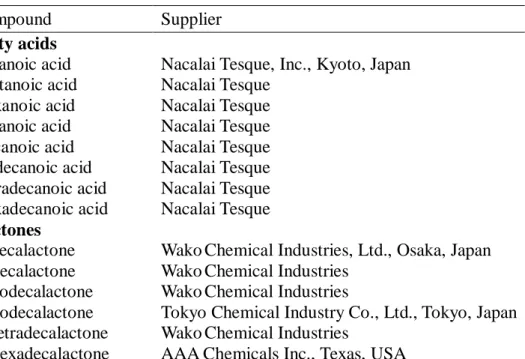
The compounds and their suppliers are listed in Table II-2. They were selected as the represents for the key flavor compounds in butter oil from the analyzed data in Table II-1. The spiked samples were extracted by LDPE membrane pouch method in triplicate. The recovery of each compound (%) was calculated as follow;
Where Ess = Extracted amount from spiked sample (μg) Eus = Extracted amount from unspiked sample (μg) Sa = Spiked amount (μg)
Ess – Eus
Sa
Recovery (%) = x 100 (2)
Chapter II Volatile Flavor Compound Extraction from Butter Oil by
LDPE Membrane Pouch Method 35
Table II-2 Spiked compounds for determination of LDPE membrane pouch extraction efficiency
Compound Supplier
Fatty acids Butanoic acid Pentanoic acid Hexanoic acid Octanoic acid Decanoic acid Dodecanoic acid Tetradecanoic acid Hexadecanoic acid Lactones
γ-Decalactone δ-Decalactone γ-Dodecalactone δ-Dodecalactone δ-Tetradecalactone δ-Hexadecalactone
Nacalai Tesque, Inc., Kyoto, Japan Nacalai Tesque
Nacalai Tesque Nacalai Tesque Nacalai Tesque Nacalai Tesque Nacalai Tesque Nacalai Tesque
WakoChemical Industries, Ltd., Osaka, Japan WakoChemical Industries
WakoChemical Industries
Tokyo Chemical Industry Co., Ltd., Tokyo, Japan WakoChemical Industries
AAA Chemicals Inc., Texas, USA
Chapter II Volatile Flavor Compound Extraction from Butter Oil by
LDPE Membrane Pouch Method 36
The extraction efficiency of 8 fatty acids and 6 lactones shows in Table II-3 with the percent recovery of 1.00 ± 0.04 to 1.74 ± 0.06 and 10.1 ± 0.4 to 11.2 ± 0.63, respectively. The determination was done in triplicate, and showed the good reproducibility. The percent recoveries of lactones were about 10 times higher than those of fatty acids with almost constant recoveries due to the affinity of membrane to different compounds.
The volatile flavor compounds could be classified into 3 groups; lactones, fatty acids and other compounds, where lactones gave fruity, creamy and buttery odors (Mallia, 2008) which are desired characters of butter oil. Table II-4 shows the actual concentration of each compound on the basis of the extracted amounts in Table II-1, the percent recoveries in Table II-3 and response ratios. The result showed that the most abundant lactone was δ-tetradecalactone and the less abundance was δ- dodecalactone, δ-hexadecalactone and δ-decalactone, respectively. Among lactones, δ- decalactone and δ-dodecalactone are associated with sweet and body attributes of milk flavor (Shiratsuchi et al., 1994). It has been reported that the taste-active compounds of full-fat cream was contributed by heavier lactones such as δ-tetradecalactone and δ- hexadecalactone. The major fatty acids were medium- and long-chain fatty acids;
decanoic acid, dodecanoic acid, (Z)-9-tetradecanoic acid, tetradecanoic acid, pentadecanoic acid, (Z)-9-hexadecanoic acid, hexadecanoic acid, (E)-vaccenic acid, octadecanoic acid, which contributed to the flavor of buttery, oily and waxy in butter
Chapter II Volatile Flavor Compound Extraction from Butter Oil by
LDPE Membrane Pouch Method 37
Table II-3 Percent recoveries from butter oil extracted by LDPE membrane pouch method
Compound Recoverya (%) Reproducibilityb (%) Fatty acids
Butanoic acid Pentanoic acid Hexanoic acid Octanoic acid Decanoic acid Dodecanoic acid Tetradecanoic acid Hexadecanoic acid Lactones
γ- Decalactone δ-Decalactone γ-Dodecalactone δ-Dodecalactone δ-Tetradecalactone δ-Hexadecalactone
1.54 ± 0.07 1.67 ± 0.08 1.74 ± 0.06 1.63 ± 0.05 1.10 ± 0.06 1.00 ± 0.04 1.44 ± 0.07 1.36 ± 0.04 11.2 ± 0.63 10.6 ± 0.59 10.8 ± 0.42 10.1 ± 0.40 10.4 ± 0.57 10.5 ± 0.48
0.045 0.048 0.034 0.031 0.055 0.040 0.049 0.029 0.056 0.056 0.039 0.040 0.055 0.046
a
The recoveries were shown as mean ± SD of triplicate extraction processes.
b
The reproducibilities were coefficient of variation (ratio of SD to mean) of each compound
Chapter II Volatile Flavor Compound Extraction from Butter Oil by
LDPE Membrane Pouch Method 38
Table II-4 Concentration of fatty acids and lactones in butter oil
Compound Response ratio Concentrationa (μg/g) Fatty acids
Butanoic acid Pentanoic acid Hexanoic acid Octanoic acid Decanoic acid Dodecanoic acid Tetradecanoic acid Hexadecanoic acid Lactones
γ-Decalactone δ-Decalactone γ-Dodecalactone δ-Dodecalactone δ-Tetradecalactone δ-Hexadecalactone
0.53 0.53 0.50 0.57 0.90 0.83 0.74 0.63 0.53 0.56 0.66 0.66 0.63 0.66
19.1 ± 0.46 12.6 ± 0.32
ND 21.5 ± 0.37 217.7 ± 7.12 406.0 ± 20.17 2332.8 ± 83.81 2420.0 ± 44.85
ND 15.1 ± 0.47 2.7 ± 0.07 24.4 ± 0.67 32.6 ± 0.80 21.2 ± 0.64
a The concentrations based on the extracted amount (Table II-1) and the response ratio of MS detector. They were shown as mean ± SD.
ND: Not Detected; concentration < 0.5 μg/g
Chapter II Volatile Flavor Compound Extraction from Butter Oil by
LDPE Membrane Pouch Method 39
oil (Shiratsuchi et al., 1994). Meanwhile, the short-chain fatty acids such as butanoic acid and pentanoic acid, which give a strong cheesy flavor, slightly appeared on the chromatogram (Figure II-5). In comparison with lipolyzed butter oil, the proportion of short-chain fatty acids in the butter oil was very low, gave milder flavor.
The aroma recombinate was prepared from 12 odorants in the same concentration determined in butter oil. The average sensory scores and standard deviations from 10 panelists show in Table II-5. Creamy odor and buttery odor had high scores in both reference butter oil and aroma recombinate. These odors characterized the main aroma of butter oil while sweet odor was undertone of the creamy odor. The sensory scores showed that the components extracted by LDPE membrane pouch method were matched the odor character in butter oil.
The LDPE membrane pouch method could extract these lactones more effectively than the headspace techniques. It is difficult to isolate the volatile flavor compounds by the headspace techniques because the releasing of volatile flavor compounds to the gas phase was interfere by lipid in oil-based sample. A liquid-liquid extraction can not be applied to the oil-based sample because the solvent dissolves the sample. The short-path distillation technique has been proven as a proper technique for oily sample extraction. However, it required a specific apparatus with high vacuum device and liquid nitrogen trap (-195 ºC). Furthermore, the high boiling point volatile flavor compounds extracted by the short-path distillation were less than by LDPE
Chapter II Volatile Flavor Compound Extraction from Butter Oil by
LDPE Membrane Pouch Method 40
membrane pouch method. As a result, the LDPE membrane pouch method was an efficient sample preparation for butter aroma concentration prior to GC-MS analysis.
Table II-5 Sensory scores of butter oil and aroma recombinate Odour
attribute
Sensory score
Butter oil Aroma recombinate
Creamya 2.7 ± 0.17 2.8 ± 0.11
Sweeta 1.4 ± 0.25 1.5 ± 0.16
Butterya 2.9 ± 0.11 2.8 ± 0.10
Cheesya 0.3 ± 0.13 0.2 ± 0.08
Rancida 0.4 ± 0.08 0.3 ± 0.09
a There was no significant difference between butter oil and aroma recombinate (p > 0.05)
Chapter II Volatile Flavor Compound Extraction from Butter Oil by
LDPE Membrane Pouch Method 41
4 SUMMARY
LDPE membrane pouch method was developed to extract volatile flavor compounds from butter oil prior to GC-MS analysis. Butter oil represents for oil-based sample with complex flavor compounds. The butter oil was placed in a LDPE membrane pouch and the pouch was heat-sealed. The pouch containing butter oil was allowed to settle in diethyl ether. The volatile flavor compounds were extracted from the butter oil to diethyl ether through the LDPE membrane at 40 ºC for 1 h and subjected to GC-MS analysis. The result showed the wide spectrum of extracted volatile flavor compounds including 12 fatty acids and 7 lactones, which are essential for butter oil aroma. The achievement of separation of volatile flavor compounds from large molecules such as triglycerides in butter oil was explained by the molecular sieve effect of LDPE membrane. High molecular weight lactones such as δ-tetradecalactone and δ-hexadecalactone were extracted in higher concentration than the result from short-path distillation. The percent recoveries of fatty acids and lactones by this method were 1.00-1.74% and 10.1-11.2%, respectively. The concentration of δ- dodecalactone was lower than δ-tetradecalactone which contrasted to a result from the extraction by short-path distillation. Compared to the headspace techniques or the short-path distillation, the LDPE membrane pouch extraction is an effective sample
Chapter II Volatile Flavor Compound Extraction from Butter Oil by
LDPE Membrane Pouch Method 42
preparation. It showed the excellent performance in selective extraction of volatile flavor compounds in butter oil for the GC-MS analysis. The advantages of the LDPE membrane pouch extraction method are its simplicity, consistency and timesaving, which make it an effective technique for volatile flavor compound extraction from oil- based sample.
Chapter III Lactone Release in Dehydrated Butter Oil 43
Chapter III
Lactone Release in Dehydrated Butter Oil
1 INTRODUCTION
Butter is a traditional food which is widely consumed all over the world, directly or as an ingredient in processed foods such as bakeries, pastries and confections, etc. Its nutritional value, due to a high content of fat, vitamins and minerals, and its unique and pleasant flavor make butter particularly appreciated by consumers (Mallia, 2008). It has been reviewed that decanoic acid, lauric acid, δ-octalactone, δ-decalactone, indole, and skatole are important flavor compounds of butter oil (Widder et al., 1991). Lactones are also known as furanones, response to characterize buttery, creamy and over all flavor of cheese. Among lactones which are characterized by milky, buttery or creamy odor, δ- decalactone and δ-dodecalactone contribute sweet and body attribute (Shiratsuchi et al., 1994). Lactones naturally occur mainly in plants, vegetables and fruits such as peach,
Chapter III Lactone Release in Dehydrated Butter Oil 44 mango, apricot, passion fruit, strawberry, etc. They may be in the form of enantiomers, having different odour characteristics, tonality and strength. For example, γ-lactones are always found with an (R) enantiomeric excess in fruits, thus allowing for the determination of addition of synthetic racemic lactones. Concerning δ-lactones, the ratios of each enantiomer vary according to the natural products, for example, δ- octalactone is present in great enantiomeric excess of (S)-enantiomer in butter and cream and in great enantiomeric excess of (R)-enantiomer in coconut (Latrasse et al., 2004).
Lactones are important compounds in flavor of butter and other dairy products.
Margarine and other foods are always mixed with γ- and δ-lactones to imitate butter flavor (Zope et al., 2006). Six lactones have been intensively studied for their organoleptic contribution to the aroma of butter oil: δ-octalactone, δ-decalactone, δ- dodecalactone, δ-tetradecalactone, γ-dodecalactone and (Z)-6-dodeceno-γ-lactone.
Recently, heavier lactones name, γ-tetradecalactone, γ-hexadecalactone, δ- hexadecalactone and δ-octadecalactone, have been reported as taste-active compounds of full-fat cream (Sarrazin et al., 2011).
Lactones, which have been recognized as key odorants of butter, are found in various ruminant and non-ruminant milk fats and results from endogenous animal metabolism. However, freshly secreted milk contains an almost negligible quantity of free lactones, and its lactone potential is realized by heating or acidifying (Kinsella et
Chapter III Lactone Release in Dehydrated Butter Oil 45 al., 1966). Hydroxy fatty acids, esterified in glycerides are thought to be the precursor of lactones in heating (Alewijn et al., 2007). Ellis and Wong (1974) investigated the effect of temperature (65 ºC to 145 ºC) on lactone content in butter oil. They found that the higher temperature, the faster lactone production i.e., at 65 ºC, the maximum lactone production was reached in 8 h while at 145 ºC the maximum production was reached in 2 h.
Lactones can be prepared through many routes, e.g., extensive lipid oxidation, microbial action, biosynthetic routes and chemical routes (Zope et al., 2006). Among those routes, controlled enzymatic hydrolysis of milkfat has been used in the dairy industry to produce butter-like flavor products (Balcão and Malcata, 1998). During the enzymatic hydrolysis, volatile fatty acids are released from the milk triglycerides and lactones are also derived from the triglycerides bearing 4- and 5-hydroxy fatty acids.
Therefore, the hydrolyzed milkfats can provide different kinds of milk flavors depending upon the lipases used and the conditions of hydrolysis. Lactones are also prepared by chemical routes and recently some syntheses of lactones have been published (Zope et al., 2006).
Lipase-catalyzed hydrolysis (Lipolization) of milkfat is a well known technique.
The flavor of lipolyzed milkfat directly relates to the composition of the free fatty acid released during the lipolysis process. However, this technique has some drawbacks.
First, it is difficult to control the specific release of short-chain fatty acids, which
Chapter III Lactone Release in Dehydrated Butter Oil 46 generally gives the product a strong cheesy flavor. Second, during heat treatment to complete the inactivation of residual lipases, the desired milkfat flavor is thermally and/or enzymatically deteriorated. Last, the specific enzymes that give a proper flavor profile are difficult to identify.
We noticed that butter oil developed clear creamy and peach flavor during the process of vacuum dehydration. It was considered that this flavor development could result from the lactone formation via nucleophilic attack on the acyl carbon by the alcoholic oxygen atom of 4- or 5-hydroxy fatty acid.
This chapter aims to reveal the effects of moisture content, storage temperature and time on the non-enzymatic lactone release in butter oil.
Chapter III Lactone Release in Dehydrated Butter Oil 47
2 MATERIALS AND METHODS
2.1 Butter oil dehydration
Unsalted butter with 16% moisture content (Snow Brand Milk Products Co., Ltd., Tokyo, Japan) was purchased at a local supermarket. The butter was gently heated in a water bath at 40 ºC. Melted butter (sample A) was then centrifuged at 800×g for 3 min to separate the butter oil. In order to adjust the moisture content, the centrifuged butter oil (sample B) was dehydrated by a rotary evaporator under vacuum at 40 ºC.
The samples were dehydrated at 3, 6, 10, and 15 min. After dehydration, these samples were aliquoted into 50 g portions and were kept in 65 ml glass bottle and stored at 5 ºC or 20 ºC for 0 to 4 weeks.
2.2 Determination of Moisture content in butter oil
Moisture contents in the butter oil samples were determined by Karl Fischer method using AQ-300 Karl Fischer Coulometric Titrator (resolution = 0.1 ppm) (Hiranuma Sangyo Co., Ltd., Ibaraki, Japan). The applied Karl Fischer reagent was HYDRANAL Aqualyte RO (Sigma-Aldrich Laborchemikalien GmbH, Seelze, Germany).
Chapter III Lactone Release in Dehydrated Butter Oil 48 2.3 Extraction of volatile flavor compounds
Volatile flavor compounds of dehydrated and stored butter oil samples were extracted by LDPE membrane pouch method which was described in Chapter II. To avoid lactone release caused by moisture in the samples, the samples were preliminarily dehydrated by rotary evaporator at 40 ºC for 20 min to obtain the butter oil samples with moisture content below 300 ppm (the value obtained from the primary investigation). Then the butter oil sample was extracted by LDPE membrane pouch method. In brief: Twenty grams of pretreated butter oil sample was put in a LDPE membrane pouch (0.04 mm thickness, 5×6 cm) and the pouch was heat-sealed. The sample was extracted with 30 ml of diethyl ether in an airtight bottle at 40 ºC for 1 h.
The diethyl ether solution of volatile flavor compounds were concentrated to about 50 μl and analyzed by GC-MS.
2.4 Determination of lactone potentials (LP)
Lactone potential is defined as the amount of lactone release when fat fraction is heated at 160 ºC in the presence of water and in the absence of air. Under this condition, the released amount of lactone can be referred to the total amount of precursors in lactone formation. Twenty grams of butter oil (sample B) and 1 g water were put into a stainless steel tube and heated at 180 ºC for 100 min to maximize the generation of lactones (Alewijin et al., 2007). After that, the generated lactones were
Chapter III Lactone Release in Dehydrated Butter Oil 49 extracted by LDPE membrane pouch method as described above and analyzed by GC- MS.
2.5 GC-MS analysis
The GC-MS analysis was manipulated under the same conditions as described in Chapter II-2.4.
Chapter III Lactone Release in Dehydrated Butter Oil 50
3 RESULTS AND DISCUSSION
The moisture content of sample is showed in Table III-1. Centrifugation separate the oil phase from aqueous phase containing vitamin and mineral solution, and water soluble protein e.g., casein and whey in butter. However, after the centrifugation, there was high moisture content in the butter oil. Thus the butter oil was dehydrated by a rotary evaporator for several periods of time.
Table III-1 Moisture content of samples before storage
Sample Condition Moisture content
(ppm)
Dehydration (%) A
B C D E F
Melted butter Butter oil 3 min dehydrated butter oil 6 min dehydrated butter oil 10 min dehydrated butter oil 15 min dehydrated butter oil
18,600 1,220 948 757 510 280
0 93.4 94.9 95.9 97.3 98.5
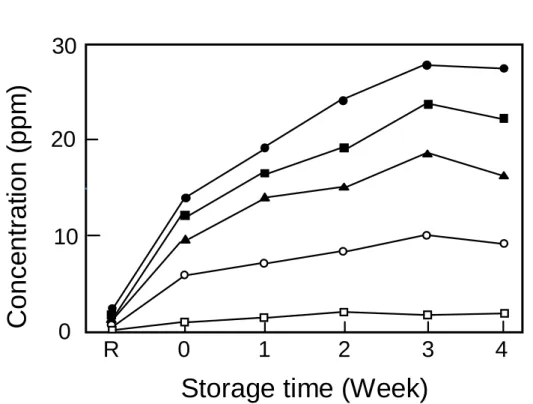
Sample D was kept at 20 ºC for 0 to 4 weeks, and the resultant lactone releases are plotted against storage time in Figure III-1. The result shows the great increase of δ-lactone until 2 weeks of storage and after that the concentrations were stable at high levels. The most abundant compounds were δ-tetradecalactone and δ-dodecalactone.
Their concentration rapidly increased in 3 weeks.
Chapter III Lactone Release in Dehydrated Butter Oil 51
C onc e nt rat ion ( ppm )
30
20
10
0
Storage time (Week)
R 0 1 2 3 4
Figure III-1 Lactone released in sample D kept at 20°C for 4 weeks. R, Reported lactone concentrations in a sweet cream butter (Sarrazin et al., 2011). ●, δ- tetradecalactone; ■, δ-dodecalactone; , δ-hexadecalactone; ○, δ-decalactone and □, γ-dodecalactone
Chapter III Lactone Release in Dehydrated Butter Oil 52 The less abundant lactones were δ-hexadecalactone, δ-decalactone and γ- dodecalactone. These lactones characterize the rich creamy flavor of butter oil which comprised of the aroma active compounds (δ-C10 and δ-C12) and taste active components (δ-C14 and δ-C16) (Zope et al., 2006).
Figure III-2 and Figure III-3 show the lactone release in sample B and sample E, respectively. The lactone release profiles in these samples are similar to the sample D.
However, there are differences in the concentrations of each lactone among the samples. For example, the maximum concentration of δ-tetradecalactone in sample B and E remained under 20 ppm while in sample D, the concentration reached 25 ppm.
Figure III-4 shows the effect of moisture content on the release of lactones.
Sample D shows the highest release of total lactones among 5 samples. The lactone releases from the samples of higher (sample B) or lower (sample E) moisture content were smaller than that from sample D. Furthermore, in sample A with extremely high moisture content, there was only small amount of lactone release. It could be considered that too many of water molecules could interfere the formation of lactone.
On the other hand, only small amount of lactones also be detected in sample F, that was almost completely dehydrated. It could be implied that the moisture content in butter oil was a key factor that influenced the lactone release during storage at 20 ºC.
The moisture content approximately 750 ppm seemed to be the proper moisture content for the releases of lactones.
Chapter III Lactone Release in Dehydrated Butter Oil 53
0 10 20 30
C onc e nt rat ion ( ppm )
0 1 2 3 4
R
Storage time (Week)
Figure III-2 Lactone release in sample B kept at 20°C for four weeks. R, Reported lactone concentrations in a sweet cream butter (Sarrazin et al., 2011). ●, δ- tetradecalactone; ■, δ-dodecalactone; , δ-hexadecalactone; ○, δ-decalactone and □, γ-dodecalactone
Chapter III Lactone Release in Dehydrated Butter Oil 54
R 0 1 2 3 4
0 10 20
30
C onc e nt rat ion ( ppm )
Storage time (Week)
Figure III-3 Lactone release in sample E kept at 20°C for four weeks. R, Reported lactone concentrations in a sweet cream butter (Sarrazin et al., 2011). ●, δ- tetradecalactone; ■, δ-dodecalactone; , δ-hexadecalactone; ○, δ-decalactone and □, γ-dodecalactone
Chapter III Lactone Release in Dehydrated Butter Oil 55
0 4 30 60 90
0 1 2 3
C onc e nt rat ion ( ppm )
×
×
×
× ×
R
Storage time (Week)
Figure III-4 Total lactone release in samples with different moisture contents. Samples were kept at 20°C for 4 weeks. R, Reported lactone concentrations in a sweet cream butter (Sarrazin et al., 2011). △, Sample A; □, Sample B; ■, Sample C; ●, Sample D; , Sample E and ✕, Sample F
Chapter III Lactone Release in Dehydrated Butter Oil 56 The concentrations of free fatty acids in sample D are plotted in Figure III-5.
Tetradecanoic acid was the predominant and the less were dodecanoic acid and decanoic acid. The concentrations of free fatty acids stabled during 4 weeks of storage.
The water contents in butter oil samples were low enough to suppress the hydrolysis of lipids. Comparing to the enzymatically hydrolyzed butter oil, the flavor of dehydrated and stored butter oil was more pleasant, because there was no release of free fatty acids which gave the sour and pungent odor.
To determine the effect of temperature on the lactone release, sample D was stored at 5 ºC for 4 weeks, and the releases of lactone are shown in Figure III-6. There was no lactone release during the storage. The effects of holding temperature and time were investigated by holding sample D at 40 ºC and 50 ºC in water bath for 8 h (Figure III-7). At both temperatures, the total amount of lactones increased until 2 h and after that they were noticeably decreased. However, the total lactones released from sample D held at 50 ºC was not reached 40 ppm while at 40 ºC, the concentration went beyond 50 ppm. It could be referred that at 20 ºC, the butter oil samples were in solid state of 26.4% solid fat fraction (Alewijin et al., 2007), which favored the lactone release. The storage temperature at 5 ºC was too low to favor the formation of lactones because of high solid fat content (56% solid fat fraction).
Chapter III Lactone Release in Dehydrated Butter Oil 57
0
C onc e nt rat ion ( ppm )
1000
500
0 0 1 2 3 4
Storage time (Week)
Figure III-5 Free fatty acid concentration in sample D kept at 20°C for four weeks. , decanoic acid; ■, dodecanoic acid and ●, tetradecanoic acid
Chapter III Lactone Release in Dehydrated Butter Oil 58
C onc e nt rat ion ( ppm )
30
20
10
0 R 0 1 2 3 4
Storage time (Week)
Figure III-6 Lactone release in sample D kept at 5°C for four weeks. R, Reported lactone concentrations in a sweet cream butter (Sarrazin et al., 2011). ●, δ- tetradecalactone; ■, δ-dodecalactone; , δ-hexadecalactone; ○, δ-decalactone and □, γ-dodecalactone