九州大学学術情報リポジトリ
Kyushu University Institutional Repository
Impacts of Agricultural Cooperatives on
Farmers' Revenues and Farm Households' Food Security in Cambodia: A Case Study of Tram Kak District, Takeo Province
フン セレィ ニッティア
http://hdl.handle.net/2324/1959178
出版情報:九州大学, 2018, 博士(農学), 課程博士 バージョン:
権利関係:
Impacts of Agricultural Cooperatives on Farmers’ Revenues and Farm Households’
Food Security in Cambodia:
A Case Study of Tram Kak District, Takeo Province
HUN SEREY NITHIA
2018
Impacts of Agricultural Cooperatives on Farmers’ Revenues and Farm Households’ Food Security in Cambodia:
A Case Study of Tram Kak District, Takeo Province
A Dissertation By
HUN SEREY NITHIA
Submitted to the
Graduate School of Bioresource and Bioenvironmental Sciences Kyushu University
In partial fulfillment of the requirements for the degree of DOCTOR OF PHILOSOPHY
Department of Agricultural and Resource Economics Laboratory of Food and Agricultural Policies
September 2018
Impacts of Agricultural Cooperatives on Farmers’ Revenues and Farm Households’ Food Security in Cambodia:
A Case Study of Tram Kak District, Takeo Province
Main Supervisor Professor Hiroshi ISODA
Sub Supervisors Professor Shoichi ITO Professor Teruaki NANSEKI
Laboratory of Food and Agricultural Policies Department of Agricultural and Resource Economics
Graduate School of Bioresource and Bioenvironmental Sciences Kyushu University, Fukuoka, Japan
September 2018
Acknowledgement
This dissertation would not be completed without supports and motivation from many people.
First of all, I would like to express my deep gratitude to Professor Shoichi ITO for accepting and supervising me as a graduate student of Kyushu University. He has always provided his valuable advice, kind support, patient guidance and encouragement in both research and daily life during my academic years at Kyushu University, Fukuoka, Japan.
I am really indebted to Professor Hiroshi ISODA for his supervision, caring supports, patient guidance, helpful comments and advice for my research. He always provided helpful and frank comments during laboratory seminars and personal discussions.
I am grateful to Japanese Ministry of Education, Culture, Sports, Science and Technology (MEXT) for providing the scholarship that covers both tuition fee and living cost. Without this financial support, this academic journey would not be successfully completed.
Moreover, I would like to thank my mother Sokhem EK and my three elder sisters Kunthea HUN, Kosny HUN and Chakrya HUN who always motivate and encourage me.
Also, I would like to dedicate this achievement to the soul of my deceased father Hay HUN, and he would be very happy if he knew that I could successfully complete the PhD course.
Furthermore, I also would like to express my appreciations to all staffs in School of Agriculture for their supports and friends in Department of Agricultural and Resource Economics especially Mr. Rada KHOY for helpful assistances and useful comments.
Finally, I would like to wish those people who I mentioned above happiness, good health and more prosperity in their lives and careers.
Fukuoka, Japan August 2018
Abstract
Agriculture is considered as the most important sector in Cambodia, and nearly 80% of the population live in rural areas in 2015. Due to the importance of this sector, the Ministry of Agriculture, Forestry and Fisheries (MAFF) has started promoting agricultural cooperatives for the purposes of increasing agricultural production, diversifying agricultural production, creating income-generating activities and expanding markets for agricultural products. This is to ease the development of agriculture sector, to collectively link with private sectors, to gain technology and credit, to stabilize food supply to local and international markets, and especially to improve rural socio-economic conditions. Agricultural cooperatives have been promoted since 2003 in Cambodia;
however, very limited studies have been done regarding the impacts of those agricultural cooperatives on farmers’ welfare. Hun et al. (2017) previously conducted a study on members’ perception of success in agricultural cooperatives in Cambodia, and they found that members perceived revenue related indicators (e.g. dividend from agricultural cooperatives, ease of selling agricultural products and access to marketing information) and food security related indicators (e.g. technical improvement in poultry, cow and pig raisings and access to paddy for consumption when in need) as among the most important ones of success in their agricultural cooperatives. This study attempts to find out if agricultural cooperatives really have actual positive effects on farmers’ revenue and food security. The objectives of this study are to identify the factors influencing farmers’
decision on membership in agricultural cooperatives and to assess the impacts of those cooperatives on farmers’ revenues and farm households’ food security.
Firstly, factors influencing farmers’ decision on membership in agricultural cooperatives were identified using probit model. The results indicated that farmers who sold their paddy and had contacted extension workers were more likely to become the members of agricultural cooperatives. In contrast, farmers who had higher off-farm income and male-headed-household farmers were less likely to join the cooperatives.
Secondly, propensity score matching technique was employed to assess the impacts of agricultural cooperatives on farmers’ revenues. The results of propensity score matching illustrated that there were no significant differences in paddy yield and revenue because the cooperatives have not provided sufficient trainings, members did not actively attend the trainings and the cooperatives failed to provide better prices comparing to other traders. However, those agricultural cooperatives had positive effects on livestock revenue and total farm revenue because they provided training on livestock operation and encourage members to raise more livestock. Members could obtain livestock and total farm revenues at US$219 and US$403, respectively higher than non-members.
Thirdly, a study on impacts of agricultural cooperatives on farm households’ food security was conducted using household dietary diversity score and instrumental variables technique. The results showed that members in agricultural cooperatives had higher food security score because agricultural cooperatives provided agricultural trainings, so that the members could consume the agricultural products they produced as food and sell them for revenue. Also, members could use credit service of agricultural cooperatives to purchase food, and they could use rice bank service as food or sell paddy they borrowed to purchase food. Moreover, agricultural land size, household income, owing TV, access to good roads and livestock operation positively influenced the food security score.
According to the results summarized above, some recommendations could be drawn to improve farmers’ revenues and food security. The government should promote more extension service, so the benefits of agricultural cooperatives could be disseminated to farmers more widely. The cooperatives should expand paddy markets and strengthen price negotiation power by increasing equity capital to procure more paddy from members, and by capacity-building of board directors in marketing expertise.
Furthermore, farmers with livestock should be encouraged to join the agricultural cooperatives to increase their revenues and improve their food security because the cooperatives can provide good technical supports for livestock raisings. The cooperatives should provide trainings on paddy production, so farmers with small paddy land size can increase their paddy yield and improve their food security status. The cooperatives should provide agricultural trainings for the livestock operation, so farmers can better operate to increase their household income. They can also afford to have a TV when the household income is improved, leading to better food security. Roads should be improved, so farmers could easily travel to do their off-farm jobs, transport their agricultural products, buy food or find available food in their village.
Keywords: agricultural cooperatives, farmers’ revenues, propensity score matching, food security, instrumental variable, Cambodia
Table of Contents
Acknowledgement ... i
Abstract ... iii
List of Figures ... ix
List of Tables ... x
List of Abbreviations ... xii
Chapter 1 Introduction ... 1
1.1. Background ... 1
1.2. Overview of agriculture in Cambodia... 2
1.2.1. Demographic characteristics ... 2
1.2.2. Contribution of agriculture in GDP ... 3
1.2.3. Labor forces in agricultural sector in 2009 and 2014 ... 4
1.2.4. Components of sub sectors in agriculture ... 6
1.2.5. Land ownership ... 7
1.2.6. Crop production and export of agricultural products ... 9
1.2.7. Livestock and poultry ... 18
1.2.8. Aquaculture and fishery ... 20
1.2.9. Existing agricultural policy goals ... 20
1.3. Agricultural cooperatives in Cambodia ... 22
1.3.1. History of agricultural cooperatives in Cambodia ... 22
1.3.2. Definition of agricultural cooperatives in Cambodia ... 25
1.3.3. Objectives of agricultural cooperatives in Cambodia ... 26
1.3.4. Structure of existing agricultural cooperatives in Cambodia ... 26
1.3.5. Education for leaders and members of agricultural cooperatives ... 27
1.3.6. Challenges in promoting and strengthening agricultural cooperatives ... 27
1.3.7. Business activities of agricultural cooperatives ... 28
1.3.8. Rights and obligations of agricultural cooperatives ... 29
1.3.9. Current number of agricultural cooperatives in Cambodia ... 30
1.4. Structure of the dissertation ... 32
Chapter 2 Literature Review ... 33
2.1. Previous studies ... 33
2.2. Perceptions of success in agricultural cooperatives in Cambodia ... 35
2.3. Justification of this research ... 37
2.4. Objectives of the study ... 38
Chapter 3 Impacts of Agricultural Cooperatives on Farmers’ Revenues ... 39
3.1. Background of this chapter ... 39
3.2. Research methodology ... 39
3.2.1. Study site ... 39
3.2.2. Data collection ... 42
3.2.3. Empirical models ... 42
3.3. Description of data variables ... 44
3.4. Descriptive results before and after matching ... 45
3.5. Determinants of membership in agricultural cooperatives ... 47
3.6. Impacts of agricultural cooperatives on farmers’ revenues ... 50
3.7. Conclusion ... 51 Chapter 4 Impacts of Agricultural Cooperatives on Farm Households’ Food Security 53
4.2. Objectives of this chapter ... 54
4.3. Data ... 54
4.4. Empirical models ... 55
4.5. Description of data variables ... 56
4.6. Results and discussion ... 57
4.7. Conclusion ... 63
Chapter 5 General Conclusions and Recommendations... 64
5.1. General conclusion and recommendations ... 64
5.3. Limitation of the research ... 65
References ... 66
List of Publications ... 72
Appendix ... 74
Appendix 1 Questionnaire for member of agricultural cooperative ... 74
Appendix 2 Questionnaire for non-member of agricultural cooperatives ... 87
Appendix 3 Presentation of PhD defense ... 98
List of Figures
Figure 1.1 Number of agricultural cooperatives in Cambodia from 2003 to 2015 ....2
Figure 1.2 Contribution of agriculture in Cambodian economy 2011-2015 ...4
Figure 1.3 Contribution of sub sectors in GDP 2011-2015 ...5
Figure 1.4 Sub-sectors of agriculture in Cambodia in 2015 ...6
Figure 1.5 Areas planted for major cereal and grain crops...13
Figure 1.6 Export of agricultural products 2010-2015 ...16
Figure 1.7 Export quantity of milled rice ...17
Figure 1.8 Milled rice export by types ...18
Figure 1.9 Number of agricultural cooperatives found in each year ...31
Figure 1.10 Distribution of agricultural cooperatives by provinces in 2015 ...31
Figure 3.1 Administrative map of Cambodia and map of Takeo Province ...40
Figure 3.2 Population as of 2008 by districts in Takeo province ...41
List of Tables
Table 1.1 Population by residence in thousands and percent ... 3
Table 1.2 Population by sex in thousands and percent ... 3
Table 1.3 Labor forces by sectors and geographical domains in 2009-2014 ... 5
Table 1.4 Agricultural land by gender of household head and zone in 2009 and 2014 . 7 Table 1.5 Number of households with agricultural land by area and zone in 2014 ... 8
Table 1.6 Number of household activities by crop production and season ... 10
Table 1.7 Crop production by main group, season and zone in 2014 ... 12
Table 1.8 Rice productions in Cambodia 2010-2015 ... 14
Table 1.9 Cultivated areas of four main crops in hectares ... 15
Table 1.10 Cultivated areas for all kinds of crops ... 16
Table 1.11 Number of households rearing livestock or poultry by zone in 2014 ... 18
Table 1.12 Number of livestock and poultry by zone in 2014... 19
Table 1.13 Number of households with fishing activities by zone in 2014 ... 20
Table 2.1 Perceptions of success of agricultural cooperatives based on selected indicators ... 36
Table 3.1 Definition of variables ... 45
Table 3.2 Characteristic difference between members and non-members ... 47
Table 3.3 Results of probit model for factors influencing cooperative membership .... 49
Table 3.4 Results of propensity score matching ... 51
Table 4.1 Definition of variables ... 56
Table 4.2 Characteristic difference between members and non-members ... 57
Table 4.3 Mean HDDS of members and non-members ... 58
Table 4.4 Determinants of membership in agricultural cooperatives ... 59
Table 4.5 Tests of endogeneity ... 59
Table 4.6 First-stage regression summary statistics ... 60
Table 4.7 Critical value of first-stage regression ... 60
Table 4.8 Test of overidentifying restrictions ... 60
Table 4.9 Results of 2SLS IV estimation ... 62
List of Abbreviations
2SLS: 2 Stage Least Squares ADB: Asian Development Bank
ATT: Average Treatment Effect for the Treated ATU: Average Treatment Effect for the Untreated CAC: Census of Agriculture in Cambodia
CSES: Cambodia Socio-Economic Survey FAO: Food and Agriculture Organization GDP: Gross Domestic Product
HDDS: Household Dietary Diversity Score ICA: International Cooperative Alliance IV: Instrumental Variables
KHR: Khmer Riels
MAFF: Ministry of Agriculture, Forestry and Fisheries MOP: Ministry of Planning
NCDD: National Committee for Sub-National Democratic Development NGO: Non-Governmental Organization
NIS: National Institute of Statistics PSM: Propensity Score Matching RGC: Royal Government of Cambodia
USAID: United States Agency for International Development USD: United States Dollar
WFP: World Food Program
Chapter 1 Introduction
1.1. Background
The population of Cambodia was estimated at 14.68 million in 2013 (National Institute of Statistics [NIS], 2013). Among the total 3.16 million households, 2.5 million households lived in rural areas (Asian Development Bank [ADB], 2014). Agriculture shared more than 30% of the gross domestic product (GDP) (Ministry of Agriculture, Forestry and Fisheries [MAFF], 2015), and it employed approximately 45.3% of the total workforce in 2014 (MAFF, 2016).
Due to the significance of agriculture in Cambodia, MAFF has initiated programs to promote the agricultural cooperative movement in the country. These programs are intended to boost agricultural production, diversify crop production, create income- generating activities through business development and also expand markets for commercializing all kinds of agricultural products produced by the cooperative members (MAFF, 2008). The development of agricultural cooperatives has been in focus in order to ease the development of agriculture sector, to collectively link with private sectors, to gain technology and credit, to stabilize the food supply to local and international markets, and especially to develop agricultural cooperatives as rural agricultural enterprises with the purpose of improving rural socio-economic situations (MAFF, 2016).
The Cambodian government started promoting agricultural cooperative movement in 2003, and the number of agricultural cooperatives significantly increased from 2003 to 2015. Between 2003 and 2015, as many as 750 agricultural cooperatives
share value of 22,186.19 million KHR and total capital of 36,091 million KHR (MAFF, 2016).
Figure 1.1 Number of agricultural cooperatives in Cambodia from 2003 to 2015
Source: MAFF, 2016
1.2. Overview of agriculture in Cambodia 1.2.1. Demographic characteristics
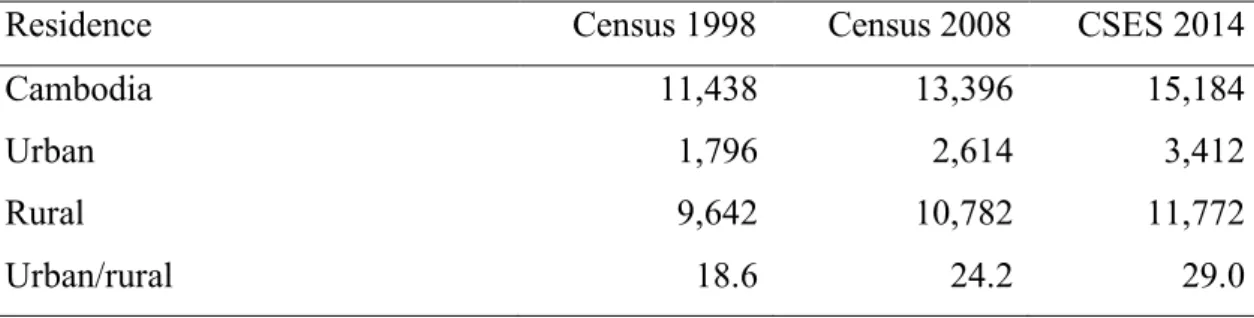
Cambodia is a Southeast Asian country surrounded by Thailand, Laos and Vietnam, and its total land area is 181,035 square kilometers. The population of this country in 2014 was estimated at 15.2 million, and between 1998 and 2014, the population increased with the annual population growth rate of 1.79% (NIS, 2015). Of the 15.2 million in Cambodia in 2014, a total of 11,772 thousand people (nearly 78% of total population) lived in rural areas (NIS, 2015).
1 14 43 62 74 93
154 218
278 419
523 677
750
0 100 200 300 400 500 600 700 800
2003 2004 2005 2006 2007 2008 2009 2010 2011 2012 2013 2014 2015
Table 1.1 Population by residence in thousands and percent
Residence Census 1998 Census 2008 CSES 2014
Cambodia 11,438 13,396 15,184
Urban 1,796 2,614 3,412
Rural 9,642 10,782 11,772
Urban/rural 18.6 24.2 29.0
Source: NIS, 2015
In 2014, woman shared 51.1% (7,748 thousands) while the man shared 48.9%
(7,436 thousands), and the sex ratio was 96% (NIS, 2015). Table 1.2 shows the population by sex in census 1998, census 2008 and Cambodia Socio-Economic Survey (CSES) 2014.
Table 1.2 Population by sex in thousands and percent
Sex Census 1998 Census 2008 CSES 2014
Woman 5,926 6,880 7,748
Man 5,511 65,16 7,436
Both sexes 11,438 13,396 15,184
Sex ratio (men/woman) 93.0 94.7 96.0
Source: NIS, 2015
1.2.2. Contribution of agriculture in GDP
Among the total 3.16 million households in the country, 2.5 million households lived in rural areas (ADB, 2014). Agriculture contributes 28.6% to GDP while industry and service sectors contributed 29.7% and 41.7%, respectively in 2015. Changes in this contribution of agriculture in Cambodian economy depend on the development of other sectors (industry, construction and service). Noticeably, the contribution of agriculture
decreased from 34.6% to 28.6% from 2011 to 2015 due to growths of industry, construction and service sectors (MAFF, 2016).
Figure 1.2 Contribution of agriculture in Cambodian economy 2011-2015
Source: MAFF, 2016
1.2.3. Labor forces in agricultural sector in 2009 and 2014
In context of Cambodian economy, workforce is classified into 3 categories: 1) workforce in agricultural sector, 2) workforce in industry sector and 3) workforce in service sector. Recently, workforce in agricultural sector has decreased noticeably. In 2009, workforce in agricultural sector was 57.6% of total workforce and it dropped to 48.7% in 2013. In 2014, agricultural workforce declined to only 45.3%. Lately, trends of people migrating to urban areas for job opportunities in other sectors other than agriculture and to overseas have become popular. Workforce in industry sector was only 15.9% in 2009 and increased to 24.3% in 2014. For workforce in service sector, it was only 26.5% in 2009 and increased to 30.4% in 2014 (MAFF, 2016).
34.6% 33.5% 31.6%
28.7% 28.6%
22.1% 23.0% 24.1% 25.5% 29.7%
37.5% 37.8% 38.5% 40.5% 41.7%
0%
10%
20%
30%
40%
50%
2011 2012 2013 2014 2015
Agriculture Industry Service
Table 1.3 Labor forces (age 15-64 years) by sectors and geography in 2009 and 2014 Industrial sector
(main occupation)
CSES 2009 CSES 2014
Cambodia Phnom Penh
Other urban
Other rural
Cambodia Phnom Penh
Other urban
Other rural Employed population
(in thousands)
7,469 686 735 6,048 8,235 1,059 957 6,220 Agriculture (percent) 57.6 1.9 24.0 68.0 45.3 2.5 17.0 56.9 Industry (percent) 15.9 21.2 17.8 15.0 24.3 28.2 25.4 23.5 Service (percent) 26.5 76.9 58.3 17.0 30.4 69.3 57.6 19.6
Other (percent) 0.0 - - 0.0 0.1 0.0 0.1 0.1
Total (percent) 100 100 100 100 100 100 100 100
Source: NIS, 2015
Note: CSES= Cambodia Socio-Economic Survey
Figure 1.3 Contribution of sub sectors in GDP 2011-2015
Source: MAFF, 2016
As previously mentioned, the contribution of agriculture sector in GDP decreased
4.2% 3.9% 3.6% 3.3% 3.0%
20.6% 20.1%
18.7%
17.2%
15.8%
7.2% 7.2% 7.0%
6.4% 5.9%
2.6% 2.4% 2.3% 2.0% 1.8%
0.0%
5.0%
10.0%
15.0%
20.0%
25.0%
2011 2012 2013 2014 2015
Animal Production Crop Production Fisheries Forestry
in GDP in 2015 includes crop production 15.8%, animal production 3%, fisheries 5.9%
and forestry 1.8% which were decreased from 20.6%, 4.2%, 7.2% and 2.6%, respectively in 2011. Noticeably, crop production and fisheries are the main drives in agricultural production. Animal production which is another important sub sector in supplying domestic demand and export has to be heavily developed.
1.2.4. Components of sub sectors in agriculture
In Cambodian agriculture, crop production shared more than half of the total agricultural products (60%) in 2015 while fisheries, animal production and forestry contributed 22%, 11% and 7%, respectively in the total agricultural products (MAFF, 2016). Crop production especially rice production is still the main source of income for Cambodian farmers (MAFF, 2015).
Figure 1.4 Sub-sectors of agriculture in Cambodia in 2015
Source: MAFF, 2016
60%
22%
11% 7%
Crop production Fisheries Animal production Forestry
1.2.5. Land ownership
Agricultural land is defined as the land that households owned or cultivated, rented in, rented out, free use of land, etc., to use for vegetable growing, agricultural or farming activities such as crop production, livestock production, fishing and fish breeding and private forestry. It excludes land under permanent pasture, wood or forest and all other non-agricultural land used for residence purpose or for other enterprise activities.
In 1989, privatized landownership was started. At that time, farming households were encouraged to submit application for land title to the land they had cultivated.
Approximately 4 million land titles were claimed, and these applications were speedily processed by the central cadaster authorities. Households whose main occupation were agriculture got the land in accordance with number of household members and other household characteristics. Anyhow, there have been major changes on socio-economic characteristics due to refugee repatriation, population growth, urbanization and economic growth), which increases the land demand for various purposes (NIS, 2016).
Table 1.4 Agricultural land by gender of household head and zone in 2014 (thousands and %)
Zone Women Men Total
Ha % Ha % Ha
Cambodia 412 12.2 2,977 87.8 3,389
Phnom Penh 3 15.2 19 84.8 23
Plain 165 15.1 932 84.9 1,097
Tonle Sap 153 10.8 1,263 89.2 1,416
Coastal 25 12.4 175 87.6 200
Plateau/Mountain 66 10.1 588 89.9 654
The statistics of agricultural land are often accumulated into five zones. Table 1.4 below reveals that Tonle Sap has the biggest portion of agricultural land in Cambodia in 2014, followed by Plain. Phnom Penh shared the smallest share of agricultural land as it is the center of trade, industry and service sectors. Female headed households own about 12% (412,000 ha) of the total agricultural land (3,389,000 ha) in the country.
Table 1.5 Number of households with agricultural land by area and zone in 2014
Area Cambodia Phnom
Penh Plain Tonle Sap Coastal Plateau/
Mountain Number
Less than 10,000 m2 2,674 31 1,215 826 202 400
10,000 m2 – 19,999 m2 221 1 85 79 17 39
20,000 m2 – 29,999 m2 242 0 65 97 16 64
30,000 m2 – 39,999 m2 102 0 23 47 7 25
40,000 m2 – 49,999 m2 44 1 7 24 1 11
50,000 m2 – 99,999 m2 53 0 10 29 1 12
100,000 m2 – and above 20 0 7 10 0 2
Total 3,358 33 1,412 1,113 245 555
%
Less than 10,000 m2 79.6 93.6 86.0 74.3 82.4 72.1
10,000 m2 – 19,999 m2 6.6 1.8 6.0 7.1 7.1 7.1
20,000 m2 – 29,999 m2 7.2 0.6 4.6 8.7 6.6 11.5
30,000 m2 – 39,999 m2 3.0 0.5 1.6 4.2 2.8 4.6
40,000 m2 – 49,999 m2 1.3 1.6 0.5 2.1 0.5 2.1
50,000 m2 – 99,999 m2 1.6 0.6 0.7 2.6 0.5 2.2
100,000 m2 – and above 0.6 1.3 0.5 0.9 0.2 0.4
Total 100 100 100 100 100 100
Source: NIS, 2015
Table 1.5 reveals the number of households having agricultural land in 2014. As shown, nearly 80% all households in Cambodia had owned agricultural land of less than 10,000 m2 or 1 hectare while around 14 percent of all households had owned the agricultural land of between 20,000 m2 and 30,000 m2.
1.2.6. Crop production and export of agricultural products
The main agricultural activities performed by agricultural households in Cambodia were cultivating temporary and permanent crops. Temporary crops were the crops whose growing cycle is less than one year, and the farmers have to plant or sow it again for another production cycle. In Census of Agriculture in Cambodia, temporary crops were crops cultivated seasonally during the research reference periods and classified into 14 categories such as cereals and grain, leguminous grain plants, oil seed crops, root, tubers and bulk crops, spices, condiments, aromatic and medicinal plants, industry crops and a various variety of vegetables. Permanent crops were the crops whose growing cycle lasts more than one year and found to be still standing and productive within agricultural holdings.
Number of households involving with crop cultivating activities were estimated to be 1,979,000 households in rainy season and 738,000 households in dry season in 2009.
The total number of households involving crop cultivation were 2,713,000 in rainy season and 832,000 in dry season in 2014.
Table 1.6 Number of household activities by main groups of crop production and season in 2009 and 2014. In thousand households and percent.
Main groups of crop production
CSES 2009 CSES 2014
Total Wet season
Dry
season Total Wet season
Dry season Number of households
Cereals harvested for grain 1,969 1,627 341 2,721 2,289 432
Tubers and leguminous plants 154 75 79 231 137 94
Industrial temporary crops 108 67 41 74 35 39
Vegetables 117 56 61 83 31 52
Fruits and nuts 296 117 179 308 154 154
Industrial permanent crops 73 37 36 124 64 60
Other crops not classified elsewhere 1 1 1 3 2 1
Total 2,717 1,979 738 3,544 2,713 832
%
Cereals harvested for grain 72.5 82.2 46.2 72.6 74.1 65.8
Tubers and leguminous plants 5.7 3.8 10.7 5.8 5.8 6.0
Industrial temporary crops 4.0 3.4 5.6 4.0 3.3 7.2
Vegetables 4.3 2.8 8.3 4.7 3.3 11.1
Fruits and nuts 10.9 5.9 24.3 10.7 11.0 9.6
Industrial permanent crops 2.7 1.9 4.9 2.1 2.5 0.4
Other crops not classified elsewhere 0.0 0.1 0.1 0.1 0.1 0.0
Total 100 100 100 100 100 100
Source: NIS, 2015
In 2014, cereals for grain were harvested in total amount of 4,781,000 tons in wet season and 1,786,000 tons in dry season. It was the largest share (62.6%) of all crop production in Cambodia in term of quantity produced in wet season and 45.2% of all crop production in dry season. Moreover, 2,481,000 tons of tubers and leguminous plants were harvested, which equaled to 32.5% of all crops produced in wet season, and 1,809,000 tons were harvested, which equaled to 45.7% of all crops produced in dry season. Among
the 5 zones classified in Cambodia, Plain was the most important cereal production zone in terms of product quantity, which accounted for 1,498,000 tons and 1,237,000 tons in wet season and dry season, respectively. It was followed by Tonle Sap, which produced 2,113,0000 tons and 424,000 tons of cereals in wet and dry season, respectively.
Table 1.7 Crop production by main group, season and zone in 2014.
Main group of crop production
Cambodia Phnom Penh Plain Tonle Sap Coastal Plateau/
Mountain
Wet Dry Wet Dry Wet Dry Wet Dry Wet Dry Wet Dry
Thousand tons
Cereals harvested for grain 4,781 1,786 32 18 1,498 1,237 2,113 424 317 33 820 75
Tubers and leguminous plants 2,481 1,809 0 0 667 754 1,334 622 2 1 478 433
Industrial temporary crops 87 51 0 0 28 24 41 19 2 3 16 6
Vegetables 32 54 2 4 21 32 6 14 1 1 2 3
Fruits and nuts 171 195 0 1 28 47 36 41 102 89 5 16
Industrial permanent crops 86 59 3 3 64 43 6 4 13 9 1 1
Other crops not classified elsewhere 1 0 0 0 1 0 0 0 0 0 0 0
%
Cereals harvested for grain 62.6 45.2 84.7 69.2 64.9 57.9 59.7 37.7 72.7 24.1 62.1 14.1 Tubers and leguminous plants 32.5 45.7 0.0 0.0 28.9 35.3 37.7 55.3 0.5 0.9 36.2 81.1
Industrial temporary crops 1.1 1.3 0.0 0.0 1.2 1.1 1.2 1.7 0.4 2.1 1.2 1.1
Vegetables 0.4 1.4 6.4 15.2 0.9 1.5 0.2 1.3 0.2 0.4 0.1 0.6
Fruits and nuts 2.2 4.9 0.7 5.5 1.2 2.2 1.0 3.7 23.4 65.9 0.3 2.9
Industrial permanent crops 1.1 1.5 8.2 10.1 2.8 2.0 0.2 0.4 2.9 6.5 0.1 0.1
Other crops not classified elsewhere 0.0 0.0 0.0 0.0 0.1 0.0 0.0 0.0 0.0 0.0 0.0 0.0 Source: NIS, 2015
The two main cultivated crops classified in cereal and grain crops were rice and maize. 2.45 million ha of grain and cereal crops were cultivated during the CAC period, accounting to approximately 86% of the total number of land parcels used for temporary crops. Most importantly, rice amounted for 82% of all temporary crops grown on land parcels in Cambodia. Three types of rice were grown in Cambodia. They are non- aromatic rice, aromatic rice and glutinous (sticky) rice. Among these three types of rice, non-aromatic rice is the common one, cultivated over 2 million ha, followed by aromatic rice which was grown 280,359 ha.
Figure 1.5 Areas planted for major cereal and grain crops
Source: NIS, Census of Agriculture in Cambodia, 2013
2,029,418 ha (83%) 280,359 ha (11%)
125,180 ha (5%) 18,028 ha (1%)
Non-aromatic rice Aromatic rice Maize Sticky rice
Rice is still the most important crop for Cambodian rural livelihoods.
Consequently, cultivated areas had been increased from 2,968,529 hectares in 2011 to 3,051,507 hectares in 2015. Also, harvested areas had been increased from 2,766,617 in 2011 to 3,025,630 hectares in 2015 while the paddy yield and production had fluctuated depending weather conditions. The average paddy yield was 3.085 tons per ha in 2015.
Noticeably, rice surplus rose from 2,780,328 MT in 2011 to 2,975,809 MT in 2015 (MAFF, 2016).
Table 1.8 Rice productions in Cambodia 2010-2015
Source: MAFF, 2015
During five-year period, the rice cultivation was increased both areas and total quantity because of farmers’ improved farm management, improved cultivation techniques and rice high yield varieties. In 2015, despite of decrease of 0.13% in cultivated areas and 0.11% in harvested areas, total amount of rice still increased 0.12%
comparing to 2014 as the yield increased 0.22% (MAFF, 2016).
Usually, the cultivated areas for seasonal crops fluctuated depending on kinds of crop and market price. The cultivated areas of crops (maize, cassava, mung bean and soy bean) significantly increased from 512,371 hectares in 2009 to 796,123 hectares in 2013.
Among these crops, cultivated areas of maize grew from 206,058 hectares in 2009 to
Descriptions 2011 2012 2013 2014 2015
Cultivated areas (ha) 2,968,529 3,007,545 3,052,420 3,055,507 3,051,412 Harvested areas (ha) 2,766,617 2,980,297 2,968,967 3,028,836 3,025,630
Yield (T/Ha) 3.173 3.117 3.163 3.079 3.085
Production (MT) 8,779,365 9,290,940 9,389,961 9,324,416 9,335,284 Rice surplus (MT) 2,780,328 3,031,017 3,090,452 3,013,783 2,975,809 Paddy surplus (MT) 4,344,263 4,735,964 4,828,832 4,709,036 4,649,702
239,748 hectares in 2013. In similar trends, cassava became the most popular crop, and its cultivated areas significantly increased from 160,326 hectares in 2009 to 421,375 hectares in 2013 while the cultivated areas of mung bean slightly increased from 49,599 hectares to just only 54,312 hectares in 2013. Unlike other crops, the cultivated areas of soybean slightly decreased from 96,388 hectares in 2009 to 80,688 hectares in 2013 (MAFF, 2014).
Table 1.9 Cultivated areas of four main crops in hectares
Source: MAFF, 2014
The cultivated areas of industrial and subsidiary crops were increased to 941,028 hectares in 2013 and the total production was increased from 9.9 million tons in 2011 to 10.54 million tons in 2013.
The cultivated areas of permanent crops were about 183,048 hectares in 2013.
Therefore, the total cultivated areas for all kinds of crops were 4.51 million hectares (3.05 million hectares for paddy production, 0.94 million hectares for industrial and subsidiary crops, 0.33 million hectares for rubber plantation and 0.18 million hectares for permanent crops).
Commodities 2009 2010 2011 2012 2013
Maize 206,058 213,622 174,257 216,330 239,748
Cassava 160,326 206,226 391,714 361,854 421,375
Mung Bean 49,599 69,206 68,111 66,850 54,312
Soybean 96,388 103,198 70,584 71,337 80,688
Total 512,371 592,252 704,666 716,371 796,123
Table 1.10 Cultivated areas for all kinds of crops
Source: MAFF, 2014
In 2010, Cambodia exported 136,854 tons of agricultural products, and the amount gradually increased to 680,457 tons in 2012, and rapidly increased to 3,659,908 tons. In 2015, 66 types of agricultural products were exported (only 47 types in 2014) to world markets in amount of 4,157,253 tons with 20% increase comparing to 2014.
Figure 1.6 Export of agricultural products 2010-2015 (in tons)
Source: MAFF, 2016
136,854 478,327 680,457
3,659,908
3,445,267
4,157,253
0 500,000 1,000,000 1,500,000 2,000,000 2,500,000 3,000,000 3,500,000 4,000,000 4,500,000
2010 2011 2012 2013 2014 2015
Export Quantity (Tons)
Areas under all crops 2013 Remarks
Areas for rice crop 3,052,420 Wet and dry seasons Areas for subsidiary and
industrial crops
941,028 Maize, sesame, sugarcane, cassava, sweet potatoes, vegetable, all kinds of bean etc.
Areas for permanent crops 183,048 Oil palm, mangoes, banana, durian, coffee, orange, cashew, pepper and other fruits etc.
Areas for rubber plantation 328,771
Total Areas (ha) 4,505,267
Milled rice was exported to 60 countries including 26 European countries, 3 ASEAN countries and other 30 countries from 2010 to 2015. Top 5 biggest markets of Cambodian milled rice were 1/ China (116,639 tons), 2/ France (75,277 tons), 3/ Poland (58,410 tons), 4/ Netherland (58,410 tons) and 5/ Malaysia (54,914 tons).
Figure 1.7 Export quantity of milled rice
Source: MAFF, 2016
Cambodia exported 105,259 tons of milled rice in 2010. The export quantity was doubled to 201,899 tons in 2011, and slightly increased in 2012. The milled rice export was 538,396 tons, which increased by 151,334 tons (39.1%) comparing to 2014. In this export, this included aromatic rice of 274,671 tons (51%), non-aromatic rice of 221,862 tons and parboiled rice of 41,863 tons.
The export quantity of agricultural products to China was significantly increased.
The total cassava export of 212,613 tons (including dried chip 149,412 tons, cassava flour
105,259
201,899 205,717
378,856 387,061
538,396
0 100,000 200,000 300,000 400,000 500,000 600,000
2010 2011 2012 2013 2014 2015
Export Quantity of Milled Rice (Tons)
27,035 tons and cassava waste 36,166 tons), which was doubled in term of cassava export quantity of 119,597 tons in 2014.
Figure 1.8 Milled rice export by types
Source: MAFF, 2016
1.2.7. Livestock and poultry
Table 1.11 Number of households rearing livestock or poultry by zone in 2014 in thousands and percent
Number of households Cambodia Phnom
Penh Plain Tonle
Sap Coastal Plateau/
Mountain Households rearing livestock
or poultry
1,814 12 751 588 165 298
All households 3,261 369 1,223 998 234 437
Percent of all households 55.6 3.2 61.4 58.9 70.6 68.2 Source: NIS, 2015
51%
41.2%
7.8%
Aromatic rice Non-aromatic rice Parboiled rice
Table 1.11 reveals the number of households having livestock or poultry by zone in 2014. Among 3,261,000 households in Cambodia, 1,814,000 households (55.6%) got involved with livestock or poultry raisings. In Phnom Penh, it shared the smallest amount (about 3%) while coastal zone shares the largest (70.6%).
Table 1.12 shows the number of livestock and poultry reared in Cambodia in 2014.
Chicken shared the largest portion, which accounted for 21,381,000 heads, followed by ducks which accounted for 7,850,000 heads. The cattle and pigs accounted for 2,478,000 heads and 1,376,000 heads, respectively. Plain and Tonle Sap zones covered the greatest number of livestock and poultry, which accounted for 14,940,000 heads, and 10,730,000 heads, respectively.
Table 1.12 Number of livestock and poultry by zone in 2014 in thousands
Type of livestock and poultry
Cambodia Phnom
Penh Plain Tonle
Sap Coastal Plateau/
Mountain Number
Cattle 2,478 25 1,048 707 202 497
Buffalos 452 1 207 138 28 78
Horses, ponies 8 0 5 1 0 2
Pigs 1,376 9 632 423 129 183
Sheep 0 0 0 0 0 0
Goats 27 0 24 2 0 1
Chicken 21,381 75 8,460 7,278 2,505 3,062
Duck 7,850 2 4,546 2,179 819 305
Quail 1 0 1 0 0 0
Other 22 0 19 1 1 1
Total 33,594 112 14,940 10,730 3,683 4,128
Source: NIS, 2015
1.2.8. Aquaculture and fishery
Table 1.13 reveals the figure of households got involved with aquaculture and fisheries. In 2014, approximately 1,371,000 households or 55.6% of all households got involved with aquaculture and fisheries, and households in Plain Zone and Tonle Sap Zone shared most important aquaculture and fishery activities, which accounted for 510,000 households and 509,000 households, respectively.
Table 1.13 Number of households with fishing activities by zone in 2014 (in thousands and percent)
Number of households Cambodia Phnom
Penh Plain Tonle
Sap Coastal Plateau/
Mountain Households with fishing
activities
1,371 5 510 509 109 238
All households 3,261 369 1,223 998 234 437
Percent of all households 55.6 1.3 41.7 51.0 46.5 54.5 Source: NIS, 2015
1.2.9. Existing agricultural policy goals
The overall policy goal of Cambodian MAFF is to promote the agriculture growth rate around 5% annually by improving agricultural productivity, diversification and commercialization, promoting livestock and aquaculture, strongly focusing on sustainable protection and forest management.
To achieve this overall policy goal, Cambodian MAFF established 5 new programs.
- Program 1: Improving agricultural productivity, diversification and commercialization
To increase the productions of all kinds of crops around 10% per year through increasing agricultural research and extension with purpose of increasing crop yields, improving agricultural products, enhancing capacity of agricultural cooperatives by linking them with contract farming and improving effectiveness of management and sustainable land use.
- Program 2: Promoting livestock and aquaculture
To increase livestock around 3% per year by depending on effective agricultural research and extension, improving ability against animal disease, ensuring the safe and hygiene supplies of animals and meats, and increasing the exports.
- Program 3: Sustainable management of fishery resources
To protect and conserve fishery resources by eliminating all kinds of fishing crimes, enhancing management capability of 100 fishing communities and promoting aquaculture in the growth rate of around 15% per annum in order to ensure the sustainable fishery management and improve quality and safety of fishery products for local consumption and exports.
- Program 4: Sustainable management of forest and wild animals
To enhance the sustainable management of forests and wild animals through enforcing the implementation of laws on forest, promoting reforestation around 25,000 hectares per annum, creating forest and wild animal protected areas 50,000 hectares per annum and 32 forestry communities per annum.
- Program 5: Strengthening institutional capacity, enhancing efficiency of supporting services and human resource management
To increase the effectiveness of institution management, deliver better supporting services and enhance education and training capabilities for sustainable agricultural development (MAFF, 2016).
To respond to importance of agriculture in economy, the Royal Government of Cambodia and Cambodian MAFF decided to introduce programs to support agricultural cooperative activities in Cambodia. This is to rapidly increase agricultural production, promote crop diversification, create income generating activities through business development and also to explore suitable markets for selling all kinds of agricultural products produced by agricultural cooperative members as well as by the rural population as a whole (MAFF, 2008).
With the support from national and international development partners, the development of agricultural cooperatives has been focused and promoted to make easier agricultural development by linking it with private sectors in order to gain new technology, credit and stable food supply for local and international markets. Also, developing agricultural cooperatives into rural agricultural enterprises enhances the rural socio-economic conditions.
1.3. Agricultural cooperatives in Cambodia
1.3.1. History of agricultural cooperatives in Cambodia
Agricultural cooperatives in Cambodia were first established between 1950s and 1960s, and at that time, there were 512 agricultural cooperatives throughout the country, and they were under the control of Royal Office of Cambodian Cooperatives and supervised by the Cambodian MAFF. Among 512 cooperatives, 13 cooperatives were provincial credit cooperatives providing loans to their members. Moreover, there were 40
school cooperatives, 55 consumer cooperatives, 390 multi-purpose agricultural cooperatives and 14 specialized cooperatives specializing in producing rice, cotton and tobacco. The total business size of agricultural cooperatives in 1965 was USD 13 millions.
During the period of civil war between 1970 and 1975, the cooperatives vanished in Cambodia. Under the Pol Pot regime from 1975 to 1979, all people were forced to form collective cooperatives that were different from globally recognized cooperative concepts and principles regarding to ideology, management and concepts. The cooperatives were collectively run with activities leading to achieve political objectives of Pol Pot regime.
There were no personal private properties, and all people were forced to work hard without sufficient food and relaxation and stay in the common houses built and controlled by Pol Pot regime.
After the fall of Pol Pot regime in 1979, rural people were formed as solidary groups by the regime of People Republic of Kampuchea for collectively producing agricultural products by using the limited resources such as labor, agricultural tools and animals remained from the Pol Pot regime. In spite of that, the solidary groups varnished when the government started providing land title programs in 1985.
A Royal Decree on the establishment and functioning of agricultural cooperatives in Cambodia was developed by the Cambodian government in 2001 and went into effect in the same year. Cambodian MAFF was assigned by the government to be responsible for promoting agricultural cooperatives in the purpose of helping rural population for better agricultural production and rural job opportunities, which enable them to have better socio-economic conditions and food supply. The Cambodian MAFF publicly and officially announced the promulgating of royal decree on establishment and functioning
of agricultural cooperatives in Cambodia in 2003 (MAFF, 2008). The law on Agricultural Cooperatives was currently enacted in 2013. Based on this law, the Cambodian MAFF is an institution having full competence to promote and support in order to register, operate and develop agricultural cooperatives (MAFF, 2013). The Cambodian MAFF is required to have a Department of Agricultural Cooperative Development under the control of the General Directorate of Agriculture (GDA), and the Cambodian MAFF is responsible for developing agricultural cooperatives in accordance with the spirit of district and provincial administration laws (MAFF, 2013). Prior to the existence of law on agricultural cooperatives, the Cambodian MAFF assigned the obligation of promoting agricultural cooperatives to the Department of Agricultural Extension. After 2003, a large number of agricultural cooperatives were founded and run with the technical supports at all levels (national, provincial and district levels). In addition to the technical supports, the legally founded agricultural cooperatives in accordance with the legal procedures also received some subsidies from the Cambodian MAFF regarding to capacity building and some financial supports as the start-up capital for their credit and agricultural input supply business. Nowadays, the Cambodian MAFF strongly focused on promoting agricultural cooperatives in the purpose of increasing agricultural production, promoting crop diversification and creating income-generating activities through business development.
Agricultural cooperatives are very important since they help farmers improve their agricultural production and also obtain household income because farmers can get loan with lower interest rate comparing to private money lending agencies and individual money lenders in their villages. Furthermore, farmers can also get agricultural inputs such as seeds, fertilizers and other materials with lower prices comparing to private vendors.
Moreover, members of agricultural cooperatives could also receive dividends got from
profits of the cooperatives in accordance with number of shares they own. Besides economic benefits, they also get social and cultural advantages (MAFF, 2008).
1.3.2. Definition of agricultural cooperatives in Cambodia
The Law on Agricultural Cooperatives in Cambodia was developed in order to make voluntarily participation of Cambodian citizens having main jobs in agricultural production, agribusiness, agro-industry or services relating to agricultural production in the purpose of establishing and developing agricultural cooperatives, which promotes socio-economic conditions and culture of members as well as to develop national economy.
Based on this law, agricultural cooperatives are private legal entities that were formed by a group of physical entities on volunteer basis to self-finance, self-control and democratically manage in order to expand agricultural productions, agro-industry, agribusiness or agriculture related services for social, economic and cultural enhancement of their members in accordance with basic principles of agricultural cooperatives. Those basic principles are voluntary and open membership, democratic member control, economic participation of members, autonomy and independence, education, training and information, cooperation among national and international cooperatives and concerns for community (MAFF, 2013).
According to Royal Decree on establishment and functioning of agricultural cooperatives, agricultural cooperatives are the business entities managed by their members based on democracy concepts, and their members contribute capital in the expectation of getting dividends and also being responsible for loss in proportion of number of shares they own (MAFF, 2008).
Based on law on agricultural cooperative, agricultural cooperatives to be registered must meet some criteria. First, they must have at least 15 members who are Cambodian older than 18 years old and accommodate in specific village, commune, Sangkat, town, district province or capital in Cambodia and have main job in agricultural production, agribusiness, agro-industry or any services related to agriculture. Second, the members have to contribute to the capital, and they must own at least 1 share. Third, the agricultural cooperative must have at least 1 business activity (MAFF, 2013).
1.3.3. Objectives of agricultural cooperatives in Cambodia
Agricultural cooperatives in Cambodia have main objectives as below:
- To provide credit services to their members
- To supply agricultural inputs such as fertilizers to their members and other farmers - To trade agricultural products by buying and selling the products produced by
members and non-member farmers - To process agricultural products
- To provide farming services and drying and milling services to their members - To produce and trade important agricultural products such as seeds and animals - To provide agricultural techniques to their members
- To supply materials useful for daily consumption of members (MAFF, 2008).
1.3.4. Structure of existing agricultural cooperatives in Cambodia
The agricultural cooperatives are established to deal with many challenges, and they have many business activities; all agricultural cooperatives in Cambodia are multi- purposes (MAFF, 2008). According to the law on agricultural cooperatives, members of
board directors are always in odd number at least 3 depending on number of cooperative members and actual operation specified in the statute of agricultural cooperatives while members of monitoring committee are between 3 and 5. The board directors and monitoring committee are voted by the general assembly and have 5-year-mandate.
1.3.5. Education for leaders and members of agricultural cooperatives The promotion team of agricultural cooperatives at all levels has provided capacity building trainings for agricultural cooperative leaders and members. This enables them to administer agricultural cooperatives and run their cooperative businesses.
The provided trainings for agricultural cooperative leaders and members are related to the explanation of Royal Decree on the establishment and functioning of agricultural cooperatives, credit administration, business management of agricultural input supply, cooperative management, concepts of agricultural cooperatives (including principles, values and advantages), planning of business development, marketing, financial record, accounting, farming planning, capacity building for female cooperative leaders, and computer skills (MAFF, 2008).
1.3.6. Challenges in promoting and strengthening agricultural cooperatives Nowadays, the agricultural cooperatives have faced many problems as below:
- Shortage of human resources having knowledge in agricultural cooperatives in both government sector and cooperative society
- The promotion institutions of agricultural cooperative are limited
- Limited knowledge in business management among agricultural cooperative leaders and auditors
- Insufficient infrastructure in agricultural cooperatives such as working office, paddy storage, rice mills, warehouses … for running business of agricultural cooperatives - Lack of training centers to train and build capacity for leaders, staffs and members of
newly established cooperatives
- Inability of farmers to buy shares to invest in the cooperatives
- Cambodian MAFF does not have much funds to support agricultural cooperatives - Few donors support agricultural cooperatives in Cambodia
- Loans have not been directly provided to the cooperatives by financing institutions or banks (MAFF, 2008).
1.3.7. Business activities of agricultural cooperatives
Agricultural cooperatives have main business activities such as credit, saving, organic rice farming, paddy business, rice bank service, grocery store, animal feed production, animal raising and collective sale (pig and chicken), animal breeding, mushroom production, fertilizer business, black pepper supply and trading etc.
Credit services are the common cooperatives business activities because it is the most important reason to establish the cooperatives and keep it working. Farmers have limited accessibility to get loans from financing institutions such as banks or micro finance institutions since most of them do not have collateral or real estates to guarantee the loan. Furthermore, some agricultural cooperatives expand their business activities beyond credit provision such as saving, rice bank service, rice business, animal business, fertilizer business, etc. These activities respond to the needs of cooperative members.
Among business activities provided, the agricultural cooperatives could get a lot of benefits from paddy business and fertilizer business. However, because the capacity of
agricultural cooperatives is still limited, amount of business volumes is still small, and they have limited capital to buy and sell in paddy and fertilizer businesses.
Moreover, grocery store is also a popular business activity. The cooperatives run the store and share their dividends to their members in accordance with the number of shares members own. For animal business, the members individually raise animals, but the collective sale is done by the committee members who have skills in negotiating the prices with buyers/middlemen (Heifer, 2011).
1.3.8. Rights and obligations of agricultural cooperatives Agricultural cooperatives have rights and obligations as below:
- Run business in agricultural production, agroindustry, agribusiness and other related services for the benefits of their members
- Work as the representatives of their members in signing and implementing the contracts with other private sectors or development partners
- Guarantee the rights of their members in achieving the cultural and socio-economic of agricultural cooperatives
- Provide trainings and technical assistances to enhance the capacity of their members and provide information in aim at promoting the participation of members in their agricultural cooperatives
- Submit proposal or receive financial or technical supports from government or other sources
- Be responsible for financial management, accounting, auditing, bookkeeping and capital increase as well as to manage the resources of agricultural cooperatives in accordance with existing legal framework
- Pay tax and other financial obligations as stated by laws and orders - Implement tasks regarding objectives of the agricultural cooperatives
- Agricultural cooperatives have to keep documents or other records in their office or any places as stated by laws.
- Agricultural cooperatives have to keep the AC statute, internal regulations, registration certificate, list of membership which includes
• Name and office address of agricultural cooperatives
• Name, nationality, date of birth and address of members
• Date of becoming the member of agricultural cooperatives
- List of shareholding members which includes the name and office address of agricultural cooperatives, and name of members holding share, price of share and number of shares.
- Annual financial balance of agricultural cooperatives - Annual report of agricultural cooperatives
- Audit report of agricultural cooperatives - All kinds of minutes and reports
- Other documents related to agricultural cooperatives as required by government or members (MAFF, 2015).
1.3.9. Current number of agricultural cooperatives in Cambodia
Starting from 1 in 2003, the number of agricultural cooperatives found per year fluctuated from 2004 to 2011. From 2012 to 2014, more than 100 agricultural cooperatives established annually. In 2015, MAFF officially registered 73 newly established agricultural cooperatives.
Figure 1.9 Number of agricultural cooperatives found in each year
Source: MAFF, 2016
As shown in Figure 1.10, Takeo, Battambong, Kampong Thom, Pursat, Preah Vihear, Kampot, Kratie and Prey Veng were the provinces having the largest number of agricultural cooperatives in 2015. In contrast, Steung Treng, Kep and Mondolkiri had few agricultural cooperatives since they are remote provinces with low population.
Figure 1.10 Distribution of agricultural cooperatives by provinces in 2015
1 13
29 19
12 19
61 64 60
141
104 154
73
0 20 40 60 80 100 120 140 160 180
2003 2004 2005 2006 2007 2008 2009 2010 2011 2012 2013 2014 2015
74 88
50 44 43 45 3936 29 45
30 25 22 2716 15
43
9 12 7 10 30
6 2 3 100
2030 4050 6070 8090 100
Battambong Takeo Kampong Thom Pursat Preah Vihear Prey Veng Pailin Kampong Chnang Kampong Speu Kampot Svay Rieng Kandal Oddor Meanchey Siem Reap Banteay Meanchey Kampong Cham Kratie Preah Sihanouk Tbong Khmum Koh Kong Phnom Penh Rattanakiri Steung Treng Kep Mondolkiri
1.4. Structure of the dissertation
This dissertation was organized into 5 chapters as described below. Chapter 1 provides background, overview of agriculture in Cambodia as well as general information related to agricultural cooperatives in Cambodia including the historical background, definition, principle, structure and objectives of agricultural cooperatives in Cambodia and structure of the dissertation. Chapter 2 describes the literature review on previous studies such as impacts of agricultural cooperatives in other countries and perception of success of agricultural cooperatives in Cambodia, justification and objectives of the study. Chapter 3 addresses the factors influencing on farmers’ decision on becoming a member of agricultural cooperatives using Probit model and assess the impacts of membership on farmers’ revenues from paddy, livestock and farm using propensity score matching techniques. Chapter 4 covers the effects of membership in agricultural cooperatives on farm households’ food security and other determinants using instrumental variables. Lastly, chapter 5 gives the general conclusion, draws recommendations and states the limitation of the research.