Applying 2x2 Game Theory―
著者
吉永 健治
著者別名
Kenji YOSHINAGA
journal or
publication title
Journal of Regional Development Studies
number
19
page range
127-156
year
2016-03
URL
http://id.nii.ac.jp/1060/00008256/
Creative Commons : 表示 - 非営利 - 改変禁止 http://creativecommons.org/licenses/by-nc-nd/3.0/deed.jaNegotiation and Cooperative Action
for Efficient Water Allocation
―Analysis by Applying 2x2 Game Theory-Kenji YOSHINAGA*
Abstract: The paper analyzes the water management in the irrigation system focusing on how to achieve a cooperative action among the streams for an efficient water allocation. The analysis is made by applying different types of 2x2 Game Theory. It identifies the conflict and its solution in the different situations of water management set for the analysis. The situation presented by Prisoner’s dilemma game is difficult to take a cooperative action if an incentive measure is not given. This is in contrast to other situations of water management discussed by different types of 2x2 Game Theory such as Chicken game, Battle of the sex game, Assurance game and Coordination game in which a cooperative action could be achieved. The result would lead the up and mid-streams to take the cooperative water management action for a fair water allocation to the down-stream.
Key words: water management, water allocation, 2x2 Game Theory, conflict and cooperative action, irrigation system, the up and mid-streams, the down-stream, incentives, compensation and penalty
1. Introduction
The paper discusses on how could achieve the efficient water management for a fair water allocation in the irrigation system. There exists a large-scale irrigation system in countries including Japan belong to Asian monsoon area where agricultural activities, mainly rice production, have been prevailing. Not surprisingly, the water supply is prerequisite for a crop production for which the irrigation system plays a central function and role. The irrigation system is consisted of the up-stream, the mid-stream (hereafter, the up and mid-streams) and the down-stream in each stream, in which farmers as a beneficiary are required to implement an efficient water management.
The efficient water management in the irrigation system will contribute to increase a social benefit in the basin. It includes, for example, an increase of farmer’s income ―――――――――――――――――
*東洋大学地域活性化研究所:Visiting Researcher, Institute of Regional Vitalization Studies, Toyo University
Negotiation and Cooperative Action
for Efficient Water Allocation
―Analysis by Applying 2x2 Game Theory―
Kenji YOSHINAGA*
2
with an increment of a crop production, an avoidance of conflict around the water allocation among the streams, and then, the water allocation for the environment in the basin, these positive effects of which are substantial. Water user’s association in the irrigation system has been heavily involved in securing such positive effects by arranging rules of the water management by which could regulate the water management action taken by farmers.
In some cases, however, an actual situation of the water management in the irrigation system is not necessarily efficient because of asymmetric information on water management actions taken by the up and mid-streams and the down-stream. In particular, farmers of the up and mid-streams are easy to access to the irrigation water, then they could allocate their labors and times for the opportunity cost1) which often
causes the insufficient water allocation to the down-stream. This is one of reasons behind the conflict around the water allocation among the streams. It needs an agreement on the cooperative action for both streams to implement the efficient water management to solve the conflict around the water allocation with a help of water user’s association.
With these backgrounds, the paper analyzes on the water management action among the up and mid-streams and the down-stream in the irrigation system by applying 2x2 Game Theory. Upon conducting the analysis, various situations of water management are set as the 2x2 game model, based on which discusses the process of negotiation toward the cooperative action to achieve an optimal solution. To this end, here adopts typical types of 2x2 Game Theory such as Prisoner’s dilemma game, Chicken game, Battle of the sex game, Assurance game and Coordination game.
There are many available references and technical books related to 2x2 Game Theory. In this paper, it mainly refers to those such as Okada(1996), Muto (2001), Namatame (2001), Schelling(1980), Olson (1971), Osborne (2009), Taylor (1987), Brams (1990), and then, Yoshinaga(2009, 2012, 2013, 2014)as the reference for water management and water allocation in the irrigation system.
The paper is consisted of the following 6 Chapters including the introduction. In the Chapter 2, it sets the 6 Cases based on different water management situations in the up and mid-streams to which different types of 2x2 Game Theory could be applied. These Cases are a basis for the analysis of the cooperative water management action in the
following Chapters. The Chapter 3 analyzes on the water management action taken by both streams in each Case of the water management situation by applying 2x2 Game Theory. The analysis pays an attention to how both streams could possibly achieve the cooperative water management action. Then, in the Chapter 4, it discusses on the conflict and the cooperative action around the water management in the up and mid-streams by applying Prisoner’s dilemma game. It analyzes the possible action to be taken for the cooperative water management by further applying a sort of repeated game. In the Chapter 5, two scenarios of which the up and mid-streams would either implement the water management or not are set for the application of 2x2 Game Theory. It includes the analysis about institutional arrangements such as a compensation and penalty for achieving the cooperative water management. Finally, the Chapter 6 leads to the conclusion by summing up the content of each Chapter.
2. Water Management Situations for the Application of 2x2 Game Theory 2-1 Water management action and Case setting
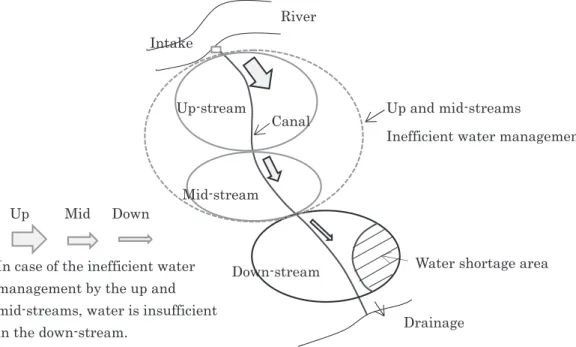
A large-scale irrigation system covers a huge beneficiary area and supplies a much quantity of irrigation water for a crop production For example, UPRIIS (Upper Pantabangan River Integrated Irrigation System)2) in Philippines has the beneficiary area of more than 100 thousand hectares with the irrigation canal of tens of thousands km. In the irrigation system, the efficient water management by farmers is dispensable in a fair water allocation for a cop production and the environment preservation in the basin. In such large-scale irrigation system, the basin could be divided in the up-stream, the mid-stream (that is, the up and mid-streams) 3) and the down-stream. A simplified basin model of water management action in the up and mid-streams and the down-stream is shown in Fig.-1.
First of all, let consider the water allocation by the water management action of farmers in the up and mid-streams and the down-stream. It assumes the following situations with a particular attention to the effect on a crop production and the environment in the basin. If both of the up and mid-streams neglect the water management, it causes a negative effect on a crop production and the environment in the down-stream. If either of the up and mid-streams implements the water management, there is no effect on a crop production but does on the environment in the basin. And, if both streams do the water management, none of the effect is for the with an increment of a crop production, an avoidance of conflict around the water
allocation among the streams, and then, the water allocation for the environment in the basin, these positive effects of which are substantial. Water user’s association in the irrigation system has been heavily involved in securing such positive effects by arranging rules of the water management by which could regulate the water management action taken by farmers.
In some cases, however, an actual situation of the water management in the irrigation system is not necessarily efficient because of asymmetric information on water management actions taken by the up and mid-streams and the down-stream. In particular, farmers of the up and mid-streams are easy to access to the irrigation water, then they could allocate their labors and times for the opportunity cost1) which often
causes the insufficient water allocation to the down-stream. This is one of reasons behind the conflict around the water allocation among the streams. It needs an agreement on the cooperative action for both streams to implement the efficient water management to solve the conflict around the water allocation with a help of water user’s association.
With these backgrounds, the paper analyzes on the water management action among the up and mid-streams and the down-stream in the irrigation system by applying 2x2 Game Theory. Upon conducting the analysis, various situations of water management are set as the 2x2 game model, based on which discusses the process of negotiation toward the cooperative action to achieve an optimal solution. To this end, here adopts typical types of 2x2 Game Theory such as Prisoner’s dilemma game, Chicken game, Battle of the sex game, Assurance game and Coordination game.
There are many available references and technical books related to 2x2 Game Theory. In this paper, it mainly refers to those such as Okada(1996), Muto (2001), Namatame (2001), Schelling(1980), Olson (1971), Osborne (2009), Taylor (1987), Brams (1990), and then, Yoshinaga(2009, 2012, 2013, 2014)as the reference for water management and water allocation in the irrigation system.
The paper is consisted of the following 6 Chapters including the introduction. In the Chapter 2, it sets the 6 Cases based on different water management situations in the up and mid-streams to which different types of 2x2 Game Theory could be applied. These Cases are a basis for the analysis of the cooperative water management action in the
4
down-stream. It is noted, however, that a degree of effect depends on a scale of available water in the irrigation system. It supposes further that farmers in the down-stream always implement the efficient water management.
Given the above, Table-1 shows the combination of efficient (
E
) and inefficient (IE
) water management action taken by the up and mid-streams and its effect on the water allocation, namely those on a crop production and the environment in the down-stream. Then, the four categorized situations of the water management action taken by the upCategory 1 Category 2 Category 3 Category 4
WMA in the up-stream
E
E
IE
IE
WMA in the mid-stream
E
IE
E
IE
Water allocation to the down-stream (+) (±) (±) (-)
WMA in down-stream
E
E
E
E
Effect on a crop production None None None Effect Effect on the environment in the basin None Effect Effect Effect
Situation A B B C
Types of 2x2 Game Theory Coordination, Assurance
Chicken, Battle of the sex
Prisoner’s dilemma (Note)1.
E
: the efficient water management,IE
: the inefficient water management. 2.(+): sufficient,(-): insufficient, (±): effect (insufficient) on the environment in the basin.Table-1:Category of water management action (WMA)
Up and mid-streams
Inefficient water management Mid-stream
Up-stream
Down-stream Water shortage area Drainage
In case of the inefficient water management by the up and mid-streams, water is insufficient in the down-stream.
Intake
Fig. -1:Basin model for water management
Canal River
and mid-streams shown in Table -1 are set as follows.
Firstly, in the category 1, both streams recognize the necessity of water management and there is no effect on and no conflict around the water allocation with the down-stream, that is, the situationA. In both of categories 2 and 3, either of streams neglects the water management and then concerns with the opportunity cost, under which it effects negatively on the environment in the basin. This situation allows either of streams to be a free-rider on other’s water management which causes a conflict around the water allocation with the down-stream, that is, the situationB. And, in the category 4, both streams neglect the water management and cause an effect on the water allocation in the down-stream. Its degree of the effect is serious when available water is limited, but milder when available water is sufficient, that is, the situationC . 2-2 Case setting for the application of 2x2 Game Theory
Here discusses the water management situation in detail according to the categories of the water management action taken by the up-stream
U and the mid-stream
M , then tries to set the 6 Cases for the application of 2x2 Game Theory. The payoff is allocated with the ordinal order of2
1
0
1
. It is also noted that the above category is a basis for the discussion on cooperative water management action in the following Chapters.To begin with, it sets Reference game which shows the situation of water management usually observed in both streams. Then, Coordination game and Assurance game could be applied for the situationA, Chicken game and Battle of the sex game for the situationB , and Prisoner’s dilemma game for the situationC to analyze the water management action by both streams in each situation. Given this, the below sets the 6 Cases for the analysis in each category with the application of 2x2 Game Theory.
Case 1: Reference game
A conflict around a fair water allocation among the up and mid-streams and the down-stream has often occurred in the irrigation system. In particular, the effect is serious for the down-stream if the up and mid-streams neglect the efficient water management at the time of water shortage. In addition, there exists asymmetric information between both streams if beneficiary area and a number of farmers is large in its scale, under which even the water user’s association sometimes faces with a down-stream. It is noted, however, that a degree of effect depends on a scale of available
water in the irrigation system. It supposes further that farmers in the down-stream always implement the efficient water management.
Given the above, Table-1 shows the combination of efficient (
E
) and inefficient (IE
) water management action taken by the up and mid-streams and its effect on the water allocation, namely those on a crop production and the environment in the down-stream. Then, the four categorized situations of the water management action taken by the upCategory 1 Category 2 Category 3 Category 4
WMA in the up-stream
E
E
IE
IE
WMA in the mid-stream
E
IE
E
IE
Water allocation to the down-stream (+) (±) (±) (-)
WMA in down-stream
E
E
E
E
Effect on a crop production None None None Effect Effect on the environment in the basin None Effect Effect Effect
Situation A B B C
Types of 2x2 Game Theory Coordination, Assurance
Chicken, Battle of the sex
Prisoner’s dilemma (Note)1.
E
: the efficient water management,IE
: the inefficient water management. 2.(+): sufficient,(-): insufficient, (±): effect (insufficient) on the environment in the basin.Table-1:Category of water management action (WMA)
Up and mid-streams
Inefficient water management Mid-stream
Up-stream
Down-stream Water shortage area Drainage
In case of the inefficient water management by the up and mid-streams, water is insufficient in the down-stream.
Intake
Fig. -1:Basin model for water management
Canal River
6
U
M
E
IE
E
1 , 1
1, 2
IE
2, 1
1, 1
difficulty to capture a reason behind the conflict. In these situations, it is possible for the up and mid-streams to take the selfish action to maximize own benefit. In other words, farmers in the up and mid-streams do not have a motive to implement the efficient water management if they could secure sufficient water for a crop production and get income as usual even without doing the water management. As a result, this causes a negative effect on the water allocation to the down-stream.
Such performance by farmers in the up and mid-streams is often observed when they are indifference to a necessity of water management. This will continue until an effective incentive is put in place for implementing an efficient water management. Fig.-2 shows the payoff matrix with the application of 2x2 Game Theory to the relation between the up and mid-streams. The Case 1 is set as “Reference game”.
Case 2: Choice of the inefficient water management
Here, let suppose the case where if either of the up and mid-streams does water management, a negative effect on the water allocation to the down-stream is limited. In this case, both streams intend to be a free-rider on the water management made by the opponent. Both streams notice that it is possible to increase their incomes by appropriating labor and time for alternative jobs. At the same time, they recognize the necessity of water management and possible conflict with the down-stream who suffers from water shortage if they neglect water management. Against this, both streams must decide by themselves whether they would do the water management or not due to a lack of information on an action taken by the other stream.
Given this situation, both streams prefer to the inefficient water management on the assumption that the opponent would does the water management. This is because both streams know an alternative possible income if they pursue the opportunity cost without implementing the water management. It needs a binding rule of the water management in order to enforce the up and mid-streams to do water management for better water allocation to the down-stream. Fig.-3 shows the payoff matrix with the application of 2x2 Game Theory to the relation between the up and mid-streams. The
U
M
E
IE
E
1, 1
0
,
2
IE
2, 0
1
,
1
Case 2 is categorized in “Chicken game”.
Case 3 : Integrated water management by the up and mid-streams
As an extension of Case 2, let suppose the case where the mid-stream could judge own water management action after confirming the action taken by the up-stream under the condition that both streams do water management4). On the other hand, the up-stream could decide not to do water management in prior to an action taken by the mid-stream. Predominance of a time lag in the decision made by both streams causes a difference of benefit. This is only effective for the case in which both streams choose the same action, namely, of implementing the water management or not. While, in the case where both streams take the different action, each stream decides by own judgement without taking into account the opponent’s action, in which there is no benefit by a time lag.
In this case, it supposes the situation where there is sufficient available water for the down-stream and if the up-stream does or does not the efficient water management, the mid-stream would follow it. And, both streams could get a benefit only if they take the same action. This is equivalent to the same as the action taken by both streams as an integrated stream5). Fig.-4 shows the payoff matrix with the application of 2x2 Game Theory to the relation between the up and mid-streams. The Case 3 is categorized in “Battle of the sex game”.
U
M
E
IE
E
1, 2
0, 0
IE
0, 0
2, 1
Case 4 : Efficient vs. inefficient water management
The up and mid-streams located geographically in the irrigation system could enjoy an easy access to water. In particular, when available water is sufficient, both streams would encounter the decision on whether they should choose to do the efficient water management or not for an alternative opportunity cost. It is fair to say that the efficient
Fig.-3: Case 2 - Chicken game
Fig.-4: Case 3 - Battle of the sex game
U
M
E
IE
E
1 , 1
1, 2
IE
2, 1
1, 1
difficulty to capture a reason behind the conflict. In these situations, it is possible for the up and mid-streams to take the selfish action to maximize own benefit. In other words, farmers in the up and mid-streams do not have a motive to implement the efficient water management if they could secure sufficient water for a crop production and get income as usual even without doing the water management. As a result, this causes a negative effect on the water allocation to the down-stream.
Such performance by farmers in the up and mid-streams is often observed when they are indifference to a necessity of water management. This will continue until an effective incentive is put in place for implementing an efficient water management. Fig.-2 shows the payoff matrix with the application of 2x2 Game Theory to the relation between the up and mid-streams. The Case 1 is set as “Reference game”.
Case 2: Choice of the inefficient water management
Here, let suppose the case where if either of the up and mid-streams does water management, a negative effect on the water allocation to the down-stream is limited. In this case, both streams intend to be a free-rider on the water management made by the opponent. Both streams notice that it is possible to increase their incomes by appropriating labor and time for alternative jobs. At the same time, they recognize the necessity of water management and possible conflict with the down-stream who suffers from water shortage if they neglect water management. Against this, both streams must decide by themselves whether they would do the water management or not due to a lack of information on an action taken by the other stream.
Given this situation, both streams prefer to the inefficient water management on the assumption that the opponent would does the water management. This is because both streams know an alternative possible income if they pursue the opportunity cost without implementing the water management. It needs a binding rule of the water management in order to enforce the up and mid-streams to do water management for better water allocation to the down-stream. Fig.-3 shows the payoff matrix with the application of 2x2 Game Theory to the relation between the up and mid-streams. The
8
U
M
E
IE
E
2, 2
1, 0
IE
0, 1
1, 1
water management would be effective for a crop production and the environment in the basin through an equal water allocation to the down-stream. Both streams, however, are in a position to gain an alternative income by seeking the opportunity cost and if it exceeds a benefit obtained by implementing the water management, they would prefer to neglect it. Further, it is noted that there is no merit for both streams if not considering the water allocation to the down-stream in the case where either of the streams does the water management while the other prefers to be a free-rider.
It is a better choice for both streams to implement the water management in a cooperative way which is effective for the operation and management in the irrigation system as a whole. For that, it is prerequisite that farmers in both streams recognize a necessity of the water management and rule of a fair water allocation to the down-stream. Against this, either of the streams has no intention to do unilaterally the water management if the utility of alternative income is higher. Fig.-5 shows the payoff matrix with the application of 2x2 Game Theory to the relation between the up and mid-streams. The Case 4 is categorized in “Assurance game”.
Case 5 : Best choice of the cooperative water management
Then, let suppose the situation where the up and mid-streams recognize an importance of the water management and does a fair water allocation to the down-stream. This is the case for both streams to tackle efficiently with the water management by which could be expected of achieving the efficient water allocation. Both streams could concentrate in the water management without any concern in the opportunity cost. Moreover, there is no conflict with the down-stream and the cooperative action would be taken through a negotiation among the streams, if any conflict.
U
M
E
IE
E
2
,
2
1, 0
IE
0, 1
1
,
1
Fig.-5 : Case 4 - Assurance gameBoth streams could gain the maximum benefit by choosing the cooperative action. This means that the benefit would be reduced if either of the streams neglects the water management, and a whole irrigation system will lose the benefit from both of a crop production and the environment preservation if both streams neglect the water management. In other words, this loss would work as an incentive for choosing the efficient water management action. Fig.-6 shows the payoff matrix with the application of 2x2 Game Theory to the relation between the up and mid-streams. The Case 5 is categorized in “Coordination game”.
Case 6 : Personal benefit rather than the water management
The situation of water management action taken by the up and mid-streams in this case is similar to Reference game except the payoff allocation. That is to say, both streams put a high priority on own benefit by pursuing an alternative opportunity cost without implementing the water management. This means that both streams do not reorganize a social benefit otherwise obtained if they take the cooperative action. In other words, both streams lose a social benefit by pursuing a personal benefit without doing the water management. Fig.-7 shows the payoff matrix with the application of 2x2 Game Theory to the relation between the up and mid-streams. The Case 6 is categorized in “Prisoner’s dilemma game”.
3.Analysis on the Water Management Action by Applying 2x2 Game Theory
Followed by the above 6 Cases set for the water management situation, it proceeds to analyze the action of both streams in each case by applying 2x2 Game Theory. In the analysis, a particular attention is paid to how to achieve the cooperative action through a negotiation by both streams in each Case. Here initiates the analysis on Reference game in the Case 1 and Prisoner’s dilemma game in the Case 6 in which there are common or contrary factors. In addition, the payoff comparison of other 4 Cases is shown in Fig.-8 which is referred in the following 2x2 game analyses.
U
M
E
IE
E
1
,
1
,1
2
IE
2, 1
0
,
0
Fig.-7 : Case 6 - Prisoner’s dilemma gameU
M
E
IE
E
2, 2
1, 0
IE
0, 1
1, 1
water management would be effective for a crop production and the environment in the basin through an equal water allocation to the down-stream. Both streams, however, are in a position to gain an alternative income by seeking the opportunity cost and if it exceeds a benefit obtained by implementing the water management, they would prefer to neglect it. Further, it is noted that there is no merit for both streams if not considering the water allocation to the down-stream in the case where either of the streams does the water management while the other prefers to be a free-rider.
It is a better choice for both streams to implement the water management in a cooperative way which is effective for the operation and management in the irrigation system as a whole. For that, it is prerequisite that farmers in both streams recognize a necessity of the water management and rule of a fair water allocation to the down-stream. Against this, either of the streams has no intention to do unilaterally the water management if the utility of alternative income is higher. Fig.-5 shows the payoff matrix with the application of 2x2 Game Theory to the relation between the up and mid-streams. The Case 4 is categorized in “Assurance game”.
Case 5 : Best choice of the cooperative water management
Then, let suppose the situation where the up and mid-streams recognize an importance of the water management and does a fair water allocation to the down-stream. This is the case for both streams to tackle efficiently with the water management by which could be expected of achieving the efficient water allocation. Both streams could concentrate in the water management without any concern in the opportunity cost. Moreover, there is no conflict with the down-stream and the cooperative action would be taken through a negotiation among the streams, if any conflict.
U
M
E
IE
E
2
,
2
1, 0
IE
0, 1
1
,
1
Fig.-5 : Case 4 - Assurance game10
Case 1 : Reference game
As shown in Fig.-2, Reference game presents the action that the up and mid-streams try to maximize the personal benefit, and its equilibrium solution is
IE, IE
and payoff is
1, 1
, then it is Pareto optimal. In this case, both streams do not take unilaterally the efficient water management action (E) because they have not any incentive to do so. This requires an incentive from the outside such measures as a compensation for the efficient water management action and a penalty to the inefficient action but which should be more than the opportunity cost. Even at an actual field level, once both streams fall in this Case, they would neglect the efficient water management. Against the Case 1, what is the most necessary is to enhance farmer’s awareness on an importance of water management through the training planned by water user’s association6). By doing so, both streams must make an effort to move to the cooperative solution
E, E
from the equilibrium solution
IE, IE
which means a change of value system for farmers in both streams.Case 6 : Prisoner’s dilemma game
In the next place, it discusses Prisoner’s dilemma game in relation to Reference game. A rational choice for the up and mid-streams is also inefficient water management action ( IE ), then the equilibrium solution is
IE, IE
and payoff is
,0 0
, but not the Pareto equilibrium solution. The Pareto equilibrium is
E, E
that is the case for both streams to take the cooperative action. In Prisoner’s dilemma game, it loses a social benefit by pursuing personal benefit. In order to move to the cooperative action, it needsCase Line 2x2 game 2 Chicken game 3 Battle of the sex game 4 Assurance game 5 Coordination game 0 1 2 1 2 U U M U
Fig.-8 : Payoff comparison in each Case
-1 -2 -1 -2 Case 2 Case 3 Case 4 Case 5
for both streams to repeat the water management action, that is, a repeated game, in the process of which they could reorganize the action to produce the best benefit.
Hereafter considers the different features between the Case 1 and the Case 6 by referring to the payoff comparison shown in Fig.-9. The Pareto optimal sets of the water management action in these two Cases are
IE, IE
and
E, E
, respectively, but the same payoff of
,1 1
. This is the equilibrium solution for the former but the equilibrium of the latter is
IE, IE
and payoff
0, 0
is not Pareto optimal. It means that there is no room for a negotiation in Reference game but some possibility left toward the cooperative action in Prisoner’s dilemma game.Yet, it should be noted that the slope of lines linked each payoff point as shown in Fig.-9 are negative or zero which indicates the difficulty for both streams to move to the cooperative action. This is in contrast to the other 4 Cases of having positive slopes as shown in Fig.-8 which are possible to take the cooperative action.
Case 2 : Chicken game
In Chicken game shown in Fig.-3, there are two Nash equilibriums of
E, IE
and
IE, E
, its payoffs are
0, 2
and
2, 0
, respectively, which are Pareto optimal. Further, the set of efficient water management action of both streams, that is,
E, E
and its payoff
,1 1
is placed in the center of the line linked between two Nash equilibriums as shown in Fig.-10. The former equilibrium solution is best for the mid-stream ( M ) and the latter for the up-stream (U) which are the optimal solution forCase Line 2x2 game
1 Reference game
6 Prisoner’s dilemma game 0 1 2 1 2 U U M U
Fig.-9: Payoff comparison of Case1 and Case 6
-1 -2 -1 -2 Case 6 Case 1
Case 1 : Reference game
As shown in Fig.-2, Reference game presents the action that the up and mid-streams try to maximize the personal benefit, and its equilibrium solution is
IE, IE
and payoff is
1, 1
, then it is Pareto optimal. In this case, both streams do not take unilaterally the efficient water management action (E) because they have not any incentive to do so. This requires an incentive from the outside such measures as a compensation for the efficient water management action and a penalty to the inefficient action but which should be more than the opportunity cost. Even at an actual field level, once both streams fall in this Case, they would neglect the efficient water management. Against the Case 1, what is the most necessary is to enhance farmer’s awareness on an importance of water management through the training planned by water user’s association6). By doing so, both streams must make an effort to move to the cooperative solution
E, E
from the equilibrium solution
IE, IE
which means a change of value system for farmers in both streams.Case 6 : Prisoner’s dilemma game
In the next place, it discusses Prisoner’s dilemma game in relation to Reference game. A rational choice for the up and mid-streams is also inefficient water management action ( IE ), then the equilibrium solution is
IE, IE
and payoff is
,0 0
, but not the Pareto equilibrium solution. The Pareto equilibrium is
E, E
that is the case for both streams to take the cooperative action. In Prisoner’s dilemma game, it loses a social benefit by pursuing personal benefit. In order to move to the cooperative action, it needsCase Line 2x2 game 2 Chicken game 3 Battle of the sex game 4 Assurance game 5 Coordination game 0 1 2 1 2 U U M U
Fig.-8 : Payoff comparison in each Case
-1 -2 -1 -2 Case 2 Case 3 Case 4 Case 5
12
both streams. However, if taking into account the water allocation to the down-stream, these equilibriums are not the optimal action because only either of streams takes the efficient water management action.
Now, let suppose that both streams negotiate for a fair water allocation to the down-stream. The scope for negotiation is on the line linked between two equilibriums of
A
and B as shown in Fig.-10. Then, it could reach to the equilibrium point
,1 1
for the agreement if both streams compromise each other on the neutral stance in terms of payoff. This results in the changed payoff comparison shown with dotted line in Fig.-10. It is also presented in the payoff matrix in Fig.-11 where shows that the efficient water management action E in both streams weakly dominates the inefficient action IE and reach to the equilibrium point for the agreement, that is, the optimal solution
E, E
and payoff
,1 1
7). This indicates that both streams choose the cooperative action by which a social benefit for the basin as a whole is the same as the one before the negotiation.Case 3 : Battle of the sex game
In Battle of the sex game shown in Fig.-4, the up and mid-streams are asked to choose whether they do the efficient (E ) or inefficient (IE ) water management under the situation where available water is sufficient. Given this, both streams choose two equilibriums
E, E
and
IE, IE
that are Nash equilibrium and Pareto optimal. It is, however, noted that the payoffs are
,1 2
and
2, 1
, respectively, and both areU M E IE E
1, 1
0, 1
IE
1, 0
1, 1
0 1 2 1 2 UU M U Scope of negotiationFig.-11: Changed payoff matrix Fig.-10: Payoff comparison and scope of negotiation
Equilibrium for agreement
,1 1
-1
-1
A
asymmetric. Thus, which equilibrium is preferred depends on the negotiation of both streams. It is clear for the mid-stream to choose the former while the up-stream does the latter, but yet, the former is better choice for a benefit of the basin as a whole8).
As a next step, suppose that both streams negotiate as did in the Case 2. Then, the scope for negotiation is on the line linked between two equilibriums of
A
and B as shown in Fig.-12. This results in the changed payoff as shown in Fig.-13 in which there are two sets of Nash equilibriums of
E, E
and
IE, IE
and both are Pareto optimal with the symmetric payoff of
1.5, 1.5
. It is noticed that it could reach to the equilibrium solution
E, E
in which both streams will agree to take the cooperative water management action with a high probability.Case 4 : Assurance game
In Assurance game shown in Fig.-5, there are two equilibrium solutions of
E, E
and
IE, IE
and its payoffs are
2, 2
and
,1 1, respectively. It is clear that the former equilibrium is the optimal solution and Pareto optimal. If both streams consider a social benefit with a high priority without pursuing a personal benefit, they could reach to the optimal solution
E, E
. To this end, it requires for both streams to keep a rule of the water management.It is marked here that the opportunity cost is not taken into account for the latter 0 1 2 1 2 U U M U Scope of negotiation U M E IE E
1.5, 1.5
0, 0
IE
0, 0
1.5, 1.5
Fig.-13: A change of payoff Fig.-12: Payoff comparison and scope of negotiationEquilibrium for agreement
1.5, 1.5
-1 -1 A B 1.5 1.5both streams. However, if taking into account the water allocation to the down-stream, these equilibriums are not the optimal action because only either of streams takes the efficient water management action.
Now, let suppose that both streams negotiate for a fair water allocation to the down-stream. The scope for negotiation is on the line linked between two equilibriums of
A
and B as shown in Fig.-10. Then, it could reach to the equilibrium point
,1 1
for the agreement if both streams compromise each other on the neutral stance in terms of payoff. This results in the changed payoff comparison shown with dotted line in Fig.-10. It is also presented in the payoff matrix in Fig.-11 where shows that the efficient water management action E in both streams weakly dominates the inefficient action IE and reach to the equilibrium point for the agreement, that is, the optimal solution
E, E
and payoff
,1 1
7). This indicates that both streams choose the cooperative action by which a social benefit for the basin as a whole is the same as the one before the negotiation.Case 3 : Battle of the sex game
In Battle of the sex game shown in Fig.-4, the up and mid-streams are asked to choose whether they do the efficient (E ) or inefficient (IE ) water management under the situation where available water is sufficient. Given this, both streams choose two equilibriums
E, E
and
IE, IE
that are Nash equilibrium and Pareto optimal. It is, however, noted that the payoffs are
,1 2
and
2, 1
, respectively, and both areU M E IE E
1, 1
0, 1
IE
1, 0
1, 1
0 1 2 1 2 UU M U Scope of negotiationFig.-11: Changed payoff matrix Fig.-10: Payoff comparison and scope of negotiation
Equilibrium for agreement
,1 1
-1
-1
A
14
equilibrium
IE, IE
which could be obtained by choosing the inefficient action. Now sets an income
obtained by the opportunity cost and then, if 1 2, 1 , the equilibrium solution moves to
IE, IE
and payoff becomes
1, 1
which is the optimal solution and Pareto optimal. However, this is not optimal if considering the water allocation to the down-stream. On the other hand, suppose the case of penalty if both streams neglect the water management, then if 11, 2 , the payoff for the equilibrium solution
IE, IE
is
1, 1
which results in Pareto optimal solution of
E, E
.Case 5 : Coordination game
Refereeing to Coordination game shown in Fig.-8, the slope of the lines linked each payoff point is positive by which it settles in the equilibrium solution
E, E
and Pareto optimal. This shows that farmers in both streams recognize the effectiveness of water management which could bring about a social benefit. In this case, it does not need to negotiate for both streams but it is a matter of how to maintain the status quo. However, if farmers in both streams concern with the income obtained from the opportunity cost and neglect the water management, they will lose the equilibrium, thus a social benefit. So as to avoid such risk, it needs to set an institutional arrangement for farmers to keep a rule of the water management. For that, it requires for water user’s association to play a key role.At last, it discussed in the above on the water management action taken by the up and mid-streams in the 6 Cases by applying 2x2 Game Theory. The result shows, in particular, that it is difficult to move to the cooperative action in the cases of Reference game and Prisoner’s dilemma game in comparison to the other 4 Cases. This requires incentives to make both streams move to the cooperative action which should be a binding rule for the water management designed in a democratic way.
4. Conflict and Cooperation around the Water Management 4-1 Water management action and Prisoner’s dilemma game
The next is to analyze on the conflict and cooperation around the water management action taken by the up and mid-streams. As a presumption for the analysis, here again sets the situation where it is possible to allocate water to the down-stream if either of the up and mid-streams does the water management but it causes serious water
U M E IE
E
x ,i xi
z ,i wi
IE
w ,i zi
y ,i yi
shortage to the down-stream if both streams neglect the water management.
The situation in the above is corresponding to Prisoner’s dilemma game. Fig.-14 shows the payoff matrix of Prisoner’s dilemma game with the conditions of
i i i
i x y z
w and 2xiwizi. The former condition shows that a choice of the selfish action ( IE ) is advantageous than the cooperative action ( E ) while the latter means that both streams could get favorable outcome by taking the cooperative action. Against this, both streams choose the selfish action ( IE) since it strongly dominates the cooperative action (E), as the outcome of which they are put in the inferior payoff position, that is, in the situation of dilemma.
Then, let apply Prisoner’s dilemma game to analyze the water management taken by the up and mid-streams. As mentioned, a socially Pareto optimal situation could not be achieved although both streams choose the action to maximize a personal benefit based on the rationality. In this case, both streams decide their actions independently without sharing information on the water management. As shown in Fig.-14, Nash equilibrium is
IE, IE
and payoff is
y ,i yi
which is inferior to a socially Pareto optimal equilibrium solution of
E, E
and payoff
x ,i xi
.4-2 Move to the cooperative action
It proceeds to analyze the possibility of a move from the selfish action to the cooperative action in Prisoner’s dilemma game. Here sets
n
as a number of beneficiaries in the up and mid-streams, then p presents the ratio ofn
who chooses the efficient water management action ( E ) and p1 for the inefficient water management action ( IE ). Given this, the expected payoff for the up-stream who choosesE is;
(Note) 1. wixiyizi,2xiwizi , 2. It means that
UM is for the row (up and mid-streams) and D is for the column (down-stream) 3. E means the efficient water management (Cooperation) and IE does the inefficient water management (Defeat).
Fig.-14 : Payoff matrix of Prisoner’s dilemma game equilibrium
IE, IE
which could be obtained by choosing the inefficient action. Nowsets an income
obtained by the opportunity cost and then, if 1 2, 1 , the equilibrium solution moves to
IE, IE
and payoff becomes
1, 1
which is the optimal solution and Pareto optimal. However, this is not optimal if considering the water allocation to the down-stream. On the other hand, suppose the case of penalty if both streams neglect the water management, then if 11, 2 , the payoff for the equilibrium solution
IE, IE
is
1, 1
which results in Pareto optimal solution of
E, E
.Case 5 : Coordination game
Refereeing to Coordination game shown in Fig.-8, the slope of the lines linked each payoff point is positive by which it settles in the equilibrium solution
E, E
and Pareto optimal. This shows that farmers in both streams recognize the effectiveness of water management which could bring about a social benefit. In this case, it does not need to negotiate for both streams but it is a matter of how to maintain the status quo. However, if farmers in both streams concern with the income obtained from the opportunity cost and neglect the water management, they will lose the equilibrium, thus a social benefit. So as to avoid such risk, it needs to set an institutional arrangement for farmers to keep a rule of the water management. For that, it requires for water user’s association to play a key role.At last, it discussed in the above on the water management action taken by the up and mid-streams in the 6 Cases by applying 2x2 Game Theory. The result shows, in particular, that it is difficult to move to the cooperative action in the cases of Reference game and Prisoner’s dilemma game in comparison to the other 4 Cases. This requires incentives to make both streams move to the cooperative action which should be a binding rule for the water management designed in a democratic way.
4. Conflict and Cooperation around the Water Management 4-1 Water management action and Prisoner’s dilemma game
The next is to analyze on the conflict and cooperation around the water management action taken by the up and mid-streams. As a presumption for the analysis, here again sets the situation where it is possible to allocate water to the down-stream if either of the up and mid-streams does the water management but it causes serious water
16
i i E pnx p nz U 1 ……… (1) when IE is chosen;
i i IE pnw p ny U 1 ……….. (2)then, the difference of (1) and (2) is;
w x
pn
y z
p
n nz p pnx ny p pnw U U i i i i i i i i E IE 1 1 1 …………. (3)Now, if the difference of payoff
y
iz
i is small and close to 0 9), the 2nd term in (3)could approximate to 0 which is presented as follows;
w
x
pn
U
U
IE
E
i
i ……….. (4)Further, theoretically, if p and
n
are small, the right side in (4) could be approximated with
wixi
pn0, herewith no difference between payoff w for IE iand x for E , then the superior in terms of payoff becomes smaller for both streams. i
This means that there is a possibility for farmers in both streams to move from the inefficient action to the cooperative action. Given that the ratio of p and the value of
n
are smaller, a number of farmers to choose IE becomes smaller if the difference of payoff between the actions of w and i x are smaller. On the contrary, if the ratio of i pand the value of
n
are large, then
wixi
pn0 by which farmers prefer to choose IEsince the superior in terms of payoff becomes larger. This could increase a number of farmers to choose IE . This means that if a number of beneficiaries is smaller, easier to achieve the cooperative action and if does larger, the most prefer to choose IE10).
As a next step, it tries to make a move to the cooperative action. Fig.-7 (reproduced) presents the situation around the water management in the up and mid-streams with Prisoner’s dilemma game. Let consider both streams that prefer to the selfish action move to the cooperative action. The measure for that is for both streams to allocate times of own payoff to the opponent. This means that it is a sort of reward if choosing E while is a sort of penalty if choosing IE by which could coordinate the payoff as shown in Fig.-15. The changed payoff matrix is shown in Fig.-16 in which the set of water
U M E IE E
,1
1
1, 2
IE
2, 1
0
,
0
management action
E, E
and payoff
2, 2
is Nash equilibrium solution and Pareto optimal. By adopting this operation, the type of 2x2 game would changes from Prisoner’s dilemma game to Coordination game.In the same way, it links each set of payoff with the line in Prisoner’s dilemma game, the result of which is shown with the rhombus in Fig.-1711). In the Figure, the area for Pareto improvement is shown with the shaded part surrounded by the right side of the equilibrium solution
0, 0
and both vertical and horizontal axes where the Pareto optimal solution is in the set of the inefficient water management action
IE, IE
and payoff is
1, 1
. On the other hand, the payoff matrix of Coordination game that is obtained by the above procedure is also shown in Fig.-17. It is presented in the dotted line that links the equilibrium solution
0, 0
and Nash equilibrium solution
2, 2
. Then, the equilibrium solution of Prisoner’s dilemma game
1, 1
is on this line. It is, here, marked the presumption in the above discussion that both streams could access to information on the action by the opponent through, for example, experience and rumor even though there exists asymmetric information between them. This process is the move to the cooperative action under the situation being similar to the repeated game.
Theoretically, the move to the cooperative action in Prisoner’s dilemma game could be achieved in the infinite repeated game. In the repeated game, if one moves from the selfish action to the cooperative action and then, the opponent follows the cooperative
U M E IE E
1
, 1
1 2, 2
IE
2, 12
0, 0
U M E IE E
2, 2
1, 1
IE
1, 1
0, 0
Fig.-7:Prisoner’s dilemma game (reproduced)
Fig.-15 : Mutual arrangement of payoff
Fig.-16 : Move to Coordination game
i i E pnx p nz U 1 ……… (1) when IE is chosen;
i i IE pnw p ny U 1 ……….. (2)then, the difference of (1) and (2) is;
w x
pn
y z
p
n nz p pnx ny p pnw U U i i i i i i i i E IE 1 1 1 …………. (3)Now, if the difference of payoff
y
iz
i is small and close to 0 9), the 2nd term in (3)could approximate to 0 which is presented as follows;
w
x
pn
U
U
IE
E
i
i ……….. (4)Further, theoretically, if p and
n
are small, the right side in (4) could be approximated with
wixi
pn0, herewith no difference between payoff w for IE iand x for E , then the superior in terms of payoff becomes smaller for both streams. i
This means that there is a possibility for farmers in both streams to move from the inefficient action to the cooperative action. Given that the ratio of p and the value of
n
are smaller, a number of farmers to choose IE becomes smaller if the difference of payoff between the actions of w and i x are smaller. On the contrary, if the ratio of i pand the value of
n
are large, then
wixi
pn0 by which farmers prefer to choose IEsince the superior in terms of payoff becomes larger. This could increase a number of farmers to choose IE . This means that if a number of beneficiaries is smaller, easier to achieve the cooperative action and if does larger, the most prefer to choose IE10).
As a next step, it tries to make a move to the cooperative action. Fig.-7 (reproduced) presents the situation around the water management in the up and mid-streams with Prisoner’s dilemma game. Let consider both streams that prefer to the selfish action move to the cooperative action. The measure for that is for both streams to allocate times of own payoff to the opponent. This means that it is a sort of reward if choosing E while is a sort of penalty if choosing IE by which could coordinate the payoff as shown in Fig.-15. The changed payoff matrix is shown in Fig.-16 in which the set of water
18
action, namely call it, “Tit for tat strategy”, the cooperative action will be achieved by noticing its payoff being more than that by the selfish action. Usually, the discount rate
1 0 ,
is applied in payoff comparison. In the infinite repeated game, if the discount rate is set to be close to 1, the discounted average payoff in Nash equilibrium
1, 1
could be approximated with the equilibrium solution
1, 1
. A random set of payoff
x1, x2
being in the shaded part in Fig.-17 is the equilibrium solution that is Pareto improved comparing to Nash equilibrium
0, 0
. The discounted average payoff of the random set of payoff
x1, x2
could be approximated by Nash equilibrium attained inthe infinite repeated game with the discount rate being to be close to 1 (Osborne, 2009)12).
As a different approach, here takes up the nonmyopic equilibria which is a dynamic equilibrium concept of more foreseeing the future than Nash equilibrium (Brams,1990)13). It assumes that a player, in deciding whether to depart from an outcome, thinks over not only an immediate effect of its action but also a long-term stable outcome by considering a consequence of the other player’s probable response, then its own counter-response, and so on. Through this process in comparing the final outcome to the initial outcome, if they are better off at the initial outcome, they will not depart from the first place. Then, the initial outcome will be the equilibrium in a nonmyopic sense.
Also, let consider the sequential game with the following rules (Brams,1990); namely,
Line 2x2 game
Prisoner’s dilemma game Coordination game 1 2 -1 -2 -1 -2
2, 2
,1 2
2 , 1
0, 0
1, 1
Fig.-17:Payoff allocation toward Cooperation
U U M U
x1, x2
2 1(1) Both players simultaneously chooses the strategy, thereby defining the initial outcome. (2) At an initial outcome, either player can unilaterally switch its strategy and changes that outcome to a sequential outcome. (3) Followed by, other player responds by unilaterally switching its strategy, thereby moves to a new outcome. (4) By repeating this process, the outcome will reach to the final outcome where the game terminates. And, (5) the play will terminate at the node such that the player with the next move can ensure its best outcome by staying at there.
Fig.-18 shows the sequential game being replaced with Prisoner’s dilemma game presenting the water management action by the up and mid-streams. Let try to find the nonmyopic equilibria by following the above rules. Then, suppose that both streams choose the efficient action (E ) by which sets it as the initial outcome
,1 1
and the up-stream
U firstly departs from there, then moves to
2 , 1
and followed by, the mid-stream
M switches to
0, 0
as a counter-response, against which the up-stream
U chooses
0, 0
where the game terminates. This process in the sequential game produces the game tree.Here applies the backward induction to this sequential game, then the up-stream
U chooses the equilibrium solution
0, 0
at the terminal node, followed by the mid-stream
M does the equilibrium solution
0, 0
at the second node, and finally, at the initial node, the up-stream
U prefers to stay at the equilibrium solution
1, 1
by which could maximize own benefit , that is, the final outcome. In other words, this means that the up-stream
U foresees to reach to the equilibrium solution
0, 0
if it departs from the equilibrium solution
1, 1
.U
1, 1
U
0, 0
M
,2 1
Move
1, 1
Stay Stay
,2 1
0, 0
,1 2
Move Stay Move Fig.-18:Prisoner’s dilemma game as the sequential game action, namely call it, “Tit for tat strategy”, the cooperative action will be achieved bynoticing its payoff being more than that by the selfish action. Usually, the discount rate 1
0 ,
is applied in payoff comparison. In the infinite repeated game, if the discount rate is set to be close to 1, the discounted average payoff in Nash equilibrium
1, 1
could be approximated with the equilibrium solution
1, 1
. A random set of payoff
x1, x2
being in the shaded part in Fig.-17 is the equilibrium solution that is Pareto improved comparing to Nash equilibrium
0, 0
. The discounted average payoff of the random set of payoff
x1, x2
could be approximated by Nash equilibrium attained inthe infinite repeated game with the discount rate being to be close to 1 (Osborne, 2009)12).
As a different approach, here takes up the nonmyopic equilibria which is a dynamic equilibrium concept of more foreseeing the future than Nash equilibrium (Brams,1990)13). It assumes that a player, in deciding whether to depart from an outcome, thinks over not only an immediate effect of its action but also a long-term stable outcome by considering a consequence of the other player’s probable response, then its own counter-response, and so on. Through this process in comparing the final outcome to the initial outcome, if they are better off at the initial outcome, they will not depart from the first place. Then, the initial outcome will be the equilibrium in a nonmyopic sense.
Also, let consider the sequential game with the following rules (Brams,1990); namely,
Line 2x2 game
Prisoner’s dilemma game Coordination game 1 2 -1 -2 -1 -2
2, 2
,1 2
2 , 1
0, 0
1, 1
Fig.-17:Payoff allocation toward Cooperation
U U M U
x1, x2
2 120 Initial outcome Final outcome
1, 1
1, 1
/
1, 1
2 , 1
2 , 1
/
0, 0
1, 2
0, 0
/
1, 2
0, 0
0, 0
/
0, 0
U M E IE E
,1
1
/
,1
1
0, 0
/
1, 2
IE
2 , 1
/
0, 0
0
,
0
/
0
,
0
U M E IE E
,1
1
0. ,5 1
IE
,1 .05
0
,
0
The above process could be applied to both streams and other combination sets of payoff, namely as an initial outcome, by which 2 players (U andM ) with 4 combination sets of payoff produce 8 final outcomes. It is shown in Table-2 in which the right-side is for the up-stream
U and the left-side for the mid-stream
M in the final outcome. Then, the final outcome is substituted for the initial outcome in the original payoff matrix shown in Fig,-7 which produces a changed payoff matrix shown in Fig.-19.In Fig.-19, let try to find the equilibrium solution by taking into account the expected payoff of U and M in the final outcome. In doing so, the payoff matrix of Fig.-19 could be transferred to the new matrix shown in Fig.-20. It results in two equilibrium solutions of
E, E
and
IE, IE
, and payoffs
,1 1
and
0, 0
, respectively and the former is Pareto optimal. This means that the inefficient water management action in Prisoner’s dilemma game could be shifted to the efficient water management if the up and mid-streams take a sequential game to seek the best choice.5. Water Management Action toward Cooperation
In the analysis in this Chapter, it redefines the up and mid-stream as the integrated Table-2 : Initial and final outcomes
Fig.-19:Changed payoff matrix by the final outcome