三重県立看護大学紀要, 4,1...,7. 2000.
I
n
q
u
i
r
y
-
B
a
s
e
d
Learning a
s
a Teaching-Learning S
t
r
a
t
ε
g
y
f
o
r
C
r
i
t
i
c
a
l
Thinking i
盟MieP
開f
e
c
t
u
r
a
lC
o
l
l
e
g
e
o
f
Nursing
Masashi Kawano* Mayumi Tsujikawa* Kana Nakamura*
Junko Muramoto* J
i
l
l
i
a
n
Inouye**
【Abstract]In Mie Prefectural College of Nursing, IBL was utilized for almost every nursing course1
) • IBL was instituted for the freshmen in their fundamental nursing course. The validity of IBL was assessed through class assessment of the students. IBL was evaluated through class evaluations. The evaluation is a 5 level Likert scale of 16 items with open ended answers. These include items such as,“1 could collaborate with other students in the group", and “1 enhanced my thinking ability" which received high score. “1 feel safe",“1 was not sure how to develop IBL", and
“
1 got closer to the faculty" recieved lower scores. According to these answers, learning in high school is a passive actively which students are exposed to, such as lectures. It is difficult to change the learning style from the lecture method to self-learning, and it also may lead to some confusion. However, the students were interested in this learning method and they found it interesting. This demonstrates that this learning method stimulates knowledge, as students researched訂easby themselves as well as collaborated with others.【Keywords] Inquiry-Based Learning, Teaching-Learning Strategy, Critical Thinking
Introduction kinds of limitations in the educational process, coupled with the demands of a rapidly changing With the information explosion of the healthcare system, require us to focus away modern age and the complexity of the healthcare from didactic pedagogy with content mastery system, nurses face the difficult challenge of that will be of little use to today' s nurses, processing this information to make independent who will need to gather, analyze, synthesize, judgments in the clinical setting.2) N ursing and carefully evaluate information.2)3)
education, therefore, must prepare students to Miller4
) argues for a greater emphasis on
think critically and act independently. 3) A the mental process needed to solve nursing
curriculum that merely conveys knowledge is problems and less emphasis on the mere identifi -not enough. Current knowledge in the healthcare cation of the correct answers. Miller4
) also
field becomes outdated rapidly, and specific stresses the importance of critical thinking skills information learned in the educational setting in the process of deriving clinical inferences can 民 quicklyforgotten.2) In addition, advances from available data, such as deductive reasoning,
in a field may require a whole new realm of recognizing unstated assumptions, weighing knowledge that could not be predicted. These evidence, and distinguishing between weak and
*
MasashiKA W ANO, Mayumi TSU]IKA W A, Kana NAKAMURA, Junko MURAMOTO, : Mie Prefectural College of Nursing**五llianINOUYE : University of Hawaii, School of Nursing
-strong arguments. As an educational model objectives of the IBL method訂eto:2)
and strategy, inquiry-based learning (IBL) presents • Develop critical thinking and reasoning skills;
the opportunity to assess and refine the mental • Promote integration of relevant knowledge in
processes of students as they problem-solve a usable form;
clinical situations. • Develop independent learning and research
The thinking skills outlined by Miller4
) skills;
and the educational outcomes cited by the NLN and in 19925
) are integral components of the IBL • Motivate student learning in collaborative
method. groups.
Inquiry-Based Learning Aim of the research
In 1992, the University of Hawaii at Manoa, In Mie Prefectural College of Nursing, we School of Nursing (UHMSON) adopted the utilized IBL for almost every nursing coursell
)-14).
following definition of IBL: We also used IBL for the freshmen in their fundamental nursing course. This study will An orientation toward learning that is flexible examine the validity of IBL through evaluation and open and draws on the varied skills and of the process. The pro blems and prospects resources of faculty and students, in which concerning IBL in our college are identified and faculty are co-learners who guide and facilitate evaluated.
the student-driven learning experience to achieve
goals of nursing practice. This includes an 問ethod interdisciplinary approach to learning, pro blem
solving, critical thinking, as well as self learning.
IBL in U.H. community r[lental health
graduate program is, to a large extent, modeled on problem-based learning (PBL) curricula used by medical educators across the United States and by nurse educators in Australia. Although minor differences between IBL and PBL exist,
both methods征efounded on the same educational
principles and goals.6)-9)The graduate faculty of
U. H. nursing school adopted the major principles and goals of PBLlO
) and at the same time it “ad
-apted" certain techniques (e. g., nursing situations rather than medical pro blems) to best fit the nursing discipline and the diverse needs of their clients in Hawaii.
IBL is designed to help students acquire content knowledge in the context of problem solving in clinical situations. The educational
The fundamental nursing IBL is introduced to the students soon after they enter the college.13
) The students are involved in the
learning method called IBL which aims to teach the basic human needs as the study su bject. Therefore, we provide a case that is easy to imagine and is interesting for the students. In 1999, the life of a 19 year-old male college student was chosen as the case. The case consists of four parts; each part is expressed in few lines, and each part has more information than the previous part (table 2 ) . In one day 4 parts are presented in 180 minute segments. The next week 90 minutes is used for the pre -sentation in the group and the other 90 minutes for class presentation, feedback and evaluation.
To ca汀yout IBL, each student is assigned
either a“facilitator" ,“recorder" ,“time keeper" or“member" role (table 3). The “facili tator"
-may say“please read part one of this case out loud" and the mem bers respond to it. The
“recorder" uses the work sheet (see table 4) on a large piece of paper and writes down member' s answers or responses using the major areas such as“fact" “hypothesis" “information needed" “learning issues". The “time keeper" keeps the time for each item in 5 -10 minute discussion segments and each p訂 tis completed
in about 40 minutes. At the end,“learning issues" are assigned to the student members.
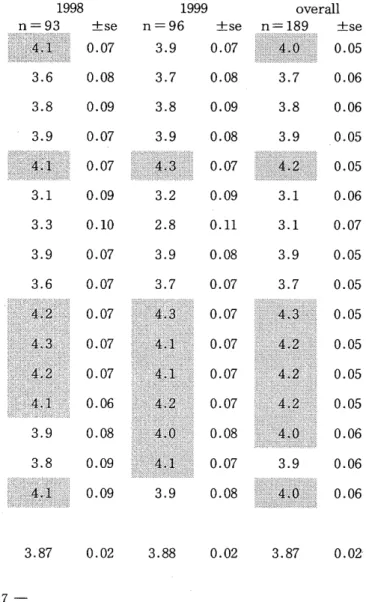
students is appropriate=4.2 points, 12) 1 would like to recommend this class to freshman =4.2 points, and 13) 1 enhanced my thinking ability=4.2 points (table 5).
On the other hand, the items with lower score were 6) 1 feel safe = 3.1 points, 7) 1 was sure of how to follow the IBL process = 3.1 points, 2) 1 got closer to the faculty= 3.7 points, and 9) 1 would like to learn more from this faculty=3.7 points.
Then, the students and the tutor review the Discussion IBL for 10-15 minutes. The total time required
for each tutorial is 180 minutes. The low scores on the items 6) 1 feel The next week, the learning issues are safe, and item 7) 1 was sure of how to follow presented in the group. The aim is for the the IBL process, could be due to the confusion students to think critically about the case while about the differences between college education they share their information. The student is and education they received until high school. stimulated by other group mem民rsand explains The learning method in high school is passive his/her own synthesized information to the with information gained through lectures. The other students. method of study for the majority of students
was to prepare for the entrance examination for Results
Class evaluation by the students is completed with a 5 point Likert scale for 16 items and open-ended answer. The levels in the 5 point Likert scale are“strongly agree" (5 points),
“agree" (4 points),“neutral" (3 points), “disagree" (2 points),“strongly disagree" (1 point). The results for the fundamental nursing IBL completed by the students in 1998 and 1999 is shown on table 5. The items 5), 7), 16) were converted to positive expression because they were expressed in a negative manner. Therefore, if the students had high evaluation, the total score would be higher.
According to the results in 1998 and 1999, the high scores were 10) 1 could collaborate with other students in the group=4.3 points,
5) the faculty paid attention to student' s response=4.2 points, 11) the number of member
college. Very few students received a self-learning style education, such as thinking for themselves, questioning and acquiring the information by themselves. For the students who just entered college, switching from lectures to self-learning is difficult and confusing.
There was some difficulty in the small number of students and the group-learning setting. ]apanese people traditionally do not want to call attention to themsevles, are not selιassertive, and are not likely to express their opinion in group work. Since the requirement of IBL is to give opinions in limited time with little emphasis on relationships within the group, the students may have been confused about what roles to assume in the group.
The evaluation items,“1 got closer to the faculty" (item 2) received a low score, but“'faculty paid attention to student's response" (item 5), had a high score. This may mean that the
faculty paid attention to the students, but were In summary, we found several problems not close to the students. Because the tutor' s related to this study. However, we assume role in IBL is to refrain from lecturing directly that IBL contributes to the student' s progress to the students and display a different type of in critical thinking ability and a future study is supportive attitude, the students whu were not in process. Presently, the IBL process involves used to this learning method, may felt insecure. only one case over a period of 2 days for each Tutors were more involved in fostering critical class. The third year comprehensive course thinking and the group process. However, this involves a case over 3 weeks. In future we area may need to be developed further. plan on increasing the number of cases and IBL
The class evaluation, 12) 1 would like to process in all of our classes after further tutor recommend this class to freshman, and 14) the development and evaluation of effectiveness. class was interesting, scored high. Also 10ω) 1 A part of this pa叩pe訂rwaおspresented aιt ls坑t
could collaborate with other students in the As討ia一一-乎a配ci出五c--ζ(コα
∞
Ont色er,閃enceon Problem一based工β却a訂ming.group, 13め) 1 enhanced my thinking ability, and (本論は執筆依頼論文である) 16) desire to learn increased, scored high.
Therefore, although the students may have been confused, they found the IBL method interesting. As the purpose of this learning method was to stimulate knowledge, the result of increasing research and collaboration with others was accomplished.
One of the difficulties performing IBL is the role of the tutor. The tutor has as important 'role in IBL. According to the student' s evaluation,
the tutor' s contact with them could be one of the reasons for the low scores on item 6) 1 feel safe, and 7) 1 was sure of how to follow the IBL process. Although we had three training sessions on IBL twice before starting and once after, this may have not been enough. Also, di旺erencesamong the faculty members educational view, values and ability as a teacher may have contributed to di宜erentscores. This may contribute to the differences even though we prepared a standardized tutor guide.5) Some faculty members
have difficulty embracing IBL. To perform IBL successfully as a college, continuously tutor training is required. As a future goal, we will try to raise the score of items 6) 1 feel safe and 7) 1 was sure how to follow the IBL pr
∞
ess by focusing on tutor development and student attitudes, and group process.References
1) Kawade, F. : IBL in Mie Prefectural College of Nursing, Quality Nursing, 5 (10), 756-758, 1999.
2) Inouye, ]. , Flannelly, L. : Inquiry Based Leaming as a teaching strategy in a graduate community mental health program, Clinical Nurse Spcialist, 12, 67-72, 1998.
3) Inouye, ]. : Article review regards ]apanese nursing education for PBL&IBL, Quality Nursing, 5 (10), 803-809, 1999.
4) Miller, M.A. : Outcomes evaluation : measuring critical thinking in nursing education, ]. Adv Nurs, 17: 1404-1407, 1992.
5) National League for Nursing : Criteria and guidelines for the evaluation of baccalaureate and higher degree programs in nursing, New Y ork : NLN; 1989.
6) Bound, D., Feletti, G. : The challenge of pro blem -based leaning, N ew Y ork: St. M征tin's Press., 1991.
7) Ryan, G. : Littele P. Innovation in a nursing curriculum : a process of change. In: Bound, D, Feletti, G, The challenge of problem-based leaning.
New York : St. M,ぽtin's Press; 1991. p .111-121. '
11) Fujimoto, K., Sugisaki, H. : Tutor training, QuaHty Nursing, 5 (10), 759-762,1999. 8) Creedy, D., Horsfall]., Hand B. : Pro
blem-based leaning in nurse education : an Australian view , ] .Adv Nurs, 17: 727-733, 1992. 9) Creedy, C., Hand, B. : The implementation
of problem-based leaning : changing pedagogy in nursing education,
J
.
Adv Nurs, 20: 696 -702, 1994.12) Kawano, M: Introducing IBL atMie Prefectural College of Nursing, QuaHty Nursing, 5 (10), 752-755, 1999.
13) Tsujikawa , M. : IBL at fundamental nursing, QuaHty Nursing, 5 (10), 764-773,1999. 10) B紅TOWS,H.S. : A Taxonomy of problem-based
leaning methods, Med. Educ., 20: 481-486, 1986.
14) Tsujikawa, M. : Evaluation for tutorial-peer evaluation, The ]apanese ]. NursiHg Education, 40( 5) : 384-389, 1999.
Table 1 IBL for students who entered in 1997 First year Second year (1997) (1998) Spring Fall Spring Fall . . .psychiatric . . . Fundamental '.geriatnc '.adult .'.pediatric -・community .'.maternity ①fundamental IBL
@t
ield IBL(freshman class) (speciality areas) Table 2 Recen t life of1¥在r. Takahashi Part 1 Third year (1999) Spring Fall .'comprehensive IBL ①comprehensive IBL (junior level) Fourth year (2000) Spring Fall
Mr.Takahashi is 19 years old, male. Ithas been a year since he entered the M university in Mie prefecture. N ow he rents an apartment and lives by himself, because he is from Fukuoka prefecture. He never lived by himself before. Though he was not used to this everyday life, he is getting used to it.
Part 2
He had lived with his family ( parents, grandmother, younger sister) until last year. He has friends now and seems pretty busy every day. Also he started a part time job at the convinience store. Today, a worker at the cafeteria told him “You look pale".
Part 3
He feels sluggish these days and does not have much appetite. He was aware of this and measured his weight. His weight was 60kg.
This is 5kg less than three months ago. He is beginning to sleep later in the morning and be late for his classes or not attend the classes at all.
Part 4
His major is in engineering. Recently, he bought a computer with his parents' help. He was going to use it for his classes, but now he is into getting on the intemet and he is on the internet through the night until early next morning. When he goes to school, he has brunch such as set menu or noodles at the cafetria instead of having a breakfast.
5
Table 3
h在EMBERROLES STUDENT MEMBERS
1. Learn to brainstorm and allow others freedom to do so
2. Ask questions about what is known or not known and how to get what is known 3. Pro blem solve and think critically
4. Be self directed learners, take responsibility for their own learning, with some guidance 5. Examine health care problems, identify learning issues, develop and fulfill personal learning
goals and contribute to the development of other members FACILITATOR (student)
1.Implementation of ground rules of the tutorial 2. Direct and focus on the subject matter
3. Focusing attention on segments of the case 4.五1:akingsure everyone is heard and recorded
5. Closing of each session with summary and synthesis of the case
6. Assisting with evaluation and group progress regarding how and what learning occurred in the sessions
RECORDER (student)
1. Records brainstorming session of generating ideas, issues, hypothesis, information needed and leaming issues
2. Keeps record of who vlill be responsible fur which learning issue 3. Reports at the closing session each responsibility relevant to hypothesis TlME KEEPER
Responsible for making sure there is enough time for each case segment and time at the end to synthesize and process
TUTOR (faculty)
1. Facilitate learning by the group 2. Guide without forcing or directing
3. Help students identify important concepts and issues and synthesize into problem formulation and management plan
4. Knowledgeable about resources available and able to advise students on study approaches 5. Assist students in selecting learning issue
6. Provide a role model of critical thinking and self-examination
7. Encourages students to take active role in the group process and a critical part in their learning
8. Summarize the case and tutorial process 9. Participate in student evaluations
10. Evaluation of best and least effective leaming issues
-Table 4
WORKSHEETS FOR IBL CASE
ISSUES/FACT HYPOTHESES INFORMATION NEEDED LEARNING ISSUES
Table 5 Class evaluation by studens 1998 1999 overall 士se n=96 士se 士se 1) I am satisfied with the class 0.07 3.9 0.07 0.05 2) I got closer to the faculty 3.6 0.08 3.7 0.08 3.7 0.06 3) I felt that I was in college level class 3.8 0.09 3.8 0.09 3.8 0.06 4) The faculty guided us appropriately 3.9 0.07 3.9 0.08 3.9 0.05 5) The faculty did pay attention to the student' s 0.07 進/3 0.07 ι V九蓬i三2総z 0.05 response 6) I feel safe 3.1 0.09 3.2 0.09 3.1 0.06 7) I was sure of how to develop 3.3 0.10 2.8 0.11 3.1 0.07 8) I was stimulated in positive way 3.9 0.07 3.9 0.08 3.9 0.05 9) I would like to learn more from this faculty 3.6 0.07 3.7 0.07 3.7 0.05 10) I could collaborate with other students in the 0.07 設、蓬18 0.07 抗 日4ι3 0.05 group 11) the number of member students is appropriate 0.07 0.07 タ今仁三進捗2 0.05 12) I would like to recommend this class to freshman 0.07 0.07 議対2 0.05 13) I enhanced my thinking ability 0.06 0.07 九、議 ~Zγγ 0.05 14) The class was interesting 3.9 0.08 V 準。ゃ 0.08 γJ滋 謀 総 0.06 15) I gained the a bili ty to research by myself 3.8 0.09 0.07 3.9 0.06 16) Desire to learn increased 0.09 3.9 0.08 i4 ~Q{...{ 0.06 average score 3.87 0.02 3.88 0.02 3.87 0.02' 7