第 巻 第 号 抜 刷
年 月 発 行
Is the European Central Bank
QE Monetary Policy effective ?
Is the European Central Bank
QE Monetary Policy effective ?
Kazuyoshi Matsuura
IntroductionSection .The Practice of the ECB’s Quantitative Easing monetary policy ..The methods of the QE
..The Practice of the QE Section .The impacts of the QE
..Mapping the impact channels of the QE
..The empirical evaluation on the monetary side and real economic sides Section .The side effects of the QE
..Asset risk of the Eurosystem ..A potential risk of the assets bubble Conclusion
Introduction
The euro-area entered a recession in the first quarter of , and quarterly growth rates collapsed in the first quarter of , when the financial crisis hit Europe full-force. The sovereign crisis occurred in Portugal, Ireland and Greece (Greek sovereign crisis occurred in succession in , and )off and on.
The financial crisis was compounded of the sovereign debt crisis and the bank solvency crisis. A hike of government bonds yields induced credit market interest rates to increase, thus contracted credit markets. Banks which hold government bonds on the balance sheet were heavily damaged by a decrease of asset values. Moreover, since investors shifted funds from the nation to others, an outflow of funds forced banks to face liquidity crisis.
The ECB has implemented Non-Standard Monetary Policy measures, in order to prevent sovereign crisis and liquidity crisis, to sustain price stability and the financial system. The Non-Standard monetary policy was conducted in the form of open market operation reforms, assets purchase programmes and negative interest rate policy. Moreover, the ECB started to purchase public bonds massively under the expanded asset purchase programme(APP)from March . This policy has been common to the Fed’ Quantitative Easing monetary policy(QE)in a sense that the assets purchase by the central bank expands monetary base on a large scale. In this article, the ECB’s monetary policy under the APP since March is defined as the QE.
The main purpose of this article is to evaluate the effects and the side effects of the QE in the euro-area after the financial crisis.
SectionI presents the methods and practice of the ECB’s QE monetary policy. SectionII presents the impacts of the QE on the monetary side and the real economic side. The ECB announced that its measures of the QE can help to enhance the transmission mechanism, support financial condition, and facilitate credit provision to the real economy. The repeated phrase of the ECB’s announcement is functioning of the transmission mechanism. Although the influences on the monetary aspects of the transmission mechanism differ in the euro-area because of different financial structures, macro-economic data of the euro-euro-area is analyzed to give an empirical evaluation on the real economy.
SectionIII address the side effects of the QE. The Implicit aim of the ECB’s monetary policy was to rescue nations which are struggling with heavy sovereign debt and to rescue the commercial banks with non-performing assets. It was necessary for the ECB to prevent contagion of bankruptcy which causes systemic risks of financial markets. However, the side effects also should be analyzed to evaluate the QE as a whole.
Section .The Practice of the ECB s Quantitative Easing
monetary policy
..The methods of the QE
In the depths of the financial crisis which hit peripheral nations, the ECB implemented the monetary policies reforms intermittently. The methods were compounded with open market operation reforms, assets purchase programme, and the negative interest rate policy. The methods of the Eurosystem’s instruments are explained in more details on the ECB website.) The essence of the measures is described as below.
Open market operation reforms
In October , the Governing Council of the ECB decided to increase the frequency and size of its longer-term refinancing operations(with a maturity of up to six months)and to conduct all liquidity-providing operations through a fixed rate tender procedure with full allotment.)
In December , the ECB decided to implement additional non-standard monetary policy measures. The agreed package of measures included two longer-term refinancing operations(LTROs)with a maturity of three years and the option of early repayment. The first operation was conducted in December , while the second will be conducted in February in the midst of severe tensions in financial markets of peripheral nations. Through these operations, carried out as fixed rate tender procedures with full allotment, the Eurosystem was in particular ensuring that banks continue to have access to stable funding with longer maturities.)
)ECB, monetary policy, instruments.[https://www.ecb.europa.eu/mopo/implement/omt/html/cspp -qa.en.html]
As announced on ndAugust , on thSeptember , the ECB has taken
decisions on many technical features regarding the Eurosystem’s outright transactions in secondary sovereign bond markets that aim at safeguarding an appropriate monetary policy transmission and the singleness of the monetary policy. This operation was known as Outright Monetary Transactions(OMTs). The ECB announced to purchase sovereign bonds with a maturity of a year to three years unlimitedly under the appropriate conditions of the sovereign nations.)
The targeted longer-term refinancing operations(TLTROs) are Eurosystem operations that provide financing to credit institutions for periods of up to four years. They offer long-term funding at attractive conditions to banks in order to further ease private sector credit conditions and stimulate bank lending to the real economy. A first series of TLTROs was announced on th June and a second series
(TLTRO II)on thMarch .)
Asset Purchase Programmes
On the th May , the ECB’s Governing Council decided on several
measures to address the severe tensions in certain market segments which are hampering the monetary policy transmission mechanism. The measures(Securities Markets Programme)were interventions in the euro area public and private debt securities markets to ensure depth and liquidity in those market segments which was dysfunctional.)
In October , the Eurosystem started to buy covered bonds under a third
)ECB, Monthly Bulletin January , Box , p. .
)ECB, Press Release, Technical features of Outright Monetary Transactions, September . )ECB, Press Release, ECB announces monetary policy measures to enhance the functioning of the monetary policy transmission mechanism, June .
)ECB, Press Release, ECB decides on measures to address severe tensions in financial markets,
covered bond purchase programme(CBPP ). The measure helps to enhance the functioning of the monetary policy transmission mechanism. Then the asset-backed securities purchase programme(ABSPP) started on st November . The
ABSPP was supposed to help banks to diversify funding sources and stimulates the issuance of new securities.
The expanded asset purchase programme(APP), as announced in January , added the purchase programme for public sector securities to the existing private sector asset purchase programmes(CBPP and ABSPP) announced in September , to address the risks of a too prolonged period of low inflation.) Thus, the APP comprises the following purchase programmes ; third covered bond purchase programme(CBPP ), asset-backed securities purchase programme (ABSPP)and public-sector purchase programme(PSPP).
On thMarch , the Eurosystem started to buy public sector securities under
the public-sector purchase programme(PSPP). The securities covered by the PSPP include(a)nominal and inflation-linked central government bonds,(b)bonds issued by recognized agencies, regional and local governments, international organizations and multilateral development banks located in the euro area. The Eurosystem intends to allocate % of the total purchases to government bonds and recognized agencies, and % to securities issued by international organizations and multilateral development banks(from March until March these figures were % and % respectively).
The ECB’s negative interest rate
On the thJune , the ECB started a negative interest rate policy. Since
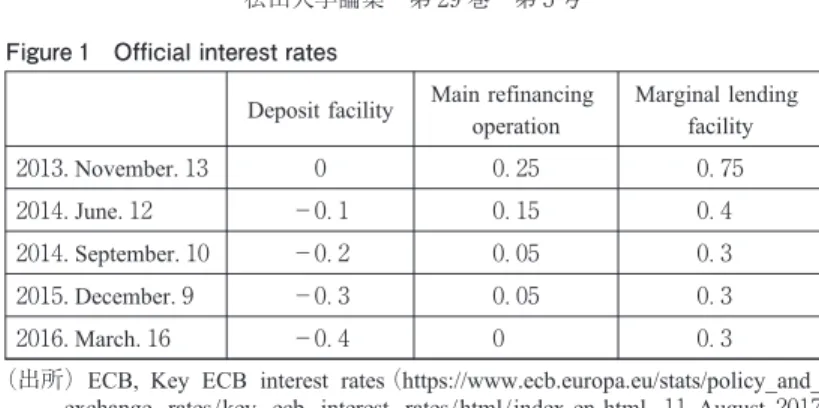
the euro area inflation was expected to remain considerably below % for a prolonged period, the ECB’s Governing Council judged that it needs to lower interest rates. Since the deposit rate was already at % and the refinancing rate at . %, a cut in the refinancing rate to . % meant the deposit rate was lowered to minus . % to maintain this corridor(see figure ). The cut was part of a combination of measures designed to ensure price stability over the medium term. The ECB intended to encourage banks to increase lending by charging fee on the banks’ balance on the ECB’s deposit balance. The rate of deposit facility was lowered successively from minus .% in June to minus .% in March
.)
)ECB, HP, statistics, ECB/Eurosystem Policy and exchange rates, key ECB interest rates, . April. access.
Deposit facility Main refinancing operation Marginal lending facility . November. . . . June. − . . . . September. − . . . . December. − . . . . March. − . .
Figure Official interest rates
(出所)ECB, Key ECB interest rates(https://www.ecb.europa.eu/stats/policy_and_ exchange_ rates/key _ ecb _ interest_ rates/html/index. en. html, August access).
..The Practice of the QE
The central bank’s purchase of government bonds causes an increase of monetary base. As the ECB started the massive purchase of government bonds from March , monetary base has grown dramatically. The monetary base volume expanded in double from . trillion euro in March to . trillion euro in January .) The main factor of the increased monetary base is Other Liquidity Providing Operations which includes liquidity provided under the Eurosystem’s asset purchase programmes.
Because the Eurosystem’s direct purchase of bonds from the governments is prohibited by the Maastricht Treaty, the Eurosystem must purchase government bonds from the secondary market. However, the Bundesbank criticized that the Eurosystem’s purchase of bonds violates the Maastricht Treaty for the reason that the Eurosystem’s purchase applies for the direct financing of the nations.
Then the question is what the distinction between the NCB’s(National Central Bank)direct purchase of government bonds from the government and the NCB’s purchase of bond from the secondary market is. ) Figure . A shows the NCB’s purchase operation. Assuming that the government issues billion euro public bonds and a private bank(A)buys these bonds(②). Then, when the government expends billion euro, the deposit of the bank(A)increases by billion euro (③). If the NCB buys billion euro public bonds from the bank(A), the
NCB’s central deposit increases by billion euro(④).
)European Central Bank Statistical Data Warehouse, http://sdw.ecb.europa.eu/browseChart.do? node= &SERIES_KEY= .ILM.M.U .C.LT .Z .EUR, . March. access. )Okuda( )tackles the issue of theoretical relation between the Japan’ QEE and monetary base and money stock. This article owes theoretical analysis of the influence of money stock and monetary base of public finance to Okuda’ work.
NCB Private bank(A) Government PBD 20 CBD 20 PBD 10 CBD 10 GVD 10 Bond 10 PBD 30 CBD 30 CUD 30 ① liability Bond 10 asset Bond 10
asset liability asset liability
② asset liability asset liability asset liability
GVD 10 Bond 10
③ asset liability asset liability asset liability PBD 20 CBD 20
Bond 10
CUD 30 Bond 10
④ asset liability asset liability asset liability
Loan 20 CUD 20
CUD 20 Figure .A Buying operation
* PBD : private bank deposit, GVD : Government deposit, CBD : Central Bank deposit, CUD : current deposit
①:The private bank(A)has billion euro at the NCB’ deposit.
②:Government issues million euro public bonds, and the bank(A) buys bonds. The private bank’ purchase of billion bonds is financed by the NCB’s deposit. Assuming that NCB doesn’t credit to private bank(a)or the bank(A)’s deposit at NCB doesn’t increase because of the government deficit, the source of funds is formed by deposit which nonbanks or private firms own. In this case, the bank(A)’s deposit at NCB(monetary base)decreases by billion euro and the bonds of assets increase by billion euro. The government’s central bank deposit increases by billion euro.
NCB Private bank(A) Government
PBD 20 CBD 20
PBD 20 CBD 20 GVD 10 Bond 10
① asset liability asset liability asset liability
② asset liability asset liability asset liability
GVD 10
③ asset liability asset liability asset liability
PBD 30 CBD 30 CUD 30 Bond 10 Loan 20 Loan 20 CUD 20 CUD 20 Bond 10 Loan 20 Bond 10
Figure .B NCB s purchase of the public bonds from government
③:Government expend million euro and a private sector deposits funds into the bank(A). When the government expends funds to the private sector, then the government’s deposit of the NCB decreases, the bank(A)’s deposit of the NCB increases and private sector’s deposit of the bank(A)increases.
Central bank deposit at NCB decrease by billion euro by purchase of public bonds from government for a time at stage ②, but NCB deposit of the bank (A)restores to billion euro at stage ③. This means that when public bonds are issued by government due to deficits, monetary bases doesn’t increase, but money stock increases.
④:The NCB buys million bonds from the bank(A).
When NCB buys billion euro bonds from the bank(A), public bonds switches to central bank deposit at private bank(A)’s balance sheet, monetary base(= private bank’s deposit on the NCB’s liability)increases by billion from stage③. However, money stock volume doesn’t increases by from stage ③.
Figure .B shows the government’ direct purchase of the government bonds. The government issues billion-euro bonds and the NCB purchases these bonds from the government.
①:The bank(A)deposits billion euro at the NCB.
②:Government issues public million euro bonds and NCB buys million bonds directly from Government. On NCB balance sheet, public bonds increases by billion euro on asset side and government’ deposit increases by the same amount on liability side. On government balance sheet, central bank deposit increases by billion euro on asset side and public bonds increases by the same amount on liability side.
③:Government expends million euro and a private sector deposits million euro on the bank(A). Thus, money stock volume increases by million euro from stage②.
In stage ③, monetary base (= private bank’s deposit on Central bank’s liability)increases by million euro from stage②.
At stage ③, monetary base increases by billion euro and money stock increase by billion euro.
Figure .A assumes that the bank(A)have funds which are deposited by private sectors. The bank(A)buys public bonds by using private sector’s deposit, and NCB buys the bonds from the bank(A). Thus, when the NCB purchases the bond, the purchase is financed by the private sector’s deposit. However, the NCB’s direct purchase of bonds doesn’t assume that the bank(A)holds the deposit owned by the private sector. Therefore, there is a risk that the NCB’s direct purchase of bonds is unlimitedly financed by the NCB.
The current balance is equal to(S−I)+(T−G)in terms of national accounts statistics. When the current balance is balanced or is in a surplus, private sector’s
surplus finances the government’ deficit(T−G < ). In other words, when private sector’s surplus finances the government deficit through financial sectors including private banks, private sector’s surplus is a precondition of the finance. But, because figure .B doesn’t assume the public sector’s surplus, it shows an unlimited finance of government deficit.
Since the current account is balanced in the Euro area, the government’s deficit is financed by the private sector’s surplus. Thus, the public sector’s deficit isn’t unlimitedly financed by the NCB. However, when the surplus reserve is created through central bank’s operation, the reserve could be a source of private bank’s credit creation, and could be available funds to the real economy. If private banks expand lending to private sectors through credit creation, and the currency circulation increases in the common commodity markets, there is a risk of inflation.
Section .The impacts of the QE
..Mapping the impact channels of the QE
In the ECB’s official announcements on the QE, the transmission mechanism of monetary policy has been repeatedly presented to be a central part of the policy.
The transmission mechanism describes how the QE should cause an increase of consumer prices through purchase of government bonds. The transmission mechanism is characterized by long, variable and uncertain time lags. Deutsche Bundesbank Report explained the process and theory of the ECB’s monetary policy transmission mechanism in details. ) It shows that a change in asset prices and yields through the portfolio rebalancing channel and the signaling channel creates the conditions under which the QE can be transmitted through other channels such as the balance sheet channel.
The main channels and theories of the process are showed as below.
The portfolio rebalancing channel
In the absence of Wallace neutrality, the QE policy causes investors to adjust their portfolios in various ways ; this is reflected in relative yield shifts for individual asset classes and, above all, a flattening of the yield curve. This portfolio rebalancing channel is based chiefly on what is referred to as the preferred-habitat theory )to explain the yield curve, which combines the liquidity premium and market segmentation theories.
In this environment, the purchase of long-term government bonds influence the yield curve via several channels. On the one hand, purchasing long-term bonds lowers their supply in the market(segment)in which the purchases take place. Market segmentation means that investors with a preference for these bonds will be prepared to pay a higher price. ) If investors buy the bond, the bond price goes up. This reduces the yield not only on this bond class but also on close substitutes (segmentation theory). If, on the other hand, the central bank purchases very large volumes of long-term bonds, the average maturity of the portfolios held by investors will falls(liquidity premium theory).) The fall of liquidity premium induces the fall of the aggregate term premium. Thus, the fall of long-term bond yield influences other bonds yields.
The report states that portfolio adjustments and therefore a potential fall in long-term yields can be triggered in an environment in which negative interest in applied to central bank balances and in which the level of excess reserve held by commercial banks is high. )
)Vallante, D.( ), p. .
)Deutsche Bundesbank, Monthly Report June , p. . )Ibid, p. .
The signaling channel
The signaling channel is based on expectations theory, according to which the long-term interest rate is approximately equivalent to average short-term interest rate expectations. If, in addition to communicating the future evolution of policy rates (forward guidance), the central bank announces that it intends to purchase assets, market participants could interpret this as a further indicator of an expansionary monetary policy stance being maintained for some time to come. This would imply that what is being communicated is backed by concrete measures, supporting market participants in their perception of the future path of policy rates. )
The balance sheet channel
The bank capital channel attributes special importance to a commercial bank’s balance sheet position. If asset prices increase as a result of purchases, the assets of a bank, too, will increase. All other things being equal, the resulting profit has the effect of increasing commercial banks’ capital. This increase enables commercial banks both to meet the higher capital requirements of a growing loan portfolio and facilitates their access to the funding needed to refinance their loans to enterprises, increasing banks’ willingness to provide credit. )
Functioning of the monetary transmission mechanism differs in terms of degree and speed in the euro-area. The reason is expressed in the speech of President of the Deutsche Bundesbank, Weidmann saying that the national financial systems still differ significantly within the euro area, and member states retain a large degree of autonomy in fiscal and economic policy, which favours the existing decentralized setup. ) Recognizing this feature, we move on an empirical analysis on the QE.
)Ibid, pp. − . )Ibid, pp. − .
..The empirical evaluation on the monetary side and real economic side The market interest rates
An analytical decomposition of the change in the ten-years interest rate only allows a distinction to be made between the contribution of interest rate Expectations and term premium. The results suggest that the decline in the ten-years interest rate was attributable to both a lower term premium and declining interest rate expectations, with the term premium initially of great importance since July . ) Long-term government bonds yields converged among the euro-area except for Greece from January to April . After a temporary yield hike at the third Greek financial crisis in July , long term government bond yield of the most of euro-area countries have gradually gone down but bond yields of Portugal and Greece have gone up since July . Thus, there has been a disparity of bond yields among euro-area nations due to a great credit risk of these nation. For example, the yield disparity between Germany and Greece has been over % since the summer. )
Bank lending rates for non-financial corporations(NFCs)declined gradually from the late . Since the announcement of the ECB’s credit easing measures in June , composite bank lending rates for loans to NFCs and households have decreased by significantly more than market reference rates, signaling an improvement in the pass-through of monetary policy measures to bank lending rates. )
However, the Deutsche Bundesbank reported that the interest rates on corporate loans remained relatively unstable and did not change very much in many countries
)Deutsche Bundesbank, Monthly Report, June , pp. − .
)Eurosta, database(http://ec.europa.eu/eurostat/tgm/table.do?tab=table&init= &language=en& pcode=teimf &plugin= , . December. .
since . ) To put it more precisely, bank lending rates have fluctuated in some nations. This trend implies unstable lending market condition since in the short term.
In an analysis of the impact on the market interest rate, the impact on the real interest rate is more important to analyze the impact on the real economy. Gross, D argues that real interest rates are the key variable for savings and investment decisions and estimates of the equilibrium long term real interest rate today are highly uncertain in a global market. He concludes that with integrated global capital markets national monetary policy can no longer be expected to have an impact in bond yields at home. Activism by the ECB, for example, extending the bond purchase programme, might thus be largely ineffective. )
The impact on the real interest rates due to the QE is a one of crucial factors which influences the investment and saving, thus influences the production.
The influence on the real economic side
The ECB’s intervention in security debt markets has influenced to monetary aspect of the transmission mechanism differently in the euro-area. Thus, it is reasonable to imagine that the impact on the real economic side also differ within the euro-area. In addition to it, as stated before, it is expected that the impact on the long term real interest rates are limited in the euro-area. Moreover, real interest rates are one of factors which drive investment. That is, the key decision variable for investment decisions is usually the expected rate of return from a project relative to the weighted average cost of capital(WACC), the weighted average of a
)Deutsche Bundesbank, Monthly Report, June , p. . The same trend can be seen in the data as follows. Banco Portugal, Statistical Bulletin-February , p. , A Banking and deposit, BAOCO DE ESPANIA, Statistical Bulletin, December, p. .
company’s debt servicing costs and its cost of equity. When the equity risk premium goes up, the WACC increases vis-à-vis the risk-free rate, making corporate investment less attractive. Gros, D pointed that the increase of the equity risk premium has affected the WACC in a global market. )
Based on limits of the analysis, however, macro-economic data will be analyzed to present an empirical evaluation of the QE’s impact on the real economy because the aim of this article is to evaluate the effect of the QE in the euro-area as a whole.
Monetary Stock, credit condition
The ECB’s asset purchase of public bonds increases both monetary base. Banks create money stock as a by product of their lending.
Annual M growth and M growth decreased during , and started to increase from April . M growth rate increased from April to April and remained around % annual rate since April to February . M growth rate increased from April ( .%)to July ( .%)and remained between % and % since the summer. )
ECB Economic Bulletin(issue / )shows that among the M counterparts, the Eurosystem’s purchases of general government debt securities, mainly in the context of the ECB’s public-sector purchase programme(PSPP), contributed positively to M growth. In addition, M growth continued to be supported by domestic counterparts other than credit to general government. This was driven by the ongoing recovery in credit to the private sector, together with the persistent contraction in MFIs’ longer term financial liabilities. )
)Ibid, pp. − .
)ECB, Statistical Data Warehouse, Money, Credit and banking, . March. access. )ECB, Economic Bulletin, issue / , p. .
What is noteworthy is an increase of loan by credit creation since March . Growth rate of credit to euro-area residents by MFI was minus .% in , .% in , and .% in . ) This trend indicates that the QE contributed to the increase of money stock by banks’ loan through some channels.
The GDP growth rate and the consumer prices
The GDP grew moderately in the euro area. The GDP growth rate was .%
in , .% in , and .% in . The evolution was marked by
a relatively increase in moderate gross fixed capital formation and a weak recovery of private consumption since . ) Despite of the moderate GDP growth, Consumer Prices has remained at levels close to zero and minus till May . HICP stared to rise gradually since summer and increased further to .% in February . However The increase of the period was mainly driven by energy prices rise and, to a lesser extent, food prices rise. )
The increase of monetary base directly doesn’t increase banks’ lending. But banks’ excess reserve which is induced by the creation of monetary base is the fund sources for bank lending through credit creation. The reduction of long term government bonds yields contributed to the gradual reduction of interest rates of private banks’ loan. The decrease of banks’ lending interest rate is one of factors to increase the expected rate of profit of firms and to expand household spending.
The money demands can be noticed from money borrowers on the MFI’s balance sheet. Among credit to other euro area residents, financial corporations and debt securities contributed positively to credit growth. ) This data indicates that
)ECB, Economic Bulletin, issue / , S . )ECB, Economic Bulletin, Chat , issue / , p. .
)ECB, Economic Bulletin, Chart , p. , Eurostat, HICP( = )− monthly data(annual rate of change)Last update : . March. , . April. access.
money can be used to invest securities, real estate and commodities, which intensifies volatility of assets prices.
Section .The side effects of the QE
..Asset risk of the Eurosystem
① The boundaries between monetary and fiscal policy
Weidmann argued that the government bond purchases by the ECB blur the boundaries between monetary and fiscal policy. He pointed out two issues as to the ECB’s government bond purchases. One is that the Eurosystem’s holding of public bonds would distort an order of the government bonds’ markets and make it difficult to exit the QE. Weidmann said in his speech as follow.
Central banks are becoming countries’ biggest creditors. And once finance ministers get used to the favourable financing conditions, there is a danger that monetary policy will be harnessed to fiscal policy and will be put under pressure to make high levels of debt sustainable through low interest rates. That would make it increasingly difficult to exit the ultra-easy monetary policy. Monetary policy measures that seek to improve the situation in individual member states in a targeted way are particularly problematic. That would be the case, for instance, if central banks were to buy only bonds issued by the governments of crisis countries, as was the case with the Eurosystem purchases in to . )
The other issue is the influence of the government bonds’ market risks. Weidmann stated as follow.
Such purchases may cause a redistribution of fiscal risks through central bank balance sheets, as, ultimately, taxpayers in the member states are on the hook for potential central bank losses. I have already explained that redistributing fiscal risks
is alien concept to the existing regulatory framework of monetary union, which is based on the principle of individual national responsibility, and would probably be counterproductive. If, however, decisions on redistribution are to be taken, then at least they should be taken by those with the legitimacy to do so. Those people sit in governments and parliaments ; they do not work at central banks. )
If the ECB suffers from capital loss of the bonds, the government needs to compensate for the losses. Finally, nations need to pay tax to clean the government’s debt. Nobody can deny a possibility of such an abnormal rise in bond yield hike which would cause the ECB’s capital loss.
② Bank profitability decreases
Weidmann pointed that banks suffer from a decrease of profitability in the ultra-easy mode. Most banks find it difficult to pass on the negative interest rates to their depositors. Banks suffer from a decrease of income that is generated through their bond purchase because the Eurosystem’s bond purchases depress long term interest rates. Those banks with a lower portability find it difficult to strengthen their capital base.
Of course, as a central banker, I am not concerned here with the profits that the banks make. From a monetary policy perspective, however, it is crucial that banks transmit monetary policy stimuli – and this depends partly on their capital base. For only banks with sufficient capital can issue loans to enterprises and households. )
With regard to bank profitability, Demartzis, M and Wolff, G. B. shows that )Ibid, Jens Weidmann, . September. .
bank profitability of euro-area(quarterly profile up to Q )has improved since Q , but the level is still below Q level. )
When rates of consumer prices are minus, the burden of real interest rates increases for borrowers. As the result, as borrowing demand decreases, banks’ lending volume decreases. In addition to it, since banks cannot pass all of losses resulting from minus deposit rate on the ECB to private depositors, then interest rate income of banks decrease. Therefore, banks tend to go to risky business.
..A potential risk of the assets bubble
The ultimate goal of the QE is to increase consumer prices and the nominal GDP. In fact, the GDP growth rate has been gradually going up and HICP has been increasing since the Ultra-QE(started from March ), while the QE monetary policy causes a potential risk of asset bubbles. The ECB’s purchase of government bonds increases monetary base. An increase of excess reserve of banks created by bonds sale to the Eurosystem can be used as source for security and real estate investment.
A Social demand for money is divided into a general commodity transaction use and the other uses. Regarding with the other uses, take a security circulation for example, if the securities prices and the security transaction volume increase, the money demand for a settlement should increase. If a bond yield is expected to increase in the future, people want to hold cash for portfolio investment. This money exists outside of the general commodity circulation.
Moreover, excess reserve created by sale of government bond can be used as source for money creation which increases bank lending. As indicated in section , banks have increased lending to financial corporations and debt securities. Money
circulates in the security markets through these non-banking corporations, which leads to an expansion of the security transactions.
In the wake of an increase of money stock and the negative interest rate, investors have increased investment for securities and real estate. Financial Stability Review states that in an environment of overall subdued yields on debt instruments, investors have gradually been taking on higher credit and duration risk in their portfolios in . This has been the case not only for investment-grade bonds, but also riskier segments of global fixed income markets. It shows that the prices of bonds and stocks in the euro-area kept moving up slowly with great volatility. )
The crucial issue is that bank’s excess reserve created by purchase of government bonds can be used a source for money creation. The momentum of monetary base creation should be the central bank’s discount of the commercial bill on the condition that firms produce commodities, in other words, that added value is produced by firms in the market. Assuming that the firm produces a commodity, the firm sells it to a trader for exchange of a commercial bill. If the bill is offered from the firm to a bank for discount, the bank provides funds to the firm(a bill holder)by creating the firm’s deposit. Then, if the bank needs cash instead of the bill, the bank requests the central bank to rediscount the bill. In this case, monetary base created by the central bank corresponds to the commercial bill which is issued in exchange for commodities with added value.
However, the Eurosystem’s public bond purchase means that the creation of monetary base corresponds to the government bond. The point is that government bonds are only guaranteed by the government’ credit, and are not backed up by the added value which is produced by human’s labour. As money stock which is equivalent to the monetary base circulates in the asset markets, the increase of
money stock maintains assets transaction and an increase of assets prices.
Conclusion
Shlichter, D. S. a pointed out that the QE causes a potential risk of higher inflation. Shlichter argues that the ECB started using the printing press with the explicit objective of propping up government bond prices and managing interest rates on government debt to lower levels. He concludes that the funding of the states by ongoing money production from the central bank is simply a logical extension of the idea behind the present monetary system. ) Since the printing press causes inflation by weakening the purchasing power of the monetary unit, fiat money systems have historically always led to high inflation, ending usually in total collapse. ) He warns that this argument is true for the present system.
Hyperinflation doesn’t occur in the present QE, however excess reserve created by the Eurosystem’s purchase of government bonds is used as a source of credit creation for financial assets investment and real estate investment, thus money circulates in those markets. Therefore, the QE sustains the high level of asset and real estate prices. With regard to the side effect of the QE, governor of Federal Reserve Bank, in case of the Federal Reserve Bank of the USA, Stein criticized defects of inflation targeting of the central bank that excess reserve injected by the central bank circulates not only through loan to private sector but also through assets investment and the financial technology. ) His argument is applicable to the Eurosystem’s QE. Once the asset prices and housing prices start to increase with euphoria spreading, it is difficult for the central bank to regulate banks’ credit expansion. The asset bubble will be repeated.
)Detlev S. Shlichte, , pp. − . )Ibid, p. .
Since the government bond yields are minus due to the QE, the government bonds holders are levied tax by the government. That means that governments’ debts will be gradually reduced by levying tax on holding of governments bond. When hyperinflation hit the German economy in the ’s, the government outstanding obligation was dramatically reduced at the cost of asset holders’ loss in the short term. However, we should notice that the negative interest rate substantially means that financial assets are levied tax, by which the government reduces its outstanding obligation at the cost of taxpayers in the long term. Although the QE has contributed to lowering market interest rates and easing of credit markets, the side effects of the QE cannot be ignored to assess the QE as a whole.
reference
Cinzia Alcidi, Matthias Busse and Daniel Gros, ‘Is there a need for additional monetary stimulus ? Insights from the original Taylor Rule’, Center European Policy Studies, No. , April . Daniel Gros, ‘Ultra-low or Negative Yields on Euro-Area Long-term Bonds : Causes and
Implications for Monetary Policy’, Center for European Policy Studies, No. /September . Deutsche Bundesbank Monthly Report, ‘The macroeconomic impact of quantitative easing in the
euro area’, June , Vol. , No. , pp. − .
Detlev S. Schlichiter, Paper Money Collapse, The Folly to Elastic Money and the coming Monetary Breakdown, Wiley, John Wiley & Sons, .
Diego Valiante, ‘The visible hand of the ECB’s Quantitative Easing’, No. /May .
European Central Bank Statistical Data Warehouse, http://sdw.ecb.europa.eu/browseChart.do?node= &SERIES_KEY= .ILM.M.U .C.LT .Z .EUR, −March− − access.
ECB, Press Release, Technical features of Outright Monetary Transactions, September . ECB, Press Release, ECB announces monetary policy measures to enhance the functioning of the
monetary policy transmission mechanism, −June− . ECB, Financial Stability Review, November . ECB, Economic Bulletin, issue / .
ECB, Press Release, ECB decides on measures to address severe tensions in financial markets,
Jeremy C. Stain, ‘Overheating in Credit Markets : Origins, Measurement, and Policy Responses’, Board of Governors of the Federal Reserve System, February , , https://www.federalreserve. gov/newsevents/speech/stein a.htm
Kazuo Mizuno, ‘The truth of Minus interest’, Economist, Mainichishinbunsha, , April, , pp. − .
Jens Weidmann President of the Deutsche Bundesbank, Lessons from the crisis for monetary policy and financial market regulation, Keynote speech given at the Frankfurt Finance Summit, Frankfurt am Main, . . .
Jens Weidmann President of the Deutsche Bundesbank, Aspiration and reality : the situation in the European monetary union Speech at the Institut Ökonomie der Zukunft in Karlsruhe, . .
.
Maria Demertzis and Guntram B. Wolff, “What impact does the ECB’s quantitative easing policy have on bank profitability ?”, Policy Contribution, Issue No. , , Brugel.
Okuda, H., Three issues concerning Japanese QQE, Ritumeika International Studies, Volume . , , June. pp. − .