Abstract
The Nepalese education system has replaced the School Leaving Certificate (SLC) examination with the Secondary Education Examination (SEE) to mark the end of secondary schooling. This seemingly drastic move may not be as revolu-tionary as it seems: The modes of teaching, learning, and testing remain the same, only the grading system has changed from a percentage-based score to letter grades. The underlying problem mainly lies in the belief of the general population that English proficiency and test scores are the benchmarks for quality education in Nepal. The paper seeks to examine how the change in the grading system has af-fected secondary education in Nepal, and how academic achievement and English correlate with student performance in future endeavors.
Keywords: SLC, SEE, Secondary School Education in Nepal, English Language Education in Nepal.
1. Introduction
The School Leaving Certificate, also known as the SLC examination, was the final nationwide secondary school examination in Nepal. This examination is given to students at the end of Grade 10. The exam was generally given between April and June each year. Students could continue on to higher secondary or intermediate-level (high school equivalent) education in Nepal only after passing the SLC.
The Secondary Education Examination (SEE) has since replaced the SLC. The format of the exam itself has not changed; however, the results of the SEE are published as letter grades with weighted grade point averages (GPAs) instead of the percentage
The Impact of the SLC on Nepali Education and Students
with a Special Emphasis on English Language Competency
system used in the SLC. Students do not fail the SEE in the sense of being required to repeat a grade. Instead, under the new system employing the SEE, students with low GPAs are simply not permitted to advance to high school. The system has thus received much negative feedback for its ambiguous role and implications for students’ futures.
2. Overview of Nepali Secondary Education System
The SLC, much like other standardized exams, covers a limited portion of the curriculum, and thus captures only a part of an examinee’s achievement. Students who underperform due to factors such as examination anxiety are naturally at a disadvantage in national examinations such as the SLC, which focus only on easily assessed concepts and thus encourage moralistic teaching and rote learning (Marsh, 2009).
The SLC exam was also heavily criticized by some educators in Nepal as outdated in the modern context, which led to a move to replace it. They claimed that the test could neither truly measure student ability, nor was it truly standardized. For the past 30 years, experts have been urging the Nepalese government to review and update the examinations, but they say that the government has been running the same old mechanism of their time, which will continue to work in the same manner for students several decades later. Educators argued that the SLC results and examination itself have been so random and haphazard that the examination results cannot accurately reflect the Nepalese education system.
The education law was amended, changing the final grade of school-level education to Grade 12, making the SLC now the final exam taken by Grade 12 students. Per this change, school education is now classified into two stages: basic (Grade 1 to 8) and secondary (Grade 9 to 12). According to the spokesperson for the Education Ministry, only schools that meet the criteria decided by the Ministry of Education (MOE) are allowed to teach Grade 12 classes (Marsh, 2009).
After broad criticism for the SCL for a long time, the government had finally decided to reform the evaluation system of SLC/SEE, specifically they adopted a letter grading system instead of the former grading system. Under the old grading system, students who could get over 40 points (out of 100 points) for all the subjects passed the SLC. On the other hand, the new letter grading system rarely give failing grade (F) to examinees (Giri, 2005). Technically speaking, this is not as drastic a change as it appears. The evaluation criteria have not changed at all; students are still evaluated on the marks they
obtain in the written examination, only they assigned an equivalent letter grade rather than a percentage score.
Students faced numerous issues if they couldn’t get a good grade on the SLC. It meant a lost opportunity to advance to further studies or find work, as well as personal shame. Those who complete the SLC exam with higher grades are eligible to apply for seats in competitive departments such as science, engineering, and medicine, as well as to prestigious institutions. Less-popular subjects are the only available options for those with lower grades.
Teachers are also impacted by SLC exam results. A teacher’s credentials are often judged by their students’ exam results. Inadequate or unsatisfactory exam scores can be seen as signs of incompetence or negligence and may jeopardize a teacher’s job. Conversely, bonuses or certificates of appreciation are often awarded to teachers who deliver high success rates in the SLC.
The MOE usually awards prizes to schools with high passing rates for the SLC; such schools are considered prestigious. Conversely, schools that fail to secure good exam scores are regarded as suffering from bad organization and incompetence. Such schools are penalized by reducing the government budget. Public schools have consistently been out-performed by private schools, both in average scores received in individual subjects and in average pass rates (Bhatta et al, 2004).
Because SLC is a high-stakes exam, students aged 15-16 years (the average age of Grade 10 students) have developed a pass-at-any-cost mentality and often employ any means possible to ensure a good score, as good performance on the SLC is vital for both the school and the students. Parents, family, and the community share this anxiety. To many students, this was their main motivation to learn.
“One of the good influences of the change [to the no-fail SEE system] is that it now spares young children the immense pressure the ‘Iron Gate’ exerted on them.”(V&S VMAG, 2017), said the vice principal of a public school in Kathmandu.
The SLC required students pass all subjects to go to Grade 11. If he/she failed even one subject, the student had to retake the exam. On the contrary, under the new system, students can pass with 1.6 GPA and D+ test score in English, Nepali, and Social studies. However, education experts point out that the new grading system is not the fundamental solution to the failing education system. “School-level education is desperately in need of improvement. From updating the curriculum to focusing on the quality of teachers and shifting the focus from teacher-centered learning to student-centered
learning to using summative assessments and implement formative assessments now― there are a lot of things that need to be taken care of first.”(V&S VMAG, 2017).
The only apparent difference is the change from presenting the results as a “mark sheet” form to presenting them as a “grade sheet.” However, this simply reflects the conversion of student marks from a numeric to letter form. There has been no actual change in how students learn, teachers teach, or how the assessment itself is conducted. Question papers that focus on lower-order cognitive skills are the sole focus of the current assessment system. The stark reality of the assessment system in Nepal is that there is a glaring inconsistency between the question papers and the curriculum covered in class. Thus, the question papers and the examinations do not necessarily measure what they are intended to measure―problem-solving and other applicable skills. Hence, any measurement derived from such assessment would be invalid, whether depicted in numbers or grades (Bhatta, 2014).
The general understanding of “quality education” has been associated with examination scores: Students securing higher marks are considered “good” students, and schools with greater percentages of students with high marks are considered “good” schools (Bhatta, 2014).
Interestingly, this understanding of quality is not only sensible but accepted policy in Nepal. Carney and Bista (2009), in their paper on the genealogy of education reform since 1990, notes that members of the team preparing the second master plan revealed that ” ... test scores became the one and only criterion of quality of education. All of us understood quality from that perspective.”
The formation of a study team to better analyze the results of the SLC in 2005 can be regarded as an important action by the Nepalese government (Mathema and Min, 2006). After the research, however, a lot of discrepancies were found both in the findings and recommendations and in the formation of the team in itself. First, no significant fact-finding about student performance took place in the study. The study report did include a few statistical results; however, those results failed to point out reasons for higher performances of certain students over the others in exams. Additionally, it could not identify any contributing factors to their performances, whether good or bad. Second, the majority of the research team members were claimed not to be qualified enough to analyze student performance on the SLC. Third, their recommendations and findings were sometimes contradictory and inconsistent with the original goal of the team. For example, it failed to acknowledge the role of examinations in educational reform. The
examination results from 1981 to 2009 showed that between 69% and 80% of the students who failed the SLC did so by failing in English (Giri, 2005).
3. Significance of English in the National Examinations with Some Examples The examination system even now focuses on testing the language knowledge emphasized in the traditional approach to language education. Instructional schemes, for instance, continually rely on the traditional approach that emphasizes accurate memorization. Rote learning is promoted and encouraged. Comprehensive questions require answering factual questions by locating the relevant information in the given text. The old format of the SLC exam is still used in spite of severe criticism on its reliability and validity. Obviously, a wash-back effect from the former exam was observed, and many discrepancies and inconsistencies during the test-developing process impeded the potential of the new English teaching curriculum (Mathema and Min, 2006).
Regarding the poor learning environment, especially in terms of impairing educational qualities and rising needs for well-educated manpower, education authorities seek low-price means of improving the existing education system. Reforming the examination can be an affordable yet effective way of improving the quality of education (Heyneman and Ransom, 1990).
The Alderson Report on the National Certificate of English of Sri Lanka (Alderson, 1986) offers a great way in which a national examination can positively lead teachers’ daily teaching activities. Other changes have accompanied the change in Sri Lanka’s national examination, which include changes in the text materials, instructional goals, and teaching methodologies. Supplementary materials such as learning materials, instructor’s guides, and test materials were based on the skills, activities, and sub-skills followed the concepts and styles of the national examination. As Alderson noted, the fundamental principle was that classroom activities cultivated English skills and abilities targeted by the instructional goals, which were subsequently assessed in the national examination. Besides, the tests had a strong influence on both teachers and students. His report shows that “ingredients, nature, and use” have a strong positive or negative impact of the test. As one expert noted, “A well-designed examination system can monitor and measure achievement and occasionally aptitude; provide feedback to individuals, districts, schools, and students; provide feedback on the overall strengths and weaknesses of the educational system, and suggests directions for change and improvement”(Heyneman
and Ransom, 1990). Experts cannot say the same for the reforms that brought SEE. One Nepalese education expert noted the redundancy of the change in the system as well, saying, “The SLC exam is merely a demarcation point.”(Inter Press Service, 2013). The perception that SLC/SEE scores accurately reflects student aptitude and learning needs to be changed, since in reality, good exam scores do not ensure future professional success.
The education system in Nepal seems to be at a crossroads with the recent changes, with all stakeholders identifying the underlying problems of both the old and the new systems. However, one important topic in the mode of education within Nepal has not yet been addressed: the language of instruction in schools and its correlation with student performance. The majority of private schools, especially in bigger cities such as Kathmandu and Pokhara, use English as the medium of instruction. Parents and students consider education in English as the most important motive for their participation in private schooling because mastery of English is essential in the modern world, since it is used globally.
English education is needed, in the public perspective, for the ability to use computers and will ensure good jobs in areas such as medicine, engineering, aviation, or in NGOs. Even when nearby public schools offer education in English, many parents believe that quality of teaching in private schools is better, employing arguments such as “boarding students are required to speak in English at all times in the school premises”(Phyak, 2016). The administrative data of the MOE in Nepal shows that the percentage of students studying at private schools has rapidly increased between 2005 and 2010, to be precise, from 6% to 13% at primary schools, 7.6% to 15% at lower secondary schools, and 9.7% to 17% at secondary schools. One of the problems, according to a professor of education at Tribhuvan University, is that “Nepali society misunderstands ‘quality education’ as fluency in the English language” while “quality education means going beyond textbooks, encouraging students to be curious and analytical, and to ask questions and draw their own conclusions.”(Bhatta, 2014).
Enrichment of education as a private sector led not only to the domination of English in teaching but also to the belief that acquiring English is the only way to engage in the global economy and escape from poverty. This extreme language policy has pushed the government to insist that public education should be done in English from Grade 1. Many public schools adopted the “Only in English” policy due to the strong pressure from policymakers; however, the results have been rather pessimistic. Even though students
had been taught in English, many children could not get enough knowledge about main subjects such as science and mathematics mainly due to their lack of English skills or teachers’ poor skills of teaching in English. Although the ‘Only in English’ policy was beneficial for many Nepalese, especially to those belonging to the upper- middle class, quite a lot of students still cannot achieve a passing score and cannot pursue higher education(Kirkpatrick and Thuy, 2016).
According to a study conducted by an English Language Teaching (ELT) survey team of the British Council, “(a) both teachers and students in public schools had very low English language proficiency, (b) textbooks were not used effectively, and (c) the predominant teaching method was grammar-translation and rote learning. Even the English subject on the SLC exams were intended to test students’ memorization skills rather than English language skills and abilities.”(Lee, 2000)
4. Student Views on the Relationship Between English Language Proficiency and Good School Performance
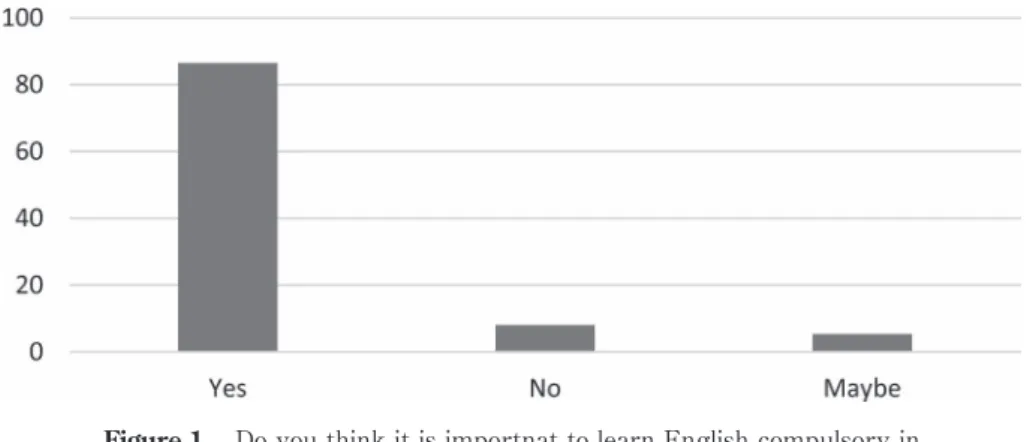
In this study, the author asked 74 students who passed the SLC in Nepal, for their opinions on the necessity of studying English language within the formal setting. Figure 1 shows that an overwhelming majority of students, over 86% , stated that English learning should be mandatory in secondary schools.
Figure 1. Do you think it is importnat to learn English compulsory in secondary schools?
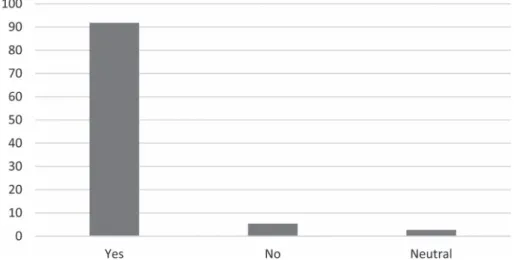
The opinions were more divided on the question of whether proficiency in English reflected a person’s intellectual ability. Only a few respondents strongly agreed or
disagreed, while many expressed a neutral perspective.
Figure 2. Is English fluency a good indicator of a person’s intellectual ability?
Considering the question based on their own experiences, over 90% of respondents agreed that learning English did help them in their academic advancement, as well as in their professional lives.
Figure 3. Do you think learning English language helped you in your academic advancedment?
As making English a compulsory subject for small children has already been difficult for teachers and students, making it the medium of instruction has generated more problems. Many public educators in Nepal do not believe that it is not very effective, as they think it is quite difficult for students to learn the school subjects in English. (Kumar, 2017)
The obsession with learning English is increasing every day due to the growing influence of urbanization, globalization, migration, and the advancement of Information and Communication Technology (Phyak, 2016). Growing parental demand for English-medium schools is the most significant factor behind the expansion of English in schools. But it is not very clear how the implementation of English as the teaching medium has actually affected the examination results of the nationwide tests.
5. English Instructor Views on the Relation Between English Language Proficiency and Good School Performance
The author asked some teachers in Nepal their opinion on the SLC/SCC. When one of the English teachers in Kathmandu was asked for his opinion on the correlation between the SLC/SEE and students’ future potential, he said “The question of the SLC score is a bitter one. It has rarely been able to determine student potential. However, it could determine the potential if the standard of English language teaching is raised beyond just teaching language as an academic subject or a theoretical concept.” His answers reiterated the sentiment of other survey responders, who stated that while English may not be an indicator of one’s capabilities, it does impact their performance in other areas of life.
When asked to provide suggestions for improving the evaluation criteria for SEE examinations, he said, “The exam might be too easy, especially for private school students, unless they opt to include advanced English textbooks.” He further added, “I recommend that we improve the pedagogical approaches that the curriculum designers have been using for so long, research current demands and expectations, and design curricula that are context- and time-specific.”
Another English language teacher in Kathmandu elaborated upon this idea. “I don’t agree. Up to the SLC, students do not live independently. They have not yet reached full maturity. The SLC may be an indicator.” He pointed out the seemingly unremarkable lives of many students who had exemplary scores on the SLC exams over the years, even
among those who made the news for getting the highest scores nationwide. Conversely, many who had average scores in have become leaders in their fields. “Students need to be self-motivated to advance and excel, regardless of the score they receive. The SLC itself cannot be an indicator.” He further added it must not be taken as such.
6. Conclusion
The education system in Nepal has many problems, and the recent shift in the secondary school examination system from the SLC to SEE is an attempt to address some of them. The immense pressure on young students stemming from the risk of failing the nationwide exams has been mitigated by the letter grading system, which is more inclusive and less punitive to students than the previous percentage system. But the problems faced by the Nepalese education system arise mostly from issues not addressed by this change. The mode of examination and the perception that the quality of education and students’ inherent worth can be measured through such standardized tests are still prevalent. Moreover, the prevailing popular belief that English language proficiency directly reflects student competency further impacts student performances.
The study has found that standardized tests only provide a narrow assessment of student skills. By only changing the grading system, the SEE has failed to address this shortcoming. Furthermore, SEE results do not directly correlate to future success, either academic or professional, nor can they be used as a yardstick to measure English proficiency. While students do consider English proficiency an important factor in their future endeavors, they do not believe that their SLC/SEE scores, especially in English, directly reflect their capabilities.
Acknowledgment
I would like to express my deep gratitude to Sharad Sharma,(A. A. E. E. Nepal) for working together with me. Without his sincere efforts, I could not have accomplished a lot in Nepal.
Also, I am hugely grateful to all the researchers, educators, and students who have supported my projects in Nepal.
This study was generously supported by a research grant provided to the author by Tokyo Keizai University (Grant Number 17-15) in the academic year 2017.
BIBLIOGRAPHY
Alderson, J. C. (1986). “Innovations in language testing.” Innovations in language testing, pp. 93-105.
Bhatta, P. (2014) “Public Desire for Private Schooling in Nepal” in Macpherson, I. Robertson, S. & Walford G (edit). Education, Privatization and Social Justice: case studies from Africa, South Asia, and Southeast Asia, Symposium Books Ltd.
Bhatta, S. D, et al. (2004). “Disparities in school performance in the SLC exams: An exploratory analysis.” Studies in Nepali History and Society 9.2, pp. 293-343.
Carney, S. and Bista, B. (2009). “Community Schooling in Nepal: A Genealogy of Education Re-form since 1990.” Comparative Education Review Vol. 53, No. 2, pp. 189-211.
Giri, R. A. (2005)Aaptation of language testing models to national testing of school graduates in Nepal: Processes, problems and emerging issues. Diss. Victoria University of Technology. Heyneman, S. P., and Angela W. R. (1990) “Using examinations and testing to improve
educa-tional quality.” Educaeduca-tional Policy 4.3, pp. 177-192.
Inter Press Service. (2013) “Nepal Scores Low on Quality Education” Inter Press Service News Agnecy. http://www.ipsnews.net/2013/07/nepal-scores-low-on-quality-education/
Kirkpatrick, R., and Thuy Thi, N. Bui. (2016) “Introduction: The challenges for English educa-tion policies in Asia.” English language educaeduca-tion policy in Asia. Springer, Cham, pp. 1-23. Kumar, S. P. (2017) “English language education policy in Asia” Journal of Multilingual and
Mul-ticultural Development, 39(3), pp. 287-288.
Lee, J. J. (2000). “Language Testing as a Technique to Enhance EFL Teaching Effects on Vocab-ulary Acquisition at the Intermediate Level.” Faculty of Education. Philadelphia, Pensylva-nia State University.
Marsh, C. J. (2009)Key concepts for understanding curriculum. Routledge.
Mathema, K. B, and Min, B. B. (2006). Study on student performance in SLC, pp. 1-425.
Phyak, P. (2016) “Local-global tension in the ideological construction of English language educa-tion policy in Nepal.” English language educaeduca-tion policy in Asia. Springer, Cham, pp. 199-217. V&S VMAG (2017) “SEE aims to bring changes to the higher secondary board exam” http://