1
Culture-oriented language teaching:
A new experience with online classroom
異文化理解の語学教育~遠隔授業での体験
TRAN Hoang Nam
Research Center for Higher Education – Tokushima University
1
1.. IInnttrroodduuccttiioonn
There is an increasing need for learning foreign language among university students and adult learners in general. Besides English, some learners choose to study another foreign language based on its potential to become useful in the future. Recently, the strengthened relationship between Japan and Vietnam has resulted in increasing number of Vietnamese come to Japan and Japanese come to Vietnam. Therefore, there is a potential need for leaning Vietnamese language and culture in Japan. Since 2018, several courses for Vietnamese language was provided by the Tokushima University (TU).
On the other hand, the Covid-19 has changed the way of education. At TU, all courses were shifted to online platforms after April 2020. By analyzing the results of courses on Vietnamese language and culture conducted at TU in 2020, this presentation is aiming to explore: (1) potential of integrating culture at the same time of learning a new language; and (2) potential of diversified techniques for improving results.
2
2.. MMeetthhoodd
Data collection was conducted qualitatively by discussion and opinion exchange with students of TU and adult learners, observation of the trainer, results of tests, final evaluation questionnaire and feedback from learners. All data was collected at TU during the online courses on Vietnamese language and culture for students and general adult learners conducted from
June – September 2020. This course used the Google Meet platform for lecture and discussion, and Google forms for testing and evaluation.
3
3.. RReessuullttss
(1) Integrating culture with language For each lesson, the participants were introduced to new vocabulary and basic expressions related to a socio-cultural theme.
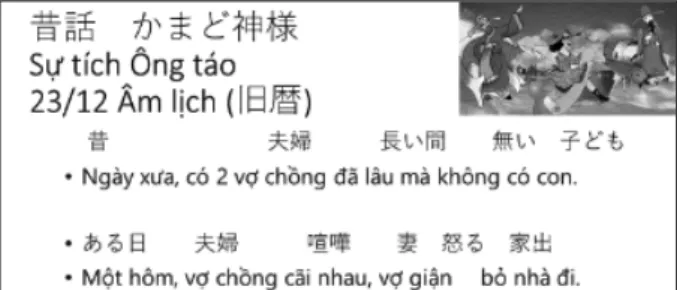
Figure 1. Mythology via reading exercises Themes were introduced systematically, such as history, tradition (Fig.1), arts, etymology, ethnicity, culinary, national character, medical system, sightseeing, business, social issues (Fig.2) etc. The order of themes was introduced selectively with minimal vocabulary and basic conversation pattern so that the participants can memorize and practice within the context. Starting from history and tradition of Vietnam, the participants were introduced into the evolution process of the modern Vietnamese language in relation to its culture, and what does it have in common with Japanese language. This comparative approach made mastering Vietnamese language easier for Japanese speakers. ポ ス タ ー 発 表 64 ― ― ― ―65 令和 2 年度 全学FD推進プログラム 第16回大学教育カンファレンス in 徳島 ポスター発表P⑫ 13:30~14:00
2
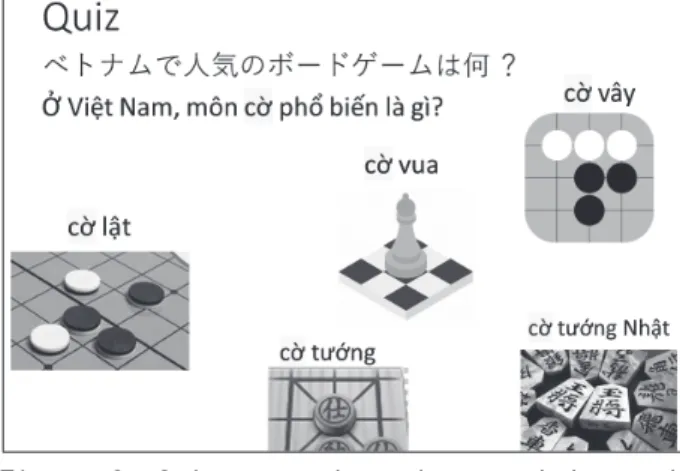
(2) Using teaching techniques online Through this course, a wide range of methods and materials was applied such as reading exercise (Fig.1), introducing traditional music via videos, vocabulary building using pictures, funny stories, crosswords, quizzes using multiple choice answers followed by analysis of each choice (Fig.2), open-ended question for analyzing a social issue, online test for assessment and evaluation. These interactive techniques were well perceived by the participants and contributed to improving their interest and stay active during lessons. There was no big difference in using these techniques between online and offline classroom in terms of participants’ involvement. The final reflection results shown that most of the participants prefer online or hybrid classroom over offline.
Figure 2. Quizzes to introduce social trend (3) Challenges
While conducting the language classroom, there were no obstacles of using these techniques in online mode. Taking the small number of participants (maximum 10 persons per class), the teacher-learner interaction and learners’ reactions could be well controlled. But it may become harder to assure the class quality with a greater number of participants. Moreover, it was found to be difficult to apply some techniques typical for an offline workshop such as pair-work, group discussion, role playing, in terms of getting participants’ involvement.
4
4.. CCoonncclluussiioonn
Integrating teaching a foreign language with its corresponding culture is a common approach to target students as adult learners. On the other hand, the Covid-19 pandemic challenges the education to switch from face-to-face classroom to online platform. This presentation shows the lessons learned from the course “Basic Vietnamese language and culture” targeting university students and adult learners conducted at the TU. Through this course, a wide range of methods and materials was applied, and the participants were introduced to new vocabulary and basic expressions related to a socio-cultural theme. The results shown some positive experiences that could be considered for improving language classroom quality in the future. The results show that integrating culture into language teaching at the beginner level could be an effective approach targeting university students and adult learners with some background and clear goal for learning. Moreover, this approach could be applied successfully in the online classroom mode, supplemented by using diversified techniques for improving results. If the limitations to the online classroom could be improved, the online mode may stay firmly as an equal alternative to the traditional offline classroom in the future.
R
Reeffeerreenncceess
Sachiko-Igarashi (2018). Incorporating Intercultural Awareness and Critical Thinking Skills into the ELT Classroom.
Cambridge University Press.
Batardière M. (2015). Promoting critical thinking in online intercultural communication. EuroCALL Review. Vol 23, No 1. Neff P. and Rucynski J. (2013). Tasks for Integrating Language and Culture Teaching.
English Teaching Forum. Vol 1, No 2.
Osborne R. (2013). It Can Be Taught: Explorations into Teaching the Foundations for Multicultural Effectiveness in an Online Course. MERLOT Journal of Online Learning and
Teaching. Vol. 9, No.4.
ポ ス タ ー 発 表 64 ― ― ― ―65 令和 2 年度 全学FD推進プログラム 第16回大学教育カンファレンス in 徳島 令和 2 年度 全学FD推進プログラム 第16回大学教育カンファレンス in 徳島 ポスター発表P⑫ 13:30~14:00