Problems
on
Low-dimensional
Topology,
2014
Edited by T.
Ohtsuki1
This is a list of open problems on low-dimensional topology with expositions of
theirhistory, background, significance,
or
importance. Thislistwas
made by editing manuscripts written bycontributors of open
problems tothe
problem sessionof the
conference “Intelligence of Low-dimensional Topology”’ held at Research Institute
for Mathematical Sciences, Kyoto University in May 21-23, 2014.
Contents
1 Applications of Laver tables to braids 2
2 Similarity between number theory and knot theory 4
3 Iwasawa
invariants
of cycliccovers
of linkexteriors
44 Profinite knots 6
5 Invariants of knots derived from the algebraic $K$-theory 7
6 1-cocycles in the space of knots 8
7 Canonical
arc
index of cable links 98 The state numbers for virtual knots 11
9 Local and global properties of graphs 13
10 Essential tribranched surfaces in 3-manifolds 14
11 Invariants of homology 3-spheres motivated by the Chern-Simons
perturbation theory 16
lResearch InstituteforMathematicalSciences, Kyoto University, Sakyo-ku, Kyoto, 606-8502, JAPAN
1
Applications of
Laver tables to braids
(Victoria Lebed)
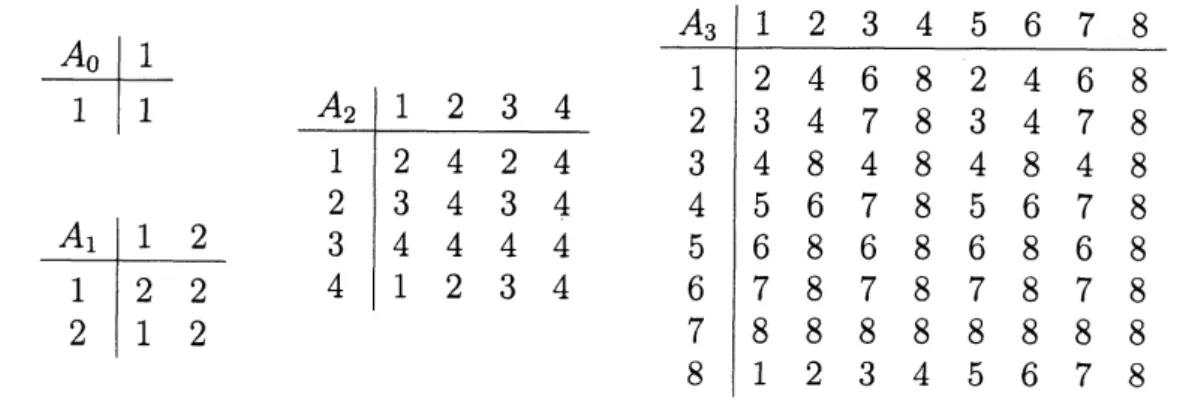
A Laver table $A_{n}$ is the set $\{$1,2,3, .
.
. ,$2^{n}\}$ endowed with the unique binaryoperation $\triangleright_{n}$ satisfying the (lefl) self-distributivity condition
$a\triangleright_{n}(b\triangleright n^{\mathcal{C})}=(a\triangleright_{n}b)\triangleright_{n}(a\triangleright n^{\mathcal{C})}$ (1)
and the initial condition $a\triangleright_{n}1\equiv a+1(mod 2^{n})$. They form
an
infinite familyof finite shelves ($=$ sets endowed with
a self-distributive
operation). The smallest examplesare
presented in Figure 1; the cell $(i,j)$ of the table for $A_{n}$ contains $i\triangleright_{n}j.$In the table for $A_{1}$ one recognizes operation “implication” from Logic.
Figure 1: Multiplication tables for the first four Laver tables
Laver tables were discovered by Richard Laver as a by-product of his analysis of
iterations of elementary embeddings in Set Theory [33]. Since then this structure
was
redefined in elementary terms (as above), and many of its deep propertieswere
given a combinatorial proof. However,
as
for now,some
fundamental facts aboutLaver tables have been established only under
an
unprovable large cardinal axiom.One of them states that the inverse limit ofthe $A_{n}$ contains a copy of the shelf $\mathcal{F}_{1}$
freely generated by a single element.
Shelves have gained recognition among knot theorists due to coloring techniques.
Namely,
a
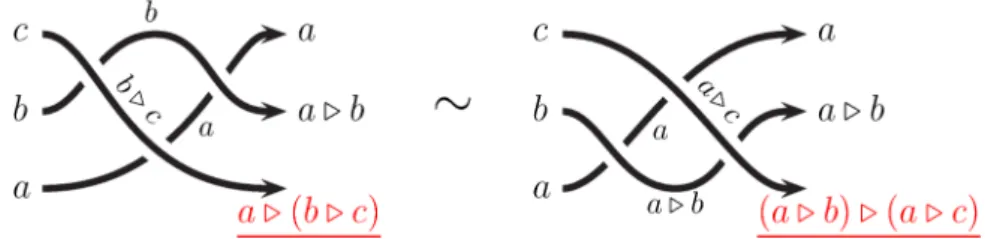
coloring of apositivebraid diagram$D$bya shelf$(Q, \triangleright)$ assigns an elementof$Q$ to every arc of$D$ in such a way that a $b$-colored strand becomes $(a\triangleright b)$-colored
when it
over-crosses
an $a$-colored strand. Figure 2 shows that this coloring conditionis compatible with the RIII
move
thanks to (1). Hence the number of $Q$-coloringsof diagrams yields
an
invariant ofunderlying positive braids. This invariant extendsto arbitrary braids if $Q$ is a rack $(i.e.$, for all $b$, the map $a\mapsto b\triangleright a$ is bijective
on
$Q)$, and to knots if $Q$ isa
quandle $(=a$ rack where every element is idempotent:$a\triangleright a=a)$
.
Such $Q$-coloring counting invariants turn out to be extremely powerfuland well adapted for actual calculations.
Now,
even
though the free shelf $\mathcal{F}_{1}$ is not a rack, the $\mathcal{F}_{1}$-colorings of arbitrary$\sim$
Figure 2: Reidemeister III move $\Leftrightarrow self$-distributivity
presented in the normal form, they lead to a construction of a well-behaved order
on
braids [12]. Since conjecturally Laver tablesare
finite approximations of $\mathcal{F}_{1}$, itis natural to expect that $A_{n}$-colorings
can
alsosay
a
lot about
arbitrarybraids.
Moreover, because of the finiteness, they
are
well adapted for computations. Thefollowing question thus
seems
very promising:Question 1.1 (P. Dehornoy [13]). How
can
one
extract topologicalinformation from
the colorings by Laver tables in the case
of
arbitrary braidsA possible strategy for answering this question involves rack cohomology,
as
de-veloped in [17, 8]. For
a
shelf $(Q, \triangleright)$, rack cohomology $H_{R}^{k}(Q)$ is definedas
thecohomology of the complex $(Hom(Q^{\cross k}, \mathbb{Z}), d_{R}^{k})$, where $d_{R}^{k}= \sum_{i=1}^{k+1}(-1)^{i-1}(d_{i}^{k}-\tilde{d}_{i}^{k})$,
and
$(d_{i}^{k}f)(a_{1}, \ldots , a_{k+1})=f(a_{1}, \ldots, a_{i-1}, a_{i}\triangleright a_{i+1}, . . . , a_{i}\triangleright a_{k+1})$,
$(\tilde{d}_{i}^{k}f)(a_{1}, \ldots, a_{k+1})=f(a_{1}, \ldots, a_{i-1}, a_{i+1},\ldots, a_{k+1})$
.
The 2-cocycles from this cohomology theory – that is, maps $\phi$ : $Q\cross Qarrow \mathbb{Z}$
satisfying
$\phi(a\triangleright b, a\triangleright c)+\phi(a, c)=\phi(a, b\triangleright c)+\phi(b, c)$
–are
of particular importance. Evaluate such a 2-cocycleon
the colors adjacentto each crossing of a $Q$-colored positive braid diagram
as
shownon
Figure 3, andsum
up the values obtained. Figure 3 proves the multi-set of the results of thissummation for all possible $Q$-colorings to be
an
invariant of positive braids. These$Q$-coloring cocycle invariants sharpen the $Q$-coloring counting invariants: the latter
are
obtained by considering any constant 2-cocycle $\phi$.
A slight modification of thismethod involves region coloring and rack 3-cocycles.
$(j((1, b)+(^{1}\prime)^{:}(a, c)+(\prime\supset^{:}(a\triangleright b, 0\triangleright c)$
Figure3: Two-cocycle $\phiarrow$ diagram weights
In [14], we explicitly described rack 2- and 3-cocycles for all the $A_{n}$
.
They formof$A_{n}$-coloring cocycleinvariants. We showed that thesecocycles capture important
combinatorial properties of the $A_{n}$
.
Question 1.1can now
be narrowedas
follows:Question 1.2 (Dehornoy-Lebed [14]). How can
one
extract topologicalinformation
from
the colorings by Laver tables, weighted by rack 2-or
3-cocycles, in thecase
of
arbitrary braids./?
Independently oftopological applications, rack cohomology calculations for Laver
tables
can
be instrumental for a better understanding of the structure of the $A_{n}.$In [14], we established that $H_{R}^{k}(A_{n})\simeq \mathbb{Z}$ for all $n$ and for $k\leq 3.$
Conjecture 1.3 (V. Lebed). For all
Laver
tables $A_{n}$ and integers $k$, the rackk-cocycles
for
$A_{n}$form free
modulesover
$\mathbb{Z}$of
rank $\theta_{k}(2^{n})$, where $\theta_{k}$ is a degree $k-1$polynomial with integer
coefficients.
Moreover,one
has $H_{R}^{k}(A_{n})\simeq \mathbb{Z}$, with (theequivalence class of) the constant cocycle $\phi(a_{1}, . . . , a_{k})=1$
as
generator.Preliminary computationsconfirm this conjecture for $k=4$
.
However, calculationmethods for general $k$
are
still missing. It would also be interesting to findexplicit
formulas
for the polynomials $\theta_{k}$ and to study their properties.Further,
as
follows from the work of A. Dr\’apal [15, 55], all finite shelves witha single generator
can
be regardedas
“interpolations” between Laver tables andcyclic shelves $C_{m}(i.e.$, sets $\{$1, 2,3,
$\ldots,$$m\}$ with the operation defined by $a$ $o_{m}b\equiv$
$b+1$ (modm)). Like for Laver tables, first cohomology groups for the $C_{m}$ turn out
to be isomorphic to $\mathbb{Z}.$
Conjecture 1.4 (V. Lebed). For all
finite
mono-generated shelves $Q$, one has$H_{R}^{k}(Q)\simeq \mathbb{Z}.$
2
Similarity between number theory and knot theory
(Teruhisa Kadokami)
Number Theory and Knot Theory are said ‘similar’ because Galois Theory in
Number Theory and Alexander Theory in Knot Theory are similar theoretically
[39, 43]. They may be unified from a group theoretical view point; see Figure 4.
Problem 2.1. Describe clearly
a
unified
notionof
Number Theory andKnot Theory.3
Iwasawa invariants
of
cyclic
covers
of link
exteriors
(Yasushi Mizusawa)
Let $L$ be a link ina rational homology 3-sphere $M$, and let $X$ be the exterior of$L$
with the
fundamental
group $G_{L}=\pi_{1}(X)$.
A surjective homomorphism $\sigma$ : $G_{L}arrow \mathbb{Z}$corresponds toan infinitecycliccover$X_{\sigma}$ over $X$
.
Let$X_{\sigma,p^{n}}$ be the subcover of degree $p^{n}$, for a fixed prime number
$p$
.
Thenwe
obtain atower $\{M_{\sigma,p^{n}}\}_{n}$ ofcyclic branched$\cup$
palrs$0$ groups$W1$
somestructures
Iwasawamodule Aexander module
Iwasawapolynomial Alexanderpolynomial
Figure4: Similarity between Number Theory and Knot Theory
knot theory and number theory, Morishita $et$
.
al. ([25, 28, 42]) gavean
analogue ofIwasawa’s class number formula (cf. [61] etc
Assume
that $H_{1}(M_{\sigma,p^{n}};\mathbb{Z})$ is finitefor all $n\geq$ O. Then there are non-negative integers $\lambda_{L,\sigma},$ $\mu_{L,\sigma}$ and an integer $\nu_{L,\sigma}$
(possibly negative) such that
$v_{p}(\# H_{1}(M_{\sigma,p^{n}};\mathbb{Z}))=\lambda_{L,\sigma}n+\mu_{L,\sigma}p^{n}+\nu_{L,\sigma}$
for all sufficiently large $n$, where $v_{p}$ denotes the $p$-adic valuation normalized
as
$v_{p}(p)=1$. These invariants $\lambda_{L,\sigma},$
$\mu_{L,\sigma},$ $\nu_{L,\sigma}$
are
calledIwasawa
invariants.Professor Masato Kurihara gave
us
the following problem.Problem 3.1.
Refine
theformula
removing thefiniteness
of
$H_{1}(M_{\sigma,p^{n}};\mathbb{Z})$, i. e., givea$p$-adic growth
formula
for
the torsion partof
$H_{1}(M_{\sigma,p^{n}};\mathbb{Z})$.
The following problem also
seems
to be considerable.A
partial result is obtainedin [29].
Problem 3.2 (T. Kadokami, Y. Mizusawa). Determine the possible values
of
$\lambda_{L,\sigma},$ $\mu_{L,\sigma}$ and $v_{L,\sigma}.$We often consider a non-archimedean prime (a prime ideal of the integer ring
of a number field)
as an
analogue of 1-component link (a knot). However, in theanalogies between Alexander-Fox theory and Iwasawa theory, the set of all prime
ideals lying over a fixed prime number $p$ in a totally real number field looks like
1-component link. It
seems
that the following problem is considerable to understandProblem 3.3 (T. Kadokami, Y. Mizusawa). What is “the number
of
components”’of
a prime $/p$If $L$ is
an
$r$-component link in $S^{3}$, the link module $B_{L}$ and the Alexandermod-ule $A_{L}$
are
modulesover
$\Lambda=\mathbb{Z}[t_{1}^{\pm 1}, \cdots, t_{r}^{\pm 1}]$.
Then there is a natural injective$\Lambda$-homomorphism $\theta$ : $B_{L}\mapsto A_{L}$
.
Let $M_{L}$ be the $\Lambda$-submodule of $A_{L}$ generatedby meridional elements (cf. [24]). Motivated by Greenberg’s conjecture (cf. [21]) in
Iwasawa theory, the following problem is proposed (with
some
examples) in [29], which is nota
strict analogue of the conjecture.Problem
3.4
(T. Kadokami, Y. Mizusawa). When is$Y_{L}:=B_{L}/\theta^{-1}(M_{L})$ apseudonull$\Lambda$-module?
If we have a homomorphism $\rho$ : $G_{L}arrow GL_{d}(\mathbb{Z}_{p})$ with large image,
we
obtain ap-adic Lie tower
over
X. (Thetower $\{X_{\sigma,p^{n}}\}_{n}$ isa
$p$-adic Lie tower for $d=1.$) In [3, 7]etc., the growth of Betti numbers in a $p$-adic Lie tower is studied. The invariant
$\lambda_{L,\sigma}$
can
be regardedas a
kind of Betti numbers. Motivated by analogous studies([50] etc.) in noncommutative Iwasawa theory,
we
have the following problem.Problem 3.5 (T. Kadokami, Y. Mizusawa). Give Iwasawa type
formulas for
$p$-adicLie towers
of
branchedcovers over
$L$, with many examples.4
Profinite knots
(Hidekazu Furusho)
Let $\mathcal{K}$ be the set of isotopy classes of oriented (topological) knots, which forms
a
commutative monoid by the connectedsum.
Let $\hat{\mathcal{K}}$be the monoid of profinite
knots constructed in [18]. The set $\hat{\mathcal{K}}$
forms a topological commutative monoid by
the connected
sum
and there is a natural monoid homomorphism$h:\mathcal{K}arrow\hat{\mathcal{K}}$
whose image is dense in $\hat{\mathcal{K}}$
,
as
is shown in [18].Problem 4.1 (H. Furusho). Is the map $h$ injectiv$e^{}?$
If it is non-injective, then the Kontsevich knot invariant fails to be perfect.
As
forArtin
braid group $B_{n}(n\geq 2)$, it is known that $B_{n}$ is residually finite,namely, the natural map
$B_{n}arrow\hat{B_{n}}$
is injective.
Problem 4.2 (H. Furusho). Is there any Alexander-Markov-like theorem
for
profi-nite link$s^{}?$
One can find several proofs ofAlexander-Markov’s theorem for topological links
([4,58,60,64] etc). Howevertheylookheavily based
on a
certainfiniteness property,Let Frac $\hat{\mathcal{K}}$
be the fractional group of$\hat{\mathcal{K}}$
, which forms
a
topological commutativegroup. The action of the absolute Galois group $G_{\mathbb{Q}}$
$:=Ga1()$
ofrationals $\mathbb{Q}$on
Frac $\hat{\mathcal{K}}$
was
constructed in [18].Problem 4.3 (H. Furusho). Is the $G_{\mathbb{Q}}$-action
on
Rac $\hat{\mathcal{K}}faithful’$?As
for the braid groups, the $G_{\mathbb{Q}}$-action on $\hat{B_{n}}$is known to be faithful for $n\geq 3$
by $Bely_{\dot{1}}$’s theorem [2].
Problem 4.4 (H. Furusho). Does there exist
any
(co)homologytheow
$H_{\star}$ (orany
fundamental
group theory $\pi_{1}^{\star}$) and any (pro-)variety $X$defined
over
$\mathbb{Q}$ such that $H_{\star}(X_{\overline{\mathbb{Q}}})$ (resp. $\pi_{1}^{\star}(X_{\overline{\mathbb{Q}}})$ ) carries a natural $G_{\mathbb{Q}}$-action and Rak$\hat{\mathcal{K}}$
is
identified
with$H_{\star}(X_{\overline{\mathbb{Q}}})$ (resp. $\pi_{1}^{\star}(X_{\overline{\mathbb{Q}}})$ )
so
thatour
$G_{\mathbb{Q}}$-actionon
Fkak $\hat{\mathcal{K}}$can
be derivedfrom
the$G_{\mathbb{Q}}$-action there. $\int p$
5
Invariants
of knots derived from the algebraic
$K$-theory
(Takefumi Nosaka)
We start preliminarily recalling$K$-theoretic results in knot theory. In general, the
conceptof$K$-groups oftenplays
a
role to uniformly understand several mathematicalphenomena. As examplesin3-dimensional knot theory, fixing
a
commutativefield$F,$values in $K_{1^{-}},$ $K_{3}$-groups obtained from $SL_{2}$-representations oflink groups $\pi_{1}(S^{3}\backslash$
$L)arrow SL_{2}(F)$ are much studied so far. However, as far
as
I have looked over, Ihad found no second $K$-value with respect to such representations $f$; so, in [49], I
proposed such aninvariant valued in “Milnor-Witt $K_{2}$-group $K_{2}^{MW}(F)$” in anatural
way, where the preferred longitude is
a
key in construction. Without the details,the $K$-invariants
are
roughly summarizedas
follows:However, the work
on
the $K_{2}$-valuewas
two years ago;so
thereare
many somethingmysterious.
Problem 5.1 (T. Nosaka). Give
some
applicationsof
the $K_{2}$-value to knot theoryor to number theory.
Problem 5.2 (T. Nosaka). Describe an arithmetic meaning
of
the $K_{2}$-values. Forexample, how about the hyperbolic holonomy
of
the figure-eight knot $4_{1}9$Problem 5.3 (T. Nosaka).
If
$F$ is a global field, givean
exampleof
some
represen-tation $\pi_{1}(S^{3}\backslash L)arrow SL_{2}(F)$ which takes non-trivial global
information
in $K_{2}^{MW}(F)$.
Actually, in the paper [49], I dealt with
some
partsof
$K_{2}^{MW}(F)$ only arisingfrom
local
fields.
Problem 5.4 (T. Nosaka).
If
a
hyperbolic holonomy$\pi_{1}(S^{3}\backslash K)arrow SL_{2}(F)$ is closedand arithmeticproperties $(e.g., a$ special$value of the zeta$
function
$\xi_{F})$ is well studied(see a conprehensive book [37]). Discover an arithmetic relation
of
the $K_{2}$-value.$Furthermore_{f}$ compare the $K_{2}$-value with Birsh-Tate conjecture that states the
equality
$\zeta_{F}(-1)=?(-1)^{r_{1}}|K_{2}(\mathcal{O}_{F})|/|K_{3}(\mathcal{O}_{F})|,$
where $F$ is
a
totally realfield, and$\mathcal{O}_{F}$ is the ringof
integers in $F.$To solve them, the followingtwo interpretations of$K_{2}^{MW}(F)$in number theory would
be useful: First, from $\mathbb{A}^{1}$
-homotopy theory, two isomorphisms
$K_{2}^{MW}(F)\cong\pi_{1}^{A^{1}}(SL_{2}(F))\cong\pi_{1}^{A^{1}}(\mathbb{A}^{2}\backslash 0)$
hold via $\mathbb{A}^{1}$
-Galois
correspondence”’or
“‘(stable) sphere $\mathbb{A}^{1}$-spectrum” ;
see
[41] fordetails. Next, followingMerkujev-Suslin theorem, we can analyse the$m$-torsion part
of$K_{2}^{MW}(F)$ from $H_{e’t}^{2}(Spec(F);\mu_{m}^{\otimes 2})$
or
the Brauer $m$-group $\pi Br(F)$ via “the Galoissymbol if $F$ contains a primitive m-th root of unity; see,
$e.g.$, [63].
Incidentally, it is not invaluable to consider
some
problems parallel to knotted surfaces:Problem 5.5 (T. Nosaka). With respect to a knotted
surface
$K\subset S^{4}$ witha
rep-resentation $\pi_{1}(S^{4}\backslash K)arrow SL_{2}(F)$, construct invariants which
are
valued in $K_{2;}K_{3}$or$K_{4}$-group
of
$F.$6
1-cocycles
in
the
space
of knots
(Arnaud Mortier)
Following V.A.Vassiliev [59]
we
consider the space $\mathcal{K}$ of smooth immersions $\mathbb{R}arrow$$\mathbb{R}^{3}$
that coincide with the map $t\mapsto(O,0, t)$ outside of the segment [-1, 1]. The
subset of singular immersions (that
are
not embeddings) is denoted by $\Sigma$and called
the discriminant of $\mathcal{K}$
.
The complement$\mathcal{K}\backslash \Sigma$ is the set of (smooth) long knots.
Whenspeaking of the cohomology of thespace of knots,
we mean
the cohomologyof $\mathcal{K}\backslash \Sigma$
.
At the zeroth level, the cohomology group $H^{0}(\mathcal{K}\backslash \Sigma_{1\mathbb{Q})}$ is the set of $\mathbb{Q}-$valued knot invariants. Our main object of interest here is the first cohomology
group $H^{1}(\mathcal{K}\backslash \Sigma;\mathbb{Q})$, shortly denoted by $H^{1}$. In
[59], Vassiliev introduced particular
cohomology classes of the space of knots, well-known in degree $0$
as
finite-type knotinvariants. Vassiliev (or finite-type) 1-cohomology classes form
a
subgroup $H_{f.t}^{1}$. of
$H^{1}.$
Question 6.1 (A. Mortier). Is there an axiomatic description
of
$H_{f.t}^{1}$. similar to the
well-known axiomatization
of
Vassiliev invariants by J.Birman and X.-S.$Lin[5]’$?One
interest of considering 1-cocycles is that their evaluationon
specific cyclesleads to knot invariants. For this, the cycles need to be defined independently of
the knot. Examples of such cycles are:
$\bullet$ rot (K) , the positive rotation of a
$\bullet$ drag(K) ,
the dragging of the second component of the connected
sum
$K\# K$along the first (as in the proofof the equality $K\# L=L\# K$);
$\bullet$ Hat(K), the Hatcher cycle, which consists of dragging a “ball at infinity”’ all
along
a
fixed representation of a knot in $S^{3}.$Problem
6.2
(A. Mortier). Findother
examplesof
cycles in the space $\mathcal{K}\backslash \Sigma$, thatare
defined
independentlyof
the knot.Question 6.3 (A. Mortier). The evaluation
on
the above cyclesdefines
maps$rot^{\star},$drag\star and $Hat^{\star}$
from
$H^{1}$ to the setof
knot invariants $H^{0}$.
Is ittrue that under these maps, the image
of
a
finite-type 1-cocycle is afinite-type invariant?Since M.Polyak and O.Viro [51], followed by M.Goussarov [19], it is known that
finite-type knot invariants
can
be represented bymeans of
linear combinationsof
Gauss diagrams. This idea
was
extendedin [44] to produce combinatorialpresenta-tions of 1-cocycles, as follows.
We fix
a
linear projection $\mathbb{R}^{3}arrow \mathbb{R}^{2}$that is generic with respect to the axis of
long knots. Then, given
a
cycle of knot diagrams,we
makea
list of theReidemeis-ter
moves
involved, depictedas Gauss
diagrams with singularities, and count theirsubdiagrams with prescribed weights that define the 1-cocycle.
Question 6.4 (A. Mortier). Is it true that any 1-cocycle with a combinatorial
de-scription
as
above represents afinite-type cohomology class.$(p$For finite-type invariants there is
a
link between Polyak-Viro’s combinatorialformulas and integral formulas, described in [52]. Integral formulas for 1-cocycles have been found by K.Sakai in [53].
Question 6.5 (A. Mortier). Is there a link between the integral
formulas from
[53]and the combinatorial
formulas from
[44]97
Canonical
arc
index of cable links
(Hwa Jeong Lee and Hideo Takioka)
An open-book decompositionof$\mathbb{R}^{3}$
is a decomposition which has open halfplanes
as
pages and the standard $z$-axisas
the binding axis. Anarc
presentation ofa
link$L$ is an embedding of $L$ in finitely many pages of an open-book decomposition so
that each of these pages meets $L$ in
a
single simplearc.
It is known that everylink has an arc presentation [10]. The arc index, denoted by $\alpha(L)$, of a link $L$ is
the minimum number of pages neededfor $L$ to be presented as an
arc
presentation.It is known that the arc index equals the crossing number plus two for non-split
alternatinglinks [1, 45, 56]. Foranon-alternating prime link $L$,
we
have the followinginequality [27, 45]:
where $F_{L}(a, z)$ is the
Kauffman
polynomial of$L$ and $c(L)$ is the crossing number of$L$
.
It is important to determine thearc
indices of non-alternating links. Since the
arc
indices of torus knotsare determined
in [16],we
focuson
cable links.A grid diagram of
a
link is alink diagram which consists of vertical andhorizontalline segments with the properties that at each crossing the vertical line segment
crosses
over the horizontal line segment and no two horizontal line segments arecollinear and
no
two vertical line segmentsare
collinear. A grid diagram with $n$ vertical line segments is easilyconverted toan arc
presentationon
$n$ pages, and vice versa [10]. Therefore, thearc
index of $L$can
be definedas
the minimum number ofvertical line segments among all grid diagrams of $L.$
$arrow$
Figure 5: $\alpha(G_{1}^{(3,16)})=\alpha(G_{2}^{(3,16)})=15,$ $\alpha(G_{3}^{(3,16)})=18$ for grid diagrams $G_{1},$ $G_{2},$ $G_{3}$ of the right
handed trefoil
Let $G$ be
a
grid diagram ofa
knot $K$ and $p,$ $q$ integers with $p>$ O. In [35],we
constructedan
algorithm called the canonical $(p, q)$-cabling algorithm of $G$ inorder to obtain a sharper upper bound of the arc index of the $(p, q)$-cable link $K^{(p,q)}$
of $K$
.
Briefly, the procedure is given in Figure 5. We call the resulting diagramthe canonical grid diagram of $K^{(p,q)}$ obtained from $G$ and denote it by $G^{(p,q)}$
.
Letindex of $K^{(p,q)}$, denoted by $\alpha_{c}(K^{(p,q)})$, is defined
as
follows:$\alpha_{c}(K^{(p,q)})=\min$
{
$\alpha(G^{(p,q)})|G$ isa
grid diagramof
$K$}.
From the definition of the arc index and the canonical
arc
index,we
have the following inequality:$\alpha(K^{(p,q)})\leq\alpha_{c}(K^{(p_{)}q)})$
.
Thenwe
havea
natural question:Question 7.1 (H. J. Lee, H. Takioka). $\alpha(K^{(p,q)})=\alpha_{c}(K^{(p,q)})$?
It is shown in [35] that the
answer
of Question 7.1 is “yes” for infinite families of(2, q)-cable links of all prime knots with up to 8 crossings. Moreover,
we see
thata minimal grid diagram of $K$ leads to the equality above in this special
case.
Themost interesting view is whether
any
minimal grid diagramof
$K$ gives the exactvalue of
arc
indices of cable links of $K$.
So,we
have natural questions:Question 7.2 (H. J. Lee, H. Takioka). For two minimal grid diagrams $G,$ $G’$
of
a
knot $K$,
we
have$\alpha(G^{(p,q)})=\alpha(G^{\prime(p,q)})$?
Question 7.3 (H. J. Lee, H. Takioka).
If
$G$ isa
minimal grid diagramof
a knot$K$, then
we
have$\alpha_{c}(K^{(p,q)})=\alpha(G^{(p,q)})$?
8
The
state
numbers for virtual knots
(T. Nakamura, Y. Nakanishi, S. Satoh, Y. Tomiyama)
A virtualknot diagram $D$ is a knot diagram in $\mathbb{R}^{2}$
with ordinary crossings, which
are called real crossings $(\nearrow^{\backslash }\backslash , \backslash _{/}\nearrow)$, and virtual crossings $(X)\cdot$ A virtual
knot $K$ is an equivalence class of virtual knot diagrams under “generalized
Reide-meister moves”’ (cf. [30]).
Let $D$ be
a
virtual knot diagram.A
state $S$ of $D$ isa
union of circles possiblywith virtual crossings obtained from $D$ by splicing all real crossings.
A
state $S$ issaid to be
an
$n$-state if $S$ consists of $n$ circles. We denote by $s_{n}(D)$ the number of$n$-states of D. The $n$-state number for a virtual knot $K$, denoted by $s_{n}(K)$, is the
minimal number of $s_{n}(D)$ for all possible virtual knot diagrams $D$ for $K$ (cf. [47]).
In [47], the following upper and lower bounds of $s_{n}(D)(n=1,2,3)$
are
given:For any virtual knot diagram $D$ with $r$ real crossings, it holds that $1\leq s_{1}(D)\leq$
$\frac{2^{r+1}-(-1)^{r+1}}{3},$ $0\leq s_{2}(D)\leq 2^{r-1}$, and $0\leq s_{3}(D)\leq 3\cdot 2^{r-3}$
.
Moreover, it is showedthat $r\leq s_{2}(D)$ if $r\geq 3$
.
Virtual knot diagrams realizing the lower bound of each$s_{n}(D)(n=1,2,3)$ are characterized in [47] and [48].
Problem 8.1 (T. Nakamura, Y. Nakanishi, S. Satoh, Y. Tomiyama). Characterize
Namely, characterize the virtual knot diagrams $D$ with $r$ real crossings $\mathcal{S}$atisfying
each
of
$s_{1}(D)= \frac{2^{r+1}-(-1)^{r+1}}{3},$ $s_{2}(D)=2^{r-1}$, and $s_{3}(D)=3\cdot 2^{r-3}.$
Examples of such virtual knot diagrams
are
given in [47] in terms of their Gaussdiagrams.
Let $D$ be a virtual knot diagram. Weregard $D$
as
the imageofan immersion ofacircle$S^{1}$ into $\mathbb{R}^{2}$
with crossinginformation at each double point. A Gauss diagram of
$D$ is
an
oriented circle regardedas
the preimage of the immersed circle withchords,each of which connects the preimages of each double point corresponding to
a
realcrossing. A chord is oriented from the preimage of the over-crossing-point to that of
the under-crossing-point in the circle, and labeled by the sign of the corresponding
real crossing. Two chords of a Gauss diagram $G$ of $D$ is linked if their end-points
appear along the circle
on
$G$ alternately. A chord isfree
if it is not linked with anyother chords.
Let $F_{r}$ and $F_{r}’$ be the
Gauss
diagrams with $r$ chordsas
in Figure 6 (1) and (2),respectively. Then we see that $F_{r}$ produces a virtual knot diagram $D$ satisfying
81$(D)= \frac{2^{r+1}-(-1)^{r+1}}{3},$ $F_{r}’$ and $F_{r-1}$ with one free chord produce virtual knot
diagrams $D$ satisfying $s_{2}(D)=2^{r-1}$
.
Moreover,$F_{r-2}’$ with two free chords and $F_{r-3}$ with three free chords produce virtual knot diagrams $D$ satisfying $\mathcal{S}_{3}(D)=3\cdot 2^{r-3}.$
(1) $F_{r}$ (2) $F_{r}’$
Figure 6
It is known that $s_{1}(K)\geq|V_{K}(-1)|=\det K$ for a classicalknot $K$, where $V_{K}(t)$ is
the Jones polynomial for $K$ and $\det K$ is the determinant of $K$. As a generalization
of this fact, lower bounds of $s_{1}(K)$ for a virtual knot $K$ are given in terms of the
Jones polynomial and the Miyazawa polynomial (cf. [26, 40]) in [47].
Problem 8.2 (T. Nakamura, Y. Nakanishi, S. Satoh, Y. Tomiyama). Find a lower
bound
for
$s_{n}(K)(n\geq 2)$ by algebraic invariants, such as the Jones polynomial theMiyazawa polynomial and
so
on.J. Green [20] made a table of virtual knots with four real crossings or less. We
propose a fundamental problem.
Problem 8.3 (T. Nakamura, Y. Nakanishi, S. Satoh, Y. Tomiyama). Determine
$s_{n}(K)(n\geq 1)$
for
the virtual knots in Green’s table.Y. Tomiyama [57] determined $s_{1}(K)$ of several virtual knots in the table. In [47],
9
Local and global properties of
graphs
(Takahiro Matsushita)Agraph is a pair $G=(V(G), E(G))$ where $V(G)$ is
a
set and $E(G)\subset V\cross V$ suchthat $(x, y)\in E(G)$ implies $(y, x)\in E(G)$
.
A graph homomorphism from $G$ to $H$ isa
map $f$ : $V(G)arrow V(H)$ suchthat $(f\cross f)(E(G))\subset E(H)$.
The existence problemof graph homomorphisms between two graphs is
a
classical problem ofgraphtheory,and this is closely related to the existence problem of $\mathbb{Z}_{2}$-equivariant maps between
given two $\mathbb{Z}_{2}$-spaces. For backgrounds of these topics, see
[31].
In [38], $r$-fundamental groups $\pi_{1}^{r}(G)$ and $r$-covering
maps
are
defined, whichcan
be applied to the existence problem of graph homomorphisms.
There
isa
close
relation between $r$
-fundamental groups
and $r$-covering mapsas
is thecase
of thecovering space theory in topology.
To state the problems suggested here,
we
give the definition of$r$-covering maps.For $v\in V(G)$,
we
write $N(v)$ for $\{w\in V(G)|(v, w)\in E(G)\}$, and $N_{s}(v)$ for $s\geq 1$is defined by $N_{1}(v)=N(v)$, $N_{s+1}(v)= \bigcup_{w\in N_{s}(v)}N(w)$
.
A graph homomorphism$p$ : $Garrow H$ is called
an
$r$-covering map $(r\geq 1)$ if for any $v\in V(G)$ and $i$ with$1\leq i\leq r,$ $p|_{N_{i}(v)}:N_{i}(v)arrow N_{i}(p(v))$ is bijective.
Let
us
observe some phenomena. Let $n$ be a positive integer, and $G$ a connectedgraph such that $\# N(v)=n$ for any $v\in V(G)$. Consider the following conditions.
(a) $\#(N(v)\cap N(w))>n/2$ for any $v,$$w\in V(G)$ with $w\in N_{2}(v)$
.
(b) $\#(N(v)\cap N(w))=1$ for
any
$v,$ $w\in V(G)$ with $v\neq w$and
$w\in N_{2}(v)$.
If $G$ satisfies (a), then the diameter of $G$ is smaller than 4 (and hence, such a $G$ is
finite). If $G$ satisfies (b), then $\pi_{1}^{2}(G)_{ev}$ must be free.
From the above phenomena,
we
can
observe that there might be close relationsbetween the (local” and the “global properties of graphs. Before suggesting
ques-tions, let
us
make the meaningof the (local” propertyofgraphs clear. Fora
positiveinteger $r$, let
us
call the property (P) ofgraphs is $r$-local if fora
surjective $r$-coveringmap$p:Garrow H,$ $G$ satisfies (P) if and only if$H$ satisfies (P). The above properties
(a) and (b)
are
2-local properties in this definition.Question 9.1 (T. Matsushita).
(1) Find $r$-local properties such that
a
connected graph satisfying sucha
propertyis
finite.
(2) Find$r$-local properties such that
if
aconnected graph$G$satisfies
sucha
property,then $\pi_{1}^{r}(G)$ is hyperbolic.
As
one
example of the above question (1), I suggest the following.Question 9.2 (T. Matsushita). Is
a
connectedgraph$G$ satisfying both thefollowing2-local property
finit
$e^{}?$$\bullet$
For vertices$v,$$w\in V(G)$ such that$v\neq w$,
we
have$N(v)\neq N(w)$ and$\#(N(v)\cap$$N(w))\neq 1.$
These questions are related to the existence problem of graph homomorphisms. Indeed, if
a
2-local property (P) implies thefiniteness
forconnected graphs, then theuniversa12-covering
of the graph also satisfies (P), and hence isfinite.
This impliesthat if a connected graph $G$ satisfies (P), then $\pi_{1}^{2}(G)$ is finite, and
we
have thatthe
chromatic
number of$G$ is not equal to 3 by the result of [38].10
Essential
tribranched
surfaces
in
3-manifolds
(Takashi Hara)
Throughout this section let $M$ be a 3-manifold which is compact, connected,
irreducible and orientable. A closed subspace $\Sigma$
of$M$ is called
a
tribranchedsurface
ifthe following conditions
are fulfilled:
(TBSO) the pair $(M, \Sigma)$ is locally homeomorphic to $(\mathbb{C}\cross[0, \infty$),
$Y\cross[O,$$\infty$ where
$Y$ is
a closed
subspace of$\mathbb{C}$defined
as
$Y=\{$$re^{\sqrt{-1}\theta}$
$r\in[0, \infty)$, $\theta=0,$$\pm\frac{2}{3}\pi\}$ ;
(TBSI) the
intersection
of$\Sigma$and
a
sufficiently small tubular neighbourhood of$C(\Sigma)$in $M$ is homeomorphic to $Y\cross C(\Sigma)$
;
(TBS2) each connected component of$S(\Sigma)$ is orientable.
Here we denote by$C(\Sigma)$ theclosedsubset of$\Sigma$
(called the branch set of$\Sigma$
) which
cor-responds to the subset $\{0\}\cross[0, \infty$) of$\mathbb{C}\cross[0, \infty$) under theidentification
in (TBSO), by $S(\Sigma)$ the complement of a sufficiently
small tubular neighbourhood of $C(\Sigma)$ in
$\Sigma$
, and by $M(\Sigma)$ the complement of
a
sufficiently smalltubularneighbourhood of $\Sigma$
in $M.$
Now let
us
focuson
acertainclassoftribranched surfacescontained in3-manifolds.A
tribranched
surface $\Sigma$in $M$ is said to be essential ifit has following properties:
(ETBSI) for each connected component $N$ of $M(\Sigma)$, the natural
functorial
homo-morphism $\pi_{1}(N)arrow\pi_{1}(M)$ is not surjective;
(ETBS2) for connected components $C,$ $S$ and $N$ of $C(\Sigma)$, $S(\Sigma)$ and $M(\Sigma)$
re-spectively, the natural functorial homomorphisms $\pi_{1}(C)arrow\pi_{1}(S)$ and
$\pi_{1}(S)arrow\pi_{1}(N)$ are injective (ifthey exist);
(ETBS3) there does not exist a connected component of $\Sigma$
which is contained in a
ball in $M$ or a collar of $\partial M.$
The notion of essential tribranched surfaces is a natural generalisation of that of
essential $surface\mathcal{S}$ in
a
usual sense; indeedan
essential surface is regardedas an
es-sential tribranchedsurface with the emptybranch set. Basedupon geometry of
buildings,
we
maysystematically construct essential tribranched
surfacescontained
in
a 3-manifold
$M$, which may be regardedas a
natural extension of the methodof Marc Culler and Peter B. Shalen in [11] (the main theorem of [23]; refer also to
[22]). The first problem is whether
or
notour
method provides amore
sophisticatedway
even
in theconstruction
ofessential surfaces
(without branch sets). Namely,Question 10.1 (T. Hara, T. Kitayama). It is known that there exist
essential
$\mathcal{S}ur-$faces
which one could not obtain utilising the methodof
Culler and Shalen. Canone
construct
such essentialsurfaces
by applying the construction in [23]$\varphi$One great merit of
our
method is thatwe
may apply this constructioneven
to
3-manifolds
whoseassociated
$SL_{2}$-character varietiesare
of dimension zero; inparticular,
we
may apply it to (a certain class of)non-Haken
manifolds!
It is thusin the nature of things that essential
tribranched
surfaces are expected to containfruitful information concerning topological properties of non-Haken
manifolds.
Problem 10.2 (T. Hara, T. Kitayama). Extract topological
information of
(non-Haken)
3-manifolds from
theinformation of
essentialtribranched
surfaces
contained
in them.
Let
us
deal witha more
concrete question concerning Problem10.2.
In thelow-dimensional
topology, it is widely known that the procedures for cutting alongessential surfaces endow
a
Haken manifold with a structure called the Hakenhier-archy. This simple observation leads
us
to the following naive question.Question 10.3 (T. Hara, T. Kitayama). Do the procedures
for
cutting alonges-sential tribranched
surfaces2
endow amanifold
(containing essentialtribranched
surfaces) with a certain structure like the Haken hierarch$y^{\prime p}$
The notion ofessential
tribranched
surface itselfis, however, quitenew
and rathermysterious at the present, and
therefore we
might have to study topologicalprop-erties of essential
tribranched surfaces more
deeply before trying Problem10.2 or
Question 10.3.
Next we point out that essential
tribranched
surfacesare
deeply related to thetheory of complexes
of
groups, as essential surfaces (in a usual sense) are to Bassand
Serre’s
theory of graphsof
groups. Indeedwe
may associate a 2-complex ofgroups
$c(y_{\Sigma})$ ina
canonical
manner
toan essential tribranched surface
$\Sigma$
contained
in $M$ (see [23] for details). Contrary to graphs of groups, a 2-complex of groups
does not always
come
froma group
action on $a$ (contractible) 2-complex (see [6,Chapter III.$C$] and [9]). To guarantee that $c(y_{\Sigma})$
comes
froman
action of $\pi_{1}(M)$on a contractible 2-complex,
we
should impose thefollowing additional condition on$\Sigma$:
(ETBS4) for each
connected
component $N$ of $M(\Sigma)$, the naturalfunctorial
homo-morphism $\pi_{1}(N)arrow\pi_{1}(M)$ is injective.
$\overline{2Here}$
weremark that, after cutting alongan essential tribranched surface, the resulted manifold is equippedWe callanessentialtribranched surface $\Sigma$
satisfying the additionalcondition (ETBS4)
a strongly essential tribranched surface. The additional condition (ETBS4) is a
rather algebraic (and ad hoc) condition, and thus we
are
interested in whether ornot there exists a topological criterion which distinguishes the notion of strong
es-sentiality from that of essentiality.
Question 10.4 (T. Hara, T. Kitayama). Does there exist atopological (or geometrical)
characterisation
of
strongly essentialtribranched
surface
$s^{}?$We remark that there is
a
geometricsufficient
condition fora
2-complexof groupsto
come
from a group action on $a$ (contractible) 2-complex, which is called thenon-positive curvature condition (for details
see
[6, 9 The $(answer^{)}$’to Question 10.4
might be related to such a kind ofconditions.
We would like to end this section with
a
practical problem. Note thatwe
maynot apply the method of [23] ifthe associated character variety is ofdimension
zero.
It is therefore crucial to
know
when its dimension is positive.Problem 10.5 (T. Hara, T. Kitayama). For a natural number $n$ greater than
or
equal to three,
find
asuficient
conditionfor
the $SL_{n}$-character variety to beof
dimension greater than
or
equal toone
(as practicalas
possible).Here
we
limit ourselves to topics around topological properties of essentialtri-branched
surfaces for want of space. We shall deal with problems and questionsconcerning actions of 3-manifold groups from the arithmetic viewpoint in [22].
11
Invariants
of
homology
3-spheres
motivated
by
the
Chern-Simons
perturbation
theory
(Tatsuro Shimizu)
We denote by $Z^{KKT}$ the invariant of homology 3-spheres defined
by G.
Kuper-berg and D. Thurston in [32] motivated by the Chern-Simons perturbation theory.
T.
Watanabe’s
invariant $Z^{FW}[62]$ and the invariant $\tilde{Z}$of [54] give alternative
con-structions of $Z^{KKT}$
.
Let $Z^{LMO}$ bethe LMO
invariant [34].Question 11.1. $Z^{KKT}=Z^{LMO}$
for
rational homology 3 spheres9
A remarkable progress toward this question is given by D. Moussard. She proved
in [46] that $Z^{LMO}$ and $Z^{KKT}$ have
same
ability to distinguish two rationalhomol-ogy 3-spheres in the
sense
that, for rational homology 3-spheres $M$ and $N$ with$|H_{1}(M;\mathbb{Z})|=|H_{1}(N;\mathbb{Z})|$ and for any $n\in \mathbb{N},$
$(Z_{k}^{LMO}(M)=Z_{k}^{LMO}(N)$ for all $k\leq n)\Leftrightarrow(Z_{k}^{KKT}(M)=Z_{k}^{KKT}(N)$ for all $k\leq n)$
.
Let $Y$ be a rational homology 3-sphere. The topological invariant $Z_{n}^{KKT}(Y)$
is a
sum
of theprincipal term depending on a framing $\tau$ of$Y$ and the correction term tocancel out the ambiguity of the choice of$\tau$
.
The correction term isgivenby $\delta_{n}\sigma_{Y}(\tau)$,where
$\sigma_{Y}(\tau)$ is the signature defect of$\tau$ and $\delta_{n}$ is
a
constant independent of $\tau$ and$Y$;
see
[36]for
thedefinition
of$\delta_{n}$.
Kuperberg and Thurston conjecturedin [32] thatthis correction term is vanishing for any $n>1.$
Conjecture 11.2 ([32, Conjecture 6 $\delta_{n}=0$
for
any $n>1.$The next question may be related to the singularity theory of smooth maps. Let
$X$be
a
closed compact oriented 4-manifold witha
metricsuch that $\chi(X)=0$,where$\chi(X)$ isthe Eulercharacteristic of$X$
.
Takea
unit vectorfield$\gamma$on
$X$ and denote by $T^{v}X$ the normal bundle of$\gamma$ in $TX$.
Let $\beta_{1},$$\beta_{2}$ and $\beta_{3}$ be “generic vector fields of$T^{v}X$
.
For
generic $\beta_{1},$$\beta_{2},$ $\beta_{3}$,the
set $\{x\in X|\dim\langle\beta_{1}(x), \beta_{2}(x), \beta_{3}(x)\rangle=1\}\subset X$has
a
structure ofa
compactoriented $0$-dimensional manifold. Here $\langle\beta_{1}(x)$, $\beta_{2}(x)$,$\beta_{3}(x)\rangle$isthevectorsubspaceof$(T^{v}X)_{x}$ spannedby$\beta_{1}(x)$,$\beta_{2}(x)$ and$\beta_{3}(x)$
.
So we can
countthe number of point of this set with sign. We denote it by $\langle\langle\beta_{1},$$\beta_{2},$$\beta_{3}\rangle\rangle\in \mathbb{Z}$
.
Theconstruction ofthe correction term of$\tilde{Z}$
or
$Z^{FW}$ implies (see Appendix of [54]) that $\langle\langle\beta_{1},$$\beta_{2},$$\beta_{3}\rangle\rangle=3Sign(X)$ for any generic $\beta_{1},$$\beta_{2},$ $\beta_{3}$.
Itfollows
from this fact and$\chi(X)=0$ that $\langle\langle\beta_{1},$$\beta_{2},$$\beta_{3}\rangle\rangle$ is divisible by 6.
Question 11.3 (T. Shimizu). What is
a
topological interpretationof
areason
why$\langle\langle\beta_{1},$$\beta_{2},$$\beta_{3}\rangle\rangle\in 6\mathbb{Z}^{\varphi}$
References
[1] Bae, Y., Park, C. Y., An upper bound
of
arcindexof
links, Math. Proc. Camb. Phil. Soc. 129(2000) 491-500.
[2] $Bely\dot{1}$, G. V., Galois extensions
of
a maximal cyclotomic field, (Russian) Izv. Akad. NaukSSSR Ser. Mat. 43 (1979) 267-276, 479.
[3] Bergeron, N., Linnell, P., L\"uck, W., Sauer, R., On the growth
of
Betti numbers in $p$-adicanalytic towers, arXiv:1204.3298v3 (2013).
[4] Birman, J. S., Braids, links, and mapping class groups, Annals of Mathematics Studies, 82.
Princeton UniversityPress, Princeton, N.J.; UniversityofTokyo Press, Tokyo, 1974.
[5] Birman, J. S., Lin, X.-S., Knot polynomials and Vassiliev’s invariants, Invent. Math. 111
(1993) 225-270.
[6] Bridson, M. R., Haefliger, A., Metric spaces
of
non-positive curuature, GrundlehrenderMath-ematischen Wissenschaften319, Springer-Verlag, Berlin, 1999.
[7] Calegari, F., Emerton, M., Mod-p cohomology growth in$p$-adic analytictowers
of
3-manifolds,Groups Geom. Dyn. 5 (2011) 355-366.
[8] Carter, J. S., Jelsovsky, D., Kamada, S., Langford, L., Saito, M., Quandle cohomology and
state-suminvariants
of
knottedcurues andsurfaces, Trans. Amer. Math. Soc. 355(10) (2003)3947-3989.
[9] Corson, J. M., Complexes ofgroups, Proc. London Math. Soc. (3) 65 (1992) 199-224.
[10] Cromwell, P. R., Embedding knots and links in an open book I: Basic properties, Topology
Appl. 64 (1995) 37-58.
[11] Culler, M., Shalen, P. B., Varieties
of
group representations and splittingsof
3-manifolds,[12] Dehornoy, P., Braids and self-distributivity, Progress inMathematics 192, Birkh\"auser Verlag,
Basel, 2000.
[13] –, Laver’sresults and low-iimensional topology, ArXiv $e$-prints, January 2014.
[14] Dehornoy, P., Lebed, $V_{\rangle}$ Two- and three-cocycles
for Laver tables, To appear in J. Knot Theory Ramifications, 2014.
[15] Dr\’apal, A., Finite
left
distributive groupoidswith onegenerator, Internat. J. AlgebraComput.7(6) (1997) 723-748.
[16] Etnyre, J. B., Honda, K., Knots and contactgeometry I: torusknots and thefigure eight knot,
J. Symplectic Geometry 1 (2001) 63-120.
[17] Fenn, $R_{\rangle}$ Rourke, C., Sanderson,
B., Tmnks and classifying spaces, Appl. Categ. Structures
3(4) (1995) 321-356.
[18] Furusho, H., Galois action on knots I: Action
of
the absolute Galois group, preprintarXiv:1211.5469.
[19] Goussarov, M., Finite-type invariants arepresented by Gauss diagram formulas, 1998.
Trans-lated from Russian by O. Viro.
[20] Green,J.,A table
of
virtualknots,http:$//www$.
math. toronto.edu/drorbn/Students/GreenJ[21] Greenberg, R., Iwasawa theory–past and present, Class fleld theory–its centenary and
prospect (Tokyo, 1998), 335-385, Adv. Stud. Pure Math. 30, Math. Soc. Japan, Tokyo, 2001.
[22] Hara, T., Concerningactions of 3-manifoldgroups:
from
topological andarithmeticviewpoints,RIMS Kokyuroku, this volume.
[23] Hara, T., Kitayama, T., Character varieties
of
higher dimensional representations andsplit-tings of3-manifolds, preprint inpreparation (2013).
[24] Hillman, J., Algebraicinvariants oflinks, Series on Knots and Everything 32,WorldScientific
Publishing Co., Inc., River Edge, NJ, 2002.
[25] Hillman, J., Matei, D., Morishita, M., Pro-p link groups and$p$-homologygroups, Primes and
knots, 121-136, Contemp. Math. 416, Amer. Math. Soc., Providence, RI, 2006.
[26] Ishii, A., The pole diagram and the Miyazawapolynomial Internat. J. Math. 19 (2008)
193-207.
[27] Jin, G. T., Park, W. K., Primeknots whose arcindex is smaller than the crossing number, J.
Knot Theory Ramifications 21(10) (2012) 1655-1672.
[28] Kadokami, T., Mizusawa,Y., Iwasawatypeformula
for
coversofa link in arationalhomologysphere, J. Knot Theory Ramifications 17 (2008) 1199-1221.
[29] Kadokami, T., Mizusawa, Y., On the Iwasawa invariants
of
a link in the 3-sphere, Kyushu J.Math. 67 (2013) 215-226.
[30] Kauffman, L. H., Virtual knot theory, Europ. J. Combinatorics, 20 (1999) 663-690.
[31] Kozlov, D., Combinatorial algebraic topology, Algorithms and Computation in Mathematics
21. Springer, Berlin, 2008.
[32] Kuperberg, G., Thurston, D. P., Perturbative
3-manifold
invariantsby cut-and-paste topology,[33] Laver, R., On the algebra
of
elementary embeddingsof
a rank into itself, Adv. Math. 110(2)(1995) 334-346.
[34] Le, T. T. Q., Murakami, J., Ohtsuki, T., On a universalperturbative invariant
of
3-manifolds,Topology 37 (1998) 539-574.
[35] Lee, H. J., Takioka, H., On the arc index
of
cable links, preprint.[36] Lescop, C., On the Kontsevich-Kuperberg-Thurston construction
of
a configuration-space in-variantfor
rational homology 3-spheres, $arXiv:math/0411088.$[37] Maclachlan, C., Reid, A.W., The arithmetic
of
hyperbolic 3-manifolds, Graduate Texts inMathematics 219. Springer-Verlag, New York, 2003.
[3S] Matsushita, T., $r$
-fundamental
groupsof
graphs, arXiv 1301.7217[39] Mazur, B., Remarks on Alexander polynomial (unpublished manuscript), 1964, http://
www.math.harvard. edu $mazur/papers/alexander_{-}polynomia1$
.
pdf[40] Miyazawa,Y., A multivariablepolynomial invariant
for
virtual knotsand links,J.KnotTheoryRamifications 17 (2008) 1311-1326.
[41] Morel, F., $A^{1}$-algebraic topology over afield, Lecture Notes in Mathematics 2052. Springer,
Heidelberg, 2012.
[42] Morishita, M., Primes and knots (Sos\^u to musubime) (in Japanese), Have fun with
mathe-matics (S\^ugakuno tanoshimi), 2004 Autumn, Nippon Hyoron ShaCo., Ltd., 125-144.
[43] –, Knots and primes. An introduction to arithmetic topology, Universitext. Springer,
London, 2012.
[44] Mortier, A., Finite-type 1-cocycles
of
knots and virtual knots given by Polyak-Viroformulas, Submitted. Available at https:$//$sites.google. $com/site/mortier2x0/home/$
publications thesis and-preprints
[45] Morton, H. R., Beltrami, E., Arc index and the
Kauffman
polynomial Math. Proc. Camb.Phil. Soc. 123 (1998) 41-48.
[46] Moussard, D., Finite typeinvariants
of
rational homology 3-spheres, Algebr. Geom. Topol. 12(2012) 2389-2428.
[47] Nakamura, T., Nakanishi, Y., Satoh S., Tomiyama, Y., The state number
of
a knot, J. KnotTheory Ramifications 23 (2014) 1450016 (27 pages).
[48] Nakamura, T., Nakanishi, Y., Satoh, S., Onknots withno3-state, toappearintheProceedings
of InternationalConferenceonTopology and Geometry 2013, jointwith the6thJapan-Mexico
Topology Symposium, Topology Appl.
[49] Nosaka, T., Longitudes in $SL_{2}$-representations
of
link groups and Milnor- Witt $K_{2}$-groups offields, preprint.
[50] Perbet, P., Sur les invariants d’Iwasawa dans les extensions deLie$p$-adiques, Algebra Number
Theory 5 (2011) 819-848.
[51] Polyak, M., Viro, O., Gauss diagram
formulas for
Vassiliev invariants, Internat. Math. Res.Notices 1994, no. 11, 445ff., approx. 8 pp. (electronic).
[53] Sakai, K., An integral expression
of
thefirst
nontrivial one-cocycleof
the spaceof
long knotsin$\mathbb{R}^{3}$
, PacificJ. Math. 250 (2011) 407-419.
[54] Shimizu, T., An invariant ofrational homology 3-spheres viavectorfields, arXiv:1311.1S63.
[55] Smedberg, M., A densefamily ofwell-behaved
finite
monogeneratedlefl-distributive
groupoids,Arch. Math. Logic 52(3-4) (2013) 377-402.
[56] Thistlethwaite, M. B., On the
Kauffman
polynomialof
an adequate link, Invent. Mat. 93(1998) 258-296.
[57] Tomiyama, Y.,Kasou-musubimenokouten-suuto suteito-suu(in Japanese), Crossingnumbers
and state number ofvirtual knot, MasterThesis, Kobe University (2010).
[58] Traczyk, P., A new proofofMarkov’s braid theorem, Knot theory (Warsaw, 1995), 409-419,
Banach Center Publ. 42, PolishAcad. Sci., Warsaw, 1998.
[59] Vassiliev,V.A., Cohomology
of
knot spaces, “Theory of singularities and its applications” (V.I.Arnolded.) Adv. Soviet Math. 1, Amer. Math. Soc., Providence, RI (1990) 23-69.
[60] Vogel, P., Representation of hnks by braids: a new algorithm, Comment. Math. Helv. 65
(1990) 104-113.
[61] Washington, L., C., Introduction to cyclotomic
fields
(Second edition), Graduate Texts inMathematics 83, Springer-Verlag, NewYork, 1997.
[62] Watanabe, T., Higher order generalization
of
Fukaya’s Morse homotopy invariantof
3-manifolds I. Invariants
of
homology 3-spheres, arXiv:1202.5754.[63] Weibel, C.A., The $K$-book. Anintroduction to algebraic $K$-theory Graduate Studies in
Math-ematics 145. American Mathematical Society, Providence, RI, 2013.
[64] Yamada, S., The minimal number
of Seifert
circles equals the braid index ofa link, Invent.Math. 89 (1987) 347-356.
[65] Zickert, C., The volume and Chern-Simons invariantofa representation, DukeMath. J. 150