INTRODUCTION
The various cortical regions of the mammalian telencephalon contain a variety of neuronal types, whose diversity is becoming more apparent as new chemical markers have been identified. The 28-kDa vitamin D-dependent calcium-binding protein (calbindin-D28K) is a new member of a family of cytosolic calcium-binding proteins which shows a discrete distribution in most brain areas and among different neurons (1, 2). For this reason, antibody against calbindin-D28K as an
immunocytochemical marker has been used for char-acterizing morphological and chemical subpopulations of neurons in the normal developing and adult nerv-ous system (1-3). Studies of postnatal development of calbindin-D28K immunoreactivity in the rat cer-ebral cortex have suggested that the adult pattern of calbindin-D28K in the primary somatosensery cortex and primary visual cortex (4). However, a detailed description concerning the distribution of calbindin-D28K in primary motor cortex has not been reported. Since the primary motor cortex and other cerebral cortexes are different in cytoarchitecture and function, we focused on the staining pattern of the primary motor cortex in the adult rat with immunocytochemistry for calbindin-D28K anti-body in the present study.
ORIGINAL
Distribution of calbindin-D28K immunoreactive neurons
in rat primary motor cortex
Xue-Zhi Sun, Sentaro Takahashi, Chun Cui
**, Minoru Inoue
*, and Yoshihiro Fukui
**Environmental and Toxicological Sciences Research Group, National Institute of Radiological Sci-ences, Chiba, Japan ;*
Shin Nippon Biomedical Laborarories, Ltd., Kagoshima, Japan ; and**
Depart-ment of Anatomy, The University of Tokushima School of Medicine, Tokushima, Japan
Abstract: Distribution of calbindin-D28K immunoreactive cells in the primary motor area of the adult rat neocortex was studied in the present experiment. In the primary motor cortex, calbindin-D28K immunoreactivity was found in two populations of cortical neur-ons. One was composed of neurons heavily labeled with anti-calbindin antibody, which were present in two bands corresponding to cortical layers II-III, and V. The morphologi-cal types of these cells were varied ; they had oval, fusiform or mutiangular somata. The proximal dendrites of the heavily stained cells showed that these cells were non-pyramidal neurons, and they were either bitufted or multipolar cells. The other was a weakly stained population, mainly concentrated in layers II and III, that also contained pyramidal neur-ons. In addition, one outstanding feature of the neuropil staining deep to layer II was the labeling of the long, vertically oriented bundles of immunoreactive processes. Such a dis-tinct pattern of calbindin-D28K immunoreactive neurons in the primary motor cortex suggests a relatively high density of calcium channels exists in the superficial layers of the rat primary motor cortex. J. Med. Invest. 49 : 35-39, 2002
Keywords : GABAergic neuron, calbindin-D28K, calcium-binding protein, immunocytochemistry, primary
motor cortex,
Received for publication September 25, 2001 ; accepted Oc-tober 4, 2001.
Address correspondence and reprint requests to Dr. Xue-Zhi Sun, Environmental and Toxicological Sciences Research Group, National Institute of Radiological Sciences, Anagawa, Inage-ku, Chiba 263-8555, Japan and Fax : + 81- 43 -251- 4853.
The Journal of Medical Investigation Vol. 49 2002
35 35
MATERIALS AND METHODS
Animals and TreatmentEight adult male Wistar rats weighing 300-350 g (Shizuoka Laboratory Animal Center, Hamamatsu, Japan) were used. Animals were deeply anesthetized with diethyl-ether and the brains were perfused through the heart with saline followed by 4% paraformaldehyde in phosphate buffered saline solution (PBS, pH7.4). After perfusion, the brains were rapidly removed from the skull, cut into smaller blocks and postfixed in the same fixative overnight.
Immunocytochemistry
The blocks used in the present study were taken from the region of the frontoparietal cortex corre-sponding to the primary motor area. The small blocks were then cryoprotected with 25 % sucrose in phosphate buffer, frozen in liquid nitrogen and stored at -80℃ until use. Serial cryostat sections were cut at 10µm in the coronal plane and thaw-mounted onto poly-L-lysine-treated glass slides. After extensive washes in PBS, the sections were blocked with 3% normal
goat serum and incubated at 4℃ overnight with the polyclonal calbindin-D28K antibody (Swant anti-bodies, Bellinzona, Switzerland). The antibody was used at dilution of 1 : 2,000 in PBS containing 0.3% Triton X-100 and 2% goat normal serum. The sections were subsequently incubated for 1 h in biotinylated goat anti-rabbit IgG (Vector, dilution of 1 : 200), and avidin-biotin peroxidase complex (Vectastain ABC kit, Vector ; dilution of 1:100). The peroxidase was visualized with diaminobenzidine-HCl. After rinsing in distilled water, the sections were dehydrated and cover-slipped. False positive immunoreactions were ruled out by incubating a few sections without the primary antibody.
Quantitative Study
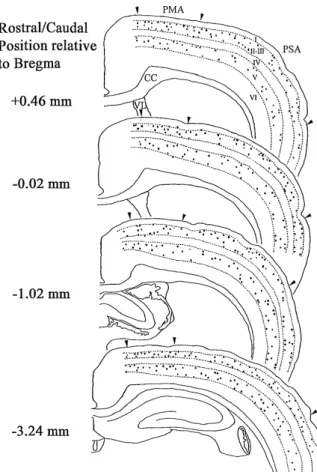
To compare the immunocytochemical distribu-tion of calbindin D-28 K in the primary motor and somatosensory cortexes, four animals and eight sec-tions per animal were examined for each region. The examining areas in details are shown in Fig. 1. Calbindin-D28K-labeled neurons were counted in the primary motor and somatosensory cortexes bounded by two parallel lines of the same length. The number
Fig. 1. Topographic organization showing the examining areas and the immunocytochemical distribution of calbindin-D28K in the primary motor and somatosensory cortexes. Each dot represents one heavily labeled cell. The rostral/caudal coordinates show the level from which the sections were taken as estimated from the atlas of Zilles and Swanson (7, 8). PMA : primary motor area, PSA : primary somatosensory area, CC : corpus callosum, VL : lateral ventricle.
X. Z. Sun et al. Ca-D28K staining cells in primary motor cortex
36 X. Z. Sun et al. Ca-D28K staining cells in primary motor cortex
of labeled cells in each layer to the total number of labeled cells ratio (%) were used to eliminate influences of differences in neuronal populations in motor and somatosensory areas. Since there were very few cells in layer I, no quantitative study of layer I was carried out. The results were compared using Student’s t test. P-values of less than 0.05 were considered significant.
RESULTS
The primary motor areas of the rat cerebral cortex were defined in the hematoxylin-eosin-stained sections on the basis of cytoarchitectures shown in the atlas of Zilles et al . (5-8). In the hematoxylin-eosin-stained
sections the motor areas could be differentiated by the prominent layer Vb of the motor cortex which contained many large and darkly stained pyramidal cells.
Anti-calbindin-D28K antisera stained cell bodies and their processes in the neuropil throughout the primary motor cortex. However, some of them were stained heavily, and some of them were stained weakly. The cells heavily labeled with anti-calbindin-D28K antibody were scattered in two bands corresponding to cortical layers II-III and V (Fig. 2). The morphological types of these cells were varied, and they had oval, fusiform or multiangular somata. The proximal dendrites of the heavily stained cells showed that these cells were non-pyramidal neurons, and they were either double bouquet or multipolar cells (Figs. 2, 3). The
Fig. 2. Coronal sections through the rat primary motor cortex stained with calbindin-D28K antibody. (a) Calbindin-D28K-immunoreactivety is shown in two populations of cortical neurons. One is composed of cells heavily labeled with calbindin, which appear in layers II-III and V ; the other is a weakly labeled population, mainly concentrated in the upper layers (II and III). Some of them are neurons of pyramidal shape (arrows). Moreover, the long and vertically oriented bundles of immunoreactive cell processes which are descending (arrowheads) can also be observed. (b) Higher power photomicrograph of (a). WM : white matter. Scale bar : a=100µm, b=40µm.
Fig. 3. High power photomicrographs of examples of calbindin-D28K immunoreactive neurons in the rat primary motor cortex. The morphological types of these cells are oval, fusiform or multiangular. Arrows indicate terminal-like puncta of immunoreactive neurons. (a) & (b) Heavily stained cells in the upper layers (II and III). (c) & (d) Heavily stained cells in layer V. Scale bar=25µm.
37
The Journal of Medical Investigation Vol. 49 2002 37
cells weakly labeled with anti-calbindin-D28K antibody were observed in all layers of the neocortex. Most were concentrated in the upper parts of the layers (II and III), in which a small number of cell somata had a pyramidal shape (Fig. 2).
The densest plexus of immunoreactive processes and terminal-like puncta were also seen in layers II and III, due to the abundance of immunoreactive cell processes in those layers. The most outstanding feature of the neuropil staining deep to layer II was the labeling of the long, vertically oriented bundles of immunoreactive processes. Some of these processes could be traced back to small calbindin-D28K-positive neurons in layer II and upper layer III. These processes descend to layer V where they were less dense than that in layers II and III (Fig. 2).
A similar distribution of calbindin-D28K immunoreactive cells were observed in the primary somatosensory cortex (Fig. 1), that was in agreement with previous findings by Alcantara (4). However, a quantitative study revealed regional differences in the laminar distribu-tion of calbindin-D28K immunoreactive cells between the primary somatosensory cortex and the primary motor cortex. The significant differences were observed in layers IV and V, but not in layers II-III and VI. Labeled cells were fewer in layer IV of the primary motor cortex and those in layer V were more numerous than in the primary somatosensory cortex (Fig. 4).
DISCUSSION
In the primary motor cortex of the rat, calbindin-D28K immunoreactivity was found in two populations of cortical neurons. One was composed of neurons heavily labeled with anti-calbindin antibody, which were non-pyramidal cells and scattered throughout layers II-III and V ; the other was a weakly stained population, which mainly concentrated in layers II and III and also contained pyramidal neurons. Such distribution patterns of calbindin-positive neurons in the primary motor cortex were essentially the same as those in somatosensory cortical areas of the rat, but statistically significant differences in the distri-bution of calbindin-positive neurons were found in layers IV and V between the primary motor cortex and the primary somatosensory cortex. These differ-ences could be due to basic differdiffer-ences in laminar cell density as well as the cell types in the two cortical areas. For example, the primary motor area shows a relative peak in cell density in layer V, while the cell density peak in the granular layer IV of the somatosensory area (7). The different distributive patterns of calbindin-positive cells found in the present study confirmed again that the primary motor cortex is separated cytoarchitectonically from the primary somatosensory cortex.
In this study, we found that there were gradations in staining intensity for calbindin-D28K immunoreactivity in the primary motor cortex. This result suggests that calbindin-D28K is present in varying concentrations in different neuronal populations. It is of interest to note that the neurons stained intensely with anti-calbindin-D28K antibody were mainly located in the upper cortex. Such preferential localization of calbindin-D28K-immunoreactivity in the upper layers correlated well with the distribution of the dihydropyridine-sensitive calcium channel (9 -11). Previous studies have reported that the distribution of N-methyl-D-aspartate receptors is biased towards the superficial layers in the rat frontoparietal cortex, supporting the suggestion that a major function of calbindin-D28K might be to buffer the calcium influx occurring voltage-and receptor-operated calcium channels (12, 13).
In addition, co-location studies have reported that calbindin positive non-pyramidal neurons, especially in layers II and III, are also GABA-immunoreactive, therefore these calbindin immunoreactive cells are suggested to be GABAergic (14). In the present study, those vertically oriented bundles of calbindin-positive cells were probably media for the passage of inhibitory GABAergic influences between cells that form parts
Fig. 4. Histogram showing numbers of neurons labeled (heavily and weakly) with anti-calbindin-D28K antibody in the primary motor and primary somatosensory cortexes. n=4 ; mean±S.D ; **
P-value of less than 0.05 is considered significant. Student’s t test.
X. Z. Sun et al. Ca-D28K staining cells in primary motor cortex
38 X. Z. Sun et al. Ca-D28K staining cells in primary motor cortex
of the same functional column but are situated in different layers. The majority of calbindin-positive cells situated in the upper layers may have descending influences.
The present results, taken together with earlier studies (1, 2), show that a distinct distribution of calbindin immunoreactive cells in primary motor cortex, or in primary somatosensery cortex. They support the hypothesis (1) that calbindin-D28k can be used as a marker for specific populations of cortical neurons and functional systems in the rat neocortex. However, in spite of the wealth of available data which correlates the presence of calbindin-D28K to specific cellular functions (12, 13, 15), no direct evidence has been obtained linking the functions of the calbindin protein, such as its specific electriphysiological and metabolic characteristics or protection against calcium-mediated cell injury in the cerebral cortex. These relationships need to be more firmly established in electrophysiologically and morphologically charac-terized neurons by injecting calbindin protein into neurons that lack it or by blocking its function in cells that contain calbindin-D28K by injecting appropriate antibody.
REFERENCES
1. Baimbridge KG, Celio MR, Rogers JH : Calcium-binding proteins in the nervous system. Trends Neurosci 15 : 3030-308, 1992
2. Clio MR : Calbindin-D28K and paralbumin in the rat nervous system. Neuroscience 35 : 375-475, 1990
3. Andressen C, Blumcke I, Celio MR : Calcium-binding proteins : selected markers of nerve cells. Cell Tissue Res 271 : 181-208, 1993
4. Alcantara S, Ferrer I, Soriano E : Postnatal
devel-opment of parvalbumin and calbindin D28K immunoreactivities in the cerebral cortex of the rat. Anat Embryol 188 : 63-73, 1993
5. Krieg WJS : Connections of the cerebral cortex. I. Albino rat. A. Topography of the cortical areas. J comp neurol 84 : 221-275, 1946
6. Krieg WJS : Connections of the cerebral cortex. I. Albino rat. B. Structure of the cortical areas. J comp neurol 84 : 277-324, 1946
7. Zilles K : The cortex of the rat. A stereotaxic atlas. Springer, Berlin, 1985
8. Swanson LW : Brain maps : Structure of the rat Brain. Elsevier, New York, 1998
9. Murphy KRM, Gould JR, Snyder SH : Auto-radiographic visualization of 3H-nitrendipine binding sites in the rat brain : localization to synaptic zones. Eur J Pharmac 81 : 517-519, 1982
10. Cortes R, Supavilai P, Karobath M, Paracios JM : Calcium antagonist binding sites in the rat brain : quantitative autoradiographic mapping using the 1, 4-dihydropyridines (3H) PN 200-110 and (3H) PY108-068. J Neural Transm 60 : 169-197, 1983 11. Quirion R : Autoradiographic localization of calcium channel antagonist, 3H-nitrendipine, binding sites in rat brain. Neurosci Lett 36 : 267-271, 1983 12. Braun K : Calcium-binding proteins in avian and
mammalian central nervous system. Prog Histochem Cytochem 21 : 1-64, 1990
13. Celio MR : Calbinding D-28k and parvalbumin in the rat nervous system. Neuroscience 35 : 375-475, 1990
14. van Brederode JFM, Mulligan KA, Hendrickson AE : Calcium-binding proteins as markers for subpopulations of GABAergic neurons in monkey striate cortex. J Comp Neurol 298 : 1-22, 1990 15. Heizmann CW : Calcium binding proteins of the
EF-type. J cardiovasc Pharmac 12 : 30-37, 1988 39
The Journal of Medical Investigation Vol. 49 2002 39