Entrance Examinations and Their Effect on
Pre-tertiary Learners' Motivation to
Communicate in English
journal or
publication title
国際学研究
volume
5
number
1
page range
85-97
year
2016-03-30
URL
http://hdl.handle.net/10236/14315
Introduction
Explaining the inability of the Japanese education system to produce communicative compe tence in its English learners is an ambitious undertaking. It has however been a permanent fixture in
Entrance Examinations and Their Effect on
Pretertiary Learners’ Motivation to Communicate in English
Samuel CROFTS*大学入試が中高生の英語コミュニケーション活動の動機づけに及ぼす影響 クロフツ サミュエル
Abstract :
This paper suggests that Japanese university entrance examinations, the majority of which do little to test communication, drive pretertiary learners away from improving their English communication skills. After a review of literature exploring the nature of entrance examinations in Japan, the research element of the paper is presented in the form of a motivational factors questionnaire adapted from previous work by Dörnyei and Taguchi (2010). Administered in May 2014 to 1048 learners at various stages of the Japanese public education system, the results of the survey data highlight a direct link between entrance examinations and the effort expended in studying English. The strength of this link, it is argued, can be used as evidence that reform of the entrance examination system in Japan presents a potential opportunity to provide learners with a powerful source of external motivation to improve their communicative abilities, an op portunity that is especially important, considering the seeming lack of alternative sources of mo tivation in Japan.
要旨:本論は、言語運用能力を重視しない大学入学試験が、日本人英語学習者のコミュニ ケーション能力の上達を阻む可能性があることを提言している。日本におけるこれまでの 入学試験の形態を概観したのち、Dörnyei and Taguchi(2010)の質問紙を援用し、学習者 の学習動機の本質を調査する。調査は、2014 年 5 月に小学校から大学生までの日本人英 語学習者 1,048 名を対象に実施し、入学試験と英語学習に取り組む学習動機を問う質問 で、特に、入学試験と外発的動機との間に強い相関関係があることを明らかにしている。 両者の強い相関関係から、コミュニケーション能力の視点を盛り込んだ入学試験を行うこ とが、内発的動機づけが困難な日本の英語学習環境において、外発的動機の高い学習者の コミュニケーション能力の発達を促進する契機となることが期待される。
Key words : Motivation, Communicative Competence, Entrance Examinations
────────────────────────────────────────────
*Instructor of English as a Foreign Language, School of International Studies, Kwansei Gakuin University
Japanese educational dialogue throughout the past 30 years (Ryan, 2008) and it remains an under taking worthy of time and effort. In this paper, I argue that reform of the examination system has the potential to improve students’ desire to develop their own communicative competence. The vast majority of entrance examinations do little to test communicative ability and therefore, as powerful sources of motivation, it is argued that such examinations drive students away from focussing on their communicative abilities. As a result, such examinations can be said to contribute significantly to a system which, after six years of instruction, produces learners with “weak English communica tion ability and low motivation toward learning the language” (Nakata, 2006 : 166).
The term communicative competence, which has been credited to Dell Hymes (1971), is under stood to be the product of a combination of distinct competencies ; including the correct employ ment of language items, the use of appropriate communication strategies, grammatical knowledge, and the ability to infer meaning from context. Considering this, I will look at the non communicative nature of entrance examinations before presenting a study that links the effort ex pended by preuniversity learners in Japan to the presence of entrance examinations. In highlighting this link, I suggest that the Japanese entrance examination system incentivizes students to direct their energies away from improving communicative abilities and that in the absence of other exter nal motivators, misses an excellent opportunity to provide Japanese students with a tangible and powerful source of external motivation to such skills.
Of course, entrance examinations are not the sole explanation for a lack of communicative Eng lish abilities amongst Japanese learners and a range of other explanations exist alongside the ideas presented here. In practical terms, a lack of opportunities to practice English in real communicative situations as well as a near absence of English from mainstream media has, according to McArthur (1998) relegated English to a state of decoration in Japan. Further to this, fundamental and irrecon cilable phonetic differences between the Japanese and English languages (see Bradlow, 2008), can result in a cognitive burden for native speakers of Japanese that is heavier than that experienced by speakers of other languages. In terms of pedagogy, low communicative ability has also been ex plained as a result of an over reliance on grammar translation approaches to language instruction (Koike et al, 1995 ; Law, 1995). A final contributory factor in highlighted by Kerr (2001) from a cultural point of view, where hesitation, shyness and a lack of willingness to draw attention to one self inhibit learners’ desire to communicate in English.
In terms of how examinations themselves affect learners, the effect of testing on learning is commonly referred to as the ‘washback’ effect and has been characterised by Stobart (2003 : 140) as a process that is not neutral and one which always has consequences for students, affecting both what is taught and how it is taught. Wall (2005) goes on to suggest that the effects of examinations differ greatly depending on students, and such differences are particularly acute in large scale lan guage tests. It is of course worth noting that Japanese university entrance examinations are not dedi cated language tests in the style of TOEIC or IELTS and therefore before trying to establish a link between such tests and students motivation, it is useful to consider what exactly such examinations are, and what they test.
Entrance Examinations in Japan
Within the Japanese education system, university entrance examinations are, put simply, the de
fining points of Japanese students’ educational career. Fukuzawa (1998) observes that entrance ex ams are tightly connected with future income, prestige and job security and that Japanese students are highly aware of this fact from a young age, with Sugimoto (2003) adding that entrance to uni versity in Japan is in fact more demanding than graduation from it. In contrast with, for example the ‘Alevel’ examinations taken by students of an equivalent age in the United Kingdom, the Japa nese ‘National Center Test for University Admissions’ is an annually administered examination with no resits allowed. The exam is administered on the same weekend of the year throughout the coun try and consists of 29 separate tests, with candidates sitting the exams specified by their university of choice.
For many wishing to enter more prestigious universities in Japan, as well as those wishing to enter private institutions (of which there are many), further examinations are often set individually by universities and the burden on students to prepare for multiple exams can by very heavy indeed. Each entrance exam typically consists of sections on Japanese, maths and foreign languages, though as Ryan (2008) observes, the negligible numbers of students taking the test in other languages means that the ‘foreign language’ category basically refers to English.
Criticism of entrance examinations is certainly not a new phenomenon (see Murphey, 2001), and the negative effects that such exams can have on teaching methods are identified by Browne and Kikuchi (2009). Unfortunately for this study, the high number of examinations being set by dif ferent institutions in Japan means that attaching even a small proportion of the entrance examina tions set in one year would result in a prohibitively lengthy appendix section. Instead previous work into the effects of examinations in Japan is used as evidence to support the claim that such examina tions do little to test communicative abilities.
The ‘National Center Test for University Admissions’ comprises exclusively of multiplechoice questions (Stewart, 2009), with Nakata (2006) speculating that preparation for such exams takes place at the expense of communicative learning. Butler & Iino (2005) go further, suggesting that juken eigo (English for the purpose of entrance examinations) developed in the Japanese education system, not necessarily as a tool for communication, but as a screening process for educational insti tutions. Despite the fact that the contemporary political and economic situation in Japan does call for a degree of English communicative competence in its university graduates, it seems that univer sities are failing to recognise this call and refusing to adapt from previous ways of thinking. The consequences of this refusal are felt by students throughout Japan, and are particularly serious when considered in light of research by Yashima (2002) exploring willingness to communicate among Japanese learners.
As a concept, ‘willingness to communicate’ is the combination of factors necessary to drive a learner to communicate in a language other than their own. Studying the concept in a Japanese envi ronment, Yashima (2002) concludes that motivation alone is insufficient to compel learners to com municate, and instead identifies a link between individuals’ perceptions of their own competence and their willingness to communicate in a second language. Motivation therefore, must exist along side positive selfperception in order to encourage communication in a foreign language.
Unfortunately, in a system which places almost no importance on communicative ability, and in which the time spent on communicative activities is not even close to adequate to acquire any de gree of fluency (Weschler, 1997), it is difficult to see where the confidence and positive self
Samuel CROFTS:Entrance Examinations and Their Effect on Pretertiary Learners’ Motivation to Communicate in English
perceptions required to encourage communication will come from. With the burden of examinations inhibiting teachers’ and students’ willingness to practice communicative English, a situation has emerged in which “for most secondary students in Japan, English has a clearly defined instrumental function, stripped of any communicative function” (Ryan, 2009 : 215).
This paper argues that the current entrance examination system is a major source of this per ception of English and suggests that the addition of communicative elements to entrance examina tions could have a positive effect on students’ desire to acquire communicative English skills. In or der to support this claim, research presented in the next section aims to provide a direct link be tween the desire to pass entrance examinations and students’ own efforts in studying English, along with the hypothesis that as a source of motivation, the power of entrance examinations grows as stu dent progress through the education system towards university.
Methodology
In order to draw a quantifiable link between motivated behaviour and the presence of entrance examinations, the study presented in this paper is based on previous research from Zoltan Dörnyei. Though still relatively young as an academic construct, Dörnyei’s (2005) L2 self motivational system has become a powerful force in language learning motivation research, with studies being replicated successfully in a number of international contexts (Taguchi et al, 2009 ; Ryan, 2009). Considering the success of these replication studies, as well as the limited resources available for this research, it was felt that the use of an established data collection method was more likely to yield useful results. The decision was therefore made to base this study on previous research conducted by Dörnyei and Taguchi (2010), using a questionnaire to identify sources of
motivation among Japanese preuniversity students, and then cross referencing these variables with indicators of moti vated behaviour. In the following subsections, I provide an outline of the participants and instrument used in the study before presenting and discussing the results.
Participants
Nara is the 33rd most populous prefecture in Japan (out
of 47) and the 14th highest in terms of population density
(GSIJ, 2008). The prefecture borders the major cities of Osaka to the east and Kyoto to the north, providing easy ac cess to both, but also containing a number of rural areas in the south of the prefecture. Nara is neither heavily urban nor overly rural and in generating the sample, attention was paid to achieving a balance between surveying learners from both rural and urban areas.
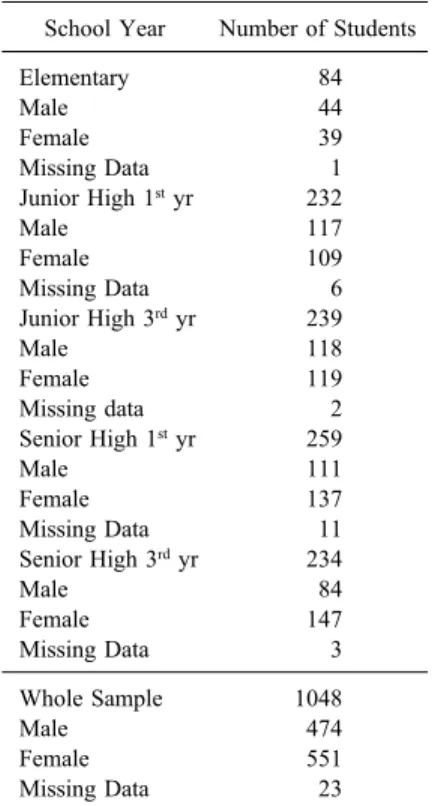
Conducted in May 2014, research took place in the first months of the Japanese academic year, surveying 1048 Japa nese learners at various stages of the education system. A questionnaire was administered to final year students from
Table 1 Sample’s Statistics
School Year Number of Students Elementary Male Female Missing Data Junior High 1styr Male Female Missing Data Junior High 3rdyr Male Female Missing data Senior High 1styr Male Female Missing Data Senior High 3rdyr Male Female Missing Data 84 44 39 1 232 117 109 6 239 118 119 2 259 111 137 11 234 84 147 3 Whole Sample Male Female Missing Data 1048 474 551 23 ― 88 ―
elementary school (1112 yrs), junior high school (1415 yrs), and senior high school (1718 yrs), as well as first year students from junior high school (1213), and high school (1516). It should be noted that participants were selected at random from each participating school, and were not se lected on the basis of any particular ability or interest in foreign languages.
Instrument
The instrument used in this study was adapted from a questionnaire produced by Dörnyei and Taguchi (2010) to measure the motivation of Japanese language learners. The questionnaire con sisted of 40 statements, which measured five variables (see appendix A). Four of the variables looked at various motivating factors (one of which was entrance examinations), with the final vari able, ‘intended effort’ acting as the criterion measure for the study against which the other variables were compared. In the questionnaire, learners were asked to indicate the degree to which they agreed with certain statements from a 6 point Likertstyle scale. The decision to remove a ‘middle’ value was determined by previous research (Rian, 2007 ; Taguchi et al, 2009) suggesting a ten dency, especially among Japanese respondents, to look for median answers.
In order to combat fatigue effects, and to refocus the study toward the motivational power of entrance examinations, a number of variables considered irrelevant to the aims of this study were re moved from Dörnyei and Taguchi’s (2010) original instrument, with three variables retained to al low the reliability of the research to be compared with the other studies. Finally, additional items measuring the influence of entrance examinations were designed and added following consultations with a number of Japanese and nonJapanese education professionals. English translations of the items used to capture this data can be found below :
− Studying English is important to me, as I want to go to a famous University/High School − I have to study English because there is an English section on all Entrance examinations − I have to learn English because without it, I cannot go to University/High School − Studying English is necessary to pass important exams
Results
The first part of this section assesses the reliability of the multi item scales used in the ques tionnaire and compares the internal reliability of the scales used here with those reported in previous similar studies. Following this, correlations in the dataset between entrance examinations and in tended effort are illustrated alongside gender differences and a possible weakness of the research de sign.
Reliability
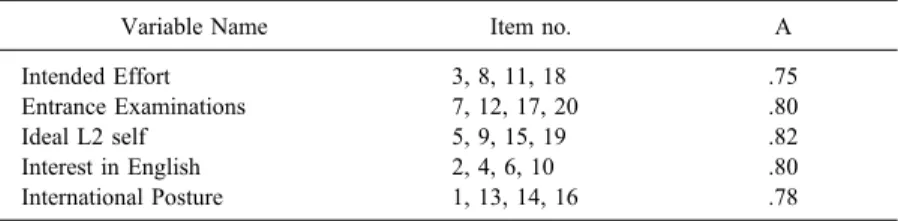
Table 2 presents the Cronbach Alpha(α) internal reliability coefficients based on the data col lected from the participants for the five variables tested, including intended effort and entrance ex-aminations. The original questionnaire used in this study is available as an appendix to this paper (Appendix B).
Samuel CROFTS:Entrance Examinations and Their Effect on Pretertiary Learners’ Motivation to Communicate in English
As shown in the table, there was a generally high internal reliability across the variables, with coef-ficients of above 0.7, an accepted boundary for internal reliability (Dörnyei & Taguchi, 2010). Pleasingly for this paper, the variable used to examine entrance examinations was shown to have the highest score in terms of internal reliability. With over a thousand responses, the internal reliability coefficients returned by SPSS, especially concerning the variables of specific interest to this paper, intended effort, and entrance exams were positive, adding credibility and validity to any conclusions drawn.
To be as sure as possible about the reliability of the scales used in the instrument, internal reli-ability coefficients were compared with those of other recent studies assessing similar variables. Ta-ble 3 presents a comparison of the reliability coefficients generated by two variaTa-bles in this study and with those from two previous studies undertaken in Japan (Taguchi et al, 2009) and Iran (Papi, 2010).
Similar internal reliability coefficients compared with both previous studies indicates a positive de-gree of replication, which adds to the overall validity of the present study.
Entrance examinations and intended effort
At the beginning of this paper, entrance examinations were suggested to be a powerful source of motivation for pre-tertiary learners in Japan. The design of the research instrument therefore looked to focus upon these exams and measure their correlation with intended effort. Table 4 pre-sents the correlation of the entrance examinations variable with intended effort.
As shown in Table 4, the results of the survey indicate a positive correlation between entrance examinations and the intention to expend effort in studying English among pre-tertiary learners. Alongside this, Table 5 shows that the power of the entrance examination variable to compel
stu-Table 2 Variable items, with Cronbach Alpha(α) coefficients
Variable Name Item no. A
Intended Effort Entrance Examinations Ideal L2 self Interest in English International Posture 3, 8, 11, 18 7, 12, 17, 20 5, 9, 15, 19 2, 4, 6, 10 1, 13, 14, 16 .75 .80 .82 .80 .78
Table 3 Reliability coefficients compared with previous studies
Variable Name This study Taguchi(2009) Papi(2010) Intended Effort Ideal L2 self .78 .80 .86 .89 .79 .79
Table 4 Correlation of Entrance Examinations with intended effort Variable
Entrance Examinations .60
dents to study steadily increases as students move through the educational system, as suggested ear-lier in the paper.
Gender differences
Although not considered in the paper so far, the dataset produced by this research also allowed for the division of responses based not only by the stage at which respondents were located in the education system, but also by gender. The division of results in this way produced some interesting results as shown by Table 6, which presents the correlation coefficients for the Ideal L2 self, en-trance examinations and intended effort, divided by gender.
As shown above, an interesting and unexpected result of the research was that correlations be-tween entrance examinations and intended effort are significantly higher in male learners than in fe-male learners, with the ideal L2 self showing the opposite trend. As gender differences are not the primary focus of this investigation, I do not intend to return to investigate their significance and will instead briefly discuss them here ; the ideal L2 self as a variable, is strongly related to future con-ceptions of oneself. What the results of this research indicate is that female students are able to har-ness such future conceptions to drive their language study. Male students on the other hand, seem to rely more on the concrete notion of entrance examinations to provide their own motivation. What causes this divergence is not immediately clear, but further research to establish how gender affects motivation would no doubt yield interesting results.
Limitations
Among the difficulties associated with making inferences in a study such as this, the question of correlation vs. causality stands out. A positive correlation between two variables can exist com-pletely independently of causality, leaving coincidence to explain the correlation. In other cases, a third ‘lurking variable’ can exist alongside that which is being measured to give an impression of causality where in fact there is none. In social sciences, it is almost impossible to establish absolutes and therefore, in trying to establish that the presence of entrance examinations ‘cause’ students to direct their English learning efforts towards the development of non-communicative skills, it is ac-cepted that we are unlikely to ever prove this as a fact. What we can aim to do however is provide
Table 5 Correlation between entrance examinations and intended effort at different stages of the Japanese education system
School year JHS 3 SHS 1 SHS 3
Correlation coefficient .51 .62 .65
Table 6 Correlation coefficients of intended effort and the three main variables, di-vided by gender
Variable Male Female
Ideal L2 self Entrance Examinations .51 .66 .59 .54
Samuel CROFTS:Entrance Examinations and Their Effect on Pre-tertiary Learners’ Motivation to Communicate in English
enough evidence to reasonably conclude that one variable is likely to have a causal effect on an-other.
In terms of the results presented above, perhaps the most significant in terms of the main hy-pothesis tested by this paper is the positive correlation observed between entrance examinations and intended effort. Although not proof of causality, these results add weight to the suggestion that such exams are important motivators for pre-tertiary learners in Japan. As a consequence, it can be rea-sonably surmised that entrance examinations do indeed drive students to direct their efforts away from improving their communicative English abilities.
Conclusion
At the beginning of this paper, I identified the prominence in educational literature of the fail-ure of the Japanese education system to produce communicative competence it its English learners and suggested that entrance examinations made a significant contribution to this problem. The deci-sion to focus on these examinations was inspired initially by personal experience of the power they seem to exert over pre-tertiary learners in the public education system, but was affirmed by further research as discussed in work of Nakata (2006) and Sugimoto (2003). The general lack of an lish language context in Japan means that there is a shortage of sources of motivation to study Eng-lish, but entrance examinations are one of those sources and therefore some sort of communicative element would seem to be an ideal complement to a government drive to increase communicative abilities.
As explained more fully in the body of the paper, entrance examinations, which are typified by multi choice tests with no creative or communicative component, are immensely important in decid-ing the future lives of Japanese students. It was therefore suggested that if a direct link between en-trance examinations and motivation could be established, then there would be strong case to suggest that pre-tertiary learners of English in Japan may not be unmotivated, but moreover ; motivated only to develop the skills required to pass exams which have no communicative element. When con-sidered alongside the national drive to improve communicative English abilities then, reform of the entrance examination system would seem to present a golden opportunity to affect learners’ own motivation to improve their communicative English abilities.
To empirically identify entrance exams as a significant source of motivation for pre-tertiary English learners in Japan, an instrument was adapted from previous research (Dörnyei & Taguchi, 2010) to quantitatively measure the motivation of Japanese pre-tertiary learners. Administered to 1048 learners in May 2014, the results of the research reflected interestingly on the questions posed at the start of the paper. In terms of establishing entrance examinations as a source of motivation, the research could be defined tentatively as a success, showing a positive correlation between efforts expended in learning English and entrance examinations, as well as the increasing potency of this variable as students get older. Looked at in conjunction with literature describing the nature of such examinations, the study concludes therefore that exams do indeed exert real pressure in driving learners to direct their efforts away from improving their communicative ability and toward the sort of skills that help them to pass current examinations.
This paper does not suggest that entrance exams are the only barrier to improving communica-tive competence among learners in Japan and an array of factors clearly contribute towards
ing language learners. What the paper is trying to argue however, is that the presence of entrance examinations in the education system is significant, and does deserve to be taken into account in any discussion of what drives learners to direct their learning efforts, and why students’ communica-tive abilities are often bemoaned by educators in Japan.
There is no easy way to become competent in a foreign language and hours of practice are nec-essary for even the most gifted of linguists. However, the argument that this paper is predicated upon is that motivation is required to make the whole process work and in Japan, in the absence of a multitude of other sources of motivation, the potential of entrance examinations must be capital-ised upon. In reforming the entrance examination system to include a communicative element, it is suggested that changes in classroom practice will necessarily develop to include a focus on commu-nicative skills. The knock on effect of which would be to improve students’ confidence as well as their perception of their own competence. If, as this study suggests, the potential benefits are so clear, then why, it must be asked, have such reforms not yet been implemented?
Among the reasons for a lack of reform of the system so far, logistical issues could be the most pressing. The actual process of reforming the examination system would undoubtedly be a huge un-dertaking in terms of both time and money. Alongside this, the fact that exams are produced indi-vidually by each university presents the problem of which institution will ‘jump first.’ In an auto-ethnographical study about his own drive to reform entrance examinations in Japan, Murphey (2001) reports a number of barriers to reform, exacerbated by Japan’s risk-averse culture :
The lines of decision making and authority seem very poorly drawn and inhibit change by pushing the responsibility to another group or person. Individuals in a position to make decisions fear blame if things go wrong (Murphey, 2001 : 200)
Further to this, the position of entrance examinations as a revenue generator led Murphey (2001 : 200) to suggest that those in charge of entrance exams may be worried that a more chal-lenging exam based on communicative English would “scare away” fee paying candidates. Also writing on the subject of entrance examinations as revenue generators, Stewart (2009) suggests that a lack of government funding for higher education in Japan has raised the importance of institu-tional testing in raising funds, suggesting they are “a cash cow that must be milked” (Stewart, 2009 : 11).
A further problem with instituting wide changing reform is the high number of private universi-ties in Japan. Although Stewart (2009) suggests that MEXT could offer incentives to institutions that use the ‘Center Test’ as their sole criteria for admissions, private institutions are less accountable to government education ministries and therefore, even if the political will to institute reforms existed, “the reality of the situation illustrates the relative powerlessness of the government in this regard” (Stewart, 2009 : 11).
A significant amount of my own motivation to undertake this research came from personal ex-perience of the power that entrance examinations seem to exert over pre-tertiary learners in Japan. Furthermore, the study was driven by a genuine belief that reform of the system has the potential to provide learners’ with a tangible source of motivation to improve their communicative skills. Now, having established an empirical link between the motivation to study and the desire to pass entrance examinations, my conviction that such exams can be harnessed for the purposes of raising communi-cative competence has been strengthened.
Samuel CROFTS:Entrance Examinations and Their Effect on Pre-tertiary Learners’ Motivation to Communicate in English
References
Bradlow, A. R. (2008) Japanese Adults on the /r/−/l/ contrast, Chapter 10, 287-309, in
Hansen Edwards, J. G. & Zampini, M. L. (eds.) (2008) Phonology and Second Language Acquisition, Amsterdam : John Benjamins.
Browne, C. & Kikuchi, K. (2009) English Educational Policy for High Schools in Japan : Ideals vs. Reality. RELC Journal, 40 : 172-191.
Butler, G. Y. & Iino, M. (2005) Current Japanese Reforms in English Language Education : The 2003 Action Plan.
Lan-guage Policy, 4 : 25-45.
Davis, C. (1995) Extensive Reading : An Expensive Extravagance? ELT Journal, 49/5 : 329-336.
Dörnyei, Z. (2005) The Psychology of the Language Learner : Individual Differences in Second Language Acquisition, Mah-wah, NJ : Lawrence Erlbaum.
Dörnyei, Z. & Taguchi, T. (2010) Questionnaires in Second Language Research : Construction Administration and
Process-ing. Oxford : Routledge.
Fukuzawa, R. E. (1998) The path to Adulthood According to Japanese Middle Schools, Chapter 12, 295-320 in Rohlen, T. and LeTendre, G. (1998) Teaching and Learning in Japan. Cambridge : Cambridge University Press.
GSIJ, Geographical Survey Institute of Japan (2008) Areas of Japanese Prefectures as of October 1st2008. Retrieved July
15, 2011 from http : //www.gsi.go.jp/ KOKUJYOHO/ MENCHO/200810/ichiran.htm.
Hymes, D. H. (1971) On Communicative Competence. Philadelphia : University of Pennsylvania Press. Kerr, A. (2001) Dogs and Demons, The Fall of Modern Japan. London : Penguin
Koike, I. et al. (1995) English in Foreign Language Education Policy in Japan. World Englishes, 14/1 : 13-25. Law, G. (1995) Ideologies of English Education in Japan. JALT Journal, 17/2 : 213-224.
McArthur, T. (1998) The English Languages. Cambridge : Cambridge University Press.
Murphey, T. (2001) Face Validity, in Churchill, E. F & McLaughlin, J. W. (eds.) (2001) Qualitative research on Japanese
Learners and Contexts : Temple University Japan Working Papers in Applied Linguistics, 19 : 188-206.
Nakata, Y. (2006) Motivation and Experience in Foreign Language Learning. Bern : Peter Lang.
Papi, M. (2010) The L2 motivational self system, L2 anxiety, and motivated behaviour : A structural equation modelling ap-proach. System, 38 : 467-479.
Rian, T. (2007) Attitudes towards English and English Learning at three rural Japanese Middle Schools. MA. Dissertation, University of Birmingham. Retrieved on April 22, 2011, from : http : //www.asian-efl-journal.com/ Thesis/Thesis-Rian. pdf.
Ryan, S. (2009) Self and Identity in L2 Motivation in Japan : The Ideal L2 Self and Japanese Learners of English, Chapter 6, 99-120, in Dörnyei, Z & Ushioda, E. (eds.) (2009) Motivation, Language Identity and the L2 Self. Bristol : Multilin-gual Matters.
Ryan, S. (2008) The Ideal L2 selves of Japanese Learners of English. Ph. D. Thesis, University of Nottingham. Retrieved on May 29, 2011 from http : //etheses. nottingham.ac.uk/550/1/ryan-2008.pdf.
Stewart, T. (2009) Will the new English Curriculum for 2013 work? The Language Teacher, 33/11 : 9-13.
Stobart, G. (2003). The Impact of Assessment : Intended and Unintended Consequences. Assessment in Education, 16, 139-140.
Sugimoto, Y. (2003) An introduction to Japanese society. Cambridge : Cambridge University Press.
Taguchi, T. et al. (2009) The L2 Motivational Self system among Japanese, Chinese and Iranian Learners of English : A Comparative Study, Chapter 4, 44-66 in Dörnyei, Z & Ushioda, E. (eds.) (2009) Motivation, Language Identity and the
L2 Self. Bristol : Multilingual Matters.
Taguchi, T. (2010) Illustration : Developing a Motivation Questionnaire, Chapter 5, 111-126 in Dörnyei, Z & Taguchi, T. (2010) Questionnaires in Second Language Research : Construction Administration and Processing. Oxford : Routledge. Wall, D. (2005).The impact of high-stakes examinations on classroom teaching.Cambridge : Cambridge University Press. Weschler, R. (1997) Uses of Japanese (L1) in the English Classroom : introducing the Functional-Translation Method. The
Internet TESL Journal : 3/11 : Retrieved May 23rd, 2011, from http : //iteslj.org/Articles/Weschler-UsingL1.html.
Yashima, S. (2002) Willingness to Communicate in a Second Language : the Japanese EFL Context. The Modern Language
Journal, 86/1 : 54-86.
Appendix A : List of items used to generate variables in the instrument Criterion measures
If an English course were offered at a University/High school in the future, I would take it I am prepared to expend a lot of effort in learning English
I am working hard at learning English I think that I am doing my best to learn English
Ideal L2 self
I can imagine myself living abroad and having a discussion in English Whenever I think of my future career, I imagine myself using English I can imagine a situation where I am speaking English with foreigners I imagine myself as someone who can speak English
Entrance Exams
Studying English is important to me, as I want to go to a prestigious University/High School I have to study English because there is an English section on all Entrance examinations I have to learn English because without it, I cannot go to University
Studying English is necessary to pass important exams
Interest in English
If I make more effort, I am sure I will be able to master English I find learning English really interesting
I feel excited when I hear English spoken
I am interested in the way English is used in conversation
International Posture
Learning English is important to me because I would like to travel internationally I like watching English films
I like meeting people from English speaking countries I study English so I can enjoy foreign travel
Samuel CROFTS:Entrance Examinations and Their Effect on Pre-tertiary Learners’ Motivation to Communicate in English
Appendix B: Japanese Questionnaire Appendix B : Japanese Questionnaire
Samuel CROFTS:Entrance Examinations and Their Effect on Pre-tertiary Learners’ Motivation to Communicate in English