Research on the Evolution and Dynamics of
Issue Attention on China's Climate Change
著者
FAN Shiwei
学位授与機関
Tohoku University
学位授与番号
11301甲第16564号
PhD Thesis
Research on the Evolution and Dynamics of
Issue Attention on China’s Climate Change
Legal and Political Studies Graduate School of Law
Tohoku University
B0JD1008 FAN Shiwei
Copyright 2015 FAN Shiwei All Rights Reserved.
Abstract
In public policy process, how attention characterized by scarcity is allocated? What’s the evolution process of issue attention? And what factors affect the issue attention dynamics? In order to answer the questions above, my study focuses on China’s climate change issue and analyzes the evolving process of China’s climate change issue attention. Based on the theory and observation on China’s climate change policy process, a dynamic model for climate change is proposed and tested empirically. Climate change issue emerged on China’s policy agenda ever since 1980s and evolved constantly. In this process, climate change issue attention shifted, evolved and developed, which exhibits fluctuation and change of issue attention in terms of attention level and structure. The studies on China’s climate change policy process have mainly focused on policy making and policy implementation for a long time, but how climate change issue entered China’s policy agenda and how climate change issue grabbed attention as well as how climate change issue attention evolved are paid meager attention. With this being said, my study attempts to answer these questions through innovations on research design and methodology.
The content analysis toolbox is employed in my research. My study utilizes the official and authoritative newspaper, the People’s Daily, as data resource. More than 5500 texts relating to climate change are retrieved and downloaded from 1947 to 2013. In my research, natural language process technology is used. Through computer coding and human coding, climate change issue attention is extracted and analyzed ranging from 1950s to 2010s. The research results show climate change used to be understood as the weather change with huge time and space scale. In addition, my research finds that climate change issued attention had been dominated by agriculture dimension, environment and ecology dimension, and economy development and international governance dimension respectively. Meanwhile, the correlation between climate change attention and other attentions in climate change issue attention space has been becoming more and more complex. My research also reveals the process in which climate change issue attention has been becoming more complex and dispersed but the relative proportion of climate change issue attention is declining, which implies the marginal attention of climate change is ascending.
research constructs an explanatory dynamic model of climate change issue attention. By way of Autoregressive Integrated Moving Average Model with Exogenous Variable(ARIMAX) analysis, my research illustrates that in short periods, the focusing effects of important global agendas of climate change and international pressure exerted significant influence on climate change issue attention. When the time step in time-series analysis becomes longer, the international pressure and the crowd-in effect resulted from issues correlation significantly affect the climate change issue attention. My study contends that climate change issue attention dynamic pattern in China is the response to politics and pressure rather than to problem itself. In addition, the findings of empirical research provide insights on agenda setting theory through expanding issue attention dynamic model by synthesizing international factors and trans-subsystem effects into agenda setting theory. My study is also expected to shed light on the understanding of climate change policy process in China.
Contents
CONTENTS ... III LIST OF FIGURES ... VII LIST OF TABLES ... IX
INTRODUCTION ... 1
1.1THEORY BACKGROUND ... 1
1.1.1 Focus on the Beginning Stages of Policy Process ... 1
1.1.2 Focus on the “Scarcity” in Decision Making Process ... 3
1.1.3 Proposing Theoretical Questions ... 4
1.2POLICY BACKGROUND ... 5
1.2.1 Climate Change: An Unconventional Policy Issue ... 5
1.2.2 The Background of Climate Change in China ... 8
1.2.3 The Value of the Research for Climate Policy ... 11
1.3RESEARCH FRAMEWORK ... 12
1.3.1 Main Research Idea ... 12
1.3.2 Research Method ... 12
1.3.3 Thesis Structure ... 13
LITERATURE REVIEW... 14
2.1PROCESS PERSPECTIVE ... 14
2.1.1 Theoretical Bases ... 14
2.1.2 Explanatory Frameworks and Models ... 15
2.1.3 Explanatory Power and limitations ... 22
2.2SYSTEM PERSPECTIVE ... 23
2.2.1 Theoretical Bases ... 23
2.2.2 Explanatory Frameworks and Models ... 26
2.2.3 Explanatory power and limitations. ... 30
2.3BEHAVIOR PERSPECTIVE ... 31
2.3.1 Theoretical Bases ... 31
2.3.2 Explanatory Frameworks and Models ... 32
2.3.3 Explanatory Power and Limitations ... 33
2.4.1 Theoretical bases ... 34
2.4.2 Explanatory frameworks and models ... 35
2.4.3 Explanatory power and limitations ... 37
2.5RESEARCH REVIEW OF STUDIES ON CLIMATE CHANGE POLICY PROCESS IN CHINA 38 2.5.1 A Politics-Bureaucracy Perspective of policy-making ... 39
2.5.2 An Organization-Behavior Perspective of Policy Implementation ... 40
2.6SUMMARY OF LITERATURE REVIEW AND ROOM FOR FURTHER STUDY ... 40
THE ISSUE AND THE AGENDA OF CHINA’S CLIMATE CHANGE 43 3.1PRE-CLIMATE CHANGE ISSUE:EMERGENCE OF ENVIRONMENTAL ISSUES ... 43
3.2CLIMATE CHANGE:FROM SCIENCE TO POLICY ... 45
3.3GRADUAL ADVANCEMENT IN STABILIZATION:FROM RIO SUMMIT TO KYOTO PROTOCOL ... 48
3.4OUTBURST OF ISSUE ATTENTION: THE KYOTO PROTOCOL AND POST-KYOTO -PROTOCOL STAGE ... 52
ISSUE ATTENTION: INDEX, METHOD AND MEASUREMENT ... 55
4.1RESEARCH DESIGN AND RESEARCH METHOD ... 55
4.1.1 Former Designs and Methods ... 55
4.1.2 Challenge for collecting data ... 61
4.1.3 Data Source of Research ... 65
4.2CONTENT ANALYSIS:AMETHOD FOR INFORMATION MINING ... 67
4.2.1 Framework of Content Analysis ... 67
4.2.2 The Choice of Technique Approach ... 70
4.2.3 Techniques for measurement ... 72
4.3PROCESS OF MEASUREMENT ... 75
4.3.1 Database Building ... 75
4.3.2 Keywords Extraction and Design for Weighting Scores ... 77
4.3.3 Setting Coding Scheme and Coding Process ... 79
ANALYSIS ON ATTENTION EVOLUTION OF CLIMATE CHANGE ISSUE IN CHINA... 83
5.1AMACROSCOPIC DESCRIPTION ON ISSUE ATTENTION ON CLIMATE CHANGE ISSUE
5.1.1 Conceptual Framework of Issue Attention ... 83
5.1.2 An Macroscopic Description of China’s Climate Change Issues ... 85
5.2FROM 1947 TO 1977:“CLIMATE CHANGE” IN THE PERSPECTIVE OF METEOROLOGY ... 87
5.2.1 Component analysis on dimensions of attention on climate change ... 87
5.2.2 Correlation analysis on dimensions of attention on climate change ... 92
5.3FROM 1977 TO 1992:FROM SCIENTIFIC AGENDA TO POLICY AGENDA ... 97
5.3.1 Component analysis on dimensions of attention on climate change ... 97
5.3.2 Correlation analysis on dimensions of attention on climate change ... 102
5.4FROM 1992 TO 2013:CLIMATE CHANGE AS AN IMPORTANT POLICY AGENDA ... 106
5.4.1 Component analysis on dimensions of attention on climate change ... 106
5.4.2 Correlation analysis on dimensions of attention on climate change ... 111
5.5SUMMARY AND DISCUSSION ... 114
5.5.1 Evolution of Attention Dimensions of Climate Change Issue ... 114
5.5.2 Trend Analysis of Attention on Climate Change ... 116
5.5.3 Dispersion Analysis of Issue Attention on Climate Change ... 119
RESEARCH ON ISSUE ATTENTION DYNAMICS OF CLIMATE CHANGE IN CHINA ... 121
6.1CONVENTIONAL PERSPECTIVES ON EXPLAINING ISSUE ATTENTION ... 121
6.1.1 Problem indicator and issue attention ... 121
6.1.2 Focusing events and issue attention ... 122
6.1.3 Information feedback and issue attention ... 123
6.2THE POSSIBLE EXTENSION OF THEORETICAL PERSPECTIVES ON CLIMATE CHANGE ISSUE ATTENTION... 123
6.2.1 Policy knowledge and attention ... 123
6.2.2 Crowding effects and issue attention ... 126
6.2.3 International agenda and issue attention ... 126
6.3CONSTRUCTION OF INTERPRETATION MODEL AND MEASUREMENT ON RELATED VARIABLES ... 127
6.3.1 Dynamics Model and Research Hypotheses of Climate Change Issue Attention ... 128
6.3.2 Measurement of Variables ... 129
6.3.3 Empirical Research Approach ... 135
6.4.1 Test on Time Series ... 136
6.4.2 Empirical Result of Time Series Analysis ... 140
6.5ISSUE ATTENTION DYNAMICS ANALYSIS WITH QUARTER AS TIME UNIT ... 144
6.5.1 Test on Time Series ... 144
6.5.2 Empirical Result of Time Series Analysis ... 148
6.6CONCLUSION AND DISCUSSION ... 152
6.6.1 Comparison of Results ... 152
6.6.2 Discussion about Issue Attention Dynamics of Climate Change in China 153 CONCLUSION AND DISCUSSION... 157
7.1RESEARCH CONCLUSIONS AND DISCUSSIONS ... 157
7.1.1 The Main Conclusions of Research ... 157
7.1.2 Discussions on Research Conclusions ... 160
7.2INNOVATIONS AND CONTRIBUTIONS OF RESEARCH ... 164
7.2.1 Innovations of Perspectives ... 164
7.2.2 Innovations of Methods ... 164
7.2.3 Contributions of Research ... 165
7.3POSSIBLE IMPROVEMENTS AND PROSPECTS FOR RESEARCH ... 165
List of Figures
Figure 1-1 Challenge of climate change issue for conventional policy analysis
assumptions ... 8
Figure 1-2 Greenhouse Gas Emission in China(MtCO2) ... 9
Figure 2-1 The cyclical issue-attention cycle model ... 17
Figure 2-2 A dynamic response model of a political system ... 24
Figure 2-3 Hofferbert’s model for comparative study of policy formation ... 24
Figure 2-4 Information processing in decision-making process ... 27
Figure 4-1 Approaches for collecting data and measuring variables ... 59
Figure 4-2 CSSCI(Social Science Citation Index in China, from CNKI database) academic articles with the keywords “agenda setting” (collected by topics) ... 62
Figure 4-3 Basic logic of content analysis ... 68
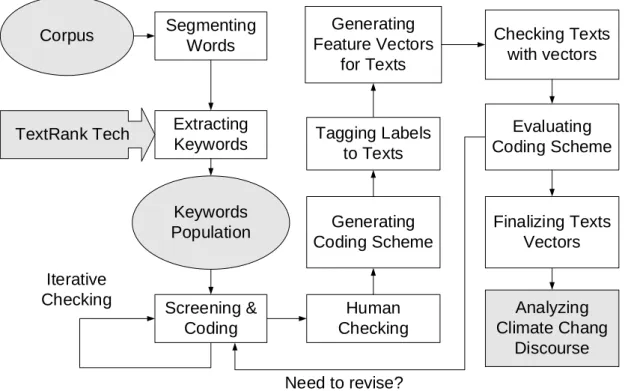
Figure 4-4 Procedure and framework of content analysis in this thesis ... 77
Figure 4-5 Exponential declining trend of scores for keywords ... 80
Figure 5-1 Logic of decision making in behavior science ... 84
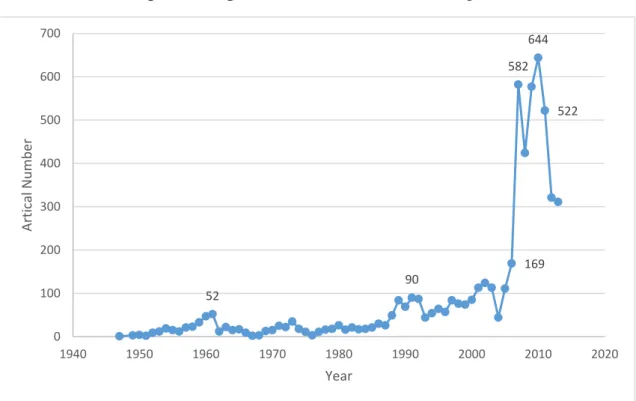
Figure 5-2 Annual number of articles relating to climate change ... 85
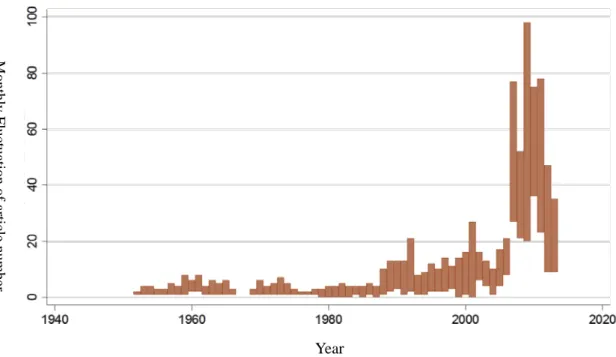
Figure 5-3 Monthly fluctuation of article number relating to climate change ... 86
Figure 5-4 1947-1977 Comparative analysis on attention attributes of climate change (I) ... 89
Figure 5-5 1947-1977 Comparative analysis on attention dimensions of climate change (II) ... 90
Figure 5-6 1947-1977 Comparative analysis on attention dimensions of climate change (III) ... 91
Figure 5-7 1947-1977 Accumulative percentage area diagram of climate change attention dimensions ... 91
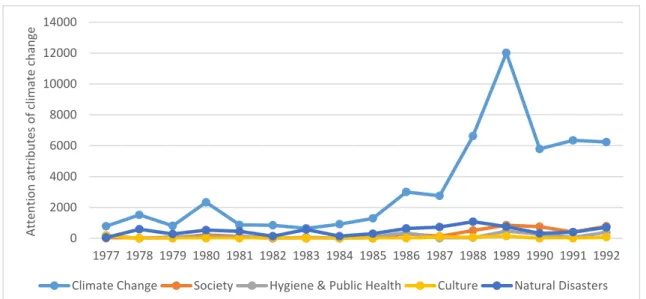
Figure 5-8 1977-1992 Comparative analysis on attention dimensions of climate change (I) ... 98
Figure 5-9 1977-1992 Comparative analysis on attention dimensions of climate change (II) ... 99
Figure 5-10 1977-1992 Comparative analysis on attention dimensions of climate change (III) ... 100
Figure 5-11 1977-1992 Accumulative percentage area diagram of climate change attention dimensions ... 100 Figure 5-12 Comparative analysis on attention dimensions of climate change (I) ... 107 Figure 5-13 Comparative analysis on attention dimensions of climate change (II) ... 108 Figure 5-14 Comparative analysis on attention dimensions of climate change (III) ... 109 Figure 5-15 1992-2013 Accumulative percentage area diagram of climate change
attention dimensions ... 109 Figure 5-16 Changing rate of attention on climate change ... 117 Figure 5-17 Trends of attention on climate change after 1988 ... 117 Figure 5-18 Rate of climate change accounting for within all dimensions after
1988... 118 Figure 5-19 Entropy of issue attention on climate change after 1977 ... 120 Figure 5-20 Linear trend of entropy of issue attention on climate change after 1977 ... 120 Figure 6-1 Generation, transmission, and use of environmental knowledge ... 125 Figure 6-2 Explanatory framework for issue attention dynamics on climate change ... 128 Figure 6-3 Disaster extreme index scatter graphic ... 132 Figure 6-4 Monthly curve of numbers for academic articles concerning climate
change ... 134 Figure 6-5 Monthly curve of issue attention on climate change in China ... 137 Figure 6-6 Autocorrelogram (left) and partial correlogram (right) for monthly
issue attention... 138 Figure 6-7 Autocorrelogram and partial correlogram for monthly issue attention
with AR and MA ... 139 Figure 6-8 Quarterly curve of issue attention on climate change in China ... 144 Figure 6-9 Autocorrelogram (left) and partial correlogram (right) for quarterly
issue attention... 146 Figure 6-10 Autocorrelogram and partial correlogram for quarterly issue attention
List of Tables
Table 1-1 Types of political research and policy research ... 4
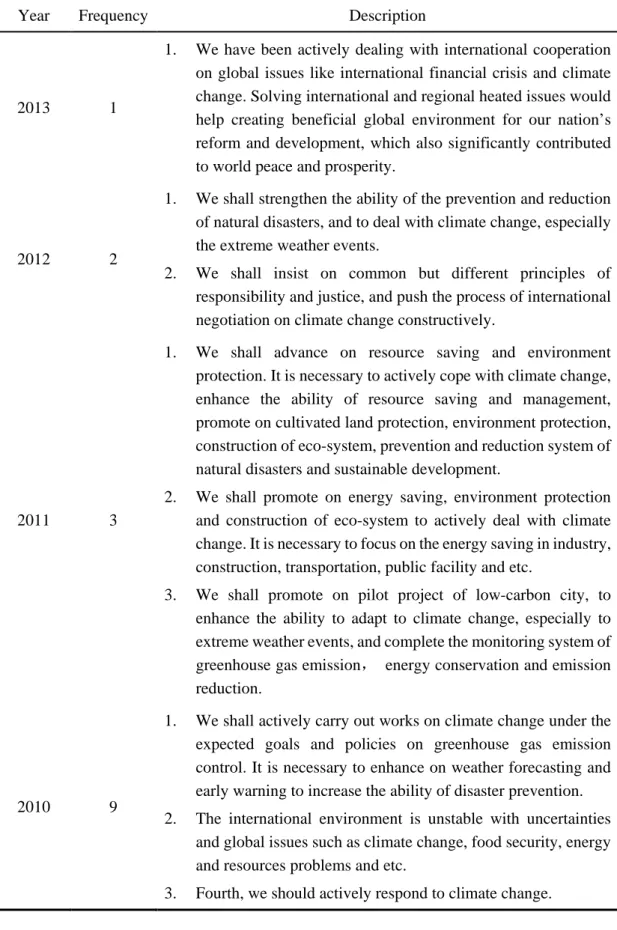
Table 4-1 The descriptions of “climate change” in the government’s work reports ... 64
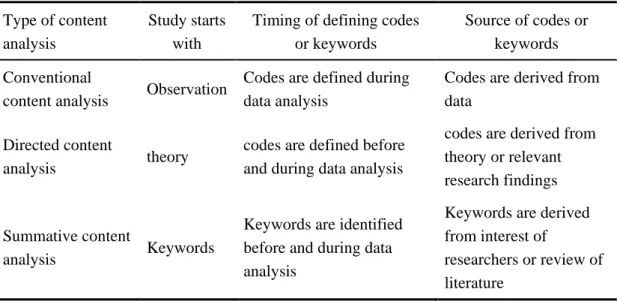
Table 4-2 Major Coding Differences Among Three Approaches to Content Analysis... 69
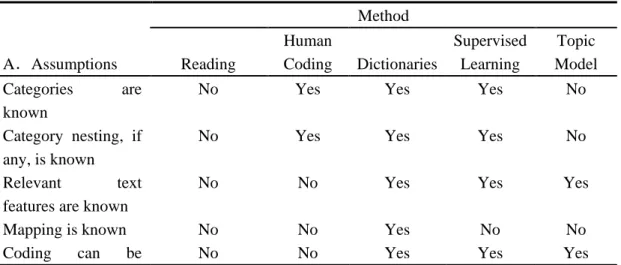
Table 4-3 A Summary of Common Assumptions and Relative Costs Across Different Methods of Discrete Text Categorization ... 70
Table 5-1 1947-1977 Cross Correlations between attention on climate change and other dimensions (By year and quarter) ... 93
Table 5-2 1977-1992 Cross Correlations between attention on climate change and other dimensions (By year and quarter) ... 103
Table 5-3 1977-1992 Cross Correlations between attention on climate change and other dimensions (By year and quarter) ... 111
Table 5-4 Evolution of issue attention on climate change in China ... 115
Table 6-1 Important International Agendas ... 132
Table 6-2 Stationarity test results of monthly issue attention ... 137
Table 6-3 ARIMA regression results for monthly issue attention dynamics model ... 138
Table 6-4 Stationarity test results and methods of data transforming for explanatory variables ... 139
Table 6-5 ARIMAX regression results of MONTHLY issue attention dynamics models ... 142
Table 6-6 Stationarity test results of monthly issue attention ... 145
Table 6-7 ARIMA regression results for quarterly issue attention dynamics model ... 146
Table 6-8 Stationarity test results and methods of data transforming for explanatory variables ... 147
Table 6-9 ARIMAX regression results of QUARTERLY issue attention dynamics models ... 150
Introduction
1.1 Theory Background
1.1.1 Focus on the Beginning Stages of Policy Process
Where do policies come from? This query must become the “original sin” of many confusing issues in public policy. On the one hand, we seemingly know where those policies originate from since numerous glorious names and their achievements in the history of public policy research have already unravel such mystery. Harold D. Lasswell’s Theory of Policy Cycle, John Kingdon’s Streams Theory, and Thomas Dye’s Top-down Policymaking Theory, could all lead us to the “roadmap” towards the origin of policy. On the other hand, sometimes we feel confused about these theories because new policy issues keep arising, which will incur criticism to these exquisite and imaginative theories and push them down from the altar. Then we return to the endless circle of optimizing or rebuilding theories. Hence, the query of “Where do policies come from” is both often asked and answered, and the answers are frequently updated. Public policy is not the product of rational designing, and, of course, we are not able to be perfectly rational during policy making either. Herbert A. Simon’s notion of bounded rationality provides the context for many policy scholar’s conception of the policy process: first, individuals lack the ability to pay attention to every dimension of a problem at once; second, decision-makers lack perfect information about their choices; third, individuals face uncertainty about how their decisions will play out in the future; finally, and perhaps as a function of the other limitations, individuals may not have access to complete knowledge of their own preferences (Pump, 2011; Simon, 1990). Charles Lindblom claimed that decision makers tend to prefer conservative policies, so public policy would be just like a way of
Muddling through (Lindblom, 1959). However, incrementalism remains far from the
destination of our discussion, because in reality public polices sometimes muddle through but sometimes suddenly change. The rigorous logic of rationalism and incrementalism seems fragile and vulnerable in front of these practical problems. Faced with such confusion, Frank Baumgartner and Bryan D. Jones brought up the punctuated-equilibrium model, originated from biological evolution research, which together with Kingdon’s streams theory become the most well-known contributions to public policy research. Is
this still not sufficient to answer the “where do policies come from” query? Actually reality remains more rich and dramatic than theories. This query seems to open the Pandora’s box and result in lots of confusion; existing and newly arising unknown things always challenge the connection between theory and reality. It’s fortunate that previous research results provide the hope in Pandora’s box. With some limitations, though, those creative theories could still help provide new starting point in answering the question of where policies originate from, which will save us from seeking after the answer from the very beginning every time.
In The Future of Political Science, Lasswell introduced his model of Policy Circle Theory, which he divided into seven main phases, including the intelligence phase, the promoting or recommending phase, the prescribing phase, the invoking phase, the application phase, the appraisal phase and the terminating phase(Lasswell, 1963). Policy Circle Theory has been always involved but inevitably criticized in the research of policy process. Due to the huge significance of this model in modeling the complex policy-making process, this theory could never be ignored while studying policy process. However, for it over simplified and linearized policy process, the complexity and chaos of policy making can hardly be explained by it. Yet no matter how many criticisms it receives, there is no doubt that public policy is a kind of process or procedure over time. No matter whether there exists crisscross, repetition, or circulation, researchers could generally divide the policy process into policy-making phase and policy-implementation phase. The former phase could be further subdivided into issue framing, agenda setting and alternatives selecting. In terms of policy research, a better idea is to get to the root and origin to find out the causes of policy confusion, because the hidden risks of poor implementation may be planted at the phase of issue establishment, and the poor performance may result from deviation in agenda-setting . However, the biggest embarrassment in policy research lies in the fact that the nearer the researchers reach the beginning phase of policy process, the harder for them to access the information. It’s like a “black box” for the outsiders. So sometimes they have to speculate how policy is made merely relying on the fragmented and incoherent information, which challenges the theorization of the beginning phase in policy process (Sabatier, 1991). Doubtlessly, each policy researcher has the insuppressible impulse to uncover the black box in policy-making process. Though it is destined to be a tough journey, it’s of great significance and value for policy research (Kingdon, 1995).
1.1.2 Focus on the “Scarcity” in Decision Making Process
Kingdon is a renowned political scientist, known for his book Agendas, Alternatives
and Public Policies. At the beginning chapter of his book, he described a puzzle put by a
one well-informed individual high in the federal executive branch:
It’s a fascinating question that you’re dealing with. Why do decision makers pay attention to one thing rather than another? I’ve seen situations in which the Secretary has been dealing with absolute junk when he should be working on some really significant issue. I’ve always wondered why.
Policymakers will encounter various problems every day; some are step-by-step routine problems, while some sudden accidents also happen. When doing research we are often curious about, among all the numerous files stacked on the desks of policymakers, which document will first gain the attention of policymakers and then occupy its own position in their busy agenda, while which document fails to attract the interests and then would be neglected. Although decision-makers can hire more assistants and rely on think tanks in order to improve their abilities to solve problems, they could never totally get rid of “scarcity” -- the scarcity of effective information concerning decision-making and the scarcity of attention.
During the process of decision making, it’s common that effective information is scarce. The unknown we often mention in policy process includes not only the known unknown, but also the unknown unknown (Knight Frank, 1921), and even the unknownable unknown (Chua Chow&Sarin, 2002). As for decision making, it’s not that easy to collect reliable, accurate and complete information. Then policymakers must constantly cognize and judge the information, and choose to accept it or ignore it. Despite that decision makers in the top of bureaucratic pyramid are surrounded by abundant information, the overload of information increase the costs of identifying and processing it. Hence, it seems that the shortage and the redundancy of information exist at the same time (戴维&毕瑟姆, 2005). Invariably, decision makers have to allocate his attention which is also scarce to the difference pieces of information. Attention refers to “processes or conditions within the organism that determine how effective a particular stimulus will be”(Berlyne, 1974), so it has always been synonymous with selectivity (Jones, 1994). One limitation to decision making is such an attention “bottleneck”, which is rooted in
the surprisingly small information capacity of human beings. So humans have to process information serially (Simon, 1985). The attention of an organization is also formed by humans’ attention. Though the factors influencing attention of an organization are more complicated, the scarcity of attention remains universal.
Under the circumstance of information and attention scarcity, policy making becomes a process of allocating attention and screening information. Thus, compared with the policy itself, it’s more critical whether the policy makers would pay attention to the issue.
1.1.3 Proposing Theoretical Questions
The beginning of policy process remains full of mystery due to the lack of information, but there is no doubt that this seemingly blurred process starts the whole story. During this process, the interactions between screening information and allocating attention form the basic mechanism of agenda dynamics. Therefore, we wonder what kind of visible or invisible “hands” control the basic rules of such dynamics mechanism; how the distribution of attention get affected by information; how attention exert influence in turn on information flows; and how the factors and interactions above finally affect the product of policy. To examine these questions would be much valuable and beneficial to improve the understandings of policy process.
Table 1-1 Types of political research and policy research
Applied Recreational
Non-empirical Normative philosophy Formal theory
Empirical Engineering research Theory-oriented research
Philips W. Shively divided research into four types which are normative philosophy, formal theory, engineering research and theory-oriented research, based on different combinations of two dimensions: the uses for which research is designed (applied versus basic research), and extent to which it seeks to provide new factual information (empirical versus non-empirical), as shown in Table 1-1 (Shively, 2010). This thesis does not intend to reconstruct or improve the policy process theories through theoretical deduction and thought experiments, since there are already abundant existing researches on theorizing policy process. Thus, further study should focus more on dragging closer the logical
distance between theories and reality. Therefore, this thesis will follow the research paradigm of empirical analysis, even though this thesis start with bringing up some theoretical questions. Nevertheless, this thesis also differs from policy-oriented research which is designed for fixing specific policy problems and dilemmas in real life. Overall, this thesis is devoted to answering the theoretical questions proposed above about how issue attention is influenced by other factors through combining the existing theories of policy process and the real case of climate change issue in China.
1.2 Policy Background
1.2.1 Climate Change: An Unconventional Policy Issue
Actually it is difficult to find a research case that exactly fits the four types of research shown in table 1-1. Generally it’s more like a mixture of those types (Shively, 2010). To answer the theoretical questions needs a medium, which plays the role of linking policy theories and the reality. This thesis mainly focuses on the policy issue of “climate change”, which differs significantly from other policy issues concerned by policy researchers in the past. Anthropogenic climate change is a global risk which is believed to pose serious threats to human development and even livelihood with high confidence (Stocker et al., 2013). Climate change is a complex issue because it’s not only fraught with scientific uncertainties but also plagued with social complexities. An unstructured policy problem or a diabolical policy problem epitomize the degree of complexity and difficulty in understanding and tackling climate change (Garnaut, 2008; Klinke&Renn, 2002). The reason to study climate change issue is that climate change characterized by complexity and uncertainty may trigger an unconventional behavior of policy system, which provides us a fabulous opportunity to reconsider “where does policy come from”. In addition, as a global issue, climate change would be a very good example to examine the emerging pattern of policy process under the circumstance of globalization.
Climate change was first noticed in humans’ history by Jean-Baptiste Joseph Fourier①
, who was known for his research on heat conduction and the earth’s surface temperature. His research paper, publish in 1824, stated the critical importance of atmospheric layer to earth climate. Around 30% energy from the sun is reflected back to
① Jean-Baptiste Joseph Fourier (1768.3.21~1830.5.16) was a French mathematician and physicist born in Auxerre and best known for initiating the investigation of Fourier series and their applications to problems of heat transfer and vibrations.
space by clouds, ice and deserts, while the left 70% heat as long wave radiation is captured by atmospheric layer to warm the earth①
. John Tyndall, an Irish scientist working at Royal Society in London, continued to study climate issues and found that the water vapor is playing the biggest role in the endothermic process, “water vapor acts like blankets for British plants, the importance of which goes beyond what clothes mean to human”(Christian Arthur et al, 2010) Now human has realized that many gases contribute to “greenhouse effect”, including CO2 ,CH4, N2O, HFCS ,PFCS, and SF6, as listed in Kyoto Protocol②
.
Similar to many other serious environmental problems, it takes long time before public policy decision makers pay attention to the issue of climate change. In the early 1960s, climate change receives almost no attention from the public or the governments. It’s not until 1970s when energy policies were heatedly debated that climate change gained slight attention (Dessler&Parson, 2010). On August 8, 1975, Wallace S. Broecher, from Columbia University, published Climatic Change: Are We on the Brink of a
Pronounced Global Warming? on Science, stating that if there was no restriction to
emission of CO2, then “the proportion of CO2 in atmosphere will cause the average temperatures to rise, higher than any other time in the previous 1000 years”(Broecker, 1975). In 1979, the declaration of first World Climate Conference attended mainly by scientists pointed out: if the CO2 continued to increase, then at the end of 20th century the temperature would rise to high level which could be measured, and in the middle of 21st century the rise would become remarkable (Torrance, 2006). Villach Conference, 1985 in Austria, was regarded as a scientific discussion with “catalyst” effect, co-held by International Council of Science Union (ICSU), World Meteorological Organization (WMO), and United Nations Environment Programme. This conference discussed and assessed the global environment problems of climate warming and ozone depletion (Mitchell et al., 2006). The conference confirmed that it is an urgent task to assess future climate changes, “if in atmosphere the concentration of greenhouse gases, CO2 included, continues to increase at the current speed, the CO2 in 2030s will double the amount of that in pre-industrial days; the double concentration of CO2 in the atmosphere will raise the global average temperature by 1.5 to 4.5 Celsius degrees and the sea level by 0.2 to 1.4 meters” (Torrance, 2006). Toronto Conference, 1988 in Canada, pointed out that the
① Some also asserted that 40% of solar energy is reflected back to the universe, while 60% remains in atmosphere. ② See Appendix A of Kyoto Protocol http://unfccc.int/resource/docs/convkp/kpchinese.pdf
rapid changes that Earth’s climate was undergoing would severely threaten world economic development and human health. And it called upon world’s attention to climate issues and to take collective action to protect the atmospheric environment. In the summer of 1988, North America suffered attack of extreme heat wave, causing the most severe drought since 1930s. Then the media started to pay great attention to climate issues, with extensive reports on the relation between climate changes and extreme weather. The focusing effect produced by media was usually called the “weather hooks” (Schneider, 1989). By the late 1980s, with the increase of scientific evidence, scientific cognition about global warming became more “mature”, and there were more reliable research conclusions about the close relation between global warming and greenhouse gas emission (Mitchell et al., 2006). The problems of climate changes began to move beyond scientific discussion, and entered some special international agencies such as the United Nations (UN) and United Nations General Assembly. Many countries also started to pay attention to climate change, and the attention from international media grew rapidly as well in 1987 and 1988 and reached its peak in 1990 (Clark, 2001).
Climate changes have brought a huge challenge to policy making, due to the tremendous uncertainty, the long-lasting period, the global scale, and the diverse goals. Granger Morgan pointed out that conventional analytical tools would fail for the assumptions upon which conventional tool are based begin to break down when dealing with global climate change (as shown in Figure 1-1) (Morgan et al., 1999)①
. Meanwhile, climate change issue characterized by uncertainty, complexity and ambiguity, becomes an unstructured problem (Klinke&Renn, 2002)②
. Thus, Ross Garnaut named climate change problem as a “Diabolical Policy Problem”, and once human society fail to tackle it, it will “haunt human beings forever” (Garnaut, 2008).
① The basic assumptions proposed by Professor Granger Morgan for conventional policy analysis are (1) there is a single public-sector decision maker who faces a single problem in the context of a single polity; (2) the impacts involved are of manageable size and ca be valued at the margin; (3) the assumption that values that are known, static and exogenously determined, and that the decision maker should select a policy by maximizing expected utility; (4) time preference is accurately described by conventional exponential discounting of future costs and benefits; (5) the assumption that uncertainty is modest and manageable; (6) for most questions of interest, the system under study can reasonably be treated as linear.
② Uncertainty refers to a lack of clarity or quality of the scientific or technical data; complexity refers to difficulties in identifying and quantifying causal links between a multitude of potential causal agents and specific observed effects; ambiguity results from divergent or contested perspectives on the justification, severity or wider meanings associated with a given threat.
Time required to implement or to reverse choice Resources required or at stake Cultural/political distance between parties
Political election cycle Individual career block
Generation Lifetime of an individual Lifetime of an organization Lifetime of a nation or culture Domain of conventional policy problems Domain of most climate-related policy problems
Figure 1-1 Challenge of climate change issue for conventional policy analysis assumptions
As climate change has increasingly become a global concern, more and more people join in the actions dealing with it. Then information from various channels intertwines and collides in the process of decision making, and mutually exerts impact on issue framing and agenda setting. Therefore, the particularity of climate change offers a window for researchers to re-examine decision-making process. And through the perspective of climate change issue, they can have a better understanding of the dynamics of policy process.
1.2.2 The Background of Climate Change in China
Climate change problem has long attracted the attention of China’s policy makers, and China is also one of the earliest countries to sign and ratify the UN Framework
Convention on Climate Changes. Due to the fast development of China’s economy, the
emission of greenhouse gas in China increases rapidly and now China has been the world’s largest greenhouse gas emitter. Meanwhile, since China’s one of the largest economy, global society expects more contributions from China in governing such a
global issue.
Figure 1-2 Greenhouse Gas Emission in China(MtCO2)
Admittedly, as a new rising international scientific problem, the process of climate change turning into a policy issue in China wasn’t accomplished overnight. This process witnessed the cognitive change of policy makers, which was affected by both internal and external factors. Generally speaking, in addressing climate change, China has experienced changes in the following aspects. First, the institutions and policy systems to tackle climate changes have changed. China’s original policy goal about “climate change” aimed at solving energy predicament in economic development and so relevant policies were mainly supported and carried forward by sectors of economy and energy, while the National Meteorological Administration shouldered the responsibility of coping with affairs pertaining to climate change. As this problem became increasingly a highly focused policy issue, China established the National Climate Change Coordination Group, and later the National Leading Committee on Climate Change, in order to strengthen coordination when coping with climate change. On June 3, 2007, the National Development and Reform Commission issued the National Climate Change Program, as guidance in addressing climate changes. The institutions of coping with climate change transformed from separate ones into a united one, and relevant policies for coping with climate change also get increased and improved step by step. Second, the policy goals of coping with climate change have changed. In the 1980s, at a stage of rapid economic development, China’s energy demand grew and the imbalance between supply and demand also escalated. Although the “bonus” for saving energy and improving energy
0 1000 2000 3000 4000 5000 6000 7000 8000 9000 10000 1902 1907 1912 1917 1922 1927 1932 1937 1942 1947 1952 1957 1962 1967 1972 1977 1982 1987 1992 1997 2002 2007 GH G e m issio ns year
efficiency would help reduce the greenhouse gas emissions per unit of GDP, these policies were not targeted directly on mitigating climate change. Thus, coping with climate change had not been prioritized in government’s policy agenda. After China signed the United
Nations Framework Convention on Climate Change and the Kyoto Protocol, the
international regime began to exert significant impact on China’s policies on climate change(于宏源, 2005). “Coping with climate change” and “reducing greenhouse gas emissions” frequently iterated in various policy documents both became important policy goals. The 21st chapter of 6th part of Twelfth Five-year Plan for National Economic and
Social Development planed to “respond proactively to global climate change” through
“controlling greenhouse gas emissions”, “enhancing the ability to adapt to climate change”, and “carrying out extensive international cooperation”. This is the first time that the policy goals of coping with climate change were presented explicitly in national plan. Third, the main actors on coping with climate change have also changed. Climate change was originally a scientific issue, and in China the National Meteorological Administration was the first institution involved. Then in 1990, the National Climate Change Coordination Group was set up within the National Meteorological Administration. Along with the international negotiations about climate change and the advancement of energy conservation and pollutants reduction (CO2 was not included at first) in China, the National Leading Committee on Climate Change led by Premier Wen Jiabao was established in 2007. The next year the National Development and Reform Commission set up the Climate Change Department. Since then, the governmental agencies involved in coping with “climate change” began to include the departments relating to economic development, foreign affairs, social construction, etc. In the Eleventh Five-year Plan, the obligatory indicator system for local governments was set up to facilitate conserving energy and reducing pollutants. In 2011, carbon trading launched a pilot project, marking that the market mechanism had been introduced into the policy portfolio to mitigate climate change, which would more effectively stimulate industrial enterprises to curtail greenhouse gas emissions. Moreover, China also embarked on advocating citizens to save energy and lead a low-carbon life. China began to realize that coping with climate change was the common responsibility for all the citizens, and attempt to mobilize the whole society to participate in this campaign.
Judging preliminarily from the brief history of China’s climate policy, China’s policy agenda on climate change has gone through the process from low level to high level, from
science to politics, and from fragmentation to integration, which could be reflected, understood and explained by the issue attention, the essence of agenda setting.
1.2.3 The Value of the Research for Climate Policy
Climate change has become one of the most important issues in global policy agenda. As the largest emitter of greenhouse gases, and as a country most exposed to natural and social economic risks caused by climate change, China should realize the severity and significance of climate change. Addressing climate change will take a long time, since the time for response of natural system would exceed normal policy circle a lot, which means the cost of addressing climate change would not be rewarded soon. According to the report of Intergovernmental Panel on Climate Change (IPCC), CO2 would stay in atmosphere for a very long time, even up to 100 years. Thus ineffective actions could further accumulate more greenhouse gases in atmosphere, leaving a series of negative impacts for the future (Stocker et al., 2013). Besides, the increase of temperature and the influence of global warming would not just stop or disappear the moment greenhouse gases stop increasing. The inertial effect will still increase the global temperature in the next decades, thus there exists a huge time lag between the costs of mitigating climate change and potential profits (Steffen, 2011). This will definitely undermine the incentives of taking action at present. Dealing with climate change, therefore, needs the decision-making system to keep a constant focus on it. Only with high level and stable policy agendas for addressing climate change, would it have sufficient efforts to invest to cope with such an unprecedented global risk.
However, such requirement remains a huge challenge for policy makers and policy system. A series of studies concerning issue cycle and issue attention, as represented by Downs here, show that the attention for a policy issue could not last for a long time; and any issue which even has been concerned a lot by decision makers, mass media or public, it would inevitably go into recession phase (Downs, 1972). What's more, the issue of climate change will suffer from the crowd-out effect caused by other issues, so it has to compete with other issues for scarce attention and crowded agenda (Djerf-Pierre, 2012a). A worthy question is, therefore, what factors would drive or lower the issue attention of climate change and how do the dynamic mechanisms work behind the fluctuation of attention to climate change? Addressing climate change hinges on the better understandings of the answers for the questions above, because gaining issue attention is
the prerequisite for decision making, especially for China. China will still face the challenge of balancing developing economy and coping with climate change, while as a large power and the largest GHG emitter, China is also requested to play a more proactive role in addressing climate change. Thus, to understand the history of climate change politics in China, and to demystify the dynamic mechanisms of issue attention on climate change under the institutional background of China, are of great value to both China and the global governance.
1.3 Research Framework
1.3.1 Main Research Idea
This research will focus on the evolution and dynamics of issue attention on climate change in China, based on the relative theories about issue framing and agenda setting from political science and policy science. This study will move beyond the qualitative methodology which is prevailing in policy process research. Instead, it will attempt to quantify the policy process so as to corroborate and extend existing theories. In the first part, this thesis intends to clarify different dimensions of climate change attention in complicated policy discourse, and further present the panorama of attention evolution of climate change in China in the last few decades. In terms of dynamics study of issue attention, this research will explain with empirical evidence the dynamic mechanism of China’s issue attention to climate change.
1.3.2 Research Method
This thesis will mainly adopt the quantitative method. However, some qualitative data such policy files, government documents, meeting records and news report will also be used in order to better understand the major climate change policies. In addition, so as to have a deeper understanding of policy process, a few interviews to some decision makers, experts, and NGO officials in the field of climate change have been made.
This thesis will try to apply quantitative research method to examine climate policy issue in China. At this age of “big data”, there are plenty and various kinds of data which could be used in policy process study. It is no longer a mission impossible to carry out relatively complex longitudinal dynamics research (Neuman et al., 2014). Nevertheless, in the research of policy process, it’s a huge challenge to transform qualitative data into
quantitative data. Thus, this paper will employ content analysis, a method widely accepted by modern social science research, together with a series of techniques including Natural Language Processing to transform the data. Then statistical analysis method will be used to test the hypotheses.
1.3.3 Thesis Structure
Chapter one is introduction, briefly introducing research questions and methods. chapter two is literature review, comparing and analyzing the previous theories about policy issue framing and policy agenda setting. Chapter three will illustrate the evolution process of climate change issue and agenda setting in China. Chapter four will explain the methodology, mainly presenting how the issue attention to climate change is measured. Chapter five will analyze the evolution of attention to climate change in China. Chapter six will examine the dynamics of issue attention on climate change, including the framework, the dynamics models, the measurement of all indicators, and the final analysis results. Chapter seven will summarize the research and provide the conclusions and discussions.
Literature Review
Policy agenda setting is a persistent research topic of public policy and political science. It has drawn long-term attention from both domestic and overseas scholars of policy study. A reservoir of theoretical studies has been established, which in turn greatly pushed forward public policy research. In general, to study policy agenda, the academic community has taken there perspectives over the past years, namely the perspective of process, system and behavior. All the three perspectives are based on in-depth observations of political and policy process. Theories in multiple areas, such as behavior science, politics, management, system theory, organization and communication have been incorporated into studies on agenda setting, which generates various explanatory models. This chapter will examine the theoretical foundations, logics, explanatory power and limitations of these models or frameworks from the three aforementioned perspectives. Apart from them, the constructionist perspective as an emerging paradigm in policy study is also analyzed. Finally, this paper will review the research perspectives for climate change policy process of China in the past.
2.1 Process Perspective
2.1.1 Theoretical Bases
Process Perspective, by definition, takes the process of policy making as the research objective. Policy process is seen, from this perspective, as an activity in which all relevant elements or factors interact and function to produce public policy.
The theoretical foundations for the process perspective have a long history. It came into being since the birth of modern policy science theories, and has become a starting pointing and cornerstone for the development of policy science. The modern policy science theories were considered to be established since the publication of The Policy
Science: Recent Development in Scope and Method, written by Harold Lasswell and
Daniel Lerner, two American scholars. In this book, Lasswell described policy science as the culmination of efforts to define a discipline for producing and applying “societally relevant knowledge” (Lasswell&Lerner, 1951). Ever since modern policy science originated, rationality began to take root in the studies on policy process. Lasswell, as one
of the founding fathers for modern policy science, put forward a “7-Stage” model in his later works, which clearly framed the policy making as a kind of “process” in policy science studies (Lasswell, 1963). His contribution was regarded as a landmark for policy process studies. It enables researchers to divide a rather complicated policy process into the sequence of units, which is in line with the cognitive habits of humans. The “5-Stage” model for policy created by Anderson later was also influenced by him (Anderson, 1975). Ideally, policy process should be a rational activity according to such process theories. However, when dealing with the issues being open to various factors, decision-makers usually lack the ability and time to achieve complete rationality (Simon, 1957). As a result, scholars of incrementalism came up with a less demanding policy model, in which policy is in fact a matter of “muddling through” (Lindblom, 1959). There is rarely the time, resource or inclination to conduct comprehensive research, and decision makers are entirely pragmatic, aiming to ensure that government can function, cope with pressure group demands and deal with crises as they arise. Although rationalism and incrementalism are in dispute, the two schools agree that functions such as knowledge, information and participants do matter for pushing the process of decision making forward. This then could be regarded as the basic ideas for process perspective.
2.1.2 Explanatory Frameworks and Models
2.1.2.1 Agenda Building and Issue Cycle
From the Process Perspective, the study on policy issues and policy agendas concentrates on the transitions of different stages, during which policy actors accompanied by other relevant factors shape the dynamics of agenda.
In policy issue studies, much attention has been paid to how a social problem becomes a policy issue. Cobb and Elder proposed four approaches: first, it could be initiated by one or more groups, some of them feeling that they have been treated unfairly; second, issues could also be initiated by an individual or group for the purpose of protecting their own interests; third, issues could also be triggered by accidents; fourth, some people initiated issues because they intended to seek mental comfort or commonweal (Cobb&Elder, 1972). Issue formation also needs the triggering mechanisms, which could be either from internal or external. If the event takes place within national border, it is called an internal triggering mechanism; otherwise it is the external triggering mechanism (Cobb&Elder, 1972). In their theory, the role of triggering mechanism,
especially the time when it occur, is critical for issue framing and agenda building. According to Downs, no policy issue, even if it is very important, could have long-lasting attention in a public agenda. In his classic essay Up and Down with Ecology, Downs brought up the concept of issue-attention cycle to describe the rise and fall of public attention to domestic political issues (Downs, 1972). Issue-attention cycle is comprised of five stages, which are the pre-problem stage, alarmed discovery and euphoric enthusiasm, realizing the cost of significant progress, gradual decline of intense public interest and the post-problem stage (Downs, 1972). Downs believes that social problems which would go through the issue-attention cycle generally possess some characteristics: the majority of persons in society are not suffering from the problem nearly as much as some minority; the sufferings caused by the problem are generated by social arrangements that provide significant benefits to a majority or a powerful minority of the population; the problem has no intrinsically exciting qualities; and the problem must be dramatic and exciting to maintain public interest. Downs’ description deals almost exclusively with trends in public opinion, although he includes the suggestion that policy makers are affected by the public (Soroka, 1999). Factors like technological change or the perception of a crisis are important dynamics in the increased public prominence of an issue, while the realization of cost for policy solutions are dynamics explaining the decline of public interest. However, prior to the decline new institutions, programs and policies may be created and then persist even after public attention faded, which implies that policy agenda may not be in line with issue-attention cycle (Baumgartner&Jones, 2010; Peters&Hogwood, 1985; Stone et al., 2001).
Figure 2-1 The cyclical issue-attention cycle model①
Downs’s issue-attention cycle theory leaves more space for future discussions. A more important kind of issues are those which can directly influence the majority, can be easily comprehended and resolved, and can trigger long-lasting public attention on media. Whether they follow the rules implied in issue-attention cycle theory still needs to be further investigated (Howlett, 1997; Howlett, 1998). However, since most environmental issues conform to the characteristics Downs had proposed, it is generally accepted that environmental issues would follow issue-attention cycle. Despite its imperfection, this theory is still widely adopted and referred to in policy issue and agenda studies (As is shown in Figure 2-1). Its influence is not restricted to political science and policy science, but also extends to journalism and communication. As more and more digital information about media and public opinion can be accessible , more scholars have been attracted to do empirical studies on issue-attention cycle (Djerf-Pierre, 2013; Holt&Barkemeyer, 2012; Howlett, 1997; Howlett, 1998).
2.1.2.2 Bounded Rationality and Garbage Can Model
The Policy Stage Theory Model of Lasswell is an idealized rational policy-making model. In reality, however, the information for decision making and the attention of
① Based on the issue attention cycle in (Holt&Barkemeyer, 2012). This model has made some improving modifications on Downs’s issue attention cycle model.
1. Baseline interest level 2. Event triggered rise 3. Cost recognition and high interest 4. Interest diversion and decline 5. Residual interest level
policymakers are scarce and limited, so policy-making process cannot be of perfect rationality, but only bounded rationality (Simon, 1965). The policy stages theory is often criticized for its failure in explaining the ubiquitous disorder and anarchy in policy process. Apart from rational Policy Process Model, the aforementioned Lindblom’s Incremental Adjustment Theory and Amitai Etzioni’s Mixed Scanning Model were brought forward to respond and adjust the rational policy-making models (Etzioni, 1967; Lindblom, 1959). However, the incrementalism seems to overcorrect the rationalism, for it has not clarified how a policy comes up exactly.
In 1972, Michael Cohen, James March and John Olsen proposed a new theoretical model: the garbage can model of organizational choice, which was a great leap and milestone for policy research. Since then, the debate over rationality and irrationality has been deemphasized in the discussion of policy process theories. To start with, they proposed a concept “organized anarchies”, which is characterized by the problematic preference, unclear technology and fluid participation (Cohen et al., 1972). Problematic preference, as was stated by Simon, means that people don’t have the clear knowledge of their preferences, and more often than not, people within a group also don’t have a unified preference (Simon, 1990). Unclear technology denotes that the organization usually follow the trial-and-error approach or experience. Fluid participation is the result of a fluid and blurred boundary of organization, many participants keep flowing in and out all the time (Cohen et al., 1972). Therefore, there are four streams that run through the decision-making process: problems, solutions, participants and choice opportunities, which have their own lives, largely unrelated to each other. The outcomes, then are a function of the mix of garbage (problems, solutions, participants, and participants’ resources) in the can and how it is processed. It’s worth noting that this process mentioned above does not look like comprehensive, rational decision making. Solutions and problems have equal status as separate streams in the system; moreover, people do not necessarily go through a prescribed logical routine.
The garbage can model of organizational choice greatly integrated past policy process theories and improved them at the same time. We should notice that this model is more like an agenda-setting model than a decision-making model, because it actually explains where and how a decision come up in a organization. It paved the way for developing issue framing and agenda setting theories for the coming studies (Kingdon, 1995).
2.1.2.3 The Three Streams Theory and Agenda Setting
John Kingdon’s Three Streams Theory took a monumental place in the history of agenda setting. One can say without exaggeration that almost all the studies on policy issue and agenda would inevitably invoke his theory. This theory stems from the garbage can model, which actually inspired Kingdon to revise and improve it. His modification greatly simplified the theory model without losing its strong explanatory power, to which the popularity of the model can be ascribed (Kingdon, 1995).
Kingdon used the U.S.’s federal government as an example to point out that there existed three independent streams in policy-making: (1) problem recognition, (2) the formation and refining of policy proposals, and (3) politics. Each stream has its own features and trajectories. The agenda would have a chance to change the moment these three streams converge at an appropriate point (Kingdon, 1995).
Problem stream is the series of problems that decision-makers or policy systems are concerned with. Decision-makers need to allocate their attention to these problems. Those problems can exist for a long time, but can also be the indices that decision-makers monitor on a daily basis, such as unemployment rate, CPI, disease mortality, greenhouse gas emission, annual average temperature, etc. (Carter&Jacobs, 2014; Xinsheng Liu et al., 2011). Index is the characteristic value of a specific aspects that decision-makers care about. A change of the index can lead to the change of their evaluation on the operation of a certain system. Their attention may consequently be aroused and the policy agenda may be triggered (Kingdon, 1995; Schäfer et al., 2014; Xinsheng Liu et al., 2011). Although index is the parameter of a system that decision makers pay attention to, it is not a direct presentation and identification of facts. There exist gaps between facts and indices, as well as gaps between indices and problems. The two gaps is the chance or opportunity for policy actors to frame a issue by simplifying it with indices. As a result, indices of absolute objectivity and accuracy do not exist, which is particularly significant when it comes to environmental and climate issues that feature uncertainty and complexity in multiple aspects (Dryzek, 1997; Hajer, 2002).
Problem stream can also be sensational focusing events, crisis and symbols. Focus events can gather attention and trigger concerns for issues within a short period of time. They can even attract influential participants to accelerate the policy change (Schattschneider, 1975). As is pointed out by Kingdon, focusing events can strengthen people’s pre-existing perception towards a certain issue, as well as alert people and arouse
universal attention to certain risks. If those events coincide with or follow similar events, they can also serve to define policy issues (Kingdon, 1995). Birkland pointed out that news events possess “bowling effect” that can guild people to discover problems in current policies. Birkland thus redefined focus events as “an event that is sudden; relatively uncommon; can be reasonably definded as harmful or revealing the possibility of potentially greater future harms; has harms that are concentrated in a particular geographical area or community of interest; and that is know to policy makers and the public simultaneously” (Birkland, 1997; Birkland, 1998). Baumgartner and Jones also noticed in the punctured equilibrium theory that focusing events trigger negative attention, give birth to political debates and eventually impel policies to change (Baumgartner&Jones, 2010). Given the special role focusing events play in agenda-setting, it even have given rise to disaster politics, a new branch that specialized in studying the relationship between disaster occurrence and policy change (Albright, 2011; Birkland, 1997; Birkland, 1998; Birkland, 2006; Kapucu&Liou, 2014).
Another dimension of the problem stream is feedback. In Kingdon’s Three Streams Theory, feedback refers to the feedback information about operation of existing programs. It can be the feedback officials receive through informal channels, or problems that occur to them in their daily work (Kingdon, 1995). Kingdon defined feedback information as the discrepancy between a narrow sense of expectation and the reality. Such a discrepancy will make decision-makers re-examine and rethink problems to which policies are directed. However, in reality, feedback information in decision-making not only takes the form of evaluation, but can also be information expanding decision-makers knowledge about the problem itself. For example, the knowledge output from scientific community proves itself valuable in the face of extreme uncertain issues (Walker, 1977; Xinsheng Liu et al., 2011).
Policy stream refers to the different sorts of thoughts and solutions brought up by a policy community comprised of professionals. Those thoughts and solutions float around the policy-making process. They will confront and influence each other before some of them are improved. Some thoughts and plans that meet certain standards—such as technical feasibility and value acceptability—can finally survive, wait for opportunities to fit in the policy agenda, and eventually become policy output (Kingdon, 1995). Kingdon adopted Aaron Wildavsky’s concept of policy community to describe the formation, division and impact of policy stream (Wildavsky, 1974). It can be viewed as
both a recognition of the impact that system variables in policy process have on policy output from a meso-to-macro perspective, as well as an affirmation of the impact that participants’ behavior—that of policy entrepreneurs, for example—has on policy output from a meso-to-micro perspective. The former is theoretically coherent with the system perspective, and the latter is possible to engage with bureaucrat and elite studies from the behavior perspective. As a matter of fact, policy stream attracts various explanations by many policy process theories. Some theoretical perspectives actually provided deeper insights than Kingdon, such as Paul A. Sabatier’s advocacy coalition framework. This framework explains how a stable policy coalition leads to stable policy status, from a meso-perspective. Sabatier argues that the reason this coalition remains stable is that policy participants’ multiple layers of belief remain stable in a long period (萨巴蒂尔 et al., 2011). As a result, thoughts that are related to policy-making is not floating in a normal sense. It is anchored in the specific beliefs that specific participants hold, which makes the change more difficult than as is described by Kingdon (Henry, 2011; 萨巴蒂尔 et al., 2011).
The political stream is independent from problem stream. Kingdon believes that political stream mainly includes national mood, organized political forces and events within government itself such as administrations change, turnover of key personnel (Kingdon, 1995). In his three streams theory, political stream does not directly affect decision-maker’s attention or policy’s content. Compared to other two streams, political stream is an environmental variable. In most cases, it is generated outside the policy process. Political stream is important for it provides a momentum for the initiation of a policy agenda. This momentum increases the possibility to attract policymakers’ attention to certain issues or policy thoughts and plans. In the institutional arrangements of western democracies, responding to national mood is a vital approach to gain popular support and reconsolidate its legitimacy. This process can help to cram some issues into the policy agendas. Meanwhile, the handover of power also indicates change of power-holders’ preferences, which in turn changes the political stream. When a issue is against the political stream, bringing it into policy agenda will have to encounter more resistance.
Kingdon believed that problem, policy and politicals streams flow in a relatively independent manner in governmental departments. Once policy windows open, they will converge and bring policy issue into the policy agenda. That is how policy is made. In this process, influence on the agenda comes more from problem stream and politics
stream. The policy window opens essentially because a new problem aroused
decision-makers’ concern and attention (Kingdon, 1995). Kingdon claimed that the
main reason that policy window opens is the change in politicals stream, including the handover of administrative power. However, Kingdon has ignored decision-makers’ learning abilities, which means that even if power structure remains the same, the flow and impact of information can raise their attention just as well. Moreover, decision-maker’s preferences are also flexible and changeable.
2.1.3 Explanatory Power and limitations
Process Perspective studies process activities. It concentrates on how to reasonably theorize policy process and abstract key elements from the process. It also explains how to administer issues, how to allocate attention and how to set policy agendas by analyzing relevant factors’ features and functions of policy process. Among aforementioned explanatory models, some place extra emphasis on the description and construction of process, such as Downs’s issue attention cycle. Such theories are influential for they reasonably divide the attention process into periods and conduct horizontal segmentation over time. Models like these can cover the coherence between different stages and their propelling factors. Some of the models presented above don’t intentionally focus on dividing the process into stages, but rather segmenting the process vertically, and further explaining the interactions of different factors in policy process, which illustrates the allocation of policy attention and the setting of policy agenda. The garbage can model of organizational choice and the three streams model of agenda setting are the most representative ones. The process perspective which is fundamentally based on the theorization and abstraction of complex policy process plays an important role in studies on policy issues and agenda setting. It is both descriptive and explanatory. For long, the process perspective represented by the three streams model have been widely popular in issues and agenda studies. The exact reason is that it can be easily understood and extended, and also it possesses strong explanatory power.
However, process perspective also has some limitations in issue and agenda studies. To start with, it inevitably linearize and flatten policy processes. Although the benefits of theory simplification is evident, it has compromised the existing non-linear features in actual policy process. For example, Kingdon’s three streams model claims that problem stream, policy stream and political stream are independent from each other. But later
researchers have discovered that relationship between them is much more complicated. In reality, there have been cases where the political stream seek to “stick” its own preferred alternatives to popular policy agendas, as well as cases where policy stream seek assistance from or take advantage of problem stream(Boscarino, 2009). Those cases clarified that the three streams are not in parallel or independent. Their relationship is very intricate. Besides, the process perspective sometimes may find itself unable to explain the impact caused by interactions between different policy issues and policy subsystems. Furthermore, it is not powerful enough to explain how exactly policy attention is allocated (Jochim&May, 2010).
2.2 System Perspective
2.2.1 Theoretical Bases
The system perspective is a very important paradigm in political science and policy process study. It has deeply influenced issue and agenda studies. It views information as a basic dynamical element for political process and policy process, this policy-making process is in nature a process of collecting, assembling, explaining and prioritizing information (Jones&Baumgartner, 2005b). David Easton’s book, A Systems Analysis of
Political Life is a classic example of applying system theory from engineering in political
and policy studies. Easton modeled political activity as the integration of system and environment. He explained political life with input, output, feedback and system dynamics (as can be seen in Figure 2-2) (Easton, 1965). In policy process theories, some researches also drew ideas from policy stage theories and system theories to come up with multivariate model of policy process. Those models were used to illustrate how information from various sources are processed in policy making process (as can be seen in Figure 2-3) (Mazmanian&Sabatier, 1980; Sabatier, 1991).
Figure 2-2 A dynamic response model of a political system
1
2
3
4 5
Politically Relevant Incidents
Policy output Formal Policy Conversion Historic-Geographic Conditions Socio-economic Composition Mass Political Bahavior Governmental Insititutions Elite Behavior Direct Effect Development Sequence