Maintaining
a
Dynamic Set
of
Processors
in a
Distributed System
Satoshi
Fujita\dagger
MasafunliYanlashitat
Abstract
$C_{\mathit{0}\gamma\}}\epsilon ider$a distributed system consisting
of
a set $V$of
pro-cessors, $\mathit{0}71daSS$urne $t\tau_{1_{\beta}a}t$ evpry pair
of
processors can directlycommunicate with each otlt er. A simple scheme $i_{\mathrm{t}}\mathrm{s}$ proposed,
for
keepingadynam.$i.c$ set$U\subseteq V$of
processors in a$(lp\dot{S}tr\dot{?}\iota_{ute}d$ ma$7l.7l$er. $T\prime_{\mathrm{t}}e$ dynamic set$s$i’pports the following three basic operations: Insert inserts the caller
itself
in U. $ar\mathrm{t}\prime l$, Delete removes the caller $it_{\mathit{8}C}lf$from
$U$. Find searches a processor in U. To dem onstrate the efficiencyof
scllenl$e$.
$a?l$ am ortizcrlanalysis
of
the messa$ge$complpxityof
operatio$r\iota s$ is performed; each oper$(\prime ti,\mathrm{o}r\iota re(\mathit{1}^{u.ires}.9+3\log_{2}(|V|-1)nteSSa_{J^{es}}l$.
The proposed scheme can be $(\iota_{II^{ll?\rho}})d$ to $many\uparrow,mportarlt$
$p’\cdot obl_{C}ms:e.g.$
.
to the load $bal\mathrm{c}lC?,ng$ problrm by simply us-$i71/$( the set asafree
list”. to the $n1$utual exclusion problemby $co7\mathfrak{l}strnCti71g$ a circular list in $u’ l[] iCh$ a token is circulated.
a$7\mathrm{t}d$to constrttct ($motl\iota$er data $strnct,\cdot urC$ like FIFO queue.
1
Introduction
Datastructures playanimportant role in designing time efficient algorithlns. In asimilarsellse, “processor
struc-tures”canbe used todesign communicationefficient dis-tributedalgorithms. For example, many of the routing
and broadcasting problems can be solved efficiently, by letting the processors maintain a spanning tree of the
network. Also the spanning tree can be used to
effi-ciently solve other problems such as the leader election
problem (e.g., the extrema-findingproblem) [1, 3, 5, 7].
Anin-tree isused to solve the mutualexclusionproblem
[2, 10, 11], and the decentralized object finding problem [4].
Unlike a data structure used in a sequential algorithm, a processor structure is (of course) shared by the pro-cessors in a distributed system. However, it does not
mean that every processor must know the whole struc-$r_{\mathrm{D}\mathrm{e}\mathrm{p}\cdot \mathrm{t}}\mathrm{a}1\mathrm{t}111\mathrm{e}11$ of Elcctrical$\mathrm{E}\mathrm{u}\mathrm{g}\mathrm{i}_{1}1\mathrm{e}\mathrm{e}1^{\cdot}\mathrm{i}_{1}\mathrm{l}\mathrm{g}$
.
Faculty ofEngineering, Hiroshima University,$\mathrm{K}\mathrm{a}\mathrm{g}_{\dot{C}\iota 11}1\mathrm{i}\mathrm{y}\mathrm{a}\mathrm{l}\mathrm{n}\mathrm{a}1- 4- 1,$ $\mathrm{H}\mathrm{i}\mathrm{g}\mathrm{a}\mathrm{s}\mathrm{h}\mathrm{i}- \mathrm{H}\mathrm{i}_{\mathrm{f}}\mathrm{o}\mathrm{S}11\mathrm{i}_{1}\mathrm{U}\mathrm{a},$ $739$ $\mathrm{J}\mathrm{a}_{1^{)\mathrm{a}11}}$.
ture. Rather, each processor usually maintains only a
local structure, and the whole structure is kept consis-tent, nevertheless. For example, a processor recognizes only the setof local ports corresponding to the tree edges
incident on it (rather than alltree edges), for maintain-ing aspanningtree.
Thispaper discusses how tomaintainadynamic set of processors. The dynamic set supports the following three operations:
.
lnsert: This operation adds the processor that calls theoperation in the set as anew element..
Delete: This operation removes the processor that calls the operation from the set..
Find: This operation returns the identifier of a pro-cessor in the set.Themessagecomplexity ofeach of the operations is very
small. To observe it, we perform an amortized analysis which is based on the amortized analysis invented by
Ginat et $al[6]$, and show that only $9+3\log_{2}(|V|-1)$
messages are required per operation.
The main idea of the scheme is to maintain a dynalnic set $U$ ofprocessors in the form of a distributed circular
list: Each processorhasa local register to store the next pointerto “next processor”. We naturally identify the distributed system with a directed graph $G$ with the
node set being the set of processors, i.e., there is a di-rectededge from$u$to$v$iffthe next pointer of$u$points to $v$
.
Dynamic set $U$ is maintained in such a way that allprocessors in $U$ are included in a unique directed cycle
$C$in$G$, andthat $G-C$are in-trees, each ofwhosesinks
has the nextpointer to aprocessor in $C$
.
$C$ may include processors not in $U$, since deletion is
simply achieved by marking itself in most of the cases. Removal of marked processors from$C$willbe donelater,
when Find is executed. Insert and Find called by a pro-cessor not in$C$, say $u$
,
follow the directed path startingwith $u$, until it encounters a processor in cycle $C$, say $v$, and for lnsert, $u$ and $v$ update the next pointers so
as to insert $u$ as the next processor of$v$
.
The messagecomplexity of those operationstherefore mainly depends
on the length ofdirected path the caller traverses. To shorten the path, we adopt the heuristic of path
com-pression usedin the Union-Find algorithm [8].
Thedata structure proposed inthispapercan be used to solve many important problems: To solve $\mathrm{t}1_{1}\mathrm{e}$ load balancing problem, we can simply regard the dynamic
set as the (($\mathrm{f}\mathrm{r}\mathrm{e}\mathrm{e}$ list”. To solve the mutual exclusion problem, we circulate a single token along$C$ and regard
it as a token ring system. We can further use it to constructanother data structure like FIFO queue.
The paper is organized as follows. In Section 2, we
proposea basic scheme for sharing a set in a distributed manner. In Section 3, we show several applications of the scheme. Section 4 concludes the paper with future problems.
2
The Schenle
2.1 The Model
In what follows, we call a processor a node, since we
willidentify a distributed system with a directed graph with the node set being the set of processors (in the sense we explained inSection1). Consider a distributed system with anode set$V=\{0,1, \ldots, n-1\}$
.
Weassumethat every pair of nodes in $V$ can directly communicate
with each other in the blocking mode, i.e., eachmessage
transferis synchronized using the hand shaking. Alocal area network connected by a shared bus (e.g., Ethernet)
is an example of systenls satisfying the assumption on
communication.
Let $U(\subseteq V)$ be the subset ofnodes that satisfy an
arbitrary fixed property72. Suppose that each node in$V$
knows ifit is a member of$U$, andthat the membership
to $U$maydynamically change. This paper discusses how
to implement the three operatiollslnsert, DeleteandFind efficiently, with respect to such a dynamic set $U$
.
Theefficiency is nueasured by the message complexity, i.e., the number ofmessages excllanged.
2.2
Data
Structure
In the proposed scheme, each node $v\in V$ has a local
register$r_{v}$to store the next pointer that points to a node
circular$\mathrm{l}\mathrm{i}.\mathrm{q}\mathfrak{t}$. $C_{\text{ノ}^{}\gamma}$
Figure 1: Anexample of graph $G$
.
in V. (Weuse two more registers$t_{2}$,and$m_{v}$
.
We explainabout
them
later.) The node pointed by$r_{v}$ is called thenext node of$v$
.
By associatinga directed edge from$v$ to$r_{\tau}$, with each ordered pair $(v, r_{\tau},)$, we naturally obtain a directed graph $G$, in which every node has exactly one
outgoing edge. Figure 1 illustrates an example of$G$, in
which,for example,node 1 pointsto node3 (i.e.,$r_{1}=3$)
and node 3 points to node 6 (i.e., $r_{3}=6$). Graph $G$ is
dynamicin the sense that its configuration dynamically changes, since nodes autonomously update their local registers.
In our scheme, graph $G$ is always kept connected. It
thereforeconsistsofaunique directed cycle and a set of in-trees whose sinks point to a node in the cycle, since
every node in $G$ has exactly one outgoing edge.
Fur-ther, the cycle is maintained so as to include all nodes in$U$
.
Weimplelnent thedynamicset $U$in aformofdis-tributed circular list occuredin $G$ as the cycle. As you
will see, the circular list may contain nodes not in $U$,
since,inmany cases, Delete only marks thecallerto dis-tinguish it from the
nodes.in
$U$ and the actual deletionprocess from the circular list is postponed until Find is executed. Local register (flag) $m_{v}$ is used to memorize
if$v$ is marked ornot. That $v\in U$iff$m_{\iota},$ $=0$ is intended
to hold.
We create a single token to show the “anchor” node,
and let it circulate along the circular list. Local register (flag) $t_{\tau}$, is used to memorize if$v$ has the token. That $v$
is the anchor iff$t_{v}=1$ is intended to hold. The anchor
is handled in such a way that it is not marked unless
used to guarantee the deadlock-freedom by using it as
an arbiter. Next, it is used to check whether $U=\emptyset$ or
not.
2.3
Primitive
OperationsThe system is $\mathrm{i}_{11}\mathrm{i}\mathrm{t}\mathrm{i}\mathrm{a}\mathrm{l}\mathrm{i}_{\mathrm{Z}}\mathrm{e}\mathrm{d}$ as follows, assuming that ini-tially $U=V$ holds. Hence, for each $v\in V,$ $m_{\mathrm{I}},$ $=0$, initially. Local registers $r_{\eta)}$ are initialized to $r_{\tau},$ $:=v+1$
(mod $n$) for each $v\in V$, i.e., the corresponding $G$ is a
singledirectedcycle. The token is initiallygivento node
$0(\in V)$. Hence, initially, $t_{l},$ $=1$ iff$v=0$
.
In thefollow-ing, we present three procedures Find, lnsert and Delete that areimplementationsof corresponding primitive op-erations, respectively. Those procedures areassumed to
be executed as atomic ones, in the sense that once the
execution starts, the processor is dedicated to execute it, until it finishes. The only exception is the case in which Delete is initiated by the anchor; the anchor may handle a message that Delete does not expect before it
finishes, to avoid possible deadlocks. 2.3.1 Procedure FindNode
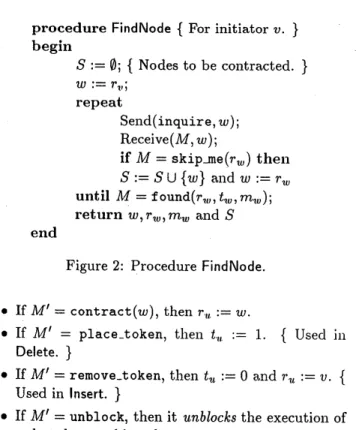
We first present a procedure FindNode that is used as a
centralsubroutine in the implementations of the three operations. When a node $v$ calls FindNode, it returns $w,$$r_{w},$$t_{u},,$$?\eta_{\{v}$ and $S$, where $w$ is either the first node in $U$ appeared in the unique directed path $P_{\tau},(G)$ from $v$ (if $U\neq\emptyset$), or the anchor node (otherwise). Here $S$ is
the set of nodes appeared in $P_{\tau}$
)$(G)$, excluding$v$ and $w$,
and is used to apply the heuristic ofpath compression later.
If a returned value $m_{1’)}=1$, i.e., if FindNode cannot
find a node in $U,$ $U=\emptyset$ and therefore$w$ is the anchor,
i.e., $t_{\tau\iota},$ $=1$. FindNode is given in Figure 2.
Each node $u$ on the path traversed, upon receiving a
message $M’$ from$v$, acts as follows:
.
If$M^{t}=\mathrm{i}\mathrm{n}\mathrm{q}\mathrm{u}\mathrm{i}\mathrm{r}\mathrm{e},$tllen-if$m_{\iota},=1$ and$t_{\tau},$ $=0$, i.e., if$u\not\in U$ and is not the anchor, then it replies $\mathrm{s}\mathrm{k}\mathrm{i}_{\mathrm{P}}\mathrm{m}- \mathrm{e}(r_{u})$ to $v$
and blocks the execution of$u$, untilit receives
message contract from$v$
.
-elseitrepliesfound$(r_{?},, t_{\tau},, m_{v})$ to$v$, and blocks
the execution of$u$ until it receives a message
from $v$
.
procedure FindNode
{For
initiator $v$.
}
begin
$S:=\emptyset$;
{Nodes
to be contracted.}
$w:=r_{v}$; repeat Send$(\mathrm{i}\mathrm{n}\mathrm{q}\mathrm{u}\mathrm{i}\mathrm{r}\mathrm{e}, w)$ ; Receive$(M, w)$; if$M=\mathrm{s}\mathrm{k}\mathrm{i}\mathrm{p}_{-}\mathrm{m}\mathrm{e}(r_{w})$ then $S:=S\cup\{w\}$ and$w:=r_{w}$ until $M=\mathrm{f}\mathrm{o}\mathrm{u}\mathrm{n}\mathrm{d}(rw’ tw’ mw)$; return $w,$$r_{w},m_{w}$ and $S$ end
Figure 2: Procedure FindNode.
.
If$M’=\mathrm{c}\mathrm{o}\mathrm{n}\mathrm{t}\mathrm{r}\mathrm{a}\mathrm{c}\mathrm{t}(w)$, then$r_{?\iota}:=w$.
.
If $M’=$ place-token, then $t_{\tau\iota}:=1$.
{Used
inDelete.
}
.
If$M’=\mathrm{r}\mathrm{e}\mathrm{m}\mathrm{o}\mathrm{v}\mathrm{e}$-token,then$t_{\tau\iota}:=0$ and$r_{\tau\iota}:=v$
.
$\{$Usedin lnsert.
}
.
If$M’=\mathrm{u}\mathrm{n}\mathrm{b}\mathrm{l}\mathrm{o}\mathrm{c}\mathrm{k}$, then it unblocksthe execution of$u$, but does nothing else.
All nodes traversed byFindNodeblock themselves un-til a further instruction (message) arrives from$v$, which
will be issuedinthe procedure that calls FindNode as a subroutine. Note that for the simplicity of description,
$v$ may send or receive a message to orfrom $v$ itself. In
this case, we assume that $v$ behaves like other $u$
(with-out actually exchanging messages), except that $v$ does
notblock itself.
2.3.2 Procedure Find
Suppose that a node$v$ wishes to find a node $u\in U$ and
calls Procedure Find. If$m_{I},$ $=0$, it returns$v$ itself, since
$m_{\tau},$ $=0$ implies $v\in U$
.
If$t_{v}=m_{\mathrm{t}}.,$ $=1$, it returns Fail,since $U=\emptyset$ in this case. When
$v$ is neither an element
in $U$ nor the anchor, Find$\cdot$
returns a $u\in U$ as long as
$U\neq\emptyset$
.
If$U=\emptyset$, Fail is returned. The node$u$found is
the first nodein $U$ appearedin the directed path$P_{v}(G)$
from $v$
.
Find is given in Figure3.
2.3.3 Procedure Delete
Suppose that a node $v$ wishes to delete itself from $U$
procedure Find
{For
initiator$v$.
}
begin
if$m_{v}=0$ then return $v$;
if$t_{\tau 1}=1$ thell return Fail;
Call FindNode;
{It
returns$w,$$r_{w},t_{w},$ $m_{w}$, and $S$.
}
$r_{v}:=w;$
{
$r_{v}$ points to the found node.}
$\mathrm{s}_{\mathrm{e}\mathrm{n}}\mathrm{d}(\mathrm{c}\mathrm{o}\mathrm{n}\mathrm{t}\mathrm{r}\mathrm{a}\mathrm{c}\mathrm{t}(w), x)$for all $x\in S$;
{Path
compressed.}
if$m_{w}=0$ then return $w$
else return Fail elld
Figure 3: Procedure Find.
$t_{v}=0$, then the deletion is simply achieved by marking
itself.
Otherwise, ifit is the anchor, Delete first finds a node
$u\in U$ by calling FindNode, transfers the token to $u$,
lnarks itself, and then the path compression is applied. As mentioned, if a message is waiting for being pro-cessed when the anchor $v$ is executing FindNode,
sus-pending FindNode, it first handles the message, which belongs to another execution instance of operation ini-tiated by a node $v’$, in order to guarantee
deadlock-freedom. The message must be an inquire. When $v$
receives the inquire, it freezes the execution of Find-Node after $\mathrm{a}\mathrm{p}\mathrm{p}\mathrm{l}\mathrm{y}\mathrm{i}_{1}$the path compression for nodes in the current $S$, and responds to the inquire first.
Find-Node resumes control when $v$ finishes the execution of
instruction given by $v’$. A more formal description of
this (
$‘ \mathrm{i}\mathrm{n}\mathrm{t}\mathrm{e}\Gamma \mathrm{r}\mathrm{u}\mathrm{p}\mathrm{t}$handler” is given in below.
.
If inquire arrives from $v’$ while waiting for are-ply fromanode $w$, then Send (contract$(w),$$x$) for
all $x\in S,$ $S:=\emptyset$, and Send$(\mathrm{n}\mathrm{o}\mathrm{b}\mathrm{l}\mathrm{o}\mathrm{c}\mathrm{k},w)$ (i.e., it
(($\mathrm{f}\mathrm{l}\mathrm{u}\mathrm{s}\mathrm{h}\mathrm{e}\mathrm{S}$”the current
$S$). Themessagearriving from $w$ is discarded. It then replies $\mathrm{f}_{0}\mathrm{u}\mathrm{n}\mathrm{d}(r_{\mathrm{t}}tm)$ to
$v’$ (since it does not complete the deletion), and
blocks itself until it receives a further instruction
(includingunblockinstruction)from$v’$ andfinishes
executing it. Finally, $v$ resumes the execution of
FindNode $\mathrm{f}\mathrm{r}\mathrm{o}\ln$ thepoint it is suspended.
.
Ifinquire arrives from$v’$immediatelyafterreceiv-ing $\mathrm{s}\mathrm{k}\mathrm{i}_{\mathrm{P}^{\lrcorner \mathrm{n}}}\mathrm{e}(r_{\mathrm{t}\iota},)$ from $w$ (before sending out an-other inquire), it first executes $S:=S\cup\{w\}$ and
$w:=r_{\tau\iota},$, and then does the sequence ofinstructions
procedureDelete
{For
initiator$v$with$m_{\mathrm{t}},$ $=0.$}
beginif$t_{v}=0$ then $m_{v}:=1$ and terminate;
Call FindNode;
{It
returns $w,$$r_{\tau v},t_{w},$$m_{w}$, and $S$.
}
$r_{v}:=w$;
if$w\neq v$ then $t_{v}:=0$ and
Send$(\mathrm{p}\mathrm{l}\mathrm{a}\mathrm{c}\mathrm{e}-\mathrm{t}\mathrm{o}\mathrm{k}\mathrm{e}\mathrm{n},w)$;
{Send
token.}
$m_{v}:=1$;
{Mark
itself.}
Send$(\mathrm{c}\mathrm{o}\mathrm{n}\mathrm{t}\mathrm{r}\mathrm{a}\mathrm{c}\mathrm{t}(w), x)$for all $x\in S$;
{Path
compressed.}
$\mathrm{s}_{\mathrm{e}\mathrm{n}}\mathrm{d}(\mathrm{u}\mathrm{n}\mathrm{b}1_{0}\mathrm{c}\mathrm{k}, w)$
end
Figure 4: Procedure Delete.
given forthe above case.
.
Finally, if inquire has already arrived when $v$en-ters FIndNode, it simply delays $\mathrm{F}_{1}\mathrm{n}\mathrm{d}\mathrm{N}\mathrm{o}\mathrm{d}\mathrm{e}$and pro-cesses the inquire first.
FindNode finds $v$ itself as $w$, when $U=\{v\}$
.
In thiscase, as theresult,$t_{2^{1}}=m_{v}=1$holds. Delete is given in
Figure 4.
2.3.4 Procedure lnsert
Suppose that a node $v$ wishes to add itself in $U$ and
callsprocedureInsert. It first looks for a node$w$ in$U$by
calling FindNode. Then it inserts$v$ in the circular list as
thenext nodeof$w$
.
If$t_{w}=m_{w}=1$, which implies that $U=\emptyset$, the anchor is transferred to$v$ from $w$. A $\mathrm{f}_{0\Gamma \mathrm{n}}1\mathrm{a}1$ description of lnsert is given in Figure 5.
2.4
Observing Correctness
First, observe that the circular list $C$ contains every
node in $U$ all the time. To this end, we observe that all
nodes not in $C$ are marked. Every node is not marked
and resides in the circular list $C$ at the time of
initia-tion. Suppose that an unmarked node $u$ exists outside
of$C$ at some time instant. Then either $u$ was removed
fronl $c$despitethat it wasnot marked, or its mark was
removed despite that it was outside of $C$
.
The lattercasenever occur since the removal of mark occurs only
in Insertandit alwaysinsertsthecaller as the next node
of thenode in$U$that $\mathrm{F}_{\mathrm{I}}\mathrm{n}\mathrm{d}\mathrm{N}\mathrm{o}\mathrm{d}\mathrm{e}$found. Let us check that the formercasedoes not occur, either. This occurs only
procedure Insert
{For
initiator$v$with$m_{v}=1.$}
begin
Call FindNode;
{It
returns$w,$$r_{w},$$t_{\not\in \mathrm{t}},,$$m_{\mathrm{t}\{},$, and $S$
.
}
$m_{11}:=0$;
{Remove
mark.}
if$t_{w}=m_{1\{},$ $=1\mathrm{t}1_{1}\mathrm{e}\mathrm{n}$
$\mathrm{s}_{\mathrm{e}\mathrm{n}}\mathrm{d}(\mathrm{r}\mathrm{e}\mathrm{m}\mathrm{o}\mathrm{V}\mathrm{e}_{-}\mathrm{t}\mathrm{o}\mathrm{k}\mathrm{e}\mathrm{n},w),$ $r_{v}:=v$ and $t_{\mathrm{t}},$ $:=1$
{Token
Received.}
else $r_{\tau 1}:=r_{w}$ and $\mathrm{S}\mathrm{e}\mathrm{n}\mathrm{d}_{\mathrm{C}\mathrm{o}}\mathrm{n}\mathrm{t}\mathrm{r}\mathrm{a}\mathrm{c}\mathrm{t}(v),$ $w)$;
{
$v$ inserted.}
Send$(\mathrm{C}\mathrm{o}\mathrm{n}\mathrm{t}\mathrm{r}\mathrm{a}\mathrm{c}\mathrm{t}(w), x)$for all $x\in S$
{Path
compressed.}
end
Figure5: Procedure Insert.
when a contractmessageis sent to anunmarkednode.
However, FindNode always returns a set $S$ of marked
nodes. Therefore,$C$ includes all nodes in $U$
.
Second, we observe that the graph $G$ is weakly
con-nected, i.e., the procedures never generate a new di-rected cycle besides $C$
.
To this end, we examine thefollowing claims:
1. At any time instant, $C$ contains the anchor.
2. Anycontract messageto a node$x$ asks forsetting
its next pointer to anodein $C$
.
The firstclaim holds,sincetheanchor is in$C$atthe
initi-ation time, andit istransferred to a node found by
Find-Node, i.e., to a descendant of the current anchor. The second claim also holds,since ineach procedure, each of
contractmessages takes $w$as its argument, where $w$is
the node found by FindNode (cases of Find and lnsert),
or anodereachable from the anchor (thecase of Delete initiated by the anchor). In both cases, $w$ is a node in $C$. Hence the anchor is reachable from every node in $G$ at any time instant, or in other words, $G$ is weakly
connected.
Finally, we observe the deadlock-freedom of the
scheme. Suppose that a deadlock occurs. Then there
are a set $D$ ofnodes who are executing $\mathrm{F}\mathfrak{l}\mathrm{n}\mathrm{d}\mathrm{N}\mathrm{o}\mathrm{d}\mathrm{e}$, and
eachofsearch paths encounters anode already blocked by another search path. Since the number ofoutdegree
ofevery node is 1, it implies that every node in $C$
be-longs to one ofthe search paths (because there is only
one cycle in $G$). However, this is a contradiction, since
anexecutioninstance of FindNode sends an inquire to
the anchor, and it terminates by finding the anchor.
The following theorem can be shown using the
ob-servations, by induction on the set of time instants, at whichan operation is performed.
Theorem 1 The implementations
of
operations Find,lnsert and Delete are correct. $\square$
2.5
Amortized Message
ComplexityIn this subsection, we evaluate the amortized message complexity of the scheme.
Let $\mathcal{E}$ be a sequence of events (i.e., operations
per-formed) with
.
$X$ Insertoperations and.
$Y$ Find or Delete operations.Let $N^{-}$ (resp. $N^{+}$) denote the total number of nodes
deletedfrom (resp. added to) $U$ during$\mathcal{E}$
.
2.5.1 Inquiries Received by Nodes in the Cir-cular List
The total number ofmessagesreceived by or sent from nodesin the circular list during$\mathcal{E}$ is at most
$3(X+Y)+3N^{-}+3(X+Y)$
since each call ofFindNode discards at nlost three
mes-sages (due to FindNode initiated by the anchor), and
since, upon receiving an inquiry, anode either replies skip-me and thenreceives contract (and it is excluded from the circular list), or replies found and then
re-ceives unblock, remove-token, or place-token. Since
$N^{-}\leq Y$, the total number ofmessageshandled by those
nodes during$\mathcal{E}$ is at most
$6X+6Y+3Y=6X+9Y$
,whichisa constant per operationin an
amortized
sense.2.5.2 Inquiries Received by Nodes Not in the
Circular List
Next,let us count the total number ofmessageshandled by nodes not in the circular list. Let $T$ be the set of
nodesexcluded from the circularlist. Notethat$T$forms
a forest. In what follows, a primitive event implies an event associated with an event in $\mathcal{E}$ which modifies the configuration of$T$; i.e., it either deletes a node from $T$
with cost zero, inserts a node to $T$ as a root of existing
trees with cost zero, or applies a path compression to
$T$ with a cost equals to the length of the compressed
path. Note that the cost of a primitive event equals to the number of inquire messages received by nodes not in the circular list during the event in$\mathcal{E}$ associated with the primitive event.
Inthe following, we prove that the cost of a primitive event is atmost $\log_{2}|V|$ in the amortizedsense. To
ob-tain the bound, we apply the potential function method invented in [6]. Let thesize $s(v)$ of a node$v$in$T$ be the
number of descendants of $v$ including $v$ itself. Let the
potential of$T$ be
$\Phi(T)=\frac{1}{2}\sum_{Tl1\in}\log 2S(v)$
.
Define the amortized cost of a path compression over
a path of $k$ edges to be $k-\Phi(T)+\Phi(T’)$, where $T$
and$T’$ are the forestsbefore and afterthe compression,
respectively. For any sequence of$m$ events,we have $\sum_{i=1}^{m}a_{i}=\sum_{i=1}^{m}(t_{i}-\Phi i-1+\Phi_{i})=i1\sum_{=}^{nl}t_{i}-\Phi 0+\Phi_{m}$,
where $a_{i},$$t_{i}$, and $\Phi_{i}$ are the amortized cost of the $i^{1l}$)
primitive event, the actual cost of the$i^{f\prime_{1}}$ primitive event, and the potential after the $i^{t\prime_{\mathrm{t}}}$
prilllitive event, respec-tively, and$\Phi_{0}$ is thepotentialofthe initial forest. Since
$\Phi_{0}=0$ (recallthat $T_{0}$ is an empty forest) and $\Phi_{m}\geq 0$,
we have
$\sum_{i=1}^{m}t_{i}\leq\sum_{i=1}^{\mathit{7}||}a_{i}$
.
Now, letus bound the anlortized cost$a_{i}$for each
prim-itive event.
An insertionof a node into $T$ increases the potential
by at most$\log_{2}(|V|-1)$, and a deletion of a node from
$T$ following a path compression, does not increase the
potential. Since none of those primitive events take ac-tual cost, the amortized cost of those primitive events is at most $\log_{2}(|V|-1)$
.
On the other hand, byusing asimilar argument to [6] we can also claim that the
amor-tized costof a pathcompression isat most$\log_{2}(|V|-1)$
.
Sincethe number of inquirymessagesper event in$\mathcal{E}$
as-sociated with a primitive eventis atmost$\log_{2}(|V|-1)$ in
the amortized sense, and since each of such inquiries is followed by twomessages (i.e., skip-me and contract),
we have thefollowing theorems.
Theorem 2 The number
of
messages handled by nodesnotin the circularlistis at most3$\log_{2}(|V|-1)$ perevent
in$\mathcal{E}$ in the amortized sense.
$\square$
Theorem 3 For any sequence
of
events with $X$ Insertoperations and $Y$ Find $or$Delete operations, the
amor-tized message complexity
of
each operationof
thepro-posedscheme is at most
$(6+3\log 2(|V|-1))x+(9+3\log_{2}(|V|-1))Y$
.
$\square$
3
Applications
3.1
Load Balancing
Suppose that at any time instant, each node in $G$ is
either lightly loaded, mediumly loaded or heavily loaded. For convenience,weassociate the load of a node withthe
number of $‘(\mathrm{t}\mathrm{a}\mathrm{s}\mathrm{k}\mathrm{S}$”
in the ready-queue of the node. A task is dynamicallycreated and removed on each node. A loadbalancingproblem is the problem ofmigrating
tasks of heavilyloaded nodes to lightly loaded nodes as quick as possible [9].
The scheme proposed in Section 2 can be applied to the load balancing problem as follows. The basic idea is to let $U$ be the set of lightly loaded nodes. When the
loadbalancingalgorithm is initiated, all nodes in $V$ are
assumed to be lightly loaded, i.e., $U=V$
.
Ifthe load ofa node$v$ notin $U$ becomes light, itinsertsitselfin $U$byperforming Insert. On the other hand, when the load
of a node $v\in U$ increases to medium, it deletes itself
$\mathrm{f}\mathrm{r}\mathrm{o}\ln U$ byperforming Delete. If a node with heavy load
wishes to migratesome $\mathrm{t}\mathrm{a}s$ks to a light one, it performs Find tofind a light node.
Theimer and Lantz’s loadbalancingalgorithm, for ex-ample, essentially requires$O(|V|)$ messagestofind outa
lightlyloadednode in the worst case,whileoursrequires
$O(\log_{2}|V|)$ messages (inthe amortized sense).
3.2
Mutual Exclusion
Weinitiatethe system suchthat$U=\emptyset$
.
Ifanode wishestoenter the critical section, itperforms Inse$r\mathrm{t}$ and waits for it becoming the anchor. Ifa node $v$ wishes to leave
the critical section, it performs Delete. Since $v$ is the
in $C$ (who is $\mathrm{w}\mathrm{a}\mathrm{i}\mathrm{t}\mathrm{i}_{1\mathrm{l}}\mathrm{g}$ for its turn), and then deletes $v$ from $C$
.
Thismutual exclusion algorithmrequires only$O(\log_{2}|V|)$ messages per entry. Furthermore, this has
the following advantage.
In many cases, the set of nodes which are interested
inenteringthecriticalsection isa rather small dynamic
subset $U$ of the whole node set $V$
.
The abovesolu-tion can be viewed as a tokenring system among $U$, in
which $U$ may dynamically change. The token is
circu-lated among the small group $U$
.
3.3
FIFO Queue
A FIFO queue can be implemented, by modifying the
proposed scheme as follows. We let the token represent
the head of the circular list. We modify FindNode so that it looks for only the head. Operation Find then returns the head. Operation Insert first finds the head
and inserts the caller as the predecessor of the head,
i.e., from the tail of the circular list Operation Delete is
exactly thesalne as in Section 2. It passes the token to
the next node, and delete the previous head (the caller)
from$C$
.
4
Concluding Remarks
In thispaper, we proposed a simpleschemefor keeping a set $U$ of nodes in a distributed manner, and for
find-ing a node in $U$ by using at most $9+3\log_{2}(|V|-1)$
nlessages peroperationin an amortizedsense. The
pro-posed scheme can be applied to many important
prob-lems, which includesa load balancing problem, the
mu-tualexclusion problem, and a constructionofdistributed
FFOO queue.
An important future problenl is to apply the scheme
to distributedsystemsin which thecommunicationcost
betweentwo nodes is ($‘ \mathrm{n}\mathrm{o}\mathrm{t}$” unique; i.e., to consider the problem offindinga“closest” nodein$U$insuch systems.
Another interesting$\mathrm{p}\mathrm{r}\mathrm{o}\mathrm{b}\mathrm{l}\mathrm{e}\ln$ is to apply the scheme to several practical problems such as load balancing
prob-lem described in Subsection 3.1, and evaluate the
per-formance experimentally. Also implelnenting other pro-cessor structures such as a stack and a priority queue is
an interestingopenquestion.
References
[1] B. Awerbuch. Optimal distributed algorithms for
minimal weight spanningtree, counting,leader
elec-tion and related problems. In Proc. 19th STOC,
pages 230-240. ACM, 1987.
[2] Jos\’e M. Bernab\’eu-Aub\’an and Mustaque Ahamad.
Applyingapath-compressiontechnique toobtainan
efficient distributed mutual exclusion algorithm. In Proc. 3rd WDAG (LNCS 392), pages 33-44, 1989.
[3] F. Chin and H. F. Ting. An almost linear tinue and $o(n\log n+e)$ messages distributed algorithm
for minimum-weight spanning trees. In Proc. 26th
FOCS, pages 257-266. IEEE, 1985.
[4] Robert Joseph Fowler. The complexity of using for-warding addresses for decentralized object finding. In Proc. 5th PODC, pages 108-120. ACM, 1986.
[5] R.G. Gallager, P.A. Humblet, and P.M. Spira. A
distributedalgorithm for minimum-weight spanning
tree. In ACM Transactions on Programming Lan-guages and Systems 5, 166-77, 1983.
[6] David Ginat, Daniel D. Sleator, and Robert E. Tar-jan. A tight amortized bound for path traversal.
Information
Processing Letters, 31:3-5, April 1989.[7] Gurdip Singh and Arthur J. Bernstein. A highly asynchronousminimum spanningtree protocol. Dis-tributed Computing, 8:151-161, 1995.
[8] Robert E. Tarjan. Data
Structures
and NetworkAl-gorithms. Society for Industrial and Applied Math-ematics, 1983.
[9] MarvinM. Theimer and Keith A. Lantz. Finding idle
machines in a workstation-based distributedsystem.
In Proc. 8th ICDCS, pages 112-122, IEEE, 1988.
[10] Michel Rehel and Mohamed Naimi. A distributed
algorithm for mutual exclusion based ondata
struc-tures and fault tolerance. In Proc. 6th Annual
Phoenix
Conf.
on Computers and Communications,pages 35-39. IEEE, 1987.
[11] Tai-Kuo Woo. Huffman trees as a basis for a
dy-namic mutual exclusion $\mathrm{a}_{0}\mathrm{r}\mathrm{i}\mathrm{t}\mathrm{h}\mathrm{n}1$ for distributed systems. In Proc. 12th IEEE Int.