Japan Advanced Institute of Science and Technology
JAIST Repository
https://dspace.jaist.ac.jp/
Title
Room temperature ferromagnetism in anatase
Ti_<0.95>Cr_<0.05>O_2 thin films: Clusters or
not?
Author(s)
Nguyen, Hoa Hong; Ruyter, Antoine; Prellier, W.;
Sakai, Joe
Citation
Applied Physics Letters, 85(25): 6212-6214
Issue Date
2004-12
Type
Journal Article
Text version
publisher
URL
http://hdl.handle.net/10119/3998
Rights
Copyright 2004 American Institute of Physics.
This article may be downloaded for personal use
only. Any other use requires prior permission of
the author and the American Institute of Physics.
The following article appeared in Nguyen Hoa
Honga, Antoine Ruyter, W. Prellier, Joe Sakai,
Applied Physics Letters 85(25), 6212-6214 (2004)
and may be found at
http://link.aip.org/link/?apl/85/6212.
Room temperature ferromagnetism in anatase Ti
0.95Cr
0.05O
2thin films:
Clusters or not?
Nguyen Hoa Honga) and Antoine Ruyter
Laboratoire LEMA, UMR 6157 CNRS-CEA, Université F. Rabelais, Parc de Grandmont, 37200 Tours, France
W. Prellier
Laboratoire CRISMAT, CNRS UMR 6508, ENSICAEN, 6 Bd du Maréchal Juin, 14050 Caen, France Joe Sakai
School of Materials Science, JAIST, Asahidai 1-1, Tatsunokuchi-machi, Ishikawa 923-1292, Japan
(Received 21 May 2004; accepted 27 October 2004)
Laser ablated Cr-doped TiO2thin films grown on LaAlO3substrates are single phased anatase and
room temperature ferromagnetic. The magnetic moment of Cr-doped TiO2films is rather large, and
it is consistent with the theoretical predictions. Magnetic force microscopy measurements certainly
suggested that the strong ferromagnetism at high temperature in Cr-doped TiO2films is intrinsic,
and it must originate from the diluted magnetic matrix but not from any form of clusters. © 2004
American Institute of Physics. [DOI: 10.1063/1.1841457]
Recently, study on ferromagnetic semiconductors with a
Curie temperature 共TC兲 well beyond room temperature has
become an attractive topic for many research groups due to the promising potential of those materials for spintronics ap-plications. One of the biggest interests is the search for high
TC ferromagnetism (FM) in oxides such as ZnO, TiO2, or
SnO2 doped with transition metals.
1–7
Besides the quest for materials with a high TCalong with
having large magnetic moments, it is of utmost importance to find doped compounds which have great homogeneities, where the dopant atoms could be well dissolved into the oxide host to be “really diluted” and the resulted FM indeed originates from the doped matrices.
Theoretical work has predicted that doping Cr may
in-duce FM in ZnO crystal.8,9 In this letter, we report about
room temperature FM in Cr-doped TiO2 thin films.
270-nm-thick Ti0.95Cr0.05O2 films were grown on(001)
LaAlO3 substrate by using the pulsed laser deposition
method from a Ti0.95Cr0.05O ceramic target(KrF laser with
=248 nm). The repetition rate was 5 Hz and the energy
density was 2 J / cm2. The substrate temperature was either
700 or 650 ° C. During deposition, the oxygen partial pres-sure共PO2兲 was kept as 10−6 Torr, and after deposition, films
were cooled down slowly to room temperature under a PO2
of 20 mTorr. The structural study was done by x-ray diffrac-tion(XRD) using a Seifert XRD 3000P. The magnetization measurements were performed by a Quantum Design super-conducting quantum interference device system from 0 up to 0.5 T under a range of temperatures from 400 K down to 5 K. The magnetic force microscopy measurements using
Solver LS(NT-MDT) were performed at room temperature
in zero field. The chemical composition was determined by a
Rutherford backscattering spectroscope(RBS).
The Cr content in Cr: TiO2 films was determined from
RBS data to be 5% and it is almost the same as the Cr
content in the synthesized target(the error of RBS is of 4%).
XRD data showed that all Cr: TiO2 film are single phased
anatase, well c-axis oriented and neither peak of Cr metal nor
CrO2phase is seen(see an example in Fig. 1). However, the
films which were fabricated at 650 ° C seem to be better
crystallized(XRD peaks are sharper with a larger intensity)
and from magnetization data shown later, it is also obvious that those films are more strongly ferromagnetic, and thus, there must be some correlation between the structural and magnetic properties. This is similar to what was observed in
Co: TiO2films on LAO and STO as well as Fe: TiO2films on
Si.10,11 The out-of-plane lattice parameter as c = 9.493 Å is
deviated a bit from that of the nondoped anatase TiO2 as of
9.523 Å.
The magnetization versus temperature (taken at 0.2 T)
and versus magnetic field(taken at 300 K) for Cr:TiO2films
are shown in Fig. 2. Figure 2(a) shows that all films have
Curie temperature 共TC兲 around 400 K (while the magnetic
moment remains almost constant in the whole range of
tem-perature below TC, and starts falling down while approaching
400 K). The saturation magnetization共Ms兲 of Cr:TiO2films
is rather large, indicating a very strong FM in those films. A well-defined hysteresis loop which could be seen clearly
from the M – H curves[Fig. 2(b)] taken at room temperature
for Cr: TiO2films ensured the observation for room
tempera-a)Electronic mail: [email protected] FIG. 1. XRD patterns of a film of Titase peaks are marked by “A.” 0.95Cr0.05O2fabricated at 650 ° C.
Ana-APPLIED PHYSICS LETTERS VOLUME 85, NUMBER 25 20 DECEMBER 2004
0003-6951/2004/85(25)/6212/3/$22.00 6212 © 2004 American Institute of Physics
ture FM mentioned earlier. Certainly all Cr: TiO2 films are ferromagnetic even beyond room temperature. Note that dif-ferent growth conditions could result in a large difference in
the magnitude of saturation magnetization 共Ms兲 (it is
1.3B/ Cr for films fabricated at 700 ° C and 2.6B/ Cr for
films fabricated at 650° C). Measurements for four films
fab-ricated under the same growth conditions showed that those results are reproducible.
The large magnetic moment as of 2.6B/ Cr is in accord
with the prediction of the theory that, as regards the magni-tude of magnetic moment, Cr doping results in a value about
half of that of V doping but surpasses that of Fe doping(in
comparison with the values as of 4.2B/ V for V : TiO2films
and 1.5B/ Fe for Fe: TiO2film which were grown under the
same conditions).8,4,12 This value could not result from Cr
metal clusters because Cr metal is known as paramagnetic at high temperature and antiferromagnetic below 308 K. Both
the TCand Msvalues of Cr: TiO2films(at larger than 400 K
and 2.6B/ Cr, respectively) do not match those values of
CrO2 either (CrO2 has TC as of 386 K and
Ms= 2.03B/ Cr),13thus it is impossible to presume that FM
in the film comes from CrO2 clusters(also recall the XRD
data with no peak of CrO2).
Our Cr: TiO2 films have a very high resistivity (about
107⍀ cm at room temperature and keeps oscillating in the
same order in the whole range of temperatures and just rises up slightly at very low temperatures) and certainly it is semi-conductors. Since the films do not have metallic behavior,
there are two assumptions: One is that our Cr: TiO2 films
appear to be cluster-free. Another is that films may have clusters which are not connected to one another, therefore, no
conductive flow. Theoretically, Sheng et al.14 calculated for
hopping transport of metallic clusters, and found that samples having clusters should have a relationship with
tem-perature that obeys the law of log R⬀T−1/2(and
experimen-tal work on Co: TiO2films with the existence of Co clusters
also confirmed it).15 In our films, log R versus T−1/2 is not linear, and definitely it can be considered as a indirect evi-dence for having no clusters.
In order to confirm the room temperature FM in those films and clarify its magnetic origin, direct observations of
local magnetic response from MFM measurements(by using
atomic force microscopy in MFM mode) were done. We
used a cantilever whose radius of curvature is less than
90 nm and is sensitive to magnetic forces(i.e., it was coated
with two layers of Co and Cr), and it was magnetized
paral-lel to its axis. Five topography measurements confirm the flatness of the sample with the roughness estimated as of
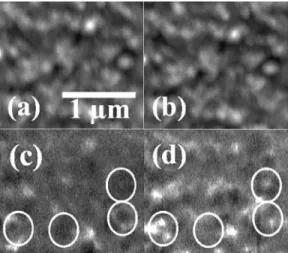
only 1.26 nm. Figures 3(a) and 3(b) show topography images
of the area of 2m⫻2m recorded during two scans using
two opposite directions of magnetization of the cantilever
(i.e., Up and Down).
The corresponding phase changes MFM, recorded with
the same lift height of 52 nm, are shown in Figs. 3(c) and
3(d), respectively. Note that several dark spots in the MFM
images do not match dark spots in the topography images[in
Figs. 3(a) and 3(b)], then surely the magnetic signals are real, and they are not due to the surface effect. Strong magnetic signals detected confirm the strong FM which was observed from magnetization measurements. Also, we can notice that the different brightness showing only a small variation of the MFM response does not support the presence of any mag-netic cluster which should give a very strong magmag-netic
re-sponse and a clearer contrast(in principle, the difference in
magnetic response when moving from one spot of having no clusters to another spot with clusters must go through a steep
rise which is akin to a step).16 On the contrary, what we
observed is only like “a fluctuation” and it is in favor of a real diluted magnetic structure.
The cantilever, which had been magnetized by using a magnetic field of 0.35 T, seems to present a field which is strong enough to tilt the magnetic moments of a few points
[see circles in Figs. 3(c) and 3(d)]. Note that, for the image
recorded using the Up polarization configuration of the
can-FIG. 2. Magnetization of Ti0.95Cr0.05O2films fabricated at 650 and 700 ° C vs(a) temperature under 0.2 T and (b) magnetic field at 300 K.
FIG. 3.(a) and (b) Topography images of the same area of 2m⫻2m for the Ti0.95Cr0.05O2film fabricated at 650° C. Corresponding phase images recorded using different polarization for the cantilever: Up for(c) and Down for(d). Circles are only guides for eyes.
Appl. Phys. Lett., Vol. 85, No. 25, 20 December 2004 Honget al. 6213
tilever[Fig. 3(c)], the observed contrasts are not totally op-posite to those obtained in the image taken with the Down
polarization configuration[Fig. 3(d)]. This observation is
an-other proof(besides the comparison between the MFM
im-ages and the topography imim-ages) to confirm that the detected
magnetic signal is real, and the sample is certainly ferromag-netic at room temperature. On the other hand, it shows that the sample has not been demagnetized between these two measurements, so that the magnetic moments aligned with the field in the previous state still remained, therefore the field with the opposite direction applied in the next state was just able to align the magnetic moments in the specimen
partially (that is why it could not turn all the spins in the
opposite direction to give a completely opposite contrast in
MFM measurements).
In conclusion, we obtained laser ablated Ti0.95Cr0.05O2
thin films on LaAlO3substrates as strong ferromagnets with
a single phased anatase structure. The maximum saturation magnetic moment which could be achieved in our films is
2.6B/ Cr, and this value seems to be in accord with the
prediction of theories. Moreover, MFM measurements con-firm the room temperature FM, and more crucially, also
en-sures that the Cr-doped TiO2 films certainly have a diluted
magnetic structure with the FM originated from the doped matrix rather than any type of magnetic cluster.
The authors thank A. Hassini for preparing the target. Financial supports of CNRT is acknowledged.
1
T. Dietl, H. Ohno, F. Matsukura, J. Cibert, and D. Ferrand, Science 287, 1019(2000).
2
K. Ueda, H. Tabata, and T. Kawai, Appl. Phys. Lett. 79, 988(2001). 3
Y. Matsumoto, M. Murakami, T. Shono, T. Hasegawa, T. Fukumura, M. Kawasaki, P. Ahmet, T. Chikyow, S. Koshihara, and H. Koinuma, Science
291, 854(2001). 4
N. H. Hong, J. Sakai, and A. Hassini, Appl. Phys. Lett. 84, 2602(2004). 5
N. H. Hong, W. Prellier, J. Sakai, and A. Hassini, Appl. Phys. Lett. 84, 2850(2004).
6
S. B. Ogale, R. J. Choudhary, J. P. Buban, S. E. Lofland, S. R. Shinde, S. N. Kale, V. N. Kulkarni, J. Higgins, C. Lanci, J. R. Simpson, N. D. Browning, S. Das Sarma, H. D. Drew, R. L. Greene, and T. Venkatesan, Phys. Rev. Lett. 91, 077205(2003).
7
J. M. D. Coey, A. P. Douvalis, C. B. Fitzgerald, and M. Venkatesan, Appl. Phys. Lett. 84, 1332(2004).
8
K. Sato and H. Katayama-Yoshida, Jpn. J. Appl. Phys., Part 2 39, L555 (2000).
9
W. Prellier, A. Fouchet, and B. Mercey, J. Phys.: Condens. Matter 15, R1583(2003).
10
N. H. Hong, W. Prellier, J. Sakai, and A. Ruyter, J. Appl. Phys. 95, 7378 (2004).
11
N. H. Hong, J. Sakai, and W. Prellier, J. Magn. Magn. Mater. 281, 347 (2004).
12
N. H. Hong, J. Sakai, W. Prellier, A. Hassini, A. Ruyter, and F. Gervais, Phys. Rev. B 70, 195204(2004).
13
C. Kittel, Introduction to Solid State Physics, 7th ed.(Wiley, New York, 1996).
14
P. Sheng, B. Abeles, and Y. Arie, Phys. Rev. Lett. 31, 44(1973).
15
R. J. Kennedy, P. A. Stampe, E. Hu, P. Xiong, S. von Molnar, and Y. Xin, Appl. Phys. Lett. 84, 2832(2004).
16
S. A. Koch, R. H. te Velde, G. Palasantzas, and J. Th. M. De Hosson, Appl. Phys. Lett. 84, 556(2004).
6214 Appl. Phys. Lett., Vol. 85, No. 25, 20 December 2004 Honget al.