Fat
solenoidal attractors
Masato
TSUJII
Department of Mathematics
Hokkaido
University
November
8,
2000
AbstractWe studydynamical systemsgeneratedby skewproducts
$T$:$S^{1}\mathrm{x}\mathbb{R}arrow S^{1}\cross \mathbb{R}$, $T(x, y)=(\ell x, \lambda y+f(x))$
where $\ell\geq 2,1/\ell<\lambda<1$ and$f$ isa $C^{2}$ function on $S^{1}$. We show that
the SBRmeasurefor $T$isabsolutely continuous for almost every $f$.
1
Introduction
Inthispaper, westudyaclassof dynamicalsystemsthat stablyadmit an
abso-lutely continuous ergodicmeasure(acem)with anegative Lyapunov exponent. It
is well-known that expanding dynamical systems generally admit acem’swhose
Lyapunov exponentsare all positive. The aim of this paperis to studyanother
kind of acem’s which is produced by a quite different mechanism: overlap and
slidinginshort.
We can find a typical example of such acem’s in a paper of Alxander and
$\mathrm{Y}\mathrm{o}\mathrm{r}\mathrm{k}\mathrm{e}[1]$, where the so-called generalized
$\mathrm{b}\mathrm{a}\mathrm{k}\mathrm{e}\mathrm{r}^{)}\mathrm{s}$transformation is considered:
$B$ : [-1, 1] $\cross[-1,1]0$, $B(x, y)=\{$
$(2x-1, \beta y+(1-\beta))$ $x\geq 0$
$(2x+1, \beta y-(1-\beta))$ $x<0$.
When$\beta=1/2$, this map$B$ is nothing but the ordinarybaker’s transformation.
Alxander and Yorke studied the case $1/2<\beta\leq 1$. In such case,the images of
left and right halves of thedomain, $i.e.,$$B([-1,0]\cross[-1,1])$ and$B([0,1]\cross[-1,1])$
overlapwithsomesliding. This makes thedynamicalnatureofthe map$B$
more
complicated and interesting. They observed that the map $B$ admits an acem
if and only if the number $\beta$ satisfies a delicate numerical condition: absolute
continuityof the corresponding infinitelyconvolutedBernoullimeasure. Asthey
noted, thereare infinitely many numbers in (1/2,1] $(e.g. (\sqrt{5}-1)/2)$ forwhich
$B$ admits no acem’s, accordingto a result of$\mathrm{E}\mathrm{r}\mathrm{d}\ddot{\mathrm{o}}\mathrm{s}[2]$. On the other hand, $B$
admits an acem for Lebesgue almost every $\beta$ in (1/2, 1] according to a more
recent result of$\mathrm{S}\mathrm{o}\mathrm{l}\mathrm{o}\mathrm{m}\mathrm{y}\mathrm{a}\mathrm{k}[3]$ .
数理解析研究所講究録
In this paper, weconsider aclass of dynamical systems generated by maps
$T$ : $S^{1}\cross \mathbb{R}arrow S^{1}\cross \mathbb{R}$, $T(x, y)=(\ell x, \lambda y+f(x))$ (1)
where $\ell\geq 2$ is an integer, $0<\lambda<1$ is a real number, and $f$ is a $C^{2}$ function
on $S^{1}=\mathbb{R}/\mathbb{Z}$. We may regard this class of maps as a conceptualgeneralization
ofthe generalized baker’s transformations $B$ in the sense that the translation
invertical direction depends smoothlyon $x$.
The map $T$ is a skew product on the expanding map $\tau$
:
$x-\rangle$ $\ell x$ and it isuniformly contractinginthefiber direction. So$T$ is an Anosovendomorphism.
The ergodic property of$T$ is rather simple: there exists anergodic probability
measure $\mu$ on
$S^{1}\mathrm{x}\mathbb{R}$, for which Lebesgue almost every point $\mathrm{x}\in S^{1}\mathrm{x}\mathbb{R}$ is
generic, that is,
$\lim_{narrow\infty}\frac{1}{n}\sum_{i=0}^{n-1}\delta_{T^{i}(\mathrm{x})}=\mu$ weakly.
We willcall this measure$\mu$ the $SBR$ measurefor $T$.
The question is smoothness of the SBR measure $\mu$ with respect to the
Lebesgue measure on $S^{1}\mathrm{x}\mathbb{R}$. In the case $\lambda\ell<1$, the SBR measure is
to-tally singular because $T$ contractsarea. The case $\lambda l>1$,which corresponds to
thecase$\beta>1/2$for the generalized baker’stransformations,ismoreinteresting.
We will focus onthis case. Firstwe givetwo examples in opposite directions.
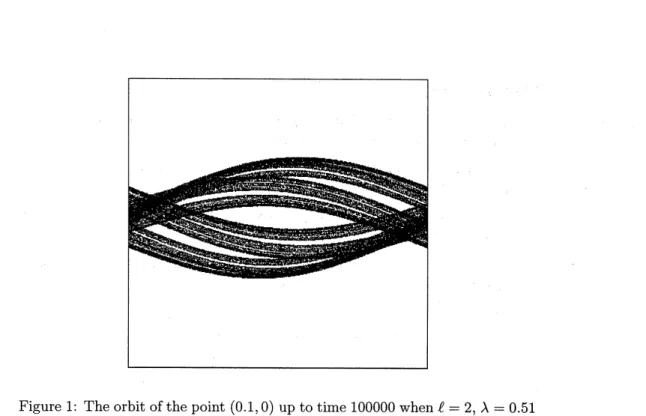
Example 1 Let $\ell=2_{f}0.5<\lambda\leq 0.51$ and $f(x)=\sin 2\pi x$. Then the $SBR$
measure $\mu$
for
$T$ is absolutely continuous with respect to the Lebesgue measureof
$S^{1}\mathrm{x}$R. (Seefigure 1.)Example 2
If
$f(x)=\varphi(\tau(x))-\lambda\varphi(x)$for
somemeasurablefunction
$\varphi$ on$S^{1}$,
the $SBR$ measure
for
$T$ is supported on the graphof
$\varphi$ and totally singular.
We claim that the SBR measure is absolutely continuous for almost every
$T$ and, moreover, that the absolute continuity is robust. Fix an integer $\ell\geq 2$.
Let$D\subset(\mathrm{O}, 1)\cross C^{2}(S^{1}, \mathbb{R})$ be the set of combinations $(\lambda, f)$ for which the SBR
measure is absolutely continuous w.r.t. the Lebesgue meaeure on $S^{1}\cross \mathbb{R}$. We
considerthe interior$D^{\mathrm{o}}$ of$D$with respect to the topologythat is defined asthe
product ofthe canonical topologyon $(0,1)$ and$C^{2}$-topology on$C^{2}(S^{1}, \mathbb{R})$. The
mainresult ofthis paper is the following.
Theorem 1 Let$\ell-1<\lambda<1$
.
There exists afinite
collectionof
$C^{\infty}$functions
$\varphi_{i}$ : $S^{1}arrow \mathbb{R},$ $i=1,2,$$\cdots$ ,$m$, such that ,
for
any $C^{2}$function
$g\in C^{2}(S^{1}, \mathbb{R})$,the subset
of
$\mathbb{R}^{m}$,$\{(t_{1}, t_{2}, \cdots, t_{m})\in \mathbb{R}^{m}|(\lambda,$ $g(x)+ \sum_{i=1}^{m}t_{i}\varphi_{i}(x))\not\in D^{\mathrm{o}}\}$ ,
is a nullset with respect to the Lebesgue mesure on$\mathbb{R}^{m}$.
Figure1: The orbit of thepoint $($0.1,$0)$ up to time100000 when$\ell=2,$ $\lambda=0.51$
and $f(x)=\sin(x)$.
As simple consequences,weobtain
Corollary 2 $D$ contains an open and dense subset
of
$(1/\ell, 1)\mathrm{x}C^{2}(S^{1}, \mathbb{R})$.Corollary 3 For$\ell-1<\lambda<1$ and$2\leq r\leq\infty$, the set
of functions
$D_{\lambda}^{r}=\{f\in C^{r}(S^{1}, \mathbb{R})|(\lambda, f)\in D^{\mathrm{o}}\}$
is an open and dense subset
of
$C^{r}(S^{1}, \mathbb{R})$.
Moreover, the claim oftheorem 1 implies that the subset $D_{\lambda}^{r}$ above occupies
almost everywhere in $C^{r}(S^{1}, \mathbb{R})$. In fact, if$C^{r}(S^{1}, \mathbb{R})$ were afinite dimensional
Euclidean space, the claim would imply that the subset $D_{\lambda}^{r}$ had full
measure
with respect tothe’Lebesgue measure’ on $C^{r}(S^{1}, \mathbb{R})$. See [5] and [6] for
discus-sions about measure-theoretical conditions that imply ”almost everywhere” for
subsets in infinite dimensional spaces.
The proof of theorem 1 isbased onanideathattransversality ofthe unstable
manifolds leads to absolute continuity of the SBR measure. We took this idea
froma paperofSolomyak and$\mathrm{P}\mathrm{e}\mathrm{r}\mathrm{e}\mathrm{s}[4]$ where the authors gaveasimplified proof
ofthe above mentioned result of Solomyak.
One can download the full paper at
http:$//\mathrm{w}\mathrm{w}\mathrm{w}$
.
math.sci.hokudai.$\mathrm{a}\mathrm{c}.\mathrm{j}\mathrm{p}/\sim_{\mathrm{t}\mathrm{s}\mathrm{u}\mathrm{j}\mathrm{i}\mathrm{i}}/\mathrm{i}\mathrm{n}\mathrm{d}\mathrm{e}\mathrm{x}$
.
htmlReferences
[1]
J.C.Alexander&J.A.
Yorke, Fat Baker’s transformations, Ergodic theoryand dynamical systems,4, 1-23 (1984)
[2] P. Erd\"os, On afamily
of
symmetric Bernoulliconvolutions,Amer. J. Math.61, 974-976, (1939)
[3] B. Solomyak, On the random
se
r.ies $\sum\pm\lambda^{n}$ (an Erd\"osproblem), Ann. ofMath. (2) 142, no. 3, 611-625, (1995)
[4] B.Solomyak
&Y.
Peres, Absolute continuityof
Bernoulli convolutions, $a$simple proof, Math. Research Letters 3, 231-239 (1996)
[5] M. Tsujii, A measure on the space
of
smooth mappings and dynamicalsys-tem theory., J. Math. Soc. Japan 44, no. 3, 415-425, (1992)
[6] B. R.Hunt, T. Sauer
&J.
A. Yorke, Prevalence: a translation-invariant”almost every” on
infinite-dimensional
spaces, Bull. Amer. Math. Soc. ,27, no.2, 217-238(1992); Addendum ibid. 28, no. 2, 306-307, (1993)