〈研究ノート〉
Tourism Development and Environmental Problems
on Hawaii in the late 20
thCentury
Hayato ISHIHARA*
Koichi NAGAHAMA
†1. Introduction
This paper explains tourism development and environmental problems in the late 20th
century, with specific focus on Maui’s water problem in 1990’s. The following three emphasized: (1) tourism industry has experienced rapidly and significant great growth since the 1950’s, making it currently one of the most important industries in the world; (2) the growth of Hawaii coincides with the rise of the mass tourism industry; and (3) the tourism development-related water problem creates serious damage to a community such as Maui. Further, this paper shows that tourism development connotes a negative environmental impact for the destination.
2. About the tourism industry
2. 1. The growth of tourism industry and its industrial scale
According to James Mak, the tourism has become an economic sector of enormous global significance. Mak and other tourism researchers recognize that the tourism industry has experienced rapid growth since World War II1
. In addition, the United Nations World Tourism Organization (UNWTO)’s 2015 report indicates that the growth of the tourism industry influenced the global economic trend.
The UNWTO points out the scale of tourism by means of
the following: (1) the tourism industry directly or indirectly generates about 9% of world GDP; (2) export reached 1.5 trillion U.S. dollars in 2014, representing about 6% of the world export value; (3) the number of international tourists has increased from 23 million in 1950 to 11 billion in 2014; and (4) the estimated number of domestic tourists in the same period is between five and sixe billion. As outlined above, the tourism industry is a mega business in the world economy.2 Figure 1 also indicates that the share of tertiary industry has increased since the 1960’s. It is assumed that the growth of the tourism industry will keep pace with the growth of the tertiary industry for a while.
2. 2. The relationship between the tourism industry and economic growth
The tourism industry depended more strongly on business fluctuations than other economic sectors. For example, Figure 2 shows the number of international tourists to Hawaii from 1966 to 2005, and Figures 3 and 4 show American and Japanese economic growth, respectively. These figures indicate that the American and Japanese economies worsened in the early 1990’s and in 2008, and that the decrease in international tourists to Hawaii at these times coincides with the US and Japanese recession. In other words, the Hawaiian economy depended deeply on the U.S. and *長崎県立大学経済学研究科修士課程
†長崎県立大学地域創造学部講師
Figure 1 Share of the tertiary industry (Japan and U.S.)
The figure creates to us from Watanabe, 2000.
Figure 2 Change in the number of tourists in the state of Hawaii from 1966 to 2014
http://www.hawaiitourismauthority.org/research/reports/annual-visitor-research/Hawaii State Department of Business, Economic Development and Tourism, Tourism Research Branch, Annual Visitor Research Report; Hawaii Tourism Authority, Tourism Research (2016/1/27)
Japanese economic trends. We can assume that the tourism industry in Hawaii is a mirror of American and Japanese business fluctuations.
2. 3. Background to the tourism industry’s growth
According to the UNWTO, the number of international tourists consistently increased to 1.1 billion in 2014, and the
tourism industry estimates this number at 1.8 billion in 2030. In other words, the tourism industry is for the foreseeable future considered as one of prosperous growth. This paper focuses on some of the economic and historical factors as background to such growth. According to a recent mass tourism study, American people recieved more paid leave and more free time after WW II3
and as such had more “time” to
Figure 3 Economic growth rate (U.S.)
Figure 4 Economic growth rate (Japan)
The data shows that how much growth does GDP compared with Year-on-Year
Economic growth rate = (this year’s GDP-last year’s GDP)÷ last year’s GDP × 100 (IMF-World Economic Outlook database 2015)
https://www.imf.org/external/pubs/ft/weo/2015/01/weodata/index.aspx(2016/1/26)
travel. Further, American enjoyed economic affluence and stable economic growth after WW II, a mass middle class appeared; as such, they had “money” to travel. Ford mass-produced the automobile since the 1950’s and the jumbo jet was introduced into international tourism during the 1970’s. The people have experienced a transportation revolution, that is, they had a “means” to travel. We conclude that the success of mass tourism is based on the establishment of a mass consumption society during the 1950’s. Consequently, people can travel further, longer, and more luxurious4.
2. 4. Tourism research results
Tourism is still a developing academic field. In 1974, the
Annual of tourism was published as the first academic journal.
Following this, the International Academy for the Study of Tourism was established in 1988 as a representative international society in the tourism study field. This implies that we did not have handbooks for tourism research for extended period of time. This situation has changed since 2000. Handbooks of varying reputation could be found, such as A Companion to Tourism and The Routledge Handbook of
Tourism and the Environment. These handbooks indicate that
tourism study is an interdisciplinary field. For instance, “environmental impacts and sustainability” became very significant keywords on the study field. However historical research has not played an important role in the this fields. It is expected that the study of historical standpoints would lead to criticize the current status of tourism study5
.
3. Hawaii as tourism destination
3. 1. Location of Hawaii
Why did this paper select Maui (Hawaii) as research object? Figure 5 illustrates the location of Hawaii in the center of the Pacific Ocean− a journey of about nine hours from the
US and Japan by air. Many people in the Pacific region have
been attracted to Hawaii6, leading to its status as one of the most popular tourist destinations. Recently, the number of tourists to Hawaii amounted to 7 million per a year with most visitors from the U.S. and Japan (see Figure 6). This description shows that U.S. and Japanese economics decide the Hawaiian economic fate.
3. 2. Relationship between the mass consumption society and tourism growth
Hayato Yamanaka, one of the foremost Japanese authorities on Hawaiian history, points out that Hawaii has been developed as a visitor destination since the early 1900’s7. However, this quantitative index indicates that the Hawaiian tourism industry has experienced rapid growth since the second half of the 20th
century, thus becoming a mass tourism destination.
As mentioned above, Hawaii is a symbolic place in which mass tourism keeps pace with the rise of the mass consumption society. We must consider historical factors when we study the tourism industry of Hawaii famous destination. The U.S. and Japan−two economic powers in the pacific
region−have experienced great economic growth in the
1970’s. Especially, Japanese tourists have visited Hawaii after high economic growth in the 1960’s, leading Japanese people have become major customer of Hawaii. In addition, the technical development and commercialization of the jumbo jet during the 1970’s promoted mass tourism over the world. More people could travel to further destination during the 1970’s, leading to the worldwide spread of mass tourism8
. Environmental problems have gradually become more serious since the 1970’s. The plastic-products problem should be mentioned here, due to cheap mass production that significantly influenced the environment. Many tourists have created significant amounts of waste, such as beverage, sun oil, and other container. This increased waste has impacted on the quality of life in Hawaii, where it is important for resort
Figure 5 Location of Hawaii
MAP 6. Copy of an early map of Hawai’i as the “Crossroads of the Pacific” by the Hawaii Promotion Committee in the journal devoted to Hawaiian tourist interest. Paradise of the Pacific 15, no, 12 (1992)
Figure 6 The number of tourist arrivals in the state of Hawaii
Source: Adapted from Annual Visitor Research, 2014
destinations to continue protecting the beautiful sea. While Hawaii continuously faces waste problems, resort destinations have many environmental concerns. Besides garbage, water shortage is one of their most serious problems, since this impacts on the environment as well as the community.
3. 3. Tourism development and the water problem
Most of the resort destinations are located in arid limited rainfall regions with water shortages. Generally, the tourism industry consumes water more wastefully than other industries.
According to Blackford, most of the famous resort
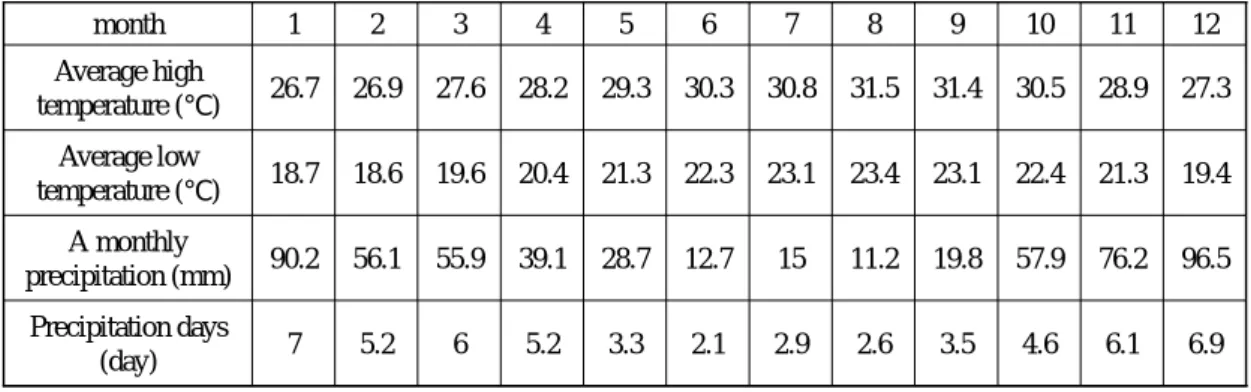
destinations need “the shining sun”, “a comfortable climate”, “the beautiful sea”, and “limited rain” in order to satisfy their travellers. Table 1 shows the average temperature and precipitation in Honolulu. How much water is used per day? Japan’s domestic water usage per capita is about 313!. In contrast, consumption is estimated in the range of 2000 to 10000! in resort destinations. The data in Table 2 show that industrial water usage is about 30 times more than general waste, which implies resort destinations have a potential dilemma with water consumption9.
3. 4. The case study of Maui
Maui Island has experienced a serious water shortage
Tabel 1 Average temperature and precipitation in Honolulu
month 1 2 3 4 5 6 7 8 9 10 11 12 Average high temperature (℃) 26.7 26.9 27.6 28.2 29.3 30.3 30.8 31.5 31.4 30.5 28.9 27.3 Average low temperature (℃) 18.7 18.6 19.6 20.4 21.3 22.3 23.1 23.4 23.1 22.4 21.3 19.4 A monthly precipitation (mm) 90.2 56.1 55.9 39.1 28.7 12.7 15 11.2 19.8 57.9 76.2 96.5 Precipitation days (day) 7 5.2 6 5.2 3.3 2.1 2.9 2.6 3.5 4.6 6.1 6.9
30 years average precipitation (from 1961 to 1990)
Source: Created by the World Meteorological Organization (WMO) https://public.wmo.int/en (2016/7/28)
Table 2
Water Use Category Liters per tourist per day
Accomodation (Direct) 84∼200
Activities (Direct) 10∼3
Fossil fuels (Indirect) 90 (a)
Biofuels (Indirect) 7500 (b)
Food (Indirect) 2000∼500
Total estimated range:2000∼1000
(a)an average of 120 km/day (UNWTO-UNEP-WMO,2008) (b)use of 40 km/l and 120 km/day Created byGossling, S.,/ Peeters, P./ Hall, C. M./ Ceron, J. P./ Dubois, G./ Lehmann, L. V./ Scott, D., 2012, “Tourism and water use: supply, demand, and security. An international review. “, In: Tourism Management 33(1), pp.1-15.
problem since the 1970’s. Because of the high reliance on ground water, the situation continued during the 1990’s. The Island has experienced multiple droughts due to the pressure places on water consumption by tourism and climate change. The Maui county council has been facing the problem that tourism development is limited by the amount of water consumption, which is still unsolved. Therefore, they have been caught up in a dilemma of choosing between economic growth and environmental sustainability. In this regard, Maui is a “Fragile Paradise”.
4. Conclusion
This paper confirmed the development of tourism since the 1960’s and the importance of Hawaii as tourism destination, where serious water problems became known. The tourism industry has various negative impacts on the environment and the community. Especially, the resort destination has changed into a fragile paradise. Unfortunately, this paper could not be reflect in detail on the effects of the tourism industry on environment; tourism’s negative impacts are discussed in detail in another article.
Center materials on this paper
Refer to our historical center materials for this research. This paper analyzes the Maui News articles. Because Mansel, G. Blackford who is authority of Hawaiian tourism history, has recommended summary information about the tourism industry, the environment, and the community. Further, he has researched the Maui tourism development from a standpoint of environmental impact. This paper was therefore much enlightened by his research. We adopted his method and tried to analyze the water problems mainly from the Maui News.
Acknowledgements
This paper is a revision of the contents presented at the 5th
Forum for East Asian Academic Exchange (November 6, 2015 at the International Center, University of Dong-A Bumin Campus, Busan, Korea). The authors are grateful for the opportunity to present this paper.
The authors are especially grateful to Professor Mr. Yutaka Yamamoto, University of NAGASAKI, for his cooperation with respect to this research.
1 Mak, J., 2008, Developing a Dream Destination
Tourism and Tourism Policy Planning in Hawaii,
University of Hawaii Press, pp.2-3.
2 http://www.e-unwto.org/ (accessed 2016/12/29) 3 Inagaki, T., 2011, “Mass tourism taisyuu syouhi
syakai no hikari to kage”, pp.114-115; Oohashi, S./ Hashimoto, K./ Endo, H./ Kanda, T. (eds.), 2014,
Kankougaku guide book, Nakanishiya syuppan, pp
16-17.
4 Surdam, D. G., 2015, Century of the Leisured
Masses Entertainment and the Transformation of Twentieth- Century America, Oxford University Press,
pp 33-43; Davis, S. G., 2006, “Time out; Leisure and Tourism”, pp.70-71; Yaguchi, Y., 2002, Hawaii no
rekishi to bunka higeki to hokori no mozaiku no nakade, Tyuukousinsyo, pp.144-146; Oohashi, S./
Hashimoto, K./ Endo, H./ Kanda, T. (eds.), 2014,
Kankougaku guide book, Nakanishiya syuppan,
pp.15-16.
5 Lew, A. A./ Hall, C. M./ Williams, A. M.(eds.), 2014, The Wiley Blackwell Companion to Tourism, John Wiley & Sons, Ltd; Holden, A./ Fennell, D.(eds.), 2013, The Routledge Handbook of Tourism and the
Environment, Routledge.
6 Mak, op. cit., pp.1-8, Yaguchi, op. cit., pp.144-146. 7 Yamanaka, H., 1992, Image no rakuen,
Tikumasyobou, pp.121-129
8 Blackford, M. G., 2001, Fragile Paradise: The
impact of tourism on Maui, University press of
Kansas, pp.10-23; Yaguchi, op. cit., pp.144-146. 9 Gossling, S., 2002, “Global environmental
consequences of tourism.”, In: Global Environmental Change 12(4), pp.283-302; Gossling, S.,/ Peeters, P./ Hall, C. M./ Ceron, J. P./ Dubois, G./ Lehmann, L. V./ Scott, D., 2012, “Tourism and water use: supply, demand, and security. An international review. “, In:
Tourism Management 33(1), pp.1-15
References
Blackford, M. G., 2001, Fragile Paradise: The
impact of tourism on Maui, University press of
Kansas.
Cambers, G., 2006 “Islanders’ Perspectives on Sustainable Living.”, Island Studies Journal, 1 (1), pp.125-142.
Davis, S. G., 2006, “Time out; Leisure and Tourism”, in: Agnew, J./ Rosenzweig, R.(ed.), 2006, A Companion to Post-1945 America, Blackwell Publishing Ltd, pp.64-72.
Eijigelaar, E./ Peeters, P., 2014 “The Global Footprint of Tourism”, in: Lew, A. A./ Hall, C. M./ Williams, A. M.(eds.), 2014, The Wiley
Blackwell Companion to Tourism, John Wiley
& Sons, Ltd, pp.454-465.
Gossling, S., 2002, “Global environmental consequences of tourism.”, In: Global Environmental Change 12(4), pp.283-302. Gossling, S.,/ Peeters, P./ Hall, C. M./ Ceron, J. P.
/ Dubois, G./ Lehmann, L. V./ Scott, D., 2012, “Tourism and water use: supply, demand, and security. An international review. “, In: Tourism
Management 33(1), pp.1-15.
Graci, S./ Dodds, R., 2010, Sustainable Tourism
in Island Destinations, Earthscan.
Hall, C. M., 2014, “Tourism and the Environment : Change , Impacts , and Response”, in: Lew, A. A./ Hall, C. M./ Williams, A. M.(eds.), 2014, The Wiley Blackwell Companion to Tourism, John Wiley
& Sons, Ltd, pp.447-453.
Holden, A./ Fennell, D.(eds.), 2013, The Routledge Handbook of Tourism and the Environment, Routledge.
Inagaki, T., 2011, “Mass tourism taisyuu syouhi
syakai no hikari to kage”, In: Yamashita, S., 2011, Kankougaku keyword, Yuuhikaku. Lew, A. A./ Hall, C. M./ Williams, A. M.(eds.),
2014, The Wiley Blackwell Companion to
Tourism, John Wiley & Sons, Ltd.
Maeda, I. (ed.), 2003, 21 seki no kankougaku
tenbou to kadai, gakubunsya.
Mak, J., 2008, Developing a Dream Destination
Tourism and Tourism Policy Planning in Hawaii, University of Hawaii Press.
Mizoo, Y. (ed.), 2009, Kannkougaku zensyu dai 1
kan kankougaku no kiso, gensyobou.
Okamoto, N. (ed.), 2001, Kankougaku nyuumon
post mass tourism no kankougaku, Yuuhikaku.
Oohashi, S./ Hashimoto, K./ Endo, H./ Kanda, T. (eds.), 2014, Kankougaku guide book,
Nakanishiya syuppan.
Rothman, H. K., 1998, Devil’s Bargains Tourism
in the Twentieth-Century American West,
University Press of Kansas.
Rothman, H. K., 2010, “The Emergence of the U. S. Environmental Movement”, in: Miller, C. (ed.), 2010, Cities and Nature in the American
West, University of Nevada Press, pp.162-163.
Sharpley, R., 2009, Tourism Development and the
Environment : Beyond Sustainability ? ,
Earthscan.
Sisson, M., 2010, “Population Growth and Consumption”, in: Miller, C.(ed.), 2010, Cities
and Nature in the American West, University of
Nevada Press, pp.144-145.
Surdam, D. G., 2015, Century of the Leisured
Masses Entertainment and the Transformation of Twentieth- Century America, Oxford University Press, pp 33-43.
Tsunematsu, Y., 1997, Taisyuusyouhisyakai to
America syakai syouhisykai no syakaishi,
Yamakawa syuppan.
Yaguchi, Y., 2002, Hawaii no rekishi to bunka
higeki to hokori no mozaiku no nakade,
Tyuukousinsyo.
Yamanaka, H., 1992, Image no rakuen,
Tikumasyobou.
Yamashita, S., 2011, Kankougaku keyword,
Yuuhikaku.