Revisiting the Construction of Knowledge in
Science
journal or
publication title
Journal of Global Communication Studies
volume
1
page range
3-17
year
2016-03-31
Revisiting the Construction of Knowledge in Science
Judy Noguchi
Faculty of Global Communication, Kobe Gakuin University [email protected]
Abstract
The “truths” of science are achievements of communication in which scientists come to accept the claims of other scientists based on supporting evidence. A process describing how knowledge is constructed in the sciences via the summarizing and synthesizing of information in review articles was proposed by Noguchi in 2006 (The Science Review
Article: An Opportune Genre in the Construction of Science. Bern: Peter Lang). However,
in view of the rapidly increasing pace of online dissemination of information, this process appears to be undergoing a change. The present study reexamines the process of knowledge construction in science by investigating how viewpoints in the sciences are disseminated via news sources based on citation metrics, which gauge the impact that the information has on the general public. Based on the current findings, a new process is proposed that takes into account the rapid dissemination of information and also calls for some form of curating the knowledge to be accepted.
Key words
construction of knowledge, information flood, citation metrics, curation of knowledge, Perspective articles
I. Introduction
Science is an achievement of communication. Gross (1990, p. 203) states that “facts are by nature linguistic—no language, no facts.” He points out that “the sciences create bodies of knowledge so persuasive as to seem unrhetorical—to seem, simply, the way the world is” (Gross, 1990:206-207). To clarify how knowledge construction occurs in the sciences, Noguchi (2006), from work on a doctoral dissertation completed in 2001, proposed a process pivoting around science review articles. The findings were from a study that analyzed all of the 25 review articles published during 1993 in the Proceedings
of the National Academy of Sciences (PNAS) and also included interviews with specialist
informants in disciplines related to those of the reviews to discover what practicing scientists thought about the respective review articles (Noguchi, 2006). The knowledge
in the mind of a researcher gradually evolves into an accepted “fact” in the sciences. The proposed process suggested that the review article plays an important role in having the “idea” or “claim” of the researcher become acknowledged by the scientific community and then be introduced to the general public. One of the specialist informants commented about the reason for writing a review article as follows: “there was a large body of literature but little understanding of it all. Therefore, there was a need for someone to summarize and synthesize it into models which could be used to predict, to lead to new experiments, and to move the field forward” (Noguchi, 2006:113). Thus, knowledge in the field develops and evolves when an established researcher in the discipline summarizes and synthesizes what is known so that it can be used to propel the field forward.
Table 1 Process of knowledge construction in science (adapted from Noguchi, 2006: 244)
Stage Manifestation Conception Idea in the mind of a researcher
Birth Written manifestation available for public scrutiny Notebook (lab notebooks, records, notes) Conference abstract
Conference proceedings Research article
Follow-up research articles Citation in other research articles
Coming-of-age Acceptance as “truth” by scientific community
Review
Popular science literature
Middle age Acceptance as “truth” by general community Textbook
Popular literature Death
or
No longer accepted by community or superseded by a new paradigm
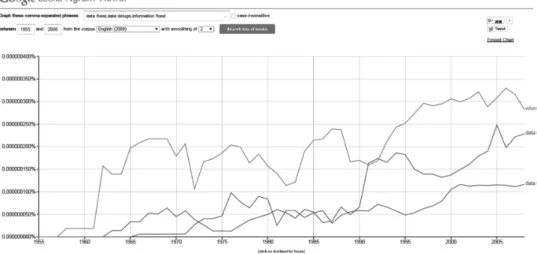
In 2009, Noguchi reexamined this knowledge construction process in view of the flood of information deluging the sciences and other fields, especially since the mid-1990s, with the advance of online communications. As can be seen from Fig. 1, the Google Books Ngram Viewer (2015) shows the rising tendency of usage of the terms “information flood,” “data deluge,” and “data flood,” especially from the 1990s. This offers evidence for the rapid increase of information with which scientists, professionals and even the general public must now be able to handle and comprehend.
Fig. 1 Google Books Ngram Viewer (2015) results for “information flood,” “data deluge,” and “data flood,” in that order, in the Google corpus of books published between 1955 and 2008.
To find whether or not the review article was still functioning as a pivot point in the evolution of an idea into a fact in the sciences, Noguchi (2009) traced the citation records of the 25 review articles that had been examined in the study published in 2006. These 25 review articles had been categorized into four types: history reviews that described the background of a research field, status quo reviews that presented the current state of the research field; theory reviews that presented a theory or model to explain a phenomenon; and issue reviews that pointed out some problem and offered a possible solution (Noguchi, 2006). This examination of how the 25 reviews had fared since their publication revealed that the most cited ones were the issue reviews (Noguchi, 2009). These were the review articles that included a relatively high percentage of opinion statements in comparison with the other types of reviews (Noguchi, 2006:158).
Another finding was that the position of the review article in the process of knowledge construction in the sciences seemed to be changing (Noguchi, 2009). While there were 25 review articles published in PNAS in 1993, the number dropped sharply after that to only seven in 1997, two in 1998, four in 1999 and only one or two a year, or even none, from 2000, except for 2006 in which there were five. Noguchi (2009:47) suggested that “the review article itself appears to be undergoing metamorphosis.”
In the present study, PNAS was revisited to find how the process of constructing knowledge in science has been evolving.
II. The Perspective article in PNAS
Today, the PNAS (2015) Instructions for Authors does not even list review articles as a type of publication—“PNAS publishes research reports, Letters, Front Matter, Commentaries, Perspectives, and Colloquium Papers.” The research reports present original research; Letters are brief comments about recent PNAS articles; Front Matter refers to a variety of text types for general discussions of science, including opinions, news features, and core concepts; Commentaries aim at directing attention to specific papers; Perspectives aim at presenting “a viewpoint on an important area of research” so that it will be accessible to nonspecialists; and Colloquium Papers are reports of colloquia held by the Academy of Sciences. Of the six types of papers published, the last four are only “written at the invitation of the Editorial Board” (PNAS, 2015). Of these invited papers, the one closest to a review article of the 1993 corpus is the Perspective article, which presents a viewpoint and should also be accessible to nonspecialists. Like the review articles of 1993, it seems to be positioned between the specialist community and the general public.
To clarify the role of the Perspective article in the construction of knowledge in the second decade of this 21st century, the 34 Perspective articles published in PNAS in 2014
were subjected to detailed examination. Linguistic and content analyses of their abstracts showed that 13 could be classified as presenting an issue, 11 as presenting the status quo of a field, 6 as describing a method, 4 as presenting a stance on policy, and 2 as describing a large-scale project.
Table 2 List of 34 Perspective articles in the PNAS Vol. 111 (2014) in their order of appearance with their classification according to type.
Title Type Vol. no. Pages
Is the simplest chemical reaction really so simple? Issue 1 15–20 Integrating the invisible fabric of nature into fisheries
management Issue 2 581–584
Evolution of microbial markets Method 4 1237–1244
Very early warning of next El Niño Method 6 2064–2066 Astronomical reach of fundamental physics Status quo 7 2409–2416 The Inter-Sectoral Impact Model Intercomparison Project
(ISI–MIP) Project 9 3228–3232
Toward a new vaccine for pertussis Method 9 3213–3216 How biological vision succeeds in the physical world Method 13 4750–4755 Mathematical approaches to modeling development and
reprogramming Method 14 5076–5082
Rescuing US biomedical research from its systemic flaws Issue 16 5773–577 Archaeological and genetic insights into the origins of
domesticated rice Status quo 17 6190–6197
Defining functional DNA elements in the human genome Project 17 6131–6138
Evaluating the roles of directed breeding and gene flow in
animal domestication Status quo 17 6153–6158
Particularism and the retreat from theory in the archaeology
of agricultural origins Issue 17 6171–6177
Changing the academic culture Issue 18 6542–6547
Use (and abuse) of expert elicitation in support of decision
making for public policy Policy 20 7176–7184
Feeling the hidden mechanical forces in lipid bilayer is an
original sense Status quo 22 7898–7905
Prehistoric deforestation at Chaco Canyon? Issue 32 11584–11591
History of vaccination Status quo 34 12283–12287
Unleashing the potential of NOD- and Toll-like agonists as
vaccine adjuvants Status quo 34 12294–12299
Vaccines against poverty Policy 34 12307–12312
Valuing vaccination Policy 34 12313–12319
Exploring exoplanet populations with NASA’s Kepler
Mission Status quo 35 12647–12654
Natural selection drives the evolution of ant life cycles Status quo 35 12585–12590 Spectra as windows into exoplanet atmospheres Issue 35 12601–12609
The future of spectroscopic life detection on exoplanets Status quo 35 12634–12640 Does aquaculture add resilience to the global food system? Policy 37 13257–13263 Antibody persistence and T-cell balance Issue 44 15614–15621 The nature of protein folding pathways Issue 45 15873–15880 Meal frequency and timing in health and disease Issue 47 16647–16653
Evolutionary cell biology Issue 48 16990–16994
Dealing with femtorisks in international relations Issue 49 17356–17362 Reversals of national fortune, and social science
methodologies Issue 50 17709–17714
A taxonomy of prospection Method 52 18414–18421
III. Citation metrics of the Perspective articles
Thanks to the advancement of search technologies, all of these Perspective articles come with citation metrics showing how often and where they were cited as well as the number of times they were downloaded. One of the main features of the metrics is the Altmetric score which indicates the ranking of the article in comparison with similar tracked articles of a similar age in all journals as well as specifically for PNAS articles (Altmetric 2015b). The metrics also show how often the article has been picked up by news outlets, mentioned in blogs, tweeted, and mentioned on Facebook pages, Wikipedia, Mendeley and CiteULike. Table 3 gives the statistics for the top 11 Perspective articles in the corpus. The remaining 23 Perspective articles in 2014 had Altmetric scores of 50 or less and were not picked up by news outlets (except for one which was picked up by four but had a low Altmetric score of 4).
Table 3 Top 11 Perspective articles based on Altmetric score and coverage by news outlets (Altmetrics, 2015a; Metrics retrieved on 4 October 2015)
Title No. Pages Altmetric
score
News outlets
Type
Rescuing US biomedical research from its
systemic flaws 16 5 961 10 Issue
Meal frequency and timing in health and disease
47 7 195 7 Issue Very early warning of next El Niño 6 3 166 7 Method Defining functional DNA elements in the
human genome
17 8 142 2 Project The Inter-Sectoral Impact Model
Intercomparison Project (ISI–MIP)
9 5 95 9 Project
Spectra as windows into exoplanet
Evolution of microbial markets 4 8 92 7 Method Integrating the invisible fabric of nature into
fisheries management
2 4 85 6 Issue Dealing with femtorisks in international
relations 49 7 81 9 Issue
Changing the academic culture 18 6 74 3 Issue
The future of spectroscopic life detection on exoplanets
35 7 70 2 Status quo
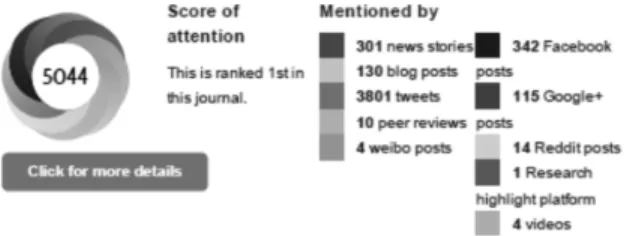
The Altmetric (2015b) site poses the question “Which academic research caught the public imagination in 2014?” In other words, this score is meant to gauge the impact an article can have on the general public. The top-ranking Altmetric score for 2014 was 5,044 for the research report “Experimental evidence of massive-scale emotional contagion through social networks” by Kramer, A.D., Guillory, J.E., and Hancock, J.T. in PNAS. Below is the entry showing that this study was mentioned in 301 news stories.
Fig. 2 Altmetric score for top-ranking research report in 2014.
Another interesting item in the Altmetric Top 100 for 2014 was the item ranking in fourth place. It was the paper by Obokata et al. (2014) that appeared in Nature and has since been retracted. The impact that research can have on the general public is indicated by the fact that this paper was mentioned by 159 news stories.
In sum, the overall top-ranking Altmetric articles for 2014 were specialist research articles that were very quickly picked up by news outlets and were offered to not only the professional community, but even to the general public. In the case of the Obokata et al. (2014) article, the data proved to be unverifiable and the paper, which appeared in January, was retracted in July 2014. It has since been followed by a Brief Communications Arising published in September 2015, which identifies what had been claimed to be STAP cells as actually having been derived from ES cells (Konno et al., 2015). What the Altmetrics and citation metrics reveal are how much of an impact a paper in a specialist journal can have on the general public when the information is disseminated via news stories, posted on blogs, Facebook and other sites.
IV. Rapid dissemination of information from specialist journals
In this section, the dissemination of information from a specialist journal, in this case
PNAS, to news media will be examined by tracing the news outlets that took up the 2014
Perspective article with the highest Altmetric score of 961—“Rescuing US biomedical research from its systemic flaws.” This article was taken up by 10 news outlets in 19 news stories (Table 4). The abstract of this article states that the authors wish to point out problems with biomedical research in the United States, warning that the “unsustainable hypercompetitive system…is discouraging even the most outstanding prospective students from entering our profession” (Alberts et al., 2014).
Table 4 News stories based on Perspective article with the highest Altmetric score for 2014.
News outlet Title Synopsis
1 Science/AAAS, 1 4 Apr 2014
U.S. Biomedical Research ‘Unsustainable,’ Prominent Researchers Warn
Researchers urged to “confront the dangers at hand” and push reforms 2 The Scientist
Magazine, 15 Apr 2014
Report: Current Research System? Unsustainable?
Four prominent academics call for an overhaul of the US biomedical research workforce.
3 Phys.org, 15 Apr 2014
Noted researchers warn that biomedical research system in US is unsustainable
Four noted biomedical researchers have banded together to write and publish a Perspective piece in the journal…
4 Arstechnica, 16 Apr 2014
Is US biomedical research heading for a breakdown?
Senior researchers who helped build the system now think it’s
unsustainable. 5 Pacific
Standard, 25 Apr 2014
It’s a Great Time for the Life Sciences, but a Terrible Time to Be a Life Scientist
Despite numerous recent breakthroughs and discoveries, the extreme
competition and lab-research feedback loop don’t bode well…
6 The
Conversation, 05 May 2014
Research and innovation in Australia need a long-term strategy
Most researchers would agree with the Commission of Audit’s finding that “given overall budget constraints, it is important to…
7 Phys.org, 12 May 2014
The scientific enterprise must change: A conversation on systemic flaws in biomedical research
That funding for basic science research in the U.S. is bordering on crisis is hardly news to any researcher submitting grant…
8 Huffington Post, 01 Jul 2014
Academia, Applied Research and Your Tax Dollars
An intriguing article was recently published in the Proceedings of the National Academy of Sciences – one of the most…
9 Pacific Standard, 18 Jul 2014
What Are the Benefits of Government-Funded Research?
Congress wants to know.
10 The Scientist Magazine, 18 Sep 2014
Opinion: How Postdocs Can
Participate Graduate students and postdoctoral researchers should be taking part in discussions on the future of biomedical research.
11 The Scientist Magazine, 01 Oct 2014
Opinion: The Planet Needs More Plant Scientists
Academia is not producing sufficient PhDs in the plant sciences to solve the crop production challenges facing a rapidly…
12 The Scientist Magazine, 06 Nov 2014
Opinion: Star Trek Medicine An apology for basic research
13 The
Conversation, 09 Dec 2014
STEM postdoc researchers are highly trained, but for what?
All dressed up with nowhere to go? Joe Hall The STEM fields of Science, Technology, Engineering and Mathematics supposedly… 14 Phys.org, 09 Dec
2014 STEM postdoc researchers are highly trained, but for what? The STEM fields of Science, Technology, Engineering and Mathematics supposedly suffer from a shortage of graduates.
15 Technology.org,
15 Dec 2014 STEM postdoc researchers are highly trained, but for what? All dressed up with nowhere to go? Joe Hall The STEM fields of Science, Technology, Engineering and
Mathematics The post STEM… 16 The Scientist
Magazine, 25 Dec 2014
Science Setbacks: 2014 This year in life science was marked by paltry federal funding increases, revelations of sequence contamination, and onerous…
17 Nature, 04 Mar 2015
Harold Varmus to resign as head of US cancer institute
Nobel laureate has led the National Cancer Institute since 2010. 18 Huffington
Post, 27 Aug 2015
The Need for Venture Science I just spent several hours down a rabbit hole. The topic was the “electric universe,” an unconventional cosmological theory… 19 Chemistry
World, 31 Aug 2015
The postdoc problem: too many, or the wrong kind?
Are concerns about postdoc proliferation valid? Maybe we just need to make their training more diverse, suggests Keith Micoli
Examination of the news outlets reveals that most are aimed at quickly disseminating news related to science and technology to a wide-ranging audience. The Scientist
Magazine, which refers to this Perspective article in five different stories, offers
“penetrating analyses and broad perspectives on life-science topics both within and beyond their areas of expertise” for life science professionals who are researchers in industry and academia (The Scientist Magazine, 2015). Huffington Post, a news blog and aggregation website (Ask, 2015), carried two articles referring to this Perspective article. In Japan, this website is operated in association with The Asahi Shimbun (Huffington Post, 2015). Also carrying two items related to this Perspective article was the Pacific Standard (2015), which is an award-winning magazine available in both digital and print versions.
The Conversation (2015) is an independent source of news and views based in Australia. Ars Technica (2015) is a website offering technology news, which started with a base in
the United States. Phys.org (2015) is a web-based news service covering science, research and technology. Chemistry World (2015) is a magazine offered by the Royal Society of Chemistry (UK) in both print and online versions. Technology.org (2015) is a website offering news related to science and technology. Nature and Science are top-ranking science journals that also have news sections aimed at a more general audience. Thus, this top-ranking PNAS Perspective article for 2014 was quickly featured in news stories after its publication in March, with five articles appearing in April, two in May and the flow of stories continuing to August 2015 (data available as of the writing of this paper).
Examination of other Perspective articles with high Altmetric scores reveals similar tendencies. The second-place “Meal frequency and timing in health and disease” article was referred to in seven news outlets that are aimed at an even more general audience, such as Mother Nature Network, The Epoch Times (a Chinese media group), UPI.com (United Press International) and La Stampa (an Italian news site).
The third-ranking article, “Very early warning of next El Niño,” appeared in January and by February had been featured by five news outlets—The Sydney Morning Herald,
Time, U~T San Diego, New Scientist and Phys. Org—followed by the Los Angeles Times
in March.
As can be seen, topics which are considered to have a wider appeal, such as those related to health and the weather, are quickly taken up by more general news outlets, i.e., newspapers and news websites. This means that material from specialist journals can quickly find its way into the view of the general public.
V. Reconsideration of the knowledge construction process
The findings of the present study indicate that the process of knowledge construction in the sciences shown in Table 1 needs to be revised. In the case of PNAS, the review article seems to have been replaced by other types of papers, such as the Perspective article, which is written at the invitation of the Editorial Board and presents a viewpoint in a manner that would make it accessible to nonspecialists.
However, examination of the citation metrics of not only these Perspective articles, but also research reports in general reveal a very rapid and free flow of information from specialist disciplines to the general public. Of course, open sharing of information is to be welcomed but two issues arise: how to deal with the flood of information and how to construct knowledge in the specialist discipline by proper curation of claims.
The deluge of information that surrounds us every day, which has been mentioned in section I, can become a disturbing and bothersome cacophony. Taking a look at the news outlets that took up the top-ranking Perspective article for 2014 reveals how much of a deluge of material there is. The November issue of The Scientist Magazine, a monthly publication, is devoted to “The Obesity Issue” and has three featured articles and at least 20 articles related to obesity. The Huffington Post is updated daily and carries everything from politics and world affairs to business, sports and entertainment and, of course, technology and science stories. The Pacific Standard has stories in the categories of politics and law, business and economics, health and behavior, nature and technology, and books and culture. The Australian website The Conversation offers material in arts and culture, business and economy, education, environment and energy, health and medicine, politics and society, and science and technology. If one tried to read through even one of these sites every day, it would probably take several hours of intensive concentration. This means that one would be forced to be selective as to the choice of information sources and topics to pursue.
The second issue is perhaps more serious. As pointed out by a specialist informant in Noguchi’s earlier study, “there was a need for someone to summarize and synthesize it into models which could be used to predict, to lead to new experiments, and to move the field forward” (Noguchi, 2006:113). This means that, in the case of a review article, an experienced scholar in the field would be asked by the editorial board of a journal to take on the responsibility to serve as a curator of the knowledge of the discipline and point out future directions for development. What seems to be occurring today is research reports going directly into general news media circulation without the gatekeeping restriction of judging whether or not the claims put forth by the authors are acceptable. A research article is basically expressing a claim of the author(s) based on experimental studies done
to test hypotheses. However, news media often report original research as though it were the “proven truth.” This can lead to problems such as that caused by the Obokata et al. (2014) article which had to be subsequently retracted due to charges of falsification of the data. The Altmetrics for this STAP cell article ranked it in fourth place for the year 2014, showing how great an impact it had on the general public.
What can be done to resolve this issue? One possible solution is offered by Vale (2015) in a Perspective article published in 2015—“Accelerating scientific publication in biology.” Referring to the retracted Obokata et al. (2014) paper, he states that allowing scientists to use a preprint system to quickly upload material that is under consideration for publication should be a deterrent to cases such as that of “a recent fictitious method for preparing pluripotent stem cells” (Vale, 2015:6 out of 8). In other words, rather than appearing in an elite journal like Nature, which tends to make readers more prone to accept the content, if the paper had first appeared as a preprint for examination by the professional community, then its flaws would have more likely been detected earlier. The gatekeeping activity by others in the professional discourse community should be maintained in some manner to properly construct the body of accepted knowledge in a discipline.
VI. Conclusion: Proposal of a new process for the construction of knowledge in science in the 21st century
With the rapid dissemination of information over the Web, the following process is proposed as a more realistic one for the construction of knowledge in science in the 21st
century.
Table 5 Proposal of a revised process for the construction of knowledge in science
Stage Manifestation Conception Idea in the mind of a researcher
Birth Written manifestation available for public scrutiny Notebook (lab notebooks, records, notes) Conference abstract
Conference proceedings Research article
Coming-of-age Curating by peer reviewing within scientific community Appearance in news media
Middle age Acceptance as “truth” by general community Appearance in textbooks
Death
or No longer accepted by community or superseded by a new paradigm Sainthood Acknowledged as a “law of nature”
Science that has not been vetted by scientific experts is science that has not yet been “proven” to be true. Norton, associate professor of business administration at Harvard Business School, warns of the danger of “science by (social) media” (Norton, 2014:145). He points out “the curious possibility of a general public that reads more and more science while becoming less and less scientifically literate” (Norton, 2014:145).
What is important to remember is that a research paper is simply a report on a study that has found some evidence to support a hypothesis proposed by the researchers. In other words, what is stated there is merely a “claim” about a finding. Whether or not this claim can be proven to be “true” and applicable to furthering knowledge in the field must await testing by other qualified members of the professional community who can replicate the study. If this curating step is omitted and the material appears in the news media, unfortunate circumstances can result, as in the case of the Obokata et al. (2014) paper described above. One of the co-authors, Yoshiki Sasai, a deputy director of RIKEN, the research institute at which the work had been done, committed suicide over the affair. In a press conference, Sasai had specifically stated that the STAP cells were “just a ‘hypothesis’” (Kameda, 2014). With respect to Sasai, Nature issued the following statement: “This is a true tragedy for science and an immense loss to the research community. Yoshiki Sasai was an exceptional scientist and he has left an extraordinary legacy of pioneering work across many fields within stem cell and developmental biology, including organogenesis and neurogenesis” (Oransky, 2014). Had the Obokata et al. paper not been taken up so rapidly by the news media, with the attendant sensational coverage, testing of its claims made could have been conducted in a well-reasoned manner. The claim would have simply been refuted. That is what research papers are for—to present hypotheses to be tested and scrutinized by the professional community in order to be accepted or rejected.
To avoid the danger of being misled by unproven scientific claims which have been presented in research articles, the curating step is essential. In the past, review articles could be commissioned by editors of scientific journals to fulfill this need. Now, with the rapid dissemination of information, the suggestion by Vale (2015) of having papers appear as preprints for examination before being published could be a viable solution to ensuring a well-reasoned process for the construction of knowledge in science.
References
Alberts, B., Kirschner, M.W., Tilghman, S., & Varmus, H. (2014). Rescuing US biomedical research from its systemic flaws. Proceedings of the National Academy
of Sciences, 111, 16, 5773-5777.
Altmetric. (2015a). Top 100 for 2014. Retrieved on 1 November 2015 from
http://www.altmetric.com/top100/2014/?utm_source=announcement&utm_mediu m=social&utm_term=2014top100&utm_campaign=top1002014social
Altmetric. (2015b). What we do. Retrieved on 2 November 2015 from http://www.altmetric.com/whatwedo.php
Ars Technica. (2015). Retrieved on 3 November 2015 from http://arstechnica.co.uk/about-us/
Ask. (2015) What is the Huffington Post? Retrieved on 3 November 2015 from
http://www.ask.com/technology/huffington-post-8674b40c7b8a8d46?o=2802&qsrc=999&ad=doubleDown&an=apn&ap=nortonsaf e.search.ask.com
Chemistry World. (2015). Retrieved on 3 November 2015 from
http://www.rsc.org/chemistryworld/about/
Google Books Ngrams. (2015). Retrieved on 1 November 2015 from
https://books.google.com/ngrams/graph?content=data+flood%2Cdata+deluge%2Ci nformation+flood&year_start=1955&year_end=2010&corpus=0&smoothing=2&d irect_url=t1%3B%2Cdata%20flood%3B%2Cc0%3B.t1%3B%2Cdata%20deluge% 3B%2Cc0%3B.t1%3B%2Cinformation%20flood%3B%2Cc0
Gross, A. (1990). The Rhetoric of Science. Cambridge, MA: Harvard University Press. Kameda, M. (2014). Obokata mentor, co-author: STAP cells just a ‘hypothesis.’ The
Japan Times (April 16, 2014). Retrieved on November 23, 2015 from
http://www.japantimes.co.jp/news/2014/04/16/national/science-health/co-author-stap-just-hypothesis/#.VlHqgtLhBmN
Konno, D., Kasukawa, T., Hashimoto, K., Itoh, T., Suetsugu, T., Miura, I., Wakana, S., Carninci, P., & Matsuzaki, F. (2015). STAP cells are derived from ES cells.
Nature, preprint.
Noguchi, J. (2006). The Science Review Article: An Opportune Genre in the Construction
of Science. Bern: Peter Lang.
Noguchi, J. (2009). Reviewing science in an information-overloaded world. In K. Hyland and G. Diani. Academic Evaluation: Review Genres in University Settings. London and New York: Palgrave Macmillan. p. 34-49.
Norton, M.I. (2014). Science by (social) media. In J. Brockman. What Should We Be
Worried About? New York and London: Harper. p. 143-145.
Oransky, I. (2014). STAP stem cell co-author commits suicide. Retraction Watch. Retrieved on November 23, 2015 from http://retractionwatch.com/2014/08/04/stap-stem-cell-co-author-commits-suicide-reports/
Obokata, H., Wakayama, T., Sasai, Y., Kojima, K., Vacanti, M.P., Niwa, H., Yamato, M., & Vacanti, C.A. (2014). Stimulus-triggered fate conversion of somatic cells into pluripotency. Nature 505, 641-647. Retracted in July 2014.
Pacific Standard. (2015) Retrieved on 3 November 2015 from
http://www.psmag.com/page/about
Phys.org.㻌(2015). Retrieved on 3 November 2015 from http://phys.org/help/about-us/
Proceedings of the National Academy of Sciences Information for Authors. (2015).
Retrieved on 1 November 2015 from http://www.pnas.org/site/authors/index.xhtml
Technology.org. (2015) Retrieved on 3 November 2015 from
http://www.technology.org/about/
The Conversation. (2015). Retrieved on 3 November 2015 from
http://theconversation.com/au/who-we-are
The Huffington Post. (2015). Japan Edition. Retrieved on 3 November 2015 from
http://www.huffingtonpost.jp/
The Scientist Magazine. (2015). Retrieved on 3 November 2015 from
http://www.the-scientist.com/?home.about
Vale, R.D. (2015). Accelerating scientific publication in biology. PNAS Early Edition. Retrieved on 2 November 2015 from