E26
Risk-based Flood Evacuation Decision using a Distributed Rainfall-Runoff Model
〇 Paul James Smith, Katsuyoshi Sekii, Toshiharu Kojiri
Introduction
A methodology is introduced for using a distributed probabilistic flood forecast to enable optimal evacuation decision-making during times of flood risk. A probabilistic approach to evacuation decision is preferred over traditional approaches based on ‘best guess’ flood predictions as decisions can be made based on an understanding of the risk involved and the potential outcomes of each decision.
Probabilistic flood forecasting
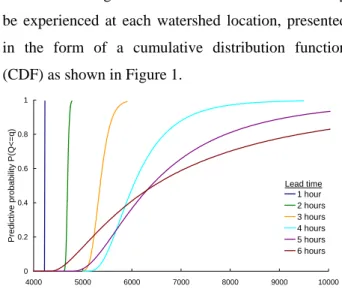
A probabilistic forecast of future short-term flood conditions can be provided for every location in a watershed using the methodology developed by Smith (2005). This is achieved through the use of a Monte Carlo simulation for stochastically modeling and estimating the range of future rainfall conditions, and the use of an adaptive updating scheme for reducing and simultaneously estimating the flood modeling error. The influence of each source of uncertainty on the flood forecast is quantified and combined to estimate the range of future flood conditions that may be experienced at each watershed location, presented in the form of a cumulative distribution function (CDF) as shown in Figure 1. 0 0.2 0.4 0.6 0.8 1 4000 5000 6000 7000 8000 9000 10000 Discharge Q (m3/s) Pred ict ive p ro b a b ility P( Q < = q ) 1 hour 2 hours 3 hours 4 hours 5 hours 6 hours Lead time
Figure 1: Example probabilistic forecast in CDF form
Evacuation
A decision model approach to evacuation decision is developed that aims to minimize loss of life and disruptions to communities through identification of the evacuation decision and strategy that has the maximum expected value based on currently forecasted conditions. The expected value of a given action per unit of population is calculated by integrating over the range of forecasted discharge rates, and the danger to human life associated with each rate. This expected value will vary depending on the geographical characteristics of each location being considered and the choice of action (AE: evacuate;
E
A : don’t evacuate) taken. The decision model
considers a trade-off between the costs to a community of issuing false alarm evacuations, and the risk of loss of life in the event where an evacuation order is not given. Once the expected value of action
AE becomes greater than AE, evacuation becomes
optimal.
As an inundation risk level is assigned in real-time to each area within the target watershed, the optimal evacuation path can be rapidly identified from a number of alternatives by selecting that route which avoids areas at high risk.
Application of the evacuation decision-making framework is discussed in this research considering the Nagara River watershed located in Gifu, Japan.
References
Smith, P. J. (2005). Probabilistic flood forecasting using a distributed rainfall-runoff model. Doctoral thesis, Graduate School of Engineering, Kyoto University, Kyoto.