
Positive Emotion Elicitation in an Example-Based Dialogue System
3
0
0
全文
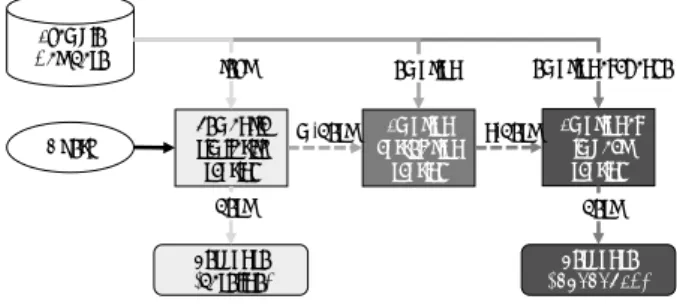
(2) 情報処理学会研究報告 IPSJ SIG Technical Report. Given a query, the cosine similarity scores between its term vector and each of the example queries’ in the database are calculated, and treated as the example scores. The response of the example with the highest score is then returned to the user as the system’s response. This approach has a number of benefits. First, The TF-IDF weighting allows emphasis of important words. Such quality is desirable in considering emotion in spoken utterances. Second, as this approach does not rely on explicit domain knowledge, it is practically suited for adaptation into an affective dialogue system. Third, the approach is straightforward and highly reproducible. On that account, it serves as the baseline in this study.. 4. Proposed Dialogue System. We make use of tri-turn units in the selection process in place of the query-response pairs in the traditional EBDM approach. A tri-turn consists of three consecutive dialogue turns that are in response to each other. In this work, we exploit the tri-turn format to observe emotional triggers and responses in a conversation. Within this work, the first, second, and third turns in a tri-turn are referred to as query, response, and future, respectively. The change of emotion observed from query to future can be regarded as the impact of response. In designing our method, we consider an analogy in human-human communication: emotional impact of a response is heavily dependent on semantic and emotional context of the conversation. For example, an apology could have contrasting outcomes depending on what happened preceding the apology as well as the emotional state of the listener. This suggests that the emotional impact in our examples are specific to the tri-turn context. In other words, semantic and emotional similarity is pre-requisite for the response to yield consistent impact in real interaction. In addition to semantic constraint as described in Section 3, we formulate two types of emotional constraints: (1) emotion similarity between the query and the example queries, and (2) expected emotional impact of the candidate responses. We measure emotion similarity by computing the Pearson’s correlation coefficient of the emotion vector between the query and the example queries. Secondly, we measure the expected emotional impact of. ⓒ 2018 Information Processing Society of Japan. Vol.2018-MUS-118 No.2 Vol.2018-SLP-120 No.2 2018/2/20. the candidate responses by calculating the difference of emotional states between each of their respective query and future. Example Database. Query. text Semantic similarity scoring. emotional change. emotion m-best. Emotion correlation scoring. n-best. Emotional impact scoring. best. best. Response (baseline). Response (proposed). Figure 2: Steps of response selection. Figure 2 illustrates the steps of response selection of the baseline and proposed systems. We perform the selection in three steps based on the defined constraints. For each step, a new score is calculated and re-ranking is performed only with the new score, i.e. no fusion with the previous score is performed.. 5. Experimental Set Up. We utilize The SEMAINE database, consisting of dialogues between a user and an agent in a Wizardof-Oz fashion [6]. There are 5 agent characters with distinct personalities; cheerful Poppy, angry Spike, sad Obadiah, and sensible Prudence. Poppy and Prudence tend to draw the user into the positive-valence region of emotion compared to Spike and Obadiah. To promote positive emotion, we exclusively use sessions of Poppy and Prudence to construct the example database. The training set and test set comprise 29 (15 Poppy, 14 Prudence) and 4 (2 Poppy, 2 Prudence) sessions, respectively. We construct the example database exclusively from the training set, containing 1105 tri-turns. We utilize the transcription and emotion annotation provided from the corpus as information of the tri-turns to isolate any recognition errors. We sample the emotion annotation of every dialogue turn into 100-length vectors. For the n-best filtering, we chose 10 for the semantic similarity constraint and 3 for the emotion.. 6. Human Subjective Evaluation. A total of 50 queries are evaluated through crowdsourcing. The queries are presented in form of text,. 2.
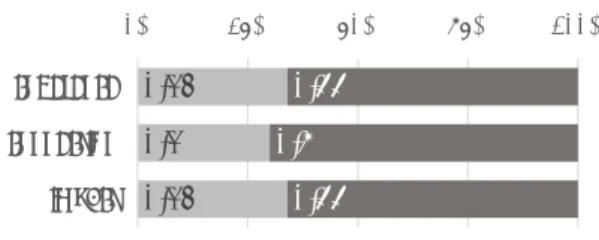
(3) 情報処理学会研究報告 IPSJ SIG Technical Report. Vol.2018-MUS-118 No.2 Vol.2018-SLP-120 No.2 2018/2/20. along with the responses from the baseline and proposed systems. The evaluators are asked to select the better response in terms of naturalness, potential emotion connection, and positiveness of elicited emotion. 50 judgements are collected per query. The final judgement of each query for each question is based weighted majority voting of the judgements. 0% coherence. 0.34. connection. 0.3. impact. 25%. 50%. 75%. 100%. 0.66. 0.7. 0.34. 0.66 baseline. proposed. Figure 3: Subjective evaluation result. Figure 3 visualizes the evaluation result. It is shown that in comparison to the baseline system, the proposed system is perceived as more coherent (66% of the time), having more potential in building emotional connection (70%), and giving a more positive emotional impact (66%). Furthermore, we observe that the queries where the proposed system wins have far stronger agreement than that where the baseline system wins (Fleiss’ Kappa of 0.35 vs. 0.16). Higher agreement level suggests a stronger win, where bigger majority of the evaluators are voting for the winner.. 7. Conclusions. We presented a novel attempt in eliciting postive emotional impact in dialogue response selection by utilizing examples of human appraisal in spoken dialogue. We augment the response selection criteria to take into account emotion similarity between query and the example query, as well as the expected future impact of the candidate response. Human subjective evaluation showed that the proposed system can elicit a more positive emotional impact in the user, as well as achieve higher coherence and potential emotional connection.. References [1] Marcin Skowron, Mathias Theunis, Sebastian Rank, and Arvid Kappas, “Affect and social processes in online communication–experiments with an affective dialog system,” Transactions on Affective Computing, vol. 4, no. 3, pp. 267–279, 2013. [2] Takayuki Hasegawa, Nobuhiro Kaji, Naoki Yoshinaga, and Masashi Toyoda, “Predicting and eliciting addressee’s emotion in online dialogue.,” in Proceedings of Association for Computational Linguistics (1), 2013, pp. 964–972. [3] James A Russell, “A circumplex model of affect.,” Journal of personality and social psychology, vol. 39, no. 6, pp. 1161, 1980. [4] Cheongjae Lee, Sangkeun Jung, Seokhwan Kim, and Gary Geunbae Lee, “Example-based dialog modeling for practical multi-domain dialog system,” Speech Communication, vol. 51, no. 5, pp. 466–484, 2009. [5] Nio Lasguido, Sakriani Sakti, Graham Neubig, Tomoki Toda, and Satoshi Nakamura, “Utilizing human-to-human conversation examples for a multi domain chat-oriented dialog system,” Transactions on Information and Systems, vol. 97, no. 6, pp. 1497–1505, 2014. [6] Gary McKeown, Michel Valstar, Roddy Cowie, Maja Pantic, and Marc Schroder, “The SEMAINE database: Annotated multimodal records of emotionally colored conversations between a person and a limited agent,” Transactions on Affective Computing, vol. 3, no. 1, pp. 5–17, 2012.. Acknowledgement This research and development work was supported by the MIC/SCOPE #152307004.. ⓒ 2018 Information Processing Society of Japan. 3.
(4)
図

関連したドキュメント
As we have said in section 1 (Introduction), using the mentioned tree T , Barioli and Fallat gave the first example for which the equivalence between the problem of ordered
The case n = 3, where we considered Cayley’s hyperdeterminant and the Lagrangian Grass- mannian LG(3, 6), and the case n = 6, where we considered the spinor variety S 6 ⊂ P
In the last part of Section 3 we review the basics of Gr¨ obner bases,and show how Gr¨ obner bases can also be used to eliminate znz-patterns as being potentially nilpotent (see
“Breuil-M´ezard conjecture and modularity lifting for potentially semistable deformations after
Then it follows immediately from a suitable version of “Hensel’s Lemma” [cf., e.g., the argument of [4], Lemma 2.1] that S may be obtained, as the notation suggests, as the m A
Section 3 is first devoted to the study of a-priori bounds for positive solutions to problem (D) and then to prove our main theorem by using Leray Schauder degree arguments.. To show
[Mag3] , Painlev´ e-type differential equations for the recurrence coefficients of semi- classical orthogonal polynomials, J. Zaslavsky , Asymptotic expansions of ratios of
In Section 7, we classify the sets reduced decompositions which can correspond to paths between two flags in a semimodular lattice, and in Section 8, we use our results to derive
