Japanese loanwords in English : A corpus-based
study
著者
MORROW Phillip R
journal or
publication title
THE NAGOYA GAKUIN DAIGAKU RONSHU; Journal of
Nagoya Gakuin University; HUMANITIES and
NATURAL SCIENCES
volume
57
number
1
page range
1-13
year
2020-07-31
URL
http://doi.org/10.15012/00001260
¡
ɜÂóõêäíæɝ¡
Japanese loanwords in English: A corpus-based study
Phillip R. MORROW
Faculty of Foreign Studies Nagoya Gakuin University¡Âãôõóâäõ¡
ɉ This study examines a sample of Japanese loanwords currently used in English with the aim of describing patterns of usage over time and identifying genres in which loanwords are most commonly used. The study is based on investigation of loanwords in two large corpora: The Corpus of Historical American English (COHA) and The Corpus of Contemporary American English (COCA). Findings indicate that, with few exceptions, Japanese loanwords are not very frequent in English, though there is a tendency for their frequency to increase over time.
¡Ìæúøðóåô: Japanese Loanwords, Corpus Studies, COHA, COCA
ᔐȾȝȤɞஓటϋႊᴷɽ˂ʛʃȾژȸȢᆅሱ
P. R. ˸̃ʼ
פࠜᬎށࠜݹ۔ៜࠜᧅ¡²¯±ɉÊïõóðåöäõêðï¡
ɉ For at least 400 years there has been contact between Japan and English-speaking countries, and since the Meiji Era it has been more or less constant. One linguistic result of this has been large-scale borrowing of English words in Japanese; Japanese dictionaries of loanwords include vast numbers of entries for loanwords from English (e.g., Kamiya 1994). However, the borrowing has not been in one direction only. Although borrowing from Japanese has been on a much smaller scale, hundreds of loanwords from Japanese have found their way into English and some of them have become household terms.
ɉ While the spread and use of English loanwords in Japanese has been extensively described and analyzed, Japanese loanwords in English have received much less attention. There are now dictionaries of Japanese loanwords in English which, along with definitions, provide phonetic, grammatical and historical information. However, there has not been much research on the spread and use of Japanese loanwords in English. The existence of large corpora of English makes it possible to investigate in some depth the use of individual lexical items including loanwords. From corpora we can gain information about the frequency of a loanword’s use in various time periods, its frequency in various genres, and we can also examine instances of usage in authentic texts.
ɉ The purpose of this study is to examine a sample of Japanese loanwords that are currently used in English with the aim of describing patterns of usage over time and identifying the genres in which they are most commonly used.
¡³¯±ɉÑóæ÷êðöô¡ôõöåêæô¡
ɉ There has been some research on loanwords related to compiling dictionaries of Japanese loanwords in English. In 1996, Garland Cannon published a volume entitled, The Japanese Contributions to the English Language: An Historical Dictionary . This dictionary contains 1,425 entries for Japanese loanwords which were identified from a survey of major general dictionaries of English, including the second edition of the Oxford English Dictionary , Webster’s Third International Dictionary of the English Language and others. For each entry various information is provided including the first recorded entry date of the word into English, its Japanese meaning(s), its English meaning(s), and notes about grammar and sources. The dictionary also contains a lengthy essay on the semantic fields of the loanwords, and another on their phonological and grammatical features. They provide considerable information about the historical circumstances related to the borrowing of individual loanwords. Individual entries also include a rating for the item’s ždegree of naturalizationſ which is related the frequency of a word in modern usage. However, these ratings were based mostly on the dictionary sources, ž... as there was no access to the attitudinal and other massive data needed
to make refined judgements.ſ (1996: 20)
ɉ A similar volume is A Dictionary of Japanese Loanwords by Toshie M. Evans (1997). This dictionary sets out to provide an index of English terms borrowed from Japanese. The entries come not only from standard English dictionaries, but also publications that analyze new words (1997: ix). Thus, it includes not only loanwords that have long been part of English, but recent borrowings as well. Entries include one or two authentic example sentences to illustrate how each word is used. ɉ Apart from the dictionaries, there has also been research on loanwords by Schun Doi, who published articles about Japanese loanwords in English (2010, 2014) based on a master’s thesis (2006) and doctoral dissertation (2013) at Nagoya University. Doi (2010) investigates the kinds of Japanese loanwords in English, basing the study on the loanwords in the Oxford English Dictionary . Doi’s research also has a historical dimension as it examines in particular the words that came into English from the English version of Kæmpfer’s The History of Japan, which was published in 1727, reissued in 1728, and was žthe greatest single contributor of Japanese loanwords found in the OED ...ſ (Doi 2010: 85). An exhaustive list of some 1,500 Japanese words contained in the book was made from a digitalized version of the book (Doi 2010: 91).
ɉ The dictionaries by Cannon (1996) and Evans (1997), and the publications by Doi (2010, 2014) provide significant linguistic and historical information about the borrowing of loanwords from Japanese. They do not, however, provide much information about the spread and use of Japanese loanwords after they have been introduced. For this purpose, data from large corpora of English are valuable. The following sections describe how corpus data can be used to gather information about the spread and use of loanwords in English.
¡´¯±ɉÅâõâ¡
ɉ The present study is concerned with Japanese loanwords that have currency among ordinary speakers of American English. Therefore, in selecting loanwords to study, I have generally avoided technical terms and items which were used at one time but have since fallen out of use, or are very infrequently used. Moreover, as this is a small-scale study, the number of items had to be limited. I attempted to include a range of loanwords by including items from a variety of semantic fields, and by including items that have long been part of English as well as items that have been introduced relatively recently. The English version of Wikipedia contains a žList of English words of Japanese originſ with about 150 items. Some of them could be considered household words that would certainly be familiar to almost every speaker of American English, for example, haiku , karate, sushi , tsunami or tycoon . Others would be familiar to Americans who have some experience of or interest in Japanese culture, for example, aikido, futon, kabuki, manga , or shogun . And then there are items which may be less well-known, but are widely-used by those with an interest in, for example,
Japanese cuisine, martial arts or religion. These include, for example, miso, wasabi, dojo, kendo, koan and torii . As I wished to use items that were part of current English, I limited items to those included in the online edition of the Merriam-Webster Dictionary of the English Language. The online edition contains 60,000 of the most common words in the English language. Less common loanwords can be found in the unabridged edition of the dictionary.
ɉ By limiting items in this way, I narrowed the scope of the study to 85 items drawn from a range of semantic fields, including items with meanings related to cuisine, business, art, fashion, politics, martial arts, religion and other aspects of Japanese life and culture. I did not attempt to balance the numbers of items from different fields. It is clear that there are many more loanwords from some fields (e.g., cuisine) than others (e.g., religion), and consequently, the items investigated here come more from some fields than others. Cannon (1996: 35) has noted that loanwords are more frequent in certain fields. He classified his dictionary’s 1425 entries into 40 semantic fields. Among them, there were seven with 50 or more loanwords: botany (280), martial arts (85), food (80), politics (58), Buddhism (57), industry (56), and fish (50) (Cannon 1996: 35). In the present study, items from all of these fields were included.
¡µ¯±¡Îæõéðåðíðèú¡
ɉ The use of corpora makes it feasible to investigate the spread and use of loanwords on a much broader scale than would otherwise be possible. Two corpora were used for this study: the Corpus of Historical American English (COHA) and the Corpus of Contemporary American English (COCA). Both are very large: COHA contains about 400 million words from the 1810s to the 2000s, and COCA has more than one billion words (20 million words for each year 1990 Ż 2019). COHA is balanced by genre and decade. COCA is organized into five categories of equal size: Spoken, Fiction, Popular Magazines, Newspapers and Academic journals. There is further balancing within these categories: Newspapers, for example, includes texts from various sections. COCA texts are also grouped in five-year periods.
ɉ Using these large corpora enables a researcher to get a picture of how frequent a particular loanword is, the genres in which it is used, and patterns of usage over the time period covered by the corpora. However, it is not an exact picture. In order to see from a corpus how a word is used in the language over time, the corpus needs to be a representative sample of the language. It needs to include texts from many different genres and time periods. Very large corpora such as COHA and COCA are designed to provide a representative sample, but even in such corpora, some of the texts that comprise them might have a particularly high or low frequency of a given word making it appear that that word is more or less frequent than it actually is in the language overall. Nevertheless, corpora can provide us with a good indication of how frequently, in what genres, with which collocates,
and in which syntactic patterns a particular word is used. This is especially true for common words with relatively high frequency.
ɉ Because of differences in size and structure, we cannot make exact comparisons between findings from COHA and COCA, but by using both corpora we can get a clearer picture of the patterns of usage of individual loanwords in the past and at the present.
¡¶¯±ɉÓæôöíõô¡âïå¡åêôäöôôêðï¡
ɉ This section presents findings and related discussion about frequencies of loanwords and genres they occur in, and considers some general characteristics of Japanese loanwords.
¡¶¯²ɉÇóæòöæïäêæô¡ðç¡íðâïøðóåô¡
ɉ Table 1 presents frequency information about Japanese loanwords in COHA. Each item is followed by a year in parentheses: the year of the item’s first attested use in English, as reported in the Merriam-Webster Online Dictionary. The third column shows the number of tokens (occurrences) of each item in COHA. Texts in COHA are classified according to the decade in which they were published. The fourth column indicates the decade of the earliest occurrence of the item in the texts that make up the corpus. The fifth column shows the decade for which there are the most tokens. This number is given only for items with 10 or more tokens in the corpus. The items in Table 1 are not listed alphabetically, but grouped by semantic field.
ɉ It was necessary to adjust some of the token numbers because some items were used not only as loanwords, but had some other use(s), often as proper names. For instance, an automatic search of COCA returned 238 tokens of torii , but examination of individual concordance lines showed that in the majority of these, torii was used as a proper noun (the name of a famous baseball player). These instances were eliminated manually leaving only 12 cases in which torii was used as a loanword. In order to deal with such cases, I examined the first 100 concordance lines for each item to verify that the item was being used as a loanword. Instances in which the item was used with a different meaning–often cases in which a word was used as a proper name–were deducted from the frequency count produced automatically by the corpus search. A few words of high frequency were eliminated because they were used almost entirely in a sense unrelated to their loanword meaning (e.g., sake was hardly ever used to refer to the alcoholic beverage).
ɉ An initial observation on the data in Table 1 is that a majority of these current loanwords were first used in English more than century ago. Most date from the 19 th century, but there are a few from the
18 th century ( ginkgo, shoyu, daimyo, satori, Shinto, torii, koi ). There are also two items from the 17 th
century, inro and soy , and one from the 16 th , bonze .
Table 1. Loanword data from COHA Loanword First Recorded Appearance Tokens in COHA Decade of First Corpus Appearance Decade of Highest Token Frequency (Token No.) 1 bokeh 2000 0 2 bonsai 1899 87 1960 1960ᶨ44ᶩ 3 bunraku 1920 3 1980 4 haiku 1902 70 1950 2000ᶨ20ᶩ 5 ikebana 1901 10 1980 1990ᶨ6ᶩ 6 kabuki 1899 62 1940 1950ᶨ19ᶩ 7 kakemono 1889 11 1883 1900ᶨ5ᶩ 8 karaoke 1977 85 1970 2000ᶨ29ᶩ 9 koto 1795 10 1880 1980 & 1990ᶨ3ᶩ 10 makimono 1880 4 1910 11 manga c. 1951 33 1990 2000ᶨ20ᶩ 12 netsuke 1876 76 1880 2000ᶨ70ᶩ 13 origami 1948 50 1970 2000ᶨ27ᶩ 14 shamisen 1864 3 1990 15 ukiyo-e 1879 2 1990 16 kanban 1977 8 1980 17 keiretsu 1975 5 1980 18 tycoon 1857 510 1860 1920ᶨ91ᶩ 19 zaibatsu 1947 42 1940 1990ᶨ21ᶩ 20 inro 1617 3 2000 21 kimono 1886 526 1890 1950ᶨ95ᶩ 22 zori 1823 24 1950 1950ᶨ23ᶩ 23 bento 1895 3 1980 24 daikon 1873 21 1980 1990ᶨ10ᶩ 25 dashi 1955 5 2000 26 edamame 1951 9 2000 27 fugu 1909 9 1980 28 ginkgo 1773 114 1910 1990ᶨ50ᶩ 29 hibachi 1863 27 1890 1890/1990/2000ᶨ5ᶩ 30 kombu 1884 5 1990 31 matsutake 1883 3 1990 32 mirin 1874 6 2000 33 miso 1615 96 1970 2000ᶨ73ᶩ 34 mizuna 1976 2 1990 35 mochi 1970 7 2000 36 nori 1892 3 1990 37 ramen 1962 26 1990 1990/2000ᶨ13ᶩ 38 sashimi 1879 38 1955 2000ᶨ17ᶩ 39 satsuma 1882 4 2000 40 shiitake 1877 47 1980 1990ᶨ24ᶩ
41 shoyu 1727 3 1980 42 soba 1896 22 1990 2000ᶨ13ᶩ 43 soy 1679 845 1820 2000ᶨ359ᶩ 44 sukiyaki 1919 17 1940 1950ᶨ7ᶩ 45 surimi 1973 5 1980 46 sushi 1893 218 1970 2000ᶨ116ᶩ 47 tempura 1920 27 1940 1990ᶨ7ᶩ 48 teriyaki 1901 30 1970 2000ᶨ14ᶩ 49 tofu 1771 254 1970 2000ᶨ125ᶩ 50 udon 1902 4 1990 51 umami 1963 2 2000 52 wakame 1950 3 2000 53 wasabi 1891 34 1980 2000ᶨ27ᶩ 54 yakitori 1962 1 1990 55 daimyo 1727 10 1900 1900ᶨ4ᶩ 56 genro 1876 11 1910 1930ᶨ6ᶩ 57 mikado 1727 178 1840 1900ᶨ46ᶩ 58 shogun 1727 98 1880 2000ᶨ35ᶩ 59 aikido 1954 10 1980 2000ᶨ5ᶩ 60 dojo 1942 14 1960 2000ᶨ6ᶩ 61 judo 1889 179 1840 1960ᶨ66ᶩ 62 karate 1926 243 1950 2000ᶨ61ᶩ 63 kendo 1921 39 1960 2000ᶨ36ᶩ 64 bonze 1577 18 1860 1900/1960ᶨ4ᶩ 65 koan 1945 11 1980 1980/1990/2000ᶨ4ᶩ 66 satori 1727 8 1970 67 shinto 1727 113 1890 1950ᶨ26ᶩ 68 torii 1727 6 1950 69 emoji 1997 0 70 futon 1876 129 1980 1990ᶨ70ᶩ 71 geisha 1881 160 1900 1950ᶨ42ᶩ 72 honcho 1945 47 1970 1990ᶨ17ᶩ 73 kamikaze 1945 116 1940 2000ᶨ24ᶩ 74 koi 1727 34 1980 2000ᶨ23ᶩ 75 kudzu 1876 199 1940 2000ᶨ140ᶩ 76 ninja 1964 97 1980 2000ᶨ49ᶩ 77 rickshaw 1879 148 1890 1990ᶨ30ᶩ 78 sayonara 1872 148 1890 1990ᶨ30ᶩ 79 samurai 1727 282 1880 2000ᶨ75ᶩ 80 sensei 1874 10 1950 2000ᶨ4ᶩ 81 shiatsu 1967 6 1980 82 skosh 1952 0 83 sudoku 2000 12 2000 2000ᶨ12ᶩ 84 tsunami 1896 167 1940 2000ᶨ143ᶩ 85 urushiol 1908 17 1950 1990ᶨ15ᶩ
decades in which five or more loanwords were most frequent: 1950s, 1990s and 2000s. For each of the other decades, beginning with 1810, there were fewer than five words that were most frequent. The last two decades in the nearly 200 years covered by COHA were the ones in which the largest number of loanwords occurred most frequently. 15 loanwords occurred most frequently in the 1990s, and 29 in the 2000s. In general, this points to a tendency for loanwords to be more frequent more recently. Further evidence of this tendency can be seen in Table 3 based on findings from COCA. ɉ Table 2 shows the items that had overall frequencies of 1.0 per million words or higher in the two corpora, and Table 3 provides information about the frequency of loanwords in COCA and the genres in which frequently used loanwords appeared. Table 3 also shows genres in which an item had a frequency greater than 1.0 per million words. In some cases, loanwords with a frequency of less than 1.0 per million words overall had frequencies higher than 1.0 in particular genres.
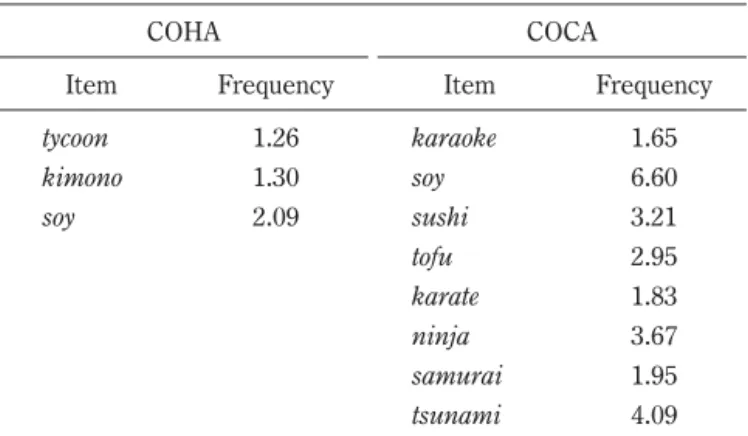
ɉ Table 2 shows that there are three items with an overall frequency higher than 1.0 per million words in COHA, and seven items in COCA. One of the items, soy , is frequent overall in both corpora. ɉ We can make a rough comparison of loanword frequency in COHA and COCA by taking account of their relative sizes. COHA contains slightly over 400 million words and COCA slightly over a billion. Thus, COCA is about 2.5 times as large as COHA, and a frequency of 20 tokens in COHA would be comparable to a frequency of 50 tokens in COCA. If we adjust the COHA figures (multiply by 2.5) to compare them with the figures for COCA, we find that 71 of 85 loanwords are more frequently used in the time period covered by COCA (1990 Ż 2019) than that covered by COHA (1810 Ż 2000). Among the 14 loanwords that were not used more frequently in COCA, there were five that were borrowed in 1727 or earlier, and there were only three that were borrowed after 1900. This could suggest a tendency for earlier loanwords to be less frequent, though there is not enough data to draw a clear conclusion on this point. Furthermore, it is not clear exactly how much the use of Japanese loanwords in English has increased overall based on this data because the sample size is relatively small and may not be representative of all Japanese loanwords, even though the loanwords were selected from
Table 2. Loanwords with frequency higher than 1.0 per million words in COHA and COCA
COHA COCA
Item Frequency Item Frequency
tycoon 1.26 karaoke 1.65 kimono 1.30 soy 6.60 soy 2.09 sushi 3.21 tofu 2.95 karate 1.83 ninja 3.67 samurai 1.95 tsunami 4.09
Table 3. Loanword data from COCA
Loanword Tokens in COCA
Genres with High Frequencies of Loanwords (tokens per million words)
1 bokeh 179 2 bonsai 418 3 bunraku 19 4 haiku 554 5 ikebana 57 6 kabuki 499 Newsᶨ1.35ᶩ 7 kakemono 1
8 karaoke 1,810 TV/M 3.63, News 2.66, Mag 1.82, Spok 1.63, Web 1.42, Blog 1.34, Fic 1.30
9 koto 36
10 makimono 12
11 manga 1,405 Web 5.75, Blog 2.25, Acad 1.44
12 netsuke 87
13 origami 711 Fic 1.43, Web 1.18
14 shamisen 19
15 ukiyo-e 21
16 kanban 79
17 keiretsu 116
18 tycoon 1,081 News 2.15, Mag 2.05, Fic 1.1
19 zaibatsu 52
20 inro 4
21 kimono 937 Fic 3.15, Acad 1.44
22 zori 5 23 bento 301 24 daikon 197 25 dashi 74 26 edamame 378 Mag 2.13 27 fugu 79 28 ginkgo 474 Mag 1.98 29 hibachi 110 30 kombu 43 31 matsutake 22 32 mirin 159
33 miso 697 Mag 2.72, News 1.34
34 mizuna 87
35 mochi 87
36 nori 203
37 ramen 746 Web 1.19, News 1.13, Blog 1.07
38 sashimi 311
39 satsuma 67
40 shiitake 482 Mag 2.13
41 shoyu 33
43 soy 7,337 Mag 26.73, News 8.11, Web 7.49, Blog 4.92, TV/M 3.65, Fic 2.96, Acad 2.82
44 sukiyaki 34
45 surimi 153 Acad 1.1
46 sushi 3,679 News 6.78, TV/M 5.63, Web 4.60, Mag 4.08, Blog 3.16, Spok 1.36
47 tempura 193
48 teriyaki 348
49 tofu 3,167 Mag 13.16, News 4.14, Blog 1.97, TV/M 1.87, Web 1.63, Fic 1.45
50 udon 90
51 umami 154
52 wakame 38
53 wasabi 497 Mag 1.36, News 1.23
54 yakitori 34 55 daimyo 19 56 genro 3 57 mikado 128 58 shogun 368 Fic 1.14 59 aikido 177 60 dojo 333 61 judo 822 News 2.51
62 karate 1,979 TV/M 5.30, Fic 2.47, Mag 2.06, News 1.98, Blog 1.35, Web 1.26, Spok 1.09 63 kendo 113 64 bonze 6 65 koan 179 66 satori 136 67 shinto 316 68 torii 12 69 emoji 384 Mag 1.32 70 futon 672 Fic 3.36 71 geisha 630 Fic 1.25 72 honcho 414 73 kamikaze 573 74 koi 428
75 kudzu 658 Mag 2.21, News 1.08, Fic 1.01
76 ninja 4,177 TV/M 17.85, Web 4.73, Blog 3.65, Mag 2.61, Fic 1.83, News 1.51
77 rickshaw 436 Fic 1.81
78 sayonara 318 TV/M 1.33
79 samurai 2,185 TV/M 5.15, Fic 3.90, Web 2.45, News 1.55, Blog 1.52 80 sensei 883 TV/M 3.58, Fic 1.85
81 shiatsu 168
82 skosh 54
83 sudoku 209
84 tsunami 4,827 Spok 10.10, Web 7.15, Mag 6.01, News 5.44, Blog 4.49, Acad 2.16, TV/M 1.71, Fic 1.34
a variety of fields. Nevertheless, these findings strongly suggest that the use of Japanese loanwords has become more frequent since 2000. This is consistent with the trend noted earlier in COHA for frequent loanwords to be used with highest frequency in the last decades (1990s ᶦ 2000s) included in that corpus.
¡¶¯³ɉÈæïóæô¡ðç¡íðâïøðóåô¡
ɉ As for genre, it is difficult to discern any clear overall patterns. For example, if we look at the six items with an overall frequency higher than 1.0 per million (see Table 2), we find that soy and tofu occurred with the highest frequency in the genre of Magazine, while karate and ninja occurred mostly in the TV/Movie genre, sushi occurred most frequently in the News genre, and tsunami in the Spoken genre. Table 4 shows the number of loanwords with a frequency higher than 1.0 per million in each genre. Fiction, Magazine and News genres have relatively high numbers, while Spoken and Academic have lower ones.
Table 4. Number of loanwords with frequency
above 1.0 per million words by genre
Genre Frequency 1 Fiction 16 2 Magazine 16 3 News 15 4 Web 11 5 TV/Movie 10 6 Blog 10 7 Academic 5 8 Spoken 4
ɉ Although there were not clear patterns of usage by genre for the loanwords as a whole, within the semantic field of food, there was a tendency for frequent loanwords to be used in the Magazine genre. Eight of the ten food-related loanwords which had frequencies higher than 1.0 per million in a particular genre were frequent in the Magazine genre.
¡¶¯´ɉÄéâóâäõæóêôõêäô¡ðç¡íðâïøðóåô¡
ɉ All of the loanwords in this study were nouns or had nominal forms. Nouns are the most common type of loanword. Perhaps this is natural since loanwords are typically for new things or concepts that have been borrowed from another culture and for which there were no names or terms in the borrowing language. In other words, they are borrowed in order to fill a lexical gap. This is not always case, but it is very often so.
suffix. This contrasts with Japanese in which nouns are not marked for plurality. Most Japanese loanword nouns do not take the plural suffix when they become part of English. According to the Merriam-Webster online dictionary only 18 of the 85 loanwords in this study take the suffix. However, it is possible that a larger proportion of Japanese loanword nouns will be used with the plural suffix over time as they become more fully assimilated in English. For example, I have heard American native English speakers say kimonos , though the Merriam-Webster dictionary does not include kimono as a form which takes the plural suffix.
ɉ There are also a few cases in which loanwords take other suffixes. The following forms are included in Merriam-Webster and are attested in COCA: kimonoed, Shintoism, Shintoist, shogunal and shogunate . Merriam-Webster also includes Shintoistic and karateist , but these forms were not attested in COCA. The use of suffixes makes it possible for a loanword to be used as a part of speech other than noun. The extent to which a loanword can be used with English affixes could be considered one indication of the extent to which the form has been assimilated in English, or has penetrated American culture. We cannot generalize based on these limited examples, but the use of English morphological affixes with Japanese loanwords is a research issue to be pursued with a larger number of loanwords.
ɉ In the examples above, an English affix was added to a loanword, but there is at least one case in which borrowing resulted in a truncated form. This is the case of skosh ‘a small amount’, from the Japanese sukoshi , ‘a bit’ or ‘a few’.
¡·¯±ɉÄðïäíöôêðï¡
ɉ This study illustrates how large corpora can be useful in researching the spread and use of loanwords in a language. Corpora can provide frequency data which is useful in at least two important ways. First, it enables researchers to track the spread of an individual lexical item over time and to identify the genres in which it is frequently used. Second, if we look at frequency data about a large number of loanwords we can identify general trends related to the use of loanwords in the language over time.
ɉ In the present study we could see that although many Japanese loanwords are familiar, very few of them are highly frequent in English. Among the 85 loanwords surveyed in this study, only seven had frequencies higher than 1.0 per million words in COCA overall. However, it was shown that some of these items did have much higher frequencies in certain genres. Furthermore, comparison of loanword frequencies in the two corpora indicated that Japanese loanwords have come to be more frequently used over time. It would be very useful to pursue this line of research with a larger sample.
clearly the extent to which they have assimilated to English, and how much they taken on new meanings or uses. For instance, there has been some semantic shift for hibachi . In Japanese it refers to a traditional heating device used in cooking, but in its English usage, it refers to a portable grill heated by charcoal, and usually used for barbecues. To take another example, kamikaze originally referred to a member of the Japanese air attack forces who made suicidal crashes on a target, or to an airplane used for such attacks, but now kamikaze is also used as an adjective with the meaning, žhaving or showing reckless disregard for safety or personal welfare.ſ (Merriam-Webster online) Such cases of semantic shift or expansion could be investigated by detailed study of concordance lines for items in a corpus. Thus, there remains ample scope for further studies of the spread and use of Japanese loanwords in English.
¡Óæçæóæïäæô¡
Cannon, G. (1996). The Japanese contributions to the English language: An historical dictionary . Wiesbaden: Harrassowitz Verlag.
Doi, S. (2006). The adaptation of Japanese loanwords into present-day English: With special reference to the Oxford
English Dictionary . Unpublished MA Thesis, Nagoya University.
Doi, S. (2010). Japanese loanwords in the Oxford English Dictionary and in the English version of Kæmpfer’s the History of Japan. In T. Fujita, S. Suzuki, and N. Matsukura (Eds.), The future of English studies (pp. 84 Ż 99). Tokyo: DTP Publishing.
Doi, S. (2013). Japanese loanwords found in the Oxford English Dictionary and Kæmpfer’s the History of Japan . (Doctoral dissertation, Nagoya University). Retrieved from https://nagoya.repo.nii.ac.jp
Doi, S. (2014). The naturalisation process of Japanese loanwords found in the Oxford English Dictionary. English Studies, 95 , 674 Ż 699.
Evans, T. M. (1997). A dictionary of Japanese loanwords . Westport, CN: Greenwood Press.
Kamikaze. (2020). In Merriam-Webster.com. Retrieved March 30, 2020 from https://www.merriam-webster. com/dictionary/kamikaze.
Kamiya, T. (1994). Tuttle new dictionary of loanwords in Japanese: A user’s guide to Gairaigo . Tokyo: Tuttle. List of English words of Japanese origin (2020, March 6). In Wikipedia . Retrieved from https://en.wikipedia.org/