F0, EMG and Tonogensis in Thai
著者
Erickson Donna, Abramson Arthur S.
journal or
publication title
THE NAGOYA GAKUIN DAIGAKU RONSHU; Journal of
Nagoya Gakuin University; LANGUAGE and CULTURE
volume
24
number
2
page range
1-13
year
2013-03-31
1. Introduction
1.1. Thai tones.
Central Thai has five lexically contrastive tones: mid, low, high, falling, and rising (e.g., Haas, 1956; Henderson, 1949; Abramson, 1962; Erickson, 1976). The mid, high, and low tones are somewhat static or level; their F0 trajectories are relatively flat. In contrast, the falling and rising tones are contour or dynamic tones; during these tones, F0 changes direction sharply (Abramson, 1962).
Figure 1 (Erickson, 1976) shows typical F0 contours for the five tones of Central Thai for long
F0, EMG and Tonogensis in Thai
1)Donna Erickson
*, Arthur S. Abramson
*** Showa University of Music & Sophia University ** University of Connecticut & Haskins Laboratories
1) This work is based on the first author’s doctoral research in Thailand during 1972 ― 1974, and is a part of her doctoral dissertation (Erickson, 1976), parts of which have been published in Erickson (1994) and Erickson (2011) but reports about muscle activity in connection with initial stops have not been published anywhere other than the thesis itself. The research into tonogenesis appeared in Erickson (1975), and was done at the Central Institute of English Language, under the sponsorship of the National Research Council of Thailand and a grant from the National Science Foundation of the United States of America.
Abstract.
This paper, based on examination of initial F0 of bilabial stops in Standard Thai, reports that pre-voiced bilabial stops (negative VOT) have lower initial F0 than the voiceless (approximately 0ms VOT) or voiceless aspirated stops (those with positive VOT). Also reported in this paper are measurements from electromyographic (EMG) laryngeal muscle activity (cricothyroid and strap muscles) associated with the initial F0 of the bilabial stops. The F0 and EMG data are discussed in terms of historical theories of tonogenesis for Thai. The F0 data support the hypothesis of tonogenesis as put forth by historical linguists; however, a connection between the laryngeal muscles examined and the high/low intrinsic F0 of the bilabial stops was not found. Additional acoustic, aerodynamic and laryngeal research is needed in order to understand the interaction between initial stops and the development of tones.
vowels in citation form of two male Bangkok speakers. They are the averages of 16 utterances, spoken with the carrier phrase /əə buu/, meaning, “Yes, it is a ‘buu’”, where /buu/ has a meaning on three of the tones (high falling tone: dented, crushed; high tone: action packed; low tone: goby, a kind of fish), and the final syllable is the one that carries the tones, as realized in phrase final position. Long vowels are represented by double vowel symbols in the phonemic transcription.
The F0 trace begins at the onset of phonation after release of the stop. The mid tone has a relatively flat contour in the mid voice range that in phrase final position drops toward the end of the syllable. The high tone has a relatively flat contour that begins with an F0 slightly higher than the mid tone and reaches an even higher F0 before dropping slightly. The low tone begins with an F0 slightly lower than the mid tone and slopes downward to end on an even lower F0. The falling and rising tones have relatively dynamic ranges of F0 excursions compared to the other three tones. The falling tone begins with an F0 slightly higher than the mid tone, rises to a high maximum, and then drops rapidly to an F0 about as low as that of the low tone. The rising tone begins with an F0 slightly lower than the mid tone, drops down to a low minimum, and then rises rapidly to a high F0 sometimes even above that of the high tone.
Figure 2 shows F0 for two additional Bangkok speakers, one male (CT) and one female (SS). The contours are quite similar to those in Figure 1, although perhaps the F0 onsets of the high tone are slightly lower than that for the mid tone for these two speakers. Also, for SS there appears to be an initial “bump” for the high, mid and rising tones not seen for the other male speakers.
Figure 1. F0 contours of Thai tones on the syllable /buu/ for two male Bangkok speakers of Thai. The x-axis is time in ms, with 0 indicating the release of the stop; the y-axis, fundamental frequency in Hz.
1.2. Thai initial stops
For initial stops, Thai has three categories of voice onset time (VOT) for bilabial and alveolar stops. In this study, the focus is on the bilabial stops, /b/, /p/, and /ph/: /ph/ is an aspirated voiceless stop for which voicing (vibration of the vocal folds) begins some time after the release of the stop; /p/ is an unaspirated voiceless stop for which voicing begins at about the same time the stop is released; and /b/ is a voiced stop for which voicing begins some time before the release. As for voicing contrasts, for their Thai data, Lisker and Abramson1 (1964), found average VOT values of +64ms for /ph/, +6ms for /p/, and -97ms for /b/.
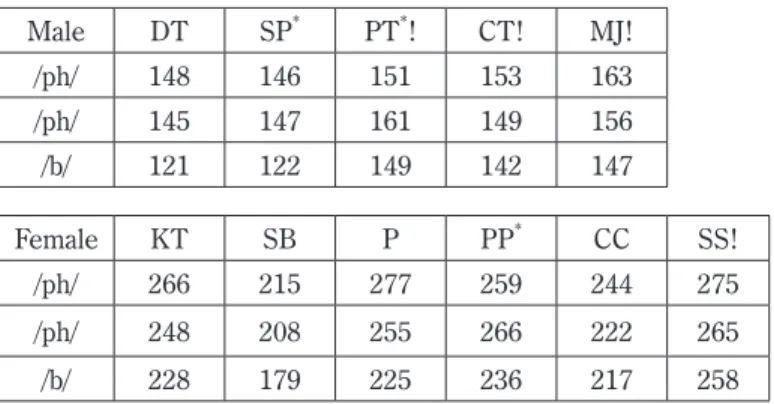
Initial F0 of bilabial stops also varies, such that generally the voiceless aspirated stop /ph/ starts with the highest F0, then the voiceless unaspirated stop /p/, with the pre-voiced stop /b/ having the lowest F0. Table 1 shows average F0 measurements from narrow band spectrograms of bilabial stops for 11 Thai (Bangkok) speakers (Erickson, 1975, p. 102). Looking at the averaged values, 100% show /b/ with the lowest F0, 73% have /ph/ with highest F0, and 27% have /p/ with highest F0. These results suggest that in Standard Thai, the voiced stop /b/ has an intrinsically low F0, while the voiceless stops have intrinsically high F0 values, with a tendency for /ph/ to be higher in initial F0 than /p/.
Figure 2. F0 contours of Thai tones on the syllable /buu/ for one male (CT) and one female (SS) Bangkok speaker of Thai. The x-axis is time in ms, with 0 indicating the release of the stop; the y-axis, fundamental frequency in Hz.
2. Fundamental frequency (F0)
Fundamental frequency, (F0), the major acoustic correlate of the sensory dimension pitch, is defined as the rate of the quasiperiodic vibration of the vocal folds. Both laryngeal and respiratory functions contribute to F0, and the exact role of each still remains to some extent unclear.
According to Van den Berg’s (1985) myoelastic aerodynamic theory, the vocal folds are set into vibration by pressure forces generated by the lungs during expiration. For phonation, the vocal folds are brought together by adductor muscles of the larynx. Adduction causes an increase in subglottal pressure to be built up under the folds. When the subglottal pressure overcomes the glottal resistance, the vocal folds are blown apart. The decrease in pressure at the glottis while the folds are in the abducted position (Bernouilli effect) along with the elastic properties of the vocal folds themselves, causes the vocal folds to return to the closed position. The entire cycle is thus repeated. The fundamental frequency (F0) corresponds to the rate at which the vocal folds complete one full vibratory cycle, which rate is determined primarily by the vocal folds, their tension, and the subglottal pressure. With regard to F0 changes in an intonation type language such as English, aerodynamic and electromyographic studies, (e.g., Vanderslice, 1967; Ohala, 1970; and Atkinson, 1978) suggest that laryngeal muscles have the primary role in the control of F0, with aerodynamic factors a secondary. The laryngeal muscles primarily affecting F0 are the cricothyroid, vocalis and strap muscles (sternohyoid, sternothyroid and thyrohyoid) which interact in a complex fashion to change the length, mass and tension of the vocal folds. The cricothyroid changes the tension of the folds by modifying their length and mass, while the vocalis muscle varies tension inherent in the folds in the absence of change in their length or mass (Kotby and Haugen, 1970: 207). The strap muscles are thought to
Table 1. Average F0 (Hz) for initial bilabial stops /b p ph/ on the syllable /uu/. N=8. The asterisk indicates speakers for whom /ph/ does not have higher F0 than /p/. The ! indicates the four speakers who participated in the EMG experiment discussed in sections 3 and 4. Male DT SP* PT*! CT! MJ! /ph/ 148 146 151 153 163 /ph/ 145 147 161 149 156 /b/ 121 122 149 142 147 Female KT SB P PP* CC SS! /ph/ 266 215 277 259 244 275 /ph/ 248 208 255 266 222 265 /b/ 228 179 225 236 217 258
reduce the tension by either shortening the folds or by increasing their mass, or by a combination of these strategies. For a more detailed account of laryngeal control of F0, the reader is referred to e.g., Honda (2007).
2.1 Laryngeal muscle control of F0 underlying tones of Thai
An electromyographic (EMG) study of Thai tones by Erickson (1976, 1994, 2011) reported that each tone has a distinct pattern of EMG activity, for the cricothyroid (CT) and strap muscles (sternoyhyoid (SH), sternothyroid (ST) and thyrohyoid (TH)). For high F0 of the high, rising and falling tones, there is an increase in CT activity well before the onset of the F0 rise; for the low F0 of the low, rising, and falling tones, as well as for the final fall of the mid tone, there is an increase in strap muscle activity well before the F0 fall. A representative example of the F0 contours with CT and strap muscle activity (TH in this case) is shown in Figure 3 below, for speaker MJ. Notice the reciprocal relationship between CT and the strap muscle, TH: when the CT is active, the strap muscles (in this case, TH) are suppressed, and vice versa. This finding is consistent with the observation that the CT is involved in F0 raising and the strap muscles in F0 lowering.
Figure 3. Cricothyroid, Thyrohyoid and F0 for each of the five tones of Standard Thai, produced by a male Thai speaker (Bangkok). The x axis represents time in ms, with 0 indicating the release of the stop, and the y-axis the amount of muscle activity in microvolts.
2.2. Control of F0 for initial consonants 2.2.1. Muscle control.
Muscle control of F0 during initial bilabial stops in Thai was also investigated by Erickson (1976). In this study, the bilabial initial stops examined were for the initial consonants /b, p, ph/ spoken on each of the five tones, for a total of 45 utterance types, (five tones, three vowels and three consonants), and 16 repetitions. (Note that the Erickson (1975) study looked at the syllables /buu, puu, phuu/ for only the mid tone.) F0 of the initial stops was measured at the release of the stop, and the EMG peak activity was measured at or slightly before the onset of phonation after the stop release. In certain cases where level activity occurred in the region with no peaks apparent in the region of the lineup point (release of the stop), measurements were made at the lineup point. In order to examine the differences in F0 due to differences in initial consonants, the intial F0 was normalized across vowel and tone types for each set of similar vowel/ tone combination and the deviation from the average F0 for each of these sets was plotted to show the relative distribution of onset F0 for the different classes of initial stop consonants. The comparisons of muscle activity were prepared similarly.
The results of the examination of initial F0 of the consonants are displayed in Figure 4. Voiced /b/ consistently has a lower initial F0 than the voiceless stops /p, ph/, and the voiceless aspirate tends to have higher F0 than the voiceless inaspirate, although as mentioned above, there is some inconsistency among the speakers. Speaker SS seems to have the least F0 overlap for /p/ and /ph/, which was also seen in Table 1. Speaker MJ seems to have the clearest difference in F0 for all three stop categories. In general the F0 data are similar to those reported by Gandour (1974) and Erickson (1975).
Given the tendency for voiced stops to have lower F0 than their voiceless cognates, muscle activity at or near the stop release Figure 4. F0 of initial bilabial stops for 4 speakers of
Standard Thai. The 0 point represents the normalized F0 values across vowel and tone types for each set of similar vowel/tone combination; the deviation greater from the average F0 is indicated by the values to the right of the 0, and those less, to the left of the 0.
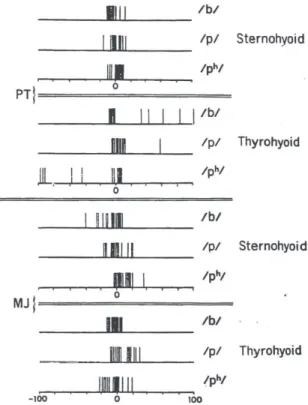
was examined to detect any correlations with F0. Results of the EMG investi-gation for strap muscle activity in initial stops are displayed in Figures 5 and 6. A great deal of inconsistency both across and within speakers is evident. Only one speaker (SS) (Figure 6) shows a clear difference in the distribution of muscle activity for different stop types (for the sternohyoid muscle) producing both /b/ and /ph/ with approximately equal low levels of activity, and /p/ showing the highest level of activity. These results do not support the view that the strap muscles are active in bringing about the low intrinsic F0 of initial /b/ stops in Thai.
As for cricothyroid activity associated with stop consonants, Figure 7 displays these results. No consistent differences in muscle activity corresponding to the different consonants are apparent, although there is a tendency for /ph/ and /b/ to show greater activity than /p/.
That /b/ shows a similar pattern of activity with /ph/ in this study is not explicable at this time.
Although it is fairly clear that the Thai voiced stops have initial low F0, and voiceless stops, initial high F0, the patterns of cricothyroid and strap muscle activity do not give evidence that these laryngeal muscles are involved in the intrinsic F0 of initial stop consonants in Thai. However, a more recent electromyographic study of Dutch and English consonants (Lö fqvist, et al., 1989), found heightened contraction of the CT during the occlusion of the voiceless consonant and the transition into the following vowel, associated with the increased F0 at syllable onset. The suggestion is that CT contraction, since it increases the longitudinal tension of the vocal folds, would also suppress voicing temporarily, thus contributing to a higher F0 upon onset of voicing for the syllable. For more in depth discussion of some of the laryngeal and aerodynamic factors possibly contributing to tonogenesis in the Tai family, the reader is referred to Abramson (1977, 2004).
Figure 5. Strap muscle activity for initial stops for the two male speakers. The 0 point represents the normalized EMG values across vowel and tone types for each set of similar vowel/tone combination; the deviation greater from the average EMG is indicated by the values to the right of the 0, and those less, to the left of the 0.
2.2.2. Aerodynamic control of F0 of initial stop consonants.
If subglottal air pressure is kept constant, changing the tension of the vocal folds would change the rate of laryngeal vibration. If vocal fold tension is kept constant, changing the subglottal air pressure would bring about a change in F0 (Van den Berg 1958, Atkinson 1978). One way of changing the air pressure difference across the glottis would be to close the mouth during phonation. This would bring the pressure below the glottis close to the pressure above the glottis, and would cause the air to flow very slowly across the glottis, and gradually stop flowing altogether. If, on the other hand, the mouth is open during phonation, the pressure difference across the glottis will be rather great and air will continue to flow out at a relatively rapid rate.
For the initial F0 of stop consonants, the pressure difference across the glottis (the “transglottal pressure difference”) at the time the stop is released is important. For the Thai prevoiced /b/, voicing begins at the same time the mouth is closed, and the pressure below the glottis and above the glottis rapidly approaches equilibrium, i.e., the transglottal pressure difference becomes rather small. At the moment the mouth opens for the release of the stop, the transglottal pressure difference is still small, Figure 6. Strap muscle activity for initial stops for one
female (SS) and one male speaker (CT). The 0 point represents the normalized EMG values across vowel and tone types for each set of similar vowel/tone combination; the deviation greater from the average EMG is indicated by the values to the right of the 0, and those less, to the left of the 0.
Figure 7. Cricothryoid activity associated with stop consonants (2 male speakers). The 0 point represents the normalized EMG values across vowel and tone types for each set of similar vowel/ tone combination; the deviation greater from the average EMG is indicated by the values to the right of the 0, and those less, to the left of the 0.
and the flow of air at the release of the /b/ stop is relatively slow. Hence, one would expect to see an initially low F0 just after the release of the prevoiced /b/.
For the voiceless stops /p/ and /ph/, the mouth is open at the time voicing begins, and the transglottal pressure difference is relatively large. Hence, air tends to flow out rapidly and it would seem that the initial F0 of these stops is generally higher than that of the prevoiced stop /b/. This is what is reported for Thai bilabial stops.
These aerodynamic mechanisms may have relevance to theories of tonogenesis in Thai, as explained in section 3.
3. Theories of tonogenesis and applications to Thai
The question of how tones developed in the Thai language is an interesting question that seems to not have a simple answer. Whether the parent language of Thai, Proto-Tai,2) had tonal distinctions is not known. According to many comparativists (Gedney, 1989; Haudricout, 1972; Li, 1970), the parent language of Thai had three tones3) and these consequently split up into allophonic variations of the original small set of tones, resulting in the modern-day tonal inventory of five tones in Standard Thai, but six tones in regional dialects of Thai and other Tai languages.
An account of how tones may have developed in a language which originally had no tones is offered by Matisoff (1973), and here theoretically applied to Thai. The theoretical arguments can also be applied to theories of tonogenesis from tonal splittings.
The forerunner of Proto-Tai may have been monosyllabic, with no tonal distinctions. Gradually, tones developed, due to a complex interaction of the acoustic and physiological characteristics of the vowel, the initial consonants, and the final consonants. In terms of initial consonants, the literature refers to voicing states of initial consonants (Haudricourt 1954, Maspéro 1911). Voiceless initial
2) “Proto-Tai” generally refers to the parent language of a group of Tai languages and dialects spoken in Thailand and Laos, and found also in Burma, Assam, North Vietnam, and southern China (Gedney, 1989). This proto-language consists of three branches: the Northern, Central, and Southwestern Branches. Whether the Northern Branch should be included among the Proto-Tai languages is a matter of current dispute (Gedney, 1989). The Thai language spoken in Thailand falls in the Southwestern Branch. In discussing the parent language of Thai, some scholars, for instance, Brown (1965), prefer to begin with the Southwestern Branch itself. Brown calls this Ancient Thai, and dates it at approximately 700 A.D. He limits his attention from ancient Thai to modern Thai. He describes it as having five tones. Other scholars, e.g., Li, Haudricourt, Maspéro, concern themselves with the larger and more ancient grouping as the ancestor of the Thai language.
3) Li (1970) refers to four tones in Proto-Tai. This fourth tone, however, is the one that occurs only in checked syllables; that is, syllables which end in a short vowel and with a consonant other than a nasal. Gedney (1989) refers to this fourth tone as the “undifferentiated tone” and prefers to regard it as a predictable variant of the basic three tones.
consonants gave rise to high tones, and voiced initial consonants, to low tones. Many complications and later developments came about with the evolution of the daughter languages, so that if one reads Li (1948), for instance, one sees that voiceless initial consonants gave rise to mid level or rising tones in Thai, and voiced initial consonants, to mid level tones.4)
How might have the initial pitch characteristics associated with the voicing states of the ancestor language worked to bring about tones in Thai. The correspondences between proto bilabial stops and those in Standard Thai, based on historical reconstruction done by Maspéro (1911), as presented in Brown (1965) and Li (1958), are shown in Table 2.
4. Intrinsic F0 of initial stops and Tonogenesis
The intrinsic F0 values for initial proto-Tai bilabial stop consonants are not known; however, an hypothetical explanation is offered in Erickson (1975). Also, see Abramson and Erickson (1992). Based on this hypothetical explanation, the following points can be offered to account for the emergence of tones in Thai, using bilabial stop consonants by way of illustration The four proto-phonemes listed above had either a high or low intrinsic F0 due to the acoustic and physiological characteristics described in Section 2. Gradually, this intrinsic F0 developed as a separate feature, becoming independent of the consonant, although the consonant still retained its intrinsic F0. Thus, in addition to the intrinsic high or low F0 of the consonant, there was a further feature of high or low tone for the syllable. We might assume that in the initial stage of this development, the high tone was always associated with the consonants with high intrinsic pitch, and the low tone, with those with low intrinsic pitch. Over time, the tones became independent of the initial pitch of the consonants to the extent that high and low tone could occur with all syllables, regardless of the pitch of the initial consonant of the syllable. This might have happened when new words or borrowings from other languages came into the vocabulary and these tones were available.
In this account, the origin of tones is an outgrowth of the intrinsic pitch of the consonants. Usually, tone development in Thai is treated as having evolved from splits in an original tonal system of three tones (Haudricout 1972). The process of tonal splits is conditioned by the same phonetic characteristics as the process of tonal development from a stage of no tones in the language. In both
4) The mid level tone is on an open syllable or syllable with final nasal or glide with no orthographic tonal markers.
Table 2. Table of correspondences between proto bilabial stops and bilabial stops in Standard Thai
Proto-Tai *ph *p *b *
b
cases, voiceless consonants, i.e., those with initial high F0, tended to bring about high tones, and voiced consonants, i.e., those with low F0, tended to bring about low tones. Haudricourt (1961) shows how it was possible to have the original three tones of Proto-Tai split into a high and low series due to the voicing states, i.e., pitch of the initial consonant. He suggests that in the evolution of the present day Thai tonal inventory, these splits into a high and low series occurred in stages as the consonants themselves evolved into different states of voicing.
According to Haudricourt, the first split, at least in certain Thai dialects, might have occurred with words beginning with aspirated consonants which had newly emerged from voiced consonants, and the other consonants did not bring about a tonal change at this time. Then, subsequent splits, as well as tonal mergers occurred, until in Standard Thai today there are five tones. This process of tone splitting and tone merging is pursued to much greater lengths in for instance, Haudricourt (1961), Matisoff (1973), and Brown (1975).5)
5. Concluding Remarks
This paper has addressed some possible effects of initial consonants on tonogenesis in Thai, by hypothesizing a period in the prehistory to Proto-Tai when conceivably there may have been no tones. Other scholars (Haudricourt, Li, Matisoff, Maspéro) have also suggested interactions between pitch, tone and initial consonants, among other things. However, in this paper are presented measured values of initial F0 of bilabial stops in Standard Thai, and these data support the hypothesis of tonogenesis as put forth by historical linguists. Also are presented here data from laryngeal muscle activity (cricothyroid and strap muscles) associated with the initial F0 of the bilabial stops. These data, however, do not show a connection between these particular laryngeal muscles and high/low intrinsic F0 of the bilabial stops. A more likely account of control of F0 for initial stops is from aerodynamic factors, as described in section 2 of this paper. Additional acoustic, aerodynamic and laryngeal research into the interaction between tones and initial stops is needed.
Acknowledgements
This research was made possible through the support of the National Research Council of Thailand and a grant from the National Science Foundation of the United States of America. We also thank Hajime Hirose, M. D. for his help with the electrode insertions, Haskins Laboratories for the use of the research facilities, and the four Thai speakers who were the subjects.
5) See also, for example, Svantesson and House (2006) for a description of ongoing tonogenesis due to an interaction between initial F0 of consonants and voicing in Kammu (a Mon-Kmer language).
References
Abramson, A. S. (1962) The Vowels and Tones of Standard Thai: Acoustical Measurements and Experiments . (Bloomington: Indiana University Research Center in Anthropology, Folklore, and Linguistics), Publication 20.
Abramson, A. S., and Erickson, D. (1992) Tone splits and voicing shifts in Thai: Phonetic plausibility. Third International
Symposium on Language and Linguistics: Pan-Asiatic Linguistics , Chulalongkorn University, Bangkok, Thailand,
pp. 1 ― 15.
Abramson A. S. (1977) Laryngeal timing in consonant distinctions. Phonetica . 34 , 295 ― 303.
Abramson, A. S. (2004) The plausibility of phonetic explanations of tonogenesis. In Gunnar Fant, Hiroya Fujisaki, Jianfen Cao and Yi Xu (Eds.), From traditional phonology to modern speech processing: Festschrift for Professor Wu
Zongji’s 95th birthday (pp. 17 ― 29). Beijing: Foreign Language Teaching and Research Press.
Atkinson, J. R. (1978) Correlation analysis of the physiological factors controlling fundamental voice frequency. J. Acoust.
Soc. Am ., 63 , 211 ― 222.
Brown, M. J. (1965) From Ancient Thai to Modern Dialects . Bangkok: Social Science Association Press of Thailand. Brown, M. J. (1975) The Great Tone Split: did it work in two opposite ways? In J. G. Harris and J. R. Chamberlain,
(Eds.), Studies in Tai Linguistics in Honor of William J. Gedney (pp. 33 ― 48). Bangkok: Central Institute of English Language.
Erickson, D. (1974) Fundamental frequency contours of the Tones of Standard Thai. Pasaa: Notes and News about
Language Teaching in Thailand , 4, 1 ― 25.
Erickson, D. (1975) Phonetic implications for an historical account of tonogenesis in Thai. In J. G. Harris and J. R. Chamberlain, (Eds.), Studies in Tai Linguistics in Honor of William J. Gedney (pp. 100 ― 111). Bangkok: Central Institute of English Language.
Erickson, D. (1976) A Physiological Analysis of the Tones of Thai . Ph. D. dissertation, University of Connecticut. Erickson, D. (1994) Laryngeal muscle activity in connection with Thai tones. Festschrift in Honor of Professor Hajime
Hirose, RILP, University of Tokyo , 27 , 135 ― 149.
Erickson, D. (2011) Thai tones revisited. Journal of the Phonetic Society of Japan , 15.2 , 1―9. Gandour, J. (1974) Consonant types and tone in Siamese. J. Phonetics , 2 , 337 ― 350.
Gedney, W. J. (1989) Future directions in comparative Tai linguistics, in Selected Papers on Comparative Tai Studies , ed. R. J. Bickner, J. Hartmann, pp. 7 ― 116. Center for South and Southeast Asian Studies: The University of Michigan. Haas, M. R. (1956) The Thai System of Writing (Washington, D.C.: American Council of Learned Societies). Haudricourt, A-G. (1954) De l’origine des tons en Vietnamien. Journal asiatique . 242 , 69 ― 82.
Haudricourt, A-G. (1961) Bipartition et tripartition dans les systèmes de tons dans quelques langues d’Extrême-Orient. Bulletin de la Société linguistique de Paris , 56 , 163 ― 180.
Henderson, E. J. A. (1949) Prosodies in Siamese : A study in synthesis. Asia Major (New Series), pp. 189 ― 215. Reprinted in Prosodic Analysis , ed. F. R. Palmer (London: Oxford University Press, 1970), pp. 27 ― 53.
Honda, K. (2007) Physiological processes of speech production, in Handbook of Speech Processing , Chapter 2, ed. J. Benesty, M. M. Sondhi, Y. A. Huang, pp. 7 ― 26. Springer-Verlag New York, Inc.: Secaucus, NJ, USA
Kotby, M. and Haugen, L. (1970) The mechanics of laryngeal function. Acta-Oto-Laryngologica , 70 , 203 ― 211. Li, Fang-Kuei (1948) The distribution of initials and tones in the Sui language, Language , 24 , 160–167.
Li, Fang-Kuei (1970) Some tonal irregularities in the Tai languages. In Studies in General and Oriental Linguistics . Ed. Roman Jakobson and Shigeo Kawamoto. Tokyo, pp. 415 ― 22.
Lisker, L. and Abramson, A. S. (1964) A cross language study of voicing in initial stops: Acoustical measurements. Word . 20, 384 ― 422.
Lö fqvist, A., Baer, T., McGarr, N. and Story, R. S. (1989) The cricothyroid muscle in voicing control. J. Acoust. Soc. Am ., 85 , 1314 ― 21.
Maspéro, H. (1911) Contribution à l’étude du système phonétique des langues thai. Bulletin de l’École française d’Extr ê me
Orient , 19.
Matisoff, J.A. (1973) Tonogenesis in Southeast Asia, in Consonant Types and Tone. Ed. Larry M. Hyman. Southern
California Occasional Papers in Linguistics . 1 .
Ohala, J. J. (1970) Aspects of the control and production of speech. Working Papers in Phonetics (University of California at Los Angeles), 15 .
Svantesson, J.-O. & House, D. (2006) Tone production, tone perception and Kammu tonogenesis. Phonology , 23 , 309― 333.
Vanderslice, R. (1967) Larynx versus lungs: Cricothyrometer data refuting some recent claims concerning intonation and archetypality. Working Papers in Phonetics (University of California at Los Angeles) , 1 , 69 ― 80.
Van den Berg, J. (1958) Myoelastic-aerodynamic theory of voice production. Journal of Speech and Hearing Research . 3.1, 227―244 .