1
Development of a Collaborative Educational Computer Game based on
a Knowledge Engineering Approach
Han-Yu Sung
Graduate Institute of Applied Science and Technology, National Taiwan University of Science and
Technology
E-mail: [email protected]
Gwo-Jen Hwang*
Graduate Institute of Digital Learning and Education, National Taiwan University of Science and
Technology
43, Sec.4, Keelung Rd., Taipei, 106, Taiwan
E-mail: [email protected]
Chun-Ming Hung and I-Wen Huang
Department of Information and Learning Technology, National University of Tainan
No. 33, Sec. 2, Shulin St., Tainan city 70005, Taiwan
E-mail: [email protected]; [email protected]
Abstract
In this study, a collaborative educational computer game based on a knowledge engineering approach is proposed; moreover, an experiment has been cnducted in an elemental school natural science course to evalue the performance of the proposed approach in terms of learning attitude, learning motivation, self-efficacy and learning achievements. From the experimental rsults, it is found that developing collaborative educational games with the knowledge engineering approach is able to improve the students' learning achievement owing to the knowldege organization facilitaties provided by the knowledge engineering approach and the knowledge sharing feature of collaborative learning.
Keywords- educational computer games, digital
game-based learning, collaborative learning, knowledge engineering, repertory grid
1. Introduction
In recent years, various issues of educational computer games have been widely discussed owing to the rapid advancement of computer and multimedia technologies [1]. Researchers have indicated that educational computer games could be an effective way of providing a more interesting learning environment for acquiring knowledge [2-4]. Several studies reported that educational computer games could enhance students' learning interest and
motivation [5-9]. Hwang, Sung, Hung, Yang, and Huang (2012) further indicated that well-designed educational computer games might have great potential in improving learning achievements of students [10].
Although computer educational games seem to be a promising approach, researchers have pointed out that, without proper design, native impacts of employing digital game-based learning approach could occur, such as deriving poor learning outcomes and increasing their self-alienating behaviors [11-13]. Kickmeier-Rust and Albert (2010) indicated that one great challenge of developing educational computer games is to provide support and guide the learners while keeping the balance between learning and gaming, and between challenge and individual learners' ability [14]. The study of Charsky and Ressler (2011) further confirmed this point via conducting a learning activity using a computer game [15]. Therefore, it is important to provide suitable learning support in employing computer games in education.
In this study, a collaborative educational computer game is developed based on a knowledge engineering approach which aims to guide the students to organize knowledge for differentiating a set of learning targets collaboratively. An experiment was conduct to evaluate the effectiveness of the proposed approach.
2. Literature Review
Learning collaboratively not only enables students to learn the spirit of respecting others, but also facilitates
2
their learning performance [16-17]. Through the processof collaboration and brainstorming in a collaborative learning group, students are able to efficiently receive a large amount of information, which is helpful to them in generating new ideas for completing learning tasks [18]. Consequently, researchers indicated that attention should be paid not only to the use of new technological solutions, but also to collaborative learning methods in order to develop students’ skills for their future jobs [19].
In the past decade, many studies concerning collaborative educational computer games have been conducted. For example, the study of Delucia, Francese, Passero, & Tortora (2009) conducted an experiment involving university students aiming at evaluating Second Life synchronous distance lectures in the proposed learning environment. The results revealed that the virtual environment successfully supports synchronous communication and social interactions. While, the tutors and the teacher referred that students were really motivated [20]. Lee, Huang, Liu and Wu (2011) found that learning achievements of the cooperative and collaborative online game-type computer assisted learning systems were significantly better than that of conventional approaches [21]. Hummel, Van Houcke, Nadolski, Van Der Hiele, Kurvers and Löhr (2011) examined how learning outcomes from playing educational computer games could be enhanced by including scripted collaboration. The experimental result showed that the collaborative learning approach significantly enhanced the quality of learning outcomes [22]. Meanwhile, Sánchez and Olivares (2011) presented the results of conducing a series of learning activities with the mobile game-based learning approach for fostering problem-solving and collaborative skills of students. The experimental results showed that the approach significantly contributed to the learning improvements of the students [23].
On the other hand, Triantafyllakos, Palaigeorgiou and Tsoukalas (2011) presented a framework for conducting game design activities that engaged students in designing educational computer games collaboratively [24]. They expected that the proposed framework could simplify the development and employment of effective and efficient collaborative game design sessions in educational settings. From those studies, it is concluded that collaborative learning has been recognized by researchers as one of the potential approaches for developing educational computer games.
3. Collaborative Educational Computer
Game based on a Knowledge Engineering
Approach
In this study, a well-known knowledge engineering approach, the Repertory Grid method, is adopted to serve as a collaborative knowledge construction tool of a game-based learning activity. The Repertory Grid method originated from the Personal Construct Theory proposed by Kelly (1955) [25]. This method has been recognized
by various studies as being an effective tool for helping domain experts organize the differentiating knowledge for developing expert systems [26-27]. Recently, it has been adopted by several studies as a learning tool for helping students collecting and organizing the knowledge related to the learning targets [28-29].
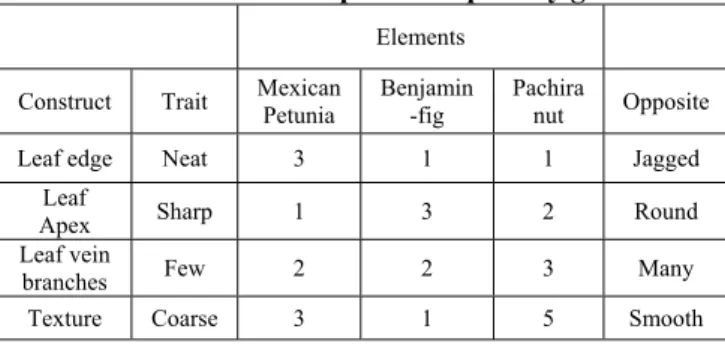
A repertory grid can be viewed as a matrix, in which the columns represent elements (i.e., concepts to be learned or learning targets to be identified) and the rows represent the constructs for identifying the elements. A construct consists of a trait and the opposite of that trait. A 5-scale rating mechanism is often employed for representing the relationships between the elements and the constructs, where “1’’ represents that “the element is highly inclined to the trait”, while ‘‘5’’ represents “highly inclined to the opposite” [30]. An illustrative example of a repertory grid for identifying a set of learning targets (i.e., the plants on school campus of an elementary school natural science course) is given in Table 1.
Table 1. Illustrative example of a repertory grid
Elements Construct Trait Mexican Petunia Benjamin -fig Pachira nut Opposite
Leaf edge Neat 3 1 1 Jagged
Leaf
Apex Sharp 1 3 2 Round
Leaf vein
branches Few 2 2 3 Many
Texture Coarse 3 1 5 Smooth
In this study, a Repertory grid-Assisted Collaborative Educational Game (RACEG) is developed, as shown in Figure 1. It consists of two subsystems, that is, the collaborative educational computer game and the collaborative knowledge construction system. The former contains a learning material module and a learning-guiding module. The latter is a web-based collaborative learning environment that assists students organizing knowledge in the form of a repertory grid based on what they have learned from the game and the discussions with peers.
Learners Educational Computer Game Repertory Grid Repertory grid‐Assisted Collaborative Educational Game (RACEG) Knowledge base Teachers or domain experts Add knowledge Delete knowledge Input Feedback Learning materials Learning‐ guiding module
3
Figure 1. The structure of collaborative game system
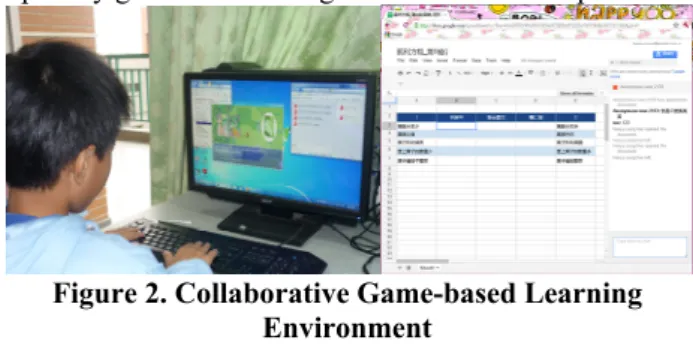
Figure 2 shows the collaborative educational computer game-base learning environment of this study. During the learning activity, the educational computer game is guided to develop the objective repertory grid, which is used as the comparative target. Following storyline of the game, the students are not only guided to collect the information of the target plants to develop their own repertory grid, also discussed with their peers, which is helpful to them to pass the learning tasks. In addition, the students were allowed to discuss and modify their repertory grid via an editing interface with their peers.
Figure 2. Collaborative Game-based Learning Environment
4. Experiment design
The experiment was conducted on the "knowing campus plants" unit of an elementary school natural science course, which aimed to teach the students the compositions of the plants (e.g., roots, stems and leaves) and their main functions, and further foster them the ability of identifying and differentiating different types of plants in fields based on those characteristics.
The participants of the experiment were three classes of sixth graders of an elementary school in southern Taiwan. A total of ninety-three students participated in this study. One class was assigned to be the experimental group, one class was the control group A and the other was the control group B. All of the three groups included thirty-one students, between seventeen and eighteen males, while thirteen and fourteen females each of groups. In order to avoid the influence of different instructors on the experimental results, the three classes were taught by the same instructor.
Before the experiment, the three groups of students took a two-week course about the basic knowledge of the plants, which is a part of the natural science course. At the beginning of the learning activity, the students took a pre-test for evaluating their basic knowledge about the plants. Following that, the students in the experimental group learned with the collaborative educational computer game with the repertory grid approach; on the other hand, those in the control group A learned with conventional collaborative game-base learning; for control group B, the educational computer game with repertory grid approach. The time for the students to complete their learning missions was a hundred minutes. After the learning activity, the students took the post-test for measuring their learning achievements.
The pre-test and the post-test were developed by two experienced teachers who had taught the information management course for years. While the pre-test aimed to ensure that three groups of students had the equivalent basic knowledge of about the natural science course content. It consisted of forty multiple-choice items with one point awarded for each accurate answer; that is, the perfect score of the pre-test was 100.The post-test contained twenty multiple-choice items for assessing the students' knowledge in identifying and differentiating the plants on the school campus, while one point was awarded for each accurate answer; therefore, the perfect score of the tests was 100. The posttest contains two parts, basic characteristics of the target plants (40%) and challenging questions (60%).The questions like “Which of the three plants, “Indian Almond”, “Orchid Tree” and “Golden Dewdrop” with the most neat leaf edge?”, after participating in the learning activity. The Cronbach's alpha value of the learning achievement was 0.65, showing good reliability in internal consistency.
5. Experimental Results
This study conducted ANCOVA using the students’ pre-test scores as the covariate to exclude the impact of the pre-test on their science learning. An assumption of ANCOVA is that the regression coefficients between groups need to be homogeneous. After conducting the learning activity, an analysis of covariance (ANCOVA) was performed on the post-test results, in which the pretest was the covariance, the post-test results were the dependent variable and the “different game-base learning strategies (three groups)” were the control variable, to examine the relationships among the post-test results of the three groups. The ANCOVA result shows that the variance between the three groups is significant (F = 11.795, p<.05) after the impact of the pre-test scores on the post-test was excluded. In other words, the post-test scores were significantly different due to the different experimental learning processes. Furthermore, post hoc analysis was performed to examine specific differences in achievement between the experimental groups. An LSD test revealed that the experimental group scores were significantly higher than those of control group A, compared with the adjusted mean of 59.37 for the experimental group, while the control group A scored 41.56 (p<.001). Additionally, the experimental group scores were also significantly higher than those of the control groups B scored 42.5 (p< .001).
6. Discussions and Conclusions
In this study, a collaborative game-based learning environment is developed based on a knowledge engineering approach. An experiment was conducted on an elementary school natural science course. From the experimental results, it is found that, in comparisons with the collaborative game-based learning approach and the knowledge engineering-based educational game approach,
4
the proposed approach is significantly more helpful to thestudents in improving their learning achievement. Consequently, it is concluded that the proposed approach is effective.
Acknowledgement
This study is supported in part by the National Science Council of the Republic of China under contract numbers NSC NSC 99-2631-S-011-002.
References
[1] Hwang, G. J., & Wu, P. H. (2012). Advancements and trends in digital game-based learning research: a review of publications in selected journals from 2001 to 2010. British Journal of Educational Technology, 43(l), E6-E10.
[2] Cagiltay, N. E. (2007). Teaching software engineering by means of computer-game development: Challenges and opportunities. British Journal of Educational Technology, 38(3), 405-415.
[3] Papastergiou, M. (2009). Digital Game-Based Learning in high school Computer Science education: Impact on educational effectiveness and student motivation. Computers & Education, 52(1), 1-12
[4] Tüzün, H., Yılmaz-Soylu, M., Karakus, T., Inal, Y., & Kızılkaya, G. (2009). The effects of computer games on primary school students’ achievement and motivation in geography learning. Computers & Education, 52(1), 68-77.
[5] Burguillo, J. C. (2010). Using game theory and Competition-based Learning to stimulate student motivation and performance. Computers & Education, 55(2), 566-575.
[6] Ebner, M., & Holzinger, A. (2007). Successful implementation of user-centered game based learning in higher education: An example from civil engineering. Computers & Education, 49(3), 873-890.
[7] Liu, T. Y., & Chu, Y. L. (2010). Using ubiquitous games in an English listening and speaking course: Impact on learning outcomes and motivation. Computers & Education, 55(2), 630-643.
[8] Dickey, M. D. (2011). Murder on Grimm Isle: The impact of game narrative design in an educational game-based learning environment. British Journal of Educational Technology, 42(3), 456-469.
[09] Harris, K., & Reid, D. (2005). The influence of virtual reality play on children's motivation. Canadian Journal of Occupational Therapy, 72(1), 21-30.
[10] Hwang, G. J., Sung, H. Y., Hung, C. M., Yang, L. H., & Huang, I. W. (2012). A knowledge engineering approach to developing educational computer games for improving students' differentiating knowledge. British Journal of Educational Technology. doi:10.1111/j.1467-8535.2012.01285.x
[11] Hong, J. C., Cheng, C. L., Hwang, M. Y., Lee, C. K., & Chang, H. Y. (2009). Assessing the educational values of digital games. Journal of Computer Assisted Learning, 25, 423-437. [12] Hwang, G. J., Sung, H. Y., Hung, C. M., & Huang, I. W. (2012). Development of a Personalized Educational Computer Game based on Students’ Learning Styles. Educational Technology Research & Development. doi: 10.1007/s11423-012-9241-x
[13] Provenzo, E. F. (1992). What do video games teach? Education Digest, 58, 56-58.
[14] Kickmeier-Rust, M. D., & Albert, D. (2010). Micro-adaptivity: protecting immersion in didactically adaptive digital educational games. Journal of Computer Assisted Learning, 26, 95-105.
[15] Charsky, D., & Ressler, W. (2011). Games are made for fun”: Lessons on the effects of concept maps in the classroom use of computer games. Computers & Education, 56, 604-615. [16] Kuo, F. R., Hwang, G. J., & Lee, C. C. (2012). A hybrid approach to promoting students’ web-based problem solving competence and learning attitude. Computers & Education, 58(1), 351-364.
[17] Schellens, T., & Valcke, M. (2005). Collaborative learning in asynchronous discussion groups: what about the impact on cognitive processing? Computers in Human Behavior, 21(6), 957-975.
[18] Lipponen L., (2002). Exploring Foundations for Computer-Supported Collaborative Learning. In G. Stahl, (Ed), 4th CSCL: Foundations for a CSCL Community, (CSCL-2002), Colorado, LEA, NJ. USA, pp.72-81.
[19] Hamalainen, R. (2008). Designing and evaluating collaboration in a virtual game environment for vocational learning. Computers & Education, 50(1), 98-109.
[20] Delucia, A., Francese, R., Passero, I., & Tortora, G. (2009). Development and evaluation of a virtual campus on Second Life: The case of SecondDMI. Computers & Education, 52(1), 220-233.
[21] Lee, W. C., Huang, W. C., Liu, Y. C., & Wu, H. H. (2011) A Study of Cooperative and Collaborative Online Game-Based Learning Systems. Lecture Notes in Computer Science, 6872, 163-167.
[22] Hummel, H. G. K., Van Houcke, J., Nadolski, R.J., Van Der Hiele, T., Kurvers, H., & Löhr, A. (2011). Scripted collaboration in serious gaming for complex learning Effects of multiple perspectives when acquiring water management skills. British Journal of Educational Technology, 42(6), 1029-1041. [23] Sánchez, J., & Olivares, R. (2011). Problem solving and collaboration using mobile serious games. Computers & Education, 57 (3), 1943-1952.
[24] Triantafyllakos, G., Palaigeorgiou, G., & Tsoukalas, I. A. (2011). Designing educational software with students through collaborative design games: The We!Design&Play framework. Computers & Education, 56(1), 227-242.
[25] Kelly, G. A. (1955). The psychology of personal constructs (Vol. 1). New York: W.W Norton.
[26] Edwards, H. M., McDonald, S., & Young, S. M. (2009). The repertory grid technique: Its place in empirical software engineering research. Information and Software Technology, 51, 785-798.
[27] Hwang, G. H., Chen, J. M., Hwang, G. J., & Chu, H. C. (2006). A time scale-oriented approach for building medical expert systems. Expert Systems with Applications, 31(2), 299-308.
[28] Chu, H. C., Hwang, G. J., & Tsai, C. C. (2010). A knowledge engineering approach to developing mindtools for context-aware ubiquitous learning. Computers & Education, 54(1), 289-297.
[29] Hwang, G. J., Chu, H. C., Lin, Y. S., & Tsai, C. C. (2011). A knowledge acquisition approach to developing Mindtools for organizing and sharing differentiating knowledge in a ubiquitous learning environment. Computers & Education, 57(1), 1368-1377.
[30] Chu, H. C., Hwang, G. J., Tsai, C. C., & Tseng, J. C. R. (2010). A two-tier test approach to developing location-aware mobile learning system for natural science course. Computers & Education, 55(4), 1618-1627.