An Interactive Fuzzy Satisficing Method for
Multiobjective Stochastic Integer Programming
Problems through Simple Recourse Model
Masatoshi Sakawa, Atsushi Karino, Kosuke Kato and Takeshi Matsui
Graduate School of Engineering, Hiroshima University
1-4-1, Kagamiyama, Higashi-Hiroshima, Hiroshima, 739-8527 Japan
E-mail:
{sakawa, m095249, kosuke-kato, tak-matsui}@hiroshima-u.ac.jp
Abstract—Two major approaches to deal with randomness
or impression involved in mathematical programming problems have been developed. The one is called stochastic programming, and the other is called fuzzy programming. In this paper, we focus on multiobjective integer programming problems involving ran-dom variable coefficients in constraints. Using the concept of sim-ple recourse, such multiobjective stochastic integer programming problems are transformed into deterministic ones. As a fusion of stochastic programming and fuzzy one, after introducing fuzzy goals to reflect the ambiguity of the decision maker’s judgments for objective functions, we propose an interactive fuzzy satisficing method to derive a satisficing solution for the decision maker by updating the reference membership levels.
I. INTRODUCTION
In constructing mathematical models of actual decision making situation in the real world, we often need to reflect the randomness or the imprecision involved in the situation since we cannot always know exact values of all parameters. Stochastic programming based on the probability theory, has been developed in various ways [2], [25], e.g., two stage prob-lem or recourse model [6], [23], chance constrained program-ming [4], [5], [9]. In particular, for multiobjective stochastic linear programming problems, Stancu-Minasian [20] consid-ered the minimum risk approach, Teghem et al. [21] and Urli et al. [22] proposed interactive methods. Furthermore, efficient solution concepts for them and their relations have been discussed by Caballero et al. [3].
On the other hand, fuzzy mathematical programming repre-senting the ambiguity in decision making situations by fuzzy concepts has attracted attention of many researchers [13], [15]. Fuzzy multiobjective linear programming, first proposed by Zimmermann [26], has been rapidly developed [11], [18], [19]. As a hybrid of the stochastic approach and the fuzzy one, Wang et al. [24] dealt with mathematical programming prob-lems with fuzzy random variables and Liu et al. [10] studied chance constrained programming involving fuzzy parameters and many researches about this issue have been reported [12], [14]. In particular, for multiobjective stochastic linear programming problems, Hulsurkar et al. [8] discussed an approach based on fuzzy programming. However, in their method, since membership functions for the objective func-tions are supposed to be aggregated by minimum operator or product operator, obtained solutions may not sufficiently
reflect the decision maker’s preference. To overcome this drawback, Sakawa et al. [16], [17] showed that satisfic-ing solutions to multiobjective stochastic linear programmsatisfic-ing problems sufficiently reflecting the decision maker’s prefer-ence can be derived through the interactive fuzzy satisficing method based on chance constrained programming models. In these existing methods for multiobjective stochastic linear programming problems [8], [16], [17], constraints including random variables are reduced to chance constrained conditions which mean that the constraints need to be satisfied with a certain probability (satisficing level). Then, the loss or cost caused by the violation of constraints for observed values is not reflected in the formulation and solution.
Under these circumstances, in this paper, focusing on the simple recourse model to consider the penalty reflecting on the degree of violation of constraints for observed values [7], we transform a multiobjective stochastic integer program-ming problems into equivalent deterministic multiobjective integer programming problems. After introducing fuzzy goals to reflect the ambiguous judgment of the decision maker on objective functions, we propose an interactive fuzzy satisficing method to derive a satisficing solution for the decision maker by updating the reference membership levels.
II. MULTIOBJECTIVE STOCHASTIC INTEGER PROGRAMMING PROBLEM
In this paper, we deal with multiobjective integer program-ming problems involving random variable coefficients in the right-hand side of constraints formulated as:
minimize zl(x) = clx, l = 1, 2, . . . , k subject to Ax = b(ω) xj∈ {0, 1, . . . , νj}, j = 1, 2, . . . , n (1) where x is an n dimensional integer decision variable column vector, cl, l = 1, 2, . . . , k are n dimensional coefficient row
vectors, A is an m× n coefficient matrix, and b(ω) is an m dimensional random variable column vector.
We are often faced with optimization problems involving randomness like (1). For instance, in a company producing m products by n processes, there may exist a multiob-jective optimization problem that the decision maker hopes to minimize the production cost and minimize the amount
14
Fifth International Workshop on Computational Intelligence & Applications
of wastes simultaneously under the situation that for each decision variable xj representing the discrete production level
for the j th process, j = 1, 2, . . . , n, the unit production cost coefficient c1j or the unit waste amount coefficients c2j and unit production amount coefficients aij of the i th product, i = 1, 2, . . . , m, are known while each demand bi for the i th
product, i = 1, 2, . . . , m varies randomly.
Since (1) contains random variable coefficients, we can-not directly apply solution methods or solution concepts for ordinary mathematical programming problems to it. If the decision maker wishes to take the cost of the shortage or surplus of products caused by the randomness of demand into account, recourse models to consider the penalty depending on the degree of violation of constraints for observed val-ues seem more desirable than chance constrained condition programming models [4], [5], [9] where chance constrained conditions mean that the constraints need to be satisfied with a certain probability (satisficing level). In this paper, we adopt the simple recourse model [7] which would be the most fundamental and practical among recourse models for situation that the shortage or surplus of products can be directly compensated by purchase of equivalent alternative products or the disposal of products.
III. MULTIOBJECTIVE INTEGER SIMPLE RECOURSE PROBLEMS
In problem (1), we assume that the decision maker must make a decision before he knows observed values of random variables. In recourse approaches, the penalty of violation of constraints is incorporated into objective functions in order to consider the loss caused by randomness.
To be more specific, denoting the difference between Ax and b(ω) by two random vectors y+ = (y1+, y2+, . . . , y+
m)T
and y−= (y−1, y2−, . . . , ym−)T, (1) can be reformulated as the
following multiobjective integer simple recourse problem. minimize wl(x) = cl+ Rl(x), l = 1, 2, . . . , k subject to Ax + y+− y−= b(ω) xj∈ {0, 1, . . . , νj}, j = 1, 2, . . . , n y+≥ 0, y− ≥ 0 (2) In (2), Rl(x) = E { min y+,y−(ply ++ q ly−) } (3) is called the expectation of a recourse for the l th objective, where pland qlare constant row vectors. Since each element of y+ = (y+
1, y +
2, . . . , ym+)T means the shortage of each
product and each element of y−= (y−1, y2−, . . . , ym−)T means
the surplus of each product, each element of pl is regarded as the unit cost to compensate the shortage of each product and each element of ql is regarded as the unit cost to dispose the surplus of each products. For pl and ql, the assumption pl + ql ≥ 0 seems natural because we could improve the objective function value infinitely by increasing y+i and yi− infinitely if pli+ qli< 0 for some i.
From the assumption, complementary relations ˆ
y+i > 0→ ˆyi−= 0, ˆy−i > 0→ ˆyi+= 0, i = 1, 2, . . . , m
hold for optimal recourse variable vector ˆy+, ˆy−. Then, the following equations ˆ yi+= boi − n ∑ j=1 aijxj, ˆy−i = 0, if b o i ≥ n ∑ j=1 aijxj ˆ y+i = 0, ˆyi−= n ∑ j=1 aijxj− boi if b o i < n ∑ j=1 aijxj
are led for i = 1, 2, . . . , m , where bo
i is the observed value
of bi(ω).
If bi(ω), i = 1, 2, . . . , m are mutually independent, the
expectation of the recourse E { min y+,y−(ply ++ q ly−) } can be calculated as: E { min y+,y−(ply ++ q ly−) } = E{plyˆ++ qlyˆ−}= m ∑ i=1 E{pliyˆ+i + qliyˆi− } = m ∑ i=1 pliE{ˆyi+} + m ∑ i=1 qliE{ˆyi−} = m ∑ i=1 pli ∫ +∞ ∑n j=1aijxj bi− n ∑ j=1 aijxj dFi(bi) + m ∑ i=1 qli ∫ ∑n j=1aijxj −∞ ∑n j=1 aijxj− bi dFi(bi) = m ∑ i=1 pliE{bi} − m ∑ i=1 (pli+ qli) ∫ ∑n j=1aijxj −∞ bidFi(bi) − m ∑ i=1 pli n ∑ j=1 aijxj + m ∑ i=1 (pli+ qli) ∑n j=1 aijxj Fi ∑n j=1 aijxj where Fi(·) is the probability distribution function of bi(ω).
Then, (2) is equivalent to the following problem. minimize Zl(x), l = 1, 2, . . . , k subject to xj∈ {0, 1, . . . , νj}, j = 1, 2, . . . , n } (4) where Zl(x) = m ∑ i=1 pliE{bi} + n ∑ j=1 ( clj− m ∑ i=1 aijpli ) xj m ∑ i=1 (pli+ qli) ∑n j=1 aijxj Fi ∑n j=1 aijxj − ∫ ∑n j=1aijxj −∞ bidFi(bi) } , and let X ={x | xj ∈ {0, 1, . . . , νj,}, j = 1, 2, . . . , n}
In general, there rarely exists a complete optimal solution that simultaneously optimizes all objective functions for a multiobjective programming problem.
As a reasonable solution concept for (4), we define the following R-Pareto optimal solution.
Definition 3.1. (R-Pareto optimal solution). x∗∈ X is said to be an R-Pareto optimal solution if there does not exist another
x ∈ X such that Zl(x) ≤ Zl(x∗) for any l ∈ {1, 2, . . . , k}
and Zj(x) < Zj(x∗) for at least one j∈ {1, 2, . . . , k}.
IV. AN INTERACTIVE FUZZY SATISFICING METHOD
In order to consider imprecise nature of the decision maker’s judgment for each objective function Zl(x) in (4), we
intro-duce fuzzy goals such as “Zl(x) should be substantially less
than or equal to a certain value.” Then, (4) can be rewritten as:
maximize µl(Zl(x)), l = 1, 2, . . . , k
subject to xj ∈ {0, 1, . . . , νj}, j = 1, 2, . . . , n }
(5) where µl(·) is a membership function to quantify the fuzzy
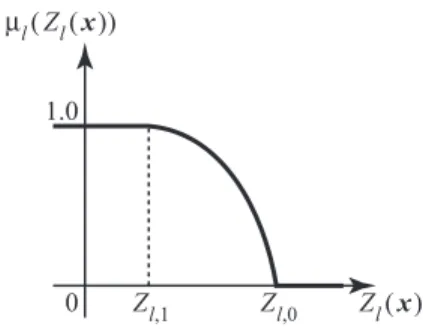
goal for the l th objective function in (4). To be more specific, if the decision maker feels that Zl(x) should be less than or
equal to at least Zl,0 and Zl(x)≤ Zl,1(< Zl,0) is satisfactory,
the shape of a typical membership function is shown in Fig. 1.
Fig. 1. An example of a membership function µl(Zl(x))
Since (5) is regarded as a fuzzy multiobjective decision making problem, there rarely exists a complete optimal solu-tion that simultaneously optimizes all membership funcsolu-tions.
As a reasonable solution concept for such fuzzy multiobjec-tive decision making problems, Sakawa et al. [18] defined M-Pareto optimality on the basis of membership function values by directly extending the Pareto optimality for multiobjective programming problems.
Definition 4.1. (M-Pareto optimal solution). x∗ ∈ X, where
X is the feasible region of the problem, is said to be an
M-Pareto optimal solution if and only if there does not exist another x ∈ X such that µl(zl(x)) ≥ µl(zl(x∗)) for any l∈ {1, 2, . . . , k} and µj(zj(x)) > µj(zj(x∗)) for at least one j ∈ {1, 2, . . . , k} where zl(·)s stand for objective functions.
Based on the concept of R-Pareto optimal solution and that of M-Pareto optimal solution, we now define M-R-Pareto optimal solution.
Definition 4.2. (M-R-Pareto optimal solution). x∗ ∈ X is said to be an M-R-Pareto optimal solution to (5) if and only if there does not exist another x ∈ X such that
µl(Zl(x)) ≥ µl(Zl(x∗)) for all l ∈ {1, 2, . . . , k} and
µj(Zj(x)) > µj(Zj(x∗)) for at least one j ∈ {1, 2, . . . , k}
in (5).
Introducing an aggregation function µD(x) for k
member-ship functions in (5), problem (5) can be rewritten as: maximize µD(x)
subject to xj∈ {0, 1, . . . , νj} j = 1, 2, . . . , n }
(6) The aggregation function µD(x) represents the degree of
satisfaction or preference of the decision maker for whole of k fuzzy goals.
Following conventional fuzzy approaches, as the aggre-gation function, Hulsurkar et al. [8] adopted the minimum operator [1] define by
µD(x) = min
l=1,2,...,kµl(Zl(x)) (7)
and the product operator [26] defined by µD(x) =
k ∏ l=1
{µl(Zl(x))}. (8)
Although these operators are widely used as an aggregation function, the usefulness of the minimum operator or the product operator is limited since the preference of the decision maker is not always well expressed by them in general decision situations. It would be desirable to identify an appropri-ate aggregation function which well represents the decision maker’s preference, but it is rarely possible to identify such the aggregation function explicitly and exactly. As an alternative, interactive methods which derive the local information of the decision maker’s preference through interactions and find a satisficing solution for the decision maker without the explicit identification of the aggregation function seem promising to (5). In this paper, we develop an interactive fuzzy satisficing method to derive a satisficing solution for the decision maker through interaction proposed by Sakawa et al. [18]. In their method, in order to derive a satisficing solution, the decision maker interactively updates aspiration levels of achievement for membership values of all fuzzy goals, called reference membership levels, until he is satisfied [18].
To be more specific, for the decision maker’s reference membership levels ¯µl, l = 1, 2, . . . , k, the following
aug-mented minimax problem is repeatedly solved. minimize max l=1,...,k[¯µl− µl(Zl(x)) +ρ k ∑ i=1 (¯µi− µi(Zi(x)))] subject to xj∈ {0, 1, . . . , νj}, j = 1, 2, . . . , n (9)
In (9), ρ is a sufficiently small positive number and the corresponding optimal solution to (9) is nearest to the require-ments in the augmented minimax sense or better than them if the reference membership levels are attainable.
The relationship between an optimal solution to (9) and the M-R-Pareto optimality can be characterized by the following theorems.
Theorem 4.1. If x∗ ∈ X is an optimal solution to (9) for some ¯µl, l = 1, 2, . . . , k, then x∗ is an M-R-Pareto optimal
solution to (5).
Theorem 4.2. If x∗∈ X is an M-R-Pareto optimal solution to (5), then there exists ¯µl, l = 1, 2, . . . , k such that x∗ is an
optimal solution to (9).
We now summarize the interactive algorithm. Interactive fuzzy satisficing method
Step 1: Calculate individual minima Zl,min of objective
func-tions Zl(x), l = 1, 2, ..., k, in (5) by solving the following
problems.
minimize Zl(x)
subject to xj ∈ {0, 1, . . . , νj}, j = 1, 2, . . . , n }
(10) Then, calculate Zl,min from optimal solutions xlmin, l = 1, 2, . . . , k to (10). Go to step 2.
Step 2: Ask the decision maker to subjectively determine membership functions µl(Zl(x)) for objective functions,
based on minimal values Zl,min calculated in step 1. Go to
step 3.
Step 3: Ask the decision maker to set the initial reference membership levels (they are often set as ¯µl = 1, l = 1, 2, . . . , k). Go to step 4.
Step 4: Solve the following minimax problem for given reference membership levels ¯µl, l = 1, 2, . . . , k.
minimize max l=1,...,k[¯µl− µl(Zl(x)) +ρ k ∑ i=1 (¯µi− µi(Zi(x)))] subject to xj ∈ {0, 1, . . . , νj}, j = 1, 2, . . . , n (11)
Then, calculate membership function values µl(Zl(x∗)), l = 1, 2, . . . , k corresponding to the optimal solution x∗ to (11), which is guaranteed to be an M-R-Pareto optimal solution to (5). Go to step 5.
Step 5: If the decision maker is satisfied with µl(Zl(x∗)), l = 1, 2, . . . , k obtained in step 4, stop. Otherwise, ask the decision maker to update the reference membership levels ¯µl, l = 1, 2, . . . , k in consideration of the current membership function values µl(Zl(x∗)). Go to step 4.
V. CONCLUSIONS
In this paper, we focused on multiobjective integer program-ming problems involving random variable coefficients. After we reformulated them as multiobjective simple recourse prob-lems based on the concept of simple recourse, we introduced fuzzy goals for objective functions to consider the ambigious or fuzzy judgments of the decision maker. Then, we proposed an interactive fuzzy satisficing method as a fusion of stochastic approach and fuzzy one to derive a satisficing solution for the decision maker.
As future problems, we are going to consider an illustrative numerical example and show the efficiency of the proposed method.
REFERENCES
[1] R.E. Bellan and L.A. Zadeh, Decision making in a fuzzy environment, Management Science, Vol. 17, No. 4, pp. 141–164, 1970.
[2] J.R. Birge and F. Louveaux, Introduction to Stochastic Programming, Springer, London, 1997.
[3] R. Caballero, E. Cerda, M.M. Munoz, L. Rey and I.M. Stancu-Minasian, Efficient solution concepts and their relations in stochastic multiobjec-tive programming, Journal of Optimization Theory and Applications, Vol. 110, No. 1, pp. 53–74, 2001.
[4] A. Charnes and W.W. Cooper, Chance constrained programming, Man-agement Science, Vol. 6, No. 1, pp. 73–79, 1959.
[5] A. Charnes and W.W. Cooper, Deterministic equivalents for optimizing and satisficing under chance constraints, Operations Research, Vol. 11, No. 1, pp. 18–39, 1963.
[6] G.B. Dantzig, Linear programming under uncertainty, Management Science, Vol. 1, No. 3–4, pp. 197–206, 1955.
[7] R. Everitt and W.T. Ziemba, Two period stochastic programs with simple recourse, Operations Research, Vol. 27, No. 3, pp. 485–502, 1979. [8] S. Hulsurkar, M.P. Biswal and S.B. Sinha, Fuzzy Programming approach
to multi-objective stochastic linear programming problems, Fuzzy Sets and Systems, Vol. 88, No. 2, pp. 173–181, 1997.
[9] S. Kataoka, A stochastic programming model, Econometorica, Vol. 31, No. 1–2, pp. 181–196, 1963.
[10] B. Liu and K. Iwamura, Chance constrained programming with fuzzy parameters, Fuzzy Sets and Systems, Vol. 94, No. 2, pp. 227–237, 1998. [11] M.K. Luhandjula, Multiple objective programming problems with pos-sibilistic coefficients, Fuzzy Sets and Systems, Vol. 21, No. 2, pp. 135– 145, 1987.
[12] M.K. Luhandjula, Fuzzy stochastic linear programming: survey and future research directions, European Journal of Operational Research, Vol. 174, No. 3, pp. 1353–1367, 2006.
[13] H. Rommelfangar, Fuzzy linear programming and applications, Euro-pean Journal of Operational Research, Vol. 92, No. 3, pp. 512–527, 1996.
[14] H. Rommelfanger, A general concept for solving linear multicriteria programming problems with crisp, fuzzy or stochastic values, Fuzzy Sets and Systems, Vol. 158, No. 17, pp. 1892–1904, 2007.
[15] M. Sakawa, Fuzzy Sets and Interactive Multiobjective Optimization, Plenum Press, New York, 1993.
[16] M. Sakawa and K. Kato, An interactive fuzzy satisficing method for multiobjective stochastic linear programming problems using chance constrained conditions, Journal of Multi-Criteria Decision Analysis, Vol. 11, No. 3, pp. 125–137, 2002.
[17] M. Sakawa, K. Kato and I. Nishizaki, An interactive fuzzy satisfic-ing method for multiobjective stochastic linear programmsatisfic-ing problems through an expectation model, European Journal of Operational Re-search, Vol. 145, No. 3, pp. 665–672, 2003.
[18] M. Sakawa, H. Yano and T. Yumine, An interactive fuzzy satisficing method for multiobjective linear-programming problems and its appli-cation, IEEE Transaction on Systems, Man, and Cybernetics, Vol. SMC-17, No. 4, pp. 654–661, 1987.
[19] R. Slowinski and J. Teghem (eds.), Stochastic Versus Fuzzy Applica-tions to Multiobjective Mathematical Programming under Uncertainty, Kluwer Academic Publishers, Dordrecht/Boston/London, 1990. [20] I.M. Stancu-Minasian, Overview of different approaches for solving
stochastic programming problems with multiple objective functions, in Stochastic Versus Fuzzy Applications to Multiobjective Mathematical Programming under Uncertainty, R. Slowinski and J. Teghem (eds.), Kluwer Academic Publishers, Dordrecht/Boston/London, pp. 71–101, 1990.
[21] J. Teghem, D. Dufrane, M. Thauvoye and P. Kunsch, STRANGE: an interactive method for multiobjective linear programming under uncertainty, European Journal of Operational Research, Vol. 26, No. 1, pp. 65–82, 1986.
[22] B. Urli and R. Nadeau, PROMISE/scenarios: an interactive method for multiobjective stochastic linear programming under partial uncertainty, European Journal of Operational Research, Vol. 155, No. 2, pp. 361– 372, 2004.
[23] D.W. Walkup and R.J.B. Wets, Stochastic programming with recourse, SIAM Journal on Applied Mathematics, Vol. 15, No. 5, pp. 1299–1314, 1967.
[24] G.-Y. Wang and Z. Qiao, Linear programming with fuzzy random variable coefficients, Fuzzy Sets and Systems, Vol. 57, No. 3, pp. 295– 311, 1993.
[25] R.J.B. Wets, Challenges in stochastic programming, Mathematical Pro-gramming, Vol. 75, No. 2, pp. 115–135, 1996.
[26] H.-J. Zimmermann, Fuzzy programming and linear programming with several objective functions, Fuzzy Sets and Systems, Vol. 1, No. 1, pp. 45–55, 1978.