JAIST Repository
https://dspace.jaist.ac.jp/
Title 有歪中継ワイヤレス協調通信ネットワークにおけるチ
ャネル変動の伝送特性に与える影響解析
Author(s) 申, 騫
Citation
Issue Date 2017‑12
Type Thesis or Dissertation Text version ETD
URL http://hdl.handle.net/10119/15076 Rights
Description Supervisor:松本 正, 情報科学研究科, 博士
!
!
SHEN QIAN
STATISTICAL PERFORMANCE
CHARACTERIZATION OF LOSSY- FORWARD BASED COOPERATIVE
WIRELESS NETWORKS OVER FADING CHANNELS
!
Academic dissertation to be presented with the assent of the Doctoral Training Committee of Technology and Natural Science of the University of Oulu for public defence in Collaboration room 7, Asahidai, on 5 October 2017, at 2 p.m.
!
!
!
!
UNIVERSITY OF OULU and
JAPAN ADVANCED INSTITUTE OF SCIENCE AND TECHNOLOGY 2017
!
Copyright © 2017 University of Oulu,
Japan Advanced Institute of Science and Technology, 2017
! !
Supervised by
Professor Tad Matsumoto Professor Markku Juntti
! !
Reviewed by
Adjunct Professor Antti Tölli
Associate Professor Brian Michael Kurkoski Professor Francis C.M. LAU
Professor Gerhard Bauch Professor Mineo Kaneko Professor Takeo Ohgane
! !
ISBN 978-4-903092-48-5
!
!
Qian, Shen, Statistical Performance Characterization of Lossy-Forward based Cooperative Wireless Networks over Fading Channels.University of Oulu Graduate School; University of Oulu, Faculty of Information Technology and Electrical Engineering; Centre for Wireless Communications-Radio Technologies (CWC-RT); Infotech Oulu.
Japan Advanced Institute of Science and Technology, School of Information Science, Information Theory and Signal Processing Laboratory.
Abstract
Cooperative wireless communications are investigated from the perspective of exploiting statistical nature of channel property variation. The target of this research is to provide analytical assessments and theoretical bounds of lossy-forward (LF) relaying based cooperative communications in various network topologies and propagation conditions, where the channel variation information is efficiently utilized.
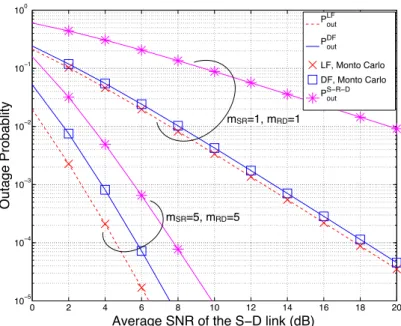
The performance of three-node LF relaying over independent block Nakagami-m fading channels is investigated. Based on the source coding with a helper theorem, the exact outage probability expression with arbitrary values of the shape factormis derived. Furthermore, the decay of the outage curve, referred to as equivalent diversity order, and coding gain of LF relaying are identified based on a yet accurate high signal-to-noise ratio (SNR) outage probability approximation. It is found that the decay of the outage curve is dominated by the less reliable channel of either the source-relay or the relay-destination link. It is also found that in terms of the outage probability, LF relaying is superior to conventional decode-and-forward (DF) relaying where relay keeps silent if error is detected after decoding. This is because the relay in LF always forwards the decoder output to the destination via re-interleaving and re-encoding of the information sequence. Therefore, the whole system can be regarded as a distributed turbo code. Moreover, with LF relaying, not only the outage probability can be reduced, but also the search area for a relay (helper) can be increased compared to conventional DF relaying while keeping the same or even lower outage probability, resulting in significant coverage expansion of the system.
The outage probabilities of LF, decode-and-forward (DF) and adaptive decode-and- forward (ADF) relaying are analyzed in block Rayleigh fading channels, with the aim of identifying the impact of the spatial and temporal correlations of the fading variations. It is proven that the coding gain with LF is larger than with DF but smaller than with ADF, where the ADF scheme utilizes error-free feedback from the relay to the source. It is found that compared to the independent fading case, in the correlated fading, to achieve the lowest outage probability, the relay should be located closer to the destination, or more transmit power should be allocated to the relay, both for reducing the gain loss caused by the fading correlation.
A comparative study on the outage probabilities of LF relaying with the two distributions, Rician and Nakagami-m, is conducted. Kullback-Leibler divergence (KLD) and Jensen-Shannon divergence (JSD) are used to identify the difference between the distributions. It is found that even with a specific parameter setting yielding the same line-of-sight (LOS) ratio, Rician is not equivalent to Nakagami-m model for representing the shape of the entire portion of the distribution.
Furthermore, we derive an upper bound of the outage probability for a two-way LF relaying system over Rician fading channels with a randomK-factor. TheK-factor is assumed to follow empirical distributions, normal or logistic distributions, which are derived from measurement data. Compared to the two-way DF transmission, the two-way LF transmission is found to achieve lower outage probability regardless of either logistic or normal distribution is used to represent the variation ofK-factor.
Because with LF, the relay always broadcast the decoder output regardless of whether error is detected after decoding in the information part or not.
The work is extended to a multi-source multi-relay transmission system, where all the links experience thek-µfading variations. It is found that, regardless of whether the LOS component exists in the channel or not, the outage performance of the system with orthogonal transmission with joint-decoding scheme is superior to that with maximum ratio transmission scheme.
Keywords:Outage probability, relay channels, lossy-forward (LF), Nakagami-m fading, Rician fading,k-µfading, Kullback-Leibler divergence (KLD), Jensen-Shannon divergence (JSD), line-of-sight (LOS) component, diversity order and coding gain
To my son Chisheng and my daughter Chicheng
Preface
This research has been conducted under the framework of joint supervision of doctoral dissertation and for awarding double doctoral degree between University of Oulu (UOulu), Finland and Japan Advanced Institute Science and Technology (JAIST), Japan.
At JAIST, the research was carried out at Information Theory and Signal Processing Laboratory, School of Information Science. At UOulu, the work was conducted at Centre for Wireless Communications (CWC).
First of all, I wish to express my deepest gratitude to my supervisor Professor Tad Matsumoto who also supervised me since my master study time. He is full of enthusiasm in his academic life, has taught me a lot of things about research. I would also like to sincerely thank my principal advisor at UOulu, Professor Markku Juntti, for the valuable advices on my research and the efforts to help me accomplish my double doctoral degree study. Without their guidance and encouragement, this dissertation would not be able to reach the current quality level. I appreciate the assistance and valuable suggestions raised by Associate Professor Brian Michael Kurkoski of JAIST. I also wish to devote my sincere thanks to all the reviewers and examiners, Professor Francis C.M. LAU from Hong Kong Polytechnic University, Professor Gerhard Bauch from TU Hamburg-Harburg, Institut f¨ur Nachrichtentechnik, Professor Takeo Ohgane from Hokkaido University, Professor Mineo Kaneko from JAIST, Associate Professor Brian Michael Kurkoski from JAIST, and Adjunct Professor Antti T¨olli from UOulu for their valuable comments and suggestions to improve the quality of this dissertation.
I would like to take this opportunity to express my gratitude to my colleagues in JAIST for their great support and help in both daily life and academic research, Dr.
Xiaobo Zhou, Dr. Meng Cheng, Dr. Penshun Lu, Dr. Xin He, Ms.c. Weiwei Jiang, Ms.c Kun Wu, Ms.c Fan Zhou, Dr. Khoirul Anwar, Dr. Ricardo Antonio Parrao Hernandez, Dr. Francisco Javier Cuadros Romero, Dr. Muhammad Reza Kahar Aziz, Dr. Yasuhiro Takano, Dr. Ade Irawan, Ms.c Garcia Alvarez, Erick Christian, and Ms.c Yu Yu. My deep gratitude also goes to colleagues in CWC, Dr. Valtteri Tervo, Ms.c Jiguang He, Dr.
Iqbal Hussain, Dr. Pedro Henrique Juliano Nardelli, and Ms.c Hamidreza Bagheri for their kind help and friendship. I wish to thank Prof. Jari Iinatti, Adjunct Professor Mehdi Bennis, and Dr. Keigo Hasegawa who have served as my follow-up group members and provided a lot of valuable advices. I was very lucky that I joined a very aggressive
team with many talented and kind members. They are very friendly and brilliant. I also would like to thank the administrative staff in both JAIST and UOulu, Aya Inoue, Kyoko Hoshiba, Tomoko Taniguchi, Dr. Anthony Heape, Dr. Minna Silfverhuth, and Kirsi Ojutkangas, for their efforts to make my double doctoral degree study possible.
In addition, I would like to express my gratitude to Doctor Research Fellow (DRF) program of JAIST, Research Grants for JAIST Students, Koden Electronics Co., Ltd, Japan, NEC C&C Foundation, Japan, The Telecommunications Advancement Foundation, Japan, for providing me with financial support such that I can focus on my research work.
Finally, I would like to express my deepest thanks to my parents Pingyi Qian and Xinping Bi far in my homeland. I wish they can accept my apologies for I cannot fulfill my filial duty at their side. Also I want to thank my beloved wife Jian Li for her continual support and encouragement. Without her love and understanding, I could not have made those achievements shown in this dissertation.
Nomi, October 5 2017 Shen Qian
List of abbreviations
AF Amplify-and-forward
AWGN Additive white Gaussian noise BER Bit error rate
BPSK Binary phase shift keying BSC Binary symmetric channel cdf Cumulative distribution function CEO Chief executive officer
CSI Channel state information DF Decode-and-forward
EXIT Extrinsic information transfer FP7 7th Framework Program FER Frame error rate HI Horizontal iteration
ICT Information and communication technology i.i.d. Independently and identically distributed IoT Internet of things
JSD Jensen-Shannon divergence KKT Karush-Kuhn-Tucker KLD Kullback-Leibler divergence
LF Lossy-forward
LLR Log-likelihood ratio LOS Line-of-sight
MARC Multiple access relay channel MAC Multiple access channel MIMO Multiple-input multiple-output MUD Multi-user detection
NLOS Non-line-of-sight P2P Point-to-point
pdf Probability density function QPSK Quadrature phase-shift keying
RESCUE Links-on-the-fly Technology for Robust, Efficient and Smart Communication in Unpredictable Environments SINR Signal-to-interference-plus-noise ratio
SNR Signal-to-noise ratio VI Vertical iteration VR Virtual reality
XOR Exclusive-OR
5G 5th generation
List of Symbols
C channel capacity D distortions
Es transmit energy per symbol En dimensionality of channel input
G geometric gain
Gc coding gain Gd diversity gain h complex channel gain K Rician factor
m Nakagami-m shape factor
n zero-mean AWGN
N0 noise variation pf bit flipping probability PT total transmit power R source coding rate Rc channel coding rate R(D) rate-distortion function a path loss exponent g instantaneous SNR
g average SNR
r correlation coefficient rs spatial correlation coefficient rt temporal correlation coefficient ACCS accumulator for the source
ACCS1 decoder of the accumulator for the source CS encoder for the source
DS decode for the source MS modulator for the source MS1 demodulator for the source PS interleaver for the source
PS1 de-interleaver for the source
bS binary information sequence of the source ACCR accumulator for the relay
ACCR1 decoder of the accumulator for the relay CR encoder for the relay
DR decode for the relay MR modulator for the relay MR1 demodulator for the relay PR interleaver for the relay PR1 de-interleaver for the relay
bR binary information sequence of the relay P0 interleaver between the source and the relay P01 de-interleaver between the source and the relay a⇤b binary convolution, i.e.,a⇤b=a(1 b) +b(1 a) C(·) Shannon channel capacity
Ccc(·) constellation constrained channel capacity
Ccc1(·) inverse function of constellation constrained channel capacity d(·,·) distortion measure function
E[·] expectation of random variable exp(·) natural exponential function H(·,·) joint entropy function H(·|·) conditional entropy function H(·) binary entropy function
H 1(·) inverse of binary entropy function I(·;·) mutual information function
I0(·) zero-th order modified Bessel’s function of the first kind min minimization
p(·) probability density function p(·,·) joint probability density function p(·|·) conditional probability density function Q1(·,·) Marcum Q function
G(·) Gamma function
g(·,·) lower incomplete gamma function ln(·) natural logarithm
log(·) logarithm function with base 2 lg(·) logarithm function with base 10 Pr(·) probability
ˆ· estimation modulo-2 addition
Contents
Abstract
Preface 7
Abbreviations 9
Symbols 11
Contents 15
1 Introduction 17
1.1 Cooperative Communications . . . 17
1.1.1 Relay Protocols . . . 18
1.2 Wireless Channel Models . . . 20
1.3 Background and Research Motivations . . . 21
1.3.1 Research Background . . . 21
1.3.2 Motivations . . . 24
1.4 Outline of Dissertation . . . 27
1.5 Summary of Outcomes . . . 29
2 On the Performance of One-Way Lossy-Forward Relay Wireless Networks 31 2.1 Lossy-Forward Transmission over independent Nakagami-m Fading Channels . . . 31
2.1.1 System Model . . . 31
2.1.2 Outage Probability Analysis . . . 34
2.1.3 Equivalent Diversity Order and Coding Gain . . . 42
2.1.4 Optimal Relay Location . . . 45
2.2 Fading Correlations for Wireless Cooperative Communications: Diversity Order and Coding Gain . . . 49
2.2.1 System and Channels Models . . . 49
2.2.2 Relaying . . . 49
2.2.3 Outage Analysis in Independent Fading . . . 50
2.2.4 Outage Analysis in Correlated Fading . . . 56
2.2.5 Optimal Relay Locations for Minimizing the Outage Probability. . . .63
2.2.6 Optimal Power Allocation for Minimizing the Outage
Probability. . . .69
2.3 Impact Analysis of Line-of-Sight Components in Lossy-Forward Relaying over Fading Channels Having Different Statistical Properties . . . . 75
2.3.1 Channel Model . . . 75
2.3.2 Outage Probability Derivation . . . 76
2.3.3 Kullback-Leibler divergence and Jensen-Shannon divergence . . . 77
2.3.4 Numerical Results . . . 78
2.4 Summary . . . 80
3 Performance Analysis for Two-Way Lossy-Forward Relaying with Random RicianK-factor 83 3.1 System Model . . . 83
3.2 Outage Probability . . . 85
3.2.1 Pr(EOA|Case 1). . . 87
3.2.2 Pr(EOA|Case 2). . . 89
3.2.3 Pr(EOA|Case 3). . . 89
3.3 Numerical Results . . . 90
3.4 Summary . . . 91
4 Performance Analysis for Two-Source Two-Relay Transmission over k-µFading Channels 93 4.1 System Model . . . 93
4.2 Outage Probability . . . 95
4.2.1 Outage Probability Calculation in Case I . . . 96
4.2.2 Outage Probability Calculation in Case II . . . 98
4.2.3 Outage Probability Calculation in Case III . . . 99
4.3 Numerical Results . . . 101
4.4 Summary . . . 102
5 Conclusions and Further Work 105 5.1 Conclusions . . . 105
5.2 Future Work. . . .106
References 108
Appendices 116
1 Introduction
Next generation wireless systems (5G) is considered to be the foundation of information and communication technology (ICT)-based society including virtual reality (VR), autonomous vehicles, and internet of things (IoT). By exploiting underutilized frequency spectrum available in millimeter wave, 5G is designed to handle thousands of times of more data traffic and can provide more than ten times the transmission speed compared to the existing networks. Millimeter wave cannot well travel in the presence of obstacles, e.g., buildings and shadowing objects, and tend to be affected by weather, e.g., absorbed by rain [1]. In cooperative communications, relays overhear the wireless signal and enhance the transmission between the nodes. Consequently, the wireless signal can be forwarded over the obstacles with the aid of relays, which can well solve the aforementioned problems. Cooperative communication in wireless networks is also of great importance as it has great potential for achieving diversity gain, enhancing network throughput, and extending communication coverage. This dissertation focuses on statistical performance characterization of the novel lossy-forward (LF)-based cooperative wireless networks and theoretical analysis of system performance by exploiting the statistical nature of channel variations.
In this chapter, we briefly introduce the basic concept of cooperative wireless communications. The wireless channel models are then described. The background and motivation of the research on exploiting channel variation in LF-based cooperative wireless communications are described, which is followed by the in-depth literature survey on the analyses and their results related to this research. The outline of this dissertation and the contributions of this research are also provided.
1.1 Cooperative Communications
Cooperative communication has been recognized as one of the most important techniques not only in designing the next generation wireless communication networks but also enhancing services and coverage of the existing systems, especially when it is used for the coverage expansion or diversity rather than static link design. It was initially introduced by Van der Meulen [2] in 1970s and the information theoretic analyses for the relay networks were intensively conducted by Cover and Gamal in [3]. Before the cooperative communications emerged, the transmission quality only relies on the
condition of the direct link between source and destination. However, with cooperative communications, nearby nodes (i.e., base stations, mobile devices, stationary devices) who overhear the source information can serve as relays for helping in transmission. By formingvirtual antenna array[4] to cooperate with each other to mitigate the signal attenuation due to the variation of the propagation conditions, without having to impose strict constraints in deployment or excessively high hardware complexity compared with f ixedmultiple-input multiple-output (MIMO) techniques, cooperative communications are able to enhance power and spectrum efficiencies and improve communication reliability [5].
1.1.1 Relay Protocols
The relay protocol specifies the processing performed by the relay upon its received signals. Based on the operations at the relay, relay protocols can be mainly classified into following categories [6–9].
Amplify-and-Forward
In amplify-and-forward (AF) relaying (also called observe-and-forward) [7], the received signal sent via the source-relay link is simply scaled and amplified by a relay, and forwarded to the destination. The destination make decision by properly combining signals sent from the source and relay, and thereby spatial diversity can be achieved by the AF protocol. The major problem of the AF protocol is that the noise at the relay is also amplified and forwarded, which causes performance degradation.
Decode-and-Forward
Among the various relaying protocols, decode-and-forward (DF) relaying has drawn significant attentions, and been widely studied. In DF relaying, if the transmitted information sequence is successfully recovered at the relay, the recovered information sequence is re-encoded and forwarded to the destination. The relay keeps silent if error is detected after decoding at the relay to avoid error propagation. Several analyses on the diversity and multiplexing gains as well as their tradeoff of DF relaying have been conducted for half duplex and full duplex systems [10–12]. Various practical
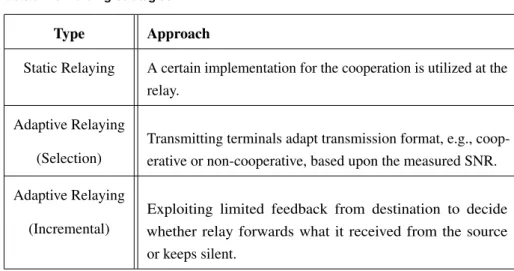
Table 3. Forwarding Strategies
Type Approach
Static Relaying A certain implementation for the cooperation is utilized at the relay.
Adaptive Relaying (Selection)
Transmitting terminals adapt transmission format, e.g., coop- erative or non-cooperative, based upon the measured SNR.
Adaptive Relaying (Incremental)
Exploiting limited feedback from destination to decide whether relay forwards what it received from the source or keeps silent.
implementations of DF relaying in single-antenna scenarios have been analyzed in [13, 14], and in multiple-antenna scenarios in [15, 16].
Compress-and-Forward
In compress-and-forward relaying, the relay quantizes and compresses the received information by utilizing the source-relay correlation, then forwards the compressed version to the destination. The destination estimates the received information sequence by utilizing the information sequence transmitted from source as a helper [17, 18].
Compute-and-Forward
In compute-and-forward relaying, the relay decodes linear functions of the received signals by using the linear combinations provided by the channel, and forwards the decoded results to the destination. At the destination, the linear combinations are solved for recovering the original information [9].
Derivative Strategies
Various forwarding strategies have been proposed to achieve the benefits of cooperative communications. Lanemanet al. outlined a variety of strategies [8, 19] which are categorized in Table 3.
1.2 Wireless Channel Models
In wireless communications, radio signal propagation is subject to reflection, diffraction, and scattering due to the obstacles in the environment. These mechanisms affect the radio propagation in different ways, i.e., path-loss, shadowing, and fading [20]. Path-loss is related to transmission distance and free space loss; shadowing (sometimes called large scale fading) indicates the received signal variation around the path-loss attenuation and its statistics are typically well characterized by the log-normal distribution; the (small scale) fading or short-term signal variation is typically caused by multiple signals received via different propagation paths. Due to the existence of a great variety of fading environments, channel fading can be statistically described by different models [21].
Radio signals arrive at the destinations via multiple propagation paths where there are obstacles. Therefore, each component signal received has different energy1. The received signal is a superposition of the component signals, which results in amplitude variation and phase rotation. The Rayleigh fading model is widely used to characterize the variations where the amplitude follows Rayleigh distribution over [0,•) and the phase follows uniform distribution over [0, 2p). The speed of the variation depends on the velocity of the mobile node. Each component signal suffers from different Doppler shi f t, hence the received composite signal composed of the received signal components suffers from Dopplerspread.
The Rayleigh fading2is commonly used to describe random variations due to multi- path effect having non-line-of-sight (NLOS) components, such as densely populated urban areas having a lot of buildings and other objects, resulting in no direct path between the transmitter and the receiver in the wireless channel.
However, in some scenarios, channels are composed of both line-of-sight (LOS) and NLOS components in wireless communications systems, e.g., terrestrial mobile and satellite mobile communications systems. A mathematical model of the channel having LOS and NLOS components is Rician fading, where the amplitude is characterized by a Rician distribution. The Rician fading model is widely used to characterize the channels that exploit the performance gain due to the LOS conditions. Rician factorK denotes the ratio of the LOS component power-to-NLOS components average power.K
1We only assume frequency non-selective fading. The impact of the frequency selectivity in relaying system is left as a future work, as described in Chapter 5
2Strictly speaking, the first order statistic of vehicle-to-vehicle communication is described by double Rayleigh distribution, if there are non-line-of-sight (NLOS) components. However, this dissertation assumes the simplest NLOS components model, Rayleigh fading.
factor represents severity of fading variation. WithK=0, Rician fading reduces to Rayleigh fading. WithK=•, channel is equivalent to static additive white Gaussian noise (AWGN) channel (Receiver hardware always introduces AWGN to the received signal).
Although the Rician distribution is widely used to represent the statistical behaviors of the channels, it is still not accurate enough as the first-order statistics of the channel variations are compared with the measurement data gathered in the fields. The Nakagami- m distribution is derived empirically based on the measurement data [22]. It is known that the Nakagami-m fading is able to better represent the distribution of the channel behaviours compared to the Rician distribution [23]. Nakagami-m model can model a wider range of channel conditions including severe, moderate, light and no fading.
It is well known that both Rayleigh and Rician distributions are connected to the Nakagami-m fading model by adjusting the shape factormrepresenting the fading severity in Nakagami-m model [20, 24].
Yacoubet al.proposed two more generalized fading models,k-µandh-µ, which are fully characterized in terms of measurable physical parameters and known to be better matched to measurement data than the other models [25]. Thek-µdistribution includes the Rician, the Nakagami-m, and the Rayleigh distributions as special cases, whereas, theh-µdistribution includes the Nakagami-m, the Rayleigh, and the one-sided Gaussian distributions as special cases. In particular, thek-µdistribution better fits LOS scenarios. Theh-µdistribution is better suited for NLOS applications.
1.3 Background and Research Motivations 1.3.1 Research Background
As stated before, cooperative communications have been recognized as the promising technologies for next generation wireless communication systems. A key to create efficient and flexible technologies for the further generation wireless communication networks is to know how the latest results of network information theory can be best utilized in wireless communication network design. For example, in the DF relaying systems, the information sequences sent from the same source are correlated, which, in the theoretical side, invokes the idea of utilizing the source coding with a helper theorem. In the practical system design side, the correlation knowledge can be utilized in the distributed turbo coding with the idea of log likelihood ratio (LLR) updating
corresponding to the errors occurring in the network [26, 27]. The theoretical and practical considerations have created the relaying technique called lossy-forward (LF) [27]. It has been proven that LF relaying can reduce outage probability, compared to conventional DF relaying [28].
bS
bR
CS ΠS ACCS MS
MS-1
ACCS-1
ΠS-1
DS
Π0 CR ΠR ACCR MR
MS-1 ACCS-1 ΠS-1 DS
MR-1 ACCR-1 ΠR-1 DR
Source (S)
Relay (R)
Destination (D)
fc fc
Π0 Π0-1
Time Sl
ot 2 Time Slot 1
ΠR
ˆ b
SHIR
HIS
ΠS
VI
Fig. 1. Coding and decoding structure of the LF relaying system.
In conventional DF relaying [3, 19], the recovered information sequence is discarded at the relay if error is detected after decoding. It has been believed that if the relay re-encodes the information sequence containing error and forwards it to the destination, error propagation will occur, resulting in even worse performance [29]. However, even though error may be detected at the relay, the information sequences transmitted from the source and relay are still correlated. Therefore, the source coding with a helper theorem [30] can be used in this scenario by utilizing the information sequence transmitted from the relay as a helper. In LF relaying, the relay does not aim to perfectly correct the errors occurring in the source-relay link. The decoded information sequence at the relay is re-interleaved, re-encoded, and transmitted to the destination, even though error may be detected in the information sequence after decoding. The probabilities of the errors occurring in the source-relay link can be estimated at the destination [31]. After converting the received signals from the source and the relay to the LLR sequences of the systematic bits, iterative processing for the systematic LLR exchange between the two decoders, one for decoding the signal received via the source-destination link and the other via the relay-destination link, is invoked. The systematic LLR is modified to best utilize the estimate of the error probability of the source-relay link by a LLR
modification function [26]. The LLR modification function makes compensation of the systematic LLR values, according to the knowledge of the source-relay link error probability, resulting in decoding performance improvement [27].
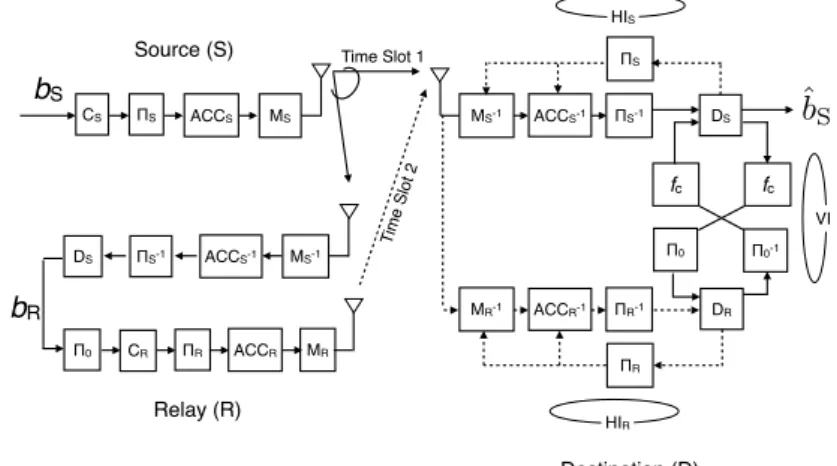
The coding/decoding structure of a three-node LF relaying system is shown in Fig. 1. At the source, the binary information sequencebS is first encoded by CS. Then, the encoded information sequences are interleaved by a random interleaverPS
and doped-accumulated by a ACCS(The purpose using ACCSis to control the shape of the extrinsic information transfer (EXIT) curve of the demodulator and keep the convergence tunnel open. [40]). Then, the outputs of ACCSare mapped onto symbols by a modulator MS, and broadcasted to both the relay and the destination in the first time slot. The received signal at the relay is first fed to a demodulator MS1, followed by the decoder ACCS1of ACCS. The extrinsic LLR output from ACCS1is fed to the de-interleaverPS1, followed by the decoder DSof CS. Instead of performing the fully iterative decoding/detection between MS1and DS1, only simple non-iterative decoding is performed. Hard decision is then performed on the output of DS1to obtain the information sequencebRat the relay. With this technique, we can significantly reduce the complexity of the relay compared to conducting iteratively decoding.
Due to the weak decoding at the relay,bRmay contain errors. However,bRis again random interleaved byP0, channel re-encoded by CR, re-interleaved by a random interleaverPRand fed to ACCR. The purpose of the use ofP0is that the interleaved sequenceP0(bR)is made statistically independent ofbS. Finally, the information sequence is re-mapped by MR, and transmitted to the destination in the second time slot.
At the destination, detection process for the signal received in the first and second time slots, respectively, is first performed independently as shown in Fig. 1. At this stage, fully iterative docoding/detection is adopted between MS1and DS1, which is referred to as horizontal iteration (HI), as well as between MR1and DR1[27]. After each round of HI, the extrinsic systematic LLRs obtained from the two decoders DSand DRare further exchanged with each other, which is referred to as vertical iteration (VI).
The extrinsic systematic LLR is updated by the function LLR updating function fc[31].
By utilizing the function fc, the extrinsic systematic LLRs, forwarded by the relay, help the decoder eliminate the errors in the original information sequencebSby exploiting the correlation knowledge between the source and the relay. Finally, the detection ofbS
can be completed by making hard decisions of the a posteriori LLRs of the systematic bits outputs from DS.
The LF technique can be viewed as a distributed joint source-channel coding system with a helper [32–35]. It is shown that with the help of the accumulator, LF can achieve turbo-cliff-like bit error rate (BER) performance over AWGN channels [27, 36].
The LF concept is originated from the idea of Slepian-Wolf cooperation presented in [37]. The coding algorithms are proposed for fading relay channel in [38, 39]. The key concept of the coding technique for LF is introduced in [27], where it assumes that the relay does not need to necessarily recover the information sent from the source perfectly. In [40], a three-node LF relaying over Rayleigh fading channels is studied by identifying the relationship between the DF protocol and Slepian-Wolf coding [41].
However, a drawback of [27, 40] is that the admissible rate region is determined by the Slepian-Wolf theorem which does not perfectly match the problem setup, since only the information of the source needs to be recovered at the destination. Zhouet al. [28]
eliminate the aforementioned drawback by utilizing the source coding with a helper theorem in the network information theory. Based on [28], the technique is further extended to multiple access relay channel (MARC) [42], where a pair of correlated sources are transmitted to a destination with the aid of one relay. Furthermore, Heet al.[43] apply the LF technique to the multi-source multi-relay system. A two-relay LF transmission system is proposed and a power allocation scheme for minimizing the outage probability of the two-relay LF system is presented in [44]. The technique is applied to wireless sensor networks, where a simple, yet efficient, power allocation scheme for an arbitrary number of sensors is derived in [45]. The major contributions under the LF relaying framework are summarized in Table 6.
1.3.2 Motivations
The primary goal of this dissertation is to identify the statistical properties performance of the LF-based cooperative wireless networks, and to provide theoretical analysis of system performance by exploiting the statistical characteristics of channel variations. In wireless communications, channels experience variations due to fading. The direct source-destination link and the via-relay link propagations are often found to be in different conditions. Hence, it is quite reasonable to assume that the statistical properties of the fading variations are also different, link by link. A most probably scenario is that since the direct link from source to destination suffers from severe fading, the destination needs the help of a relay via source-relay and relay-destination links which suffer from moderate fading. Hence, we consider the cases that the source-destination
link suffers from block Rayleigh fading (or equivalent Rayleigh fading), while the other links (the source-relay and relay-destination links) experience mild fading, e.g., having LOS component. It is, hence, very interesting to identify the impact of the LOS component on system performances.
In practical cooperative networks such as vehicle-to-infrastructure communications, it is often the case that the fading conditions experienced by different links are correlated due to insufficient separation in the space or time domains between the nodes or transmissions [46–48]. Therefore, examining the performance of diversity techniques in correlated fading conditions has been a long lasting problem with great importance [49].
Motivated by this, system performance in correlated fading is also investigated.
Diversity gain shows how fast the outage probability or frame error rate (FER) can decrease by increasing the average SNRg[50], by which one can have the insights regarding the factors determining the system performance in fading channels. How many independently varying signal components exist in the propagation medium, and how many of them can be extracted, for example, by using multiple antennas, different and/or time slots determines the diversity order that corresponds to the decay of the outage probability or FER curves as a function ofg. Coding gain appears in the form of the parallel shift of the outage probability/FER curves versusg. At high SNR, the outage probabilityPoutcan be asymptoticly expressed in terms of diversity order and coding gain, as,
Pout= (Gc·g) Gd, (1) whereGdandGcindicates the diversity order and coding gain, respectively. It should be noted here that in Rayleigh fading environment having NLOS components, the diversity order has only integer values which corresponds to the decay of the outage probability curve. However, in the presence of the LOS component, the decay can take negative real values, depending on the ratio of LOS component to NLOS components. Therefore, we refer the decay of the outage probability curve as toequivalent diversity order. This dissertation derives the equivalent diversity order and coding gain for LF relaying over block Nakagami-m fading with arbitrary values of the shape factorm. Also, the account is took of the channel correlations when investigating the diversity order and coding gain for LF, DF, and adaptive decode-and-forward (ADF). Since the capacity-achieving channel codes and infinite frame length are assumed in the theoretical analyses, the obtained theoretical results can be used for evaluating the asymptotic performances of practical systems.
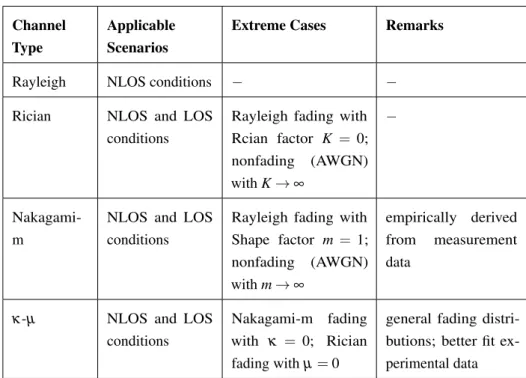
Table 4. Fading channel models.
Channel Type
Applicable Scenarios
Extreme Cases Remarks
Rayleigh NLOS conditions
Rician NLOS and LOS
conditions
Rayleigh fading with Rcian factor K = 0;
nonfading (AWGN) withK!•
Nakagami- m
NLOS and LOS conditions
Rayleigh fading with Shape factor m = 1;
nonfading (AWGN) withm!•
empirically derived from measurement data
k-µ NLOS and LOS
conditions
Nakagami-m fading with k = 0; Rician fading withµ=0
general fading distri- butions; better fit ex- perimental data
For characterizing the statistical performance under different channel conditions, we consider several fading models, as listed in Table 4. The Rayleigh fading is most widely used propagation model, applicable to the case where there is no signal component along a LOS. The Rician model describes a fading condition where there are both LOS and NLOS paths between the transmitter and the receiver [51]. The Nakagami-m fading is an empirically derived model using field measurement data, and hence is better matched to real propagation scenario compared to the Rician distribution. Therefore, we also consider Nakagami-m model as representing the propagation scenario including LOS and NLOS components. Moreover, a recently proposed generalk-µmodel, which better fits experimental data than Rician or Nakagami-m models, is also used to represent the variation of the fading signal in the presence of LOS component.
The Rician and Nakagami-m models are utilized to represent the fading variation having both NLOS and LOS components. They are connected by the Rician factorKand Nakagami-m shape factormboth representing the fading severity. Therefore, the impact difference of the Rician and Nakagami-m fading on outage performance is evaluated.
The Kullback-Leibler divergence (KLD) and Jensen-Shannon divergence (JSD) are used
to identify the difference between the Rician and Nakagami-m distributions. To further generalize the propagation model with a LOS component, this dissertation applies time-varyingKfactor scenario, where theKvalue in the Rician model is assumed to follow empirical distributions, normal or logistic distributions; they were derived from field measurement data [52], and hence recognized as being practical.
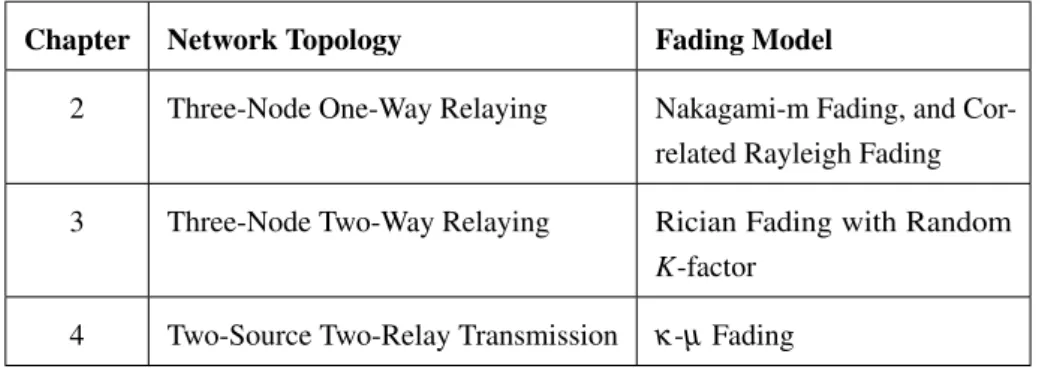
Theoretical analysis and performance evaluation of the generic cooperative network model is complicated. Furthermore, if dynamic network topology variation is taken into account, it imposes a lot of challenges. Instead, we decompose the general network into several network models having simple structures that are widely used in cooperative communication research, as summarized in Table 5.
Table 5. System model in each Chapter.
Chapter Network Topology Fading Model
2 Three-Node One-Way Relaying Nakagami-m Fading, and Cor- related Rayleigh Fading 3 Three-Node Two-Way Relaying Rician Fading with Random
K-factor 4 Two-Source Two-Relay Transmission k-µFading
Although only simple system structures are considered, the information theoretic analysis for these basic network models provides insights into understanding of more generic networks.
1.4 Outline of Dissertation
In Chapter 2, we investigate the performance of a three-node one-way relay system.
First of all, the exact outage probability of LF relaying over Nakagami-m fading channels with arbitrary values of the shape factormis derived. With a yet accurate approximated expressions, the equivalent diversity order and coding gain of LF relaying are identified. Compared with conventional DF relaying, LF relaying can achieve even lower outage probability. We then analyze the impact of the spatial and temporal correlations of the fading variations on the system performance of LF, DF and ADF relaying. The diversity orders with LF, DF, and ADF are derived in the presence of
the spatial and temporal fading correlations. Obviously, the larger the correlation, the higher the outage probability. Chapter 2 provides formulas that represents this relationship in a mathematical way. It is found that the optimal relay locations yielding the smallest outage probability move towards to the destination, compared with the case in independent fading. Finally, the differences between the outage performances with LF relaying in Rician and Nakagami-m fading, are also investigated. The Kullback- Leibler divergence (KLD) and Jensen-Shannon divergence (JSD), which represent the difference quantitatively between two probability distributions, are used to verify the performance difference on the outage curves with Rician and Nakagami-m distributions.
The analytical results show that, even with the parameter settings yielding the same LOS-to-NLOS power ratio, Rician can not exactly replace the Nakagami-m model to represent the entire shape of distributions.
Chapter 3 propose a two-way LF relaying system utilizing non-orthogonal source- to-relay links transmission, and hence it can achieve significant spectral efficiency gain compared to one-way relaying. Another focus point of Chapter 3 is the impact analysis of time-varying LOS signal energy. We assume the channels suffer from Rician fading with randomK factor. The RicianK-factor is assumed to follow empirical distributions derived from measurement data, i.e., logistic and normal distributions.
From the analytical results, we found that compared to two-way DF relaying, two-way LF relaying achieves lower outage probability regardless of either logistic or normal distribution is used to represent the variation ofK-factor. This is because with LF relaying, the relay always broadcast the decoder output regardless of whether or not error is detected after decoding in the information part, and hence source correlation can be well exploited at the decoder of the destination.
Chapter 4 extends the major results of the previous chapters, and focuses on the problem of transmitting two sources to one destination over a two-relay transmission system. All the links experiencek-µfading variation, which is more consistent to measurement data than Rician or Nakagami-m model. Two transmission, non-orthogonal maximum ratio transmission and orthogonal transmission with joint-decoding at the destination, are considered as the relay-destination transmission schemes. The theoretical analysis indicates that the outage performance of the two-source two-relay system with orthogonal transmission with joint-decoding scheme outperforms that with maximum ratio transmission scheme.
Chapter 5 summarizes the work and presents insight discussion for the future work.
1.5 Summary of Outcomes
This dissertation is written as a monograph based on two journal papers [53, 54], one letter [55], and two conference papers [56, 57]. The first journal paper [53] has already been published and the other [54] has been accepted. The author has the main responsibility for performing the analysis, generating the numerical results, and writing all the papers [53–57]. The other authors have provided comments and constructive criticisms.
Besides the aforementioned publications, the authors published four other conference papers [58–61] and co-authored several papers in the relevant topic [62–66] during the doctoral study. Furthermore, the author has been involved in creating Technical reports/Deliverables [67–71] under the 7th Framework Program (FP7) Links-on-the- fly Technology for Robust, Efficient and Smart Communication in Unpredictable Environments (RESCUE) project.
Table 6. Summary of major contributions on LF relaying.
Year Authors Contributions 2005 Hu and Li
[37]
Proposed Slepian-Wolf cooperation, which exploits distributed source coding technologies in wireless cooperative communica- tions.
2007 Woldegebreal and Karl [72]
Considered a network-coding-based MARC in the presence of non-ideal source-relay links, and analyzed the outage performance and coverage.
2007 Sneessens et al.[39]
Derived a decoding algorithm which enables the use of turbo- coded DF relaying by taking into account the probability of error between the source and the relay.
2012 Anwar and Matsumoto [27]
Proposed an iterative decoding technique, accumulator-assisted distributed turbo code, where the correlation knowledge between the source and the relay is estimated and exploited.
2013 Chenget al.
[40]
Proposed a scheme for exploiting the source-relay correlation in joint-decoding process at the destination, based on the Slepian- Wolf theorem.
2014 Zhou et al.
[28]
Derived the exact outage probability by utilizing the lossy source- channel separation and source coding with a helper theorems.
2015 Wolf et al.
[44]
Proposed an optimal power allocation strategy for a two-relay sys- tem based on convex optimization to minimize outage probability.
2015 Lu et al.
[42]
Derived the outage probability for orthogonal MARC for corre- lated source transmission where erroneous source information estimated at the relay is forwarded.
2016 Wolf et al.
[45]
Proposed asymptotically optimal power allocation scheme for wireless sensor networks with correlated data from an arbitrary amount of sensors.
2 On the Performance of One-Way
Lossy-Forward Relay Wireless Networks
In this chapter, we investigate the performance of three-node LF relaying over indepen- dent block Nakagami-m fading channels. Based on the source coding with a helper theorem, the outage probability expression with arbitrary values of the shape factormis derived. Then, we identify the impact of the spatial and temporal correlations of the fading variations on the outage performances of LF, DF and ADF relaying in correlated Rayleigh fading. Finally, the impact difference of the Rician and Nakagami-m fading on outage performance of the one-way LF relaying system is evaluated.
2.1 Lossy-Forward Transmission over independent Nakagami-m Fading Channels
2.1.1 System Model
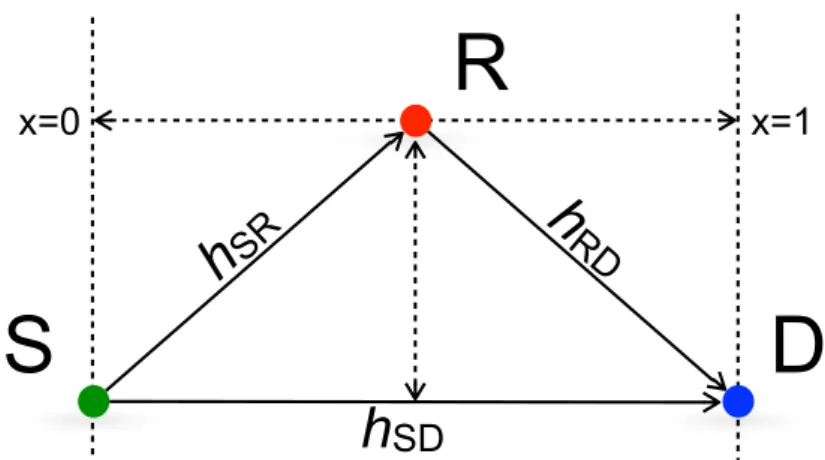
We consider a simple three-node relaying system as shown in Fig. 2. The source S communicates with the destination D with the help of a single relay R. The location of R varies in a line parallel to the line connecting S and D betweenx=0 (nearest to S) and x=1 (nearest to D). Unless otherwise specified, the distant between R and the line connecting S and D is set at12of S-D link length. We assume time-division transmission, where the overall transmission is divided into two time slots. In the first time slot, the original uniformly distributed binary information sequencebSis encoded and broadcast from S. The relay R aims to recover the information sequence, and always re-interleaves the information sequence, re-encodes it and forwards the encoder output to D in the second time slot, even though the decoding result may contain error in the original information sequence.
LF Relaying
In conventional DF relaying, R keeps silent if error is detected after decoding in the information sequence sent through the S-R link. With LF relaying, after receiving the signal from S, R attempts to recoverbS. Although the decoding result ofbSat R,
R
d SD1 d SD2
d SR
d RD
S D
d SD =d SD1 +d SD2
d 0
G sr = d sd d sr
⎛
⎝⎜
⎞
⎠⎟
α
G rd = d sd d rd
⎛
⎝⎜
⎞
⎠⎟
α
d sd1 + d sd 2 = 1;
d sr = d sd1 2 + r 2 ; d rd = d sd 2 2 + r 2 ;
path-loss exponent: α=3.75
b S
b R
Rayleigh fading
Rici an fading Rici an fading
S
R
D
h SR
h SD
d SD
h RD
d 0
x=0 x=1
Fig. 2. The schematic of one relay aided communication system, where all the links (the S-R, R-D and S-D links) in Nakagami-m fading.
denoted bybR, may be found to contain error, R re-interleaves the information sequence bR, re-encodes the re-interleaved sequence, and forwards it to D.
The S-R link is virtually modeled by a binary symmetric channel (BSC) model with a crossover probabilitypf. More specifically,pf represents the bit flipping probability between the information sequence obtained after decoding at R and the original information sequence sent from S. Hence,bR=bS e, where denotes the modulo-2 addition andeis a realization of a binary random variableEwith Pr(E=1) =pf. pf
stays the same within each block while changes block-by-block with its value being determined by the instantaneous SNR.
At D, after receiving the signals from S and R, joint decoding is performed to retrieve the original informationbS. Iterative decoding is utilized between two decoders for decoding the information sent from S and R. In the decoding process, the S-R link error probabilitiespf can be estimated at D. The estimated pf value is used as the correlation knowledge betweenbSandbR[27]. The LLRs of the systematic bits are exchanged between the two decoders via the interleaver/de-interleaver. Therefore, the system, as a whole, can be viewed as a distributed turbo code.
Channel Model
The signals received at D and R in the first time slot,yD,1andyR,1, respectively, and the signal received at D in the second time slot,yD,2, are expressed as3
yD,1=p
GSDhSDx1+nD,1, (2) yR,1=p
GSRhSRx1+nR,1, (3) yD,2=p
GRDhRDx2+nD,2, (4) respectively, whereGi j(i2(S,R),j2(R,D),i6=j)are the geometric gains related to the transmit distance of each link. The modulated symbols transmitted from S and R are denoted byx1andx2, respectively. hi jdenotes the complex channel gain andnj,1
andnj,2are zero-mean AWGN with variance ofN0/2 per dimension. It is assumed thatE[|hi j|2] =1 andhi jstays constant over one block duration due to the block fading assumption. We assume that the channel state information (CSI) is only available at the receiver side.
The transmit energy of each symbol is denoted asE{|x1|2}=E{|x2|2}=Es. There- fore, the average and instantaneous SNR of each link is expressed asgi j=Gi jEs
N0 and gi j=|hi j|2gi j(i2(S,R),j2(R,D),i6= j), respectively. For the sake of simplicity, the variations due to shadowing and the fading frequency selectivity are not taken into account.
We assume that all the links (i.e., the S-R, S-D, and R-D links) suffer from independent block Nakagami-m fading, with the probability density function (pdf) ofgi j
given by
p(gi j) = mmi ji j(gi j)mi j 1
⇣gi j⌘mi j
G(mi j)
exp mi jgi j
gi j
!
,mi j>0.5, (5)
whereG(·)is the Gamma function. The shape factormi jrepresents the severity of the fading variation of each link.
We consider a scenario that the S-D link suffers from severe fading and the destination needs the help of a relay via S-R and R-D links, which suffer from mild fading, i.e., not as severe as the S-D link. Hence, we set the shape factor of the S-D linkmSD=1, corresponding to Rayleigh fading, while for other links (the S-R and R-D links), we set theirmvalues as parameters (mSR>1,mRD>1).
3The symbol indexes are omitted in (2), (3), and (4) for conciseness.
Encoder 1
Encoder 2
Decoder
R
Rb
S⊕
E b
RR
S ⇣ˆ b S
ˆbR
⌘
Fig. 3. Block diagram for the coding/decoding ofbSandbRfrom the view of source coding with a helper. bRis the bit-flipped version ofbSand serves as a helper for the decoding of bSat the decoder .
2.1.2 Outage Probability Analysis
In this section, the definition of admissible rate region and the derivation for outage probability of LF relaying are provided. The outage probability is derived based on both Gaussian codebook capacity and constellation constrained capacity assumptions.
Admissible Rate Region Based on Source Coding with a Helper Theorem In LF relaying, D aims to recoverbSonly and thebRtransmitted from R does not need to be decoded successfully. Therefore, the analysis falls into the problem category of source coding with a helper. In other words, in the LF relay system,bRservers as a helper for the successful recovery ofbS, as shown in Fig. 3. AssumebSandbRare described with ratesRSandRR, respectively. According to the source coding with a helper theorem [30, Section10.4]
Theorem 1. Lossless Source Coding with a Helper bS can be recovered with an arbitrarily small probability of error if the rate pair (RS,RR) satisfies
8<
:
RS H(bS|bˆR),
RR I(bR; ˆbR), (6)
where ˆbRis the estimate ofbRobtained at the decoder of the destination.H(·|·)andI(·;·) denote the conditional entropy and the mutual information between their arguments, respectively. Eq. (6) indicates thatI(bR; ˆbR)bits per symbol can be used to describebR. Then,bScan be described at the rate ofH(bS|bˆR)bits per symbol in the presence of a helper ˆbR.
inadmissible region
A
H(b
R)=1 R
SH(b
R)=1 R
Radmissible region
S
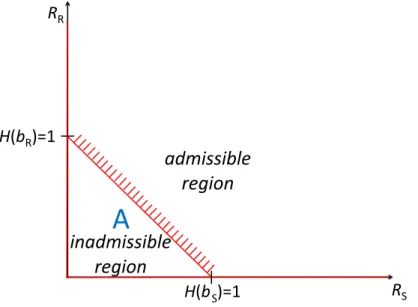
Fig. 4. Rate region for S and R when pf =0; the red solid line with bars separates the admissible and inadmissible regions.
With the block fading assumption, we also use a BSC model to represent the R-D link, as ˆbR=bR e0with Pr(E0=1) =p0f, wheree0is a realization of a binary random variableE0. Since the source is assumed to be binary, uniform, and independently and identically distributed (i.i.d), (6) can be expressed as [28]
8<
:
RS H(pf⇤p0f),
RR H(bˆR) H(bˆR|bR) =1 H(p0f), (7) wherepf⇤p0f = (1 pf)p0f+ (1 p0f)pf andH(·)denotes the binary entropy function.
pf =0 indicates perfect decoding at R, and henceH(bS|bR) =H(bR|bS) =0. In this case, the inadmissible rate region becomes the triangle area A as shown in Fig. 4.
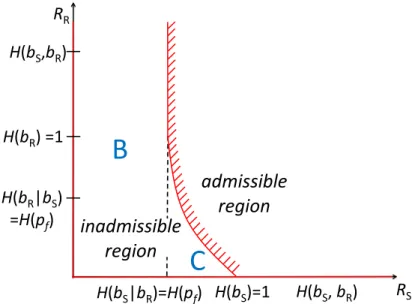
When 0<pf 0.5, the inadmissible region, which can be divided into two areas, B and C, is shown in Fig. 5.
If the relay sendsbRto the destination without error, ˆbR=bRandp0f =0, then, the condition isRR H(bR)andRS H(bS|bR). In the casep0f =0.5, which indicates that bˆRis totally wrong and does not contain any useful information aboutbR. Therefore, the condition becomes asRS 1 andRR=0. In any case of 0<p0f <0.5, the condition is RS H(pf⇤p0f)andRR 1 H(p0f).
B
C
H(b
S|b
R)=H(p
f) H(b
S)=1 H(b
S, b
R) R
SH(b
R|b
S)
=H(p
f) H(b
R) =1
H(b
S,b
R) R
Rinadmissible region
admissible region
Fig. 5. Rate region for S and R when pf 6=0; the red solid line with bars separates the admissible and inadmissible regions.
Outage Event of LF relaying
If the rate pair (RS,RR) falls into the inadmissible regions in Fig. 4 or Fig. 5, the outage event occurs and D cannot guarantee the reconstruction ofbSwith an arbitrarily small error probability. The outage probability of LF relaying can be expressed as
PoutLF=PA+PB+PC, (8) wherePA,PB, andPCdenotes the probability that (RS,RR) falls into the inadmissible areas A, B, and C, respectively. Taking into account the impact ofpf andp0f,PA,PB, andPCcan further be expressed as
PA=Pr[pf =0,0RS1,0RRH(pf⇤p0f)], (9) PB=Pr[0<pf0.5,0RS<H(pf),RR 0], (10) PC=Pr[0<pf0.5,H(pf)RS1,
0RR<H(pf⇤p0f)]. (11)
(A) Outage Derivation with Gaussian Codebook Capacity
For calculating the outage probability, first we establish the relationship betweengSD
andRS, and the relationship betweengRDandRR. According to the Shannon’s lossless source channel separation theorem [73], if the total information transmission rates over the S-D and R-D links satisfy
8<
:
H(bS)·RcSDRS·RcSDCSD(gSD),
H(bR)·RcRDRR·RcRDCRD(gRD), (12) the error probability can be arbitrarily small at the destination.CiDandRciD, respectively, denote the channel capacity of thei-D link and the normalized spectrum efficiency of the corresponding transmission chain. The normalized spectrum efficiency includes the channel coding and the modulation multiplicity (constellation size). With the assumption that Gaussian codebook is used, the channel capacityCiDof each link can be expressed as
CiD(giD) =En 2 log
✓ 1+2giD
En
◆
,(i2S,R), (13)
whereEndenotes the dimensionality of the channel input, e.g.,En=1 for binary phase shift keying (BPSK) andEn=2 for quaternary phase shift keying (QPSK). Hence, the relationship between the instantaneous channel SNRgiDand its corresponding source coding rateRiis given by
RiQ(giD) =CiD(giD) RciD = En
2RciDlog
✓ 1+2giD
En
◆
,(i2S,R) (14)
with its inverse inequality
giD Q 1(Ri) =En 2
✓
22RiRciDEn 1◆
. (15)
Then, we establish the relationship betweengSRandpf. Sincepf only depends on the quality of the S-R link, according to Shannon’s lossy source channel separation theorem [74], we have
R(D)·RcSRCSR(gSR), (16) whereR(D)denotes the source rate-distortion function with the distortion measureD.
In the case of binary transmission, the Hamming distortion between a source bitx and its estimate ˆxgiven by
d(x,x) =ˆ 8<
:
0 ifx= x,ˆ
1 ifx6=x,ˆ (17)
−2 −1.5 −1 −0.5 0 0.5 1 10−4
10−3 10−2 10−1
S−R link SNR (dB)
p f
S−R link theoretical pf
Fig. 6. S-R link Hamming distortionpf versus SNR, whereEn=2andRcSR=1.
is used as the distortion measure.
With the bit-wise Hamming distortion measure, the sequence-wise distortion measure Dis equivalent to the crossover probabilitypf, since bothpf andDcan be regarded as the theoretical BER of the S-R transmission with long enough sequence length. The rate-distortion function is represented asR(D) =1 H(D)for i.i.d binary source [75].
Since we assume that Gaussian codebook is used for the S-R link transmission, the relationship between the required instantaneous channel SNRgSRand its corresponding source rateR(D)with distortionDis given by
gSR En 2
✓
22R(D)RcEnSR 1
◆
. (18)
Then, we can obtain the relationship betweenpf andgSRas
pf =H 1 0
@1
En 2log⇣
1+2gESRn
⌘ RcSR
1
A, (19)
withH 1(·)denoting the inverse function ofH(·). The relationship between the S-R link SNR andpf is shown in Fig. 6. It is found from Fig. 6 that the value of error probabilitypf decreases as the SNR of the S-R link increases. Note that pf stays