JAIST Repository
https://dspace.jaist.ac.jp/
Title マイクロブログにおける皮肉表現を対象とした感情分
析
Author(s) TUNGTHAMTHITI, PIYOROS Citation
Issue Date 2016‑09
Type Thesis or Dissertation Text version ETD
URL http://hdl.handle.net/10119/13826 Rights
Description Supervisor:白井 清昭, 情報科学研究科, 博士
Sentiment Analysis of Sarcasm on Microblogging
Piyoros Tungthamthiti
Japan Advanced Institute of Science and Technology
Doctoral Dissertation
Sentiment Analysis of Sarcasm on Microblogging
Piyoros Tungthamthiti
Supervisor: Professor Kiyoaki, SHIRAI
School of Information Science
Japan Advanced Institute of Science and Technology
September, 2016
Abstract
Sentiment analysis of sarcasm in microblogging is important in a range of natural language processing (NLP) applications such as text mining and opinion mining. However, this is a challenging task, as the real meaning of a sarcastic sentence is the opposite of the literal meaning. Furthermore, microblogging messages are short and usually written in a free style that may include misspellings, grammatical errors, and complex sentence structures. This thesis proposes a novel method of sentiment analysis on microblogging that enables us to identify orientation and intensity of the sentiment expressed in the tweets, especially in the sarcastic tweets.
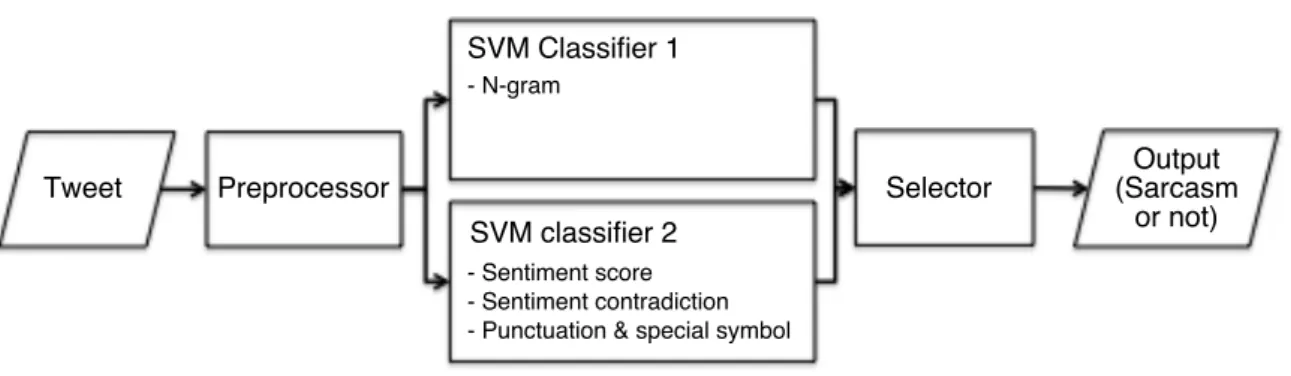
First, we introduce a novel method to identify sarcasm in tweets. It is an ensemble of two supervised classifiers: one is Support Vector Machine (SVM) with N-gram features, the other is SVM with our proposed features. Our features represent intensity of senti- ment and contradiction of sentiment derived by a naive sentiment analysis of the tweet.
In the sentiment contradiction feature, coherence among multiple sentences in the tweet is also considered, which is automatically identified by our proposed method based on unsupervised clustering algorithm. Furthermore, a way to expand concepts of unknown sentiment words is presented to compensate for insufficiency of a sentiment lexicon. Our method also considers punctuation and special symbols, which are frequently used in Twitter. Results of experiments using two datasets show that our proposed system out- performs baseline systems. The accuracy of sarcasm identification on two datasets is 83%
or 76%.
Next, we propose a sentiment analysis system designed for handling sarcastic tweets.
To train the model to guess the polarity and intensity of the sentiment in the sarcastic tweets, we used a rich set of features, that are our proposed features used for sarcasm recognition as well as the features grounded on several linguistic levels proposed by the previous work. A decision tree with these features is trained to classify the tweets into an 11-scale score in range of−5 to 5. The system is evaluated on the dataset released by the organizers of the SemEval 2015 task 11. The results show that our method largely
outperforms the systems proposed by the participants of the task on sarcastic and ironic tweets.
Finally, we propose a method for developing a sentiment analysis tool that can guess the fine-grained sentiment score for various types of the tweets. The system consists of two steps. At the first step, the given tweets are classified if they are sarcastic by our sophisticated sarcasm recognition method. At the second step, our sentiment analysis sys- tem designed for the sarcastic tweets is used to guess the sentiment scores of the tweets that are judged as sarcasm in the first step. On the other hand, for the tweets judged as non-sarcasm, the three existing sentiment analyzers are applied to guess the sentiment score. The results of the experiments show that our proposed two-steps sentiment anal- ysis system outperforms any single sentiment analyzers on a data set consisting of both sarcastic and non-sarcastic tweets.
In addition, as for the application of the proposed method, our technique to recognize the sarcasm is integrated to an existing target-dependent sentiment analysis system. We also show that the integration can improve the performance via the experiments using a relatively small data set consisting of three targets.
Keywords: Sarcasm, Microblogging, Sentiment analysis, Coherence, Concept Knowl- edge, Machine learning, Clustering
Acknowledgments
First and foremost, I would like to express my sincere gratitude to my advisor, Assoc.
Prof. Shirai Kiyoaki for the continuous support of my Ph.D. study and research, for his patience, encouragement, motivation, enthusiasm, and immense knowledge. In 2013, Assoc. Prof. Shirai Kiyoaki offered me one of the greatest opportunities of my life to join his natural language processing laboratory, Japan Advanced Institute of Science and Technology (JAIST). Since then, he has been giving me a lot of advises and knowledges regarding the area of my studies, researches, and also giving me a lot of help in my daily life. Without his encouragement and support, I would have given up on the completion of this research. I could not have imagined having a better advisor for my Ph.D. study.
I would like to thank the other members of my committee, Assoc. Prof. Minh Le Nguyen, Assoc. Prof. Hieu Chi Dam, Assoc. Prof. Shinobu Hasegawa and Prof. Hiroyuki Iida for their time, insightful comments on my thesis and their excitement and interest in all my professional and personal research routines.
In addition, I acknowledge my external committee member, Assoc. Prof. Hiroya Takamura for sharing his tremendous experience in the field of natural language processing and data mining. I also greatly appreciate his enthusiasm on giving me a lot of suggestions and comments in details to improve the quality of my dissertation.
I am also grateful to my friends at Hong Kong Polytechnic University, Enrico Santus, Hongzhi Xu and their advisor, Prof. Chu-ren Huang for a great collaboration in the 29th Pacific Asia Conference on Language, Information and Computation (PACLIC 29).
I want to thank their excellent cooperation and all of the opportunities I was given to conduct my research.
The days would have passed far more slowly without the support of my Thai friends at JAIST. I had an enjoyable moment and memorable time during these 3 years. Thank you for putting up with me and being so supportive of me and my work.
My sincere thanks also go to Dr. Yongyos Kaewpitakkun and Tomotaka Fukuoka for their generosity, friendship and kindness during these three years. They always offered to
help and gave good advice on anything.
Also, I would also like to thank all Shirai laboratory members for their questions and useful comments on my research. The learning curve would have been much steeper without them.
Special thanks to my family. Words can not express how grateful I am to my parents for all of the sacrifices they made on my behalf. I would like to thank for the love, support, and constant encouragement I have gotten over the years. I undoubtedly could not have done this without them.
Contents
Abstract i
Acknowledgments iii
1 Introduction 1
1.1 Background . . . 1
1.1.1 Natural Language Processing . . . 1
1.1.2 Sentiment Analysis and Opinion Mining on Microblogging . . . 4
1.1.3 Literal and Figurative Language . . . 5
1.2 Goal . . . 6
1.2.1 Statement of problems . . . 6
1.2.2 Goal and research questions . . . 8
1.2.3 Research methodology and originality . . . 9
1.3 Chapter organization . . . 11
2 Literature review 13 2.1 Statistical machine learning methods . . . 13
2.1.1 Supervised learning . . . 14
2.1.2 Clustering method . . . 17
2.2 Linguistic aspect of sarcasm . . . 20
2.3 Recognition of sarcasm . . . 21
2.4 Sentiment analysis . . . 23
2.5 Coherence identification . . . 26 3 Recognition of Sarcasm in Tweets Based on Sentiment Analysis and
Coherence Identification 28
3.1 Data preprocessing . . . 29
3.2 Proposed features . . . 30
3.2.1 Sentiment score features . . . 30
3.2.2 Sentiment contradiction feature . . . 32
3.2.3 Punctuation and special symbol feature . . . 33
3.3 Concept expansion and pruning . . . 34
3.3.1 Concept expansion . . . 34
3.3.2 Concept pruning . . . 35
3.4 Coherence identification . . . 37
3.4.1 Heuristic-based coherence identification . . . 38
3.4.2 Coherence clustering with feature weight optimization (CC-FWO) . 38 3.5 Classification procedures . . . 43
3.6 Evaluation . . . 45
3.6.1 Experiment I . . . 45
3.6.2 Experiment II . . . 51
3.6.3 Limitations . . . 59
3.7 Summary . . . 60
4 Sentiment Analyzer with Rich Features for Sarcastic Tweets 62 4.1 Data preprocessing . . . 63
4.2 Module 1 . . . 65
4.3 Module 2 . . . 66
4.3.1 Concept expansion sub-module . . . 67
4.3.2 Polarity identification sub-module . . . 67
4.3.3 Coherence identification sub-module . . . 67
4.3.4 Punctuation and special symbols . . . 68
4.4 Experiment . . . 68
4.4.1 Data . . . 68
4.4.2 Task . . . 69
4.4.3 Evaluation measures . . . 69
4.5 Results and discussion . . . 70
4.5.1 Results on the training data . . . 70
4.5.2 Results on the test data . . . 73
4.6 Summary . . . 76
5 General Sentiment Analyzer for Microblogging 77 5.1 Sentiment analysis of tweets . . . 78
5.1.1 NRC-Canada sentiment analyzer . . . 79
5.1.2 Stanford sentiment analyzer . . . 81
5.1.3 SentiStrength . . . 82
5.2 Evaluation . . . 82
5.3 Target-dependent sentiment analysis . . . 85
5.3.1 Motivation and proposed method . . . 85
5.3.2 Evaluation of target-dependent sentiment analysis . . . 87
5.4 Summary . . . 88
6 Conclusion 90 6.1 Summary of Dissertation . . . 90
6.2 Contribution of our research . . . 93
6.2.1 Research contributions . . . 93
6.2.2 Contribution on social impact . . . 94
6.3 Future work . . . 94
Biblography 96
Publications 108
List of Figures
1.1 Levels of natural language processing . . . 2
1.2 Example of syntactic analysis parsing sentence “I love a dog.” . . . 3
1.3 Flowchart of overall process of our method . . . 10
2.1 Separating hyperplane in Support Vector Machine . . . 15
2.2 Example of Decision Tree training . . . 16
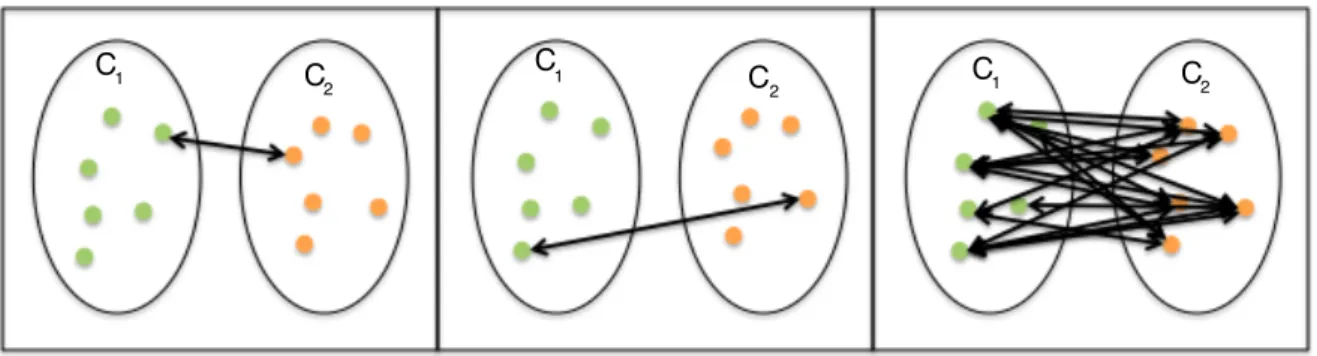
2.3 Hierarchical clustering: Single Linkage (left), Complete Linkage (center) and Average Linkage (right) . . . 18
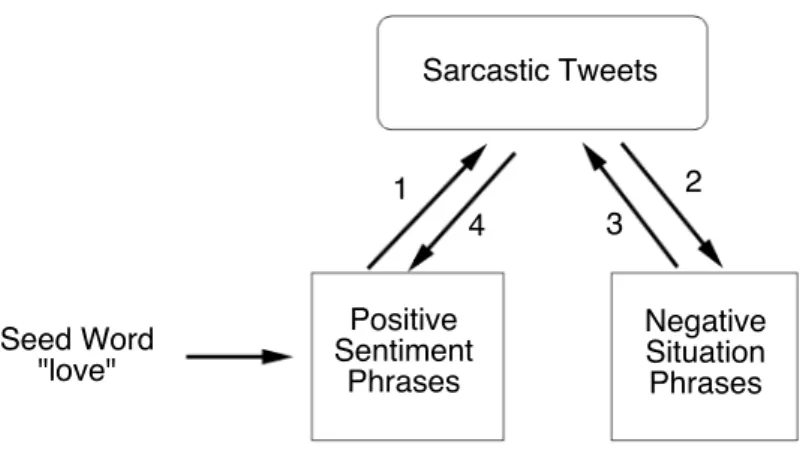
2.4 Bootstrapping Learning of Positive Sentiment and Negative Situation Phrases 21 3.1 Method overview of sarcasm recognition system . . . 29
3.2 Optimization of the parameter Tc: Skip-gram model (left) and Resnik’s algorithm (right) . . . 37
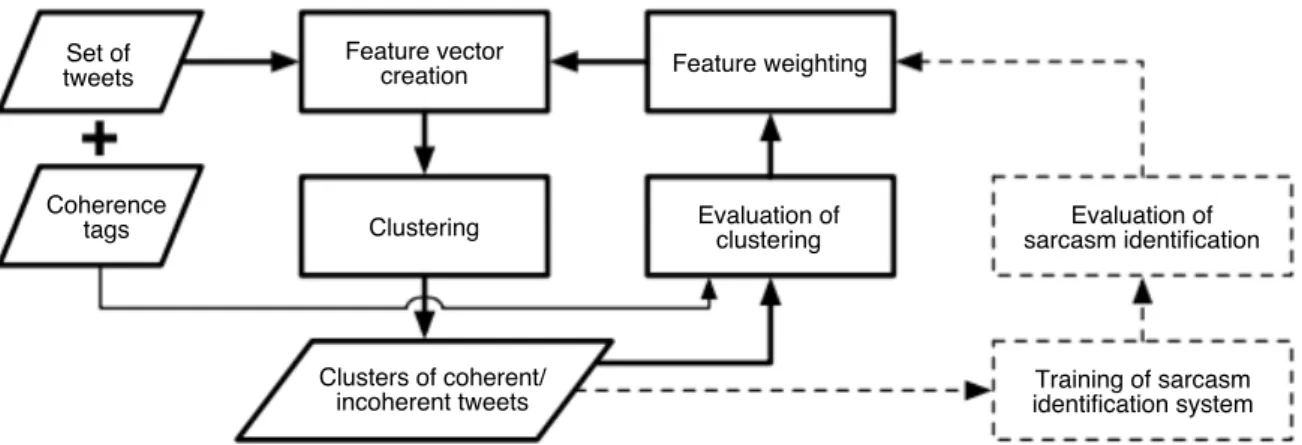
3.3 Procedures of coherence identification in tweets based on CC-FWO . . . . 39
3.4 Example of conflicts of two SVM classifiers . . . 43
3.5 Flowchart of overall process of our sarcasm recognition method . . . 46
4.1 Flowchart of overall process of sentiment analyzer for sarcastic tweets . . . 64
5.1 The overall method of our proposed sentiment analyzer for Microblogging . 78 5.2 Calculation of sentiment score for normal tweets . . . 78
5.3 The overall procedure of NRC-Canada sentiment analysis system . . . 79
5.4 Example of positive (left) and negative (right) sentiment prediction based on the Recursive Neural Tensor Network . . . 81
5.5 The overview of procedure of TASK-SEN system . . . 86
List of Tables
1.1 Examples of figurative language . . . 5
3.1 Features for clustering of coherent/incoherent tweets . . . 40
3.2 Accuracy of coherence identification . . . 41
3.3 Comparison of different coherent identification methods in terms of the accuracy of sarcasm identification . . . 42
3.4 Summary of features . . . 44
3.5 Results of sarcasm identification based on sentiment contradiction . . . 47
3.6 Results of sarcasm identification of single classifier . . . 47
3.7 Results of the proposed method and effectiveness of individual features . . 48
3.8 Results of McNemar’s test between Baseline 1 or Baseline 2 and our pro- posed method on ARTK-50K dataset . . . 49
3.9 Effectiveness of concept expansion and pruning . . . 51
3.10 Number of expanded concepts . . . 51
3.11 Results of sarcasm identification . . . 53
3.12 The average length and percentage of single and multiple sentences of tweets in ARTK and SemEval dataset . . . 54
3.13 Accuracy of sarcasm identification on different length of tweet data . . . . 54
3.14 Effectiveness of individual features . . . 56
3.15 Effectiveness of concept expansion and pruning . . . 57
3.16 Number of expanded concepts . . . 57
3.17 Effectiveness of feature weights by CC-FWO . . . 58
3.18 Results of McNemar’s test between Baseline 1, Baseline 2 or Baseline 3 and our proposed method on ARTK-300K and SemEval dataset . . . 59
4.1 Results of the module 1 of 5-fold cross validation on the training data . . . 70
4.2 Results of the module 2 of 5-fold cross validation on the training data . . . 72
4.3 Results of the integrated system of 5-fold cross validation on the training data . . . 73
4.4 Results of the module 1 on the test dataset . . . 73
4.5 Results of the module 2 on the test dataset . . . 73
4.6 Results of SA-SAR on the test dataset . . . 74
4.7 Pairedt-test for comparison between SA-SAR and each module . . . 74
4.8 Comparison of our SA-SAR against five top systems participated in Se- mEval 2015 Task 11 . . . 75
5.1 Summary of the features in the NRC-Canada sentiment analyzer . . . 80
5.2 Results of individual sentiment analyzers . . . 83
5.3 Improvement by integration of sentiment analyzers . . . 83
5.4 Paired t-test results between Stanford, NRC-Canada or SentiStrength and SA-GEN . . . 84
5.5 Results of target-level senitment analysis with sarcasm feature. . . 88
5.6 Results of target-level senitment analysis without sarcasm feature. . . 88
Chapter 1 Introduction
With a rapid growth of microblogging such as Twitter, the importance of sentiment analysis on the microblogs is increasing in a filed of natural language processing (NLP).
Meanwhile, it is well known that the automatic interpretation of sarcasm is difficult due to its special linguistic features. Understanding the sarcasm in the microblogging is indispensable for a practical use of sentiment analysis, but it is still challenging. In this chapter, we first explain the background of this research, then clarify the goal of this thesis.
1.1 Background
1.1.1 Natural Language Processing
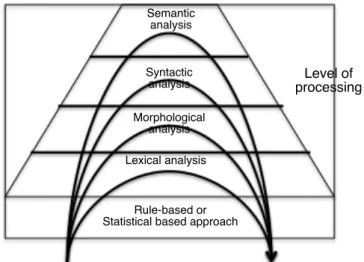
NLP is a technique to handle with the interactions between computers and human natural languages. The process of understanding the information in natural language can be divided into multiple layers, including lexical analysis, morphological analysis, syntactic analysis and semantic analysis. The machine should proceed through each layer (i.e., character, word, phrase, sentence, paragraph, meaning and so on) in order to perceive the information from given texts or speeches efficiently. Each layer is related to many different major tasks in NLP as follows.
• Lexical analysis
Generally, lexical analysis is considered as the first stage of text processing. The task
��������
����������
����������������� �����������������
����������������
�������������
��������
���������
��������
��������
��������
�������������
��������������������������
Figure 1.1: Levels of natural language processing
of the lexical analysis is to segment a given sequence of string characters into word tokens or lexemes. This level is capable of determining of word or token and sentence boundary. Then, the tokens will be taken into the next level of the processing such as part-of-speech tagging (POS), parsing and so on. The task is usually performed together with a parser (syntactic anlysis) to analyze the grammatical errors in linguistic or syntax errors in programming languages.
• Morphological analysis
Morphological analysis is a process to identify the structure of words or morphemes.
Morpheme is considered as the smallest meaningful unit in linguistic, such as prefix, suffix and root of the word. The task is capable for determining a form of the word and other additional information. For example, “dogs” is divided into the root “dog” and the suffix of the plural form “s”. “investment” is divided into the root “invest” and the suffix “ment”. It means that the noun “investment” is derived from the verb “invest”.
Another important task in morphological analysis is POS tagging, where the POS of each word in the sentence is identified.
• Syntactic analysis
Syntactic analysis also known as “parsing” is a process of determining the structure of an input sentence. This task is to ensure that the input sequence of words or symbols
� ����
� ����
� �
��
�
��
�
�
Figure 1.2: Example of syntactic analysis parsing sentence “I love a dog.”
conforms to the rules of the grammar in linguistics. Generally, the process describes the structure of an input sentence by a tree where each node represents a word, phrase or clause and the root of the tree represents the overall sentence. Figure 1.2 shows an illustrative example of syntactic analysis of the sentence “I love a dog.” The parse tree represents the entire structure, starting from the root S (Sentence), branching NP (Noun phrase) and VP (Verb phrase), and ending in the leaf nodes N (Noun), V (Verb) and D (Determiner).
• Semantic analysis
Semantic analysis refers to the analysis of a meaningful sequence of words or tokens.
It can be performed on various levels of textual units, including phrases, sentences, paragraphs or the whole document. The task examines the grammatical and word patterns to determine the actual intended meaning of written texts. In linguistics, it is not always necessary that the correctly written phrases or sentences can have only one intended meaning as their meaning. Let us consider the example of sentence “I love being sick.” This sentence is correctly written according to the English grammatical rules. However, in pragmatic meaning, it is unnatural for a human to have such a positive feeling for sickness. Thus, it illustrates an example of sarcastic sentence where the intended meaning is opposite to its literal meaning. In this case, semantic analysis is capable for determining the actual meaning for such sentences. The task is also capable of handling with other types of ambiguous phrases or sentences, such as the usage of idioms or figurative language.
1.1.2 Sentiment Analysis and Opinion Mining on Microblogging
Microblogging is an easy access online information sharing platform with a significant increase in number of usage of social media. It is usually created in a form of blog where people can write and post messages of text or media (pictures, video, or sounds) in limited length. Twitter is one of the most well-known microblogging service, where users can post a short text messages less than 140 characters, called “tweets”, to their followers. In Twitter, users can also unidirectionally follow other users and subscribe to their tweets. Since it was launched in 2006, Twitter has been on an explosive growth to a global service with over 200 millions active users [1] generating messages at a peak rate over 230,000 tweets per a minute [2]. The amount of the information sharing and spreading in today’s microblogging services is unprecedentedly large.
According to the statistics provided by Twitter, there are more than hundreds millions of individuals who have registered on Twitter and more than billions of new status are updated everyday. Tweets carry the users’ views, opinions and sentiments on various kinds of topics, including both personal and businesslike ones. They can be used to keep in touch with friends and family and also to express opinions or broadcast messages on some specific topics. Due to this reason, tweets can become a useful source of information to investigate people’s opinions and attitudes on some particular topics.
Sentiment analysis or opinion mining is a task of understanding the subjective infor- mation, such as attitudes, emotions and opinions of a speaker or a writer. It is applied in a wide variety of media, including customer reviews, social media, news, chat dialogues, etc. One of the most simple applications is classifying the subjectivity or polarity (neu- tral, positive, negative) of a given text or speech. For example, sentiment analysis can be applied to online product reviews to determine the polarity of customers’ comments on a particular product or service[3]; or infer 5-star rating of the users from written reviews in terms of wide range of categories, such as “product quality”, “price”, “service”, etc.[4, 5].
The sentiment analysis can be applied for business companies to trace their customers’
opinions in order to improve the quality of their plans, decisions and strategies.
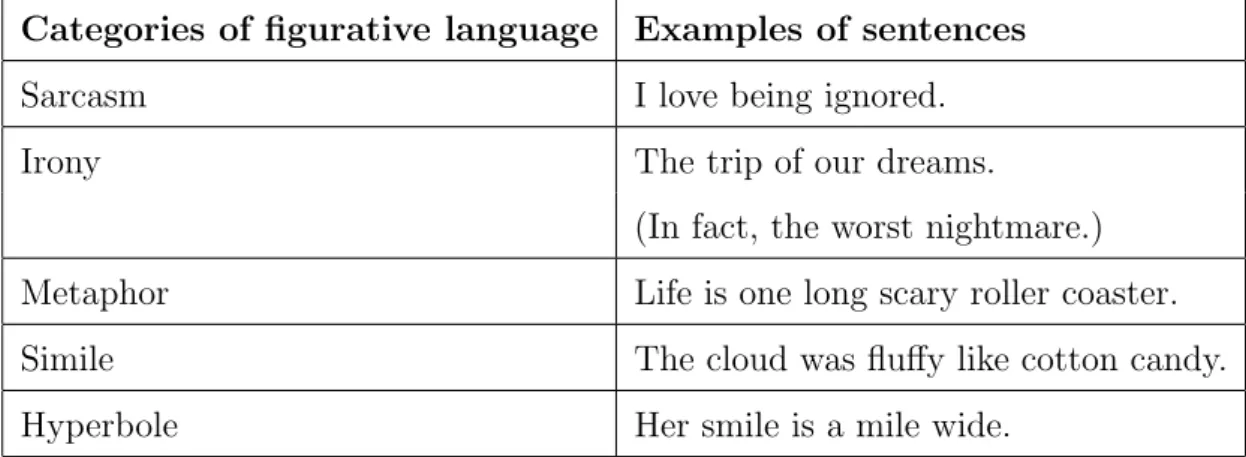
Table 1.1: Examples of figurative language Categories of figurative language Examples of sentences
Sarcasm I love being ignored.
Irony The trip of our dreams.
(In fact, the worst nightmare.)
Metaphor Life is one long scary roller coaster.
Simile The cloud was fluffy like cotton candy.
Hyperbole Her smile is a mile wide.
1.1.3 Literal and Figurative Language
Literal and figurative are two distinct terms that are related to each other in the research field of linguistics. Literal language refers to the use of words to convey the exact meaning or definition as they are given in dictionaries. It is easy to understand and often used to deliver important information, such as scientific, technical and legal documents. In con- trast, figurative language is known as the use of words or expressions with a meaning that is deviated from their original interpretation. Figurative language is an effective way to express abstract thoughts. It provides an excellent communication for emotional content.
It vibrantly visualizes emotion and imagery in the reader’s or listener’s mind. Figurative language can make the expressed meaning become easier and more understandable to the readers. The definitions of several types of figurative language are shown below, while Table 1.1 shows the examples of sentences in each category.
Sarcasm – is a form of communication that intends to mock or harass someone by using the opposite meaning of words. It is normally represented in a form of ironic speech in which the speakers convey implicit message to criticize a particular person. The basic purpose of using sarcasm is when bitterness is hard to express in a pleasant way, or in other words to say something without hurting somebody directly.
Irony – is the use of words to convey a meaning that is the opposite of its literal meaning, but its purpose is not intended to hurt other people. It is mainly used to emphasize the meaning of messages by the intentional use of language to say the opposite of the truth. Also, the readers’ and listeners’ role in realizing the difference between what
is said and what is expected is essential to the successful use of irony.
Metaphor – is a figure of speech which makes an implied or implicit comparison between two different things that are unrelated but share something important in com- mon. They can be very helpful when trying to explain something that’s very complicated because it provides a visual description of the word or thought. Furthermore, a metaphor avoids the usage of explicit words “like” and “as” by using implicit or hidden comparison.
Simile – is similar to metaphor since both are used for making comparisons between two different things. However, simile usually uses the words “like” or “as” for making the comparison. The purpose of simile is also similar to metaphor. Generally, writers or speakers try to use simile to visualize a picture inside the reader’s or listener’s head, in order to make a story become more interesting.
Hyperbole – is the use of overemphasized statement to exaggerate a strong feeling or response. Similarly to other figurative terms, hyperboles are used in speaking and writing to make a boring story become more interesting. Normally, it is used to express excitement, distress, and many other emotions or feelings depending on the context in which the speaker or writer uses.
1.2 Goal
In this research, we aim to create a sentiment analysis system with a particular focus on sarcasm on microblogging. This section presents major problems of sentiment analysis, goal of this thesis, some research questions and an overview of the proposed method.
1.2.1 Statement of problems
Over recent years, the sentiment analysis have become very popular in the area of business, especially in the stock market and e-commerce.
In stock market, there are many researches in both financial and computational lin- guistic domain showing that news articles can influence the stock market price [6, 7, 8, 9].
News is an important source of information about the situations of everywhere around the world, which is updated every second. For this reason, it contains the information which can influence the stock market prices. For example, a cheap gasoline price will
cause an increase in car sales. According to this example, the stock prices of all vehicle companies will increase due to the lower cost of complementary product. However, due to the great amount of information available on the internet and newspapers, the needs of producing summaries have become more considerable. In e-commerce, merchants selling products on the online marketplace often ask their customers to write a review for the purchased product and the associated service. The reviews can be useful for the sellers as they show how the sellers can improve their products to satisfy their customers. Also, the reviews can be helpful for other customers to make a decision for purchasing the reviewed product. However, as e-commerce is becoming more popular, the number of customer reviews for each product also grows rapidly. It makes difficult for both customers and sellers to handle all of the reviews. To solve the problems regarding the stock market and e-commerce, the sentiment analysis and other related NLP techniques are very helpful.
Apart from the news and product reviews, Twitter is also considered as an important source to gain information about people’s opinions in various topics. Many previous studies have shown that tweets also contain the information which can influence both stock market and e-commerce [10, 11, 12]. However, tweets are represented in short messages, where opinions, evaluations and judgments often constitute an important part of the message [13]. The users are allowed to write only short messages of 140 characters per tweet. Also, the users usually post tweets in free or non-restricted writing styles including complex sentence structures. Regarding to these issues, it is difficult to understand the actual meaning of the tweet messages.
Another problem is that tweets are sometimes written as a sarcastic message. Recog- nition of sarcasm is a problem of determining if an actual meaning of a given tweet is not coincident with a literal meaning. Normally, the sarcasm is used in unpredictable ways in communication (either in criticized forms or in creative ways) and it can involve several linguistic and extra-linguistic levels (i.e. from syntax to concepts and pragmat- ics). Therefore, identification and understanding of sarcasm is often difficult, even for human beings. Another problem is that the tweet is not a speech, where prosody plays an important role in communication. Although humans are able to rely on prosody (e.g.
stress or intonation), kinesis (e.g. facial gestures), co-text (i.e. immediate textual envi- ronment) and context (i.e. wider environment), as well as cultural background, machines
are usually hard to access the same type of information. These difficulties pose a major challenge in sarcasm identification of the tweets.
1.2.2 Goal and research questions
The ultimate goal of this research is to create a sentiment analysis system designed for handling sarcastic tweets. It can accept a set of the tweets as an input, and guess an 11-scaled sentiment score between -5 to 5 that represents the polarity and intensity of the opinions in each tweet. The system can handle any types of the tweets, but it introduces special procedures to precisely guess the sentiment score of the sarcastic tweet. The system can potentially provide a lot of benefits to many areas of NLP, such as machine translation, text summarization, word sense disambiguation and knowledge acquisition.
Understanding sarcasm enables consumers to obtain more accurate information about people’s opinions in various topic domains (e.g. commercial products, business, sports and politics). It prevents us from misinterpreting sentences whose meanings are opposite to their literal meaning. It also allows companies or service providers to know precise opinions about their products or services, which are useful to improve their plans, decisions or business strategies. Therefore, the system can help us to overcome the difficulty in understanding of sarcasm which causes misunderstanding in our daily communication.
This dissertation investigates the following research questions that take the above goal in our mind.
Q1 What are effective features to identify sarcasm in microblogging?
As discussed before, recognition of the sarcasm is useful for various NLP applications but a challenging task. This study aims at developing an effective method to identify the sarcasm in the tweets. Especially, we will explore useful features for sarcasm identification and empirically investigate the effectiveness of them via experiments.
Q2 How to handle informal and short sentences in microblogging in sarcasm identification process?
Processing of the text in microblogging is more difficult than the text in other domains such as newspaper, technical paper or web pages. This study also aims at exploring the way how to precisely and robustly handle informal texts in Twitter
in the task of sarcasm identification. We mainly focus on handling unknown words, since one of the major difficulties for processing of microblogging is that a large number of the words are not compiled in sentiment lexicons.
Q3 How to infer polarity and intensity of sentiment in microblogging, especially in sar- castic tweets?
Sentiment analysis is a fundamental technique for opinion mining and text mining.
However, sentiment analysis of the sarcastic text is more difficult than the ordinary text because the genuine meaning of the sarcasm is not coincident with its literal meaning. This study develops a sentiment analysis system that especially focuses on guessing the polarity and intensity of the sarcastic tweets.
Q4 How to develop a general method to infer polarity and intensity of sentiment in microblogging?
Obviously, not all tweets are sarcastic. To improve the robustness, the sentiment analyzer should handle both the sarcastic and non-sarcastic tweets. This study also aims at developing a general system that can precisely analyze the sentiment of various types of the tweets.
We will show the solutions of the research questions Q1 and Q2 in Chapter 3, Q3 in Chapter 4 and Q4 in Chapter 5.
1.2.3 Research methodology and originality
Considering the above research questions, our ultimate goal can be divided into three research objectives or sub goals. Below is each objective and a brief summary of our method to achieve it.
• To develop a method that can identify sarcasm in tweets
The first objective of this thesis is to propose a new method to identify sarcasm in tweets. Our solution is based on supervised learning method that focuses on several features: 1) sentiment score, 2) sentiment contradiction, 3) punctuation & special sym- bol and 4) N-grams. Support vector machine (SVM) will be used to classify sarcastic
������
������������������
������������������
�������������
�����
������������������
����������
������
���������
���
��
����
�������������
��������������
����������������
�������������������
��������
Figure 1.3: Flowchart of overall process of our method
tweet based on our proposed features as well as ordinary N-grams. The output from the classifier is based on an ensemble of two SVMs with two different feature sets.
• To develop a sentiment analysis system with a particular focus on sarcasm The second objective of this thesis is to introduce a new sentiment analysis system that can guess a polarity score of a given sarcastic tweet. The system is developed by com- bining and improving two algorithms [14, 15]. In particular, some additional features grounded on several linguistic levels, including token based and polarity dictionary based features, are also used to classify tweets in an 11-scale range.
• To create a sentiment analysis application for tweets
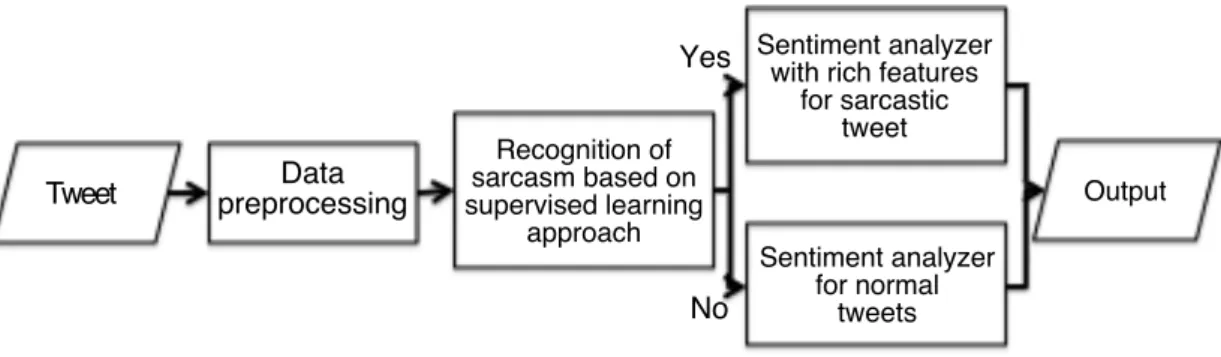
The final objective of this thesis is to create a sentiment analysis application for both normal and sarcastic tweets. The application consists of two main steps: 1) sarcasm identification and 2) sentiment analysis. In the first step, the system checks whether the input tweet is sarcastic or not. Then, the output from the first step will decide which sentiment analyzer will be used to generate the sentiment score for the input tweet. If the tweet is a sarcastic tweet, our proposed sentiment analyzer will be used.
Otherwise, the existing tools will be carried out for the task.
Our proposed sentiment analysis system with a particular focus on the identification and proper elaboration of sarcasm in tweets is summarized as shown in Figure 1.3. First, an input tweet is pre-processed by removing stop words, lemmatizing and so on. Next, sarcasm identification system is created to identify whether the input tweet is sarcastic or not. Then, two different sentiment analyzers are build: one is for sarcastic tweets,
the other is for normal tweets. According to the result of the first step, either system is chosen to determine the sentiment score of the given tweet.
One of the important characteristics of our method is that the system considers coher- ence among multiple sentences in the tweet to derive the sentiment contradiction feature in the task of sarcasm recognition. Although the contradiction of the sentiment is one of the useful clues to identify sarcasm, the contradiction in incoherent sentences might not support that they are sarcastic. We will propose a sophisticated method to identify coher- ence in the tweets based on unsupervised clustering algorithm. Furthermore, a concept expansion mechanism is introduced to improve the sentiment analysis of the tweets. Since the sentiment analysis often suffers from unknown opinion words that are not compiled in a sentiment lexicon, related concepts of unknown words would be helpful to guess the sentiment polarity of them.
Although there are many types of figurative languages, this thesis only focuses on sarcasm. Furthermore, our method can be applied only for English. However, some knowledge obtained from this study as well as results and discussions presented in this dissertation would be helpful for development of sentiment analysis for other types of figurative language and languages other than English.
1.3 Chapter organization
The remaining chapters in this dissertation is organized as follows.
Chapter 2: Literature review
This chapter discusses various types of machine learning methods. In this part, the explanation mainly focuses on the methods that will be used in this research. The chapter also discusses the related work on sarcasm identification, sentiment analysis and coherence identification task. It is important to examine the validity of existing work and their possible influence on the future development.
Chapter 3: Recognition of sarcasm in tweets based on sentiment analysis and coherence identification
This chapter introduces the method of sarcasm identification. It uses the word N- gram, sentiment score, sentiment contradiction, and punctuation & special symbol as the features for supervised machine learning. In this method, two methods of coherence iden-
tification are proposed to identify the relationship across multiple sentences in the tweets.
One is a heuristic-based method and the other is coherence clustering with feature weight optimization (CC-FWO). Concept expansion and concept pruning are also presented to enhance the accuracy of the sentiment analysis feature. Two experiments are conducted to evaluate the performance of our method.
Chapter 4: Sentiment analyzer with rich features for sarcastic tweets
This chapter will introduce a new technique to create a sentiment analyzer with a particular focus on sarcasm in tweets. The idea of the proposed method is to use various kinds of feature based on two modules. Module 1 derives the features used in the sentiment analysis system proposed by Xu et al. [15]. Module 2 derives from our proposed features, including sentiment score, sentiment contradiction and punctuation & special symbols.
Experiments are conducted to evaluate the performance of the sentiment analyzer using several data sets.
Chapter 5: General sentiment analyzer for microblogging
This chapter proposes a robust sentiment analyzer that can guess the sentiment score for various texts on microblogging. It is implemented by merging our proposed method into three additional methods: NRC-Canada sentiment analyzer, Stanford sentiment an- alyzer and SentiStrength. The performance of this sentiment analysis tool is evaluated on the data including four types of the tweets. Furthermore, as the application of our proposed sarcasm recognition method, it is incorporated into the existing tool of a target- dependent sentiment analysis. The contribution of our sarcasm recognition method is empirically evaluated.
Chapter 6: Conclusion
This chapter provides a summary of the entire research in this thesis. The summary includes the answers of the research questions and the contribution of this thesis. Finally, future work of this study is addressed.
Chapter 2
Literature review
In this chapter, we discuss the related work of this research. The chapter is structured into five parts. Section 2.1 introduces the statistical machine learning method that will be used in this research. Section 2.2 will summarize the previous work regarding the aspect of sarcasm in natural language. Section 2.3 will discuss the related work on sarcasm identification task. Section 2.4 will discuss various kinds of techniques for sentiment analysis task. Finally, the chapter will end with Section 2.5 that discusses some related work in the area of coherence and coreference resolution.
2.1 Statistical machine learning methods
Machine learning is a method to automatically acquire or learn a model that can classify entities from a large amount of data. Studies of machine learning are typically classified into four broad categories: 1) supervised learning, 2) unsupervised learning, 3) semi- supervised learning and 4) reinforcement learning. In this section, we introduce common machine learning methods that will be used in this research. Our method relies on only supervised learning and unsupervised learning. Supervised learning is briefly introduced in Subsection 2.1.1. As for unsupervised learning, we use several unsupervised clustering algorithms in our proposed method. Thus, clustering methods are introduced in Subsec- tion 2.1.2.
2.1.1 Supervised learning
In supervised learning, the machine will classify the output into one of the predefined categories based on a set of given examples. The classifiers are trained using labeled examples, where the desired outputs of them are known. The goal of this method is to generate a function that maps inputs to desired outputs. Examples of supervised learning methods are Support Vector Machine, Decision Tree, Random Forest, kNN, Logistic Regression etc.
Support Vector Machine
Support Vector Machine (SVM) is one of the most well-known supervised learning meth- ods [16, 17]. Given a set of training examples containing data in two categories, SVM creates a model that can identify the category of a newly input example. In SVM, a set of training examples L will be considered as data point xi with D attributes (or D- dimensional vector), and we want to separate such points into two classes yi =−1 or +1.
The training data can be represented in the following form:
{(x1, y1),(x2, y2), ...,(xL, yL)} where i= 1, ..., L, yi ∈ {−1,1}, xi ∈ ℜD (2.1) A hyperplane will be used to separate the data points. The hyperplane can be de- scribed by the Equation (2.2)
w·x+b= 0 (2.2)
where, wand b are the parameters of the classification model.
The best hyperplane is the one that represents the largest separation, or margin, between the separating hyperplane and the nearest data point of either class. For all training data xi, Equations (2.3) and (2.4) should be fulfilled.
xi·w+b ≥1 for yi = +1 (2.3)
xi·w+b ≤ −1 for yi =−1 (2.4)
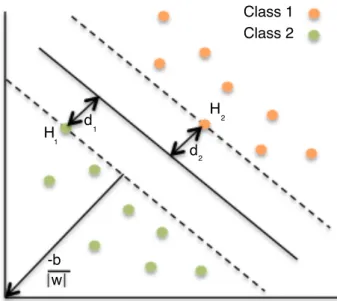
Figure 2.1 illustrates a hyperplane of two linearly separable classes. Based on the points that lie closest to the separating hyperplane, the planesH1 andH2can be described in the Equation (2.5) and (2.6), respectively.
xi·w+b= 1 (2.5)
�
�
�
�
��
�
�
� �
�
�������
�������
Figure 2.1: Separating hyperplane in Support Vector Machine
xi·w+b=−1 (2.6)
In Figure 2.1,d1andd2 are the distance fromH1 andH2 to the separating hyperplane, respectively. In this case, we consider the variable d1 and d2 as margin of SVM. The distance of d1 and d2 are always the same (d1 = d2). Roughly saying, the parameters w and b are determined so that the margind1 andd2 are maximized. Then, the margin can be used to represent the reliable degree of the results generated by the SVM classification.
Decision tree
Decision tree is a machine learning method that creates a classification model in the form of a tree structure. The method breaks down the dataset into smaller subsets while associated decision tree is incrementally developed at the same time. The core algorithm for building decision trees is called ID3 algorithm [18]. The algorithm uses Entropy and Information Gain to construct a decision tree.
A decision tree is built from the root node to leaf nodes. To build a decision tree, we need to calculate two types of entropy as follows.
1. Entropy of the distribution of the target attribute:
E(T) =
∑c i=1
−pilog2pi (2.7)
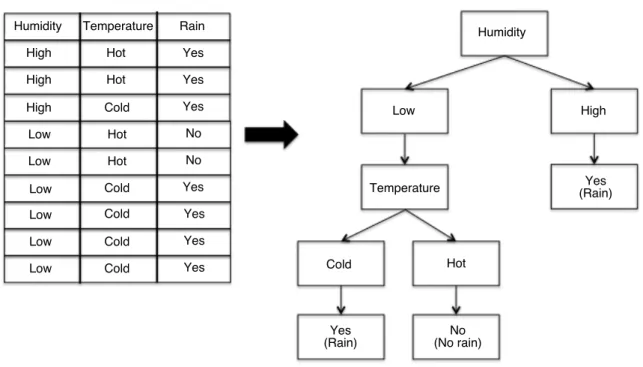
�����������
��� ���� ���
��
���������
���
������
���
���
���
���
���
�������� ����
���� ���
����
����
���
����
����
����
����
��
��
���
���
���
���
��������
����
���
������
���� ���
���
���
���
���
���
�����������
Figure 2.2: Example of Decision Tree training
where pi stands for the probability of i-th class of the target T. c stands for a number of classes.
2. Entropy of the distribution of the target and branch attribute:
E(T, X) =∑
c∈X
P(c)E(c) (2.8)
where c is an instance of the attribute X. P(c) and E(c) stand for the probability and entropy of c, respectively.
The information gain is analyzed based on a decrease in entropy value after a dataset is split on an attribute. A decision tree is constructed by repeatedly finding attribute that returns the highest information gain. The training procedure consists of five main steps as follows.
1. Calculate the entropy of the target.
In an example of Figure 2.2, the entropy of the target (Rain) can be calculated as:
E(Rain) =Entropy(7,2)
=−(0.78log20.78)−(0.22log20.22)
= 0.76
where Entropy(a, b) stands for the entropy of binary class distribution as in (2.9).
Entropy(a, b) =−a
N log2 a N − b
N log2 b
N where N =a+b (2.9) 2. Calculate the entropy and information gain of the target and branch attribute.
In Figure 2.2, the entropy of the target (Rain) and branch (Humidity) can be calculated as:
Inf ormation gain(Rain, Humidity) =E(Rain)−E(Rain, Humidity)
= 0.76−((39 ×E(3,0)) + (69 ×E(4,2)))
= 0.76−(0 + 0.61)
= 0.15
3. The attribute with highest information gain will be chosen as a decision node. As seen in Figure 2.2, “humidity” is chosen as a decision node at the root.
4. If there is a branch where the target entropy value is equal to 0, it will be considered as a leaf node. As seen in Figure 2.2, the entropy of target attribute is equal to 0 when the humidity is high. Thus, the high humidity is considered as a leaf node. Otherwise, the branch needs to continue splitting.
5. The ID3 algorithm is run recursively on the non-leaf branches, until all training data is classified.
A decision tree can be extended to an regression model that estimates not a discrete class but a continuous numerical value. In this thesis, the decision tree regression model is used to guess the sentiment score of the given tweet.
2.1.2 Clustering method
Clustering is a technique to split or divide a set of instances (or data points) into several groups, called clusters, that share similar characteristics. Clustering is performed in unsupervised manner; no label is given in the data set. Popular algorithms of clustering are K-means, Hierarchical clustering, EM algorithm, Hidden Markov models etc. In general, each data point is represented by a vector, and similarity between two data points is measured by similarity of two vectors.
�� � � � � ��
� �
� �
Figure 2.3: Hierarchical clustering: Single Linkage (left), Complete Linkage (center) and Average Linkage (right)
Hierarchical clustering
Hierarchical clustering is a method of cluster analysis which constructs a hierarchy of clusters [19, 20]. The basic procedures of the algorithm consist of four steps. First, each data point is regarded as a single cluster at the beginning. In other words, if there areN data points, there will beN clusters. Each of them contains just one data point. Second, the number of the clusters are reduced by merging the most similar pair of clusters into a single cluster. Third, after the merging, the distance between the newly merged cluster and each of the old clusters is updated. Finally, the procedure in the second and third step will be repeated until the number of clusters is reduced to the specified size of N.
The distance (similarity) between clusters can be measured in three different ways as shown in Figure 2.3.
Single Linkage In single linkage, the distance between two clusters is determined by the shortest distance between two points in each cluster. It is represented as Equation (2.10). L and D are the distances between the clusters and data points, respectively. Ci refers to a cluster, while xCij stands for a j-th point in the clusterCi.
L(C1, C2) =min
i,j (D(xC1i, xC2j)) (2.10) Complete Linkage In complete linkage, the distance between two clusters is deter- mined by the longest distance between two points in each cluster. It is represented as Equation (2.11).
L(C1, C2) = max
i,j (D(xC1i, xC2j)) (2.11)
Average Linkage In average linkage, the distance between two clusters is determined by the average distance between all pairs of data points in two clusters. It is represented as Equation (2.12), where nCi stands for the number of data points in the cluster Ci.
L(C1, C2) = 1 nC1nC2
nC1
∑
i=1 nC2
∑
j=1
D(xC1i, xC2j) (2.12)
K-means algorithm
K-means is one of the simplest unsupervised clustering algorithms [21]. At the beginning, the number of clusters K is determined and the centres of these clusters are randomly created. The next step is to calculate the distance between each data point and cluster centres. The data point will be assigned to the cluster centre whose distance is the mini- mum among all cluster centres. Then, the new point of cluster centre will be calculated using the following formula:
Vi = (1 ci)
ci
∑
j=1
xj (2.13)
where xj is the vector of the data point, Vi is the vector of the cluster center and ci is the number of data points in ith cluster. The method continues the same procedure until assignment of all data points is unchanged.
EM clustering algorithm
Expectation-maximization algorithm or EM algorithm is an unsupervised machine learn- ing method. It infers a set of parametersθ from a training (or observation) dataxso that Pθ(x) is maximized, where Pθ(x) is the probability of the observation data x under the estimated parameter θ. Since it is unsupervised learning, there is no annotation to the training data x. EM algorithm is also frequently used for data clustering. The technique of this algorithm is similar to the K-means. However, the EM algorithm extends this basic approach of clustering by computing the probabilities of cluster membership based on one or more probability distributions. The goal of the clustering algorithm then is to maximize the overall probability or likelihood of the data. The EM algorithm attempts to approximate the observed distributions of values based on mixtures of different distri- butions in different clusters. The EM algorithm does not compute actual assignments of
data points to clusters, but classification probabilities. In other words, each point belongs to each cluster with a certain probability.
2.2 Linguistic aspect of sarcasm
Sarcasm has been studied since the ancient Greece and Rome. It was, in fact, a part of the basic rhetorical background that all politicians, lawyers and military officers should have had, in order to be able to persuade and convince their audiences. Already in the first century CE, Quintilian defined sarcasm as “saying the opposite of what you mean”
[22]. This rhetorical figure violates the expectations of the listener, flouting the maxim of quality [23, 24]. In a similar way, sarcasm is also understood as the use of ironic statements to express disdain in the guise of approval [25]. In sarcasm, ridicule or mockery is used harshly, often crudely and contemptuously, for destructive purposes [26].
According to Stringfellow [23] and Gibbs et al. [27], the usage of sarcasm was studied to derive a definition and demonstrate some characteristics of sarcasm. Both studies agreed on the similar basis that irony and sarcasm arised from the contradictory intentions represented by the opposed meaning of an ironic or sarcastic statement. These studies also discovered the theories of verbal irony comprehension 1) that verbal irony requires a violation of expectations, and 2) that it requires violation of felicity conditions for speech acts. Thus, if we observe both contradictory intentions and violation of felicity conditions within a context, we can recognize a sarcastic context.
Kreuz and Glucksberg claimed that the purpose of using sarcasm and irony was to express disapproval towards situation [28]. In their experiment, they found that positive statements were more readily interpreted as sarcastic. Also, positive sarcastic utterances do not require explicit antecedents (or related situations), while negative ones do. There- fore, we can presume that sarcasm usually occurs in a positive context.
Sarcasm and irony are well-studied phenomena in linguistics, psychology and cognitive science. They are ubiquitous aspect of human communication from ancient religious to modern text styles. There is no consensus on whether sarcasm and irony are essentially the same thing, with superficial differences, or if they differ significantly. In Haiman [29], the main difference between sarcasm and irony is that sarcasm requires the presence of the intention to mock. Irony, instead, can exist independently (i.e. there are ironic
��������
���������
�������
����������������
�
�
�
�
��������
���������
�������
���������
������
Figure 2.4: Bootstrapping Learning of Positive Sentiment and Negative Situation Phrases situations, but not sarcastic ones). In Gibbs et al. [27], there is a fine statement to distinguish between sarcasm and irony: “sarcasm is a term commonly used to describe an expression of verbal irony”; whereas “sarcasm, along with jocularity, hyperbole, rhetorical questions, and understatement, are types of irony.” Sperber and Wilson distinguished the difference between irony and sarcasm as echoing one’s own utterance (irony) and echoing another person’s utterance (sarcasm) [30]. Schaffer reported the different verbal clues for irony and sarcasm, such as phonological markers and facial markers [31]. However, there are also numerous studies indicating that there does not appear to be a consensus on how to determine whether an utterance is ironic or sarcastic [32, 33, 34].
2.3 Recognition of sarcasm
In the last several years, many studies related to sarcasm have attracted a lot of attention due to the availability of data [35]. However, algorithms for sarcasm recognition are still far from perfect. Among the several approaches to sarcasm identification, Riloff et al.
introduced a novel bootstrapping algorithm that automatically learned lists of positive sentiment phrases and negative situation phrases from sarcastic tweets [36]. The learning process relied on an assumption that a positive sentiment verb phrase usually appeared to the left of a negative situation phrase in a sarcastic tweet. A bootstrapping algorithm continued iteration consisting of the following two steps, which are illustrated in Figure 2.4. The first step was learning negative situation phrases following positive sentiment, where “love” was used as an initial seed of positive sentiment word. Then, the second step
learned positive sentiment phrases that occured near negative situation phrases. After multiple iteration processes, the obtained list of negative situations and positive sentiment phrases were used to identify sarcasm in tweets by checking if the tweet contained a positive sentiment in close proximity (occurring nearby) to a negative situation phrase.
This method relied on the assumption that many sarcastic tweets contained the following structure:
[+V ERB P HRASE][−SIT U AT ION P HRASE]
The result showed that their method yielded some improvement in recall for sarcasm identification. However, the limitation of this method is that it can consider only a number of specific syntactic structures. Also, sarcasm could not be identified accurately when sarcasm appeared in a separate clauses or across multiple sentences.
There are also many different approaches to identify sarcasm. Reyes and Rosso repre- sented irony by six kinds of features, that is n-grams, POS-grams, funny profiling, posi- tive/negative profiling, affective profiling, and pleasantness profiling [37]. Naive Bayesian, Support Vector Machine and Decision Tree were used to train classifiers, achieving an ac- ceptable level of accuracy. Moreover, Reyes et al. proposed a new extended complex model to consider not the surface but deeper semantic level of the text [35]. The method introduced a new set of features in four levels: signatures, degree of unexpectedness, style, and emotional scenarios. They demonstrated that these features did not help the identi- fication of irony and sarcasm when they were independently applied. However, they did when they were combined in a complex framework.
Tsur et al. proposed a semi-supervised method for the automatic recognition of sar- casm in Amazon product reviews [38]. Their method exploited syntactic and pattern- based features and it was compared to a strong heuristic baseline that was built by exploiting the star rating meta-data provided by Amazon (i.e. strongly positive reviews associated with low star rates were considered sarcastic). A similar method was then applied to tweets by Davidov et al. [39], achieving high precision.
Sarcasm in written and spoken interaction may work differently [40]. In spoken utter- ance, sarcasm can be easily identified through the unsterilized tone of voice [41], a special intonation [42, 43] or an incongruent facial expression [44]. However, in written texts,
there is no clue like a tone of voice, a special intonation or an incongruent facial expres- sion at their disposal [45]. Carvalho et al. investigated the usage of a set of pre-defined surface patterns (i.e. emoticons, onomatopoeic expressions for laughter, heavy punctua- tion marks, quotation marks and positive interjections) in comments at newspaper articles [46]. They showed that the surface patterns were much more accurate (from 45% to 85%
accuracy) than deeper linguistic information. Barbieri and Saggion [47] also proposed a method based on seven sets of lexical and semantic features, including the frequency of the words in reference corpora, their intensity, their written/spoken nature, their length and the number of related synsets in WordNet [48]. Thelwall et al. also aimed at assessing the sentiment lexicon (SentiStrength) in a variety of different online contexts [49]. The results showed that the usage of punctuation, such as a single punctuation, repetitive punctuation marks, question marks and exclamation marks, played a key role to predict the sentiment score. Since punctuation and special symbols such as emoticons are often used to emphasize users’ emotion in the tweets, they should be taken into account for sarcasm identification.
Hao and Veale proposed a 9 steps algorithm to automatically distinguish ironic similes from non-ironic ones, without any sentiment dictionaries [50]. Buschmeier et al. assessed the impact of features used in previous studies, evaluated different classifiers and achieved 74% F1-measure using logistic regression [51]. They provided an important baseline for irony detection in English.
2.4 Sentiment analysis
Currently, a large number of researches have been devoted to the area of sentiment anal- ysis. It is an ongoing research in the field of text mining. In this section, we provide an overview of the recent researches in this area. Enhancement and applications of many recently proposed algorithms are briefly investigated.
Sentiment analysis techniques can be roughly divided into three categories: lexicon- based methods [52], machine learning-based methods [53] and hybrid methods [54]. In the lexicon-based approach, the method relies on a dictionary of words with assigned semantic scores to identify a sentiment polarity of a text or sentence. In machine learning-based approaches, the method uses the machine learning algorithms to perform the sentiment
analysis as a regular text classification task. The methods use a large number of training instances that are represented by various kinds of training features. The hybrid approach is a combined method of both lexicon-based and machine learning-based approaches.
Dictionaries for lexicon-based approaches can be created either manually [55, 56] or automatically using seed words to expand the list of words [57, 58, 59]. Regarding the dictionary-based approaches, many researches focused on using adjectives as indicators of the semantic orientation (positive, negative or neutral) of text [60, 61, 62]. First, a dictionary, a list of adjectives and their corresponding sentiment score, is prepared. Then, for any given contexts, the adjectives are extracted and annotated with the sentiment score in the dictionary. Finally, from the sentiment scores annotated to the adjectives, the statistical methods are applied to compute a single score to represent the overall polarity of the given contexts.
Recently, Deepak et al. proposed the machine learning-based method of sentiment classification [63]. In this method, the sentiment polarity was classified based on the aspect term extraction, which was a task to extract aspects or features on which opinions have been expressed [61, 64]. In other words, an aspect term was an attribute or component of the product that had been commented by the user in a review. Let us consider a product review “This camera is good but the weight is heavy.” In this example, the aspect terms are “camera” and “weight”. The word “good” denotes a positive opinion of the camera and the word “heavy” denotes a negative opinion about the weight. In this research, polarity classification of aspect terms referred to the classification into several sentiment classes such as positive, negative, and neutral. Various kinds of the features were used such as local context, part-of-speech, chunk, root word, stop word, function word, sentence length, etc. The results showed that the system achieved the accuracy of 67.37% and 67.07% for the reviews of restaurants and laptops, respectively.
In Medhat et al. [65] and Pang and Lee [66], we can find a comprehensive study of the different techniques used to identify the polarity of a text. Many efforts have been made to apply such techniques for general text to the text extracted from social media. In the literature, we can find recent attempts to solve this problem using different machine learning approaches such as Support Vector Machine, Maximum Entropy, Naive Bayes, etc. [67, 68, 69]. At best, these studies achieved F1-score close to 70%. Therefore, the
sentiment analysis on social media can still be further improved.
There are still some major problems in applying sentiment analysis to microblogging such as Twitter. Tweets are written text messages, which do not contain much contextual information and also generally require a lot of implicit knowledge to understand. They are also written in a complex grammatical sentence structure and make frequent use of emoticons and hashtags, which can form an important part of the meaning. Typically, they also contain extensive use of irony and sarcasm, which are also difficult for a machine to detect.
Gimenez et al. proposed a new method of sentiment analysis with a particular focus on figurative tweets (irony, sarcasm and metaphor) [70]. Their method used a machine learning, that is Support Vector Machine, for sentiment classification. The method consid- ered various kinds of features, including N-grams, negation context, Twitter features (e.g.
hashtags, url, retweets etc.) and character encoding (capitalized words and elongated characters). The results of sentiment classification indicated that the method achieved the best result in sentiment analysis of the tweets including sarcastic ones among the fifteen participated systems of SemEval 2015 Task 11 [71].
Similarly, Raja and Asif proposed a sentiment analysis system to compete in SemEval- 2014 Task 9 (Sentiment Analysis in Twitter evaluation challenge) [72]. In this method, Support Vector Machine was also used to perform the classification process. The method utilized a small set of features, including local context, upper case, elongated words, hashtags, repeated characters and negation context. The results showed that their system achieved the F-score in the ranges of 66-76% for contextual polarity disambiguation task and 36-55% for message polarity classification task.
We utilize three existing sentiment analysis systems in this study: 1) NRC-Canada [73], 2) Stanford sentiment analyzer [74] and 3) SentiStrength [49]. Our goal is to create a sentiment analysis system that can handle both sarcasm and normal texts on microblog- ging. We will propose a method of sentiment analysis for sarcastic tweets, then it will be integrated with these three systems to enable our system to analyze the sentiment of both normal and sarcastic tweets. The explanation of these systems and the integration process will be reported in Chapter 5.