Japan Advanced Institute of Science and Technology
JAIST Repository
https://dspace.jaist.ac.jp/
Title
三元触媒作用のためのハイスループット実験の設計
Author(s)
TRAN, PHUONG NHAT THUY
CitationIssue Date
2020‑09
Type
Thesis or Dissertation
Text versionETD
URL
http://hdl.handle.net/10119/17005
RightsDescription
Supervisor:谷池 俊明, 先端科学技術研究科, 博士
氏 名 TRAN, Phuong Nhat Thuy 学 位 の 種 類
学 位 記 番 号 学 位 授 与 年 月 日
博士(マテリアルサイエンス)
博材第496号 令和2年9月24日
論 文 題 目 Design of High-Throughput Experiments for Three-Way Catalysis
論 文 審 査 委 員 主査 谷 池 俊 明 北陸先端科学技術大学院大学 准教授 長 尾 祐 樹 同 准教授 西 村 俊 同 准教授 ダム ヒョウ チ 同 准教授 髙 橋 啓 介 北海道大学 准教授
論文の内容の要旨
To meet the increasingly stringent legislation for the gasoline engine exhaust emission, the exhaust aftertreatment systems need a breakthrough in the research and development of three-way catalysts (TWCs). While the catalysis society has made enormous efforts focusing on materials aspects for seeking the best or novel catalyst formulations, the development in methodology aspects, especially high-throughput (HTP) approaches, has just emerged to hold a great promise in that regard. Even though HTP catalyst screening techniques have become a mature and well-established tools in many catalytic systems, their applications in the TWCs have been hardly reported due to both technical and material constraints. The diversity and complexity of the catalytic system and reaction conditions necessitate a primary screening technique to quickly and broadly screen a huge parametric space. This catalytic system also requires highly accurate screening tools to distinguish the activity in a one-digit difference, signifying the essential of implementing secondary screening with higher precision. Therefore, the aim of this thesis is to design an integrated HTP screening protocol for the development of the TWCs.
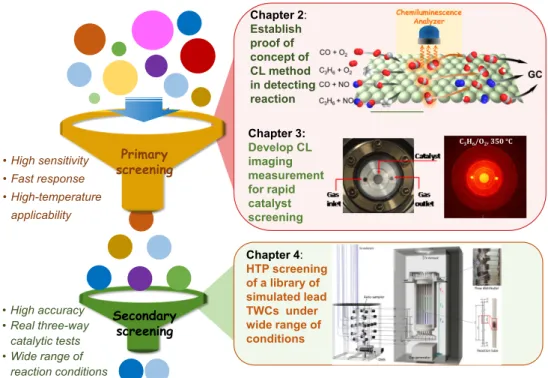
The upstream of the hierarchical HTP workflow is the primary catalyst screening, which typically requires a fast and non-intrusive technique being capable of truly parallelized screening, preferably based on an optical method. For that, a novel chemiluminescence (CL) method was developed with special emphasis on high-temperature gaseous catalysis. In Chapter 2, the proof of concept of the CL method was formulated by thoroughly studying the CL behavior of the catalytic oxidation of CO and C3H6 by of O2 and/or NO, which are the major processes in a catalytic converter, under both stoichiometric and non-stoichiometric conditions. In this
stage, a CL instrument was developed based on the cooperation among a gas mixer, a custom-made CL analyzer using a photonmultiplier as a detector, and an on-line gas chromatography (GC) for simultaneous analysis of the effluent mixture from the CL reactor. The CL activity of these oxidation reactions was confirmed by temperature-ramping measurements, where the CL intensity showed an exponential behavior against the temperature irrespective of catalysts. Steady-state measurements demonstrated a linear relationship between the CL intensity and reactions rate regardless of stoichiometry, thus the CL intensity is a good measure of the reaction rate. The capability of the CL method in rapid catalyst screening was confirmed by a good linear correspondence between the CL intensity and the catalytic activity in C3H6 oxidation by O2 for a series of Rh-based catalysts In Chapter 3, a CL imaging instrument was designed for achieving primary screening of the TWCs. The CL imaging instrument was equipped a reactor cell for gaseous catalysis and electron multiplying charged-coupled device camera for single photon detection in the form of images. The CL imaging technique exhibited the feasibility of a simple, straightforward, and rapid evaluation of catalytic activity based on a good correlation between the CL intensity and the C3H6
conversion. In addition, the one-to-one correspondence of the CL intensity obtained from the single and parallel measurement signified the great potential of the CL imaging technique in HTP catalyst screening. Chapter 4 describes the HTP secondary screening of a simulated lead TWCs library based on a HTP screening instrument featured with fully-automated catalytic evaluation of 20 reactor channels in a wide range of conditions with the aid of a quadruple mass spectrometer. The instrument allowed generation of a large process-relevant dataset at high accuracy, which is satisfactory for the secondary screening. Three-way catalytic reactions were conducted in 49 conditions over 20 catalyst samples, affording 980 data points in one operation. The obtained dataset is of high quality and accuracy, and the catalyst performance (in terms of light-off temperature and width of stoichiometric window) were found consistent with literature data. The reaction conditions cover a wide range of temperature and air/fuel equivalence ratio λ, allowing the multi-aspect comparison of the TWCs.
Figure 1. The developed high-throughput approach for three-way catalyst.
Keywords: Three-way catalysts, high-throughput catalyst screening, chemiluminescence imaging, high-throughput screening instruments, multi-aspect comparison.
論文審査の結果の要旨
電気自動車の普及が強調される一方、内燃機関による自動車の台数は2050年も5-10億 台を維持するものと予測されており、排ガスに含まれる大気汚染成分(一酸化炭素、窒素酸 化物、炭化水素)を除去する三元触媒の性能改善が依然必要とされている。三元触媒は、複 数種の貴金属ナノ粒子を複数の酸化物から成る複合体に担持する非常に複雑な組成を有し ており、また、組成毎にライトオフ温度(基質の転換率が 80%を超える温度)や浄化ウイ ンドウ(全基質の転換率を 80%以上にする空燃比の範囲)と言った性能指標を得るために 多様な温度・空燃比で触媒試験を繰り返す必要があり、あらゆる意味で研究開発コストの高 い対象となっている。
そこで本論文では、三元触媒、特にその性能評価に係るハイスループット実験の研究開発 を行った。特に、三元触媒の性能評価における化学発光法の応用を世界に先駆けて研究した。
化学発光法は、反応エネルギーが光子として放出される“化学発光”を検出することで反応 速度を、高感度且つオンライン計測可能な手法であり、高感度CCDカメラを用いた触媒の 並列評価や反応毎の発光スペクトルの違いを利用した反応分離に強みがあるものと期待さ
Primary screening
Secondary screening
Chapter 2:
Establish proof of concept of CL method in detecting reaction Chapter 3:
Develop CL imaging measurement for rapid catalyst screening Chapter 4:
HTP screening of a library of simulated lead TWCs under wide range of conditions
•High accuracy
•Real three-way catalytic tests
•Wide range of reaction conditions
•High sensitivity
•Fast response
•High-temperature applicability
C3H6/O2, 350 °C
れた。一方で、触媒の運用温度が高いため、基材からの熱放射を最小限に抑制する必要があ った。2章では、三元触媒の性能評価を可能とするオペランド化学発光装置を開発し、①排 ガス浄化に掛かる主要反応が化学発光活性を有すること、②一定温度において反応速度と化 学発光量が1対1の相関関係を有すること、③化学発光法がナノモルの検出感度を有するこ と、④スペクトルを用いた反応分離が可能であることを明らかにした上で、化学発光法(一 秒)が従来のガスクロマトグラフィー法(二十分程度)と良く対応した活性順序を与えるこ とを実証した。化学発光法の概念実証を受け、3章では光電子増倍CCDカメラを用いた化 学発光イメージング装置を開発し、触媒の多検体同時活性評価を達成した。また、ライトオ フ温度の多検体同時評価も実現した。4章では、20触媒の性能を予めプログラムした温度・
ガス組成で自動評価可能なハイスループット触媒評価システムを活用し、3種類の貴金属ナ ノ粒子と6種類の酸化物担体の組み合わせによる計18触媒の性能(ライトオフ温度・浄化 ウインドウ)を一括取得した。特に、これまで十分に検討されてこなかった非理論空燃比に おけるライトオフ温度を比較し、三元触媒の構造性能相関を明らかにした。
ハイスループットスクリーニングは、高速・多検体を旨とした一次スクリーニングと広範 な条件での評価を旨とした二次スクリーニングから成るが、本論文はこれらのスクリーニン グ技術を実装することに成功した。化学発光法を用いた触媒の性能評価の基盤も築いた。よ って、博士(マテリアルサイエンス)の学位論文として十分価値あるものと認めた。