Japan Advanced Institute of Science and Technology
JAIST Repository
https://dspace.jaist.ac.jp/
Title テキスト構造解析法とパラフレーズ識別への適用
Author(s) Ngo, Bach Xuan Citation
Issue Date 2014‑03
Type Thesis or Dissertation Text version ETD
URL http://hdl.handle.net/10119/12107 Rights
Description Supervisor:島津 明, 情報科学研究科, 博士
Text Structure Analysis Methods and Application to Paraphrase Identification
by
Ngo Xuan Bach
submitted to
Japan Advanced Institute of Science and Technology in partial fulfillment of the requirements
for the degree of Doctor of Philosophy
Supervisor: Professor Akira Shimazu
School of Information Science
Japan Advanced Institute of Science and Technology
March, 2014
To my family
Abstract
Analyzing structures of texts is important to understand natural language, both gen- eral texts and texts in some specific domains such as the legal domain. For general texts, discourse structures have been shown to have an important role in many natural language processing applications, including text summarization, question answering, information presentation, dialogue generation, and paraphrase extraction. In the legal domain, where legal texts have their own specific characteristics, recognizing logical structures in legal texts does not only help people in understanding legal documents, but also to support other tasks in legal text processing.
In this thesis, we study the structures of texts based on relations between discourse units. Regarding relations between discourse units, we focus on general semantic relations and on logical relations, which are appropriate in some cases such as laws. For general semantic relations, we study a model based on Rhetorical Structure Theory (RST). For logical relations, we study a model for legal paragraphs. Both models are based on the same framework, which consists of two steps, Recognizing discourse units of texts and Building structures of texts from the discourse units.
In our work on learning discourse structures, we propose an Unlabeled Discourse parsing system in the RST framework (UDRST). UDRST consists of a segmentation model and a parsing model. Our segmentation model exploits subtree features to rerank the N-best outputs of a base segmenter, which uses syntactic and lexical features in a Conditional Random Field (CRF) framework. The advantage of our model is that subtree features are long distance non-local features which can capture whole discourse units. In the parsing model, we introduce an incremental algorithm for building discourse trees. The algorithm builds a discourse tree for each sentence, then for each paragraph, and finally for the whole text. We also propose a new algorithm that exploits the dual decomposition method to combine a greedy model and the incremental model. Our system achieves state-of-the-art results on both the discourse segmentation task and the unlabeled discourse parsing task on the RST Discourse Treebank corpus.
Concerning our study on analyzing logical structures of legal texts, we propose a two- phase framework for analyzing logical structures of legal paragraphs. In the first phase, we model the problem of recognizing logical parts in law sentences as a multi-layer sequence learning problem, and present a CRF-based model to recognize them. In the second phase, we propose a graph-based method to group logical parts into logical structures.
We consider the problem of finding a subset of complete subgraphs in a weighted-edge complete graph, where each node corresponds to a logical part, and a complete subgraph corresponds to a logical structure. We propose an integer linear programming formulation for this optimization problem. We also introduce an annotated corpus for the task, the Japanese National Pension Law corpus, and describe our experiments on that corpus.
We then study how to exploit discourse structures for identifying paraphrases. By analyzing paraphrase sentences, we found that discourse units are very important for paraphrasing. In many cases, a paraphrase sentence can be created by applying several operations to the original sentence. Motivated by the analysis of the relation between
paraphrases and discourse units, we propose a new method to compute the similarity between two sentences. Unlike conventional methods, which directly compute similarities based on sentences, our method divides sentences into discourse units and employs them to compute similarities. We apply our method to the paraphrase identification task.
Experimental results on the PAN corpus, a large corpus for detecting paraphrases, show the effectiveness of using discourse information for identifying paraphrases.
Keywords: Text Structure Analysis, Legal Text Processing, Discourse Structure, Rhetorical Structure Theory, Logical Structure, Paraphrase Identification, Discourse Unit, Text Similarity, Conditional Random Fields, Support Vector Machines.
Acknowledgments
My last six years at the Japan Advanced Institute of Science and Technology (JAIST) have been an incredible journey, where I have grown tremendously, both academically and personally. None of this would have been possible without the support of many people.
First and foremost, I would like to sincerely thank my great supervisor, Professor Akira Shimazu of the School of Information Science at JAIST, who brought me to the interesting world of natural language processing and supported me during my study.
Without his guidance and encouragement, my work could not have been accomplished.
Professor Shimazu taught me not only how to become a good researcher, but also how to become a kind person. I am really lucky to be one of his students.
Next, I thank my terrific Committee, consisting of Professor Takenobu Tokunaga from the Graduate School of Information Science and Engineering at the Tokyo Institute of Technology, Professor Satoshi Tojo, Professor Ho Tu Bao, and Associate Professor Kiyoaki Shirai at JAIST, for the time they spent reading my thesis and for their valuable comments. My thesis is improved very much through their comments.
I wish to express my deep thanks to the Japanese Ministry of Education, Culture, Sports, Science and Technology (MEXT) and the MEXT Scholarship Program. Without their financial support, I would not have come to Japan to study.
I would like to thank Associate Professor Kiyoaki Shirai of the School of Information Science at JAIST, who supported me during my study in the natural language processing laboratory (Shimazu-Shirai Lab). Professor Shirai also gave me valuable comments during the seminars of the lab.
I would like to sincerely thank Professor Kunihiko Hiraishi of the School of Information Science at JAIST, for his guidance and support during my subtheme research on dual decomposition and its application to part-of-speech tagging.
I also would like to thank Associate Professor Nguyen Le Minh of the School of Infor- mation Science at JAIST, who always listened to me, discussed with me, and supported me. I learned a lot from him, not only how to conduct good research, but also how to solve technical problems.
I also would like to thank Mr. Kenji Takano and Mr. Yoshiko Oyama for analyzing law sentences and building the Japanese National Pension Law corpus, a very important part of my research.
I wish to send my deep acknowledgments to “The 21st Century COE program Verifi- able and Evolvable e-Society”, “The Grant-in-Aid for Scientific Research, Education and Research Center for Trustworthy e-Society”, “The JAIST Overseas Training Program for 3D Program Students”, “The JAIST Foundation Research Grant”, “The NII Research Grant”, and “The NEC C&C Foundation Grant”, for supporting me in my research and in attending international conferences.
I would like to express my deep appreciation to the English Language Education for Science, Technology & Engineering center (CELESTE) of JAIST for editing this manuscript and all JAIST staff for their kind and convenient procedures and services.
I am grateful to my colleagues in the natural language processing laboratory (Shimazu- Shirai Lab) for making JAIST an enjoyable place for my study and life.
Finally, I would like to give special thanks to my family for their sacrifice, love, and understanding.
Contents
Abstract ii
Acknowledgments iv
1 Introduction 1
1.1 Background . . . 1
1.2 Research Problems and Contributions . . . 3
1.3 Thesis Outline . . . 5
2 Background: Statistical Machine Learning Models 7 2.1 Maximum Entropy Models . . . 7
2.1.1 The Principle . . . 7
2.1.2 The Models . . . 7
2.2 Support Vector Machines . . . 8
2.3 Conditional Random Fields . . . 11
3 Learning Discourse Structures in the RST Framework 13 3.1 Introduction . . . 13
3.2 Related Work . . . 14
3.2.1 Related Work on Discourse Segmentation . . . 14
3.2.2 Related Work on Discourse Parsing . . . 15
3.3 A Reranking Model for Discourse Segmentation using Subtree Features . . 16
3.3.1 Why Reranking? . . . 16
3.3.2 Discriminative Reranking . . . 16
3.3.3 Base Model . . . 17
3.3.4 Subtree Features for Reranking . . . 18
3.4 An Incremental Algorithm for Building Discourse Trees . . . 20
3.5 Dual Decomposition for Building Discourse Trees . . . 22
3.5.1 Dual Decomposition . . . 22
3.5.2 A Parsing Algorithm using Dual Decomposition . . . 23
3.6 Experiments . . . 24
3.6.1 Data and Evaluation Methods . . . 24
3.6.2 Experiments on Discourse Segmentation . . . 25
3.6.3 Experiments on Discourse Parsing . . . 28
3.7 Conclusions . . . 29
4 Analyzing Logical Structures of Legal Texts 31
4.1 Introduction . . . 31
4.1.1 Logical Parts and Logical Structures of Legal Texts . . . 32
4.1.2 Motivation of This Work . . . 34
4.1.3 Overview of This Chapter . . . 35
4.2 Related Work . . . 36
4.2.1 Studies on Legal Text Processing . . . 36
4.2.2 Studies on Analyzing Logical Structures of Japanese Legal Texts . . 38
4.3 Task Formulation . . . 39
4.3.1 Subtask 1: Recognition of Logical Parts . . . 40
4.3.2 Subtask 2: Recognition of Logical Structures . . . 41
4.4 Framework Architecture . . . 42
4.5 Multi-layer Sequence Learning for Logical Part Recognition . . . 42
4.6 ILP for Recognizing Logical Structures . . . 45
4.6.1 ILP Formulation . . . 45
4.6.2 Learning Binary Classifier . . . 47
4.7 Experiments . . . 49
4.7.1 Corpus . . . 49
4.7.2 Evaluation Methods . . . 50
4.7.3 Experiments on Subtask 1 . . . 52
4.7.4 Experiments on Subtask 2 . . . 55
4.7.5 Limitation & Improvement . . . 59
4.8 Conclusions . . . 63
5 Exploiting Discourse Information to Identify Paraphrases 65 5.1 Introduction . . . 65
5.2 Related Work . . . 66
5.3 Paraphrases and Discourse Units . . . 67
5.4 EDU-Based Similarity . . . 69
5.5 Experiments . . . 70
5.5.1 Data & Evaluation Method . . . 70
5.5.2 MT Metrics . . . 72
5.5.3 Experimental Results with a Single SVM Classifier . . . 73
5.5.4 Revision Learning & Voting . . . 74
5.5.5 Error Analysis . . . 76
5.6 Conclusions . . . 78
6 Conclusions and Future Work 80 6.1 Summary of the Thesis . . . 80
6.2 Future Directions . . . 81
A LSDemo: A Demonstration System for Analyzing Logical Structures of Paragraphs in Legal Articles 83 A.1 Requirements . . . 83
A.2 Graphical User Interface . . . 84
References 86
Publications 98
List of Figures
1.1 A general framework for text structure analysis. . . 2
1.2 Illustration of our work in this thesis. . . 3
2.1 Large margin and small margin in SVMs. . . 9
2.2 Calculation of the margin in the SVM framework. . . 10
2.3 SVM framework in non-separable cases. . . 10
2.4 Graphical model of a CRF for sequence learning (nis the length of sequence). 11 3.1 A discourse tree [123]. . . 14
3.2 Examples of segmenting sentences into EDUs. . . 17
3.3 Partial lexicalized syntactic parse trees. . . 18
3.4 Subtree features. . . 19
3.5 An example sentence for illustrating two evaluation methods. . . 24
3.6 Some errors made by our model. . . 28
4.1 Examples of law sentences and logical parts (A: antecedent part; C: conse- quent part; T: topic part). . . 33
4.2 Four popular cases of legal paragraphs [130]. . . 34
4.3 An example of Individual type in the JNPL corpus (A means Antecedent part; C means Consequent part; T means Topic part. . . 34
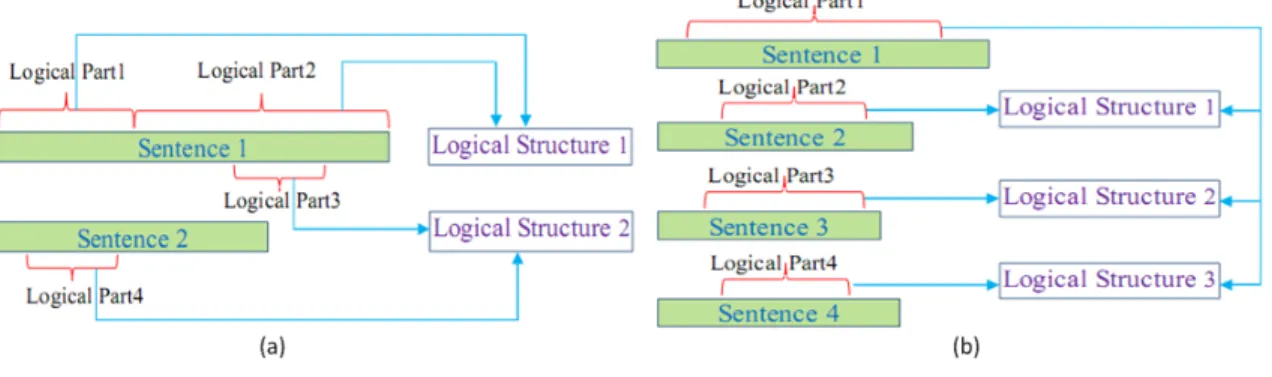
4.4 Two cases of inputs and outputs of the task. . . 39
4.5 An example ofoverlapping and embedded relationships. . . 40
4.6 Framework architecture. . . 43
4.7 A law sentence with logical parts in three layers. . . 44
4.8 An example of labeling in the multi-layer model. . . 44
4.9 Examples of graphs and their cliques. . . 45
4.10 The structure of JNPL. . . 49
4.11 Relationship between a sentence and logical parts. . . 50
4.12 An annotated sentence in the JNPL corpus. (left: the original text; right: the translated text.) . . . 51
4.13 An example of the first case. . . 56
4.14 An example of the second case. . . 58
4.15 List of cue phrases. . . 62
5.1 A paraphrase sentence pair in the PAN corpus [80]. . . 68
5.2 Another paraphrase sentence pair in the PAN corpus. . . 68
5.3 A revision learning model for the paraphrase identification task. . . 75
A.1 Graphical user interface of LSDemo. . . 84
A.2 A running example with a paragraph consisting of one sentence. . . 85 A.3 A running example with a paragraph containing multiple sentences. . . 85
List of Tables
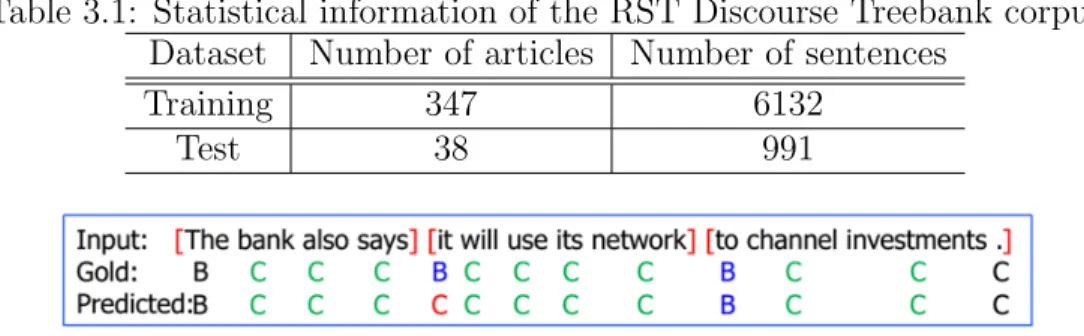
3.1 Statistical information of the RST Discourse Treebank corpus . . . 24
3.2 Performance when evaluating on B labels . . . 26
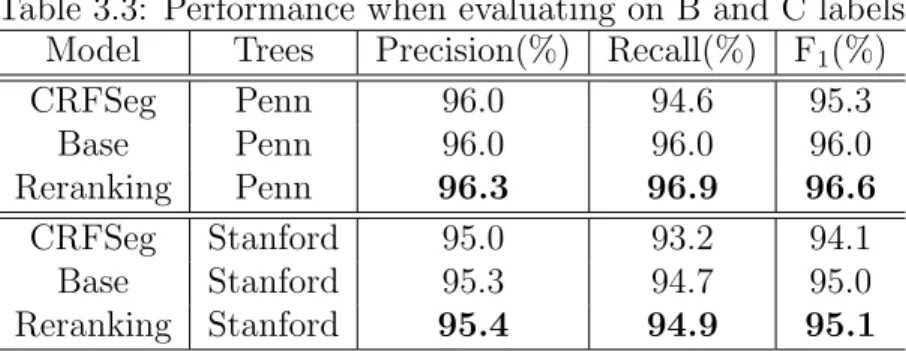
3.3 Performance when evaluating on B and C labels . . . 26
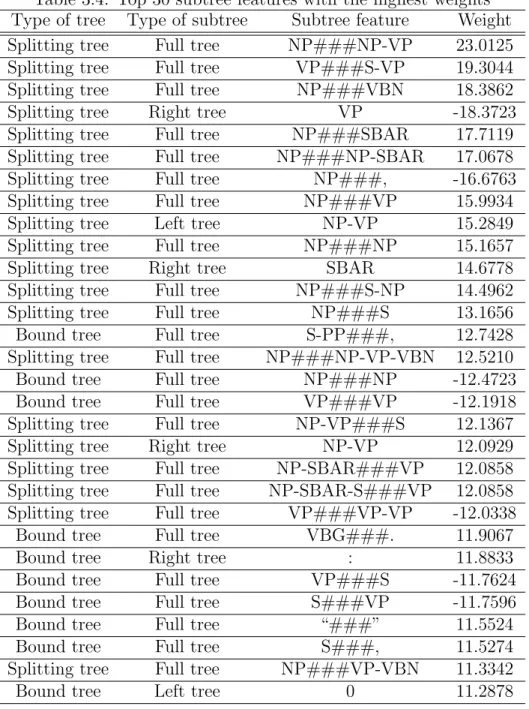
3.4 Top 30 subtree features with the highest weights . . . 27
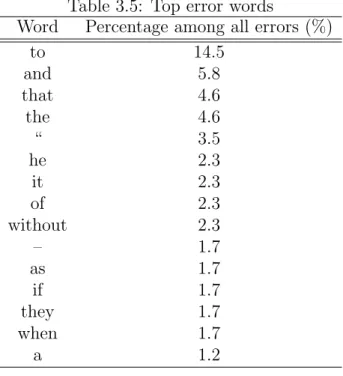
3.5 Top error words . . . 28
3.6 Most frequent words that appear before error words . . . 29
3.7 Experimental results of the tree building step (gold segmentation and gold parse trees) . . . 29
3.8 Performance of the full system (our segmentation model and Stanford parse trees) . . . 30
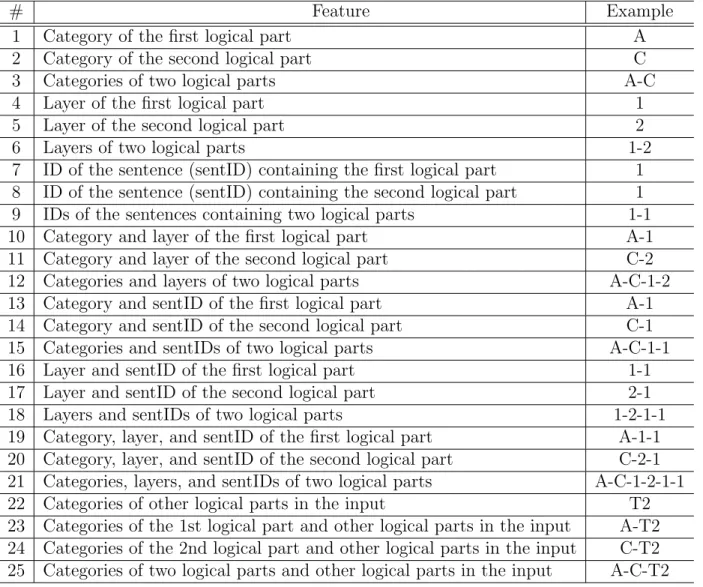
4.1 Features for learning binary classifier (T2: topic part in case 2; A: an- tecedent part; C: consequent part) . . . 48
4.2 Statistics on logical parts of the JNPL corpus . . . 50
4.3 Examples of evaluation method for Subtask 2 . . . 51
4.4 Examples of evaluation method for the whole system (PreP = Predicted logical parts, PreStr = Predicted logical structures, GP = Gold logical parts, GStr = Gold logical structures) . . . 52
4.5 Experimental results of the baseline model . . . 54
4.6 Experimental results for Subtask 1 on the JNLP corpus(W:Word; P: POS tag; B: Bunsetsu tag) . . . 55
4.7 Experimental results in more details . . . 55
4.8 Experiments on Subtask 2 (Gold-Input Setting) . . . 58
4.9 Experiments on Subtask 2 (Whole-Task Setting) . . . 59
4.10 Experimental results on Subtask 1 using Joint Decoding Algorithm (W:Word; P: POS tag; B: Bunsetsu tag). N = 1, 2, 3, 4, 5, 10, 20, 50, 100, and 1000. 60 4.11 Oracle results on Subtask 1 (the feature set consists of words and Bunsetsu tags) . . . 61
4.12 Experimental results with context features . . . 62
4.13 Experimental results with heuristic rules for post-processing . . . 63
5.1 An example of computing sentence-based and EDU-based similarities . . . 71
5.2 PAN corpus for paraphrase identification . . . 72
5.3 Experimental results on each individual MT metric . . . 73
5.4 Experimental results on combined MT metrics . . . 74
5.5 Experimental results on long and short sentences . . . 74
5.6 Experimental results of the revision learning model and the voting model . 76 5.7 Statistic information of the experimental results on the test set . . . 77
Chapter 1 Introduction
1.1 Background
Analyzing structures of texts is important to understand natural language, both general texts and texts in some specific domains such as the legal domain. In many natural language processing applications such as text summarization, machine translation, and paraphrase generation, systems should produce an output text that is not only informative but also coherent and readable. To do that, computers need knowledge about structures of texts or how information is structured in texts.
Research on text structure analysis has been a focus in natural language processing for a long time. Several linguistic theories of text structures have been proposed, including Scripts, the Centering theory, and the Rhetorical Structure Theory (RST).
1. Scripts
The idea of Scripts [1] is that memory is organized as a collection of “scripts”.
A script describes a sequence of events commonly encountered in some particular situations. Abelson and Schank [1] present an example of script, the restaurant script: “someone enters a restaurant, finds a table, moves to that table, then orders food, eats, pays money, and leaves”. Abelson and Schank [1] suggest that such a sequence of events is frequently encountered and therefore incorporated into our memory. Such knowledge helps us to recognize related and coherent texts in different situations. Abelson and Schank [1] also explain that the sentences below are not meaningful at all because they describe events that do not conform to a common situation:
“John was walking on the street. He thought of cabbages. He picked up a shoe horn.”
2. Centering theory
The idea of the Centering theory [48] is to use the property of entity repetition to describe local coherence in texts. According to this theory, adjacent sentences in a discourse often share entities and therefore focus and topic in the text are maintained. The Centering theory also states that some specific patterns of entity sharing are preferred to others in order to achieve coherence. In a coherent text, the more salient entities in a sentence are assumed to be more likely to appear in subsequent sentences. Centering proposes that such preferred coreference patterns make the text coherent for the reader.
Figure 1.1: A general framework for text structure analysis.
3. Rhetorical Structure Theory
The Rhetorical Structure Theory or RST [81] is based on theories of rhetorical or discourse relations in which clauses or sentences in coherent texts are connected by semantic relations such as cause, evidence, and contrast. The RST assumes that a text can be divided into several elementary discourse units (EDUs) which are connected by such semantic relations to form a discourse tree.
Discourse structures have been shown to have an important role in many natural lan- guage processing applications, including text summarization [79, 82], question answering [126], information presentation [10], dialogue generation [52], and paraphrase extraction [110]. In the legal domain, where legal texts have their own specific characteristics, rec- ognizing logical structures in legal texts does not only help people in understanding legal documents, but also support other tasks in legal text processing [63].
Text structure analysis, therefore, is an important task in the field of computational linguistics. From the linguistic point of view, the task contributes to understanding how information is organized in written texts as well as how coherent texts should be. On the other hand, from the computational point of view, the task plays a key role in building robust natural language processing applications.
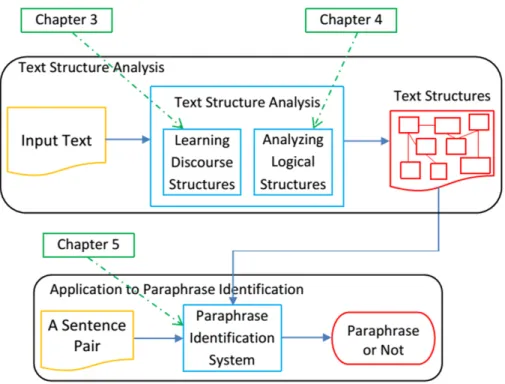
In this thesis, we study the structures of texts based on relations between discourse units. Regarding relations between discourse units, we focus on general semantic relations and on logical relations, which are appropriate in some cases such as laws. For general semantic relations, we study a model based on Rhetorical Structure Theory (RST). For logical relations, we study a model for legal paragraphs. Both models are based on the same framework (illustrated in Figure 1.1), which consists of two steps as follows:
1. Discourse Unit Recognition: Recognizing discourse units of texts, elementary discourse units (EDUs) in the case of RST discourse structures and logical parts in the case of logical structures of legal texts
2. Text Structure Building: Building structures of texts from the discourse units, RST discourse structures and logical structures of legal texts.
We also study how to utilize structures of texts for paraphrase computation. Para- phrases are phrases, sentences, or longer expressions with the same or very similar mean- ings. Paraphrases have been shown to play an important role in many natural language processing applications, including text summarization [9], question answering [39], ma- chine translation [19], and plagiarism detection [139]. Specifically, we consider the problem of using RST discourse structures to identify paraphrases, which determines whether two given sentences have the same meaning. Figure 1.2 illustrates our work in this thesis.
Figure 1.2: Illustration of our work in this thesis.
1.2 Research Problems and Contributions
This thesis focuses on the structural analysis of texts based on machine learning and its application to paraphrase identification. Statistical machine learning models have been widely applied to various fields in computer science, including computer vision, bioinformatics, chemical informatics, robotics, computer games, and natural language processing (NLP). They also have been claimed to have the potential to amplify every aspect of a working scientist’s progress to understanding [89]. In the NLP field, statistical machine learning models have been applied successfully to various problems, ranging from fundamental tasks such as part-of-speech tagging [75, 109], chunking [67, 71, 119], named entity recognition [14, 118], syntactic and semantic parsing [97, 151], discourse parsing [54], and paraphrase identification [80] to applications such as machine translation [25, 101], text summarization [96], and question answering [41, 128].
We concentrate on three problems as follows:
1. Learning Discourse Structures in the RST Framework
Rhetorical Structure Theory (RST) [81] is one of the most widely used theories of text structures. In the RST framework, a text is first divided into several elementary discourse units (EDUs). Consecutive EDUs are then put in relation with each other to build a discourse tree. This is a difficult but very important task in the field of natural language processing.
Previous studies on learning RST discourse structures reveal two remarkable points.
The first point is that the sets of rhetorical relations in different works are incon- sistent. The second point is that the performance of a state-of-the-art discourse parsing system is too low when evaluating in the labeled score. Studies on appli- cations of RST show that in many text analysis applications, only a few relations
are enough [82, 153]. The purpose of our research is to build an unlabeled discourse parsing system, which produces a discourse structure tree without relation labels.
The number of relations, types of relations, and the process of labeling relations for the discourse structure tree will be implemented in text analysis applications. Our contributions are as follows:
• We introduce a new model for segmenting texts into elementary discourse units.
Unlike previous models, which only focus on boundaries of EDUs, our model employs subtree features in a discriminative re-ranking framework, which can capture long-distance non-local features which describe whole EDUs.
• We propose a new model for building discourse trees based on the dual decom- position technique, which allows us to integrate two base models with different characteristics to yield a more powerful model.
• Our system achieves state-of-the-art results on both the discourse segmentation task and the unlabeled discourse parsing task on the RST Discourse Treebank corpus.
2. Analyzing Logical Structures of Legal Texts
Analyzing logical structures of legal texts is an important task in Legal Engineering [62, 64]. The outputs of this task will be beneficial to people in understanding legal texts. This task is the preliminary step, which supports other tasks in legal text processing (translating legal articles into logical and formal representations, legal text summarization, legal text translation, question answering in legal domains, etc) and serves legal text verification, an important goal of Legal Engineering.
Analyzing law sentences individually is not sufficient to understand a legal docu- ment. In most cases, to understand a law sentence, we need to understand related sentences or its context. To our knowledge, however, no existing research addresses the task at the paragraph level. Analyzing logical structures of legal paragraphs is therefore very important in the research of Legal Engineering to achieve its goals:
assisting people in understanding legal texts and making computers able to process legal texts automatically. Our original idea is to propose a novel learning framework that can integrate graphical model, linear programming, and machine learning for understanding legal texts. Our contributions are as follows:
• We introduce a new task for legal text processing, analyzing logical structures of paragraphs in legal articles.
• We propose a two-phase framework to solve the task: a multi-layer sequence learning model for recognizing logical parts and a graph-based model with integer linear programming for recognizing logical structures.
• We introduce an annotated corpus for the task, the Japanese National Pension Law corpus.
• We evaluate our framework on that corpus.
Our work shows promising results for further research on this interesting task.
3. Exploiting Discourse Information to Identify Paraphrases
Previous studies have shown that discourse structures deliver important information for paraphrase computation. However, such studies only consider some special kinds of data, for which the discourse structures can be easily extracted. The goal of our research is to exploit discourse structures for computing paraphrases in general texts.
Our contributions are as follows:
• We show the relation between discourse units and paraphrasing, in which dis- course units play an important role in paraphrasing. We also show that, in many cases, paraphrase sentences can be generated from the original sentences by performing several transformations
• We propose a new method to compute text similarity based on elementary discourse units. Our method is general and not limited to any kind of text.
• We apply the method to the task of paraphrase identification.
• We achieve state-of-the-art results on the PAN corpus, a large corpus for de- tecting paraphrase. Experimental results show that discourse information is effective for the task of identifying paraphrases
To the best of our knowledge, this is the first work that employs discourse units for computing similarity as well as for identifying paraphrases.
1.3 Thesis Outline
This dissertation is structured as follows. Chapter 2 gives a brief introduction to sev- eral statistical machine learning methods, including Maximum Entropy Models (MEMs), Support Vector Machines (SVMs), and Conditional Random Fields (CRFs).
Chapter 3 presents our study on learning discourse structures in the RST framework.
We first describe related work on discourse segmentation and discourse parsing in the RST framework. We then introduce our discourse parsing system, including a reranking model for segmenting a text into elementary discourse units and a dual decomposition model for building discourse trees from discourse units. We also describe our experimental results on the RST Discourse Treebank corpus and compare them with the results of previous research.
In Chapter 4, we investigate the task of analyzing logical structures of legal para- graphs. We first describe related work on legal text processing. We then present how to formulate the task of analyzing logical structures of legal paragraphs. We next introduce our proposed two-phase framework for the task, which recognizes logical parts in the first phase and logical structures in the second phase. We present experimental results on an annotated corpus, the Japanese National Pension Law corpus. A preliminary study on exploiting heuristic rules in the post-processing step to improve the performance of the system is also described.
Chapter 5 presents our study on exploiting discourse information to identify para- phrases. We first describe related work on paraphrase identification. We next introduce our findings on the relation between discourse units and paraphrasing. We then present a new method, EDU-based similarity, for computing text similarity. We also describe
our experiments on the PAN corpus to show that EDU-based similarity is effective for identifying paraphrases.
Finally, Chapter 6 summarizes this thesis and discusses future directions.
Chapter 2
Background: Statistical Machine Learning Models
In this chapter, we give a brief introduction to three common statistical machine learning models that will be employed in this thesis, including Maximum Entropy Models (Section 2.1), Support Vector Machines (Section 2.2), and Conditional Random Fields (Section 2.3).
2.1 Maximum Entropy Models
2.1.1 The Principle
The principle of Maximum Entropy states that equal probabilities must be assigned to each competing assertion if there is no positive reason for assigning them different prob- abilities.
Jaynes [58] summarizes the principle of Maximum Entropy as follows:
“. . . in making inferences on the basic of partial information we must use that prob- ability distribution which has maximum entropy subject to whatever is known. That is the only unbiased assignment we can make; to use any other would amount to arbitrary assumption of information which by hypothesis we do not have.”
2.1.2 The Models
Maximum Entropy Models (MEMs) [12, 109] are a method of estimating the conditional probability p(y|x) that a model outputs a label y given a context x:
p(y|x) = 1
Z(x)exp(X
i
λifi(x, y))
where fi(x, y) refers to a feature function; λi is a parameter of the model; and Z(x) is a normalization factor. To capture statistic information, this method requires that the model accord with some constraints which have the form:
p(f) = ˜p(f).
In this formula, f is a feature function (or feature for short), which takes a pair (x, y) as input and outputs a real value. Usually, f is a binary-value indicator function. p(f)
and ˜p(f) are the expected values of f with respect to the modelp(y|x) and the empirical distribution ˜p(x, y), respectively. They are defined as follows:
p(f)≡X
x,y
p(x)p(y|x)f(x, y),˜
˜
p(f)≡X
x,y
˜
p(x, y)f(x, y),
where ˜p(x) is the empirical distribution of x in the training samples.
Suppose that we have n feature functions fi(i = 1,2, . . . , n) and we want our model to accord with these statistics. Our model will belong to a subset Q of P (the set of all conditional probability distributions) defined by
Q≡ {p∈P|p(fi) = ˜p(fi), i= 1,2, . . . , n}.
The maximum entropy method chooses the modelp∗ ∈Qthat maximizes the entropy function H(p):
p∗ = argmaxp∈QH(p) where the entropy function H(p) is defined as follows:
H(p)≡ −X
x,y
p(x)p(y|x) log˜ p(y|x).
To solve the constrained optimization problem, we first convert the primal problem to a dual optimization problem using the method of Lagrange multipliers [12]. Then the solution of the dual optimization problem can be found by applying the improved iterative scaling method [12, 33] or LBFGS method [100].
Maximum entropy model has been applied successfully to many NLP task includ- ing POS tagging [109], chunking [67], syntactic and semantic dependency parsing [151], statistical machine translation [12, 40], and so on.
2.2 Support Vector Machines
Support Vector Machines (SVMs) are a statistical machine learning technique proposed by Vapnik et al. [15, 31, 91, 140]. SVMs have been demonstrated their performance on a number of problems in areas, including computer vision, handwriting recognition, pattern recognition, and statistical natural language processing. In the field of natural language processing, SVMs have been applied to text categorization [59], word sense disambiguation [77], text chunking [71], syntactic parsing [99], semantic parsing [97], discourse parsing [54], machine translation [150], topic classification [147], information extraction [13], sentiment analysis [107, 114], and so on, and achieved very good results.
We start with the binary classification task in linear cases, in which we want to find a hyperplane that separates positive and negative samples. Suppose that we have a set of n training samples:
S ={(xi, yi)}ni=1, xi ∈Rm, yi ∈ {+1,−1},
where xi is the feature vector and yi is the class (or label) of the ith sample. Our goal is to separate the positive and negative samples by a hyperplane in the form:
Figure 2.1: Large margin and small margin in SVMs.
w·x+b= 0, where w∈Rm and b ∈R are parameters.
Among the set of all possible hyperplanes, SVMs will find an optimal hyperplane (correspond to find an optimal parameter set for w and b). In the SVM framework, the optimal hyperplane is the hyperplane with maximal margin between training samples and the hyperplane. Figure 2.1 illustrates this strategy. Solid lines show two possible hyperplanes (or candidates). Each candidate separates correctly the training samples into two classes. Two dashed lines parallel to a candidate indicate the boundaries in which the candidate can be moved without any misclassification.
Suppose that the training samples satisfy the following constraints:
w·xi+b≥+1 for yi = +1, w·xi+b≤ −1 foryi =−1.
These constraints can be combined into the following inequalities:
yi(w·xi+b)−1≥0,∀i= 1,2, . . . , n.
Figure 2.2 shows how to calculate the margin. We have, the perpendicular distance from the origin to the solid line (w· x+b = 0) is kwk|b| , where kwk is the Euclidean norm of w. Similarly, the perpendicular distances from the origin to two dashed lines (w·x+b = 1 andw·x+b=−1) are |b−1|kwk and |b+1|kwk.
Let d+ and d− be the distances between the solid lines and two dashed lines. We will have the margin M:
M =d+ =d−= 1 kwk.
To maximize the margin M, we minimize kwk. The task now becomes solving the following optimization problem:
Minimize:
L(w) = 1 2kwk2
Figure 2.2: Calculation of the margin in the SVM framework.
Figure 2.3: SVM framework in non-separable cases.
Subject to:
yi(w·xi+b)−1≥0,∀i= 1,2, . . . , n. (2.1) The training samples which lie on two dashed lines are called support vectors.
We now move to the non-separable cases, in which the training data are not linearly separable. In such cases, for any hyperplane w·x+b = 0, there existsxi ∈S such that:
yi(w·xi+b)−1<0.
Therefore, the constraints in Equation 2.1 cannot all hold simultaneously. We use a relaxed version of these constraints by introducing slack variablesξi(1≤i≤n) as follows:
For each i∈ {1,2, . . . , n}, there exists ξi ≥0 such that:
yi(w·xi+b)−1 +ξi ≥0.
The slack variable ξi measures the distance that the vector xi violates the constraint yi(w·xi+b)−1 ≥ 0. The SVM framework in the non-separable cases is illustrated in Figure 2.3.
We want to find a hyperplane that:
1. Limits the total amount of slack, i.e., Pm
i=1ξip, here p≥1 is a constant, and
Figure 2.4: Graphical model of a CRF for sequence learning (nis the length of sequence).
2. Has a large margin.
The task now becomes solving the new optimization problem as follows:
Minimize:
1
2kwk2+C
m
X
i=1
ξip
Subject to:
yi(w·xi+b)−1 +ξi ≥0 and ξi ≥0,∀i= 1,2, . . . , n.
Here, C ≥0 is a parameter which determines the trade-off between the maximization of the margin and the minimization of the slack penalty.
2.3 Conditional Random Fields
Conditional Random Fields (CRFs) [75, 129] are undirected graphical models (see Figure 2.4), which define the probability of a label sequence y given an observation sequence x as a normalized product of potential functions. Each potential function has the following form:
exp(X
j
λjtj(yi−1, yi, x, i) +X
k
µksk(yi, x, i))
where tj(yi−1, yi, x, i) is a transition feature function (or edge feature), which is defined on the entire observation sequence x and the labels at positions i and i−1 in the label sequence y; sk(yi, x, i) is a state feature function (or node feature), which is defined on the entire observation sequence x and the label at positioni in the label sequencey; and λj andµk are parameters of the model, which are estimated in the training process. Each feature function (edge feature and node feature) takes a real value.
The probability of a label sequence y given an observation sequence x then can be defined as follows:
p(y|x, λ, µ) = 1
Z(x)exp(X
j
λjtj(yi−1, yi, x, i) +X
k
µksk(yi, x, i)) where Z(x) is a normalization factor,
Z(x) = X
y
exp(X
j
λjtj(yi−1, yi, x, i) +X
k
µksk(yi, x, i)).
Training CRFs is commonly performed by maximizing the likelihood function with respect to the training data using advanced convex optimization techniques like L-BFGS [18]. And inference in CRFs, i.e., searching the most likely output label sequence of an input observation sequence, can be done by using Viterbi algorithm [45].
CRFs have been shown to be an efficient and powerful framework for sequence learning tasks. CRFs have all the advantages of Maximum Entropy Markov Models (MEMMs) [85]
but do not suffer from the label bias problem [75]. CRFs have been applied successfully to many NLP tasks such as POS tagging, chunking, named entity recognition, syntax parsing, information retrieval, information extraction, analyzing logical structures of legal texts at the sentence level, and so on [4, 73, 75, 106, 119].
Chapter 3
Learning Discourse Structures in the RST Framework
This chapter presents our study on learning discourse structures in the RST framework, one of the most widely used theories of text structures. We first give an introduction to the discourse parsing task and motivation of our work (Section 3.1). We then describe related work on discourse parsing (Section 3.2). We next present our reranking model for discourse segmentation (Section 3.3) and two algorithms for building discourse trees, including an incremental algorithm (Section 3.4) and a dual decomposition algorithm (Section 3.5). Finally, we describe our experiments on the RST Discourse Treebank corpus (Section 3.6) and conclude this chapter (Section 3.7).
3.1 Introduction
Discourse structures have been shown to have an important role in many natural language processing applications, such as text summarization [79, 82], information presentation [10], question answering [126], and dialogue generation [52]. To produce such kinds of discourse structures, several attempts have been made to build discourse parsers in the framework of Rhetorical Structure Theory (RST) [81], one of the most widely used theories of text structures.
The discourse parsing task in the RST framework consists of two steps: discourse segmentation and discourse tree building. In the discourse segmentation step, an input text is divided into several elementary discourse units (EDUs). Each EDU may be a simple sentence or a clause in a complex sentence. In the tree building step, consecutive EDUs are put in relation with each other to create a discourse tree. Figure 3.1 shows an example of a discourse tree with three EDUs.
The quality of the discourse segmenter contributes a significant part to the overall accuracy of every discourse parsing system. If a text is wrongly segmented, no discourse parsing algorithm can build a correct discourse tree. Existing discourse segmenters usually exploit lexical and syntactic features to label each word in a sentence with one of two labels, boundary or no-boundary. The limitation of this approach is that it only focuses on the boundaries of EDUs. It cannot capture features that describe whole EDUs.
Recently, discriminative reranking has been used successfully in some NLP tasks such as part-of-speech (POS) tagging, chunking, and statistical parsing [29, 46, 57, 74]. The
Figure 3.1: A discourse tree [123].
advantage of the reranking method is that it can exploit the output of a base model to learn. Based on that output, we can extract long-distance non-local features to rerank.
The first purpose of our study is to build a discourse segmentation system, which can capture non-local features describing whole EDUs. Our discourse segmenter exploits subtree features to rerank the N-best outputs of a base segmenter, which uses syntactic and lexical features in a CRF framework. Experimental results on the RST Discourse Treebank corpus show that our model outperforms existing discourse segmenters in both settings that use gold standard Penn Treebank parse trees [83] and Stanford parse trees [66].
Previous studies on discourse parsing reveal two remarkable points. The first point is that the sets of rhetorical relations in different works are inconsistent. For instance, Marcu [82] and Thanh et al. [135] use 15 relations and 14 relations respectively, while Sagae [116]
and Hernault et al. [54] use 18 relations. We also note that in RST Discourse Treebank (RST-DT) [21], 78 rhetorical relations are used. The second point is that the performance of a state-of-the-art discourse parsing system is too low when evaluating in the labeled score (both structure and relations). HILDA [54], a state-of-the-art discourse parsing system, achieves only 47.3% in the labeled score on RST-DT. Studies on applications of RST show that in many text analysis applications, only a few relations are enough [82, 153]. Furthermore, from a machine learning perspective, working with a small set of relations can improve the performance of a discourse parsing system.
The second purpose of our study is to build an unlabeled discourse parsing system, which produces a discourse structure tree without relation labels. The number of relations, types of relations, and the process of labeling relations for the discourse structure tree will be implemented in text analysis applications, which use this discourse parser. Our discourse parsing system, UDRST, consists of a reranking-based segmentation model and a parsing model using dual decomposition. Our system achieves 77.3% in the unlabeled score on the standard test set of the RST Discourse Treebank corpus, which improves 5.0% compared to HILDA [54], a state-of-the-art discourse parsing system.
3.2 Related Work
3.2.1 Related Work on Discourse Segmentation
Several methods have been proposed to deal with the discourse segmentation task. Thanh et al. [134] present a rule-based discourse segmenter with two steps. In the first step, segmentation is done by using syntactic relations between words. The segmentation algo- rithm is based on some principles, which have been presented in [30] and [20], as follows:
1. The clause that is attached to a noun phrase can be recognised as an embedded unit.
If the clause is a subordinate clause, it must contain more than one word.
2. Coordinate clauses and coordinate sentences of a complex sentence are EDUs.
3. Coordinate clauses and coordinate elliptical clauses of verb phrases (VPs) are EDUs.
Coordinate VPs that share a direct object with the main VP are not considered as a separate discourse segment.
4. Clausal complements of reported verbs and cognitive verbs are EDUs.
The segmenter then uses cue phrases to correct the output of the first step.
Tofiloski et al. [137] describe another rule-based discourse segmenter. The core of this segmenter consists of 12 syntactic segmentation rules and some rules concerning a list of stop phrases, discourse cue phrases, and part-of-speech tags. They also use a list of phrasal discourse cues to insert boundaries not derivable from the parser’s output.
Soricut and Marcu [123] introduce a statistical discourse segmenter, which is trained on RST-DT to label words with boundary or no-boundary labels. They use lexical and syntactic features to determine the probabilities of discourse boundaries P(bi|wi, t), where wi is the ith word of the input sentence s, t is the syntactic parse tree of s, and bi ∈ {boundary, no-boundary}. Given a syntactic parse tree t, their algorithm inserts a discourse boundary after each word w for which P(boundary|w, t)>0.5.
Another statistical discourse segmenter using artificial neural networks is presented in Subba and Di Eugenio [125]. Like Soricut and Marcu [123], they formulate the discourse segmentation task as a binary classification problem of deciding whether a word is the boundary or no-boundary of EDUs. Their segmenter exploits a multilayer perceptron model with back-propagation algorithm and is also trained on RST-DT.
Hernault et al. [53] propose a sequential model for the discourse segmentation task, which considers the segmentation task as a sequence labeling problem rather than a clas- sification problem. They exploit Conditional Random Fields (CRFs) [75] as the learning method and get state-of-the-art results on RST-DT.
In our work, like Hernault et al. [53], we also consider the discourse segmentation task as a sequence labeling problem. The final segmentation result is selected among the N-best outputs of a CRF-based model by using a reranking method with subtree features.
3.2.2 Related Work on Discourse Parsing
Several methods have been proposed to deal with the discourse parsing task. In this section, we present the most related studies, which describe a discourse parsing system in the RST framework.
Soricut and Marcu [123] present a sentence level discourse parser. Two probabilistic models are built to segment and to parse texts. Both models exploit syntactic and lexical information. For discourse segmentation, authors report an F-score of 84.7%. For building sentence level discourse trees, they achieve 70.5% in the unlabeled score, and 49.0% and 45.6% in the labeled score when using 18 labels and 110 labels respectively. However, this discourse parser only processes individual sentences.
Sagae [116] proposes a shift-reduced discourse parser. The parser includes a discourse segmenter based on a binary classifier trained on lexico-syntactic features and a parsing
model which employs transition algorithms for dependency and constituent trees. Com- pared to Soricut and Marcu [123], the proposed parser is able to create text level discourse trees. The author reports an F-score of 86.7% for discourse segmentation and 44.5% in the labeled score for building text level discourse trees when using 18 labels.
Hernault et al. [54] describe HILDA, a discourse parser using Support Vector Machine (SVM) classification. The parser exploits following kinds of features: textual organization, lexical features, ‘dominance sets’ [123], and structural features. They use 18 relations like relations in the work of Sagae [116]. HILDA is considered as the first fully implemented text level discourse parser with state-of-the-art performance. It achieves 72.3% in the unlabeled score and 47.3% in the labeled score on RST-DT.
3.3 A Reranking Model for Discourse Segmentation using Subtree Features
3.3.1 Why Reranking?
Discriminative reranking with linear models has been used successfully in some NLP tasks such as POS tagging, chunking, and statistical parsing [29]. The advantage of the reranking method is that it can exploit the output of a base model to learn. Based on the output of a base model, we can extract long-distance non-local features, which are impossible in sequence learning markov models such as the Hidden markov model, the Maximum entropy markov model, and CRFs. In the discourse segmentation task, we use the reranking method to utilize subtree features extracted from the output of a base model which is learned using CRFs.
3.3.2 Discriminative Reranking
In the discriminative reranking method [29], first, a set of candidates is generated using a base model (GEN). GEN can be any model for the task. For example, in the POS tagging problem, GEN may be a model that generates all possible POS tags for a word based on a dictionary. Then, candidates are reranked using a linear score function:
score(y) = Φ(y)·W
where y is a candidate, Φ(y) is the feature vector of candidate y, and W is a parameter vector. The final output is the candidate with the highest score:
F(x) =argmaxy∈GEN(x)score(y)
=argmaxy∈GEN(x)Φ(y)·W.
To learn the parameterW we use the average perceptron algorithm, which is presented as Algorithm 1.
In the next sections we will describe our base model and features that we use to rerank candidates.
Algorithm 1Average perceptron algorithm for reranking [29]
1: Inputs: Training set {(xi, yi)|xi ∈Rn, yi ∈C,∀i= 1,2, . . . , m}
2: Initialize: W ←0, Wavg ←0
3: Define: F(x) = argmaxy∈GEN(x)Φ(y)·W
4: for t = 1,2, . . . , T do
5: for i= 1,2, . . . , mdo
6: zi ←F(xi)
7: if zi 6=yi then
8: W ←W + Φ(yi)−Φ(zi)
9: end if
10: Wavg ←Wavg+W
11: end for
12: end for
13: Wavg ←Wavg/(mT)
14: Output: Parameter vector Wavg.
Figure 3.2: Examples of segmenting sentences into EDUs.
3.3.3 Base Model
Similar to the work of Hernault et al. [53], our base model uses Conditional Random Fields1 to learn a sequence labeling model. Each label is either beginning of EDU (B) or continuation of EDU (C). Soricut and Marcu [123] and Subba and Di Eugenio [125]
use boundary labels, which are assigned to words at the end of EDUs. Like Hernault et al. [53], we use beginning labels, which are assigned to words at the beginning of EDUs. However, we can convert an output with boundary, no-boundary labels to an output withbeginning,continuation labels and vice versa. Figure 3.2 shows two examples of segmenting a sentence into EDUs and their correct label sequences.
We use the following lexical and syntactic information as features:
• Words,
• POS tags,
• Nodes in parse trees, and
1We use the implementation of Kudo [70].
Figure 3.3: Partial lexicalized syntactic parse trees.
• Lexical heads and POS heads of the nodes in parse trees2.
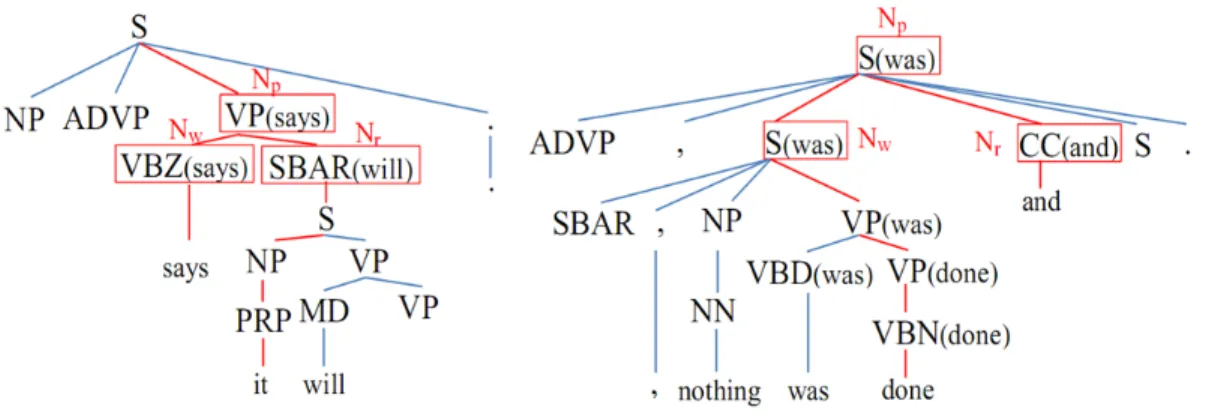
When extracting features for word w, let r be the word on the right-hand side of w and Np be the deepest node that belongs to both paths from the root to w and r. Nw and Nr are child nodes of Np that belong to two paths, respectively. Figure 3.3 shows two partial lexicalized syntactic parse trees. In the first tree, if w = says then r = it, Np =V P(says),Nw =V BZ(says), and Nr =SBAR(will). We also consider the parent and the right-sibling ofNp if any. The final feature set for wconsists of not only features extracted from w but also features extracted from two words on the left-hand side and two words on the right-hand side of w.
Our feature extraction method is different from the method in previous works [53, 123].
They defineNwas the highest ancestor ofwthat has lexical headwand has a right-sibling.
Then Np and Nr are defined as the parent and right-sibling of Nw. In the first example, our method gives the same results as the previous one. In the second example, however, there is no node with lexical head “done” and having a right-sibling. The previous method cannot extract Nw, Np, and Nr in such cases. We also use some new features such as the head node and the right-sibling node of Np.
3.3.4 Subtree Features for Reranking
We need to decide which kinds of subtrees are useful to represent a candidate, a way to segment the input sentence into EDUs. In our work, we consider two kinds of subtrees:
bound trees and splitting trees.
The bound tree of an EDU, which spans from word u to word w, is a subtree which satisfies two conditions:
1. its root is the deepest node in the parse tree which belongs to both paths from the root of the parse tree to u and w, and
2. it only contains nodes in two those paths.
The splitting tree between two consecutive EDUs, from word u to word w and from word r to word v, is a subtree which is similar to a bound tree, but contains two paths
2Lexical heads are extracted using Collins’ rules [28].
Figure 3.4: Subtree features.
from the root of the parse tree towandr. Hence, asplitting tree between two consecutive EDUs is a bound tree that only covers two words: the last word of the first EDU and the first word of the second EDU. Bound trees will cover the whole EDUs, while splitting trees will concentrate on the boundaries of EDUs.
From a bound tree (similar to a splitting tree), we extract three kinds of subtrees:
subtrees on the left path (left tree), subtrees on the right path (right tree), and subtrees consisting of a subtree on the left path and a subtree on the right path (full tree). In the third case, if both subtrees on the left and right paths do not contain the root node, we add a pseudo root node. Figure 3.4 shows the bound tree of EDU “nothing was done” of the second example in Figure 3.3, and some examples of extracted subtrees.
Each subtree feature is then represented by a string as follows:
• A left tree (or a right tree) is represented by concatenating its nodes with hyphens between nodes. For example, subtrees (b) and (e) in Figure 3.4 can be represented as follows:
S-NP-NN-nothing, and S-VP-VP-VBN-done.
• A full tree is represented by concatenating its left tree and right tree with string
### in the middle. For example, subtrees (g) and (h) in Figure 3.4 can be repre- sented as follows:
S-NP-NN###S-VP-VP-VBN, and NP-NN-nothing###VP-VP-VBN.
The feature set of a candidate is the set of all subtrees extracted from bound trees of all EDUs and splitting trees between two consecutive EDUs.
Among two kinds of subtrees, splitting trees can be computed between any two adja- cent words and therefore can be incorporated into the base model. However, if we do so, the feature space will be very large and contains a lot of noisy features. Because many words are not a boundary of any EDU, many subtrees extracted by this method will never become a real splitting tree (tree that splits two EDUs). Splitting trees extracted in the reranking model will focus on a small but compact and useful set of subtrees.
3.4 An Incremental Algorithm for Building Discourse Trees
There have been two major approaches building a discourse tree given a segmented text.
The first approach uses a greedy strategy [54]. The method gradually combines two consecutive spans (EDUs or subtrees of EDUs), which are most probably connected by a rhetorical relation, until all EDUs are merged into a single discourse tree. The tree construction algorithm is presented as Algorithm 2, where li denotes the ith element of list L. The algorithm needs a score function (used in lines 4,9, and 10), which evaluates how likely two consecutive spans should be connected. To calculate this score, we first learn a binary classifier StructClassif ier that takes two consecutive spans as the input, and returns +1 in the case two spans should be connected and −1 otherwise. Then we define the score function as follows:
StructScore(li, li+1) = P rob(StructClassif ier(li, li+1) = +1).
Algorithm 2A greedy algorithm for building discourse trees [54].
1: Input: List of EDUs, E = (e1, e2, . . . , en)
2: Initialize: L←E
3: for (li, li+1) in L do
4: Scores[i]←StructScore(li, li+1) [Calculate score]
5: end for
6: while |L|>1 do
7: i←argmax(Scores)
8: N ewSubT ree←CreatT ree(li, li+1) [Create a new subtree]
9: Scores[i−1]←StructScore(li−1, N ewSubT ree) [Calculate score]
10: Scores[i+ 1]←StructScore(N ewSubT ree, li+2) [Calculate score]
11: delete(Scores[i]) [Update Scores]
12: L←[l1, . . . , li−1, N ewSubT ree, li+2, . . .] [Update L]
13: end while
14: F inalT ree←l1
15: Output: F inalT ree.
Note that if we want to build a labeled tree, in addition to StructClassif ier, we need a multi-class classifierLabelClassif ier that also takes two consecutive spans as the input, and returns the most probable relation label holding between the two spans. In Algorithm 2, we use this classifier to find the relation label before creating a new subtree (line 8 in the algorithm).
The second approach for building discourse tress is based on a dynamic programming technique (CYK parsing) [123]. We maintain a two-dimension array t[i][j] storing the most probable structure tree covering from the ith EDU to the jth EDU, and an array Score[i][j] storing the score of t[i][j]. The final structure tree is t[1][n], where n is the number of EDUs. Score[i][j] and structure tree t[i][j] can be calculated as follows:
Score[i][j] =maxi≤k<j(Score[i][k]+Score[k+1][j]+StructScore(t[i][k], t[k+1][j])) (3.1) and
t[i][j]←CreateT ree(t[i][k∗], t[k∗+ 1][j]),
where k∗ is the index that maximizes the score function in Equation (3.1).
Although the first method gives an approximate solution, it is more suitable in practice because it runs much faster than the second method (O(n) compared toO(n3), wheren is the number of EDUs). In fact, the second method is only used in sentence level discourse parsing [123], where the number of EDUs is small.
In the tree building step, the goal is to build a discourse tree given a text which has been segmented into EDUs. Usually, the text consists of several paragraphs, and each paragraph consists of some sentences. We note that EDUs within one sentence tend to be connected to make a subtree before connecting to EDUs in other sentences. The same thing also takes place at the paragraph level. EDUs within one paragraph tend to be connected to make a subtree before connecting to EDUs in other paragraphs. It is because of the coherence of a well-written text. A sentence expresses a statement, question, exclamation, request, command, or suggestion, and sentences in a paragraph should focus on a topic. Paragraphs help separate ideas and indicate the change of topics.
Motivated by this property, we propose an incremental algorithm (our first algorithm) for building a discourse tree. The algorithm is presented as Algorithm 3. When we build a subtree for a sentence, the input consists of EDUs in that sentence. When we build a subtree for a paragraph, the input consists of several subtrees, and each subtree corresponds to a sentence. When we build the final discourse tree for whole text, the input consists of several subtrees, and each subtree corresponds to a paragraph. In all three cases, the number of spans (EDUs or subtrees) in the input is very small in comparison with the total EDUs of whole text. So we can use a dynamic programing technique like the method presented in Soricut and Marcu [123] to solve it.
Algorithm 3An incremental algorithm for building discourse trees.
1: Input: a text T
2: for each sentence s inT do
3: Create a subtree for s
4: end for
5: for each paragraph pin T do
6: Create a subtree for p based on subtrees of sentences
7: end for
8: Create a discourse tree forT based on subtrees of paragraphs
9: Output: Discourse tree
Compared to the greedy algorithm (Algorithm 2) presented in Hernault et al. [54], this algorithm has two advantages. It supports the coherence property we described before. The algorithm employs a dynamic programming technique, so it can find an extract solution in each step. However, the algorithm gives a hard constraint on the order in which EDUs are connected. So it makes the search process biased. Our solution is creating a parsing model by integrating two above algorithms. To achieve this, in the next section, we will present a dual decomposition algorithm for building discourse trees.
3.5 Dual Decomposition for Building Discourse Trees
3.5.1 Dual Decomposition
Dual decomposition is a method to solve complex optimization problems that can be decomposed into two or more subproblems, together with linear constraints that enforce the agreement on solutions of the subproblems [112]. The subproblems are chosen such that they can be solved efficiently. The constraints are incorporated using Lagrange multipliers, and an iterative algorithm is used to minimize the optimization problem.
We consider the following optimization problem:
argmaxy∈Y,z∈Z(f(y) +g(z)) subject to:
y(i) =z(i), for all i∈ {1. . . n}.
Each constraint y(i) = z(i) describes an agreement on the solutions of two subprob- lems. We introduce Lagrange multipliers u(i), i ∈ {1. . . n}, and assume that for any valueu(i)∈R, we can efficiently solve:
argmaxy∈Y(f(y) +
n
X
i=1
u(i)y(i)), and
argmaxz∈Z(g(z)−
n
X
i=1
u(i)z(i)).
The dual decomposition algorithm can be expressed as Algorithm 4, whereδk is the step size at the kth iteration.
Algorithm 4The dual decomposition algorithm [112].
1: Initialize: u(0)(i) = 0, for all i∈ {1. . . n}
2: for k = 1 to K do
3: y(k) ←argmaxy∈Y(f(y) +Pn
i=1u(k−1)(i)y(i)) [Subproblem 1]
4: z(k) ←argmaxz∈Z(g(z)−Pn
i=1u(k−1)(i)z(i)) [Subproblem 2]
5: if y(k)(i) = z(k)(i) for all i∈ {1. . . n} then
6: return (y(k), z(k))
7: else
8: u(k)(i)←u(k−1)(i)−δk(y(k)(i)−z(k)(i))
9: end if
10: end for
11: return (y(K), z(K))
As shown by Rush and Collins [112], in the cases that the solutions of two subproblems are agreement, the returned solution will be an optimal solution of the original problem.
Dual decomposition has been applied successfully to several NLP tasks such as parsing [113], dependency parsing [68], and coordination disambiguation [51].
3.5.2 A Parsing Algorithm using Dual Decomposition
Recall that the parsing problem is to find:
argmaxy∈Yh(y)
whereY is the space of all possible discourse trees, andh(y) is a score function defined on Y. In our method, the score function consists of two factorsh(y) = f(y)+g(y), wheref(y) is the score returned by our base model1 using the incremental algorithm (Algorithm 3), and g(y) is the score returned by our base model2 using the greedy algorithm (Algorithm 2).
For each discourse tree y, we define variables y(i, j) as follows:
y(i, j) =
1 if exists a subtree that covers from the ith EDU to the jth EDU 0 otherwise.
The problem now becomes:
argmaxy∈Y,z∈Z(f(y) +g(z)) subjects to:
y(i, j) = z(i, j) for all 1≤i < j ≤n, where n is the number of EDUs and Z =Y.
We solve this problem by using dual decomposition. The proposed algorithm (our second algorithm) is presented as Algorithm 5, where u(i, j) are Lagrange multipliers.
Algorithm 5A dual decomposition algorithm for building discourse trees.
1: Initialize: u(0)(i, j) = 0, for all 1≤i < j ≤n.
2: for k = 1 to K do
3: y(k) ←argmaxy∈Y(f(y) +P
1≤i<j≤nu(k−1)(i, j)y(i, j)) [Base Model1]
4: z(k) ←argmaxz∈Z(g(z)−P
1≤i<j≤nu(k−1)(i, j)z(i, j)) [Base Model2]
5: if y(k)(i, j) =z(k)(i, j) for all 1≤i < j ≤n then
6: return y(k)
7: else
8: u(k)(i, j)←u(k−1)(i, j)−δk(y(k)(i, j)−z(k)(i, j))
9: end if
10: end for
11: return y(K)
Note that when solving two subproblems (lines 3 and 4 in Algorithm 5) using two base algorithms (Algorithms 2 and 3), we need to modify score functions as follows:
Score[i][j] =maxi≤k<j(Score[i][k]+Score[k+1][j]+StructScore(t[i][k], t[k+1][j]))+u(i,j)), in Base Model1, and
Score[i][j] =maxi≤k<j(Score[i][k]+Score[k+1][j]+StructScore(t[i][k], t[k+1][j]))−u(i,j)), in Base Model2.