博 士 ( 理 学 ) Ahmed Shawky Mohammed Ghareeb
学 位 論 文 題 名
Studies on Room‑Temperature Synthesis of Nanocarbon
Materials via Electrochemical Process
(電気化学プロセスによるナノカーボン材料の室温合成に関する研究)
学位論文内容の要旨
Nanocarbons, including graphene, nanotubes, diamond like carbon (DLC), and polymeric ones showed a unusual optical, electronic and catalytic properties. Subsequently it can be used in many applications like optical, electronic and catalytic ones. Generally, synthesis techniques of nanocarbons, such as arc
discharge, laser ablation, chemical vapor deposition, etc., are based on the processes based on high voltages, high laser power and high temperatures. These methods consume a lot of energy and subsequent high cost production induced. Additionally, the large thermal fluctuation during nanocarbon growth enhances distortions and defects within their structures due to change in catalyst kinetics and hence the produced materials. For these reasons, nanocarbon synthesis with low energy consumption at room temperature has become a big b) challenge for realization of low cost, mass production and well‑defined structures.
Electrochemical synthesis is considered to be the fruitful method for producing nanocarbons with controllable structures. Electrodeposition technique has demonstrated some advantages over vapor phase deposition, such as the simplicity and low cost of experimental apparatus, possibility of low temperature synthesis and ease of experimental control to produce films with diverse properties. Consequently, it is possible to apply this method for the selective growth of nanocarbons with novel structures.
In this work, I have explored the room temperature synthesis of nanocarbons via an electrochemical process using simple three electrode cell which is significant for the production of controllable structures.
コ m 一`
.苫 m 仁 堂 仁 c m E to oピ
ヨ tO 匸 0
―ロ +一 匸 と コ o
210 225 240 1300 1400 1500 1600 Raman shift /cm‑l
Fig. 1. (a) Cyclic voltamogram of Au electrode in aqueous system without (black) and with (red) adding acetic acid as carbon source. (b) and (C) are Raman spectra and corresponding SPM images for the produced nanocarbons deposited over different size Ni supporting catalyst. Scale bar is 100 nm.
‑ 43―
■ ■
■
The study aims the production of selectively useful nanocarbons by electroreductive deposition technique through two main approaches.
The first one was aimed to produce nanocarbons in aqueous system丘Iom carboxylic acid as carbon source over Au electrode. The Au surface was modified by either roughening or supporting iron group nanocatalysts. Electrochemical studies revealed that carboxylic acids could be reduced electrochemically to on Au surface (see Fig. la). In addition, successful synthesis of single wall carbon nanotubes (SWNTs) and DLC has been reported for the first time by this original approach over Ni nanocatalyst. Raman spectroscopy and scanning probe microscopy (SPM) for samples prepared over different size Ni catalyst indicating the formation of amorphous carbon, SWNT and DLC over o nm, 2 nm and 6 nm Ni catalysts respectively (Fig. lb and lc).
Several parameters for the optimization of produced nanocarbons were investigated, and proposed mechanism for SWNT growth was discussed. However, I realized that the yield was quit low for large scale production and industrial applications.
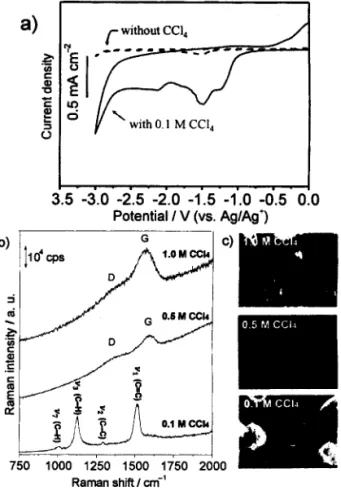
The second approach was aimed to produce higher yield of nanocarbons. In this approach, ionic liquid (IL), was used as a non‑aqueous system instead of aqueous one and chlorocarbons, such as carbon tetrachloride and chloroform as carbon sources seeking the higher yield. Electrochemical studies indicated the possibitity to reduce chlorocarbons by applying moderate reductive potential (see Fig. 2a).
Characterizations of the produced films on Ni substrates using this method indicate the formation of trans‑polyacetylene, an interesting conducting polymer, instead of pure nanocarbons, which is another benefit for this dissertation. A view on the reaction mechanism for the production of this polymer was proposed expecting that the water effect is responsible the production of trans‑polyacetylene because water is the origin of hydrogen in polyacetylene.
Following my expectations, I have successfully synthesized nanocarbon films over the Ni substrate with high yield instead of trans‑polyacetylene from the dried conditions to eliminate the hydrogen source.
The results of Raman spectra and scanning electron microscope (SEM) can be seen in Figs. 2b and 2c.
Finally, the study has indicated that it is possible to make C‑C bond in forms of SWNTs, DLC and polymeric nanocarbon materials at room temperature by electrochemical process. The nanocarbon materials prepared by this original method could have unique structure and properties.
Subsequently, it can be directly use for extreme applications like electronic and optoelectronic ones. Additionally, the doping of these nanocarbon materials can be achieved during synthesis process which opens a wide door for the catalytic applications too. Functionalization of SWNT and other produced nanocarbon can be also one of perspective work of this study.
Potential/V (vs. Ag/Ag+)
Fig. 2. (a) Cyclic voltamogram of Ni electrode in non‑aqueous system without (black) and with (red) adding CCI4 as carbon source. (b) and (C) are Raman spectra and corresponding SEM images for the produced nanocarbons deposited over different concentration of CCI4. Scale bar is 1 pm.
―44 ‑
一 ■
澄
学位論文審査の要旨
学 位 論 文 題 名
Studies on Room ‐ Temperature Synthesis of Nanocarbon IVIaterials via Electrochemical Process
(電気化学プロセスによるナノカーボン材料の室温合成に関する研究)
グラフェンシートを簡状構造にした単 層カーボンナノチューブ(SWNT)は、カイラリティー により半導体、金属的になる性質を持ち、その直径を制御することによルバンドギャップを変調 させることができるため、電子・光デバイスヘの応用が期待されている。このように特異的な物 性を持っにも関わらず、未だデバイス化されていない。その大きな原因は、従来の高温気相合成 過程の大きな熱揺らぎによって引き起こされる、バンド構造の変調や電子散乱を引き起こす欠陥 及び構造歪みのランダム生成に起因する。申請者は、この課題を根本的に解決するため、従来の 高温気相合成プロセスでの大きな熱揺らぎによる構造制御性の困難さを克服するため、溶液かつ 室温下で原料となる前駆体分子の重合が可能な電気化学的手法を用いて、SWNTの合成を試みた。
まず、電気化学合成装置の構築を行い、
SWNT
成長のための触媒であるNi
ナノ微粒子をAu
電極 上に担持するために、Niイオンを含む電解質溶液中において触媒金属の電析プロセスの最適化を 試みた。電析電位‑1V、電析時間10‑100 msの印加により、ナノチューブ成長に最適な1‑‑)10 nm のNiナノ微粒子を、精度よく作製することが可能であることを走査型プローブ顕微鏡により明 らかにした。このNiナノ微粒子を担持したAu電極を作用極として、炭素源には酢酸を用いてカ ソード電析を行った結果、酢酸の電気分解由来の大きなカソード電流が観察された。ラマン分光 法および走査型プローブ顕微鏡による評価の結果、Niナノ微粒子を担持していなぃAu電極上で はアモルファスカーボンが生成するのに 対し、Niナノ微粒子を担持したAu電極上では、SWNT の直径方位振動由来のRadial breathing mode (RBM)とグラフェン構造由来のG‑bandのラマンスペ クトルが明瞭に観察され、SWNTが生成するのを初めて明らかにした。また、Niナノ微粒子のサ イズにより、SWNTだけでなくsp3炭素結合がりッチなダイヤモンドライクカーボンが生成する ことも見出し、ナノ微粒子のサイズを制御することで生成するカーボンの形態を制御可能である ことも示した。しかしながら、還元反応のほとんどが水素発生による還元反応に浪費されること、酢酸分子は多電子移動反応が困難な分子であるため、SWNTの低収量が課題となっていた。さら なる収量増加を目指し、溶媒には非水溶液系でかつ水分含有量が極めて少ないイオン液体を、炭 素源にはより電気化学還元反応をする四塩化炭素を用いた、新しい電気化学反応系での実験を試 みた。その結果、SWNTと同じsp‑炭素結合をもつ、ポリアセチレンが高収率で生成することを 見出し、SWNT合成のためのsp'炭素結合生成の基礎的反応プロセスの知見を得ることに成功し た。
以上より、申請者は電気化学プロセスにより、室温・溶液中でSWNTの合成が可能である事を 初めて明らかにした。さらに高収率化を目指すことで、SWNTを用いた電子デバイスの実現が期 待される。よって申請者は、北海道大学博士(理学)の学位を授与される資格あるものと認める。
―45―