A Survey of the Mental Health of Chinese Special Education Teachers
ZHANG Shudong (Beijing Normal University) LIU Junli (Beijing Normal University, Graduate Student)
CHEN Chunhui (Beijing Normal University) ZHAO Libo (Beihang University)
Keywords: special education transition; SCL-90; special education teacher; mental health;
inclusive education
1. Introduction
The prevalence of mental problems was generally higher than that of any other class of chronic conditions (Kessler, Keller, & Wittchen, 2001). Several studies found that the mental health of special education teachers (SET) were worrisome (Adeniyi, Fakolade, & Tella, 2010; Shyman, 2011; Kucuksuleymanoglu, 2011; Zhao & Wang, 2012; Brunsting, Sreckovic, & Lane, 2014), wherein the working environment plays an important role (Mathers & Loncar, 2006; Tang, Leka, &
MacLennan, 2013). To migrate their working pressure and improve their mental health status, a large body of research has focused on working factors that influence the mental health of SET and measures were taken to cope with them accordingly.
Inclusive education is an international trend that refers to all children learn in the same classrooms regardless of the presence of disabilities (Loreman, Earle, Sharma, & Forlin, 2007), and the Chinese government has formulated policies and several plans to promote the development of inclusive education recently. Such macro-environment changes would bring influence to SET undoubtedly. In this way, although there have been several studies surveyed the mental health status of SET in China, we believe that these studies may have been outdated or can only provide limited information for special education development and further policies formulating. This study, which utilizes representative data SET of different levels of in-service SET training from Hubei province and Fujian province, aimed to determine the mental health status of different levels of training participants in this new period. In addition, this study also provides some enlightenment for policy formulation and school management.
1.2. The mental health of SET
“Mental health” refers to basic cognitive and social skills; emotional regulation; flexibility and ability to cope with adverse life events and function in social roles; and harmonious relationship between body and mind (Galderisi, Heinz, Kastrup, Beezhold, & Sartorius, 2015). Studies have shown that the mental health status of Teaching professionals was a worldwide concern (Stansfeld, Rasul, Head, & Singleton, 2011; McLean, Abry, Taylor, Jimenez, Granger, 2017). Even worse, it is acknowledged that SET bear the most stress-laden working conditions that are associated with poor mental health (Brunsting et al., 2014), such as challenging student behaviors (Hastings & Brown, 2002), role overload (Adera & Bullock, 2010), lack of sense of achievement in spite of efforts (Kucuksuleymanoglu, 2011).
Many studies in China have pointed that the rate of SET with mental health problems far exceeded the national average (Shen & Lin, 2007; Xu, 2004; Yu, 2007; Zhao & Wang, 2012; Zhou
& Liu, 2013). However, research about factors that contribute to this unsatisfactory mental health status of SET is still dispute and inconsistency (Zhao & Wang, 2012). Hence, it is of great
importance to re-evaluate the mental health of SET in China given to the reformation of inclusive education, so as to accurately assess the levels of support (psychological, social and professional) that should be provided to them. This will be not only beneficial for promoting the mental health of SET, but also for making the right policies to ensure the best effect of special education
transformation.
1.2. New change, new challenges
Learning in regular class (LRC), which was initiated in the 1980s, was the prime model to meet the educational need of the disabilities (Deng, Poon-mcbrayer, & Farnsworth, 2001). LRC is
“to allow special children and teenagers with certain abilities, such as visually impaired, hearing impaired, and mentally handicapped, to enter common schools to study together with common children and to take part in activities together” (The State Education Commission Basic Education Department, 1986). Over 30 years of LRC practicing shows that it cannot meet the real demand of students with disabilities because they usually are usually treated as subordinated students in regular classes (Deng & Poon-McBrayer, 2012).
To further carry forward inclusive education in China, new policies have been formulated in recent years. For example, the “Special Education Enhancement Plan (2014-2016)” (Ministry of Education of China, 2014), combined with “The Second Special Education Promotion Plan (2017- 2020)” (Ministry of Education of China, 2017) had exerted great influence on inclusive education development. Special education, an important part of Chinese educational modernization, has ushered in the transition period (Yin, 2016; Shen, 2017). The transformation of special education school (SES) is a direct reflection of special education transformation, mainly manifested in three aspects: (a) various types of disabled children out from home to receive education in schools rather than just children who are visually impaired, hearing impaired, and mentally handicapped; (b) since children with slight or mild disabilities go to regular schools to receive inclusive education, the disability degree of students in SES are shifting from mild to serious and even extreme serious; (c) with the changes in the structure of disabled students, single type of SES (e.g., deaf schools, schools
for intellectual disabilities), which was used to admit a particular type of disabled children, is developing to a comprehensive SES that admit kinds of disabled children. Undoubtedly, SET is pivot in achieving inclusive education goals. However, have these changes brought influence to the mental health of SET? An investigation is needed to discuss the mental health of SET under this new social situation.
1.3. Research aims
The overall purpose of this article was to examine, through the Symptom Check List (SCL- 90), the mental health status of SET under the background of the transition period. It is
hypothesized that: (1) the mental health of SET is worse than Chinese population norm (CPN) nowadays; (2) the mental health of different special education training programs participants various; (3) SET with different managerial position may demonstrate various mental health status;
and (4) there is no difference among SES in different teaching age groups and different types in this transition period.
2. Method 2.1. Participants
218 SET (27.06% male) from Fujian and Hubei province in China positions. The sample included SET receiving three kinds of training programs, with 42.20% received national training in Beijing, the capital city of China; 47.25% received provincial training in the capital city of Fujian province, and the rest 10.55 % received local school-based training. The national training was the most advanced, and the school-based training was the most basic, but the quality of training was equal because all these trainings were instructed by professors from Beijing Normal University.
Descriptive of sampling are presented in Table 1. 34.40% of our sample were from comprehensive special schools, 61.01% from schools for intellectual disabilities, and 4.59% from deaf schools;
44.04% had a teaching age of fewer than 5 years, 35.78% between 6-15 years, and 20.18% over 16 years. As for managerial position, 22.94% associated with the higher managerial position, 36.24%
associated with the class teacher and 40.82% were SET without managerial position. All volunteers gave informed consent for their participation.
Table 1. Descriptive of Sampling
2.2 Measurement
Symptom Check List (SCL-90). It is a self-report symptom inventory, widely used for assessing a broad range of mental disorders and symptom intensity (Rytilämanninen et al., 2016).
The scale has 90 items and covers 9 dimensions of psychological distress: somatization (12 items), interpersonal sensitivity (9 items), depression (13 items), anxiety (10 items), phobic anxiety (7 items), obsession-compulsion (10 items), hostility (6 items), paranoid ideation (6 items), and psychoticism (10 items) (Olsen, Mortensen, & Bech, 2004). The frequency of adults’ negative perception in each item is rated on a 5 points scale (1= never and 5 = very serious). SCL-90 has demonstrated good internal consistency reliability, with Cronbach’s alpha coefficient (α) for the in this study was .977 and the range of α of dimensions was from .735 to .895.
2.3. Procedure
Data were collected in summer during training. Two trained research assistants who were master students of special education and a psychologist collected the data. All participants in this study consent to fill out scale faithfully. The instruction of the SCL-90 was explained by the psychologist. In addition, demographic information was also collected. It took about 10 to 20 minutes for each participant to complete the scale.
2.4. Statistical Analysis
There was a very small proportion of missing data in the dataset. On average 3.3% of the data was missing for each variable. Since a complete dataset increases the accuracy of statistical analyses, the mean-imputation method was performed to impute the missing data. All data were
Variables Characteristics
Training level National training (42.20%); provincial training (47.25%); school-based training (10.55%)
Type of SES Comprehensive special schools (34.40%); schools for intellectual disabilities (61.01%); deaf schools (4.59%)
teaching age Less than 5 years (44.04%); between 6-15 years (35.78%); over 16 years (20.18%)
Managerial position
higher managerial position (22.94%), class teacher (36.24%); general SET (40.82%)
analyzed with SPSS 20.0. One-sample t-tests were used to examine whether the scores of SET greater than the Chinese population norm (CPN), One-Way ANOVA was used to test the main effects of these variables and post-hoc tests were used to reveal differences in more details.
3. Results
3.1. The overall mental health status of SET
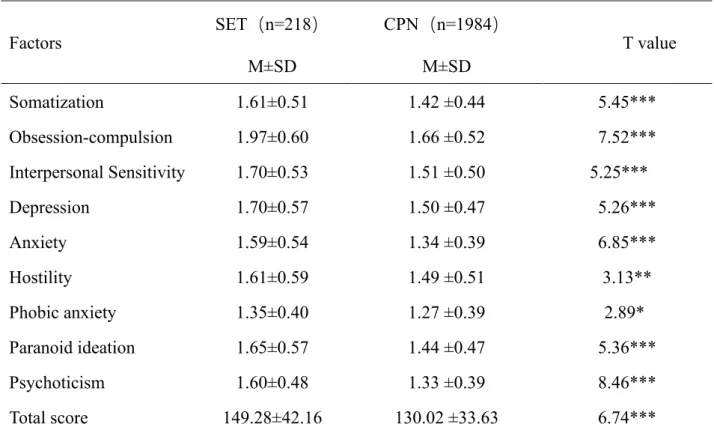
Among the 218 valid questionnaires, 70 (32.11%) cases with positive symptoms (mean scores of each dimension scores > or = 2) were identified. That is, nearly 1/3 of the SET suffered different levels of mental health problems. Obsessive-compulsive, interpersonal sensitivity, and paranoid ideation ranked the top three in the percentage of mental health problems detected in SET.
One-sample t-tests revealed that not only the total score but also all dimension scores of the 218 SET in this study were significantly higher than the corresponding mean scores in CPN (see Table 2), indicating that SET mental health status was worse than the average condition of Chinese adults.
Table 2. T- Tests on the SCL-90 Scores Between SET and CPN
Factors SET(n=218)
M±SD
CPN(n=1984)
M±SD
T value
Somatization 1.61±0.51 1.42 ±0.44 5.45***
Obsession-compulsion 1.97±0.60 1.66 ±0.52 7.52***
Interpersonal Sensitivity 1.70±0.53 1.51 ±0.50 5.25***
Depression 1.70±0.57 1.50 ±0.47 5.26***
Anxiety 1.59±0.54 1.34 ±0.39 6.85***
Hostility 1.61±0.59 1.49 ±0.51 3.13**
Phobic anxiety 1.35±0.40 1.27 ±0.39 2.89*
Paranoid ideation 1.65±0.57 1.44 ±0.47 5.36***
Psychoticism 1.60±0.48 1.33 ±0.39 8.46***
Total score 149.28±42.16 130.02 ±33.63 6.74***
Note: SET=special education teacher; CPN= Chinese domestic normal. *p< .05. **p< .01.
***p< .001.
3.2. The effect of the training level
One-Way ANOVA revealed a significant training level effect for the overall score of SCL-
90, F (2, 215) =6.304, p < .001 (see Table 3). The post-hoc test further revealed that this effect was driven by the fact that the average score of SCL-90 in the national training group was statistically higher than the provincial training group except for the somatization subscale, implied that the national training participants had poorer mental health than provincial training participants.
Table 3. One-way ANOVA and Post-hoc Analysis on the Training Level Effect Subscales Df Training Level Training Level Comparisons
Somatization 215 1.954 ——
Obsession compulsion 215 5.735** National training > provincial training Interpersonal sensitivity 215 6.500** National training > provincial training Depression 215 5.412** National training > provincial training Anxiety 215 5.375** National training > provincial training Hostility 215 3.028* National training > provincial training Phobic anxiety 215 4.696** National training > provincial training Paranoid ideation 215 5.813** National training > provincial training &
school-based training
Psychoticism 215 9.356** National training > provincial training Total 215 6.304** National training > provincial training
Note: *p < .05. ** p < .01. *** p < .001.
3.3. The effect of managerial position
As Table 4 shows, One-Way ANOVA revealed a significant managerial position effect for the overall scores of SCL-90, F (2, 215) = 5.959, p < .01, and for all of its subtests (all
subtests< .05). The post-hoc tests showed SET who was class teachers had the worst mental health status than others.
Table 4. One-way ANOVA and Post-hoc Analysis on the managerial position Effect
Subscales Df
Managerial
Position Managerial Position Comparisons Somatization 215 4.068* Class teacher > higher managerial position
Obsession
compulsion 215
5.784** Class teacher > higher managerial position
Interpersonal
sensitivity 215
5.330** Class teacher > higher managerial position
Depression 215 4.377* Class teacher > higher managerial position Anxiety 215 5.114** Class teacher > higher managerial position Hostility 215 7.395*** Class teacher > higher managerial position
Phobic anxiety 215
5.626** Class teacher > general SET > higher managerial position
Paranoid ideation 215 3.164* Class teacher > higher managerial position Psychoticism 215 5.988** Class teacher > higher managerial position Total 215 5.959** Class teacher > higher managerial position Note: *p < .05. ** p < .01. *** p < .001.
3.4. The effect of teaching age, types of SES
The one-way MANOVA on the SCL-90 scores for SET with teaching age as the factor was nonsignificant. Nor the nonsignificant correlation between different types of SES and SET mental health was found.
4. Discussion
4.1. The mental health of SET was worse than CPN
In this study, we investigated the mental health of SES in the transferring period that the Chinese government is promoting inclusive education vigorously. This result is consistent with those of previous studies, which showed that the mental health of SET was poor (Xu, 2004; Shen &
Lin, 2007; Zhao & Wang, 2012; Zhou & Liu, 2013), but extended previous research through the analyses of a relatively national representative sample of SET. The professional social status is still not attractive enough may be an important reason. A study (Wang, Xiao, Zhu, Wei, & Li, 2011) pointed out that social factors are the primary factors affecting special education work, and the influence of social approval is the highest influential factor among all social factors. Undoubtedly, although the development of special education in China has made great achievements, the social recognition degree of the SET profession is still not high enough, and its social status needs to be further improved. Fortunately, many researchers have proposed several suggestions to enhance the social status of teachers which may be useful to the mental health improvement of SET, such as improving political status, protecting legal rights and interests, boosting professional (Zhao & Jiang, 2001), and enhancing economical income (Fang, Yang, & Lu, 2017).
4.2. The mental health of national training program participants was poorer than provincial participants
The results indicated that national training program participants suffered heavier mental health disorders. It can be explained by “Effort-Reward Imbalance Model”, first proposed by Siegrist in 1996, which is used to describe job stress and strain arouse when what you paid off in work do not match with reward (for example, money, esteem, and career opportunities) received in turn (Shyman, 2011). In contrast, balanced effort and reward are a benefit to worker’s mental health. Specially, because that the opportunity for SET to take part in national training is rare, all participants must have undergone tough assessment. In other words, they may shoulder more expectations from outside. However, too much work pressure caused by personal desire and outside conditions also leads them to feel exhausted and suffer mental health problems. Therefore,
stimulating personal innate desire for success is quite necessary, but providing appropriate chance and enough quota to assess excellence also should be considered to avoid fierce competition among SET. Both government and school administrations should consider this aspect of determining related decisions.
4.3. SET in different teaching age had a similar mental health status
Inconsistency with some existed studies, we found that each dimension score of SCL-90 in different SET teaching age groups didn’t differ significantly (Xu, 2004; Zhao & Wang, 2012). This result may relate to the transformation of special education. Specially, as aforementioned above, many SET in SES were transferred from the deaf school nowadays. Though they were experts in instructing deaf students, it may not do great help for them to adapt to the new working
environment because of the giant gap in physical and mental development between deaf students and other disabilities groups. Thus, when these transferred SET confronting unfamiliar types of disabilities, they may feel stressful as well. As a result, the mental health of SET in different teaching age groups was approximate. Schools are an important source of factors that affect the mental health of teachers. “School management factor causes psychological distress to nearly half of the participated teachers and has a statistically significant impact on teachers’ mental health”
(Huang, 2012). Therefore, schools should take measures (e.g., considering different needs from different age and teaching groups, reduce unnecessary chores in their work and develop proposals to help transferred SET adapt to new surroundings rapidly, arousing their enthusiasm and love for children with disabilities) to improve SET mental health.
4.4. The mental health of SET in different types of SES was parallel
Unlike previous studies have pointed out that SET in different types of SES differed in mental health (Xu, 2004; Zhao & Wang, 2012), we found that no matter which kind of SES they work in, the mental health status of SET was similar. This may due to the changes in exceptional student structure and SES types. On the one hand, with more students with slight disabilities went to regular schools and classes, the number of students in SES decreased but their severity degree increased. As a consequence, SET had to focus more on rehabilitation and establish routines in these children’s life. Such alternation posed a challenge to teachers’ traditional knowledge structure and may bring lots of pressure to them. On the other hand, with the single type of SES is gradually transferring to comprehensive SES and SET need face multiple types of students with disabilities than they used to and therein autism, hyperactivity, and multiple disabilities are particularly commons. Therefore, even though SET work in different types of SES, the mental health situation
of them seems resemblance.
5. Conclusion
It is of great significance to pay attention to the mental health of SET as it not only associated with fitness themselves, but also student performance (McLean & Connor, 2015) and their academic outcomes (Beilock, Gunderson, Ramirez, & Levine, 2010). This study surveyed the mental health status of SET under the background of special education transformation in China. Our study contributes to the scientific literature in four ways. Firstly, we have found that the mental health of SET was worse than the national norm under the background of inclusive education in China based on a relatively national representative sample. Hence, concerns should be given to promote their mental health. Secondly, we found that SET in different training level groups appeared different levels of mental health. The mental health of national training participants was lower than provincial participants. And thirdly, teaching age, types of SES do not show significant independent effects on the mental health of SET. From a practical perspective, our findings
highlight the need to attend to different groups of SET aiming to improve their mental health. Given that research on improving the quality of special education and promoting the development of inclusive education is increasing, the mental health of SET and professional performance inextricably linked, the importance of this study is even more apparent.
References
Adeniyi, S. O., Fakolade, O. A., & Tella, A. (2010). Perceived causes of job stress among special educators in selected special and integrated schools in Nigeria. New Horizons in Education, 58, 73-82.
Adera, B. A., & Bullock, L. M. (2010). Job stressors and teacher job satisfaction in programs serving students with emotional and behavioral disorders. Emotional & Behavioural Difficulties, 15, 5-14. doi: https://doi.org/10.1080/13632750903512365
Beilock, S. L., Gunderson, E. A., Ramirez, G., & Levine, S. C. (2010). Female teachers' math anxiety affects girls' math achievement. Proceedings of the National Academy of Sciences, 107, 1860-1863. doi: http://dx.doi.org/10.1073/ pnas.0910967107
Brunsting, N. C., Sreckovic, M. A., & Lane, K. L. (2014). Special education teacher burnout: a synthesis of research from 1979 to 2013. Education & Treatment of Children, 37, 681-712. doi:
10.1353/etc.2014.0032.
Deng, M., Poon-mcbrayer, K. F., & Farnsworth, E. B. (2001). The development of special education in China: A sociocultural review. Remedial & Special Education, 22, 288-298. doi:
10.1177/074193250102200504.
Deng, M., & Poon-Mcbrayer, K. F. (2012). Reforms and challenges in the era of inclusive education: The case of China. British Journal of Special Education, 39, 117–122. doi:
https://doi.org/10.1111/j.1467-8578.2012.00551.x.
Fang, L., Yang, H. F., & Lu, S. H. (2017). The Obstacles and countermeasures of salary system for special education teachers in China. Laodong Baozhang Shihjie, 36, 3.
Galderisi, S., Heinz, A., Kastrup, M., Beezhold, J., & Sartorius, N. (2015). Toward a new definition of mental health. World Psychiatry Official Journal of the World Psychiatric Association, 14, 231.
Hastings, R. P., & Brown, T. (2002). Behavioural knowledge, causing beliefs and self-efficacy as predictors of special educators’ emotional reactions to challenging behaviours. Journal of Intellectual Disability Research, 46, 144-150. doi: 10.1046/j.1365-2788.2002.00378.x Huang, J. M. (2012). Research on the maintenance of psychological health of primary and middle
school teachers based on school management (Unpublished master’s thesis). Beijing Normal
University, Beijing, China.
Kessler, R. C., Keller, M. B., & Wittchen, H. U. (2001). The epidemiology of generalized anxiety disorder. Psychiatric Clinics of North America, 24, 19-39. doi: https://doi.org/10.1016/S0193- 953X(05)70204-5.
Kucuksuleymanoglu, R. (2011). Burnout syndrome levels of teachers in special education schools in Turkey. International Journal of Special Education, 26, 53-63.
Loreman, T., Earle, C., Sharma, U., & Forlin, C. (2007). The development of an instrument for measuring pre-service teachers’ sentiments, attitudes, and concerns about inclusive education.
International Journal of Special Education, 22, 150-160.
Mclean, L., Abry, T., Taylor, M., Jimenez, M., & Granger, K. (2017). Teachers' mental health and perceptions of school climate across the transition from training to teaching. Teaching and Teacher Education, 65, 230-240. doi: http://dx.doi.org/10.1016/j.tate.2017.03.018.
McLean, L., & Connor, C. M. (2015). Depressive symptoms in third-grade teachers: relations to classroom quality and student achievement. Child Development, 86, 945-954. doi:
http://dx.doi.org/10.1111/cdev.12344.
Mathers, C. D., & Loncar, D. (2006). Projections of global mortality and burden of disease from 2002 to 2030. PLoS Medicine, 3, 2011-2030. doi: 10.1371/journal.pmed.0030442.
Ministry of Education of China. (2014, January, 20). Special Education Promotion Plan (2014- 2016). Retrieved from: http://www.jingbian.gov.cn/gk/zfwj/gwywj/41459.htm.
Ministry of Education of China. (2017, July, 18). The Second Special Education Promotion Plan (2017-2020). Retrieved from: http://www.gov.cn/xinwen/2017-07/28/content_5214071.htm.
Olsen, L. R., Mortensen, E. L., & Bech, P. (2004). The SCL-90 and SCL-90r versions validated by item response models in a Danish community sample. Acta Psychiatrica Scandinavica, 110, 225–229. doi: 10.1111/j.1600-0447.2004.00399.x.
Rytilämanninen, M., Fröjd, S., Haravuori, H., Lindberg, N., Marttunen, M., & Kettunen, K., et al.
(2016). Psychometric properties of the symptom checklist-90 in adolescent psychiatric inpatients and age- and gender-matched community youth. Child and Adolescent Psychiatry and Mental Health, 10, 1-12. doi: https://doi.org/10.1186/s13034-016-0111-x.
Shen, H. R. (2017). The Transformation of Special Education School in Context of Inclusive Education: Direction and Path. Journal of Modern Special Education (Higher Education), 10,
16-26.
Shen, H. R., & Lin, X. (2007). A research on special educational teachers' mental health and social support in Chongqing. Modern Special Education. 84, 80-84.
Shyman, E. (2011). Examining mutual elements of the job strain model and the effort-reward imbalance model among special education staff in the USA. Educational Management Administration & Leadership, 39, 349-363. doi: 10.1177/1741143210393995
Stansfeld, S. A., Rasul, F. R., Head, J., & Singleton, N. (2011). Occupation and mental health in a national UK survey. Social Psychiatry & Psychiatric Epidemiology, 46,101-110. doi:
10.1007/s00127-009-0173-7.
The State Education Commission Basic Education Department. (1986). Anthology of special education document experience”. Beijing, China: People's Education Press.
Tang, J. J., Leka, S., & MacLennan, S. (2013). The psychosocial work environment and mental health of teachers: a comparative study between the United Kingdom and Hong Kong.
International Archives of Occupational and Environmental Health, 86, 657-666. doi:
10.1007/s00420-012-0799-8.
Wang, Y., Xiao, F., Zhu, N., Wei, S. H., & Li, H. (2011). Status quo of teachers in Chinese special education schools. A journal of Modern special education, 10, 4-9.
Xu, M. Z. (2004). Status of teachers' mental health in the special education schools. Modern Special Education, 44, 64-67.
Yin, Y. Z. (2016). Meeting challenges, coping with transformation: Perfecting and strengthening the support system for special education. Modern Special Education, 1, 5-7.
Yu, H. L. (2007). Studies on Special Education Teachers’ Psychological Health Status Master’s thesis. Northeast Normal University, Jilin, China.
Zhao, H. L., & Jiang, J. (2001). Pedagogy. Heilongjiang: Harbin Engineering University Publishing House.
Zhao, X. H., & Wang, Y. (2012). On the progress of special education teachers' mental health in China. Chinese Journal of Special Education, 141, 17-20.
Zhou Y. H., & Liu, X. Y. (2013). A Survey of the mental health of special education teachers in Shandong Province. Chinese Journal of Special Education, 151, 62-67.
Abstract
With the continuous advancement of inclusive education, the development of special education in China has entered a transitional period. Investigating the mental health of special education teachers (SET) in this new era is not only important to special education policy formulation but also to practice. This study aims to discuss the mental health status of SET in contemporary China. The results of our survey suggested that the mental health status of SET was worrisome. National training program SET participants suffered from worse mental health problems than provincial training program participants. Moreover, class teachers experienced worse mental health problems.
Possible reasons and implications were discussed in this study.