F E A T U R E
JOINT GLOBAL OCEAN FLUX THE 1989 NORTH ATLANTIC BLOOM EXPERIMENT
STUDY"
In 1989, JGOFS begins a six-nation, eight month investigation of biogeochemical processes in the North Atlantic Ocean.
By Hugh W. Ducklow
F O R THE PAST TWO YEARS, oceanographers in North America and Europe have been preparing a new study of a familiar oceanographic process: the spring phytoplankton bloom. Study of the bloom will be coordinated through the Joint Global Ocean Flux Study (JGOFS), whose principal objective is to understand on a global scale the processes control- ling the fluxes of carbon and other biogenic elements in the ocean. In 1989, JGOFS begins a six-nation, eight month investigation of biogeochemical proc- esses in the North Atlantic Ocean. This experiment will emphasize observation of the spring phyto- plankton bloom and its biogeochemical consequences along longitude 20°W, between 15 ° and 60°N lati- tude, from March to October. The North Atlantic Bloom Experiment is intended to be a pilot study for future JGOFS experiments, but its origins go back exactly a century, to the studies of the German oceanographer Victor Hensen.
Hensen first applied the term 'plankton' to the small plants and animals that lack sufficient locomo- tory ability to move against ocean currents. He also introduced quantitative sampling of planktonic or- ganisms into oceanography (Hensen, 1887). His Plankton Expedition (Fig. 1, p. 5) first showed that plankton abundance in the surface ocean is greatest at temperate and subarctic latitudes, in dramatic con- trast to terrestrial vegetation (Krfimmel, 1892). The results of Hensen' s cruise fueled a controversy which dominated German biological oceanography for twenty years (see sidebar). Present day German oceanographers under the direction of Bemdt Zeitzschel are commemorating the Hensen expedi- tion with a series of cruises in spring 1989 aboard the new Meteor. This centennial expedition provided the impetus for planning the JGOFS Pilot Study.
The Bloom Cycle
Spring blooms are characterized by rapid in- creases in phytoplankton populations in lakes and large areas of the coastal and open sea. In some regions chlorophyll concentrations may increase from less than 1 to over 20 micrograms per liter in ca. 10 days anywhere between February and May. At least in shelf waters, the spring bloom period accounts for
Hugh W. Ducklow, Horn Point Environmental Laboratories, University of Maryland Center for Environmental and Estuarine Studies, Box 775, Cambridge, MD 21613.
about half the annual primary production, and possi- bly a greater fraction of the new production the primary production fueled by NO~ and available for export (Walsh, 1988). The timing and amplitude of the spring "outburst" depend on winter mixed layer depths, surface nutrient levels, and the annual cycles of light and temperature, all of which vary with latitude. At Bermuda, where we have a good record of phytoplankton stocks and production, the bloom occurs in February-March and reaches about 0.5 p.g Chl 1 -j (Menzel and Ryther, 1960). At Ocean Weather Station India (59°N, 19°W), the bloom is in May and exceeds 2.5 p-g Chl 1 -~ . Blooms in coastal and shelf waters commonly exceed 10 lag Chl 1 ~ (Walsh, 1988). Colebrook (1979) and colleagues have syn- thesized data from the Continuous Plankton Re- corder (CPR) Survey, providing a valuable, truly basin-scale view of spatial and temporal variability of plankton cycles across the North Atlantic. Except for the CPR Survey, which documents only large- celled diatoms and dinoflagellates and zooplankton greater than 270 p.m, our observations of spring blooms and other seasonal phenomena in the plank- ton are limited to a few oceanic sites and a larger collection of coastal observations. More oceanic data are needed for the wider range of properties we can now measure routinely.
Why do blooms occur? Gran and Braarud (1935) stated that net growth of phytoplankton could only begin after cells were no longer mixed below the depth at which their respiration was balanced by photosynthesis. The modem quantitative theory of bloom development goes back to Sverdrup's (1953) mathematical formulation of the theory of critical depth, which built on Gran's ideas. Deep mixed layers in spring provide ideal conditions for light limitation of phytoplankton growth. Biomass, nutri- ents and temperature as well as respiration and other loss processes (grazing, sinking and exudation) are at least hypothetically constant through the mixed water column in early spring, while photosynthesis is pro- portional to light intensity and therefore decreases exponentially with depth. It follows that there is some critical depth at which the average light inten- sity experienced by mixing phytoplankton cells is just sufficient to balance the integrated removal processes. As the solar elevation rises in spring, the
4 OCEANOGRAPHY.APRIL. 1989
l i e 7O ~ l t
i/ /
r ~
[
i ,'
b~,"
• / ,,
~// / /
/
4 R O S S 0 -
r
IV 0 R £} ~ E ~ U ~ r 0 /
. -_ ,'
"~. ,:
i[ ,
l i +
M a B s t a b 1 : 3 1 1 5 7 0 0 0
4"
2~0 l'OWe~ll L IIGieemvlch ll) O~L1 i,~la~*' 21)
, . . . . ! ~+',t , "
i I
iil.~ ' II I:
I I '
% \ " / / - "
,
~ . / \ y \ ,
L,\
" , -' . , ,
/ , j
, f } , i t , X
- :'~+ - ~ " 3" j ! ,,\ k
4' \ ,, a ' / I K<-,,-,,, .o,
"%.; • ~ ~ P L A N K T O N G E L I A I , I ' S
x, D~ - ~ - ~ d e r ii'oeren 200 .'~Ieter d e s i
' ~ ,, ,~ ,' \ NOP, DATLANTISCttEN OCEANS. '
~'7<],. , ' , [ ~ C Ge ~ . . . ~ e , a/'I" Z l ~ o I t ]
I A L S T R 0 M
i • ~ " O U I N "~ A --~ o> I R 0 M J ' t
• { Q / j ~
:~ . .v
4 ' 1 . £ I
1.
3-.
. / : i.../_.... "@ .. . . , _ _ _ _ j ' _ ~
io
It has seldom been determined unequivocally whether grazing, sinking or nutrient limitation was responsible for the decline of a given bloom.
Fig. 1: The route ofVictor Hensen's Plankton Expedition in the Atlantic Ocean in 1889 (Kriimmel, 1892). The
width of the shaded region along the track is proportional to plankton abundance in the surface layer as collected with the first quantitative plankton net, which Hensen developed. He also invented the term plankton.
The main JGOFS stations will be located at 33 °, 47 ° and 60°N along 20°W. (Map courtesy Berndt Zeitzschel, Institut fiir Meereskunde-Kiel, Federal Republic of Germany).
O C E A N O G R A P H Y , A P R I L , 1989 5
Models of particle composition further point to the role of events like blooms as important sources of biogenic carbon in the deep sea.
20°W
72°N
60°N
47°N
34°N
15°N
March April Moy June July August September October
UK
* (56"N) USA • (52"N) FRO
F R O
U S A FR(
U K
UK (S6"N U K
UK ( 2 :'~) OK {S.Z
UK UK
u_~.K LS'N)
P)
PRG
.."L
NL
NL NL
NL (1 vN)
. . . Canada; R/V BAFFIN ... The Netherlands (NL); R/V TYRO Federal Republic of Germany (FRG); R/V METEOR United Kingdom (UK); R/V DISCOVERY
[ ' k =- UK One Day Stations]
. . . United States of America (USA); R/V ATLANTIS II (Apr./May), R/V ENDEAVOR (July)
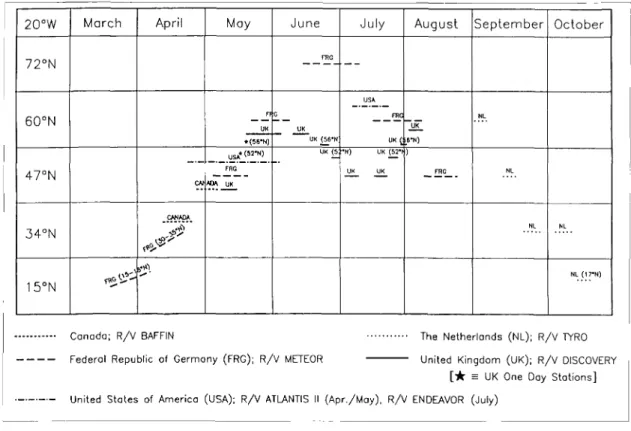
Fig. 2: Schedule of research cruises in the 1989 JGOFS North Atlantic" Bloom Study. Cruises and ovelflights will begin in March and continue through September. 1989, concentrating on biogeochemical processes at 33 °, 47 ° and 60°N latitude along 20°W. (Chart courtesy of Steve Piotrowicz, NOAA-AOML, Miami, FL).
critical depth at any given location will descend and the mixed layer will shoal. In some areas, depending on the depth of winter mixing and the size of the overwintering zooplankton stock, the bloom will be triggered by stratification and the rise of the mixed layer. In others, the descent of the critical depth below the mixed layer will cause the onset of a bloom (Colebrook, 1979).
Phytoplankton dynamics was thus intimately wedded to the physics of the upper ocean. Besides Gran's observations in the Bay of Fundy and Sverdrup's in the Norwegian Sea, critical depth theory has been used to examine bloom phenomena in the North Atlantic, including warm core rings (Bishop et al., 1986) and the subarctic Pacific, a region where the bloom is manifested as increased production without an increase in biomass (cf. Evans and Parslow, 1985). Yet while critical depth theory explains the timing and distribution of blooms rea- sonably well, especially in marginal seas, it has never been rigorously tested in the open ocean through coordinated measurements of optics, loss rates and other parameters.
Data on the space and time scales characteristic of phytoplankton blooms are scarce. It appears that blooms last ca. 10 days in upwelling and coastal areas and perhaps for weeks or months in some oceanic regions. Perhaps because of the simplified nature of the ocean in late winter compared to its physical and biological state in late spring or early summer, the factors governing the decline of phytoplankton blooms have proved to be much more difficult to
understand than the initial stages. Phytoplankton blooms signal the recovery of plankton ecosystems in temperate latitudes from the winter period of minimal biological activity. In most regions charac- terized by a deep mixing cycle, populations of graz- ers and bacteria are low in late winter, and nutrients levels are high. Thus blooms occur not only because phytoplankton are released from light limitation as the critical depth intersects the pycnocline, but be- cause losses to herbivores are low (Evans and Parslow, 1985). But grazers respond to increased supplies of food and rising temperatures, narrowing the gap between production and consumption. At the same time, primary production consumes the nitrate stock in the mixed layer leading to nutrient limitation and slowing growth rates. Nutrient limitation may also increase sinking rates for diatoms (Smayda, 1970;
Smetacek, 1985). At some stage in the evolution of these processes, losses surpass production and the phytoplankton stock declines.
These factors are well known, but their interaction and relative importance are not. It has seldom been determined unequivocally whether grazing, sinking or nutrient limitation was responsible for the decline of a given bloom, or if any one of these factors routinely supercedes the others in a given location.
For example, Radach (1984) was unable to state with certainty whether the bloom in the North Sea, studied ambitiously during the Fladenground Experiment (FLEX '76), declined because of increased grazing, sinking or nutrient limitation. Recent developments in ocean optics, sediment traps, trace-metal-free
6 O C E A N O G R A P H Y . A P R I L , 1989
measurements of primary production, high sensitiv- ity analyses of respiration, nutrient uptake, grazing, pigments, CO, and dissolved organic content (DOC), as well as powerful new modeling capabilities, have poised the oceanographic community for a new at- tack on these bloom problems.
Bloom Consequences and Significance in the Global Carbon Cycle
A series of important new observations, techno- logical innovations and modeling results form the scientific justification for a new, ambitious study of the spring bloom phenomenon. One aspect of the JGOFS program is a quantitative evaluation of the
"biological pump" of carbon dioxide on a basin-to- global scale. This term refers to the coupled proc- esses of biological fixation and transformation of CO_, in the upper ocean and the enrichment of CO, in the deep sea through decomposition of biogenic carbon formed in the surface: biological processes
"pump" carbon from the atmosphere to depth. The present oceanic uptake is estimated to be 2.5 billion tons per year--the same as the current atmospheric increase (Moore and Bolin, 1986). Some of the details of the pump components have been worked out over the past decade, and they highlight the importance of the seasonal repetition of blooms in the global carbon cycle.
An early scientific stimulus for a basin-scale bloom study came from studies of the vertical flux and deposition of particulate matter in the deep ocean. Time series deployments of deep (3000m) sediment traps at Bermuda (Deuser, 1986) and else- where have shown clearly that there is a seasonal cycle of particle flux exemplified by a springtime maximum following the surface bloom. Observa- tions from benthic camera systems show the sudden arrival of large (10-50 mm) aggregates of phytodetri- tus during late spring and early summer (Billett et al., 1983). This "flufF' appears to consist mainly of diatoms rather than fecal pellets, suggesting that the primary loss mechanism linking the decline of the bloom to the vertical flux at depth is sinking hastened by nutrient depletion. Models of particle composi- tion further point to the role of events like blooms as important sources of biogenic carbon in the deep sea (Watson and Whitfield, 1985). The overall implica- tion of these observations is that seasonal phyto- plankton blooms are important mechanisms for the fixation of atmospheric CO z and its transportation to depth. Blooms are a key component of the biological pump. The biogeochemical consequences of grazing versus sinking losses might be significantly differ- ent, and determining the relative importance of these major pathways requires further study.
The most dramatic evidence for the widespread occurrence and importance of the spring bloom is the archived imagery collected by the Coastal Zone Color Scanner (CZCS), which flew on Nimb,s-7 during 1979-86. CZCS imagery has already proved to be a powerful tool for studying the spring bloom (Brown et al., 1985). The North Atlantic spring
bloom is seen as one of the dominant seasonal signals in the global ocean (See front and back covers). In monthly composite CZCS images, the North Atlan- tic bloom is first seen off the southeastern US in February and evolves in a northeasterly direction, reaching the east basin by April. The conspicuous influence of the Gulf Stream and North Atlantic Current System in time and space was not anticipated but is currently stirring exciting debate. The most important early conclusion from the CZCS effort and the models is that the bloom is a basin-scale phe- nomenon that requires long-term international col- laboration to clarify the issues discussed here.
The JGOFS North Atlantic Bloom Experiment unites oceanographers from Canada, Great Britain, the Netherlands. Federal Republic of Germany, and the US (Fig. 2). French scientists will begin a com- plementary study of foodweb dynamics and carbon fluxes in oligotrophic, mesotrophic and eutrophic waters off West Africa at the same time. The experi- ment includes deep sediment trap deployments at 33 °, 47 ° and 60 ° N on 20 ° W longitude, an aircraft- borne remote sensing program, and a wide variety of individual and group scientific components on six different research vessels. These latter projects will provide in many cases new state-of-the-art measure- ments of biomass, nutrients, particulates, optics, radionuclides, trace metals, CO, and oxygen, dis- solved organic carbon and nitrogen, and an array of rate measurements, including primary and bacterial production, grazing, nutrient cycling and respiration.
An allied US program, the Marine Light-Mixed Layer experiment, will begin near the Ocean Weather Station (OWS) India site with a deployment of moored upper ocean sensors in April. The U.K. BOFS (Bio- geochemical Ocean Flux Study), and Dutch and German programs will continue in 1990.
These ambitious "'pilot" experiments are designed to set the stage for more fully basin scale JGOFS studies now being planned for the next decade. The advent of basin scale studies of the biogeochemical state of the ocean await collaboration with the World Ocean Circulation Experiment (WOCE), the Inter- national Geosphere-Biosphere Program (IGBP), and especially the successful orbiting of the next ocean color instrument (SeaWiFS) in 1991.
References
Billett, D.S.M,, R.S. Lampm, A.L. Rice, and R.F.C. Mantoura, I983: Seasonal sedimentation of phytoplankton to the deep-sea benthos. Nature. 302. 520-22.
Bishop, J.K.B., M.H. Conte, P.H. Wiebe, M.R. Roman and C.
Langdon, 1986: Particulate matter production and consumption deep mixed layers: observations in a warm core ring. Deep-Sea Res.. "3, 1813-1842.
Brown, O.B., R.H. Evans, J.W. Brown, H.R. Gordon. R.C. Smith.
and K.S. Baker, 1985: Phytoplankton blooming off the U.S. East Coast: a satelhte description. Science. 229, 163-
167.
Colebrook, JM., 1979: Continuous Plankton Records: Seasonal cycles ofphytoplankton and copepods in the North Atlantic Ocean and the North Sea. Mar. Biol., 51, 23-32.
[ PLEASE TURN TO PAGE 52 ]
T h e conspicuous influence of the Gulf Stream and North Atlantic Current System in time and space was not anticipated.
OCEA NOGRAPHY.APRIL- 198q 7
VICTOR HENSEN' S
PLANKTON EXPEDITION
B E F O R E Victor Hensen sailed on the new steamer National on July 15, 1889, from Kiel, German oceanographers had never been more than 100 miles from land. His "Plankton Expe- dition" had much in common with today's ma- jor oceanographic expeditions, in-
cluding the JGOFS Bloom Study. It sought to termine the distribu- tion of plankton organisms in the open sea away f r o m coastal and terrestrial influence, a subject re- kindled by modem satel- lite observa- tions and con- cerns about climate change and pollution.
Hensen justified his undertaking and sought finan- cial support for it b appealing to the nati ...
istic sentiments of Kaiser Friedrich
III, citing previous deep-sea observations un- dertaken by the USA, France, Sweden, Italy and notably Britain on the HMS Challenger. The JGOFS study has been motivated less by nation- alistic pride than by a recognition that interna- tional collaboration is required to address global problems, but national goals and concerns are as
important in the international scientific arena today as they were a century ago. Like many modem oceanographers, Hensen believed he was grossly underfunded.
Hensen was a leader of German oceanogra- phy, and "...will always be looked
n n n n a~ nne of the founders of
race of marine physi- / ' (Gran, 1912). He out to prove some- ng he already be- eyed deeply: that plankton were dis- tributed uniformly in the sea, except when disrupted by physical proc- esses. The Na- tional was 58 me- ters long, weighed 858 tons, and was equipped by Hensen with large antitative plankton of his own design.
hip also had refrig- electric lights and . . . hes. They occupied 278 stations (see Fig. 1 of the accompa- nying article) before returning in November with samples from 126 vertical plankton hauls from the upper ocean. Analyses of the samples and the problems arising from his defense of his ideas against Ernst Haeckel occupied Hensen and his colleagues, notabJy Karl Brant, Hans Lo- hmann, and Carl Apstein, for many years.
Note
This account is taken from the forthcoming history of biological oceanography in This Blood of the Sea, by Eric Mills of Dalhousie University. His book contains a long discussion of the controversy between Hensen and Haeckel. I am indebted to Mills and to Bemdt Zcitzschel for providing information and illustrations about Hensen and the Plankton Expedition.
- - Hugh Ducklow Drawing
From report by Kriimmel, 1892.
Reference
H.H. Gran, 1912: Pelagic Plant Life. In: Depths of the Ocean, J. Murray and J. Hjort, eds. MacMillan, 307-386.
8 OCEANOGRAPHY-APRIL- 1989
JOINT G L O B A L O C E A N
[ CONTINUED FROM PAGE 7 ]
Deuser, W.G., 1986: Seasonal and interannual vari- ations in deep-water particle fluxes in the Sar- gasso Sea and their relation to surface hydrog- raphy. Deep-Sea Research, 33, 225-246.
Evans, G.T. and ,I.S. Parslow, 1985: A mode[ of annual plankton cycles. Biol. Oceanogr.. 3, 327-347.
Gran, H.H. and T. Braarud, 1935: A quantitative study of the phytoplankton in the Bay of Fundy and the Gulf of Maine including obser- vations on the hydrography, chemistry and turbidity. J. Biol. Bd, Canada, 1,219-467.
Hensen, V.. 1887: Ueber die Bestimmung des Plank- tons oder des im Meere treibenden Materials an Pflanzen and Thieren. In: Fuenfter Bericht
der Kommission z. wiss. Untersuchg. d. dr.
Meere in Kiel f. d. Jahre 1882-1886, Berlin, 1-107 pp.
Krammel, O., 1892: Einige Ergebnisse der Expedi- tion. In: Reisebeschreibung der Plankton-Ex- pedition nebst Einleitung yon Dr. Hensen und Vorberichten von Drs Dalai, Apstein, Lo- hmann, Borgert, Schutt und Brandt. Kiel und Leipzig, 370 pp mit 100 Figuren im Text, sowie 5 Karten, 2 Tafeln und einer Photogra- vur, 18-46 p.
Menzel, D.W. And J.H. Ryther, 1960: The annual cycle of primary production in the Sargasso Sea off Bermuda. Deep-Sea Res., 6, 351-67.
Moore, Ill, B. and B. Bolin, 1986: The oceans, carbon dioxide and global change, Oceanus 29(4), 9- 15.
Radach, G., J. Berg, and B. Heinemann, 1984: On the relation of primary production to grazing
during the Fladen Ground Experiment, 1976.
In: Flows of energy and materials in Marine ecosystems, M.J.R. Fasham, Ed., Plenum, New York, 597-628.
Smayda, T.J., 1970: The suspension and sinking of phytoplankton in the sea. Oceanogr. Mar.
Biol. Annu. Rev.. 8, 353-414.
Smetacek, V., 1985: Role of sinking in diatom life history cycles: ecological, evolutionary, and geological significance, Mar. Biol. 84, 239- 251.
Sverdrup, H.U., 1953: On conditions of vernal bloom- ing of phytoplankton. J. Cons. Exp. Mer.. 18, 287-295
Walsh, J., 1988: On the nature of continental sheh'es.
Academic Press, New York, 520 pp.
Watson, A.J. and M. Whitfield, 1985: Composition of particles in the global ocean. Deep-Sea Res.
32, 1023-1039. CI
M A R I N E BIOLUMINESCENCE
[ CONTINUED FROM PAGE 38 ]
Stommel, H., 1979: Oceanic warming of western Europe, Proc. Natl. Acad Sci. USA, 76, No.6, 2518-2521.
Strass, V. and J. D. Woods, 1988: Horizontal and seasonal variation of density and chlorophyll profiles between the Azores and Greenland.
In: Towards a Theory of Biological-Physical Interactions in the Worm Ocean, ed. BJ.
Rothschild, D. Reidel, Dordrecht, The Neth- erlands, 113-136.
Swift, E., W.H. Biggeley, P.G. Verity, D.T. Brown 1983: Zooplankton are major sources of epipelagic bioluminescence in the southern Sargasso Sea. Bull. Mar. Sci. 33. 855-683.
Swift, E., C.R. Booth, J. Van Keuren, H.P. Bathcelder, C.P. Li, 1988: A moored instrument to meas-
BY-LAws
[ CONTINUED FROM PAGE 43 ]
4. A quorum for the transaction of business at an Annual Meeting shall be at least two percent of the members present who are eligible to vote on May 1 of that year, The affirmative vote of a majority of the memt)ers present who are ehgible to vote shall be required for the resolution of any question,
The Council may make other rules for meetings not inconsis- tent with the Articles of Incorporation or Bylaws. Business not set forth in the notice of the meeting shall not be transacted if three members eligible to vote object.
5 The Society may organize, sponsor, or co-sponsor such additional local, national, or international meetings as may be authorized by the Council.
6 The fiscal year of the Society shall conform to the calendar year.
ARTICLE XII. Publications.
The Society shall issue an official pubhcatlon and such additional journals, papers, books and the like as may be author- ized by the Council.
ARTICLE XIII. Amendments to the Bylaws.
t. No part of the Bylaws shall be amended or annulled except by mail ballot in the following manner: A proposed amendment shall be approved by the Council or submitted to the President m a petition signed by at least five percent of the members eligible to vote on the preceding May 1 The proposed amendment, with the reasons therefore, shall be pubhshed In the official publication of the Society at least ninety days belore ballots for the amend- ment are mailed.
2. Aproposed amendment, accompamed by a ballot, shall be mailed by the Executive Officer to each member ehglble to vote at least sixty days prior to the designated date the ballots are to be counted. The ballots to be counted must be received by the Executive Officer on or before the designated date for counting the ballots.
3. The adoption of a proposed amendment shall require the affirmative votes of at least two-thirds of all members voting. 1_1
ure stimulated and natural oceanic biolumi- nescence. Ocean Optics IX, ed. by M. Blizard.
Proc. Society of Photo-Optical Instrumenta- tion Engineers, 925, 76-96.
Swift, E., J.C. Dugas, P. Neidhardt, 1985a: Boilu- minescence in Icelandic waters. American Society of Limnology and Oceanography, 48th Annual Meeling Abstract.
Swift, E., E.J. Lessard, and W.H. Biggeley, 1985b:
Organisms associated with stimulated epipelagic bioluminescence in the Sargasso Sea and Gulf Stream. J. Plankton Res. 7, 831 - 848.
Tett, P.B., 1972: An annual cycle of flash induced luminescence in the euphausiid Thysanoessa raschii. Map'. Biol. 12, 207-218.
Williams, R. and D.V.P. Conway, 1981: Vertical distributions and seasonal abundance of Aglan- tha digitale (O.F. Muller) (Coelenterata: Tra-
ASSIMILATION OF OBSERVATIONS
[ CONTINUED FROM PAGE 50 ]
before the symposium starts. The extended abstracts of the papers (up to six pages) prepared according to the instructions to be distributed later should be submitted no later than December 15, 1989, to: The Sec- retary-General of WMO; Attention PTR;
World Meteorological Organization; 41, av. Giuseppe-Motta: Case postale No 5;
CH-1211 Geneva 20; with a copy sent to the chairman of the IPC: Dr. O. Talagrand;
Laboratoire de M6t6orologie Dynamique;
Ecole Normale Sup6rieure ; 24, rue Lho- mond; F-75231 Paris Cedex 05.
Participants will be notified of the ac- ceptance of their papers by the IPC before March 1, 1990. For further information concerning the symposium, please refer to the above mentioned two addresses. ZI
J. Labrousse, Research and Development Programme Department, World Meteorological Organization
chymedusae) and other planktonic coelenter- ates in the northeast Atlantic Ocean. J. Plank.
Res. 3. 633-643.
Williams, R. and C.C. Hopkins, 1974: Sampling at Ocean Weather Station INDIA (59°N 19°W) in 1974. Annls Biol. 31, 57-60.
Williams, R. and J.A. Lindley, 1982: Variability in abundance, vertical distribution and ontogen- eric migrations of Thysanoessa Iongicaudata (Cmstacea: Euphausiacea) in the north-east- em Atlantic Ocean. Mar. Biol. 09,321-330.
Woods, J., 1988: Mesoscale upwelling and primary production. In: Towards a Theory ~{f Biologi- cal-Physieal Interactions in the WoHd Ocean.
ed. B.J. Rothschild, D. Reidel, Dordrecht, The Netherlands, 7-38. Ul
The Bermuda Biological Station for Research, Inc. Announces Op- portunities for Research and Course- work in Blue-Water Oceanography and Subtropical Marine Science.
Financial aid is available for ex- ploratory research, summer courses and graduate thesis work. Facilities include a UNOL-supported vessel and a well-equipped laboratory wing.
1989 course topics include larval biology, zooplankton ecology, global environmental change, ecophysiol- ogy of corals, seagrasses and man- groves, hazard assessment and eco- logical statistics. For more informa- tion, contact:
Dr. Susan B. Cook, Assistant Director Bermuda Biological Station
for Research, Inc.
17 Biological Lane Ferry Reach GE 01
Bermuda Tel: 809-297-1880 FAX: 809-297-8143
52 OCEANOGRAPHY-APRIL* 1989