• 検索結果がありません。

from the perspective of one of the larvae. VIRTUAL REALITY IN OCEANOGRAPHY

N/A
N/A
Protected

Academic year: 2021

シェア "from the perspective of one of the larvae. VIRTUAL REALITY IN OCEANOGRAPHY"

Copied!
7
0
0

読み込み中.... (全文を見る)

全文

(1)

F E A T U R E

VIRTUAL REALITY IN OCEANOGRAPHY

• . . a virtual world

. .

provides ways of viewing the data from perspectives not possible in the real world.

By G.H. Wheless, A. Valle-Levinson and W. Sherman

A S HUMANS WE SEE and r e l a t e to the w o r l d around us in three dimensions, yet as scientists we usually attempt to understand our data by portray- ing it in visual form as a plot or a picture• These two-dimensional portrayals of inherently three-di- m e n s i o n a l processes are often difficult to under- stand in a total context due to the size of the data fields or the c o m p l e x i t y o f the system being por- trayed. "Virtual Reality" (VR) is a methodology by which h u m a n b e i n g s interface with m u l t i d i m e n - sional environments created from computer-based data. VR allows us to view and interact with three- dimensional data in a three-dimensional environ- ment and provides an actual sense of presence that can inherently change the way we analyze the data.

In short, an artificial t h r e e - d i m e n s i o n a l world is created based on a data set of interest which one is then able to enter, navigate through, and directly interact with. The data may be from recorded ob- servations, computer simulations, or from artisti- cally crafted models. The device providing an in- terface with the data m a y range from s i m p l e two-dimensional display systems like a workstation screen to more sophisticated user-immersive three- dimensional systems. In all cases, the data must be visualized in some fashion and the user should be able to manipulate or otherwise interact with the d i s p l a y e d imagery. The addition o f auditory and tactile feedback can be used to enhance the feeling o f presence, and give the user m o r e i n f o r m a t i o n about the (virtual) world.

The use of this new technology will have pro- found impacts on the way we view our data, how we develop our models, and how we interpret the results• Before you c l a s s i f y this statement as a heady, euphoric portrayal o f the p r o m i s e of new t e c h n o l o g y , c o n s i d e r the a d v a n c e s m a d e in sci- entific computing over the last decade• Computing p o w e r has d o u b l e d r o u g h l y every 1½ years, en- abling calculations once requiring massive compu- tational assets to be performed on a desktop work- station in an office. A n i m a t i o n and v o l u m e

G.H.Wheless and A. Valle-Levinson, The Center for Coastal Physical Oceanography, Old Dominion University, Norfolk, VA 23529, USA. W. Sherman, National Center for Supercomputing Applications. 405 N. Matthews Ave., Urbana, IL 61801 USA.

v i s u a l i z a t i o n of t h r e e - d i m e n s i o n a l data are now commonplace where two-dimensional scatter plots were once the norm. Improvements in display sys- tems tend to follow these computational advances, as evidenced by the proliferation of high-resolution flat-screen color monitors. Indeed, d e s k t o p - b a s e d stereographic systems which provide three-dimen- sional display of images are available now for about the same cost as a high-resolution monitor. As more users connect to the Internet and network transfer speeds increase to the Gigabit per second rate and faster, the distinction between telephone, computer, and television systems will be blurred and voice, data and video will be available via common lines.

Virtual worlds will be networked via the global In- ternet and linked with a hypertext-based language so that users will be able to interact with these envi- ronments. Current efforts to create a standardized method of interaction with these networked virtual worlds have culminated in the nascent Virtual Real- ity Modeling Language (VRML).

How can we use this technology to best advan- tage in oceanographic research? Perhaps the most attractive feature of using a virtual world as a data visualization aid is that it provides ways of viewing the data from perspectives not possible in the real world. For example, we could create a virtual envi- ronment consisting o f the multivariate results of a model of the small scale three-dimensional struc- ture of the first few meters of the ocean and posi- tion ourselves just beneath the surface to examine the effect of a parameter change on the processes responsible for momentum transfer from wind to waves. Or, we could see the effects of circulation on the modeled distribution of a larval fish swarm as it moved through the mouth of the Chesapeake Bay from the perspective of one of the larvae. Fi- nally, we could view time-dependent hydrographic observations as a three dimensional animated ob- ject and fly through the data to watch the properties

change with time from any vantage point•

The p u r p o s e of this a r t i c l e is twofold• F i r s t , w e ' l l explain some general concepts about VR and its use as an analysis and visualization tool. Next, w e ' l l put these concepts into the o c e a n o g r a p h i c context by discussing some of our recent work in utilizing VR to analyze and visualize observed and modeled salinity data from the Chesapeake Bay.

52 OCEANOGRAPHY°VoI. 8, NO. 2"1995

(2)

Virtual Reality in a Nutshell

By most accounts, the birth of virtual reality coincided with the beginnings of the digital age. A primitive system consisting of a h e a d - m o u n t e d display and hand-held control device developed in the 1960s by Ivan Sutherland was able to provide a user with the visual illusion of being in a world made up of computer-generated three-dimensional objects (Vickers, 1972; Fisher, 1990). Further de- velopment in the next decade was driven by in- creased military research funding as well as by the growth of the consumer electronic market. Most recently, advances in computational power and speed as well as in miniaturization of electronic devices have made possible high resolution, small size displays, and associated components. The ad- vent of efficient, inexpensive digital circuitry and the personal computer enabled fast, digital image generation and, soon after, virtual reality as a gen- eral scientific tool came into being. The entertain- ment industry now has a strong hand in the devel- opment of these immersive, interactive systems and will most likely continue to shape their future direction.

Although there are several types of VR systems presently in use, they all have in common the con- cept that the user may interface directly with com- puter-generated visualizations. Some VR systems portray the virtual world on a two-dimensional screen in a stereographic projection, requiring the user to view the display with stereographic glasses to get a three-dimensional effect; these types of displays are often called "desktop VR" or

"fishtank VR". In some instances, data from re- motely controlled sensors in the real world are projected into a virtual world to enhance o n e ' s ability to analyze the data or enable operations in a hostile or otherwise inaccessible environment.

This technique, called "augmented" or "mixed re- ality", is often used in medical applications com- bining miniature television cameras with small- scale invasive remote control surgical tools. The military uses this form of VR to simulate combat operations in any location or weather conditions, projecting computer generated hostile forces and real-time remotely sensed images into the wargaming database. The Department of Defense is actively working to connect military simulators of diverse nature and purpose into a large network called the Defense Simulation Internet.

Higher level systems immerse the user in the virtual world through the use of head-mounted dis- plays (HMDs), which show the computer-gener- ated objects on display screens mounted inside a helmet. The helmet is often free to move with the wearer, whose motion provides translation through the virtual world. In other cases these display screens are mounted on a tripod armature, as with Fakespace Labs' B O O M TM. The user peers into the BOOM and moves it like a periscope, though with greater mobility, to change the view o f the

scene. An example of such a higher level VR sys- tem is the Virtual Wind Tunnel (Bryson and Levitt, 1991). Located at N A S A Ames Research Center, the Virtual Wind Tunnel is a visualization system that displays computational fluid dynamics (CFD) data in a virtual environment and allows in- teractive manipulation of the displayed data with a glove input device• Scientists using an H M D or B O O M are able to walk through and around the three-dimensionally displayed CFD data as well as use the glove to directly manipulate visualization parameters such as particle release points. Other examples of this type of VR application include the University of North Carolina's Nanomanipula- tor, designed to view atomic surfaces (Taylor et al., 1993), and the Naval Postgraduate S c h o o l ' s ship walk-through system (Pratt et al., 1994)•

A n o t h e r approach to immersive display that gives an improved sense of being in a large space is the C A V E (CAVE Automatic Virtual Environ- ment). The CAVE, powered by a Silicon Graphics Onyx parallel-processor computer, is a virtual real- ity visualization system composed of high-resolu- tion projection screens arranged in a 10-foot cube with c o m p u t e r - g e n e r a t e d images projected on three walls and the floor. Developed by the Elec- tronic Visualization Laboratory (EVL) at the Uni- versity of Illinois at Chicago, the C A V E allows scientists to interact with virtual worlds created from observed data or simulations. A viewer wears a 6 d e g r e e - o f - f r e e d o m h e a d - m o u n t e d motion tracker and stereo-shutter glasses so that the cor- rect projections and perspectives of three-dimen- sional objects are presented as the viewer changes position inside the CAVE. A wand (essentially a computer mouse) held by the viewer allows inter- action with and navigation through the virtual en- vironment. Properly using the walls and the floor to display the data truly gives the viewer a sense o f being in and m o v i n g through a very large space. The inclusion of auditory input as sec- ondary cueing provides even more realism to the scene. The C A V E system was first put on public display at the S H O W C A S E exhibit during the an- nual SIGGRAPH computer graphics conference in 1992 (Cruz-Neira et al., 1992). The most recent C A V E exhibit included the presentation of over 40 reviewed VR applications during SIGGRAPH '94.

Consider the following not-so-fanciful scenario of a virtual Gulf Stream as an example of using a virtual world to increase our understanding of oceanographic processes. The results of a numeri- cal simulation of the Gulf Stream are displayed in a virtual environment as a visual, graphical object.

A researcher using a data glove "flies" toward the color contoured thermal front and hears a change in the pitch and volume of sound tied to tempera- ture or velocity. The researcher feels a force and a rise in temperature in the glove as contact is made with the Gulf Stream wall. Touching a button on the glove starts a simulated wind blowing on the

• . . t h e u s e r m a y i n t e r f a c e directly with c o m p u t e r - g e n e r a t e d v i s u a l i z a t i o n s .

OCEANOGRAPHY°VoI. 8, No, 2o1995 53

(3)

W h a t separates VR from other

visualization tech- niques is the ability to interact with and manipulate the d a t a . . .

sea surface, the results of which become immedi- ately apparent as the researcher is able to hear, see and feel the r e s p o n s e o f the G u l f Stream to this external forcing. W e ' l l discuss now the component pieces necessary to create such a virtual world.

How to Make a Virtual World

As with most c o m p u t e r graphics simulations, creation of a virtual world requires data as input and a computational simulation process. Visualiz- ing the results in a virtual environment further re- quires a graphical rendering routine. W h a t sepa- rates VR from other visualization techniques is the ability to interact with and manipulate the data, ac- complished via the interaction module. Finally, an output device is required to see the results.

The data can be observations or model results.

Model results have the advantage of fine temporal and spatial resolution but may suffer fi'om numeri- cally induced deficiencies in the portrayal of the p h y s i c s of the m o d e l e d p r o c e s s . O b s e r v a t i o n s often suffer from sparseness in coverage, both spa- tial and temporal, but have the advantage of being real data. A combination of modeled and observed datasets can be used simultaneously to enhance the feel of the virtual world or to create many graphi- cal objects.

The c o m p u t a t i o n a l s i m u l a t i o n p r o c e s s is the main program of the virtual reality application and controls the graphical creation of the virtual world by the rendering routine. It is in this main simula- tion p r o c e s s that the interaction m o d u l e r e s i d e s and is linked to the visualization process to coordi- nate the interactions between graphical objects in the virtual world and between those objects and the user. It also p o r t r a y s the virtual w o r l d on a time-iterated basis so that motion or action occurs in a seamless fashion.

The rendering or realization routine presents the output from the simulation process to the viewer in the form o f graphics, sound or tactile c u e i n g (force feedback). The data may be drawn as a se- ries of points, lines or polygons, the limiting factor being the graphics processing power available. Al- though most oceanographers tend to avoid graph- ics p r o g r a m m i n g like the p l a g u e (perhaps right- fully so!), an u n d e r s t a n d i n g o f basic c o m p u t e r graphics techniques is instructive. A large volume of work exists on the art of computer graphics; we urge interested readers to f a m i l i a r i z e t h e m s e l v e s with basic principles and techniques and r e c o m - mend Foley and Van D a m ' s work, Fundamentals of Interactive Computer Graphics (1982) or the excellent series, Graphics Gems: A Collection of Practical Techniques for the Computer Graphics Programmer (1994), p u b l i s h e d by A c a d e m i c Press. A sufficient amount of computational power is required to satisfactorily portray large datasets or complex scenes as the images need to be ren- dered at a sufficiently high-frame rate (usually 15 to 20 f r a m e s / s ) so that a n i m a t i o n is p r e s e n t e d

without flicker. Sound may be used either as an ef- f e c t which e n h a n c e s the r e a l i s m of the virtual world, similar to a sound track in a movie, or as an indicator which reflects the behavior of the sys- tem being m o d e l e d or observed. V i s u a l i z i n g the properties of complex dynamical systems by por- t r a y i n g these p r o p e r t i e s as s o u n d s in a v i r t u a l w o r l d may e n h a n c e our u n d e r s t a n d i n g o f how these systems operate. Finally, tactile cueing via f o r c e f e e d b a c k or t h e r m a l i n d i c a t i o n s in a d a t a glove could allow one to °'touch" or manipulate a virtual object.

I n t e r a c t i o n with the v i r t u a l w o r l d is a c c o m - p l i s h e d via s o m e user i n t e r f a c e tool, such as a mouse, joystick, wand, or voice activated process.

An i m p o r t a n t e l e m e n t o f this i n t e r a c t i o n is a means of tracking the position and orientation of a real world object in the virtual world. Software is often used to implement a virtual menu button or slider which can control some aspect of the virtual environment. The output d e v i c e is the c o m p u t e r screen, HMD, BOOM, or CAVE.

Using Virtual Reality in the Chesapeake Bay W e now present an example of a working VR application designed to explore observed and mod- eled salinity data from the C h e s a p e a k e Bay. Our project was developed for the C A V E as a collabo- rative effort among researchers from the Center for Coastal Physical Oceanography (CCPO) at Old Dominion University and the National Center for Supercomputing Applications (NCSA). Our moti- vation stemmed from a desire for a more complete understanding of how physical processes affect the c i r c u l a t i o n in the bay as well as how t h e y i n f l u e n c e the s h e l f - t o - b a y t r a n s p o r t o f shelf- spawning, estuarine dependent biological species such as the blue crab (Callinectes sapidus).

The Chesapeake Bay, the largest estuary in the United States, serves as nursery grounds or spawn- ing areas for m a n y c o m m e r c i a l l y i m p o r t a n t species and is home to an extensive fisheries in- dustry. The larval stages of shelf-spawning, estua- rine species are usually widely distributed over all three spatial dimensions as well as temporally. Bi- ological behavior such as motile ability, buoyancy characteristics, and affinity for light or water mass characteristics all contribute to the location of the larvae on fairly small spatial scales. Equally im- portant, yet operating on larger scales, is the ad- vection of the larvae due to the local circulation.

The complex circulation features in the estuary it- self and in the bay mouth/shelf region are due to physical processes such as wind forcing, tidal mix- ing and runoff variability, all operating over wide time and space scales.

The e s t u a r i n e c i r c u l a t i o n in the C h e s a p e a k e Bay is usually described as consisting of relatively fresh water near the surface flowing seaward atop more saline near-bottom water flowing in the op- posite direction. The salinity field is controlled pri-

54 OCEANOGRAPHY'VoI. 8. NO. 2°1995

(4)

3g .5

3g .0

3&.5

,38.0

37.E

,fiT.C

--77.0 --76.8 --76.6 --78.4- --76. .7 --7B.O - 7 5 . 8 --75.6 LDN

4.00

0.130

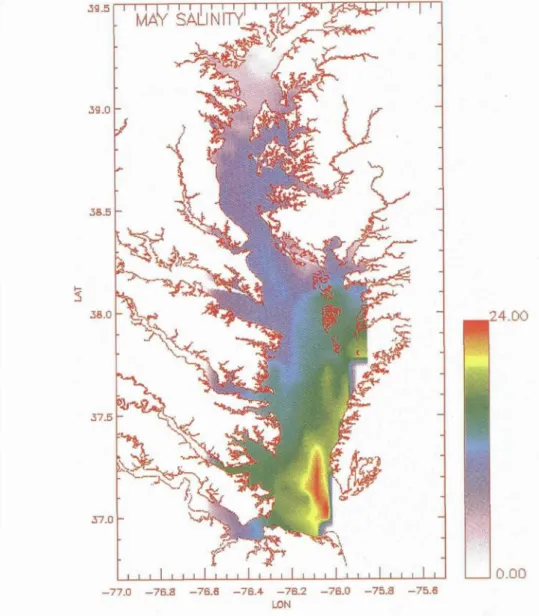
Fig. 2: Composite surface salinity for the month in the Cheasapeake Bay. This is a month with ap- preciable fresh water influence in the lower portions of the Bay. Coriolis effects deflect high (low) salin-

ity toward the eastern (western) shore of the Bay.

Visualizing our Chesapeake Bay data in a virtual environment provided a view normally unobtainable in the physical world.

River and observed the salinity isosurfaces (Fig. 4) while we discussed the concepts of estuarine circu- lation and rotationally controlled flow. The trip ended with a quick ascent followed by a hover and an explanation of the bay's seasonal salinity cycle, demonstrated by the animated salinity fields.

The implications of using virtual reality for the visualization of scientific data, both real and simu- lated, are clear. Visualizing our Chesapeake Bay data in a virtual environment provided a view nor- mally unobtainable in the physical world. Aspects of the data not clearly recognizable with static two- or three-dimensional images became immediately apparent simply because of our ability to navigate intuitively through the virtual environment and ex- amine features of the data from different positions.

The complex relief of the Bay bathymetry and asso- ciated topographical effects on the salinity distribu- tions in the Bay were obvious, confirming the pres-

ence of low salinity water over shoals and higher salinity water in the channels. A seasonal cycle of the salinity field at all depths was obvious as well.

It is well known that the shallowness and boundary dominated nature of the bay should make the circulation especially sensitive to wind forcing effects, yet exactly how this is effected is not presently clear. Wind-forced simulations of the circulation in the bay should clearly show an in- crease or decrease in the estuary/shelf volume ex- change based upon wind direction; examining these results in a virtual environment should make clear the exact progression of this process. To this end, we have ported the results from a three-di- mensional hydrodynamic circulation model of the Chesapeake Bay and adjoining shelf to our virtual Bay environment and continue to examine circula- tion dynamics arising from wind stress, tidal forc- ing, runoff/precipitation and solar in'adiance. We

56 OCEANOGRAPHY°Vo1. 8, No. 2"1995

(5)

marily by freshwater runoff, the majority of which comes from the Susquehanna River with addi- tional input from the Potomac, James, and other sources. The most buoyant water is usually found along the western side of the bay mainly as a re- sult of rotational influences. The mean flow in the estuary mouth and adjacent shelf is also rotation- ally affected and modified by bathymetry. The flow pattern consists of buoyant water outflowing along the southern reaches of the bay entrance and over the shoals whereas inflow of dense, saline shelf water is found in the bathymetric depressions or channels (Boicourt, 1981; Valle-Levinson and Lwiza, unpublished data) (Fig. 1). The outflowing buoyant water usually exhibits an initial anticy- clonic turn (to the right in the northern hemi- sphere) after exiting the mouth, becoming a right- bounded coastal plume and coastal current system (Boicourt, 1973). Seaward of the buoyant outflow area is an area of intense mixing as the fresh outflow merges with the more saline shelf water.

Our CAVE application consisted of a three-di- mensional graphical representation of a Chesa- peake Bay bathymetry data set textured and col- ored according to depth, upon which were overlaid transparent isosurfaces derived from monthly com- posites of Chesapeake Bay surface salinity obser- vations. Bathymetry resolution was 1 rain of lati- tude by 1 min of longitude and had some vertical exaggeration to highlight the relief. The monthly composites were generated from a data set that in- cludes records between 1949 and 1980. An exam- ple may be seen in Figure 2. The dependence of

salinity with depth was not always available from the data set and was prescribed analytically as in Hansen and Rattray (1965). The salinity isosur- faces were then animated to show seasonal changes of the regional salinity.

This virtual Chesapeake Bay environment was publicly presented in the VROOM (Virtual Reality Room) at the 1994 SIGGRAPH conference in Or- lando, FL. Over the week-long conference, there were 43 such applications presented to groups of five viewers at a time. The viewers wore stereo- graphic glasses to provide the three-dimensional ef- fects of the CAVE projections while a position tracker assured that the data were displayed with proper perspective. Among the other applications were projects dealing with air traffic control, tur- bulence in flow over a flat plate and the development of tornadoes along gust fronts (see NCSA's AC- CESS magazine, Vol. (8)-2 for a complete list of projects). Our 5-min presentation for each group began with a south-to-north descent from 100,000 feet and 40 km south of the bay mouth to a point just above the air-sea interface. We flew north, pointing out landmarks, geography and the three- dimensional virtual "signs" identifying the James and Potomac Rivers (Fig. 3). As we neared sea level, the sounds changed from sea gulls to that of crashing surf. Continuing the descent underwater, we crossed the air-water interface with an audible splash and hovered just under the translucent sur- face as the viewers were shown the main shipping channels and the abrupt topographic variations. We then flew to a point near the mouth of the Potomac

O u r CAVE

application consisted of a

three-dimensional graphical

representation of a Chesapeake Bay bathymetry data set . . .

- 5

- 1 0

- 1 5

- 2 0

- 2 5

25.00

- 2 5 . 0 0

5 10 15 20 25 30

D i s t a n c e F r o m Little Creek (km)

Fig. 1: Mean flow (cm/s) during the period of October 6-7, 1993. Positive--red (negative--blue) values indicate flow into (out of) the estuary. Contour interval is 5 cm/s. Looking into the estuary, Norfolk, VA is on the left and the eastern shore is on the right. Notice that outflows are found over shoals, and inflows appear affected by Coriolis acceleration over the channels.

OCEANOGRAPHY'VoI. 8, No. 2-1995 55

(6)

%

.". :"

. - • .

Fig. 3: View of the virtual Chesapeake Bay. The obeserver is located just off the mouth of the Potomac River looking northward.

have used the publicly available Princeton Ocean Model (Blumberg and Mellor, 1981) as the com- putational cornerstone o f this current effort be- cause of its embedded 2.5 level turbulence closure

scheme and its ability to reproduce accurately tidal forcing. In addition to simple process studies, we are exploring more complex scenarios using this model and immersive visualization techniques.

/ ~ i ~;i~)i!i & ¸ ~i~ i ~

Fig. 4: A view from the main channel of the virtual Chesapeake Bay looking north. Above the viewer is an isosurface with salinity of 17.

OCEANOGRAf'HY,VoI. 8, No. 2ol995 57

(7)

T o our k n o w l e d g e , o u r C A V E application is o n e o f o n l y a few a p p l i c a t i o n s o f v i r t u a l reality in t h e field o f o c e a n o g r a p h y . A n o t h e r o c e a n o g r a p h i c V R a p p l i c a t i o n d i s p l a y e d in t h e C A V E d u r i n g S1G- G R A P H ' 9 4 was the " J A S O N Interactive M a p p e r " , w h i c h re-enacted a visit to h y d r o t h e r m a l vents in the G u a y m a s B a s i n in the G u l f o f C a l i f o r n i a ( F e l d m a n et al., 1994). S c i e n t i s t s at the N a v a l P o s t g r a d u a t e S c h o o l h a v e a l s o u s e d this t e c h n o l o g y to e x p l o r e M o n t e r e y Bay with an u n d e r w a t e r a u t o n o m o u s vehi- cle ( U A V ) ( B r u t z m a n et al., 1994). The o n g o i n g de- v e l o p m e n t o f a suite o f u s e r - f r i e n d l y V R tools will m a k e this t e c h n o l o g y a v a i l a b l e soon to the o c e a n o - g r a p h i c c o m m u n i t y at large. It will b e up to us to e l n p l o y t h i s e x c i t i n g v i s u a l i z a t i o n a n d a n a l y s i s m e t h o d to e n h a n c e our k n o w l e d g e o f the ocean.

If you h a v e a c c e s s to an I n t e r n e t b r o w s e r s u c h as M o s a i c , n a v i g a t e to the U R L

h t t p : //www. ccpo. odu. e d u / v r . h t m l a n d l o o k at o u r d o c u m e n t VIRTUAL REALITY IN OCEANOGRAPHY for m o r e i n f o r m a t i o n . A d d i t i o n a l i n f o r m a t i o n a b o u t the C A V E m a y b e f o u n d at h t t p : / / w w w . n c s a . u i u c . e d u / E V L / d o c s / h t m l / C A V E , h t m l

A c k n o w l e d g m e n t s

W e gratefully a c k n o w l e d g e the c o m p u t e r g r a p h - ics p r o g r a m m i n g e x p e r t i s e o f C h r i s H a r t m a n , U n i - versity of Illinois, w i t h o u t which our C A V E applica- tion would never h a v e been successful. A p p r e c i a t k m is also expressed to Larry Smart', Director o f N C S A , for c o n t i n u i n g support o f this project. W e also t h a n k C a t h y L a s c a r a , C C P O , for s u g g e s t i o n s to i m p r o v e this article, and Eileen H o f i n a n n , also at C C P O , for serendipitous i n v o l v e m e n t .

References

Boicourt, W., 1973: The circulation of water on the continental sheff from Chesapeake Bay to Cape Hatteras. Ph.D. the-

sis. Johns Hopkins University, Bahimore. MD. 183 pp.

. 1981: Circulatkm in the Chesapeake Bay entrance region: estuary-shelf interaction. In: Chesapeake Bay Plume Study." Stqwljtux 1980. J. Campbell and J.

Thomas. eds. NASA Conference Publication 2188.

61 78.

Blumberg, A. and G. Mellor, 1981: A nmnerical calculation of the circulation in the Gulf of Mexico. Rep. 66, Dynaly- sis of Princeton, Princeton. N J, 153 pp.

Brutzman. D.. M.J. Zyda, M. Macedonia and R. Luck, 1994: A virtual world for an autonomous underwater vehicle. In:

Visual Proceedings, Association for Computing Ma- chinery (ACM) Special lnterest Group on Computer Graphics (SIGGRAPH)94. Orhmdo, Florida, July 24 29, 1994. pp. 204-205.

Brysom S. and C, Levitt, 1991: The Virtual Windtunne[: an en- vironment for the exploration of three-dimensional un- steady flows. In: Visualization '91, 17-24.

Cruz-Neira, C., D. Sandin, T. DeFanti. R. Kenyon and J. Hart.

1992: The CAVE: audio visual experience automatic virtual environment. Communications ~/" l]w ACM, 35, 65-72.

Feldman, G.. R. Haleblian. A. Mallei. M. Marra, C.

Molyneaux. D. Pape and K. Stewart, 1994: JASON in- teractive mapper. In: Visual Proceedings, Association for Computing Machinery (ACM) Special lnterest Group on Computer Graphics (S1GGRAPH)94. Or- lando, Florida. July 24-29, 1994. pp. 256.

Fisher, S.S., 1990: Virtual interface environments. In: The Art o[" Humau-Conq~uter lnte@ce Design, Brenda Laurel.

ed. Addison-Wesley Publishing.

Hansen, D.V. and M. Rattray, Jr., 1965: Gravitational circula- tion in straits and estuaries. J. Marine Res., 23,

104 122.

Pratt, D.R., M.J. Zyda and K.M, Kelleher, 1994:1994 Annual Report ~.~r the NPSNET Research Group, Naval Post- graduate School, Monterey CA.

Taylor II. R.M., W. Robinett, V.L. Chi. F.P. Brooks, W.V.

Wright, R.S. Williams and E.J. Snyder. 1993: The Nauomanipulator: a virtual reality interface for a scan- ning tunneling microscope. In: Computer Graphics (SIGGRAPH93 Proceedings), vol. 27. J.T. K~jiya, ed.

pp. 127 134.

Vickers. D.L., 1972: Sorcerer's apprentice: head-mounted display and wand. In: A Sympositm~ on Visuall3 Cou- pled S3stems: Development and Al)plicalion. Techni- cal Report. J.A. Birt and H.L. Task, eds. AMD TR 73-I.

58 OCEANOGRAPIIY°VoI. 8, No. 2"1995

Fig.  2:  Composite  surface  salinity for  the  month  in  the  Cheasapeake  Bay.  This  is  a  month  with  ap-  preciable fresh  water influence  in  the  lower portions  of the Bay
Fig.  1:  Mean flow  (cm/s)  during  the period  of October  6-7,  1993.  Positive--red  (negative--blue)  values  indicate flow  into  (out of)  the  estuary
Fig.  4:  A  view from  the  main  channel  of the  virtual  Chesapeake  Bay  looking  north

参照

関連したドキュメント

The idea is that this series can now be used to define the exponential of large classes of mathematical objects: complex numbers, matrices, power series, operators?. For the

In light of his work extending Watson’s proof [85] of Ramanujan’s fifth order mock theta function identities [4] [5] [6], George eventually considered q- Appell series... I found

The Goal of Hodge theaters: Roughly speaking, Hodge theater (at least, the ´ etale part) is a virtual “GMS” for an arbitrary elliptic curve over a number field which manages.. Θ

Here we continue this line of research and study a quasistatic frictionless contact problem for an electro-viscoelastic material, in the framework of the MTCM, when the foundation

We present sufficient conditions for the existence of solutions to Neu- mann and periodic boundary-value problems for some class of quasilinear ordinary differential equations.. We

modular proof of soundness using U-simulations.. & RIMS, Kyoto U.). Equivalence

It turns out that the symbol which is defined in a probabilistic way coincides with the analytic (in the sense of pseudo-differential operators) symbol for the class of Feller

Then it follows immediately from a suitable version of “Hensel’s Lemma” [cf., e.g., the argument of [4], Lemma 2.1] that S may be obtained, as the notation suggests, as the m A