Tomomi Sugiyama, PhD, PEng BASF Japan Ltd.
2722 Hagisono Chigasaki-shi Kanagawa 253 0071
Japan
Email:[email protected] Tel: +81-70-2812-1080
EXPERIMENTAL STUDY ON ROLE OF C-S-H NANOPARTICLE ACCELERATOR IN HARDENING CEMENTITIOUS COMPOSITE
Tomomi Sugiyama1and Takeshi Iyoda2
1BASF Japan Ltd., [email protected]
2Professor, Shibaura Institute of Technology, [email protected]
ABSTRACT
C-S-H nanoparticles accelerator has been developed as new hardening accelerator technology. C-S-H nanoparticle works as a seed of crystal growth in cement hydration process.
As the result of this seeding, it is said that hardening process can be accelerated, and hardened microstructure can be dense.
In this study, following experiments were conducted to understand role of nanoparticles, i) impact of nanoparticles concentration in concrete liquid phase on strength development and air penetration. ii) porosity and air permeability variation by changing coarse aggregate volume and nanoparticle dosage.
iii) air permeability by vertical and horizontal direction with and without nanoparticles.
According to results of above experiments, role of C-S-H nanoparticle were considered as following.
1) Distance of particle was a key to make the particles work for enhancing strength. 2) Nanoparticle could make microstructure dense to improve air/water permeability although if there is no impact on strength development. 3) Internal Transition Zone was also filled by crystalline which grew on C-S-H nanoparticle seed.
As a conclusion, it was validated that concrete microstructure could make finer by adding C-S-H nanoparticles as a nucleus of crystallization not only for enhancing strength development but also for inhibiting material permeability from early hydration stage.
Keywords: C-S-H nanoparticle, hardening accelerator, air permeability, water permeability, transition zone,
1. INTRODUCTION
Recently, reduction of number skilled labors as well as labors itself is becoming a serious issue construction field due to reduction and aging of population. And also utilization of various bi-product or recycle materials are focused for reducing environmental load as global mega trend. As countermeasures of these issues, producibility improvement is strongly required in concrete construction, and new technologies or materials which can construct concrete faster and easier are proposed as solutions to improve concrete producibility.
On the other hand, new technology hardening accelerator based on Calcium Silicate Hydrate (C-S-H) nanoparticle has been developed. It has been explained that C-S-H nanoparticles work as nuclear of crystallization in cement hydration process, then setting and strength development in early age are enhanced by this nucleation of new accelerator. According to this nature, this hardening acceleration can contribute producibility improvement of concrete construction by shorten concrete casting and curing period [1].
And as second role of nanoparticles in hardened concrete, it is expected that adding nanoparticle can make concrete microstructure dense by filling spaces by nanoparticles [2]. In this study, influence of C-S-H nanoparticles on material permeability was investigated to understand a role of C-S-H nanoparticles in hardened cement composite.
2. EXPERIMENT
In this study, 3 phases of experiments were conducted to understand roles of C-S-H nanoparticles in hardened cement composite, as below.
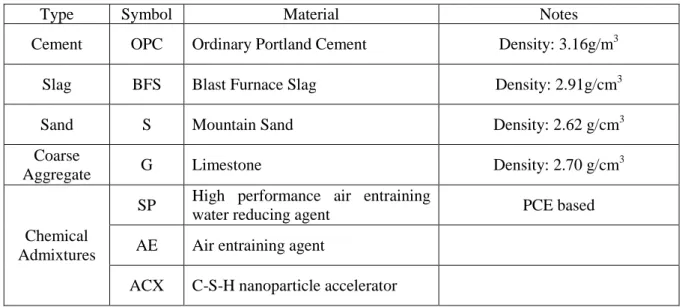
Phase 1: Influence on strength development and air permeability of concrete by C-S-H nanoparticles Phase 2: Influence on microstructure and air permeability of concrete by C-S-H nanoparticles Phase 3: Influence on anisotropy of air permeability of concrete by C-S-H nanoparticles For all phases of experiments, materials described in Table 1 were used.
Table 1. Materials
Type Symbol Material Notes
Cement OPC Ordinary Portland Cement Density: 3.16g/m3
Slag BFS Blast Furnace Slag Density: 2.91g/cm3
Sand S Mountain Sand Density: 2.62 g/cm3
Coarse
Aggregate G Limestone Density: 2.70 g/cm3
Chemical Admixtures
SP High performance air entraining
water reducing agent PCE based
AE Air entraining agent
ACX C-S-H nanoparticle accelerator
2.1. Phase 1: Influence on strength development and air permeability of concrete by C-S-H nano-particles
In order to understand an influence of ACX on concrete physical properties, compressive strength and air permeability was evaluated with different water to cement ratio and ACX dosage.
2.1.1. Mix proportions and fresh concrete properties.
Mix proportions and their fresh concrete properties were shown in Table 2.
Table 2. Mix proportions and fresh concrete properties for phase 1
2.1.2. Testing procedure i) Compressive strength
100mm x 200mm cylindrical specimens were used. Compressive strength was measured in 1day, 3days, 7days and 28days, according to JIS A 1108. Concrete was cured in a mould in 1day, then it was demoulded and measured compressive strength for 1day. All specimens were cured in 20degC water after demoulding for strength measurement in other ages.
ii) Air permeability
Air permeability test was conducted in order to evaluate mass transfer resistance of concrete. 2 specimens with 100mm x 50mm were prepared for one test condition. Concrete specimens were cured in 20˚ C, 60 % RH with sealed until 28days. Before testing, specimens were dried in 40 ˚ C oven, in order to avoid evaporating bound water in hydrates.
Pressurized air with 0.2N/cm2 as constant pressure was applied to each specimen, and permeated air was measured by water displacement method.
Air permeability coefficient was calculated by Eq. (1).
𝐾 = 2𝑃𝐿1 (𝑃12− 𝑝22)
𝑄
𝐴 (1)
Where K is air permeability coefficient (cm4N・s), L1 is specimen thickness (cm), P1 is loaded pressure (0.2 N/cm2), P2 is back pressure (0.1 N/cm2), Q is permeated air volume (cm3/s) and A is permeating area (cm2)
2.2 Phase 2: Influence on Microstructure and air permeability of concrete by C-S-H nano- particles
In order to study an influence of ACX on microstructure of cementitious composite, total pore volume and air permeability were evaluated by concrete with different s/a. Especially, impact on transition zone was focused in this study.
W OPC BFS S G kg/m3
% by cement
weight
% by water
weight SP AE Slump
(cm) Air content
(%)
C-T (degC)
- - - 0.40 0.0045 13.0 4.0 20.8
17.0 4.0 10.0 0.30 0.0025 10.5 4.5 22.5
- - - 0.40 0.0035 19.5 3.9 20.8
11.4 4.0 6.7 0.30 0.0045 18.0 3.6 21.1
17.0 6.0 10.0 0.30 0.0050 20.0 3.5 21.3
170
213 213 743 975
142 142 870 971 40
60 44
48
Unit weight (kg/m3) ACX Dosage Admixtures dosage
(% by cement weight) Fresh concrete properties W/C s/a
2.2.1 Mix proportions
Mix proportion was shown table 3. Mix proportion of mortar part was fixed as identical, and coarse aggregate volume was changed according to targeted s/a. As reference, mortar which didn’t have coarse aggregate was also prepared.
Table 3. Mix Proportions for phase 2
2.2.2 Testing procedures i) Total pore volume.
Total pore volume was measured according to Archimedes method. Specimens were dried by 40 ˚ C until achieve to constant weight, as absolute dry weight. Specimens were situated by water with vacuum, then water situated weight and underwater weight were measured for total pore volume calculation.
ii) Air permeability. (See 2.1.2 ii) )
2.3 Phase 3: Influence on anisotropy of air permeability of concrete by C-S-H nanoparticles In order to investigate influence of ACX on transition zone, anisotropy of are permeability was evaluated.
2.3.1 Mix proportion
Mix proportion was shown in Table 4
Table 4. Mix proportion for Phase 3
2.3.2 Testing procedure i) Air permeability anisotropy
150mm cube specimens were prepared, and 100mm x 50mm specimen was cored out by two direction as parallel and orthogonal against concrete casting direction, as shown in Figure 1
W OPC S G kg/m3
% by cement
weight
% by water weight
- - -
8.5 3.0 5.0
- - -
10.0 3.0 5.0
912 976 60 48
170 200 333
283 874 817 W/C s/a
Unit weight (kg/m3) ACX Dosage
W OPC S G kg/m3
% by cement
weight
% by water weight
- - -
26.9 5.0 10.0
53.8 10.0 20.0
80.7 15.0 30.0
- - -
17.0 4.5 8.9
34.0 8.9 17.9
51.0 13.4 26.8
- - -
17.0 5.0 10.0
34.0 10.0 20.0
51.0 15.0 30.0
- - -
17.0 5.7 11.3
34.0 8.9 17.9
51.0 17.0 34.0
50%-40 40 150 300 752 1141
50%-48 48 170 340 852 951
Symbol
50%-100
50%
mortar
(100) 269 540
50%-56 56 190 380
1349 -
951 761 W/C s/a
Unit weight (kg/m3) ACX Dosage
Air permeability test was followed a method described in 2.1.2. ii).
Figure 1. Specimen preparation for air permeability anisotropy
3. RESULTS AND DISCUSSIONS
3.1. Phase 1: Influence on strength development and air permeability of concrete by C-S-H nanoparticles
3.1.1 Compressive strength
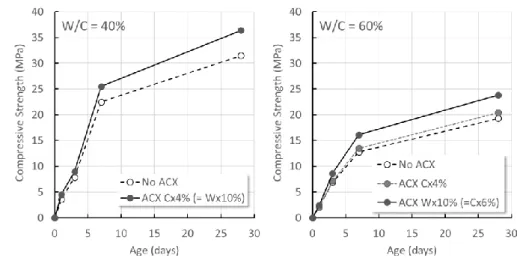
Compressive strength results were show in Figure 2.
Figure 2. Compressive strength
In W/C=40%, compressive strength was improved by dosing ACX with 4% by cement weight. On the other hand, there was almost no improvement in W/C=60% by dosing ACX with the same ratio by cement weight. However, in case that ACX was dosed with same ratio by water weight (10% by water weight) in W/C=60%, compressive strength was improved as similar to W/C=40%.
3.1.2 Air permeability
Air permeability result at 28 days was shown in Figure 3.
In W/C=40%, there was no obvious air permeability improvement by dosing ACX although there was certain improvement in strength development. In contrast with this, definite air permeability improvement was observed in W/C=60% even in dosage of Cx4% (11.4kg/m3) which did not affect strength improvement.
And when ACX added with the same ratio by water weight of W/C40% (Wx10%), air permeability of W/C=60% concrete was achieved to almost similar level of W/C=40% concrete.
Figure 3. Air permeability
According to these two results, it was suggested that ACX worked depending on concentration in liquid phase. And influence of ACX as nanoparticles for improving air permeability was much bigger in high water to cement concrete than lower one.
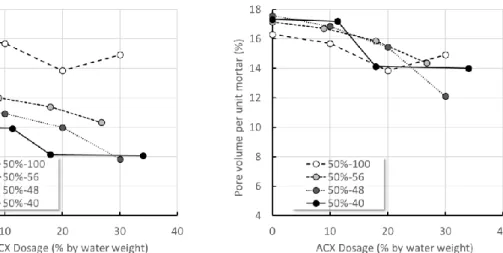
Figure 4. Total pore volume Figure 5. Pore volume per unit mortar volume
3.2. Phase 2: Influence on Microstructure and air permeability of concrete by C-S-H nanoparticles
3.2.1 Pore volume
Total pore volume result was shown in Figure 4. Total pore volume of mortar showed the highest value compare to other concrete one. Since pore structure should exist in mortal phase of concrete, this difference is expected to be related to mortar volume in concrete. In order to cancel this dependency, total pore volume was standardized by unit mortar volume as shown in Figure 5.
In Figure 5, pore volume per unit mortar volume of concrete showed higher value than that of mortar (50%-100). It was assumed that this pore volume gap between concrete and mortar was due to transition zone. By increasing ACX dosage, pore volume was tended to be reduced and achieved to similar pore volume ration in any cases.
3.2.2 Air permeability
Air permeability result with various s/a concrete conditions was shown in Figure 6.
Figure 6. Air permeability
Air permeability coefficient of concrete without ACX was 2.5~3 times higher than that of mortar.
Then the coefficient of concrete was reduced steeply by dosing ACX although there was no obvious change in the coefficient of mortar. Air permeability coefficient of concrete became similar level of that of mortar, finally.
It was indicated that transition zone as coarse structure area was disappeared by influence of ACX as nanoparticles.
To understand mechanism of air permeability improvement, relationship between pore volume per unit mortal and air permeability was described in Figure 7.
Figure 7. Relationship between pore volume and air permeability
In lower ACX dosage of concrete, remarkable air permeability coefficient improvement was observed despite less pore volume reduction. In case of pore volume per unit mortar was less than 16%, the relationship behaved as similar to mortar.
It was indicated based on these results that ACX affected transition zone much effectively to reduce air permeability with small dosage. Estimated reasons of this phenomenon were 1) bleeding reduction effect which has been reported in previous paper as a nature of accelerator containing C-S-H nanoparticles [3], and 2) filling coarser structure area by nanoparticles and hydrates which grow up from the particles.
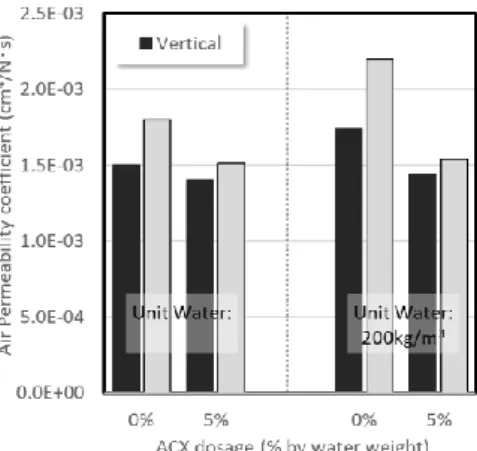
3.3. Phase 3: Influence on anisotropy of air permeability of concrete by C-S-H nano-particles Anisotropy of air permeability was investigated as shown in Figure 8.
Figure 8. Air permeability of vertical and horizontal directions
In no ACX addition, higher unit water concrete showed higher air permeability, and also difference between vertical and horizontal direction was bigger in high unit water concrete. It was suggested that high unit water concrete had much transition zone under coarse aggregate by internal bleeding.
By dosing ACX, air permeability resistant was improved in any cases, and gap between vertical and horizontal was also become smaller in both conditions.
And remarkably, air permeability coefficient of 200kg/m3 unit water concrete with 5% by water weight of ACX exhibits most likely the same of 170kg/m3.
Bleeding test result of 200kg/m3 unit water concrete was shown in Figure 9.
Figure 9. Bleeding of concrete with 200kg/m3 of unit water
As one of the reasons of air permeability coefficient improvement, bleeding reducing effect of ACX was considered. According to Figure 9., however, around 0.20 cm3/cm2 of bleeding (70% of no ACX concrete) was still remained in 5% ACX concrete, although bleeding was reduced by dosing ACX.
It was indicated air permeability improvement was achieved by not only bleeding reduction but also another factor as filling transition zone by nanoparticles.
3.4. Discussion on estimated role of C-S-H nanoparticles in hardened cement composite.
According to above results, it could be understood how C-S-H nanoparticles worked for improving strength development as well as mass transfer resistance of concrete.
To explain rales of C-S-H nanoparticles, following model would be proposed.
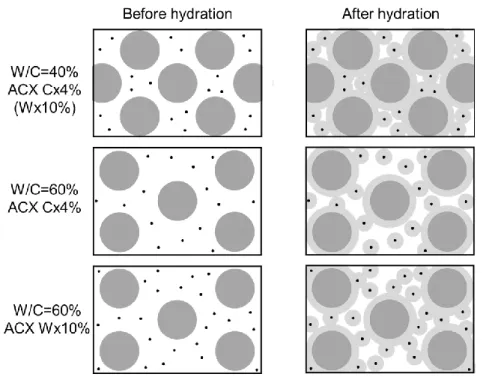
Schematic illustrations of proposed model were shown in Figure 10 and 11.
As general understanding at first, average distance between cement particles of W/C=60% with no ACX is longer than 40%. After cement hydrated from these status, microstructure of hardened cement is created by filling spaces between particles by hydrates which grow up from cement particle
surfaces. Therefore, coarseness of microstructure is depending on a distance between particles. And longer particle distance with higher W/C leads coarser microstructure after hydration. (Figure 10)
Figure 10. Schematic image of cement hydration without C-S-H nanoparticles
In case of dosing ACX, it is considered that average distance between ACX nanoparticles depends on concentration of nanoparticles in liquid phase. Since ACX concentration in liquid phase is the same meaning of ACX dosage against water weigh in concrete, it is expected that average particle distance in the same dosage against water weight is conctant despite of water to cement ratio of concrete.
(Figure 11)
Figure 11. Schematic image of cement hydration with C-S-H nanoparticles
Based on this consideration, it can be discussed that roles of ACX nanoparticles are categorized as ACX contributes on i); strength development enhancement, ii); material permeability improvement although there is almost no contribution on strength development and iii) strength development as well as material permeability improvement.
i); Nanoparticle contributes on strength development, as W/C=40% with ACX Cx4% in this study.
In case of W/C=40%, cement particle distance is relatively close before adding ACX, already. Then, if ACX is added in this matrix, ACX may exist in narrow area between cement particles and hydrates on surfaces of cement and ACX particles connect well each other.
However, since microstructure before ACX added is dense enough already for material permeability resistance, impact of ACX on improving material permeability is not observed so obviously.
ii); Nanoparticles contributes on material permeability reduction although there is no strength development improvement, as W/C=60% with ACX Cx4% in this study.
In case of W/C=60%, cement particle distance is so far away that hydrates are not connected sufficiently to develop strength. In contrast, ACX nanoparticle existence in a space between cement particles may help to extend a length of material pass way in microstructure although hydrates connection is not sufficient for developing strength.
iii); Nanoparticles contributes on strength development as well as material permeability reduction, as W/C=60% with ACX Wx10% in this study.
By increasing ACX concentration in W/C=60%, each particle may be getting closer and hydrates becomes connect well for developing strength. And also higher nanoparticle concentration surely helps reducing material permeability as well.
CONCLUSIONS
As results of investigation of; Phase 1: Influence on strength development and air permeability of concrete by C-S-H nanoparticles, Phase 2: Influence on microstructure and air permeability of concrete by C-S-H nanoparticles and Phase 3: Influence on anisotropy of air permeability of concrete by C-S-H nanoparticles, following points has been clarified.
- Depending on water to cement ratio and dosage of C-S-H nanoparticles, nanoparticles work on strength enhancement or permeability reduction or both of them.
- Especially role for permeability reduction works on transition zone to improve material permeability resistance remarkably.
According to these results, it is considered that distance between cement and C-S-H nanoparticles is a key to define a role of nanoparticles if it works on strength enhancement or permeability improvement.
REFERENCES
[1] H. Imoto, A. Ohta, Q. Feng, L. Nicoleau: Effect of a Calcium Silicate Hydrate-Type Accelerator on the Hydration and the Early Strength Development of Concrete Cured at 5 or at 20 Degrees Centigrade, Third Inter national Conference on Sustainable Construction Materials and Technologies (SCMT3), Kyoto, Japan, August 2013
[2] T. Iyoda, H. Mizuno, T. Sugiyama: Investigation of Mechanism on Progress for Strength and Air Permeability of Concrete Using C-S-H Hardening Accelerator, Fifth International Conference on Sustainable Construction Materials and Technologies (SCMT5): Volume 2, pp.83-91, (2019) [3] H. Koyama, H. Imoto, S. Koizumi, T. Tsuchitani: Characteristics and Effects of Accelerator
Containing C-S-H Nanoparticles, Concrete Journal: Volume 53, Issue 7, pp.614-621 (2015) (In Japanese)