CANONICAL SPLITTINGS OF THE LOG-THETA-LATTICE
Shinichi Mochizuki May 2020
Abstract.
The present paper constitutes the third paper in a series of four papers and may be regarded as the
culminationof the
abstract conceptualpor- tion of the theory developed in the series. In the present paper, we study the theory surrounding the
log-theta-lattice, ahighly non-commutativetwo-dimensional dia- gram of
“miniature models of conventional scheme theory”, called Θ±ellNF-Hodge theaters. Here, we recall that Θ±ellNF-Hodge theaters were associated, in the first paper of the series, to certain data, called
initialΘ-data, that includes an
elliptic curve EFover a
number field F, together with a
prime number l ≥5. Each
ar- rowof the log-theta-lattice corresponds to a certain
gluing operationbetween the Θ
±ellNF-Hodge theaters in the domain and codomain of the arrow. The
horizontal arrowsof the log-theta-lattice are defined as certain versions of the
“Θ-link”that was constructed, in the second paper of the series, by applying the theory of
Hodge- Arakelov-theoretic evaluation— i.e., evaluation in the style of the
scheme-theoretic Hodge-Arakelov theoryestablished by the author in previous papers — of the [reciprocal of the
l-th root of the]
theta functionat l-torsion points. In the
present paper, we focus on the theory surrounding the
log-link between Θ
±ellNF- Hodge theaters. The
log-link is obtained, roughly speaking, by applying, at each
[say, for simplicity, nonarchimedean] valuation of the number field under consider- ation, the
local p-adic logarithm. The significance of the log-link lies in the fact
that it allows one to construct
log-shells, i.e., roughly speaking, slightly adjusted
forms of the image of the local units at the valuation under consideration via the local
p-adic logarithm. The theory of log-shells was studied extensively in a previ- ous paper by the author. The
vertical arrowsof the log-theta-lattice are given by the
log-link. Consideration of various properties of the log-theta-lattice leads natu-
rally to the establishment of
multiradial algorithms for constructing
“splitting
monoids of logarithmic Gaussian procession monoids”. Here, we recall that
“multiradial algorithms” are algorithms that make sense from the point of view of an
“alien arithmetic holomorphic structure”, i.e., the ring/scheme structureof a Θ
±ellNF-Hodge theater related to a given Θ
±ellNF-Hodge theater by means of a
non-ring/scheme-theoretichorizontal arrow of the log-theta-lattice. These loga- rithmic Gaussian procession monoids, or
LGP-monoids, for short, may be thoughtof as the log-shell-theoretic versions of the
Gaussian monoidsthat were studied in the second paper of the series. Finally, by applying these multiradial algorithms for splitting monoids of LGP-monoids, we obtain
estimatesfor the
log-volumeof these LGP-monoids. Explicit computations of these estimates will be applied, in the fourth paper of the series, to derive various
diophantine results.Typeset by
AMS-TEX
1
Contents:
Introduction
§ 0. Notations and Conventions
§ 1. The Log-theta-lattice
§ 2. Multiradial Theta Monoids
§ 3. Multiradial Logarithmic Gaussian Procession Monoids
Introduction
In the following discussion, we shall continue to use the notation of the In- troduction to the first paper of the present series of papers [cf. [IUTchI], § I1]. In particular, we assume that are given an elliptic curve E
Fover a number field F , to- gether with a prime number l ≥ 5. In the first paper of the series, we introduced and studied the basic properties of Θ
±ellNF-Hodge theaters, which may be thought of as miniature models of the conventional scheme theory surrounding the given elliptic curve E
Fover the number field F . In the present paper, which forms the third paper of the series, we study the theory surrounding the log-link between Θ
±ellNF-Hodge theaters. The log-link induces an isomorphism between the underlying D -Θ
±ellNF- Hodge theaters and, roughly speaking, is obtained by applying, at each [say, for simplicity, nonarchimedean] valuation v ∈ V , the local p
v-adic logarithm to the lo- cal units [cf. Proposition 1.3, (i)]. The significance of the log-link lies in the fact that it allows one to construct log-shells, i.e., roughly speaking, slightly adjusted forms of the image of the local units at v ∈ V via the local p
v-adic logarithm.
The theory of log-shells was studied extensively in [AbsTopIII]. The introduction of log-shells leads naturally to the construction of new versions — namely, the Θ
×μLGP-/Θ
×μlgp-links [cf. Definition 3.8, (ii)] — of the Θ-/Θ
×μ-/Θ
×μgau-links studied in [IUTchI], [IUTchII]. The resulting [highly non-commutative!] diagram of iterates of the log- [i.e., the vertical arrows] and Θ
×μ-/Θ
×μgau-/Θ
×μLGP-/Θ
×μlgp-links [i.e., the horizontal arrows] — which we refer to as the log-theta-lattice [cf. Definitions 1.4; 3.8, (iii), as well as Fig. I.1 below, in the case of the Θ
×μLGP-link] — plays a central role in the theory of the present series of papers.
.. . .. .
⏐
⏐
log⏐ ⏐
log. . .
Θ×μ
−→
LGP n,m+1HT
Θ±ellNF Θ−→
×μLGP n+1,m+1HT
Θ±ellNF Θ−→
×μLGP. . . ⏐
⏐
log⏐ ⏐
log. . .
Θ×μ
−→
LGP n,mHT
Θ±ellNF Θ−→
×μLGP n+1,mHT
Θ±ellNF Θ−→
×μLGP. . . ⏐
⏐
log⏐ ⏐
log.. . .. .
Fig. I.1: The [LGP-Gaussian] log-theta-lattice
Consideration of various properties of the log-theta-lattice leads naturally to the establishment of multiradial algorithms for constructing “splitting monoids of logarithmic Gaussian procession monoids” [cf. Theorem A below]. Here, we recall that “multiradial algorithms” [cf. the discussion of [IUTchII], Introduc- tion] are algorithms that make sense from the point of view of an “alien arithmetic holomorphic structure”, i.e., the ring/scheme structure of a Θ
±ellNF-Hodge theater related to a given Θ
±ellNF-Hodge theater by means of a non-ring/scheme- theoretic Θ-/Θ
×μ-/Θ
×μgau-/Θ
×μLGP-/Θ
×μlgp-link. These logarithmic Gaussian procession monoids, or LGP-monoids, for short, may be thought of as the log-shell-theoretic versions of the Gaussian monoids that were studied in [IUTchII]. Finally, by apply- ing these multiradial algorithms for splitting monoids of LGP-monoids, we obtain estimates for the log-volume of these LGP-monoids [cf. Theorem B below].
These estimates will be applied to verify various diophantine results in [IUTchIV].
Recall [cf. [IUTchI], § I1] the notion of an F -prime-strip. An F -prime-strip consists of data indexed by the valuations v ∈ V ; roughly speaking, the data at each v consists of a Frobenioid, i.e., in essence, a system of monoids over a base category. For instance, at v ∈ V
bad, this data may be thought of as an isomorphic copy of the monoid with Galois action
Π
vO
Fv
— where we recall that O
Fv
denotes the multiplicative monoid of nonzero integral elements of the completion of an algebraic closure F of F at a valuation lying over v [cf. [IUTchI], § I1, for more details]. The p
v-adic logarithm log
v: O
F×v
→ F
vat v then defines a natural Π
v-equivariant isomorphism of ind-topological modules
( O
×μFv
⊗ Q →
∼) O
F×v
⊗ Q →
∼F
v— where we recall the notation “ O
F×μv
= O
×Fv
/ O
μFv
” from the discussion of [IUTchI],
§ 1 — which allows one to equip O
F×v
⊗ Q with the field structure arising from the field structure of F
v. The portion at v of the log-link associated to an F -prime-strip [cf. Definition 1.1, (iii); Proposition 1.2] may be thought of as the correspondence
Π
vO
Fv
log−→
Π
vO
Fv
in which one thinks of the copy of “ O
Fv
” on the right as obtained from the field structure induced by the p
v-adic logarithm on the tensor product with Q of the copy of the units “ O
F×v
⊆ O
Fv
” on the left. Since this correspondence induces an isomorphism of topological groups between the copies of Π
von either side, one may think of Π
vas “immune to”/“neutral with respect to” — or, in the terminology of the present series of papers, “coric” with respect to — the transformation constituted by the log-link. This situation is studied in detail in [AbsTopIII], § 3, and reviewed in Proposition 1.2 of the present paper.
By applying various results from absolute anabelian geometry, one may algorithmically reconstruct a copy of the data “Π
vO
Fv
” from Π
v. Moreover,
by applying Kummer theory, one obtains natural isomorphisms between this “coric version” of the data “Π
vO
Fv
” and the copies of this data that appear on either side of the log-link. On the other hand, one verifies immediately that these Kummer isomorphisms are not compatible with the coricity of the copy of the data “Π
vO
Fv
” algorithmically constructed from Π
v. This phenomenon is, in some sense, the central theme of the theory of [AbsTopIII], § 3, and is reviewed in Proposition 1.2, (iv), of the present paper.
The introduction of the log-link leads naturally to the construction of log- shells at each v ∈ V . If, for simplicity, v ∈ V
bad, then the log-shell at v is given, roughly speaking, by the compact additive module
I
vdef
= p
−v1· log
v( O
K×v) ⊆ K
v⊆ F
v[cf. Definition 1.1, (i), (ii); Remark 1.2.2, (i), (ii)]. One has natural functorial algorithms for constructing various versions of the notion of a log-shell — i.e., mono-analytic/holomorphic and ´ etale-like/Frobenius-like — from D
-/ D - / F
-/ F -prime-strips [cf. Proposition 1.2, (v), (vi), (vii), (viii), (ix)]. Although, as discussed above, the relevant Kummer isomorphisms are not compatible with the log-link “at the level of elements”, the log-shell I
vat v satisfies the important property
O
Kv⊆ I
v; log
v( O
×Kv) ⊆ I
v— i.e., it contains the images of the Kummer isomorphisms associated to both the domain and the codomain of the log-link [cf. Proposition 1.2, (v); Remark 1.2.2, (i), (ii)]. In light of the compatibility of the log-link with log-volumes [cf. Propositions 1.2, (iii); 3.9, (iv)], this property will ultimately lead to upper bounds — i.e., as opposed to “precise equalities” — in the computation of log-volumes in Corollary 3.12 [cf. Theorem B below]. Put another way, although iterates [cf. Remark 1.1.1]
of the log-link fail to be compatible with the various Kummer isomorphisms that arise, one may nevertheless consider the entire diagram that results from considering such iterates of the log-link and related Kummer isomorphisms [cf. Proposition 1.2, (x)]. We shall refer to such diagrams
. . . → • → • → • → . . . . . . ↓ . . .
◦
— i.e., where the horizontal arrows correspond to the log-links [that is to say, to the vertical arrows of the log-theta-lattice!]; the “ • ’s” correspond to the Frobenioid- theoretic data within a Θ
±ellNF-Hodge theater; the “ ◦ ” corresponds to the coric version of this data [that is to say, in the terminology discussed below, verti- cally coric data of the log-theta-lattice]; the vertical/diagonal arrows correspond to the various Kummer isomorphisms — as log-Kummer correspondences [cf.
Theorem 3.11, (ii); Theorem A, (ii), below]. Then the inclusions of the above
display may be interpreted as a sort of “upper semi-commutativity” of such
diagrams [cf. Remark 1.2.2, (iii)], which we shall also refer to as the “upper semi-
compatibility” of the log-link with the relevant Kummer isomorphisms — cf. the
discussion of the “indeterminacy” (Ind3) in Theorem 3.11, (ii).
By considering the log-links associated to the various F -prime-strips that occur in a Θ
±ellNF-Hodge theater, one obtains the notion of a log-link between Θ
±ellNF- Hodge theaters
†
HT
Θ±ellNF−→
log ‡HT
Θ±ellNF[cf. Proposition 1.3, (i)]. As discussed above, by considering the iterates of the log- [i.e., the vertical arrows] and Θ-/Θ
×μ-/Θ
×μgau-/Θ
×μLGP-/Θ
×μlgp-links [i.e., the horizontal arrows], one obtains a diagram which we refer to as the log-theta-lattice [cf.
Definitions 1.4; 3.8, (iii), as well as Fig. I.1, in the case of the Θ
×μLGP-link]. As discussed above, this diagram is highly noncommutative, since the definition of the log-link depends, in an essential way, on both the additive and the multiplicative structures — i.e., on the ring structure — of the various local rings at v ∈ V , structures which are not preserved by the Θ-/Θ
×μ-/Θ
×μgau-/Θ
×μLGP-/Θ
×μlgp-links [cf.
Remark 1.4.1, (i)]. So far, in the Introductions to [IUTchI], [IUTchII], as well as in the present Introduction, we have discussed various “coricity” properties — i.e., properties of invariance with respect to various types of “transformations” — in the context of Θ-/Θ
×μ-/Θ
×μgau-/Θ
×μLGP-/Θ
×μlgp-links, as well as in the context of log-links.
In the context of the log-theta-lattice, it becomes necessary to distinguish between various types of coricity. That is to say, coricity with respect to log-links [i.e., the vertical arrows of the log-theta-lattice] will be referred to as vertical coricity, while coricity with respect to Θ-/Θ
×μ-/Θ
×μgau-/Θ
×μLGP-/Θ
×μlgp-links [i.e., the horizontal arrows of the log-theta-lattice] will be referred to as horizontal coricity. On the other hand, coricity properties that hold with respect to all of the arrows of the log-theta-lattice will be referred to as bi-coricity properties.
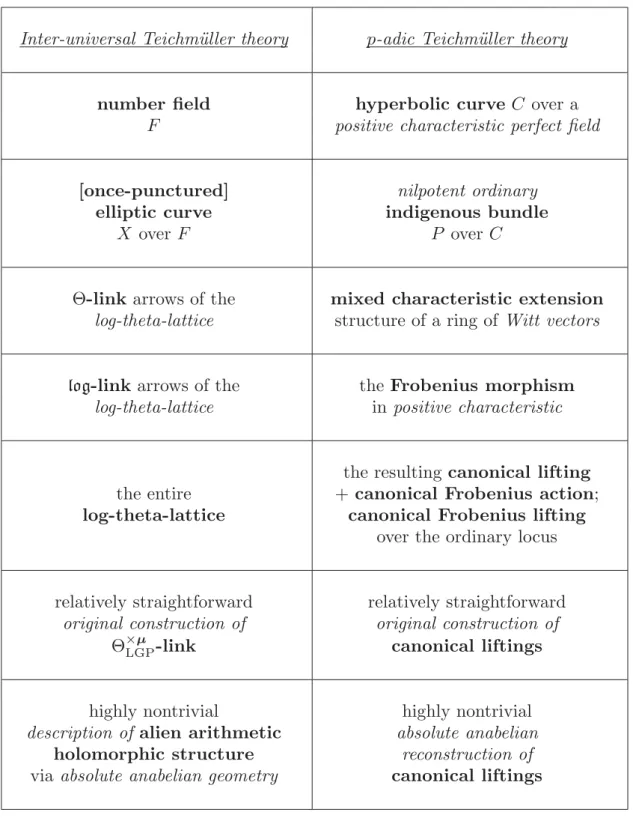
Relative to the analogy between the theory of the present series of papers and p-adic Teichm¨ uller theory [cf. [IUTchI], § I4], we recall that a Θ
±ellNF-Hodge the- ater, which may be thought of as a miniature model of the conventional scheme theory surrounding the given elliptic curve E
Fover the number field F , corresponds to the positive characteristic scheme theory surrounding a hyperbolic curve over a positive characteristic perfect field that is equipped with a nilpotent ordinary indige- nous bundle [cf. Fig. I.2 below]. Then the rotation, or “juggling”, effected by the log-link of the additive and multiplicative structures of the conventional scheme theory represented by a Θ
±ellNF-Hodge theater may be thought of as correspond- ing to the Frobenius morphism in positive characteristic [cf. the discussion of [AbsTopIII], § I1, § I3, § I5]. Thus, just as the Frobenius morphism is completely well- defined in positive characteristic, the log-link may be thought of as a phenomenon that occurs within a single arithmetic holomorphic structure, i.e., a vertical line of the log-theta-lattice. By contrast, the essentially non-ring/scheme-theoretic relationship between Θ
±ellNF-Hodge theaters constituted by the Θ-/Θ
×μ-/Θ
×μgau- /Θ
×μLGP-/Θ
×μlgp-links corresponds to the relationship between the “mod p
n” and “mod p
n+1” portions of the ring of Witt vectors, in the context of a canonical lifting of the original positive characteristic data [cf. the discussion of Remark 1.4.1, (iii); Fig.
I.2 below]. Thus, the log-theta-lattice, taken as a whole, may be thought of as
corresponding to the canonical lifting of the original positive characteristic data,
equipped with a corresponding canonical Frobenius action/lifting [cf. Fig. I.2
below]. Finally, the non-commutativity of the log-theta-lattice may be thought
of as corresponding to the complicated “intertwining” that occurs in the theory
of Witt vectors and canonical liftings between the Frobenius morphism in positive
characteristic and the mixed characteristic nature of the ring of Witt vectors [cf.
the discussion of Remark 1.4.1, (ii), (iii)].
One important consequence of this “noncommutative intertwining” of the two dimensions of the log-theta-lattice is the following. Since each horizontal arrow of the log-theta-lattice [i.e., the Θ-/Θ
×μ-/Θ
×μgau-/Θ
×μLGP-/Θ
×μlgp-link] may only be used to relate — i.e., via various Frobenioids — the multiplicative portions of the ring structures in the domain and codomain of the arrow, one natural approach to relating the additive portions of these ring structures is to apply the theory of log-shells. That is to say, since each horizontal arrow is compatible with the canonical splittings [up to roots of unity] discussed in [IUTchII], Introduction, of the theta/Gaussian monoids in the domain of the horizontal arrow into unit group and value group portions, it is natural to attempt to relate the ring structures on either side of the horizontal arrow by applying the canonical splittings to
· relate the multiplicative structures on either side of the horizontal arrow by means of the value group portions of the theta/Gaussian monoids;
· relate the additive structures on either side of the horizontal arrow by means of the unit group portions of the theta/Gaussian monoids, shifted once via a vertical arrow, i.e., the log-link, so as to “render additive” the [a priori] multiplicative structure of these unit group portions.
Indeed, this is the approach that will ultimately be taken in Theorem 3.11 [cf.
Theorem A below] to relating the ring structures on either side of a horizontal arrow. On the other hand, in order to actually implement this approach, it will be necessary to overcome numerous technical obstacles. Perhaps the most immediately obvious such obstacle lies in the observation [cf. the discussion of Remark 1.4.1, (ii)] that, precisely because of the “noncommutative intertwining” nature of the log-theta-lattice,
any sort of algorithmic construction concerning objects lying in the do- main of a horizontal arrow that involves vertical shifts [e.g., such as the approach to relating additive structures in the fashion described above]
cannot be “translated” in any immediate sense into an algorithm that makes sense from the point of view of the codomain of the horizontal arrow.
In a word, our approach to overcoming this technical obstacle consists of working with objects in the vertical line of the log-theta-lattice that contains the domain of the horizontal arrow under consideration that satisfy the crucial property of being
invariant with respect to vertical shifts
— i.e., shifts via iterates of the log-link [cf. the discussion of Remarks 1.2.2, (iii);
1.4.1, (ii)]. For instance, ´ etale-like objects that are vertically coric satisfy this
invariance property. On the other hand, as discussed in the beginning of [IUTchII],
Introduction, in the theory of the present series of papers, it is of crucial impor-
tance to be able to relate corresponding Frobenius-like and ´ etale-like structures
to one another via Kummer theory. In particular, in order to obtain structures
that are invariant with respect to vertical shifts, it is necessary to consider log- Kummer correspondences, as discussed above. Moreover, in the context of such log-Kummer correspondences, typically, one may only obtain structures that are invariant with respect to vertical shifts if one is willing to admit some sort of in- determinacy, e.g., such as the “upper semi-compatibility” [cf. the discussion of the “indeterminacy” (Ind3) in Theorem 3.11, (ii)] discussed above.
Inter-universal Teichm¨ uller theory p-adic Teichm¨ uller theory
number field hyperbolic curve C over a F positive characteristic perfect field
[once-punctured] nilpotent ordinary elliptic curve indigenous bundle
X over F P over C
Θ-link arrows of the mixed characteristic extension log-theta-lattice structure of a ring of Witt vectors
log-link arrows of the the Frobenius morphism log-theta-lattice in positive characteristic
the resulting canonical lifting the entire + canonical Frobenius action;
log-theta-lattice canonical Frobenius lifting over the ordinary locus
relatively straightforward relatively straightforward original construction of original construction of
Θ
×μLGP-link canonical liftings
highly nontrivial highly nontrivial
description of alien arithmetic absolute anabelian holomorphic structure reconstruction of via absolute anabelian geometry canonical liftings
Fig. I.2: Correspondence between inter-universal Teichm¨ uller theory and
p-adic Teichm¨ uller theory
One important property of the log-link, and hence, in particular, of the con- struction of log-shells, is its compatibility with the F
±l-symmetry discussed in the Introductions to [IUTchI], [IUTchII] — cf. Remark 1.3.2. Here, we recall from the discussion of [IUTchII], Introduction, that the F
±l-symmetry allows one to relate the various F -prime-strips — i.e., more concretely, the various copies of the data “Π
vO
Fv
” at v ∈ V
bad[and their analogues for v ∈ V
good] — associated to the various labels ∈ F
lthat appear in the Hodge-Arakelov-theoretic evaluation of [IUTchII] in a fashion that is compatible with
· the distinct nature of distinct labels ∈ F
l;
· the Kummer isomorphisms used to relate Frobenius-like and ´ etale- like versions of the F -prime-strips that appear, i.e., more concretely, the various copies of the data “Π
vO
Fv
” at v ∈ V
bad[and their analogues for v ∈ V
good];
· the structure of the underlying D -prime-strips that appear, i.e., more concretely, the various copies of the [arithmetic] tempered fundamental group “Π
v” at v ∈ V
bad[and their analogues for v ∈ V
good]
— cf. the discussion of [IUTchII], Introduction; Remark 1.5.1; Step (vii) of the proof of Corollary 3.12 of the present paper. This compatibility with the F
±l-symmetry gives rise to the construction of
· vertically coric F
×μ-prime-strips, log-shells by means of the arith- metic holomorphic structures under consideration;
· mono-analytic F
×μ-prime-strips, log-shells which are bi-coric
— cf. Theorem 1.5. These bi-coric mono-analytic log-shells play a central role in the theory of the present paper.
One notable aspect of the compatibility of the log-link with the F
±l-symmetry in the context of the theory of Hodge-Arakelov-theoretic evaluation developed in [IUTchII] is the following. One important property of mono-theta environments is the property of “isomorphism class compatibility”, i.e., in the terminology of [EtTh], “compatibility with the topology of the tempered fundamental group”
[cf. the discussion of Remark 2.1.1]. This “isomorphism class compatibility” allows
one to apply the Kummer theory of mono-theta environments [i.e., the theory of
[EtTh]] relative to the ring-theoretic basepoints that occur on either side of the
log-link [cf. Remark 2.1.1, (ii); [IUTchII], Remark 3.6.4, (i)], for instance, in the
context of the log-Kummer correspondences discussed above. Here, we recall that
the significance of working with such “ring-theoretic basepoints” lies in the fact that
the full ring structure of the local rings involved [i.e., as opposed to, say, just the
multiplicative portion of this ring structure] is necessary in order to construct the
log-link. That is to say, it is precisely by establishing the conjugate synchronization
arising from the F
±l-symmetry relative to these basepoints that occur on either
side of the log-link that one is able to conclude the crucial compatibility of this
conjugate synchronization with the log-link discussed in Remark 1.3.2. Thus, in
summary, one important consequence of the “isomorphism class compatibility” of mono-theta environments is the simultaneous compatibility of
· the Kummer theory of mono-theta environments;
· the conjugate synchronization arising from the F
±l-symmetry;
· the construction of the log-link.
This simultaneous compatibility is necessary in order to perform the construction of the [crucial!] splitting monoids of LGP-monoids referred to above — cf. the discussion of Step (vi) of the proof of Corollary 3.12.
In § 2 of the present paper, we continue our preparation for the multiradial con- struction of splitting monoids of LGP-monoids given in § 3 [of the present paper]
by presenting a global formulation of the essentially local theory at v ∈ V
bad[cf.
[IUTchII], § 1, § 2, § 3] concerning the interpretation, via the notion of multiradial- ity, of various rigidity properties of mono-theta environments. That is to say, although much of the [essentially routine!] task of formulating the local theory of [IUTchII], § 1, § 2, § 3, in global terms was accomplished in [IUTchII], § 4, the [again essentially routine!] task of formulating the portion of this local theory that con- cerns multiradiality was not explicitly addressed in [IUTchII], § 4. One reason for this lies in the fact that, from the point of view of the theory to be developed in § 3 of the present paper, this global formulation of multiradiality properties of the mono- theta environment may be presented most naturally in the framework developed in
§ 1 of the present paper, involving the log-theta-lattice [cf. Theorem 2.2; Corollary 2.3]. Indeed, the ´ etale-like versions of the mono-theta environment, as well as the various objects constructed from the mono-theta environment, may be interpreted, from the point of view of the log-theta-lattice, as vertically coric structures, and are Kummer-theoretically related to their Frobenius-like [i.e., Frobenioid- theoretic] counterparts, which arise from the [Frobenioid-theoretic portions of the]
various Θ
±ellNF-Hodge theaters in a vertical line of the log-theta-lattice [cf. Theo- rem 2.2, (ii); Corollary 2.3, (ii), (iii), (iv)]. Moreover, it is precisely the horizontal arrows of the log-theta-lattice that give rise to the Z
×-indeterminacies acting on copies of “ O
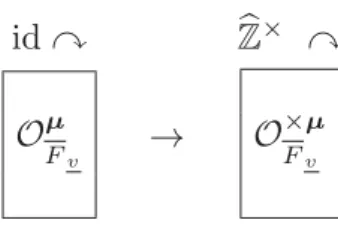
×μ” that play a prominent role in the local multiradiality theory de- veloped in [IUTchII] [cf. the discussion of [IUTchII], Introduction]. In this context, it is useful to recall from the discussion of [IUTchII], Introduction [cf. also Remark 2.2.1 of the present paper], that the essential content of this local multiradiality the- ory consists of the observation [cf. Fig. I.3 below] that, since mono-theta-theoretic cyclotomic and constant multiple rigidity only require the use of the portion of O
×Fv
, for v ∈ V
bad, given by the torsion subgroup O
μFv
⊆ O
F×v
[i.e., the roots of unity], the triviality of the composite of natural morphisms
O
μFv
→ O
×Fv
O
F×μv
has the effect of insulating the Kummer theory of the ´ etale theta function
— i.e., via the theory of the mono-theta environments developed in [EtTh] — from
the Z
×-indeterminacies that act on the copies of “ O
×μ” that arise in the F
×μ-
prime-strips that appear in the Θ-/Θ
×μ-/Θ
×μgau-/Θ
×μLGP-/Θ
×μlgp-link.
id Z
×O
Fμv
→ O
×μFv
Fig. I.3: Insulation from Z
×-indeterminacies in the context of mono-theta-theoretic cyclotomic, constant multiple rigidity
In § 3 of the present paper, which, in some sense, constitutes the conclusion of the theory developed thus far in the present series of papers, we present the construction of the [splitting monoids of] LGP-monoids, which may be thought of as a multiradial version of the [splitting monoids of] Gaussian monoids that were constructed via the theory of Hodge-Arakelov-theoretic evaluation developed in [IUTchII]. In order to achieve this multiradiality, it is necessary to “multiradi- alize” the various components of the construction of the Gaussian monoids given in [IUTchII]. The first step in this process of “multiradialization” concerns the labels j ∈ F
lthat occur in the Hodge-Arakelov-theoretic evaluation performed in [IUTchII]. That is to say, the construction of these labels, together with the closely related theory of F
l-symmetry, depend, in an essential way, on the full arithmetic tempered fundamental groups “Π
v” at v ∈ V
bad, i.e., on the portion of the arithmetic holomorphic structure within a Θ
±ellNF-Hodge theater which is not shared by an alien arithmetic holomorphic structure [i.e., an arithmetic holo- morphic structure related to the original arithmetic holomorphic structure via a horizontal arrow of the log-theta-lattice]. One naive approach to remedying this state of affairs is to simply consider the underlying set, of cardinality l
, associated to F
l, which we regard as being equipped with the full set of symmetries given by arbitrary permutation automorphisms of this underlying set. The problem with this approach is that it yields a situation in which, for each label j ∈ F
l, one must contend with an indeterminacy of l
possibilities for the element of this underlying set that corresponds to j [cf. [IUTchI], Propositions 4.11, (i); 6.9, (i)]. From the point of view of the log-volume computations to be performed in [IUTchIV], this degree of indeterminacy gives rise to log-volumes which are “too large”, i.e., to esti- mates that are not sufficient for deriving the various diophantine results obtained in [IUTchIV]. Thus, we consider the following alternative approach, via processions [cf. [IUTchI], Propositions, 4.11, 6.9]. Instead of working just with the underlying set associated to F
l, we consider the diagram of inclusions of finite sets
S
±1→ S
±1+1=2→ . . . → S
±j+1→ . . . → S
±1+l=l±— where we write S
±j+1def
= { 0, 1, . . . , j } , for j = 0, . . . , l
, and we think of each of
these finite sets as being subject to arbitrary permutation automorphisms. That
is to say, we think of the set S
±j+1as a container for the labels 0, 1, . . . , j . Thus,
for each j , one need only contend with an indeterminacy of j + 1 possibilities for
the element of this container that corresponds to j . In particular, if one allows
j = 0, . . . , l
to vary, then this approach allows one to reduce the resulting label
indeterminacy from a total of (l
±)
l±possibilities [where we write l
±= 1 + l
=
(l +1)/2] to a total of l
±! possibilities. It turns out that this reduction will yield just the right estimates in the log-volume computations to be performed in [IUTchIV].
Moreover, this approach satisfies the important property of insulating the “core label 0” from the various label indeterminacies that occur.
Each element of each of the containers S
±j+1may be thought of as parametrizing an F - or D -prime-strip that occurs in the Hodge-Arakelov-theoretic evaluation of [IUTchII]. In order to render the construction multiradial, it is necessary to replace such holomorphic F -/ D -prime-strips by mono-analytic F
-/ D
-prime-strips. In particular, as discussed above, one may construct, for each such F
-/ D
-prime- strip, a collection of log-shells associated to the various v ∈ V . Write V
Qfor the set of valuations of Q . Then, in order to obtain objects that are immune to the various label indeterminacies discussed above, we consider, for each element
∗ ∈ S
±j+1, and for each [say, for simplicity, nonarchimedean] v
Q∈ V
Q,
· the direct sum of the log-shells associated to the prime-strip labeled by the given element ∗ ∈ S
±j+1at the v ∈ V that lie over v
Q;
we then form
· the tensor product, over the elements ∗ ∈ S
±j+1, of these direct sums.
This collection of tensor products associated to v
Q∈ V
Qwill be referred to as the tensor packet associated to the collection of prime-strips indexed by elements of S
±j+1. One may carry out this construction of the tensor packet either for holomor- phic F -/ D -prime-strips [cf. Proposition 3.1] or for mono-analytic F
-/ D
-prime- strips [cf. Proposition 3.2].
The tensor packets associated to D
-prime-strips will play a crucial role in the theory of § 3, as “multiradial mono-analytic containers” for the principal objects of interest [cf. the discussion of Remark 3.12.2, (ii)], namely,
· the action of the splitting monoids of the LGP-monoids — i.e., the monoids generated by the theta values { q
j2v
}
j=1,...,l— on the portion of the tensor packets just defined at v ∈ V
bad[cf. Fig. I.4 below; Propositions 3.4, 3.5; the discussion of [IUTchII], Introduction];
· the action of copies “(F
mod×)
j” of [the multiplicative monoid of nonzero elements of] the number field F
modlabeled by j = 1, . . . , l
on the product, over v
Q∈ V
Q, of the portion of the tensor packets just defined at v
Q[cf. Fig. I.5 below; Propositions 3.3, 3.7, 3.10].
q
1q
j2q
(l)2/
±→ /
±/
±→ . . . → /
±/
±. . . /
±→ . . . → /
±/
±. . . /
±S
±1S
±1+1=2S
±j+1S
±1+l=l±Fig. I.4: Splitting monoids of LGP-monoids acting on tensor packets
(F
mod×)
1(F
mod×)
j(F
mod×)
l/
±→ /
±/
±→ . . . → /
±/
±. . . /
±→ . . . → /
±/
±. . . /
±S
±1S
±1+1=2S
±j+1S
±1+l=l±Fig. I.5: Copies of F
mod×acting on tensor packets
Indeed, these [splitting monoids of] LGP-monoids and copies “(F
mod×)
j” of [the multiplicative monoid of nonzero elements of] the number field F
modadmit nat- ural embeddings into/actions on the various tensor packets associated to labeled F - prime-strips in each Θ
±ellNF-Hodge theater
n,mHT
Θ±ellNFof the log-theta-lattice.
One then obtains vertically coric versions of these splitting monoids of LGP- monoids and labeled copies “(F
mod×)
j” of [the multiplicative monoid of nonzero elements of] the number field F
modby applying suitable Kummer isomorphisms between
· log-shells/tensor packets associated to [labeled] F -prime-strips and
· log-shells/tensor packets associated to [labeled] D -prime-strips.
Finally, by passing to the
· log-shells/tensor packets associated to [labeled] D
-prime-strips
— i.e., by forgetting the arithmetic holomorphic structure associated to a specific vertical line of the log-theta-lattice — one obtains the desired multiradial representation, i.e., description in terms that make sense from the point of view of an alien arithmetic holomorphic structure, of the splitting monoids of LGP- monoids and labeled copies of the number field F
moddiscussed above. This passage to the multiradial representation is obtained by admitting the following three types of indeterminacy:
(Ind1): This is the indeterminacy that arises from the automorphisms of proces- sions of D
-prime-strips that appear in the multiradial representation
— i.e., more concretely, from permutation automorphisms of the label sets S
±j+1that appear in the processions discussed above, as well as from the automorphisms of the D
-prime-strips that appear in these processions.
(Ind2): This is the [“non-(Ind1) portion” of the] indeterminacy that arises from the automorphisms of the F
×μ-prime-strips that appear in the Θ-/Θ
×μ- /Θ
×μgau-/Θ
×μLGP-/Θ
×μlgp-link — i.e., in particular, at [for simplicity] v ∈ V
non, the Z
×-indeterminacies acting on local copies of “ O
×μ” [cf. the above discussion].
(Ind3): This is the indeterminacy that arises from the upper semi-compatibility
of the log-Kummer correspondences associated to the specific vertical line
of the log-theta-lattice under consideration [cf. the above discussion].
A detailed description of this multiradial representation, together with the indeter- minacies (Ind1), (Ind2) is given in Theorem 3.11, (i) [and summarized in Theorem A, (i), below; cf. also Fig. I.6 below].
q
1q
j2q
(l)2/
±→ /
±/
±→
. . . →
/
±/
±. . . /
±→ . . . →
/
±/
±. . . /
±(F
mod×)
1(F
mod×)
j(F
mod×)
lFig. I.6: The full multiradial representation
One important property of the multiradial representation discussed above con- cerns the relationship between the three main components — i.e., roughly speaking, log-shells, splitting monoids of LGP-monoids, and number fields — of this multira- dial representation and the log-Kummer correspondence of the specific vertical line of the log-theta-lattice under consideration. This property — which may be thought of as a sort of “non-interference”, or “mutual compatibility”, prop- erty — asserts that the multiplicative monoids constituted by the splitting monoids of LGP-monoids and copies of F
modדdo not interfere”, relative to the various ar- rows that occur in the log-Kummer correspondence, with the local units at v ∈ V that give rise to the log-shells. In the case of splitting monoids of LGP-monoids, this non-interference/mutual compatibility property is, in essence, a formal conse- quence of the existence of the canonical splittings [up to roots of unity] of the theta/Gaussian monoids that appear into unit group and value group portions [cf.
the discussion of [IUTchII], Introduction]. Here, we recall that, in the case of the theta monoids, these canonical splittings are, in essence, a formal consequence of the constant multiple rigidity property of mono-theta environments reviewed above. In the case of copies of F
mod, this non-interference/mutual compatibility property is, in essence, a formal consequence of the well-known fact in elementary algebraic number theory that any nonzero element of a number field that is inte- gral at every valuation of the number field is necessarily a root of unity. These mutual compatibility properties are described in detail in Theorem 3.11, (ii), and summarized in Theorem A, (ii), below.
Another important property of the multiradial representation discussed above
concerns the relationship between the three main components — i.e., roughly speak-
ing, log-shells, splitting monoids of LGP-monoids, and number fields — of this
multiradial representation and the Θ
×μLGP-links, i.e., the horizontal arrows of the
log-theta-lattice under consideration. This property — which may be thought of
as a property of compatibility with the Θ
×μLGP-link — asserts that the cyclotomic
rigidity isomorphisms that appear in the Kummer theory surrounding the splitting
monoids of LGP-monoids and copies of F
mod×are immune to the Z
×-indeterminacies
that act on the copies of “ O
×μ” that arise in the F
×μ-prime-strips that appear
in the Θ
×μLGP-link. In the case of splitting monoids of LGP-monoids, this prop-
erty amounts precisely to the multiradiality theory developed in § 2 [cf. the above
discussion], i.e., in essence, to the mono-theta-theoretic cyclotomic rigidity property reviewed in the above discussion. In the case of copies of F
mod×, this prop- erty follows from the theory surrounding the construction of the cyclotomic rigidity isomorphisms discussed in [IUTchI], Example 5.1, (v). These compatibility prop- erties are described in detail in Theorem 3.11, (iii), and summarized in Theorem A, (iii), below.
At this point, we pause to observe that although considerable attention has been devoted so far in the present series of papers, especially in [IUTchII], to the theory of Gaussian monoids, not so much attention has been devoted [i.e., outside of [IUTchI], § 5; [IUTchII], Corollaries 4.7, 4.8] to [the multiplicative monoids constituted by] copies of F
mod×. These copies of F
mod×enter into the theory of the multiradial representation discussed above in the form of various types of global Frobenioids in the following way. If one starts from the number field F
mod, one natural Frobenioid that can be associated to F
modis the Frobenioid F
modof [stack- theoretic] arithmetic line bundles on [the spectrum of the ring of integers of] F
moddiscussed in [IUTchI], Example 5.1, (iii) [cf. also Example 3.6 of the present paper].
From the point of view of the theory surrounding the multiradial representation discussed above, there are two natural ways to approach the construction of “ F
mod”:
(
MOD) (Rational Function Torsor Version): This approach consists of con- sidering the category F
MODof F
mod×-torsors equipped with trivializations at each v ∈ V [cf. Example 3.6, (i), for more details].
(
mod) (Local Fractional Ideal Version): This approach consists of consid- ering the category F
modof collections of integral structures on the various completions K
vat v ∈ V and morphisms between such collections of in- tegral structures that arise from multiplication by elements of F
mod×[cf.
Example 3.6, (ii), for more details].
Then one has natural isomorphisms of Frobenioids F
mod→
∼F
MOD→
∼F
modthat induce the respective identity morphisms F
mod×→ F
mod×→ F
mod×on the asso- ciated rational function monoids [cf. [FrdI], Corollary 4.10]. In particular, at first glance, F
MODand F
modappear to be “essentially equivalent” objects.
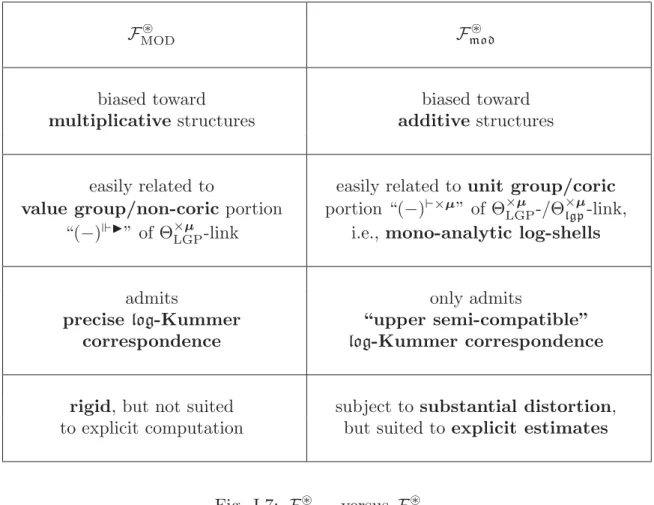
On the other hand, when regarded from the point of view of the multiradial
representations discussed above, these two constructions exhibit a number of signif-
icant differences — cf. Fig. I.7 below; the discussion of Remarks 3.6.2, 3.10.1. For
instance, whereas the construction of (
MOD) depends only on the multiplica-
tive structure of F
mod×, the construction of (
mod) involves the module, i.e., the
additive, structure of the localizations K
v. The global portion of the Θ
×μLGP-link
(respectively, the Θ
×μlgp-link) is, by definition [cf. Definition 3.8, (ii)], constructed
by means of the realification of the Frobenioid that appears in the construction of
(
MOD) (respectively, (
mod)). This means that the construction of the global por-
tion of the Θ
×μLGP-link — which is the version of the Θ-link that is in fact ultimately
used in the theory of the multiradial representation — depends only on the multi-
plicative monoid structure of a copy of F
mod×, together with the various valuation
homomorphisms F
mod×→ R associated to v ∈ V . Thus, the mutual compatibility [discussed above] of copies of F
mod×with the log-Kummer correspondence implies that one may perform this construction of the global portion of the Θ
×μLGP-link in a fashion that is immune to the “upper semi-compatibility” indeterminacy (Ind3) [discussed above]. By contrast, the construction of (
mod) involves integral struc- tures on the underlying local additive modules “K
v”, i.e., from the point of view of the multiradial representation, integral structures on log-shells and tensor packets of log-shells, which are subject to the “upper semi-compatibility” indeterminacy (Ind3) [discussed above]. In particular, the log-Kummer correspondence subjects the construction of (
mod) to “substantial distortion”. On the other hand, the es- sential role played by local integral structures in the construction of (
mod) enables one to compute the global arithmetic degree of the arithmetic line bundles consti- tuted by objects of the category “ F
mod” in terms of log-volumes on log-shells and tensor packets of log-shells [cf. Proposition 3.9, (iii)]. This property of the construction of (
mod) will play a crucial role in deriving the explicit estimates for such log-volumes that are obtained in Corollary 3.12 [cf. Theorem B below].
F
MODF
modbiased toward biased toward
multiplicative structures additive structures
easily related to easily related to unit group/coric value group/non-coric portion portion “( − )
×μ” of Θ
×μLGP-/Θ
×μlgp-link,
“( − )
” of Θ
×μLGP-link i.e., mono-analytic log-shells
admits only admits
precise log-Kummer “upper semi-compatible”
correspondence log-Kummer correspondence
rigid, but not suited subject to substantial distortion, to explicit computation but suited to explicit estimates
Fig. I.7: F
MODversus F
modThus, in summary, the natural isomorphism F
MOD→ F
∼ moddiscussed above plays the important role, in the context of the multiradial representation discussed above, of relating
· the multiplicative structure of the global number field F
modto the
additive structure of F
mod,
· the unit group/coric portion “( − )
×μ” of the Θ
×μLGP-link to the value group/non-coric portion “( − )
” of the Θ
×μLGP-link.
Finally, in Corollary 3.12 [cf. also Theorem B below], we apply the multiradial representation discussed above to estimate certain log-volumes as follows. We begin by introducing some terminology [cf. Definition 3.8, (i)]. We shall refer to the object that arises in any of the versions [including realifications] of the global Frobenioid
“ F
mod” discussed above — such as, for instance, the global realified Frobenioid that occurs in the codomain of the Θ
×μgau-/Θ
×μLGP-/Θ
×μlgp-link — by considering the arithmetic divisor determined by the zero locus of the elements “q
v
” at v ∈ V
badas a q-pilot object. The log-volume of the q -pilot object will be denoted by
− | log(q) | ∈ R
— so | log(q) | > 0 [cf. Corollary 3.12; Theorem B]. In a similar vein, we shall refer to the object that arises in the global realified Frobenioid that occurs in the domain of the Θ
×μgau-/Θ
×μLGP-/Θ
×μlgp-link by considering the arithmetic divisor determined by the zero locus of the collection of theta values “ { q
j2v
}
j=1,...,l” at v ∈ V
badas a Θ-pilot object. The log-volume of the holomorphic hull — cf. Remark 3.9.5, (i); Step (xi) of the proof of Corollary 3.12 — of the union of the collection of possible images of the Θ-pilot object in the multiradial representation — i.e., where we recall that these “possible images” are subject to the indeterminacies (Ind1), (Ind2), (Ind3) — will be denoted by
− | log(Θ) | ∈ R
{ + ∞}
[cf. Corollary 3.12; Theorem B]. Here, the reader might find the use of the notation
“ − ” and “ | . . . | ” confusing [i.e., since this notation suggests that − | log(Θ) | is a non-positive real number, which would appear to imply that the possibility that
− | log(Θ) | = + ∞ may be excluded from the outset]. The reason for the use of this notation, however, is to express the point of view that − | log(Θ) | should be regarded as a positive real multiple of − | log(q) | [i.e., which is indeed a negative real number!] plus a possible error term, which [a priori!] might be equal to + ∞ . Then the content of Corollary 3.12, Theorem B may be summarized, roughly speaking [cf. Remark 3.12.1, (ii)], as a result concerning the
negativity of the Θ-pilot log-volume | log(Θ) |
— i.e., where we write | log(Θ) |
def= − ( − | log(Θ) | ) ∈ R
{−∞} . Relative to the analogy between the theory of the present series of papers and complex/p-adic Teichm¨ uller theory [cf. [IUTchI], § I4], this result may be thought of as a statement to the effect that
“the pair consisting of a number field equipped with an elliptic curve is metrically hyperbolic, i.e., has negative curvature”.
That is to say, it may be thought of as a sort of analogue of the inequality χ
S= −
S
dμ
S< 0
arising from the classical Gauss-Bonnet formula on a hyperbolic Riemann sur- face of finite type S [where we write χ
Sfor the Euler characteristic of S and dμ
Sfor the K¨ ahler metric on S determined by the Poincar´ e metric on the upper half-plane
— cf. the discussion of Remark 3.12.3], or, alternatively, of the inequality (1 − p)(2g
X− 2) ≤ 0
that arises by computing global degrees of line bundles in the context of the Hasse invariant that arises in p-adic Teichm¨ uller theory [where X is a smooth, proper hyperbolic curve of genus g
Xover the ring of Witt vectors of a perfect field of characteristic p which is canonical in the sense of p-adic Teichm¨ uller theory — cf.
the discussion of Remark 3.12.4, (v)].
The proof of Corollary 3.12 [i.e., Theorem B] is based on the following funda- mental observation: the multiradial representation discussed above yields
two tautologically equivalent ways to compute the q -pilot log-volume − | log(q) |
— cf. Fig. I.8 below; Step (xi) of the proof of Corollary 3.12. That is to say, suppose that one starts with the q -pilot object in the Θ
±ellNF-Hodge theater
1,0HT
Θ±ellNFat (1, 0), which we think of as being represented, via the approach of (
mod), by means of the action of the various q
v
![Fig. I.1: The [LGP-Gaussian] log-theta-lattice](https://thumb-ap.123doks.com/thumbv2/123deta/7120171.2342914/2.892.116.745.883.1149/fig-i-the-lgp-gaussian-log-theta-lattice.webp)