LOG-VOLUME COMPUTATIONS AND SET-THEORETIC FOUNDATIONS
Shinichi Mochizuki
April 2020
Abstract. The present paper forms the fourth and final paper in a series of papers concerning “inter-universal Teichm¨uller theory”. In the first three papers of the series, we introduced and studied the theory surrounding the log- theta-lattice, a highly non-commutative two-dimensional diagram of “miniature models of conventional scheme theory”, called Θ±ellNF-Hodge theaters, that were associated, in the first paper of the series, to certain data, called initial Θ-data.
This data includes an elliptic curve EF over a number field F, together with a prime number l ≥ 5. Consideration of various properties of the log-theta-lattice led naturally to the establishment, in the third paper of the series, of multiradial algorithms for constructing“splitting monoids of LGP-monoids”. Here, we recall that “multiradial algorithms” are algorithms that make sense from the point of view of an“alien arithmetic holomorphic structure”, i.e., the ring/scheme structure of a Θ±ellNF-Hodge theater related to a given Θ±ellNF-Hodge theater by means of a non-ring/scheme-theoretic horizontal arrow of the log-theta-lattice. In the present paper, estimates arising from these multiradial algorithms for splitting monoids of LGP-monoids are applied to verify various diophantine resultswhich imply, for instance, the so-calledVojta Conjecturefor hyperbolic curves, theABC Conjecture, and the Szpiro Conjecture for elliptic curves. Finally, we examine
— albeit from an extremelynaive/non-expertpoint of view! — thefoundational/set- theoreticissues surrounding theverticalandhorizontal arrowsof the log-theta-lattice by introducing and studying the basic properties of the notion of a“species”, which may be thought of as a sort of formalization, via set-theoretic formulas, of the intuitive notion of a “type of mathematical object”. These foundational issues are closely related to the central role played in the present series of papers by various results from absolute anabelian geometry, as well as to the idea of gluing together distinct models of conventional scheme theory, i.e., in a fashion that lies outside the framework of conventional scheme theory. Moreover, it is precisely these foundational issues surrounding the vertical and horizontal arrows of the log-theta-lattice that led naturally to the introduction of the term“inter-universal”.
Contents:
Introduction
§0. Notations and Conventions
§1. Log-volume Estimates
§2. Diophantine Inequalities
§3. Inter-universal Formalism: the Language of Species
Typeset byAMS-TEX
1
Introduction
The present paper forms the fourth and final paper in a series of papers concern- ing “inter-universal Teichm¨uller theory”. In the first three papers, [IUTchI], [IUTchII], and [IUTchIII], of the series, we introduced and studied the theory sur- rounding the log-theta-lattice [cf. the discussion of [IUTchIII], Introduction], a highly non-commutative two-dimensional diagram of “miniature models of con- ventional scheme theory”, called Θ±ellNF-Hodge theaters, that were associated, in the first paper [IUTchI] of the series, to certain data, called initial Θ-data. This data includes an elliptic curve EF over a number field F, together with a prime number l ≥ 5 [cf. [IUTchI], §I1]. Consideration of various properties of the log- theta-lattice leads naturally to the establishment of multiradial algorithms for constructing “splitting monoids of LGP-monoids” [cf. [IUTchIII], Theorem A]. Here, we recall that “multiradial algorithms” [cf. the discussion of the Intro- ductions to [IUTchII], [IUTchIII]] are algorithms that make sense from the point of view of an“alien arithmetic holomorphic structure”, i.e., the ring/scheme structure of a Θ±ellNF-Hodge theater related to a given Θ±ellNF-Hodge theater by means of a non-ring/scheme-theoretic horizontal arrow of the log-theta-lattice. In the final portion of [IUTchIII], by applying these multiradial algorithms for split- ting monoids of LGP-monoids, we obtained estimates for the log-volume of these LGP-monoids [cf. [IUTchIII], Theorem B]. In the present paper, these estimates will be applied to verify various diophantine results.
In §1 of the present paper, we start by discussing variouselementary estimates for the log-volume of various tensor products of the modules obtained by applying the p-adic logarithm to the local units — i.e., in the terminology of [IUTchIII],
“tensor packets of log-shells” [cf. the discussion of [IUTchIII], Introduction] — in terms of various well-known invariants, such as differents, associated to a mixed- characteristic nonarchimedean local field [cf. Propositions 1.1, 1.2, 1.3, 1.4]. We then discuss similar — but technically much simpler! — log-volume estimates in the case of complex archimedean local fields [cf. Proposition 1.5]. After review- ing a certain classical estimate concerning the distribution of prime numbers [cf.
Proposition 1.6], as well as some elementary general nonsense concerning weighted averages [cf. Proposition 1.7] and well-known elementary facts concerning elliptic curves [cf. Proposition 1.8], we then proceed tocompute explicitly, in more elemen- tary language, the quantity that was estimated in [IUTchIII], Theorem B. These computations yield a quite strong/explicit diophantine inequality [cf. Theorem 1.10] concerning elliptic curves that are in “sufficiently general position”, so that one may apply the general theory developed in the first three papers of the series.
In §2 of the present paper, after reviewing another classical estimate concern- ing the distribution of prime numbers [cf. Proposition 2.1, (ii)], we then proceed to apply the theory of [GenEll] to reduce various diophantine results concerning an arbitrary elliptic curve over a number field to results of the type obtained in Theorem 1.10 concerning elliptic curves that are in “sufficiently general posi- tion” [cf. Corollary 2.2]. This reduction allows us to derive the following result [cf. Corollary 2.3], which constitutes themain application of the“inter-universal Teichm¨uller theory” developed in the present series of papers.
Theorem A. (Diophantine Inequalities) Let X be a smooth, proper, geomet- rically connected curve over a number field; D⊆X a reduced divisor; UX def= X\D;
d a positive integer; ∈ R>0 a positive real number. Write ωX for the canon- ical sheaf on X. Suppose that UX is a hyperbolic curve, i.e., that the degree of the line bundle ωX(D) is positive. Then, relative to the notation of [GenEll]
[reviewed in the discussion preceding Corollary 2.2 of the present paper], one has an inequality of “bounded discrepancy classes”
htω
X(D) (1 +)(log-diffX+ log-condD)
of functions on UX(Q)≤d — i.e., the function (1 + )(log-diffX + log-condD) − htω
X(D) is bounded below by aconstant on UX(Q)≤d [cf. [GenEll], Definition 1.2, (ii), as well as Remark 2.3.1, (ii), of the present paper].
Thus, Theorem A asserts an inequality concerning the canonical height [i.e.,
“htωX(D)”], the logarithmic different[i.e., “log-diffX”], and thelogarithmic conduc- tor [i.e., “log-condD”] of points of the curve UX valued in number fields whose extension degree overQis≤d . In particular, the so-calledVojta Conjecturefor hyperbolic curves, theABC Conjecture, and theSzpiro Conjecturefor elliptic curves all follow as special cases of Theorem A. We refer to [Vjt] for a detailed exposition of these conjectures.
Finally, in §3, we examine — albeit from an extremelynaive/non-expert point of view! — certain foundational issues underlying the theory of the present se- ries of papers. Typically in mathematical discussions [i.e., by mathematicians who are not equipped with a detailed knowledge of the theory of foundations!] — such as, for instance, the theory developed in the present series of papers! — one de- fines various“types of mathematical objects” [i.e., such as groups, topological spaces, or schemes], together with a notion of “morphisms” between two partic- ular examples of a specific type of mathematical object [i.e., morphisms between groups, between topological spaces, or between schemes]. Such objects and mor- phisms [typically] determine a category. On the other hand, if one restricts one’s attention to such a category, then one must keep in mind the fact that the structure of the category — i.e., which consistsonly of a collection of objects and morphisms satisfying certain properties! — does not include any mention of the various sets and conditions satisfied by those sets that give rise to the “type of mathematical object” under consideration. For instance, the data consisting of the underlying set of a group, the group multiplication law on the group, and the properties sat- isfied by this group multiplication law cannot be recovered [at least in an a priori sense!] from the structure of the “category of groups”. Put another way, although the notion of a “type of mathematical object” may give rise to a “category of such objects”, the notion of a “type of mathematical object” is much stronger — in the sense that it involves much moremathematical structure— than the notion of a cat- egory. Indeed, a given “type of mathematical object” may have a very complicated internal structure, but may give rise to a category equivalent to a one-morphism category [i.e., a category with precisely one morphism]; in particular, in such cases, the structure of the associated category does not retain any information of inter- est concerning the internal structure of the “type of mathematical object” under consideration.
In Definition 3.1, (iii), we formalize this intuitive notion of a “type of mathe- matical object” by defining the notion of aspeciesas, roughly speaking, acollection of set-theoretic formulas that gives rise to a category in any given model of set the- ory[cf. Definition 3.1, (iv)], but, unlike anyspecificcategory [e.g., of groups, etc.] is not confinedto anyspecific model of set theory. In a similar vein, by working with collections of set-theoretic formulas, one may define a species-theoretic ana- logue of the notion of afunctor, which we refer to as amutation[cf. Definition 3.3, (i)]. Given a diagram of mutations, one may then define the notion of a “mutation that extracts, from the diagram, a certain portion of the types of mathematical objects that appear in the diagram that is invariant with respect to the mutations in the diagram”; we refer to such a mutation as a core [cf. Definition 3.3, (v)].
One fundamental example, in the context of the present series of papers, of a diagram of mutations is the usual set-up of [absolute] anabelian geometry [cf.
Example 3.5 for more details]. That is to say, one begins with thespeciesconstituted by schemes satisfying certain conditions. One then considers the mutation
X ΠX
that associates to such a schemeX its ´etale fundamental group ΠX [say, considered up to inner automorphisms]. Here, it is important to note that the codomain of this mutation is the species constituted by topological groups [say, considered up to inner automorphisms] that satisfy certain conditions which do not include any information concerning how the group is related [for instance, via some sort of
´
etale fundamental group mutation] to a scheme. The notion of an anabelian reconstruction algorithm may then be formalized as a mutation that forms a
“mutation-quasi-inverse” to the fundamental group mutation.
Another fundamental example, in the context of the present series of papers, of a diagram of mutations arises from theFrobenius morphismin positive characteristic scheme theory [cf. Example 3.6 for more details]. That is to say, one fixes a prime number p and considers the species constituted by reduced quasi-compact schemes of characteristic p and quasi-compact morphisms of schemes. One then considers the mutation that associates
S S(p)
to such a scheme S the scheme S(p) with the same topological space, but whose regular functions are given by thep-th powers of the regular functions on the original scheme. Thus, the domain and codomain of this mutation are given by the same species. One may also consider a log scheme version of this example, which, at the level of monoids, corresponds, in essence, to assigning
M p·M
to a torsion-free abelian monoid M the submonoid p·M ⊆M determined by the image of multiplication by p. Returning to the case of schemes, one may then observe that the well-known constructions of the perfection and the ´etale site
S Spf; S S´et
associated to a reduced schemeS of characteristicpgive rise tocoresof the diagram obtained by considering iterates of the “Frobenius mutation” just discussed.
This last example of the Frobenius mutation and the associated core consti- tuted by the ´etale site is of particular importance in the context of the present series of papers in that it forms the “intuitive prototype” that underlies the theory of the vertical and horizontal lines of the log-theta-lattice [cf. the discussion of Remark 3.6.1, (i)]. One notable aspect of this example is the [evident!] fact that the domain and codomain of the Frobenius mutation are given by the same species. That is to say, despite the fact that in the construction of the scheme S(p) [cf. the notation of the preceding paragraph] from the scheme S, the scheme S(p) is “subordinate” to the scheme S, the domain and codomain species of the resulting Frobenius mutation coincide, hence, in particular, are on a par with one another. This sort of situation served, for the author, as a sort of model for the log- and Θ×μLGP-links of the log-theta-lattice, which may be formulated as muta- tions between the species constituted by the notion of a Θ±ellNF-Hodge theater.
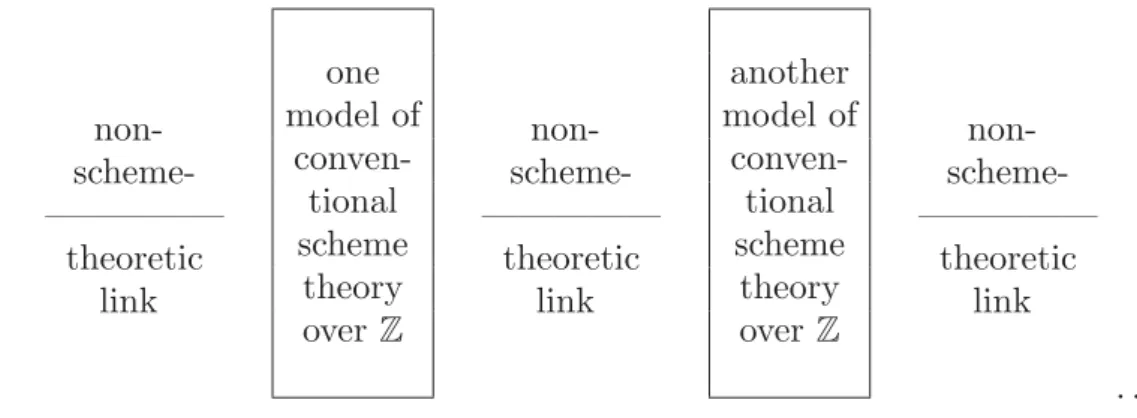
That is to say, although in theconstruction of either thelog- or the Θ×μLGP-link, the domain and codomain Θ±ellNF-Hodge theaters are by no means on a “par” with one another, the domain and codomain Θ±ellNF-Hodge theaters of the resulting log-/Θ×μLGP-links are regarded as objects of the same species, hence, in particular, completely on a par with one another. This sort of “relativization” of distinct models of conventional scheme theory over Z via the notion of a Θ±ellNF-Hodge theater [cf. Fig. I.1 below; the discussion of “gluing together” such models of con- ventional scheme theory in [IUTchI], §I2] is one of the most characteristic features of the theory developed in the present series of papers and, in particular, lies [tauto- logically!] outside the framework of conventional scheme theory over Z. That is to say, in the framework of conventional scheme theory over Z, if one starts out with schemes over Z and constructs from them, say, by means of geometric objects such as thetheta function on a Tate curve, some sort of Frobenioid that is isomorphic to a Frobenioid associated toZ, then — unlike, for instance, the case of theFrobenius morphism in positive characteristic scheme theory —
there is no way, within the framework of conventional scheme theory, to treat the newly constructed Frobenioid“as if it is the Frobenioid associated toZ, relative to some newversion/model of conventional scheme theory”.
. . .
non- scheme-
—————
theoretic link
one model of
conven- tional scheme
theory over Z
non- scheme-
—————
theoretic link
another model of
conven- tional scheme
theory over Z
non- scheme-
—————
theoretic link
. . .
Fig. I.1: Relativized models of conventional scheme theory over Z
If, moreover, one thinks of Z as being constructed, in the usual way, via ax- iomatic set theory, then one may interpret the “absolute” — i.e., “tautologically
unrelativizable” — nature of conventional scheme theory over Z at a purely set- theoretic level. Indeed, from the point of view of the “∈-structure”of axiomatic set theory, there isno way to treatsets constructed atdistinct levelsof this ∈-structure as being on a par with one another. On the other hand, if one focuses not on the level of the ∈-structure to which a set belongs, but rather on species, then the notion of a species allows one to relate — i.e., to treat on a par with one another — objects belonging to the species that arise from sets constructed at distinct levels of the ∈-structure. That is to say,
the notion of a species allows one to “simulate ∈-loops” without vio- lating the axiom of foundation of axiomatic set theory
— cf. the discussion of Remark 3.3.1, (i).
As one constructs sets at new levels of the ∈-structure of some model of ax- iomatic set theory — e.g., as one travels along vertical or horizontal lines of the log-theta-lattice! — one typically encounters new schemes, which give rise to new Galois categories, hence to new Galois or ´etale fundamental groups, which may only be constructed if one allows oneself to considernew basepoints, relative tonew universes. In particular, one must continue to extend the universe, i.e., to modify the model of set theory, relative to which one works. Here, we recall in passing that such “extensions of universe” are possible on account of anexistence axiom concerninguniverses, which is apparently attributed to the“Grothendieck school”
and, moreover, cannot, apparently, be obtained as a consequence of the conven- tional ZFC axioms of axiomatic set theory [cf. the discussion at the beginning of
§3 for more details]. On the other hand, ultimately in the present series of papers [cf. the discussion of [IUTchIII], Introduction], we wish to obtain algorithms for constructing various objects that arise in the context of thenew schemes/universes discussed above — i.e., at distant Θ±ellNF-Hodge theaters of the log-theta-lattice
— that make sense from the point of view of the original schemes/universes that occurred at the outset of the discussion. Again, the fundamental tool that makes this possible, i.e., that allows one to express constructions in the new universes in terms that makes sense in the original universe is precisely
the species-theoretic formulation — i.e., the formulation via set- theoretic formulas that do not depend on particular choices invoked in particular universes — of the constructions of interest
— cf. the discussion of Remarks 3.1.2, 3.1.3, 3.1.4, 3.1.5, 3.6.2, 3.6.3. This is the point of view that gave rise to the term “inter-universal”. At a more con- crete level, this “inter-universal” contact between constructions in distant models of conventional scheme theory in the log-theta-lattice is realized by considering [the
´
etale-like structures given by] the various Galois or ´etale fundamental groups that occur as [the “type of mathematical object”, i.e., species constituted by]abstract topological groups [cf. the discussion of Remark 3.6.3, (i); [IUTchI], §I3]. These abstract topological groups give rise to vertical or horizontal cores of the log- theta-lattice [cf. the discussion of [IUTchIII], Introduction; [IUTchIII], Theorem 1.5, (i), (ii)]. Moreover, once one obtains cores that are sufficiently “nondegener- ate”, or“rich in structure”, so as to serve ascontainersfor thenon-coricportions of
the various mutations [e.g., vertical and horizontal arrows of the log-theta-lattice]
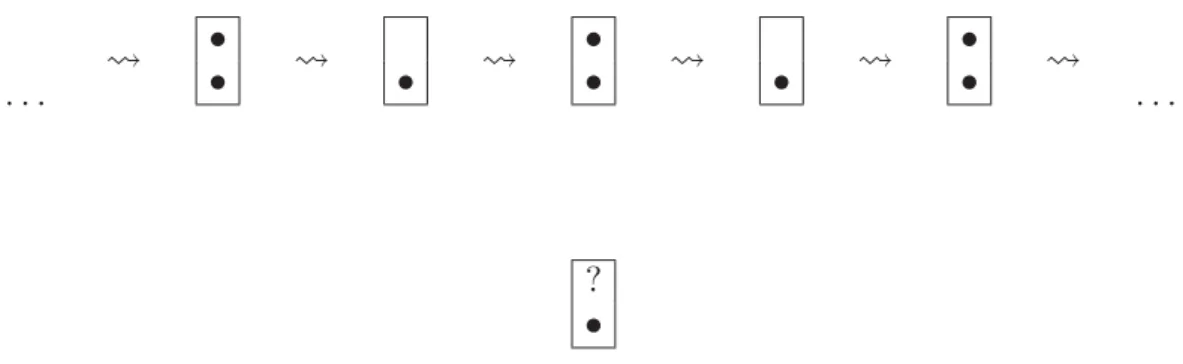
under consideration, then one may construct the desired algorithms, or descrip- tions, of these non-coric portions in terms of coric containers, up to certain relatively mild indeterminacies [i.e., which reflect the non-coric nature of these non-coric portions!] — cf. the illustration of this sort of situation given in Fig. I.2 below; Remark 3.3.1, (iii); Remark 3.6.1, (ii). In the context of the log-theta-lattice, this is precisely the sort of situation that was achieved in [IUTchIII], Theorem A [cf. the discussion of [IUTchIII], Introduction].
. . . •
• • •
• • •
•
. . .
?
•
Fig. I.2: A coric container underlying a sequence of mutations
In the context of the above discussion of set-theoretic aspects of the theory developed in the present series of papers, it is of interest to note the following observation, relative to the analogy between the theory of the present series of papers and p-adic Teichm¨uller theory [cf. the discussion of [IUTchI], §I4]. If, instead of workingspecies-theoretically, one attempts to documentall of the possible choices that occur in various newly introduced universes that occur in a construc- tion, then one finds that one is obliged to work with sets, such as sets obtained via set-theoretic exponentiation, of very large cardinality. Such sets of large cardinality are reminiscent of the exponentially large denominators that occur if one attempts to p-adically formally integrate an arbitrary connection as opposed to a canonical crystalline connection of the sort that occurs in the context of the canonical liftings of p-adic Teichm¨uller theory [cf. the discussion of Remark 3.6.2, (iii)]. In this context, it is of interest to recall the computations of [Finot], which assert, roughly speaking, that the canonical liftings of p-adic Teichm¨uller theory may, in certain cases, be characterized as liftings “of minimal complexity”
in the sense that their Witt vector coordinates are given bypolynomials ofminimal degree.
Finally, we observe that although, in the above discussion, we concentrated on the similarities, from an “inter-universal” point of view, between the vertical and horizontalarrows of the log-theta-lattice, there is one important differencebetween these vertical and horizontal arrows: namely,
· whereas the copies of the full arithmetic fundamental group — i.e., in particular, the copies of thegeometric fundamental group— on either side of a vertical arrow are identified with one another,
· in the case of a horizontal arrow, only the Galois groups of the local base fields on either side of the arrow are identified with one another
— cf. the discussion of Remark 3.6.3, (ii). One way to understand the reason for this difference is as follows. In the case of the vertical arrows — i.e., the log- links, which, in essence, amount to the various local p-adic logarithms — in order to construct the log-link, it is necessary to make use, in an essential way, of the local ring structures at v ∈ V [cf. the discussion of [IUTchIII], Definition 1.1, (i), (ii)], which may only be reconstructed from the full arithmetic fundamental group. By contrast, in order to construct the horizontal arrows — i.e., the Θ×μLGP- links — this local ring structure is unnecessary. On the other hand, in order to construct the horizontal arrows, it is necessary to work with structures that, up to isomorphism, are common to both the domain and the codomain of the arrow.
Since the construction of the domain of the Θ×μLGP-link depends, in an essential way, on the Gaussian monoids, i.e., on the labels ∈ Fl for the theta values, which are constructed from the geometric fundamental group, while the codomain only involves monoids arising from the localq-parameters“q
v” [forv ∈Vbad], which are constructed in a fashion that isindependentof theselabels, in order to obtain an isomorphism between structures arising from the domain and codomain, it is necessary to restrict one’s attention to the Galois groups of the local base fields, which are free of any dependence on these labels.
Acknowledgements:
The research discussed in the present paper profited enormously from the gen- erous support that the author received from theResearch Institute for Mathematical Sciences, a Joint Usage/Research Center located in Kyoto University. At a personal level, I would like to thank Fumiharu Kato, Akio Tamagawa, Go Yamashita, Mo- hamed Sa¨ıdi,Yuichiro Hoshi,Ivan Fesenko,Fucheng Tan,Emmanuel Lepage,Arata Minamide, and Wojciech Porowskifor many stimulating discussions concerning the material presented in this paper. Also, I feel deeply indebted to Go Yamashita, Mohamed Sa¨ıdi, and Yuichiro Hoshi for their meticulous reading of and numer- ous comments concerning the present paper. In addition, I would like to thank Kentaro Sato for useful comments concerning the set-theoretic and foundational aspects of the present paper, as well as Vesselin Dimitrov and Akshay Venkatesh for useful comments concerning the analytic number theory aspects of the present paper. Finally, I would like to express my deep gratitude to Ivan Fesenko for his quite substantial efforts to disseminate — for instance, in the form of a survey that he wrote — the theory discussed in the present series of papers.
Notations and Conventions:
We shall continue to use the “Notations and Conventions” of [IUTchI], §0.
Section 1: Log-volume Estimates
In the present §1, we perform various elementary local computations con- cerning nonarchimedean and archimedean local fields which allow us to obtainmore explicit versions [cf. Theorem 1.10 below] of the log-volume estimatesfor Θ- pilot objects obtained in [IUTchIII], Corollary 3.12.
In the following, if λ ∈R, then we shall write λ (respectively, λ )
for the smallest (respectively, largest) n∈Z such that n≥λ (respectively, n≤λ).
Also, we shall write “log(−)” for the natural logarithmof a positive real number.
Proposition 1.1. (Multiple Tensor Products and Differents) Let p be a prime number, I a finite set of cardinality ≥ 2, Qp an algebraic closure of Qp. Write R ⊆ Qp for the ring of integers of Qp and ord : Q×p → Q for the natural p-adic valuation on Qp, normalized so that ord(p) = 1; for λ ∈ Q, we shall write pλ for “some” [unspecified] element of Qp such that ord(pλ) = λ. For i ∈ I, let ki ⊆ Qp be a finite extension of Qp; write Ri def= Oki = R
ki for the ring of integers of ki and di ∈ Q≥0 for the order [i.e., “ord(−)”] of any generator of the different ideal of Ri over Zp. Also, for any nonempty subset E ⊆I, let us write
RE def=
i∈E
Ri; dE def=
i∈E
di
— where the tensor product is over Zp. Fix an element ∗ ∈I; write I∗ def= I\ {∗}. Then
pdI∗ ·(RI)∼ ⊆ RI ⊆ (RI)∼
— where we write “(−)∼” for the normalization of the [reduced] ring in paren- theses in its ring of fractions, and we observe that it follows immediately from the definition of the “normalization” that the notation on the left-hand side of the first inclusion of the above display is well-defined for suitable “pdI∗” [such as products of elements pdi ∈ Ri, for i ∈ I∗] and independent of the choice of such suitable
“pdI∗”.
Proof. Let us regard RI as an R∗-algebra in the evident fashion. It is immediate from the definitions that RI ⊆ (RI)∼. Now observe that
R⊗R∗ RI ⊆ R⊗R∗(RI)∼ ⊆ (R⊗R∗ RI)∼
— where (R⊗R∗RI)∼ decomposes as adirect sumof finitely many copies of R. In particular, one verifies immediately, in light of the fact the Ris faithfully flat over R∗, that to complete the proof of Proposition 1.1, it suffices to verify that
pdI∗ ·(R⊗R∗ RI)∼ ⊆ R⊗R∗RI
— where we observe that it follows immediately from the definition of the “nor- malization” that the notation on the left-hand side of the inclusion of the above display is well-defined and independent of the choice of “pdI∗”. On the other hand, it follows immediately from induction on the cardinality ofI that to verify this last inclusion, it suffices to verify the inclusion in the case whereI is of cardinality two.
But in this case, the desired inclusion follows immediately from the definition of the different ideal. This completes the proof of Proposition 1.1.
Proposition 1.2. (Differents and Logarithms) We continue to use the notation of Proposition 1.1. For i ∈ I, write ei for the ramification index of ki over Qp;
ai def= 1
ei · ei
p−2 if p >2, ai def= 2 if p= 2; bi def= log(p·ei/(p−1)) log(p) − 1
ei. Thus,
if p >2 and ei ≤p−2, then ai = 1
ei =−bi. For any nonempty subset E ⊆I, let us write
logp(R×E) def=
i∈E
logp(R×i ); aE def=
i∈E
ai; bE def=
i∈E
bi
— where the tensor product is overZp; we write “logp(−)” for thep-adic logarithm.
For λ ∈ e1
i ·Z, we shall write pλ·Ri for the fractional ideal of Ri generated by any element “pλ” of ki such that ord(pλ) =λ. Let
φ: logp(R×I )⊗Qp →∼ logp(RI×)⊗Qp
be an automorphismof the finite dimensionalQp-vector spacelogp(R×I )⊗Qp that induces an automorphism of the submodule logp(R×I ). Then:
(i) We have:
pai·Ri ⊆ logp(R×i ) ⊆ p−bi·Ri
— where the “⊆’s” are equalities when p >2 and ei ≤p−2.
(ii) We have:
φ(pλ·(RI)∼) ⊆ pλ−dI−aI·logp(R×I )
⊆ pλ−dI−aI−bI ·(RI)∼
for any λ ∈ e1i ·Z, i ∈ I. [Here, we observe that, just as in Proposition 1.1, it follows immediately from the definition of the “normalization” that the notation of the above display is well-defined and independent of the various choices involved.]
In particular, φ((RI)∼) ⊆ p− dI+aI·logp(R×I ) ⊆ p− dI+aI−bI ·(RI)∼.
(iii) Suppose that p >2, and that ei ≤p−2 for all i∈I. Then we have:
φ(pλ ·(RI)∼) ⊆ pλ−dI−1·(RI)∼ for any λ ∈ e1
i ·Z, i ∈ I. [Here, we observe that, just as in Proposition 1.1, it follows immediately from the definition of the “normalization” that the notation of the above display is well-defined and independent of the various choices involved.]
In particular, φ((RI)∼) ⊆ p−dI−1·(RI)∼.
(iv) If p >2 and ei = 1 for all i∈I, then φ((RI)∼) ⊆ (RI)∼.
Proof. Sinceai > p−11, pbi
+ 1ei
ei > p−11 [cf. the definition of “−”, “− ”!], asser- tion (i) follows immediately from the well-known theory of thep-adic logarithmand exponentialmaps [cf., e.g., [Kobl], p. 81]. Next, we consider assertion (ii). Observe that it follows from the first displayed inclusion [of RI-modules!] of Proposition 1.1 that
pdI+aI ·(RI)∼ ⊆
i∈I
pai ·Ri
⊆ RI =
i∈I
Ri
and hence that
pλ·(RI)∼ ⊆ pλ−dI−aI ·pdI+aI ·(RI)∼
⊆ pλ−dI−aI·pdI+aI ·(RI)∼
⊆ pλ−dI−aI·logp(RI×) ⊆ pλ−dI−aI−bI ·(RI)∼
— where, in the passage to the third and fourth inclusions following “pλ·(RI)∼”, we apply assertion (i). [Here, we observe that, just as in Proposition 1.1, it follows im- mediately from the definition of the “normalization” that the notation of the above two displays is well-defined and independent of the various choices involved.] Thus, assertion (ii) follows immediately from the fact thatφinduces an automorphism of the submodule logp(R×I ). Assertion (iii) follows from assertion (ii), together with the fact that if p > 2 and ei ≤ p−2 for all i ∈ I, then we have aI = −bI, which implies that λ−dI −aI −bI ≥λ−dI −aI −1−bI ≥λ−dI −1. Assertion (iv) follows from assertion (ii), together with the fact that if p > 2 and ei = 1 for all i∈I, then we have dI = 0, aI =−bI ∈Z. This completes the proof of Proposition 1.2.
Proposition 1.3. (Estimates of Differents) We continue to use the notation of Proposition 1.2. Suppose that k0 ⊆ ki is a subfield that contains Qp. Write R0 def= Ok0 for the ring of integers of k0, d0 for the order [i.e., “ord(−)”] of any generator of the different ideal of R0 over Zp, e0 for the ramification index of k0 over Qp, ei/0 def= ei/e0 (∈ Z), [ki : k0] for the degree of the extension ki/k0, ni for the unique nonnegative integer such that [ki : k0]/pni is an integer prime to p.
Then:
(i) We have:
di ≥d0 + (ei/0−1)/(ei/0·e0) =d0+ (ei/0−1)/ei
— where the “≥” is an equality if ki is tamely ramified over k0.
(ii) Suppose that ki is a finite Galois extension of a subfield k1 ⊆ki such that k0 ⊆k1, and k1 is tamely ramified over k0. Then we have: di ≤d0+ni+ 1/e0. Proof. By replacing k0 by an unramified extension of k0 contained in ki, we may assume without loss of generality in the following discussion that ki is a totally ramifiedextension ofk0. First, we consider assertion (i). Let π0 be a uniformizer of R0. Then there exists an isomorphism of R0-algebras R0[x]/(f(x)) →∼ Ri, where f(x) ∈R0[x] is a monic polynomial which is ≡xei/0 (mod π0), that maps x →πi for some uniformizer πi of Ri. Thus, the different di may be computed as follows:
di−d0 = ord(f(πi)) ≥ min(ord(π0),ord(ei/0·πeii/0−1))
≥ min 1
e0,ord(πeii/0−1)
= min 1
e0,ei/0−1 ei/0·e0
= ei/0−1 ei
— where, for λ, μ ∈ R such that λ ≥ μ, we define min(λ, μ) def= μ. When ki is tamely ramified over k0, one verifies immediately that the inequalities of the above display are, in fact, equalities. This completes the proof of assertion (i).
Next, we consider assertion (ii). We applyinduction onni. Since assertion (ii) follows immediately from assertion (i) whenni = 0, we may assume thatni ≥1, and that assertion (ii) has been verified for smaller “ni”. By replacingk1by some tamely ramified extension of k1 contained in ki, we may assume without loss of generality that Gal(ki/k1) is ap-group. Sincep-groups are solvable, andki is atotally ramified extension of k0, it follows that there exists a subextension k1 ⊆k∗ ⊆ki such that ki/k∗ and k∗/k1 are Galois extensions of degree p and pni−1, respectively. Write R∗ def= Ok∗ for the ring of integers of k∗, d∗ for the order [i.e., “ord(−)”] of any generator of the different ideal of R∗ over Zp, and e∗ for the ramification index of k∗ overQp. Thus, by the induction hypothesis, it follows thatd∗ ≤d0+ni−1+1/e0. To verify that di ≤d0+ni+ 1/e0, it suffices to verify that di ≤d0+ni+ 1/e0+ for any positive real number . Thus, let us fix a positive real number . Then by possibly enlarging ki and k1, we may also assume without loss of generality that the tamely ramified extension k1 of k0 contains a primitive p-th root of unity, and, moreover, that the ramification index e1 of k1 over Qp satisfies the inequality e1 ≥ p/ [so e∗ ≥e1 ≥ p/]. Thus, ki is a Kummer extension of k∗. In particular, there exists an inclusion of R∗-algebras R∗[x]/(f(x)) → Ri, where f(x) ∈R∗[x]
is a monic polynomial which is of the form f(x) = xp −∗ for some element ∗ of R∗ satisfying the estimates 0 ≤ ord(∗) ≤ p−e∗1, that maps x → i for some element i of Ri satisfying the estimates 0≤ord(i)≤ p−p·e1∗. Now we compute:
di ≤ ord(f(i)) +d∗ ≤ ord(p·p−i 1) +d0+ni−1 + 1/e0
= (p−1)·ord(i) +d0+ni+ 1/e0 ≤ (p−1)2
p·e∗ +d0+ni+ 1/e0
≤ p
e∗ +d0+ni+ 1/e0 ≤ d0+ni+ 1/e0+
— thus completing the proof of assertion (ii).
Remark 1.3.1. Similar estimates to those discussed in Proposition 1.3 may be found in [Ih], Lemma A.
Proposition 1.4. (Nonarchimedean Normalized Log-volume Estimates) We continue to use the notation of Proposition 1.2. Also, for i∈I, write Rμi ⊆R×i for the torsion subgroup of R×i , R×μi def= R×i /Rμi , pfi for the cardinality of the residue field of ki, and pmi for the order of the p-primary component of Riμ. Thus, the order of Rμi is equal to pmi ·(pfi−1). Then:
(i) The log-volumes constructed in [AbsTopIII], Proposition 5.7, (i), on the various finite extensions of Qp contained in Qp may be suitably normalized [i.e., by dividing by the degree of the finite extension] so as to yield a notion of log-volume
μlog(−)
defined on compact open subsets of finite extensions of Qp contained in Qp, valued in R, and normalized so that μlog(Ri) = 0, μlog(p·Ri) =−log(p), for each i ∈ I.
Moreover, by applying the fact that tensor products of finitely many finite extensions ofQp overZp decompose, naturally, as direct sums of finitely many finite extensions of Qp, we obtain a notion of log-volume — which, by abuse of notation, we shall also denote by “μlog(−)” — defined on compact open subsets of such tensor products, valued inR, and normalized so that μlog((RE)∼) = 0, μlog(p·(RE)∼) =
−log(p), for any nonempty set E ⊆I. (ii) We have:
μlog(logp(R×i )) =−1
ei + mi eifi
·log(p)
[cf. [AbsTopIII], Proposition 5.8, (iii)].
(iii) Let I∗ ⊆I be a subset such that for each i∈I \I∗, it holds that p−2 ≥ ei (≥ 1). Then for any λ ∈ e1
i† ·Z, i† ∈ I, we have inclusions φ(pλ ·(RI)∼) ⊆ pλ−dI−aI·logp(RI×) ⊆ pλ−dI−aI−bI ·(RI)∼ and inequalities
μlog(pλ−dI−aI·logp(R×I )) ≤
−λ+dI + 1 + 4· |I∗|/p
·log(p);
μlog(pλ−dI−aI−bI ·(RI)∼) ≤
−λ+dI + 1
·log(p) +
i∈I∗
{3 + log(ei)}
— where we write “|(−)|” for the cardinality of the set “(−)”. Moreover, dI+aI ≥
|I| if p >2; dI +aI ≥ 2· |I| if p= 2.
(iv) If p > 2 and ei = 1 for all i ∈ I, then φ((RI)∼) ⊆ (RI)∼, and μlog((RI)∼) = 0.
Proof. Assertion (i) follows immediately from the definitions. Next, we consider assertion (ii). We begin by observingthat every compact open subset of Ri×μ may be covered by a finite collection of compact open subsets of R×μi that arise as