Supervised Learning of Acoustic Models in a Zero Resource Setting to Improve DPGMM Clustering
Michael Heck, Sakriani Sakti, Satoshi Nakamura
Augmented Human Communication Laboratory, Graduate School of Information Science, Nara Institute of Science and Technology,
Nara, Japan
{michael-h,ssakti,s-nakamura}@is.naist.jp
Abstract
In this work we utilize a supervised acoustic model training pipeline without supervision to improve Dirichlet process Gaus- sian mixture model (DPGMM) based feature vector clustering.
We exploit methods common in supervised acoustic modeling to unsupervisedly learn feature transformations for application to the input data prior to clustering. The idea is to automatically find mappings of feature vectors into sub-spaces that are more robust to channel, context and speaker variability. The need of labels for these techniques makes it difficult to use them in a zero resource setting. To overcome this issue we utilize a first iteration of DPGMM clustering to generate frame based class labels for the target data. The labels serve as basis for learn- ing an acoustic model in the form of hidden Markov models (HMMs) using linear discriminant analysis (LDA), maximum likelihood linear transform (MLLT) and speaker adaptive train- ing (SAT). We show that the learned transformations lead to features that consistently outperform untransformed features on the ABX sound class discriminability task. We also demon- strate that the combination of multiple clustering runs is a suit- able method to further enhance sound class discriminability.
Index Terms: acoustic unit discovery, Bayesian nonparamet- rics, Dirichlet process, feature transformation, Gibbs sampling, unsupervised linear discriminant analysis, zero resource
1. Introduction
In azero resource scenario, large amounts of labeled training data, parallel data, and knowledge about the target language are unavailable for developing speech processing systems with su- pervised techniques. Albeit significant advances in developing methods for unsupervised learning, current speech processing technology is not yet capable to imitate the natural capacities of infants to robustly learn acoustic and language models in an unsupervised way. Specialized evaluations such as the zero re- source speech challenge [1] address this demanding task.
Confronted with an unknown language, phonologists usu- ally attempt to define a set of acoustic units to fully cover the underlying sound repertoire. Machine learning approaches to this task are pattern matching [2, 3] on raw audio data and unsu- pervised sound unit detection [4]. These techniques have been successfully applied to solve tasks such as spoken term detec- tion [5], topic segmentation [6] or document classification [7].
Model complexity usually is not known a priori when deal- ing with new data sets. Bayesian models such as the Dirichlet process Gaussian mixture model (DPGMM) can automatically adjust the model complexity given some data and have already
been successfully applied to speech processing tasks such as un- supervised lexical clustering [8]. Chen et al. [9] cluster standard MFCC speech features by inferring a DPGMM and demonstrate its suitability for automatic detection of sound classes in untran- scribed data. Their work is the best-performing contribution to the zero resource speech challenge 2015 [1].
Speech processing systems typically utilize feature trans- formations to increase sound class discriminability. Linear dis- criminant analysis (LDA) [10] is a standard technique to min- imize intra-class discriminability, to maximize inter-class dis- criminability and to extract relevant informations from high- dimensional features spanning larger contexts. Maximum like- lihood linear transforms (MLLT) [11, 12] and feature-space maximum likelihood linear regression (fMLLR) [13, 14] are commonly used to de-correlate feature components and for speaker adaptation. Naturally, class discriminating properties are critical for clustering, and adaptive feature transformations can help dealing with speaker variability. However, methods such as LDA need class labels for estimating the feature trans- formations, making it difficult to use them in a zero resource setting where the classes and even their amount are unknown.
In previous work [15] we demonstrated that it is possible to learn LDA transformations on automatically generated la- bels, and that these transformations can be used to produce fea- ture vectors that considerably improve clustering performance.
There has been work that utilize k-means clustering to automat- ically obtain pseudo labels for LDA estimation [16, 17]. But unlike in these studies we were able to overcome the limitation of having to predefine the size of prospective label sets by uti- lizing the non-parametric DPGMM sampler for clustering.
In this work we improve the DPGMM clustering by utiliz- ing multiple feature transformations that can be combined with the previously exploited LDA transformations. Labels that were automatically generated in a first pass of DPGMM clustering serve as basis for learning an acoustic model using LDA, MLLT and fMLLR in an entirely unsupervised fashion. We demon- strate that each feature transformation helps improve cluster quality and that the conjunction of transformations leads to the best results. We also demonstrate that combining multiple clus- tering runs can greatly boost sound class discriminability.
2. Dirichlet process Gaussian mixture model
DPGMMs (also known as infinite GMMs) extend finite mixture models by the aspect of automatic model selection: The model INTERSPEECH 2016
September 8–12, 2016, San Francisco, USA
finds its complexity automatically given the data. Inference is typically sample based using a Markov chain Monte Carlo (MCMC) scheme such as Gibbs sampling. The sampler used here combines a restricted Gibbs sampler with a split/merge sampler. For more in-depth informations, please refer to [9, 18].
2.1. Generative process
LetX={x1,· · ·, xn}be a set of observations. The generative process ofXgiven a DPGMM is as follows:
• Mixing weightsπ = {π1,· · ·, πk}are generated ac- cording to a stick-breaking process
• GMM parametersθ = {θ1,· · ·, θk}are generated ac- cording to a prior distributionNIW(mk, Sk, κk, νk)
• A labelziis assigned to everyxi, according toπ
• xiis generated according to thezi-th GMM component θk={µk,Σk}are Gaussian parameters, and the parameter set of the prior Normal-inverse-Wishart (NIW) distribution consists of a priorm0forµk, a priorS0forΣk, the belief-strengthκ0
inm0and the belief-strengthν0inS0. 2.2. Inference
The parallelizable sampler alternates between a non-ergodic re- stricted Gibbs sampler and a split/merge sampler to form an ergodic MCMC sampler.
Restricted Gibbs samplingallows labelszito be sampled from a finite setZ. By definition of the DPGMM, the distribu- tion of the mixture weights follows a Dirichlet distribution.
Split/merge sampling performs on the existing compo- nents. To provide good split candidates, each component is augmented with two sub-clusterscklandckr, and each obser- vation of a component is augmented with a sub-cluster label zsubi ∈l, r. Split moves are proposed in a Metropolis-Hastings fashion. Merge steps are proposed randomly.
2.3. Posteriorgram generation
The posterior probability of clusterck, given observationxiis p(ck|xi) = πkN(x|θk)
PN(x|θj) (1)
andpi= (p(c1|xi),· · ·, p(cK|xi))is the posteriorgram forxi.
3. Unsupervised speech feature transformation
We showed in [15] that the quality of DPGMM based speech feature vector clustering can be improved by using LDA trans- formed features as input, where the LDA transformations were estimated in an unsupervised fashion. To further improve the clustering quality we propose an extension to this work by uti- lizing transformations that can be used in conjunction to benefit from additive effects. The transformations help to project fea- ture vectors into a more suitable sub-space for sound class dis- crimination by feature de-correlation and speaker adaptation.
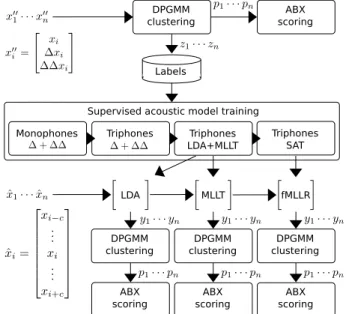
The need of labels and models makes it difficult to use these methods in a zero resource setting out of the box. Not only are there no labels for the target data available, but class identities and even the amount of classes are also unknown. Confronted with an unknown language there is often no easy way to boot- strap acoustic models. In order to overcome these issues, we use a two-staged clustering framework that automatically finds frame-based class labels in a first clustering of the target data.
DPGMM clustering
ABX scoring
fMLLR MLLT
LDA
DPGMM clustering
DPGMM clustering
DPGMM clustering
ABX scoring
ABX scoring
ABX scoring Labels
Monophones Triphones Triphones LDA+MLLT
Triphones SAT Supervised acoustic model training
Figure 1:Scheme of the iterative sampling process.
3.1. Two-stage clustering
An initial DPGMM clustering on standard feature vectors with derivatives (x00i) provides generic class labels and the hypoth- esized class membership of every speech frame. Each class is simply named with the numeric ID of the Gaussian that most likely produced the respective feature vector.
The frame-wise labels serve as basis for the subsequent model training. For each utterance, we collapse the labels to ap- proximate a more natural textual reference type by compressing all subsequent tokens of the same type to a single token, imitat- ing a phone based transcription of the audio recordings.
Figure 1 is a graphical overview of the iterative acoustic model training and clustering pipeline. Once we extract new feature vectorsyiusing one or more of the transformations in conjunction, we perform another run of frame-based DPGMM clustering. Stages at which we extract the posteriorgrams for evaluation are namedABX scoring. Each stage produces a more advanced set of features for clustering, ranging from untrans- formed features to LDA+MLLR+fMLLR transformed features.
3.2. Supervised acoustic model training
We initialize the acoustic model by context-independent mono- phone training. Then we subsequently train context dependent triphones on untransformed standard features, followed by LDA and MLLT estimation and model training on transformed fea- tures. Finally, we train a SAT model with fMLLR.
We use a 3-state HMM topology with a skip from the first state to the next HMM to allow a more dynamic alignment. Due to the nature of the automatic labels, some utterances might be represented with a relatively high number of tokens. The skip state guarantees that an alignment is always found.
3.2.1. Dimension-reducing LDA
LDA is a simple linear transformation that we use to minimize intra-class discriminability and maximize inter-class discrim- inability of the speech features. LDA also enables us to do dimensional reduction of high-dimensional stacked feature vec- tors (ˆxi) that span a larger contextcby omitting lower-ranked
coefficients. Estimation of the transformation requires the fea- ture vectors and respective class labels. In our pipeline we learn LDA transformations using the acoustic states as classes.
3.2.2. De-correlating MLLT
We attempt to apply MLLT to feature vectors so that corre- lations between the feature vector components are captured.
MLLT is computed for distributions of speech observations in the HMMs of speech recognizers. The state-dependent trans- formations are estimated so that the likelihood of the adaptation data is maximized. We learn the transformations given the ini- tialized HMMs of our unsupervisedly trained acoustic model.
3.2.3. Speaker-adapting fMLLR
fMLLR is an algorithm for speaker adaptive training (SAT). The idea of SAT is to capture inter-speaker variability in speaker de- pendent transforms and to generate speaker independent state distributions instead. The transformations are estimated based on alignments with speaker-independent features so that the likelihoods are maximized. We apply fMLLR in this zero re- source setting because we expect the transformations to help eliminate variance caused by multiple speakers.
4. Clustering combination
For further improvement of the DPGMM clustering quality we developed a method to combine the results ofnclustering runs, which are sets of posteriorgrams. For each frame, we add to- gether thenindividual posteriorgrams and normalize the new vectors so that they form proper posteriorgrams again.
Because the amount of found classes differs for each clus- tering run, a mapping between any two sets of posteriorgrams is needed. Givennsets of posteriorgrams, we randomly pick one of these sets astarget set, and consider all other sets assource sets. We use the numeric frame-wise class labels as transcrip- tions for our data. For each source/target pair we first align the transcriptions and count the co-occurrences of classes. Then we keep the single most probable “translation” for each class and map the posteriorgrams into the target space as shown by the example in Figure 2.
Algorithm 1Combination of dynamically sized posteriorgrams Require: SetP={P1,· · ·, Pn}of sets of posteriorgrams Ensure: Combined posteriorgramsPˆ
1: ptgt←random set fromP
2: ltgt←generate labels from posteriorgramsptgt
3: Pˆ←ptgt
4: for all psrc∈ P \ptgt do
5: lsrc←generate labels from posteriorgramspsrc
6: count symbol pair occurrences in align(lsrc,ltgt) 7: m←1-best mapping for all symbols in unique(lsrc) 8: Pˆ←Pˆ+map(psrc,ptgt,m)
9: end for
10: Pˆ←normalizePˆ
Posteriorgram from source set:
Class labels from source set:
1-best map:
Class labels mapped to target set:
Posteriorgram in target space:
(0.00, 0.01, 0.15, 0.70, 0.09, 0.00, 0.04) 0, 1, 2, 3, 4, 5, 6 2, 0, 1, 1, 3, 5, 4 0, 1, 2, 3, 4, 5 (0.01, 0.85, 0.00, 0.09, 0.04, 0.00)
Figure 2:Example of a posteriorgram mapping.
5. Experiments
5.1. Data
The database for all our experiments is the official data set of the Interspeech zero resource speech challenge [1], which contains two separate data sets of pure speech for American English (4h 59min) and Xitsonga (2h 29min), a southern African Bantu lan- guage. The segments contain non-overlapping speech of exactly one speaker and noise or pauses. The English data is extracted from the Buckeye corpus and consists of conversational speech.
The Xitsonga data is an excerpt of the NCHLT corpus and is comprised of read speech.
5.2. Evaluation
The evaluation metric we use to measure the cluster qual- ity is based on the minimal pair ABX phone discriminability task [19], which is related to the ABX task used in psycho- physics [20]. Each cluster is considered a phone in the context of the evaluation. We score GMM posteriorgrams that are com- puted for each speech frame after clustering, as described in Section 2.3. LetAandBbe stimuli belonging to sound cate- goriesaandb. The ABX phone discrimination accuracy is
c(a, b) = 1
|a| · |b| ·(|a| −1) X
A∈a
X
B∈b
X
X∈a\{A}
(δd(A,X)<d(B,X)+1
2δd(A,X)=d(B,X)) (2) whered(a, b)is the dynamic time warping (DTW) divergence andδis an indicator function. As in Schatz et al. [19], we use the Kullback-Leibler divergence to compute the DTW diver- gences. Our scores are the error rates within and across speak- ers. The rates are averaged over all contexts for a given pair of central phonemes and then over all pairs of central phonemes.
5.3. Setup
We utilize the Kaldi speech recognition toolkit [21] to train the acoustic model used in our framework by following a standard scheme for speaker adaptive training.
We use the same parameters than Chen et al. [9] to ensure comparability. DPGMM sampling is done for 1500 iterations, and the priors are set so thatm0is the global mean,S0 is the global covariance,κ0 = 1, andα= 1. The value ofν0slightly varies and is set to the toolkit’s default ofν0 =D+ 3, where Dis the dimension of the input feature vectors. All feature vec- tor types are extracted for a frame length of 25msec and frame shift of 10msec. Mean variance normalization (MVN) and vo- cal tract length normalization (VTLN) is applied.
5.4. Baseline
For our baseline we extract 39 dimensional MFCC+∆+∆∆as input to the DPGMM sampler. We also compare to the results of Chen et al. [9] as reference due to the identical clustering setup.
The details are listed in Table 1. Despite using the same sam- pling setup and input feature types, there is a mismatch between the results of Chen et al. [9] and our baselines. We believe this mismatch is caused by the fact that Chen et al. uses a custom voice activity detection for segmenting the full 10 hours of En- glish data and does not mention any segmentation attempts for the 5 hours of Xitsonga data, where we use the officially pro- vided segmentation that limits both data sets to about half the amount. Due to the differences we start with a higher error rate on English, but a lower error rate on Xitsonga.
English Xitsonga
Features within across within across
MFCC+∆+∆∆([9]) 10.8 16.3 9.6 17.2
MFCC+∆+∆∆([15]) 12.2 19.5 8.9 14.2
PLP+∆+∆∆ 11.8 19.6 8.5 13.9
PLP+LDA 10.5 16.1 8.3 12.8
PLP+MLLT 10.5 16.2 8.4 12.9
PLP+MLLT+fMLLR 10.6 15.7 8.4 12.2
Best combination 10.0 14.9 8.1 11.7
Table 1:The optimal results for each input feature type.
5.5. Untransformed features
In our previous work [15] we found that PLP feature vectors are consistently leading to a higher clustering quality than MFCC feature vectors. We therefore conducted all clustering experi- ments based on this feature type.
5.6. Dimension-reducing LDA
The LDA transformation takes stacked standard feature vectors without their derivatives as input. Following our findings in [15]
we fix the stacking context parameter set toc= 4, and the out- put dimensionality tod= 20. With the application of LDA we were able to produce feature vectors that considerably helped the DPGMM clustering process to find better clusters. The error rates for both languages dropped consistently, and espe- cially across speakers a clear performance boost is observable.
LDA features outperform our own baseline and also undercut the numbers of Chen et al. [9], thus compensating for the deficit in the baseline numbers that we had to begin with.
5.7. De-correlating MLLT
Applying MLLT to the LDA transformed features did not lead to a better clustering quality. This lets us assume that the de- correlating effects might not be able to aid this particular task, albeit being useful during a decoding task, as experience shows.
5.8. Speaker-adapting fMLLR
The transformations learned with fMLLR during the speaker adaptive acoustic model training prove to be very useful for boosting the discrimination capabilities across speakers. A rel- ative improvement of 3% for English and almost 6% for Tsonga proves that fMLLR based speaker adaptive transformations can considerably improve clustering quality in the face of speaker variations and greatly benefit the clustering task.
5.9. Posteriorgram combination
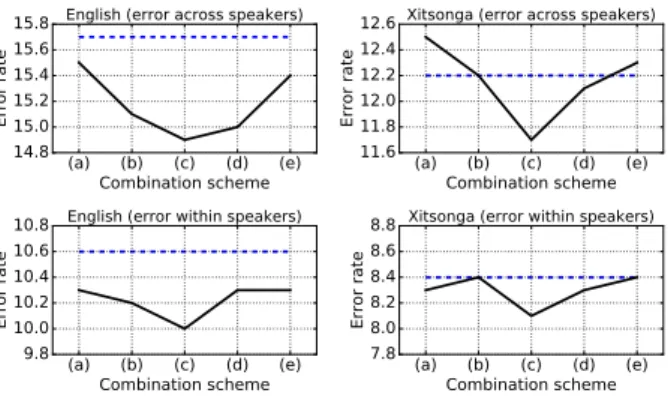
We tested combining several clustering results across (a) trans- formations, (b) features, (c) LDA input and (d) output dimen- sionalities, and (e) given multiple identical clustering runs. The results are plotted in Figure 3.
For the combination across transformations, we ran sepa- rate clusterings for each type of transformed features. However, this seems not particularly helpful. Discrimination errors for English slightly drop, but increase for Xitsonga. As fMLLR is applied to LDA+MLLT features, all useful information seems already encapsulated in the fMLLR-transformed features. Sim- ilarly, combining separate MFCC and PLP feature clustering results led to lower errors on English, but not on Xitsonga.
Combining across LDA input dimensions, where the con- text parametercranges from 1 to 8, was by far the most ef-
(a) (b) (c) (d) (e) Combination scheme 14.815.0
15.215.4 15.615.8
Error rate
English (error across speakers)
(a) (b) (c) (d) (e) Combination scheme 10.09.8
10.210.4 10.610.8
Error rate
English (error within speakers)
(a) (b) (c) (d) (e) Combination scheme 11.611.8
12.012.2 12.412.6
Error rate
Xitsonga (error across speakers)
(a) (b) (c) (d) (e) Combination scheme 7.88.0
8.28.4 8.68.8
Error rate
Xitsonga (error within speakers)
Figure 3: Error rates after combination of clustering results.
The dotted line is the best performance before combination.
ficient scheme, boosting the discrimination quality across lan- guages considerably. Combination across LDA output dimen- sionsd ∈ {16,20,23,26}also led to a better performance across the board, but to a lesser extent. These results let us assume that higher dimensional coefficients still carry compli- mentary information that can help in a combination scheme, al- beit performing worse for clustering in isolation [15].
Clustering one feature set five times with subsequent com- bination of the results had a slightly positive effect on English, but was not helpful on Xitsonga. We assume the DPGMM clus- ter generally leads to consistent output and multiple parallel it- erations are therefore not particularly useful.
6. Conclusion
We successfully utilized a supervised acoustic model training pipeline without supervision to improve DPGMM based fea- ture vector clustering. Feature transformations estimated dur- ing model training can be used to map speech feature vectors into subspaces that are more suitable for clustering. Gaus- sian posteriorgrams extracted from a DPGMM that was sam- pled on transformed vectors carry better sound class discrimi- nating characteristics than the ones sampled on untransformed standard features. We showed that LDA greatly benefits sound class discriminability within and across speakers. Consecutive fMLLR transformation noticeably decreases the discrimination error across speakers, proving the importance of speaker adap- tation in solving the clustering task.
Combining multiple runs of LDA+MLLT+fMLLR- transformed feature vector clustering that use varying input dimensionalities yielded the the best results. We achieved error rates of 10% within and 14.9% across speakers for English, and 8.1% within and 11.7% across speakers for Xitsonga, respectively. Given these results, our proposed two-stage clustering framework clearly outperforms our own baseline, as well as the baseline set by Chen et al. [9].
Our two-staged clustering approach is particularly suit- able for low-resource languages and the zero-resource scenario.
Moreover, this framework might as well be of help for more general purposes beyond low-resource languages. In future work we will explore the applicability of our model training and clustering pipeline to solving other tasks beyond sound unit detection.
7. Acknowledgements
Part of this research was supported by JSPS KAKENHI Grant Number 24240032 and 26870371.
8. References
[1] M. Versteegh, R. Thiolliere, T. Schatz, X. N. Cao, X. Anguera, A. Jansen, and E. Dupoux, “The zero resource speech challenge 2015,” inProceedings of Interspeech, 2015.
[2] A. Park and J. Glass, “Towards unsupervised pattern discovery in speech,” inAutomatic Speech Recognition and Understanding, 2005 IEEE Workshop on. IEEE, 2005, pp. 53–58.
[3] ——, “Unsupervised pattern discovery in speech,”Audio, Speech, and Language Processing, IEEE Transactions on, vol. 16, no. 1, pp. 186–197, 2008.
[4] B. Varadarajan, S. Khudanpur, and E. Dupoux, “Unsupervised learning of acoustic sub-word units,” inProceedings of the 46th Annual Meeting of the Association for Computational Linguistics on Human Language Technologies: Short Papers. Association for Computational Linguistics, 2008, pp. 165–168.
[5] Y. Zhang and J. Glass, “Unsupervised spoken keyword spotting via segmental DTW on Gaussian posteriorgrams,” inAutomatic Speech Recognition & Understanding, 2009. ASRU 2009. IEEE Workshop on. IEEE, 2009, pp. 398–403.
[6] I. Malioutov, A. Park, R. Barzilay, and J. Glass, “Making sense of sound: Unsupervised topic segmentation over acoustic input,”
in Association for Computational Linguistics Annual Meeting, vol. 45, no. 1. Citeseer, 2007, p. 504.
[7] M. Dredze, A. Jansen, G. Coppersmith, and K. Church, “NLP on spoken documents without ASR,” inProceedings of the 2010 Conference on Empirical Methods in Natural Language Process- ing. Association for Computational Linguistics, 2010, pp. 460–
470.
[8] H. Kamper, A. Jansen, S. King, and S. Goldwater, “Unsupervised lexical clustering of speech segments using fixed-dimensional acoustic embeddings,” inSpoken Language Technology Workshop (SLT), 2014 IEEE. IEEE, 2014, pp. 100–105.
[9] H. Chen, C.-C. Leung, L. Xie, B. Ma, and H. Li, “Parallel in- ference of dirichlet process gaussian mixture models for unsuper- vised acoustic modeling: A feasibility study,” inProceedings of Interspeech, 2015.
[10] R. A. Fisher, “The use of multiple measurements in taxonomic problems,”Annals of eugenics, vol. 7, no. 2, pp. 179–188, 1936.
[11] R. A. Gopinath, “Maximum likelihood modeling with gaussian distributions for classification,” inAcoustics, Speech and Signal Processing, 1998. Proceedings of the 1998 IEEE International Conference on, vol. 2. IEEE, 1998, pp. 661–664.
[12] M. J. Gales, “Semi-tied covariance matrices for hidden markov models,”Speech and Audio Processing, IEEE Transactions on, vol. 7, no. 3, pp. 272–281, 1999.
[13] T. Anastasakos, J. McDonough, R. Schwartz, and J. Makhoul,
“A compact model for speaker-adaptive training,” inSpoken Lan- guage, 1996. ICSLP 96. Proceedings., Fourth International Con- ference on, vol. 2. IEEE, 1996, pp. 1137–1140.
[14] M. J. Gales, “Maximum likelihood linear transformations for hmm-based speech recognition,”Computer speech & language, vol. 12, no. 2, pp. 75–98, 1998.
[15] M. Heck, S. Sakti, and S. Nakamura, “Unsupervised linear dis- criminant analysis for supporting DPGMM clustering in the zero resource scenario,” inProceedings of SLTU, 2016.
[16] C. Ding and T. Li, “Adaptive dimension reduction using discrimi- nant analysis and k-means clustering,” inProceedings of the 24th international conference on Machine learning. ACM, 2007, pp.
521–528.
[17] J. Tang, X. Hu, H. Gao, and H. Liu, “Discriminant analysis for unsupervised feature selection.” inSDM. SIAM, 2014, pp. 938–
946.
[18] J. Chang and J. W. Fisher III, “Parallel sampling of dp mixture models using sub-cluster splits,” inAdvances in Neural Informa- tion Processing Systems, 2013, pp. 620–628.
[19] T. Schatz, V. Peddinti, F. Bach, A. Jansen, H. Hermansky, and E. Dupoux, “Evaluating speech features with the minimal-pair ABX task: Analysis of the classical MFC/PLP pipeline,” inPro- ceedings of Interspeech, 2013.
[20] N. A. Macmillan and C. D. Creelman,Detection theory: A user’s guide. Psychology press, 2004, ch. 9.
[21] D. Povey, A. Ghoshal, G. Boulianne, N. Goel, M. Hannemann, Y. Qian, P. Schwarz, and G. Stemmer, “The Kaldi speech recog- nition toolkit,” inProceedings of IEEE, 2011.