Ⅰ Introduction
The CHADS2 (congestive heart failure, hyperten
sion, age≥75 years, diabetes, stroke [doubled]) score and CHA2DS2-VASc (congestive heart failure, hy
pertension, age≥75 years [doubled], diabetes, stroke
Ankle-Brachial Index as a Prognostic Indicator in Patients with Atrial Fibrillation-A Subanalysis of the IMPACT-ABI Study
Yasutaka O
guchi1)2)*, Tatsuya S
aigusa1), Soichiro E
bisawa1)Ayako O
kada1), Hirohiko M
otoki1)and Koichiro K
uwahara1)1) Department of Cardiovascular Medicine, Shinshu University School of Medicine 2) Department of Cardiovascular Medicine, Aizawa Hospital
Background: The CHADS2 score is a well-established predictor for outcomes in patients with atrial fibrillation (AF). The ankle-brachial index (ABI) is a known tool for diagnosing peripheral artery disease and a predictor for cardiovascular diseases ; however, it is unclear whether it can predict cardiovascular death, myocardial in
farction [MI], and stroke (major adverse cardiovascular event (MACE)) in patients with AF. The aim of this study was to investigate whether ABI could predict the prognosis in AF patients.
Methods: We measured ABI in 3131 consecutive patients who visited our cardiovascular center from 2005 to 2015, of which 401 had AF, and they were enrolled in this study. Three patients were excluded because their ABI was inadequate or higher than 1.5. The mean age was 68.0±11.3 years old, and mean observation period was 4.6±2.7 years. We examined the relationship between ABI and MACE.
Results: Of 398 patients, 52 (13.1 %) had MACE. Patients with ABI <0.92 had an increased incidence of MACE over those with ABI>0.92 (17 of 66 vs. 35 of 332, HR 2.2, 95 % CI 1.3 to 3.6, p=0.0056). Patients with CHADS2
score>2 had a statistically insignificant increase in MACE over those with CHADS2<1 (HR 1.6, 95 % CI 0.92 to 2.73, p=0.12). Further, a CHA2DS2-VASc score>2 showed a significant difference from that<1 (HR 3.0, 95 % CI 1.2 to 7.4, p=0.0079).
Conclusions: The ABI could predict the prognosis of patients with AF comparable to the CHADS2 or CHA2DS2- VASc scores. Shinshu Med J 67 : 197―204, 2019
(Received for publication December 10, 2018 ; accepted in revised form February 12, 2019) Key words: ABI, AF, CHADS2 score, CHA2DS2-VASc score
Abbreviations: ABI, ankle brachial index ; MACE, major adverse cardiovascular event ; BMI, body mass index ; CAD, coronary artery disease ; CHF, congestive heart failure ; HT, hypertension ; DM, diabetes mellitus ; SAS, sleep apnea syndrome ; AF, atrial fibrillation ; MI, myocardial infarction ; ACE-I, angiotensin-converting enzyme inhibitor ; ARB, angiotensin receptor blocker ; CCB, calcium channel blocker ; Hb, hemoglobin ; Cr, creatinine ; eGFR, estimated glomerular filtration rate ; T-Cho, total cholesterol ; HDL-Cho, high-density lipoprotein choles
terol ; LDL-Cho, low-density lipoprotein cholesterol ; HbA1c, hemoglobin A1c ; CRP, C-reactive protein ; BNP, B-type-natriuretic peptide ; LVDd, left ventricular end diastolic diameter ; LVDs, left ventricular end sys
tolic diameter ; LVEF, left ventricular ejection fraction ; LADs, left atrial diameter of systole ; LV, left ventricu
lar ; NYHA, New York Heart Association ; RA, right atrial
* Corresponding author : Yasutaka Oguchi Department of Cardiovascular Medicine, Shinshu University School of Medicine,
3-1-1 Asahi, Matsumoto, Nagano 390-8621, Japan E-mail : [email protected]
[doubled], vascular disease, sex category [if female, counted]) score are well-established predictors of stroke in patients with atrial fibrillation (AF)1). More
over, they are known to be predictors of adverse car
diovascular events2)-4). On the other hand, the ankle- brachial index (ABI) is known as a tool for detecting peripheral artery disease (PAD) with high speci
ficity (low ABI (ABI≤0.9), a strong predictor of fu
ture cardiovascular events and mortality5)-7), and as a predictor for cardiovascular diseases and all-cause mortality8)9). However, the influence of the ABI in predicting the disease outcome of AF patients has not been well researched. We think that ABI meas
urement in AF patients has two clinical meanings.
First, we wanted to evaluate their prognosis using only ABI, which is simple and non-invasive. Also, no other study has clarified this hitherto. The aim of the study was to investigate whether the ABI could predict the prognosis in AF patients.
Ⅱ Methods
A Study design and patient population
This study was a sub-analysis of the impressive predictive value of ABI for clinical long-term out
come in patients with cardiovascular disease exam
ined by the ABI (IMPACT-ABI) study. The IMPACT- ABI study was a retrospective, single-center, obser
vational study. We retrospectively identified 4619 consecutive patients admitted to Shinshu University for any cardiovascular disease between January 2005 and December 2012. All patients had their ABI measured upon admission. Of 4619 patients, 1488 were excluded because of missing data on ABI, and the remaining 3131 patients were enrolled for our study. We obtained the clinical, demographic, and laboratory data from the electronic medical records.
The follow-up data were collected from the medical records or by contacting the patients. This study was performed in accordance with the Declaration of Helsinki and was approved by the ethics committee of Shinshu University School of Medicine. As this study was performed retrospectively without written informed consent, the data were analyzed anonymously.
This study was registered with the University Hospital
Medical Information Network Clinical Trials Registry (UMIN-CTR), as accepted by the International Com
mittee of Medical Journal Editors (UMIN-ID ; 000020276). Of the initial 3,131 patients, 2730 were excluded because of the presence of sinus rhythm on admission, 2 subjects owing to ABI>1.5, and 1 with inadequate ABI data. Thus, we evaluated 398 patients who presented with atrial fibrillation on admission. We divided the study cohort into 2 groups based on the ABI : a low ABI group (ABI<0.92, n=
66), and high ABI group (ABI≥0.92, n=332). We also analyzed the relation between ABI and prognosis (Fig. 1) and analyzed between CHADS2/CHA2DS2- VASc score and prognosis. The mean observation period was 4.6±2.7 years.
B Definitions
Body mass index (BMI) was calculated as weight (kg) divided by height squared (m2). Smoking habit was defined as previous/current smoking status, as obtained by an interview. Coronary artery disease was defined as a history of angina and/or previous MI. Hypertension was defined as systolic blood pres
sure≥140 mmHg, diastolic blood pressure≤90 mmHg, or the current use of anti-hypertensive agents. Dysli
pidemia was defined as serum total cholesterol levels
≥220 mg/dL, low-density lipoprotein cholesterol levels
≥140 mg/dL, high-density lipoprotein cholesterol levels≤40 mg/dL, triglyceride levels≥150 mg/dL, or the use of lipid lowering agents. Diabetes mellitus (DM) was defined as fasting blood glucose levels≥
126 mg/dL, casual plasma glucose levels≥200 mg/
dL, HbA1c≥6.5 %, or the use of insulin or oral hypo
glycemic agents. Stroke was defined as ischemic stroke that persisted for≥24 hours or evidence of infarction on magnetic resonance imaging in accor
dance with the statement from the American Heart Association/American Stroke Association10). Previous heart failure was defined as a prior diagnosis of heart failure according to the Framingham criteria11)
or current treatment for heart failure. Sleep apnea syndrome was defined as apnea hypopnea index (AHI)≧15 with or without symptoms12). The echo
cardiographic parameters included the left ventricu
lar end diastolic diameter (LVDd), left ventricular
end systolic diameter (LVDs), and left ventricular ejection fraction (LVEF), as estimated using the Teichholz method. The estimated glomerular filtra
tion rate (eGFR) was calculuated using the Japanese equation to estimate kidney function as follows : eGFR (ml/min/1.73 m2)=194×serum creatinine-1.094
×age-0.287 for male patients, and the same formula multiplied by 0.739 for female patients13). The all- cause death was defined as any death recorded during the follow-up period. Cardiovascular death was defined as death resulting from acute myocardial infarction (MI), significant cardiac arrhythmia, congestive heart failure (HF), stroke, or other cardio
vascular causes14). MI was defined as a 2-fold rise in serum troponin I or creatine kinase-MB isoenzyme to at least twice the upper normal limits with acute onset of prolonged typical ischemic chest pain, ST- segment elevation of at least 1 mm in 2 contiguous electrocardiogram leads, or ST-segment depression of at least 0.5 mm in 2 contiguous leads14).
C ABI measurements
The ABI was determined with the patient at rest in the supine position for at least 10 minutes using the form pulse wave velocity (PWV)/ABI (Omron Colin, Tokyo, Japan), which is an automated oscillo
metric device with four cuffs that can measure the blood pressure in both upper and lower extremities
simultaneously. The ABI was obtained as a ratio of the systolic blood pressure measured in the lower extremity divided by the higher of the two systolic blood pressures measured in the upper extremities.
The lower of the two results was used as the patient ABI for all analyses.
D Endpoint
The primary endpoint of this study was the compos
ite of major adverse cardiovascular events (MACE), including cardiovascular death, myocardial infarction, and stroke. The secondary endpoint was all-cause death and cardiovascular death.
E Statistical analysis
Statistical analyses were performed using JMP 13.0 (SAS Institute, Cary, NC, USA). Continuous variables were summarized as mean±standard de
viation if normally distributed and as median and interquartile range if not normally distributed. Nor
mal data distribution was assessed using the Shap
iro-Wilk test. Categorical variables were reported as numbers and percentages and were compared using the Chi-square test and the Mann-Whitney U test for continuous variables. Kaplan-Meier plots were calculated from baseline to the time of occurrence of cardiac event and were compared using the log- rank test. Adjusted odd ratios (OR) and 95 % confi
dence interval (CI) for high ABI were obtained by Fig. 1 Study design
Study flow diagram illustrating the inclusion process and exclusion criteria. Patients were stratified into two groups based on their ankle-brachial index (ABI) values.
Hospitalization for cardiovascular disease, n = 3131
Enrolled in this study, n = 398 Exclusion criteria, n = 2733 1. Inadequate ABI data, n = 1 2. ABI > 1.5, n = 2
3. Sinus rhythm on admission, n = 2730
High ABI group (≥ 0.92)
N = 332 Low ABI group (< 0.92)
N = 66 Divided into two groups, based on ABI
multiple logistic regression analysis. Univariate Cox proportional hazard analyses were performed to iden
tify the independent predictors of MACE. The optimal Receiver-Operating-Characteristic (ROC) curve cutoff value for prediction of MACE was considered as the value maximizing sensitivity plus specificity. The proportional hazards assumption was verified with log (time) vs. log [-log (survival)] plots. The variables that exhibited a P-value of<0.05 in the univariate analysis were included in the multivariate model. The magnitude of the relationship between the variables and MACE was expressed as the hazard ratio (HR) and 95 % CI. P-values of< 0.05 were considered statistically significant.
Ⅲ Results A Baseline characteristics
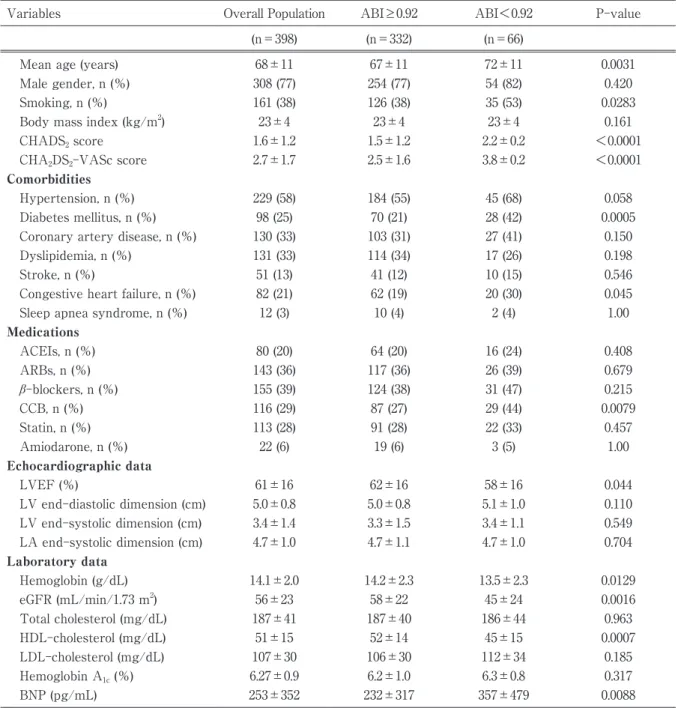
Baseline characteristics are summarized in Table 1.
This study enrolled 398 patients, with a median age of 68.0±11.3 years ; the majority of patients were male (76.9 %). The causes of admission among partic
ipants included acute myocardial infarction (1.5 %), unstable angina pectoris (0.5 %), stable angina pecto
ris (17.3 %), other atherosclerotic diseases (14.1 %), arrythmia (38.2 %), heart failure (8.8 %), and others (19.3 %). On the basis of the ABI, all patients were divided into two groups : 66 patients (16.6 %) had low ABI, 332 patients (83.4 %) had high ABI. No signifi
cant differences were found in BMI, coronary artery disease, hypertension, dyslipidemia, stroke, and sleep apnea syndrome between each group. However, low ABI values were significantly associated with higher smoking status and higher CHADS2 and CHA2DS2- VASc scores. An increased number of patients ex
hibited diabetes mellitus and congestive heart failure in the low ABI group. In the echocardiographic find
ings, there were no significant differences in median LVDd, LVDs, and LADs ; however, patients with high ABI showed significantly higher LVEF than those with low ABI. A lower ABI was significantly associ
ated with greater levels of creatinine and B-type natriuretic peptide (BNP) and lower levels of hemo
globin, estimated GFR, and HDL-Cho. At discharge, the prescription rates of drugs such as statins, angio
tensin converting enzyme inhibitors (ACEIs), and/or angiotensin receptor blockers (ARBs), and amiodarone showed no difference ; however, the use of calcium channel blockers was significantly higher in patients with low ABI.
B Outcomes
During the follow-up period (mean 4.6 years), a total of 52 cases (13.1 %) of MACE were recorded, in
cluding 37 of cardiovascular death, 4 of MI, and 11 of stroke. Between the two groups, the low ABI group exhibited significantly higher values of MACE, with significant differences in MI ; however, no significant differences in cardiovascular death and stroke were observed.
C Predictors of MACE
The univariate Cox proportional hazards analysis showed that low ABI as well as higher CHA2DS2- VASc score (≥2) were independent predictors of MACE. Multivariate Cox proportional hazards analy
sis shows that adjusted for low ABI (<0.92), CHA2DS2- VASc score≥2, LVEF, diabetes mellitus, congestive heart failure, and prescription of ACEIs, low ABI in
dependently predicted a poorer prognosis (OR, 2.21 ; 95 % CI, 1.03-4.66 ; P=0.039). (Table 2). The Kaplan- Meier analysis showed that the cumulative event- free survival rate of MACE was markedly lower in patients with a low ABI (Fig. 2).
Ⅳ Discussion
To the best of our knowledge, this is the first re
port demonstrating the predictive power of low ABI on the prognosis of patients with AF. The major finding of this study was that low ABI could predict cardiovascular events as well as a high (≥2) CHADS2
or CHA2DS2-VASc score. In patients with AF, higher CHADS2 or CHA2DS2-VASc score (≥2) is known to be a predictor of stroke1). On the other hand, the prog
nosis of AF patients with heart failure is poor15), and it is known that their risk for stroke, hospitalization for heart failure, and death is high16)-19). In such pa
tients, higher CHADS2 or CHA2DS2-VASc score (≥2) is also known to be a predictor of hospitalization for worsening of heart failure and mortality3). Ostergren and Sleight20). demonstrated that low ABI predicted
cardiovascular mortality and development of future heart failure.
We showed that low ABI was associated with in
creased incidence of MACE and all-cause mortality as well as higher CHADS2 or CHA2DS2-VASc score (≥2) in patients with AF. AF and atherosclerosis are known to be a chronic inflammatory disease and in
flammation is a triggering factor of atherosclerotic plaque rupture. AF is also associated with the in
flammatory state such as obesity, diabetes mellitus, hypertension, heart failure, metabolic syndrome and sedentary lifestyle21). In this regard, ABI serves as a measure of atherosclerosis, and thus, lower ABI can indicate vascular abnormalities causing adverse car
Table 1 Baseline Characteristics
Variables Overall Population ABI≥0.92 ABI<0.92 P-value
(n=398) (n=332) (n=66)
Mean age (years) 68±11 67±11 72±11 0.0031
Male gender, n (%) 308 (77) 254 (77) 54 (82) 0.420
Smoking, n (%) 161 (38) 126 (38) 35 (53) 0.0283
Body mass index (kg/m2) 23±4 23±4 23±4 0.161
CHADS2 score 1.6±1.2 1.5±1.2 2.2±0.2 <0.0001
CHA2DS2-VASc score 2.7±1.7 2.5±1.6 3.8±0.2 <0.0001
Comorbidities
Hypertension, n (%) 229 (58) 184 (55) 45 (68) 0.058
Diabetes mellitus, n (%) 98 (25) 70 (21) 28 (42) 0.0005
Coronary artery disease, n (%) 130 (33) 103 (31) 27 (41) 0.150
Dyslipidemia, n (%) 131 (33) 114 (34) 17 (26) 0.198
Stroke, n (%) 51 (13) 41 (12) 10 (15) 0.546
Congestive heart failure, n (%) 82 (21) 62 (19) 20 (30) 0.045
Sleep apnea syndrome, n (%) 12 (3) 10 (4) 2 (4) 1.00
Medications
ACEIs, n (%) 80 (20) 64 (20) 16 (24) 0.408
ARBs, n (%) 143 (36) 117 (36) 26 (39) 0.679
β-blockers, n (%) 155 (39) 124 (38) 31 (47) 0.215
CCB, n (%) 116 (29) 87 (27) 29 (44) 0.0079
Statin, n (%) 113 (28) 91 (28) 22 (33) 0.457
Amiodarone, n (%) 22 (6) 19 (6) 3 (5) 1.00
Echocardiographic data
LVEF (%) 61±16 62±16 58±16 0.044
LV end-diastolic dimension (cm) 5.0±0.8 5.0±0.8 5.1±1.0 0.110
LV end-systolic dimension (cm) 3.4±1.4 3.3±1.5 3.4±1.1 0.549
LA end-systolic dimension (cm) 4.7±1.0 4.7±1.1 4.7±1.0 0.704
Laboratory data
Hemoglobin (g/dL) 14.1±2.0 14.2±2.3 13.5±2.3 0.0129
eGFR (mL/min/1.73 m2) 56±23 58±22 45±24 0.0016
Total cholesterol (mg/dL) 187±41 187±40 186±44 0.963
HDL-cholesterol (mg/dL) 51±15 52±14 45±15 0.0007
LDL-cholesterol (mg/dL) 107±30 106±30 112±34 0.185
Hemoglobin A1c (%) 6.27±0.9 6.2±1.0 6.3±0.8 0.317
BNP (pg/mL) 253±352 232±317 357±479 0.0088
CHADS2, congestive heart failure/hypertension/age≥75 years old/diabetes/stroke [doubled] ; CHA2DS2-VASc, congestive heart failure/hypertension/age ≥75 years old [doubled]/diabetes/stroke [doubled]/vascular disease/sex category [if female, counted] ; ACE-I, angiotensin-converting enzyme inhibitor ; ARB, angiotensin receptor blocker ; CCB, calcium channel blocker ; LVEF, left ventricular ejection fraction ; eGFR, estimated glomerular filtration rate ; HDL, high-density lipoprotein ; LDL, low-density lipoprotein ; BNP, B-type-natriuretic peptide ; LA, left atrial.
diovascular events and heart failure in the future.
Thus, we should be cautious in AF patients with low ABI, because this patient population is more likely to experience cardiovascular events in the future than those with higher ABI. There is a possibility that early intervention in AF patients with low ABI can help in preventing the progression of the cardio
vascular disease.
A Limitations
While our study included data from a large sample
to detect a sufficient number of cardiovascular events, this study has several potential limitations. First, it was a single center, retrospective analysis and in
volved patients who were hospitalized for cardiovas
cular disease. Thus, our study population may not be representative of the general population. Second, the patients who were enrolled in this registry had heterogeneous baseline cardiovascular diseases, so sample bias might have affected the results of the study. Third, we measured ABI only once at the Table 2 Cox Regression Analysis for MACE
Variables Unadjusted HR (95 % CI) P Adjusted HR (95 % CI) P
Male 0.58 (0.30-1.15) 0.117
Age (years) 1.03 (1.00-1.07) 0.026
BMI (kg/m2) 1.00 (0.93-1.08) 0.999
Smoking 1.05 (0.63-1.73) 0.858
ABI<0.92 2.76 (1.37-5.38) 0.0054 2.21 (1.03-4.66) 0.039
CHADS2≥2 1.69 (0.92-3.16) 0.094
CHA2DS2-VASc≥2 3.35 (1.41-9.90) 0.0047 1.91 (0.78-5.41) 0.184
Coronary artery disease 0.62 (0.34-1.08) 0.090
Hypertension 0.98 (0.59-1.63) 0.938
Dyslipidemia 0.61 (0.34-1.06) 0.081
Diabetes mellitus 1.76 (1.02-3.01) 0.043 0.94 (0.43-1.98) 0.883
Stroke 1.34 (0.64-2.62) 0.428
Congestive heart failure 1.89 (1.06-3.30) 0.031 1.04 (0.46-2.23) 0.923 Echocardiographic data
LVEF (%) 0.97 (0.96-0.99) 0.0048 0.97 (0.95-1.00) 0.015
LVDd (cm) 1.00 (0.99-1.01) 0.889
LVDs (cm) 1.01 (0.99-1.03) 0.292
Medication
Statin 1.12 (0.56-2.15) 0.747
ACEIs 2.41 (1.22-4.66) 0.0126 1.76 (0.81-3.70) 0.140
ARBs 0.94 (0.48-1.78) 0.858
Beta-blockers 1.01 (0.53-1.89) 0.982
CCB 1.50 (0.77-2.83) 0.228
Amiodarone 1.22 (0.28-3.78) 0.760
Laboratory data
Hemoglobin (g/dL) 0.89 (0.77-1.03) 0.124
eGFR (mL/min/1.73 m2) 0.99 (0.97-1.01) 0.397 Total cholesterol (mg/dL) 1.00 (0.99-1.01) 0.630 LDL-cholesterol (mg/dL) 1.00 (0.98-1.02) 0.512 Hemoglobin A1c (%) 1.05 (0.75-1.43) 0.771
BNP (pg/mL) 1.00 (0.99-1.00) 0.098
BMI, body mass index ; CHADS2, congestive heart failure/hypertension/age≥75 years old/diabetes/stroke [doubled] ; CHA2DS2-VASc, congestive heart failure/hypertension/age≥75 years old [doubled]/diabetes/stroke [doubled]/vascular disease/sex category [if female, counted] ; ACEIs, angiotensin-converting enzyme inhibitor ; ARBs, angiotensin receptor blocker ; CCB, calcium channel blocker ; LVEF, left ventricular ejection fraction ; LVDd, left ventricular end diastolic diameter ; LVDs, left ventricular end systolic diameter ; LA, left atrial ; eGFR, estimated glomerular filtration rate ; HDL, high-density lipoprotein ; LDL, low-density lipoprotein ; BNP, B-type-natriuretic peptide.
time of hospitalization, so the data might not be right in patients with AF. Reports suggest that the accuracy of ABI in patients with atrial fibrillation decreases ; however, other reports suggest that atrial fibrillation does not affect ABI data22). Finally, we have no data regarding changes of medication or habits that could affect the prognosis during the ob
servation period.
V Conclusion
We found that ABI measured at the time of ad
mission can predict the prognosis of patients with AF, similar to the CHADS2 or CHA2DS2-VASc scores and can be useful to predict cardiovascular events and prevent progression of cardiovascular diseases.
Ⅵ Acknowledgement
The authors acknowledge the secretarial and tech
nical assistance of Minako Aono
References
1) Chao TF, Liu CJ : Should Atrial Fibrillation Patients With 1 Additional Risk Factor of the CHA2DS2-VASc Score (Beyond Sex) Receive Oral Anticoagulation ? Am J Coll Cardiol 65 : 635-642, 2015
2) Chao TF, Lin YJ : CHADS (2) and CHA (2)-VASc score in the prediction of clinical outcomes in patients with atrial fibrillation after catheter ablation. Am J Cardiol 58 : 2380-2385, 2011
3) Nakagawa K, Hirai T : Chronic kidney disease and CHADS (2) score independently predict cardiovascular events and mortality in patients with nonvalvular atrial fibrillation. Am J Cardiol 107 : 912-916, 2011
4) Larsen TB, Lip GY : Added predictive ability of the CHA2DS2VASc risk score for stroke and death in patients with Fig. 2 Kaplan-Meier plot
Kaplan-Meier plot for cardiovascular death, myocardial infarction [MI], and stroke (MACE).
Two groups of patients were included in the analysis. The patients were assigned to a group according to their ankle-brachial index (ABI) value.
atrial fibrillation : the prospective Danish Diet, Cancer, and Health cohort study. Circ Cardiovasc Qual Outcomes 5 : 335-342, 2012
5) Dachun X, Jue L : Sensitivity and specificity of the ankle-brachial index to diagnose peripheral artery disease : a structured review. Vasc Med 15 : 361-369, 2010
6) Fowkes FG, Murray GD : Ankle brachial index combined with Framingham Risk Score to predict cardiovascular events and mortality : a meta-analysis. Jama 300 : 197-208, 2008
7) Rooke TW, Hirsch AT : 2011 ACCF/AHA focused update of the guideline for the management of patients with peripheral artery disease (updating the 2005 guideline). Vasc Med 16 : 452-476, 2011
8) Vanholder R, Massy Z : Chronic kidney disease as cause of cardiovascular morbidity and mortality. Nephrol Dial Transplant 20 : 1048-1056, 2005
9) Go AS, Chetow GM : Chronic kidney disease and the risk of death, cardiovascular events, and hospitalization. N Engl J Med 351 : 1296-1305, 2004
10) Sacco RL, Kasner SE : American Heart Association Stroke Council, Council on Cardiovascular Surgery and Anesthesia ; Council on Cardiovascular Radiology and Intervention ; Council on Cardiovascular and Stroke Nursing ; Council on Epidemiology and Prevention ; Council on Peripheral Vascular Disease ; Council on Nutrition, Physical Activity and Metabolism. An updated definition of stroke for the 21st century : a statement for healthcare professionals from the American Heart Association/American Stroke Association. Stroke 44 : 2064-2089, 2013
11) McKee PA, Castelli WP : The natural history of congestive heart failure : the Framingham study. N Engl J Med 285 : 1441-1446,1971
12) Westchester IL : American Academy of Sleep Medicine. The International Classification of Sleep Disorders : Diagnostic and Coding Manual. 2nd ed, American Academy of Sleep Medicine, 2005
13) Matsuo S, Imai E : Revised equations for estimated GFR from serum creatinine in Japan. Am J Kidney Dis 53 : 982- 992, 2009
14) Thygesen K, Alpert JS : Joint ESC/ACCF/AHA/WHF Task Force for the Redefinition of Myocardial Infarction.
Universal definition of myocardial infarction. Circulation 116 : 2634-2653, 2007
15) Nassir F. Marrouche : Catheter Ablation for Atrial Fibrillation with Heart Failure. N Engl J Med 378 : 417-427, 2018 16) Dries DL, Exner DV : Atrial fibrillation is associated with an increased risk for mortality and heart failure progression
in patients with asymptomatic and symptomatic left ventricular systolic dysfunction : a retrospective analysis of the SOLVD trials : Studies of Left Ventricular Dysfunction. J Am Coll Cardiol 32 : 695-703,1998
17) Wang TJ, Larson MG : Temporal relations of atrial fibrillation and congestive heart failure and their joint influence on mortality : the Framingham Heart Study. Circulation 107 : 2920-2925, 2003
18) Ponikowski P, Voors AA : 2016 ESC guidelines for the diagnosis and treatment of acute and chronic heart failure : the Task Force for the diagnosis and treatment of acute and chronic heart failure of the European Society of Cardiology (ESC) : developed with the special contribution of the Heart Failure Association (HFA) of the ESC. Eur J Heart Fail 18 : 891-975,2016
19) Kirchhof P, Benussi S : 2016 ESC guidelines for the management of atrial fibrillation developed in collaboration with EACTS. Europace 18 : 1609-1678, 2016
20) Ostergren J, Sleight P : Impact of ramipril in patients with evidence of clinical or subclinical peripheral arterial disease.
Eur Heart J 25 : 17-24, 2004
21) Silva RM : Influence of Inflammation and Atherosclerosis in Atrial Fibrillation. Curr Atheroscler Rep 19 : 2, 2017 22) Dabrowski M, Lewandowski J : Atrial fibrillation does not affect ankle-brachial index measured using the Doppler
method. Hypertens Res 41 : 60-65, 2018
(2018. 12. 10 received;2019. 2. 12 accepted)