The Kx’a Family A New Khoisan Genealogy1)
Heine, Bernd
(Institut für Afrikanistik Universität zu Köln)
Honken, Henry
(Independent Scholar)
e question of whether there is a genetic unit called “Khoisan”, as proposed by Greenberg (1963), or whether there are a number of independent genetic stocks of languages within the “Khoisan” area has been discussed controver- sially in the history of Khoisan linguistics, with the second position now being prevalent. In the present study it is argued that there is a genetic unit that includes languages that are traditionally associated with both the Northern and the Southern Khoisan groupings, the languages included being !Xun (or
“Ju” or “Ju|hoan”) and Hoan. Building on the work of Honken (2004), the comparative method will be employed to reconstruct some phonological fea- tures of the common ancestor of this language family that we propose to call the “Kx’a family”.
1 Introduction
1.1 e Kx’a languages 1.2 Earlier work 1.3 e present study 2 Phonological reconstruction
2.1 Introduction 2.2 Vowels
2.2.1 Oral vowels
2.2.2 Vowel combinations
2.2.3 Vowels separated by a consonant
Keywords: Click Type, Comparative Method, Genetic Relationship, Khoisan,
!Xun
1) e present was written while the fi rst-named author spent a year at the Research Institute for Languages and Cultures of Asia and Africa of the Tokyo University of Foreign Studies. is author wishes to thank the Institute for its support, but most of all to Professor Osamu Hieda, who assisted us in multiple ways in carrying out this work. Furthermore, we are grateful to a number of other people and organizations. Our thanks are due in particular to Willi Haacke for all the support he gave us while we carried out field research on the !Xun language in Namibia, to Matthias Brenzinger, Tom Güldemann, Christa König, Bonny Sands, and the other participants of the Riezlern Khoisan workshops, and to Chris Collins. Finally, we wish to thank two anonymous referees of this paper for their insightful comments.
1 Introduction
Formerly considered to be distinct but related branches of the South African Khoisan family (Greenberg 1963), Northern and Southern Khoisan are now widely held to be genetically unrelated groupings, and whether Southern Khoisan constitutes a valid histori- cal grouping must remain controversial (Güldemann and Vossen 2000; Güldemann 2009).
Northern Khoisan, by contrast, has been demonstrated to be not only a closely related language unit but even to constitute a single, even if complex language, referred to as !Xun (Heine and König Forthc.). Recent work by Honken (2004) suggests that the north-south divide that has dominated traditional comparative Khoisan linguistics is in need of recon- sideration in that !Xun appears to be genetically related to one language that previously tended to be associated with Southern Khoisan, namely theHoan language of Botswana.
e main goal of the present study is to apply the comparative method to !Xun andHoan and to reconstruct some traits of a phonology of Proto-Kx’a, the hypothetically set up ancestor of these languages.
1.1 e Kx’a languages
Eastern Hoan, or Eastern Hûân, henceforth referred to in short as Hoan, is a highly endangered Khoisan2) language spoken by small groups of hunter-gatherers in the
2.2.4 Nasal vowels 2.2.5 Pharyngeal vowels 2.2.6 Nasal consonants 2.3 Egressive consonants 2.3.1 Plosives
2.3.2 Other voiceless stops
2.3.3 Alveolar vs. alveo-palatal sibilants 2.3.4 Velars
2.3.5 Ejectives
2.4 Ingressive consonants 2.4.1 Click accompaniments 2.4.2 Post-velar accompaniment 2.5 Tones
2.6 An overview 3 Conclusions Abbreviations References
2) We are taking the term “Khoisan” as proposed by Greenberg (1963) as a convenient label to refer to a group of non-Bantu languages of southern and eastern Africa. Whether these ↗
Kalahari region of southeastern Botswana around Tswaane, Dutlwe, Tsia, Salajwe, and Khudumelapye, who refer to themselves asHHHn (Traill 1973: 25, Collins 1998: 5, Gruber n.d.)3). According to Herman Batibo (p.c.), the number of speakers of Hoan is distinctly below 200, living in the villages of Dutlwe, Kanye, and Takatokwane as well as in two pans, namely Tswaane Pan and Lokaakwe Pan, about 150 kilometres from Molepolole and 50 kilometres from Sekoma.
atHoan exists as a language of its own was recognized fi rst by Anthony Traill (1973), who published a 200-word list of it. Subsequently, it became the target of more extensive research, fi rst by Jeff rey Gruber and later on by Christopher Collins. Still, the language is not well documented; there is some grammatical information (Gruber 1973; 1975a; 1975b;
1975c; Gruber and Collins 1997; Collins 1997; 1998; 2001a; 2001b; 2001c; 2001d; 2002; 2003;
Bell and Collins 2001), including an unpublished list of over 1000 words by Gruber (1975b), and there also exists a comparative study of Hoan and its external relationship (Collins 2004). Collins (1998: 5) observes that there is a closely related, mutually intelligible lan- guage, Sasí, spoken around Lethajwe and Artesia south of Shoshong. According to Monaka and Lepekoane (2008: 266), terms such as Tshasi, Casi, Xasi, etc. are among the alternative names that the !Xóõ use to refer to themselves. e signifi cance of this name is not entirely clear; possibly, it is a Kgalagadi (or Tswana) word for ‘San, Bushman’.
!Xun is spoken in southern Angola, northern and northeastern Namibia, and north- western Botswana. It has been described as an L-complex, that is, as a cluster of speech forms that are connected by a chain of mutual intelligibility, but speakers at the extreme ends of the chain do not understand one another. For example, !Xun speakers of central Angola do not understand !Xun speakers of eastern Namibia or northwestern Botswana.
Even dialects presumed to be fairly closely interrelated are not necessarily mutually intel- ligible. Still, no clear-cut language boundary separating the various !Xun varieties has been identifi ed so far. Since there is reason to believe that all the !Xun varieties that have come to our notice so far are linked by some chain of mutual intelligibility, we prefer to treat the various speech forms as a single, even if complex, language.
Table 1 provides a list of dialects that are distinguished by Heine and König (Forthc.), and a classification of the dialects is found in Table 2. Sands (Forthc.) distinguishes 15 dialects (more precisely, “lects”) and Snyman (1997) 12. Our catalogue of eleven dialects is based on distinctions in grammatical properties as they have been documented so far, but like the other two authors mentioned we do not have any reliable information on where dialect boundaries are to be traced, nor on how many of them there are. We will therefore use the term “dialect” in a loose sense, referring to a given variety of !Xun that in some grammatically defi nable way diff ers from other varieties as a dialect (for more details, see
↗ languages are in fact genetically related, as argued by Greenberg and others, is an issue that remains unresolved at the present stage of research.
3) e name Hoan orHuan is possibly not an endonym but rather a word from the Taa language meaning ‘south’. According to Traill (1973: 25) it is spoken “south of the Khutse Game Reserve in Central Botswana, stretching westwards from about Kudumelapye to Tshwaane Pan”.
Heine & König Forthc., section 1.3). While there is now a wealth of lexical and phonologi- cal information on !Xun dialects (especially Snyman 1979a; 1997), data on the grammar are limited to a few dialects, namely E1, E2, W1, and W2. e dialects of the Central branch of
!Xun are little known and we will therefore have little to say about them in this paper.
1.2 Earlier work
e term “Khoisan” was fi rst proposed by the anthropologist Leonhard Schultze (1928) and adopted in African linguistics by Westermann (1935). at the Khoisan languages of
Table 1. e dialects of !Xun.
Dialect label Own name Where spoken
N1 !xuun or kúándò !xuun (‘Kwando !Xun’) Southeastern Angola
N2 !o !u (‘Forest !Xun’) Eastern half of central Angola
W1 !xūún or !ālè !xòān (‘Valley !Xun’) Eenhana District, northern Namibia W2 !xūún or |ākhòè !xòān (‘Kwanyama !Xun’) Eenhana District, northern Namibia
W3 !xūún Tsintsabis, Tsumeb District, northern
Namibia
K !xūún4) Western Rundu District, northern Namibia,
and adjacent areas of Angola
C1 Tsumeb District, northern Namibia
C2 Grootfontein District, northern Namibia
E1 ju-/// hoan(-si) Tsumkwe District, northeastern Namibia,
and adjacent parts of Botswana
E2 !xun, ju-/// hoa(si) Around Dikundu5), western Caprivi Strip, northeastern Namibia
E3 ju-/// hoan(-si) or !xunor xāō-//// àèn (‘northern people’)
Gobabis District, eastern Namibia Table 2. A classifi cation of !Xun dialects.
Branch Cluster Dialect (reference form)
1 Northwestern (NW-!Xun) 1.1 Northern N1 N2 1.2 Western W1 W2 W3 1.3 Kavango K
2 Central (C-!Xun) 2.1 Gaub C1
2.2 Neitsas C2 3 Southeastern (SE-!Xun) 3.1 Ju|hoan E1 3.2 Dikundu E2 3.3 xāō-||àèn E3
4) Akira Takada (p.c.) mentions that in Ekoka the !Xun of the Kavango region are called dom
!xoan (lit.: ‘river !Xun’).
5) When we visited the Dikundu-Mutsiku area where Köhler had studied E2 in 1998, we did not meet any speakers of E2.
southern Africa form a historically defined unit of some kind, consisting of a Northern, a Central, and a Southern branch, is an old assumption (see e.g. Bleek 1927; 1929). at this unit can be defi ned in terms of genetic relationship was proposed fi rst by Greenberg 1949–54; 1963), less explicitly also by Köhler (1973/4). is hypothesis was substantiated by other researchers (e.g. Ehret 1986; Honken 1998; Starostin n.d.).
More recently, the monogenesis hypothesis is increasingly being questioned. While no one would doubt that the Khoisan languages are in some way historically related, shar- ing a substantial vocabulary and some structural features, the prevalent view has it that this relationship may as well be attributed to diff usion, that is, to language contact rather than to common origin. e present mainstream position is perhaps best represented by Güldemann and Voßen (2000), who propose to replace the traditional threefold classifi ca- tion by the genetic groupings listed in Table 3.
e genetic position of bothHoan and !Xun has been discussed controversially by Traill (1973; 1974) and Westphal (1974), even if the conclusions reached by them on the relationship between the two languages are not all that diff erent. Traill (1973: 26) argues that “the strongest links are with the languages that are geographically very remote, namely N1, N2 and S1”, and he observes that Hoan (his Eastern Hûân) shares 50% cognates with Northern, 33% with Southern, and 17% with Central Khoisan, but he suggests to leave the status of the language undecided, being either a Southern Khoisan language, “S7” accord- ing to the numbering introduced by Bleek (1929), or “N4”, that is, a Northern Khoisan language, “with the latter having a slight edge for the moment” (Traill 1973: 27). Note that the conclusion reached by Westphal is not dramatically diff erent when he observes on the basis of Traill’s (1973) material that “N4 seems a more appropriate classifi cation for his new language than S7” (Westphal 1974: 247).
A breakthrough in the comparative study of Hoan can be seen in the study by Honken (2004). Observing that “there are several reasons why a comparison of Hoã and NK [Northern Khoisan; a.n.] might be profi table”, he goes on to present a larger range of grammatical and lexical material where the two units show significant form-meaning similarities, also proposing a number of sound correspondences between the two, and he concludes:
Table 3. Genetic groupings traditionally classifi ed as Khoisan according to Güldemann and Voßen (2000: 102).
Genetic stock Branch
1 Non-Khoe 1.1 Ju (= !Xun;Northern Khoisan) 1.2 !Ui-Taa (Southern Khoisan)
1.3 Hõã (= Hoan; isolate)
2 Khoe (Central)ll 2.1 Khoekhoe 2.2 Kalahari Khoe 3 Sandawe (East Africa)
4 Kwadi (possibly extinct) 5 Hadza (East Africa)
If we take the kinds of relationships we find in those language families established beyond doubt as a model, we must conclude thatHoã is genetically related to North- ern Khoisan but not to !Xóõ or Central Khoisan. (Honken 2004: 2)
ere is in fact no indication that there was direct or indirect language contact between earlier speakers of Hoan and !Xun; the two societies are geographically more than a thousand kilometres apart, and we are not aware of any major historical processes, other than those associated with the impact of European colonial powers, that might have been instrumental to making linguistic exchange possible. We therefore see no alternative other than genetic relationship to account for the commonalities shared by Hoan and !Xun.
The Honken hypothesis that we take up here has a possible precursor, namely Westphal (1974), who suggests that the most plausible, or least controversial, classifi cation of Hoan would be one in terms of Northern Khoisan membership (Westphal 1974: 246). And the hypothesis was also supported by Starostin (n.d.), who argues thatHoan can safely be assumed to represent an “elder brother” of Northern Khoisan (NK) dialects, “much more distant from them than they are from each other, but signifi cantly closer to NK than any- thing else. According to glottochronological calculations, the split of “Proto-NK-#Hoan”
must have taken place somewhere around the 2nd millennium B.C.” (Starostin n.d.: 41).
Like Starostin, we go one step further than both Westphal (1974) and Honken (2004) in claiming that genetic relationship is not a plausible claim but rather thatHoan and
!Xunare in fact genetically related and that it is possible to reconstruct some characteristicse of the hypothetical ancestor language of the two, which we propose to call Proto-Kx’a. is term is taken from the root *kxà ‘ground, soil’ shared by all the linguistic communities concerned6).
1.3 e present study
The aim of this paper is to reconstruct a skeleton of Proto-Kx’a phonology. To this end, we will be concerned in section 2 with phonological correspondences and hypotheses on their diachronic significance, and in section 3 we will draw some conclusions on the historical implications of the reconstructions proposed. A reconstruction of the grammar of Proto-Kx’a is beyond the scope of the present paper and will be proposed in a separate publication.
There are a number of different conventions that have been employed for writing materials of the Kx’a languages. We follow Collins in using the orthography proposed by Dickens (1994) for writing not only E1 (Ju|hoan) material but also data from all other Kx’a varieties, mainly because this orthography relies on a minimum of diacritic symbols with- out being less distinctive than any other orthography and has turned out to be the most immediately acceptable to !Xun speakers. is means in particular that we diff er from other
6) We are grateful to Bonny Sands for reminding us that this root is not restricted to the Kx’a family; it is also shared e.g. by the Kwadi language of southwestern Angola, as pointed out by Ehret (2008: 108).
authors in the following conventions: As in the work on !Xun grammar (Heine & König Forthc.), nasal vowels are, following the convention introduced by Dickens (1994; 2005), written with a full nasal symbol {n} a er the vowel symbol for both Kx’a languages and for Proto-Kx’a, i.e. [ã] = {an}. To distinguish the nasal consonant [n] from nasal vowels, the former is written {nn} whenever it follows a vowel in the same morpheme. is means that e.g. {an} stands for [ã] while {ann} stands for [an] throughout.
We diverge however in a few cases from Dickens, in particular in the following: Hoan, though not !Xun, has a uvular stop, commonly rendered by {q}. Now, Dickens uses {q} for marking pharyngealization on vowels, and this convention has been adopted by Heine and König (Forthc.). But in order to be consistent across the Kx’a languages, we replace the {q}
of Dickens in this paper by {} for marking pharyngeal vowels in all Kx’a languages in the present paper.
2 Phonological reconstruction
A few decades back, Traill (1973: 27) maintained that it is generally not possible to formulate “rules of sound shi ” forHoan, and at that stage this was certainly correct. But the situation has changed: We now have more information and a better analysis of the situ- ation. It is most of all the lexical data provided by Gruber (1975a) and their comparative analysis provided by Honken (2004), together with information on the grammatical struc- ture provided by Gruber and Collins, as well as a more detailed description of !Xun and its dialects (Heine & König Forthc.) that make it possible to propose a linguistic reconstruc- tion of the historical relationship of Hoan and the language family of which it is a part.
e main crux with linguistic reconstruction in Khoisan is that there is no viable means of separating inherited from borrowed material. Accordingly, except for the comparative study of Central Khoisan (Khoe) by Rainer Vossen (1997), there has been no really success- ful attempt to apply the comparative method to Khoisan languages. More recent research suggests, however, that it may be possible to apply this method also to other groupings of Khoisan. Some techniques for distinguishing between genetically inherited and contact- induced linguistic material are proposed by Honken (2004). Still, for most of the lexical and grammatical similarities to be observed across Khoisan languages there simply is no way of deciding which of the two is involved. And, perhaps more importantly, even if we are able to establish that item X of language A was borrowed from language B, we do not know in most caseswhenthat happened. at a given word or grammatical form was borrowed is not necessarily reason enough to eliminate it from an analysis based on the comparative method. What is more important is the relative time at which borrowing took place: If it occurred prior to the split of the languages concerned then it can be expected to behave like any inherited item. Take the following series:
Hoan SE-!Xun NW-!Xun Meaning t∫àán t∫àn t∫àān (W1 tsàān) ‘gravy’
t∫òó t∫ò t∫ò (W1 tsò) ‘medicine’
∫án ∫án ∫ān (W1 sān) ‘to rest’
e items for ‘medicine’ are not restricted to the Kx’a languages; rather, they are found throughout the Khoisan languages, and we side with Honken (2004: 51) in assuming that the best hypothesis is one according to which it was the Central Khoisan languages which were the ultimate source of diff usion of this item. But the question then is whenthis diff u- sion took place. If this was prior to the split between NW-!Xun and SE-!Xun, for example, then it could safely be reconstructed back at least to Proto-!Xun, as we tentatively do here.
No claim is made to the eff ect that the reconstructed sounds and sound combinations that we propose in this study represent phonological features that were actually spoken in this form in the hypothetically set up ancestor language; but what we claim is that, on account of the regular correspondences on which they are based, they stand for units containing phonetic features that must have existed in this or a similar form in the ancestor language.
Following Honken (2004), our comparisons are restricted to three linguistic varieties, namelyHoan, Northwestern !Xun (NW-!Xun) and Southeastern !Xun (SE-!Xun). The latter two stand for the two main branches of the !Xun language; the third branch, Central
!Xun, is not considered here since there hardly any linguistic data on it. We take the W2 dialect as being representative of NW-!Xun but also include data from the W1 dialect (Heikkinen 1986; 1987) where this seems desirable (adding the label “W1” in such cases).
All our SE-!Xun data are taken from the E1 dialect (Dickens 1994; 2005), which is the only dialect of this branch that has been appropriately documented.
Hoan data presented in this paper are taken mostly from the published and un- published sources of Jeffrey Gruber, but to some extent also from the publications of Christopher Collins. Unfortunately, the data of the latter are not tone marked, hence whenever Hoan materials without tone markings are presented these are taken from the works of Collins.
2.1 Introduction
Like other Khoisan languages, the Kx’a languages are phonologically complex7); the number of segmental phonemes identifi ed is distinctly over one hundred; in addition, both
Hoan and most !Xun dialects distinguish four tone levels and four register tonemes in addition to contour tones (see 2.5). An issue that has received some attention in works on Khoisan languages concerns the question of whether complex phonetic units, e.g. [||x], should be analyzed as single units or as sets of features or segments. For the present pur- poses of phonological reconstruction we adopt the latter procedure, treating such complex
7) For !Xun, see Heine and König (Forthc.) and, most of all, Heikkinnen (1986) for W1, Dickens (1994) and Snyman (1970) for E1, and Köhler (1981) for E3.
units as combinations of segments. us, a velar ejective aff ricate such as [||x] is taken to consist of a lateral click type [||], a velar fricative [x], and a glottal stop [], and combinato- rial characteristics are analyzed as contextual features.
ere are two phonological features that may be said to be somewhat labile in !Xun in particular and the Kx’a languages in general, namely glottal stops between vowels and the nasalization of vowels, i.e. nasal vowels. In NW-!Xun dialects, glottal stops tend to be eliminated intervocally and some speakers do not pronounce intervocalic glottalization at all, e.g. W2 [|àā] or [|àā] ‘to give’. Also across dialects there is some variation in that one dialect uses an intervocalic glottal stop whereas another dialect does not. For example, the Proto-!Xun imperative verb stem *tua‘go!’ istòá in the N1 dialect,tòāāor tòàin the E3 dia- lect, but tòáin the E1 dialect (Heine & König Forthc.).
In a similar fashion, the contrast between nasal and oral vowels is only weakly distinc- tive in many !Xun varieties, if distinctive at all, and nasal vowels can be, and are, in many cases pronounced as oral vowels, e.g. W2 [|] or [|à] ‘with’. We therefore have not taken glottalization and nasality to be decisive features in establishing regular correspondences, at least in specifi c cases.
2.2 Vowels 2.2.1 Oral vowels
All modern Kx’a languages have a fi ve-vowel system of the following kind:
i u
e o
a
And all fi ve oral vowels can be reconstructed back to Proto-Kx’a. ese reconstructions are based on the correspondences to be discussed in this section.
For a set of corresponding sounds [a] we reconstruct a Proto-Kx’a vowel *a:
P-KX Hoan SE-!Xun NW-!Xun Meaning
*a a a a
chàá thá thā ‘penis’
kha kòà k ‘to fear’
kxà kxà kxà ‘earth’
xàá ‘master’ xā.mà ‘old man’
We tentatively propose that *a was lost in !Xun in word-initial position when followed by the nasal m, even if we have only two examples supporting this hypothesis:
P-KX Hoan SE-!Xun NW-!Xun Meaning
*am am m m
m ‘to eat’
àm (E2 dialect)8) ‘my’
An interesting proposal is made by an anonymous referee of this paper, who suggests that rather than vowel loss in !Xun the change might have involved vowel addition (*m >
am) in Hoan. While this proposal raises a number of problems with other occurrences of the bilabial nasal in Hoan, more research is required on this issue.
Note that in the above examples, Hoan has an initial glottal stop ( = []). is glottal stop exists also in all !Xun forms presented, for example W2 [] ‘to eat’, [] ‘my’, but is ignored here since its occurrence word-initially is predictable.
A mid front vowel *e has [e] as refl exes in all languages. e ese refl exes all involve [e]
being preceded by another vowel in the same word:
P-KX Hoan SE-!Xun NW-!Xun Meaning
*e e e e
óe d ‘using smoke for some purpose’ ‘smoke’
ùé wè-∫è wèé-sè ‘all’
|xòbe |xòbè |xòbè ‘to lend’
||àe ||àé ‘to cut meat’
A high front vowel *ihas [i] as refl exes in all languages. Most of the cognate sets con- taining [i] involve combinations of vowels where iis preceded by another vowel (cf. above under *e).e
P-KX Hoan SE-!Xun NW-!Xun Meaning
*i i i i
-∫í -sí -∫í nominalizing suffi x denoting places
g!()i, g!i g! g! ‘gnu’
xái gxàí g!!xáín (W1 gxáí) ‘scorpion’
Following a back vowel there is a set of correspondences for which we reconstruct a Proto-vowel *ithat was lost in !Xun. is set contrasts with another set for which we recon- struct the Proto-Kx’a combination *ui(see below); the exact phonetic features distinguish- ing these two sets are unclear.
8) For example, E2bāà‘my father’ (Köhler 1973: 43).
P-KX Hoan SE-!Xun NW-!Xun Meaning
*Vi i ø ø
!xűi !xó !xō ‘elephant’
!űi ‘spine’ !ú !ú ‘bone’
k
k
k ||ùi ||ú ‘to step, kick’ ||ú ‘to kick’ ‘to tread’
Similarly, there is [o] as a refl ex in all languages, for which a vowel *o is set up:
P-KX Hoan SE-!Xun NW-!Xun Meaning
*o o o o
ca tà -tòà ‘that’ (distal demonstrative)
ō h(ā) ‘be’, copula
|xòbe |xòbè |xòbè ‘to lend’
n!a n!àn n!ònà ‘duiker lamb’
||qóa ‘tortoise shell’ ||òá g||òà ‘big tortoise sp.’
In most, if not all, !Xun dialects there is an optional rule whereby a mid or high back vowel ([o] or [u]) preceding [a] in the next syllable is pronounced as a diphthong [oa] or [ua], respectively. We therefore also include the following cognate set as an instance of Proto-Kx’a *o: Hoang khóla: SE-!Xunkhóárá : NW-!Xunkhōālā (ā khwālā) ‘to unbind’.
ere is another series where !Xun [o] preceding the nasal [m] corresponds to Hoan [oa]. We propose a Proto-Kx’a phoneme *ofor this series, arguing that preceding m, *owas diphthongized in Hoan (>oa):
P-KX Hoan SE-!Xun NW-!Xun Meaning
*o/_m oa o o
òàm ‘river bed’ dhm dm ‘throat, river bed’
nòàm nòm ‘to make’
n!m n!ò n!òm ‘to limp’
!xòàm !xó ‘to cover’
k
kk -òam-òam ómá ‘to kiss’ ‘to taste mouth’
ere is an interesting proposal made by an anonymous referee of this paper, according to which a more plausible reconstruction might be *om rather than *o/_m, and that there was a development (*m >am) inHoan. is proposal raises a number of problems with other occurrences of the bilabial nasal inHoan, but more research is required on this issue.
And all languages have a high back vowel [u] to be reconstructable as *u:
P-KX Hoan SE-!Xun NW-!Xun Meaning
*u u u u
t∫ù tsú ‘uncle’ t∫ú ‘father’s brother’ ‘father’
k
k
k -n| i n|h n|h ‘to take (away, PL)’
ű- ú ú remote demonstrative
We have ignored above two additional sets of vowel correspondences where there is a high vowel [i] or [u] in Southeastern !Xun but a mid vowel [e] and [o], respectively, elsewhere in the Kx’a languages in final position. In order to distinguish these two sets from the correpondences above, we propose the Proto-Kx’a vowels *E and *E O, respectively, without attempting to determine what phonetic value may have characterized these sets.
P-KX Hoan SE-!Xun NW-!Xun Meaning
*E e i e
e: -di ‘female’ *dē (dē ‘female’) ‘mother’, ‘female’
!hàè n!hhh n!hhh è ‘lion’
||qóe g||àí g||ààè ‘bear, give birth’
*O o u o
n||n n||ùn n||ōún ‘to play’
||o ||áú ‘well’ (adv)
2.2.2 Vowel combinations
ere are a number of sets of vowel correspondences whose exact phonetic value in the hypothetical proto-language remains unclear. We propose to tentatively set up combi- nations of two vowel symbols for each of these sets but whether, or to what extent, these reconstructions are historically signifi cant needs to be established by future research. One of these combinations is [ae]. It is found in all Kx’a languages but tends to be pronounced as a monophthong [e], especially in fl uent speech, hence there are both [ae] and [e] refl exes.
P-KX Hoan SE-!Xun NW-!Xun Meaning
*ae ae, e ae ae, e
||háé ||háé-já ‘be unlucky’ ‘fail to do’
||áé !àè ||àè ‘to send message’
|x |xàè.à ‘to visit’
||xáé ||xáé ||xāē ‘to meet’
x
x xáé interrogative marker
Another reconstruction concerns the set where Hoan has [u] while !Xun shows [o], for which we propose a sequence *uo:
P-KX Hoan SE-!Xun NW-!Xun Meaning
*uo u o o
kxú kxò kxò ‘pot’
g|| g!òō g||òō ‘to cough out’
k
kk -gg gò g ‘fl ower’
e correspondence Hoan [o] : !Xun [u] is hypothesized to go back to the combina- tion *ouin Proto-Kx’a:
P-KX Hoan SE-!Xun NW-!Xun Meaning
*ou o u u
t∫ò tshù t∫∫∫ ‘to vomit’
|ò |ú |ú ‘to enter, insert’
!ó !ú !ú ‘name’
!ó g!ú g!ú ‘belly’
!h !hú !hú ‘horn’
ere is a set of correspondences Hoan [iu] : SE-!Xun [ao] : NW-!Xun [au] for which we propose to reconstruct a Proto-Kx’a unit *iaO, and we hypothesize that the front vowel segment [i] was lost in theHoan entry ‘duiker’ due to the labial environment of the
click. e reason for setting up the unit *iaO rather than *iau is the following: We observed above that one set of correspondences involves a back high vowel [u] in SE-!Xun corre- sponding to the mid vowel [o] in both NW-!Xun undHoan, and we proposed the symbol
*Ofor this set. We argue that this is the vowel that also fi gures in the present set of corre- spondences and assume further that its refl exu inHoan, instead of the expected vowel o, is due to the infl uence of the preceding high vowel i. ere is an additional set of possible cognates, namely Hoan ∫∫∫ u : SE-!Xung!áú : NW-!Xung//āō ‘hand’ which are excluded here since theHoan form should be *g//iurather than ∫∫∫ u and we do not know how to account for a click loss inHoan.
P-KX Hoan SE-!Xun NW-!Xun Meaning
*iaO (i)u au ao
u dtshàú dtshāō ‘wife’
tsu tsàù tsāō ‘tooth’
|áú |āō ‘duiker’
Finally, there is a set where all languages have the combination [ui], for which we pro- pose *uias a Proto-Kx’a combination:
P-KX Hoan SE-!Xun NW-!Xun Meaning
*ui ui ui ui
chùí thúí thúí ‘wound’
k
k
k -n| i n|hi n|h ‘to take (away, PL)’
!úi !ù !ūí ‘to rot’
dz-úí n|úí n|úí ‘friend, other’
2.2.3 Vowels separated by a consonant
For aHoan sequence of the vowels [o] and [a] separated by a consonant which cor- responds to two low vowels in !Xun we reconstruct for Proto-Kx’a the combination *oCa, arguing that in !Xun there was vowel assimilation:
P-KX Hoan SE-!Xun NW-!Xun Meaning
*oCa o-a a-a a-a
óa g|àá g|àā ‘eye’
n||óam n||à n||bā ‘to turn one’s back to’ ‘to carry on shoulder’
nóa n|àn n|àā ‘sky’
We hypothesize that the glottal stop in the Hoan noun óa‘eye’ was lost. Note that intervocalic glottal stops tend to be also suppressed in most !Xun dialects (see * below).
Another reconstruction relates to a correspondence set where Hoan has a vowel [a]
while !Xun has [o], for which we set up a sequence of two vowels, optionally having an intermediate consonant (C):
P-KX Hoan SE-!Xun NW-!Xun Meaning
*ao a o o
n|m n|òm n|m ‘springhare’
n!àm n!òm n!ò ‘to crawl’
n!ám n!óm n!óm ‘to ripen’ ‘ripe, cooked’
cxàm txò ‘to tie together’
||ám !óm ‘leg’ ||óm ‘leg’ ‘thigh’
2.2.4 Nasal vowels
As we observed in the introduction to this section, nasal vowels (e.g., [ã]) exhibit a variable behavior. But all Kx’a varieties have nasal vowels, and in a number of cases they can be reconstructed as such back to Proto-Kx’a:
P-KX Hoan SE-!Xun NW-!Xun Meaning
*Vn Vn Vn Vn
cxón txún txún ‘kin term’
n||n n||ùn n||ōún ‘to play’
|ón |un ‘hunting bow’ |ún ‘stirring stick’ ‘stick’
!hn !hūn !hún ‘kill’ (SG)
n n !!n ‘star’
2.2.5 Pharyngeal vowels
ere are two series of correspondences involving pharyngeal vowels that we present below. We have no plausible hypothesis on what the phonetic equivalent of this distinction may have been in Proto-Kx’a; we tentatively propose the symbol *VVVfor the fi rst set and
*VVV for the second set. In most !Xun dialects, intervocalic glottal stops tend to be sup- pressed, and some speakers generally omit them (see above).
P-KX Hoan SE-!Xun NW-!Xun Meaning
*V V V V
n!a n!àn n!ònà ‘duiker lamb’
n||àba n||b, n||b ‘to stride’
nóa n|àn n|àā ‘sky’
!ó !ùúrú !ūúrú W1) ‘nail’
g!à g!àán g!ààn ‘to be bitter’
||àe ||àé ‘to cut meat’
||qóa ‘tortoise shell’ ||òá g||òà ‘big tortoise sp.’
nm nà n!!ā(W1 nà) ‘to hit, strike’
P-KX Hoan SE-!Xun NW-!Xun Meaning
*V V V V
tsóa ts tsò‘to cut grass’ ‘to pluck’
k
kk -- ba dòàrà ‘leaf’
ànna !!ànnà (W1 ànnà) ‘to glitter’ ‘to be white, light’
t∫ám ‘to throw out, discard’ tàm tt m ‘fall, drop (PL)’
n||óam n||à n||bā ‘to turn one’s back to’ ‘to carry on shoulder’
n|m n|òm n|m ‘springhare’
For the following set we reconstruct a Proto-Kx’a pharyngeal unit *m by hypothesiz- ing that there was a bilabial nasal which changed into a bilabial stop in NW-!Xun. The
Hoan entry !ám ‘to enter (SG)’ is added only tentatively since on the basis of regular cor- respondences the expected form would be //ám (see *!! below). We have added the set for !
‘to carry on shoulder’ because it also illustrates the correspondence between a bilabial stop in NW-!Xun and a bilabial nasal elsewhere even though this set strictly belongs to another series (see *).
P-KX Hoan SE-!Xun NW-!Xun Meaning
*m m m b (orb)
g!ma-(t∫í-g!e) g!ò-(gàín) ‘brown horsefl y’ wasp sp.
ám-ss ddd àmà dàbà (orrdàbà) ‘child’
n||óam n||à n||bā ‘to turn one’s back to’ ‘to carry on shoulder’
[!ám (SG)] g!àām-ā g||àbà (orrg||àbà) ‘to enter’
hàma g!!hàbà (W1 ghàbà) ‘wing’
2.2.6 Nasal consonants
While there is a plethora of examples with word-final nasal consonants, correspon- dences with non-fi nal nasals, such as the following, are rare (see 2.2.1):
P-KX Hoan SE-!Xun NW-!Xun Meaning
*m m m m
àm (E2 dialect) ‘my’
m eat’
Our reconstruction is therefore largely restricted to word-final bilabial nasals. One common set involves word-final bilabial consonants ([m]). Concerning the combination [m], see above under pharyngeal vowels.
P-KX Hoan SE-!Xun NW-!Xun Meaning
*m m m m
n|m n|òm n|m ‘springhare’
n!àm n!òm n!ò ‘to crawl’
n!ám n!óm n!óm ‘to ripen’ ‘ripe, cooked’
cxàm txò ‘to tie together’
t∫ám ‘to throw out, discard’ tàm tt m ‘fall, drop (PL)’
||ám !óm ‘leg’ ||óm ‘leg’ ‘thigh’
As we observed above, we are following Dickens (1994; 2005) in rendering nasal vowels (e.g., [ã]) by means of {n} a er the vowel symbol (i.e., an), while alveolar nasal consonants ([n]) are written {nn} to distinguish them from nasal vowels (except at the beginning of morphemes, where we write [n] as {n} since no misunderstanding is possible). We have not found correspondence sets for word-initial [n] and only three examples for word-internal [n];
the reconstruction below is therefore tentative.
P-KX Hoan SE-!Xun NW-!Xun Meaning
*nn nn nn nn
ánni ánní ‘to wear’
ànna !!ànnà (W1 ànnà) ‘to glitter’ ‘to be white, light’
hònni húnní [ghúnní] ‘elbow’
In addition to the set of nasal vowels, for which we reconstructed a nasal vowel *Vn above, there is a series of correpondences where a nasal vowel in Hoan corresponds to an oral vowel in !Xun. For this series we hypothesize that in Proto-Kx’a there was a word-fi nal alveolar nasal consonant (*nn, phonetically [n]) which developed into a nasal vowel Vn in
Hoan and was lost in !Xun. is hypothesis is to be taken with care; more information on the nature of nasality features in the Kx’a languages is urgently required. Note that in many
!Xun varieties, the contrast between nasal and oral vowels is only weakly distinctive, if at all, and nasal vowels can be, and are, in many cases pronounced as oral vowels.
P-KX Hoan SE-!Xun NW-!Xun Meaning
*Vnn Vn V V
g||àn g||à g||à ‘to stand (PL)’
tsán tsá t∫∫∫ ā ‘to sleep’
nn nù nhū (W1) ‘center’
|én |àè, |è |ē ‘self’ (refl exive marker)
Finally, there is a velar nasal [] in !Xun which corresponds to zero (ø) in Hoan.
We propose a Proto-Kx’a consonant *for this nasal and argue further that it was lost in
Hoan. Note that this nasal occurs only root-fi nally, and that Hoan does not have word- fi nal velar nasal consonants.
P-KX Hoan SE-!Xun NW-!Xun Meaning
* ø
n|è n| ‘in order that’ (purpose conjunction)
n|á (<*ń|-á) n| ń|(|n-á; W1 n|) ‘to sit (SG)’
én !!Ń (W1) ‘to think’
2.3 Egressive consonants 2.3.1 Plosives
There is a regular correspondence between the voiceless alveo-palatal [t∫] and the palatal stop [c] in Hoan on the one hand and the voiceless alveolar stop [t] in !Xun on the other. And there is also a correspondence between the voiced palatal [[[ ] inHoan and the voiced alveolar stop [d] in !Xun. Following Honken (2004: 26), we assume that the pala- tals are an innovation in Hoan, being the result of an areal spread of palatalization that aff ected not onlyHoan but also neighboring languages. Hence, we reconstruct alveolar stops for these sets of correspondences, and these stops shi ed in Hoan to two diff erent obstruents. It remains unclear, however, why there are two diff erent phonemes inHoan (candt∫). Not being aware what the motivation for this diff erentiation in∫∫ Hoan may have been, we tentatively assume that both can be traced back to a voiceless alveolar stop *t in t Proto-Kx’a.
P-KX Hoan SE-!Xun NW-!Xun Meaning
*t (1) c t t
càm-!à tàm-!á ‘spider sp.’
cám tò tō ‘to be near’
chàá thá thā ‘penis’
chùí thúí thúí ‘wound’
ca tà -tòà ‘that’ (distal demonstrative)
còàn ‘shelter from sun’ tòàn ‘to stay for a short time’
cxón txún txún ‘kin term’
P-KX Hoan SE-!Xun NW-!Xun Meaning
*t (2) t∫ t t
t∫xá txá txá ‘cut/hit’
t∫ám ‘to throw out, discard’ tàm tt m ‘fall, drop (PL)’
t∫∫∫ àm tà tà ‘to taste like’
In parallel to the above reconstruction of voiceless stops, we propose a voiced proto- stop *d for the following correspondences.d
P-KX Hoan SE-!Xun NW-!Xun Meaning
*d d d
h dààà ‘polecat’
ám-ss ddd àmà dàbà ‘child’
e: -di ‘female’ *dē, dē ‘female’ ‘mother’, ‘female’
òàm ‘river bed’ dhm dm ‘throat, river bed’
óe d ‘smoke’
k
kk -- ba dòàrà ‘leaf’
In our data collection there are only few examples of plain velar stops; the following reconstructions therefore have to be taken with care.
P-KX Hoan SE-!Xun NW-!Xun Meaning
*k k k k
kha kòà k ‘to fear’
kē (linker of distributive adjuncts) kē linker (of adjuncts)
P-KX Hoan SE-!Xun NW-!Xun Meaning
*g g g g
gàa gòá g ‘to gape’
k
kk -ggg gò g ‘fl ower’
2.3.2 Other voiceless stops
In addition to the plain stops discussed above, there must have been voicless stops with either velar (*Cx) or aspirated (*Ch) release, for which we set up the proto-features presented below (where C = consonant,x = velar release,x h = aspirated release):
P-KX Hoan SE-!Xun NW-!Xun Meaning
*Cx Cx Cx Cx
t∫xá txá txá ‘cut/hit’
cxàm txò ‘to tie together’
cxón txún txún ‘kin term’
P-KX Hoan SE-!Xun NW-!Xun Meaning
*Ch Ch Ch Ch
khóla khóárá khóárá ‘to unbind’
chàá thá thā ‘penis’
chùí thúí thúí ‘wound’
2.3.3 Alveolar vs. alveo-palatal sibilants
Hoan and SE-!Xun distinguish between an alveolar and an alveo-palatal set of sibi- lants, while in NW-!Xun the alveolar ejective [ts] and the alveo-palatal ejective [t∫∫∫ ] are not distinguished, and [ts] has been generalized in the W1 dialect but [t∫∫∫ ] in the W2 dialect.
Correspondences involving alveolar and alveo-palatal features are complex; at the present stage of research we propose to distinguish two alveolar sets of aff ricates (*ts, *ts), an alveo- lar fricative *s, and an alveo-palatal feature *∫* for Proto-Kx’a on the basis of the following ∫ sets of presumed cognates:
P-KX Hoan SE-!Xun NW-!Xun Meaning
*ts ts ts t∫
tsán ‘hear, feel’ (tsa:, Traill) tsàá t∫à(ā) ‘hear, feel’
tsóa ts t∫ò ‘to cut grass’ ‘to pluck’
*ts ts ts t∫∫∫
tsu tsàù t∫∫∫ āō ‘tooth’
tsán ‘sleep’ tsá t∫∫∫ ā ‘to sleep’
P-KX Hoan SE-!Xun NW-!Xun Meaning
*s ∫ s ∫
-∫í -sí -∫∫∫ nominalizing suffi x denoting places
t∫ò tshù t∫ù ‘to vomit’
t∫ù tsú ‘uncle’ t∫ú ‘father’s brother’ ‘father’
P-KX Hoan SE-!Xun NW-!Xun Meaning
*∫ ∫ ∫ ∫
t∫àán t∫àn t∫àān (W1 tsàān) ‘gravy’
t∫òó t∫ò t∫ò (W1 tsò) ‘medicine’9)
∫án ∫án ∫ān (W1 sān) ‘to rest’
2.3.4 Velars
ere is a velar fricative [x] which occurs widely as an accompaniment feature on click types, as we saw above (under *Cx). But it occurs also as a distinct phoneme in all Kx’a languages and can be reconstructed back to the proto-language, even if there are only a couple of cognate sets:
P-KX Hoan SE-!Xun NW-!Xun Meaning
*x x x x
xàá ‘master’ xā.mà ‘old man’
g!-xl xúrú ‘larynx’
2.3.5 Ejectives
ere are a couple of ejective consonants that can be traced back to Proto-Kx’a. One set concerns the alveolar ejective set for which we reconstructed *ts above. Note that in NW-!Xun the alveolar ejective [ts] and the alveo-palatal ejective [t∫∫∫ ] are no longer distin- guished, that is, [ts] has been generalized in the W1 dialect and [t∫∫∫ ] in the W2 dialect.
Another set concerns the velar ejective [kx], which occurs in this form in all varieties and we reconstruct *kxas a proto-unit:
P-KX Hoan SE-!Xun NW-!Xun Meaning
*kx kx kx kx
kxà kxà kxà ‘earth, ground’
kxo kxàùn kxò ‘red color of dawn’
kxú kxò kxò ‘pot’
2.4 Ingressive consonants
All four of the click types commonly distinguished in Khoisan languages can be recon- structed back to Proto-Kx’a. e following illustrate these types with examples from the modern Kx’a languages. Note that the palatal click was replaced by the retrofl ex click !! in! W2 but not in the neighboring W1 dialect.
9) Concerning the entry for ‘medicine’, see above.
P-KX Hoan SE-!Xun NW-!Xun Meaning
*| | | |
|oa |ōā negation marker |ōā negation marker ‘be absent’10)
n|m n|òm n|m ‘springhare’
|ò |ú |ú ‘to enter, insert’
|xòbe |xòbè |xòbè ‘to lend’
P-KX Hoan SE-!Xun NW-!Xun Meaning
*! ! ! !
!àò !àò !àò ‘drop’ ‘to throw down’
!a:, !ao !ò ‘leg’
!ű !áú !áó ‘to trek’
!o !ò ‘cheetah’ ‘small leopard’
!ó !ùúrú !ūúrú (W1) ‘nail’
!ó !ú !ú ‘name’
!úi !ùì !ūí ‘to rot’
P-KX Hoan SE-!Xun NW-!Xun Meaning
* !! (W1 )
n n!!īí-mà (W1 níí-mà) ‘beast, dangerous animal’
nhi nhn n!! (W1 n) ‘travel by night’
ànna !!ànnà (W1 ànnà) ‘to glitter’ ‘to be white, light’
n n !!n (W1n) ‘star’
hònni húnní ‘elbow’
P-KX Hoan SE-!Xun NW-!Xun Meaning
*|| || || ||
||o ||áú ‘well’ (adv)
||àe ||àé ‘to cut meat’
||e ||òè ‘but’ ‘still’
k
k
k ||ùi ||ú ||ú ‘to tread’
||hai ||háí ‘to pull’
Following Sands and Miller-Okhuizen (1999; 2000), Heine and König (Forthc.) recon- struct a Proto-!Xun retrofl ex click type *!! for a correspondence between an alveolar click !
! in SE-!Xun and a lateral click
! // in NW-!Xun. / is set corresponds to a lateral click in
Hoan, and on the basis of this distribution we argue that Proto-Kx’a also had a retrofl ex click type *!!. Another possible cognate set is the following:Hoan∫∫∫ u : SE-!Xun g!áú: NW-
10) The expected form in !Xun would be /oa. The fact that there is no glottal stop may be due to the following: Intervocalic vowels are frequently omitted (see section 2.1). This applies especially to frequently used words, and the negation particle belongs to the most frequently used words in all !Xun dialects. Thus, the form */ōā has been reconstructed as a negation marker already for Proto-!Xun (Heine & König Forthc., section 3.3).
!Xung//āō‘hand’. We have not included this set below, because inHoan the expected refl ex would be //// u rather than ∫∫∫ u.
P-KX Hoan SE-!Xun NW-!Xun Meaning
*!! || ! ||
n||o n! n||à ‘bow’
n!àn n||āà ‘be big’
||ám !óm ‘leg’ ||óm ‘leg’ ‘thigh’
||áé ‘to send message’ !àè ‘to anounce one’s departure to’ ||àè ‘to dismiss’ ‘to depart’
g|| g!òō g||òō ‘to cough out’
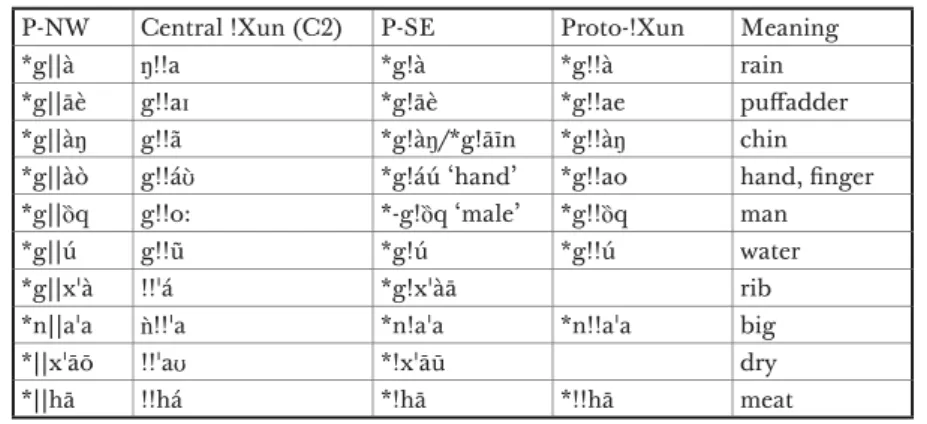
e reconstruction of a retrofl ex click in Proto-!Xun is based on evidence from Central-
!Xun, where this click has been retained, corresponding to a lateral click///in Northwest- ern !Xun and an alveolar click !!in Southeastern !Xun. Table 4 illustrates the relevant cor- respondences. Examples from the Central !Xun branch are restricted to the C2 dialect; for more discussion and data, see Heine and König (Forthc., section 1.3).
What this reconstruction suggests is that the development *!!!> // must have happened/ independently in Hoan and in Northwestern !Xun. A possible motivation for this devel- opment is that the two clicks are similar in their acoustic perception, though not in their articulation. e hypothesized development *!!!>!, by contrast, is motivated by articulatory similarity: Both the retroflex and the alveolar clicks are articulated with the tongue tip touching the pre-palatal region, the diff erence being that the former involves an aff ricate release while the latter has a plosive click release. is overall development is sketched in Figure 1.
Finally mention should be made of the labial click type () to be found inHoan but not in !Xun. This click regularly corresponds to the dental click (/) in !Xun, as the examples below show. ere is an additional set of possible cognates, namely Hoani
‘Grewia fl ava’: SE-!Xung/gg h// ‘Grewia falcistipula’, which we have excluded since no regular correspondences were found so far for the accompaniment features of the two languages.
Table 4. Reflexes of the retroflex click *!!!in !Xun (P-NW = Proto-Northwestern !Xun, P-SE = Proto-Southeastern !Xun).
P-NW Central !Xun (C2) P-SE Proto-!Xun Meaning
*g||à !!a *g!à *g!!à rain
*g||āè g!!a *g!āè *g!!ae puff adder
*g||à g!!ã *g!à/*g!āīn *g!!à chin
*g||àò g!!á *g!áú ‘hand’ *g!!ao hand, fi nger
*g||q g!!o: *-g!q ‘male’ *g!!q man
*g||ú g!!ũ *g!ú *g!!ú water
*g||xà !!á *g!xàā rib
*n||aa !!a *n!aa *n!!aa big
*||xāō !!a *!xāū dry
*||hā !!há *!hā *!!hā meat
P-KX Hoan SE-!Xun NW-!Xun Meaning
* | |
nóa n|àn n|àā ‘sky’
óá g|àá g|àā ‘eye’
|áú |āō ‘duiker’
dz-úí n|ūi n|úí ‘friend, other’
2.4.1 Click accompaniments
Presumably the most common accompaniment is voice. Voiced clicks, marked with a {g} before the click symbol (e.g. g//) are fairly common in all Kx’a languages and exhibit // regular correspondences:
P-KX Hoan SE-!Xun NW-!Xun Meaning
*gC gC gC gC
g!à g!àán g!ààn ‘to be bitter’
g!()i, g!i g! g! ‘gnu’
g||àn g||à g||à ‘to stand (PL)’
g!n-| g!n g!n ‘pestle’
Another fairly common accompaniment is glottalization (e.g., [|]), which turns out to be stable across all the languages, as the following reconstruction suggests:
P-KX Hoan SE-!Xun NW-!Xun Meaning
*| | | |
|é≅n |àè |ē ‘self’ (refl exive marker)
|ò |ú |ú ‘to enter, insert’
|ón |un ‘hunting bow’ |ún ‘stirring stick’ ‘stick’
Another click accompaniment is aspiration, which can also be traced back to Proto- Kx’a, as the following set involving the alveolar click [!] shows:
Figure 1. e development of the retrofl ex click *!!.
P-KX Hoan SE-!Xun NW-!Xun Meaning
*!h !h !h !h
!h !hú !hú ‘horn’
!hn !hūn !hún ‘kill’ (SG)
!hi !hūi !húi ‘cord’
A velar ejective with a click onset (Cx) can also be reconstructed back to the proto- language:
P-KX Hoan SE-!Xun NW-!Xun Meaning
*Cx Cx Cx Cx
|x |xàè.à ‘to visit’
||xáé ||xáé ||xāē ‘to meet’
||xà ||xá ‘wash’
!xen g!xùún g!xùn ‘to stretch’
In much the same way does nasalization as an accompaniment exhibit regular corre- pondences across the Kx’a languages:
P-KX Hoan SE-!Xun NW-!Xun Meaning
*nC nC nC nC
k
k
k -n| i n|hi n|hì ‘to take (away, PL)’
n!àm n!òm n!ò (n!ù) ‘to crawl’
n!ám n!ām ‘to cut’ ‘to puncture’
n||n n||ùn n||ōún ‘to play’
Perhaps of equal interest for the reconstruction of the phonetic structure of the hypothetical ancestor of the modern Kx’a languages is the following correspondence set where there is a glottalized nasal onset ([n]) in Hoan and NW-!Xun, but not in SE-!Xun, which—as we argue—can be reconstructed back to Proto-Kx’a:
P-KX Hoan SE-!Xun NW-!Xun Meaning
*nC nC nC nC
n|á n| ń| (|n-á); |(W1) ‘to sit (SG)’
n|m n|òm n|m ‘springhare’
n!ám n!óm n!óm ‘to ripen’;n!óm (W1) ‘ripe, cooked’
nn nù nhū (W1) ‘center’
n n!!hī (W1 Nhī) ‘to know (how)’
ere is another correspondence set that appears to refl ect a change according to which the combination of a nasal accompaniment, a click, and an aspirated release was simplifi ed inHoan in that nasality was lost, while in !Xun it is aspiration that tends to be lost:
P-KX Hoan SE-!Xun NW-!Xun Meaning
*nCh Ch nC(h) nC(h)
!hàè n!hhh n!hhh è ‘lion’
||ha n||àn ‘stone for straightening arrow sha ’ ‘stone’
|hònè ‘sputum’ n|òn n|n ‘to blow one’s nose’
2.4.2 Post-velar accompaniment
Honken (2004: 26) observes that phonological correspondences involving the uvular stop [q] are far from clear, and that their distribution patterns areally, being found in !Xóõ,
|Gui, andHoan but not in !Xun. Nevertheless, there appears to be a series of correspon- dences where a post-velar (or uvular) accompaniment of clicks corresponds to voiced clicks in !Xun, and we set up a Proto-Kx’a post-velar unit *qC for these correspondences:
P-KX Hoan SE-!Xun NW-!Xun Meaning
*qC qC gC gC
q||óe g||àí g||ààè ‘bear, give birth’
q!hu ‘recline (PL)’ g!hòó g!hó ‘sit (PL)’
q!óri g!òórí ‘wild onion’
q||óa ‘tortoise shell’ g||òà ‘big tortoise sp.’
We assume that in the case of the aspirate dental post-velar click [|qh] of Hoan there is an alternative correspondence in !Xun, namely a voiceless nasal click |h. Since there are only two examples of this correspondence, our reconstruction of a Proto-Kx’a unit *|qh must of necessity remain tentative:
P-KX Hoan SE-!Xun NW-!Xun Meaning
*q|h q|h |h |h
q|hòén |húí |húí ‘ear’
q|hòón |hún |hún ‘steenbok’
Furthermore, we postulate a voiced post-velar accompaniment *GC for Proto-Kx’a for a series where in !Xun there is a voiced click corresponding to zero (ø) inHoan. De- voicing, that is, loss of a voiced onset, is a fairly widespread process in !Xun, most of all in NW-!Xun (see Snyman 1979a).
P-KX Hoan SE-!Xun NW-!Xun Meaning
*GC øC gC gC
!ó g!ú g!ú ‘belly’
hàma g!!hàbà (W1 ghàbà) ‘wing’
!ám (SG) g!àām-ā g||àbà ‘to enter’
xái gxàí g!!xáín (W1 gxáí) ‘scorpion’
óa g|àá g|àā ‘eye’
2.5 Tones
In both branches there is a tone system characterized by four distinct tone levels (Honken 2004). The following are examples showing distinctive tones for reconstructed stems; however, a tonal analysis still needs to be done.
P-KX Hoan SE-!Xun NW-!Xun Meaning
*!!áóm ||ám !óm ‘leg’ ||óm ‘leg’ ‘thigh’
*ē(n) ēn (or ee) ‘it is’ ē proximal demonstrative stem ‘here’
*!àò !àò !àò !àò ‘drop’ ‘to throw down’
*un n n !!n ‘star’
2.6 An overview
On the basis of the phonological reconstructions proposed above it is possible to give a rough outline of the phonological structure of Proto-Kx’a, even if these reconstructions take care only of a restricted set of correspondences that we were able to establish.
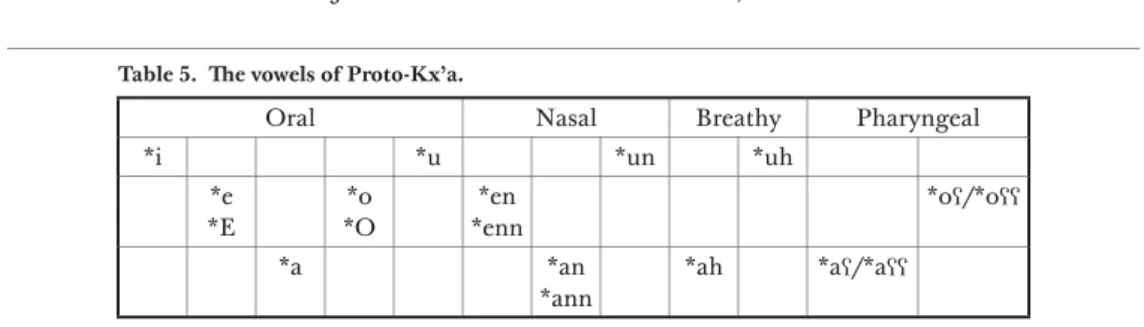
As we observed in section 2.2, all modern Kx’a languages have a fi ve-vowel system, and all fi ve oral vowels can be reconstructed back to Proto-Kx’a. Furthermore, there must have been at least a restricted set of nasal, breathy, and pharyngeal vowels. Table 5 lists the vow- els that we propose. In view of the little information that is available we do not endeavor to determine what exactly the phonetic basis of the distinction between two sets of oral vowels (*e vs. *E, *o vs. *O), of nasals (*en vs. *enn, *an vs. *ann), and of pharyngeal vowels (*avs. *a, *ovs. *o) may have been, more research on these vowel units is urgently required.
There is hardly any information on vowel combinations in !Xun, and even less in
Hoan; we therefore do not attempt to establish whether a given combination should be reconstructed as a diphthong or as a sequence of two vowels.
Furthermore, there must have been four distinct tonemes and tone levels, namely high, mid, low, and extra-low (see 2.5).
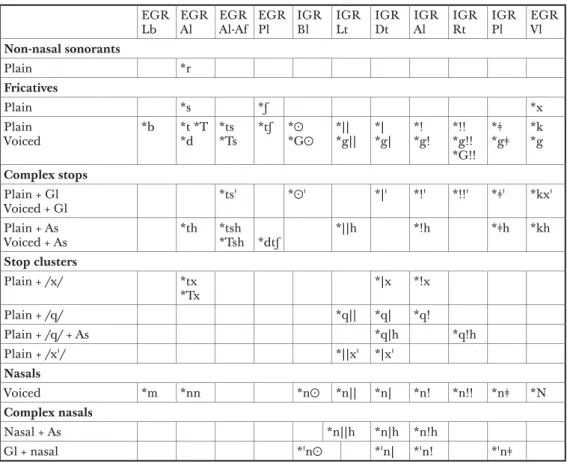
e consonants that we propose to set up for Proto-Kx’a are presented in Table 6. Note that Table 6 simply presents an inventory of units that surface in our lexical reconstruc- tions; trying to reconstruct the consonant system of the proto-language would be prema- ture at the present stage of research.
With 18 vowels, 73 consonants, and four tone units, the reconstructed phonological units constitute presumably but a fragment of the actual system that must have charac-
Table 5. e vowels of Proto-Kx’a.
Oral Nasal Breathy Pharyngeal
*i *u *un *uh
*e
*E
*o
*O
*en
*enn
*o/*o
*a *an
*ann
*ah *a/*a
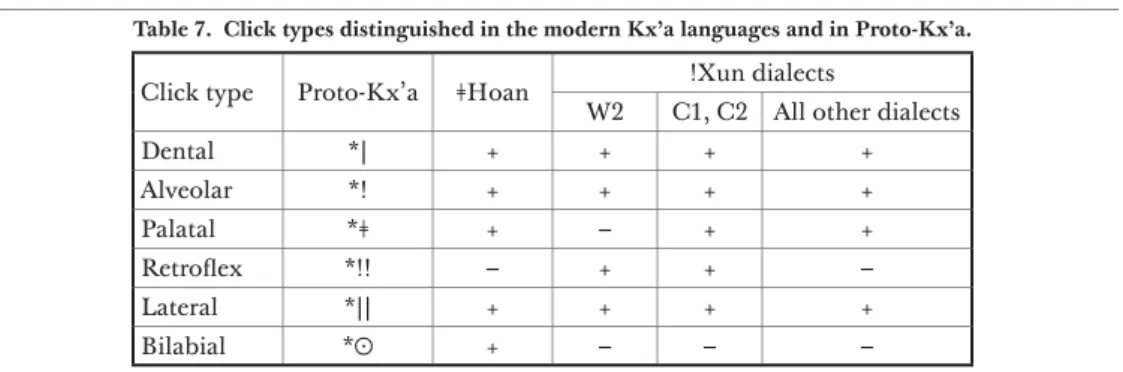
terized Proto-Kx’a; note that all modern Kx’a varieties have clearly larger phonological inventories. At the same time, the number of click types that were distinguished in the proto-language must have been larger than that of its daughter languages; as we observed in section 2.4, Proto-Kx’a appears to have distinguished six click types while the modern Kx’a varieties have only four, with the exception of Central !Xun, where fi ve click types are distinguished.11)
3 Conclusions
We hope we have presented a viable hypothesis to the eff ect thatHoan and !Xun are genetically related languages and can be traced back to one and the same hypothetically set up ancestor language. Both have a large number of lexical and grammatical similarities in
Table 6. e consonants of Proto-Kx’a.
(Abbreviations: Af = aff ricate, Al = alveolar, As = aspirated, Bl = bilabial, Dt = dental, EGR = egressive, Br = breathy, Gl = glottalized, IGR = ingressive, Lb = labial, Lt = lateral, Pl = palatal, Rt = retrofl ex, Uv = uvular, Vl = unvoiced velar fricative. e symbolggbefore a click signals voiced pronunciation, whileq signals a voiceless and GGa voiced uvular pronunciation).
EGR Lb
EGR Al
EGR Al-Af
EGR Pl
IGR Bl
IGR Lt
IGR Dt
IGR Al
IGR Rt
IGR Pl
EGR Vl Non-nasal sonorants
Plain *r
Fricatives
Plain *s *∫ *x
Plain Voiced
*b *t *T
*d
*ts
*Ts
*t∫ *
*G *||
*g||
*|
*g|
*!
*g!
*!!
*g!!
*G!!
**g *k
*g Complex stops
Plain + Gl Voiced + Gl
*ts * *| *! *!! * *kx
Plain + As Voiced + As
*th *tsh
*Tsh *dt∫
*||h *!h *h *kh
Stop clusters
Plain + /x/ *tx
*Tx
*|x *!x
Plain + /q/ *q|| *q| *q!
Plain + /q/ + As *q|h *q!h
Plain + /x/ *||x *|x
Nasals
Voiced *m *nn *n *n|| *n| *n! *n!! *n *N
Complex nasals
Nasal + As *n||h *n|h *n!h
Gl + nasal *n *n| *n! *n
11) An anonymous referee of this paper suggests that it would be good to relate this reconstruction to possible alternative scenarios in order to strengthen the present hypothesis. We are, however, not aware of any reasonable alternative scenario.
common which show regular phonological correspondences. Correpondences with sound correspondences between !Xun and Hoan are found on the one hand in grammatical morphology and on the other hand in the lexicon, especially but not only in basic semantic areas such as kin tems, important animals, body parts, or basic activities.
We were proposing phonological reconstructions based on the comparative method, using regular sound correspondences as a basis for tracing phonological and morphological features of the modern Kx’a languages back to the hypothetically proposed Proto-Kx’a lan- guage. On the basis of this reconstruction work we proposed a few features that we argue to have characterized this proto-language. For example, unlike all modern Kx’a varieties, we hypothesize that Proto-Kx’a had altogether six click types. Table 7 lists both the click types found in these varieties and the ones reconstructed back to the proto-language. We are aware that this hypothesis is not in accordance with standard assumptions on uniformi- tarianism in linguistic reconstruction since the hypothetically set up proto-language is more complex than any of the modern languages, including other Khoisan languages: Note that so far no language in the world has been found to distinguish as many as six clicks. But on the basis of the data presented above we see no way of reducing the number that must be postulated for Proto-Kx’a.
In none of the Kx’a languages is there a phonemic distincion between two types of liq- uid consonants. In some dialects of !Xun, an [r]-type of liquid is preferred while in others it is an [l]-type, and in many dialect areas no distinction is made. e situation in Hoan is slightly diff erent in that, as the examples in Gruber (1973; 1975) suggest, [r] appears to be used before the high vowels ([i] and [u]) and [l] elsewhere. On the basis of this situation, we argue that there was no phonemic contrast in Proto-Kx’a either.
e genetic classifi cation of what is traditionally known as Khoisan that we propose on the basis of the observations made in the present study is summarized in Table 8. ere is good reason to assume that the genetic stocks that are distinguished in Table 8 can be fur- ther reduced in future comparative work. In particular, we consider it possible that Khoe and Kwadi can be assigned to one and the same family, as argued for by Tom Güldemann, and the same applies to the Taa and !Ui groups. What is required however in order to strengthen these hypotheses provided is more substantial evidence.
As Honken’s (2004) detailed analysis shows, there are also many form-meaning resem- blances thatHoan shares with other Khoisan languages, in particular with its neighbors
Table 7. Click types distinguished in the modern Kx’a languages and in Proto-Kx’a.
Click type Proto-Kx’a Hoan !Xun dialects
W2 C1, C2 All other dialects
Dental *| + + + +
Alveolar *! + + + +
Palatal * + – + +
Retrofl ex *!! – + + –
Lateral *|| + + + +
Bilabial * + – – –
!Xóõ and the Central Khoisan language |Gui, and some of these similarities can be said to show regular correspondences. And much the same applies to the comparisons that Köhler (1973/4: 185–9) carried out between the Khoe (Central Khoisan) language Khwe and !Xun (= Zhu in Köhler’s terminology). How these similarities are to be interpreted is an issue that is beyond the scope of this study. Honken (2004) goes at great length searching for criteria that allow to distinguish between borrowed and inherited material. We were restricted here to proposing positive hypotheses on genetically inherited expressions and we had nothing e to say about all the form-meaning correspondences among Khoisan languages that are not covered by our hypotheses; possibly they, or at least many of them, constitute in fact loans, but we do not wish to exclude the possibility that some of them are relics of older genetic relationship patterns that have so far not yet been identified (cf. Köhler 1973/4). The problem of historical relationship among the Khoisan languages is still largely unresolved.
For good reasons we assume, like many others, that the Greenberg (1963) classifi cation is problematic; but in much the same way as it would be inappropriate to say that it is “correct”
is it also not possible to say that it is “wrong”.
Ernst Westphal suggested that, if one were to adopt what we call the Kx’a hypothesis then this would mean “that the people migrated from the !xũ area (probably Ghanzi) to their present abode [… ]” (Westphal 1974: 246). In other words, he has no doubt that the homeland of both the languages and the peoples speaking these languages are located roughly in the region where the E1 dialect of !Xun is located and that the present distribu- tion of theHoan is the result of migration. But he does not give any evidence for this hypothesis.12) Honken (2004: 18), by contrast, considers it more likely that there was migra- tion in the opposite direction since this would account for the loanword evidence: e !Xun stem *!ólé ‘country’ appears to originate from !Xóõ, which is spoken in the same area as é
Hoan, as is suggested by the fact that the !Xóõ stem!úle, PL !únsán is analyzable where
Table 8. e “ Khoisan” families of southern Africa.
Traditional classifi cation Proposed families
(genetic stocks) Sub-families Possible families
Northern Khoisan Kx’a !Xun Kx’a
Hoan
Southern Khoisan !Ui Tuu (!Ui-Taa)
Taa
Central Khoisan Khoe Kalahari Khoe
Khoe-Kwadi Khoekhoe
Kwadi
12) As much as Westphal exhibits an admirably careful attitude in his crosslinguistic comparisons, the conclusions that he draws from them on both linguistic and extra-linguistic prehistory are generally conjectural: None of the ones that we are familiar with is based on any sound methodology of reconstruction. A paradigm example is provided by his assumption that “there is a vague possibility that “Common Khoisan” was spoken some 50,000 years ago” (Westphal 1974: 247). ere are no clues on how he arrived at this fi gure, quite apart from the fact that he emphatically denied that a “Khoisan family” ever existed.